Description
PrymaLab · Research use only
CJC-1295 (no DAC), Ipamorelin 10mg (Blend)
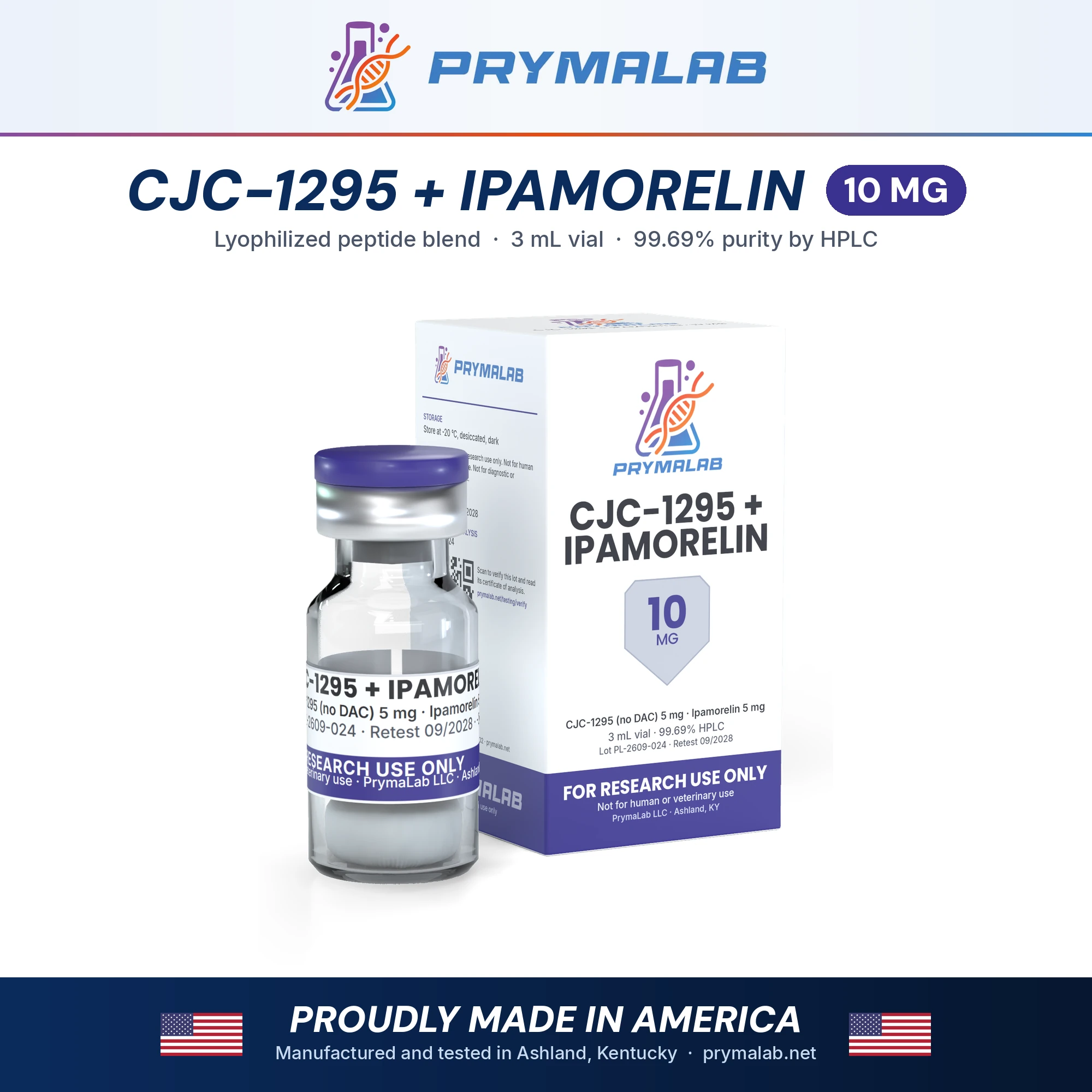
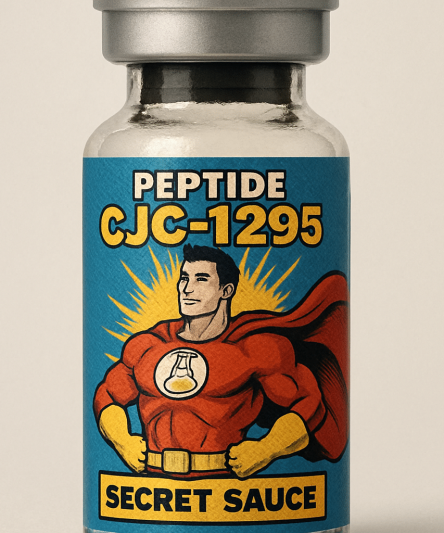
CJC-1295 without DAC and ipamorelin, 5 mg each, freeze-dried together in one vial
This vial combines two growth hormone secretagogues that work through different pituitary receptors: CJC-1295 without DAC (modified GRF(1-29)), a 29-residue GHRH analogue, and ipamorelin, a pentapeptide that acts on the ghrelin receptor. Each is present at 5 mg, freeze-dried together in one vial. Research on the pair rests on separate studies of each peptide and of the two receptor pathways; none of the papers cited here tested the blend itself.
Specifications
| Property | Value |
|---|---|
| Components | CJC-1295 (no DAC); Modified GRF (1-29); tetrasubstituted GHRH(1–29) analogue (D-Ala2, Gln8, Ala15, Leu27) Ipamorelin (NNC 26-0161; selective growth hormone secretagogue pentapeptide) |
| CJC-1295 (no DAC) CAS number | 863288-34-0 |
| Ipamorelin CAS number | 170851-70-4 |
| Label claim | CJC-1295 (no DAC) 5 mg + Ipamorelin 5 mg (10 mg in total) |
| Form | Lyophilized (freeze-dried) powder or cake in a sealed glass vial with a rubber stopper and aluminium crimp cap |
| Storage, sealed | −20 °C, desiccated, dark |
| Purity specification | 99.0% or higher by RP-HPLC |
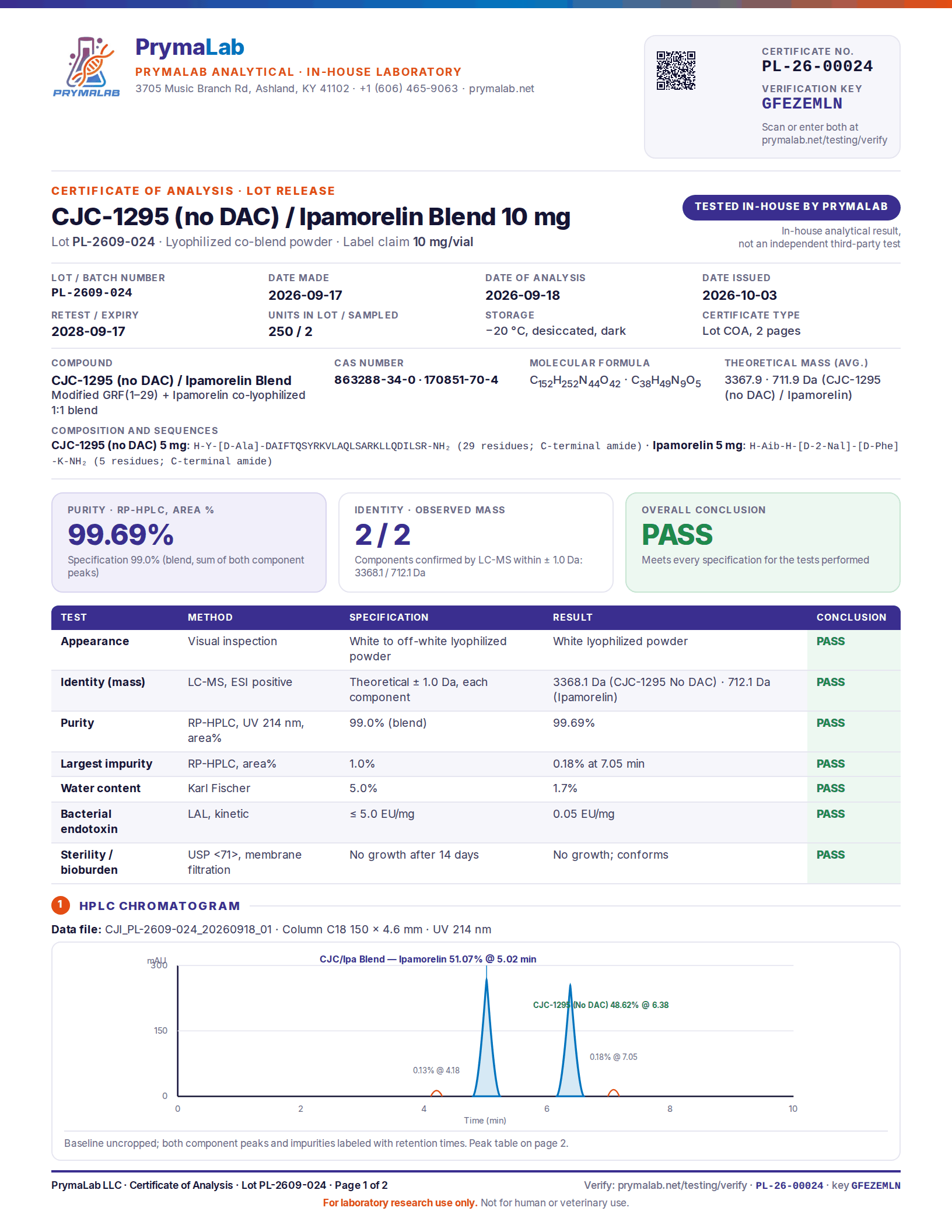
| Lot certificate | Results for the lot now shipping are in the certificate panel on this page |
| Safety data sheet | PL-SDS-040 |
What is in the vial
The vial holds 10 mg of peptide in total: 5 mg of CJC-1295 without DAC and 5 mg of ipamorelin, freeze-dried together at 1:1 by mass. By moles the ratio is far from even. Using the theoretical masses on the certificate (3367.9 and 711.9 Da), 5 mg of CJC-1295 is about 1.5 µmol and 5 mg of ipamorelin about 7.0 µmol, so the vial holds roughly 4.7 ipamorelin molecules for every CJC-1295 molecule. Both amounts sit slightly lower once the certificate’s water content is allowed for.
The certificate reports LC-MS identity for each component, so both masses can be checked against their theoretical values, alongside one RP-HPLC purity figure for the blend. The safety data sheet lists ipamorelin as a skin, eye and respiratory irritant (H315, H319, H335) and CJC-1295 as not classified. Store the sealed vial at −20 °C, dry and dark; once reconstituted, keep it at 2 to 8 °C away from light. The GHRH analogue is also sold on its own as the CJC-1295 (no DAC) 5 mg vial.
What the research covers
Two receptors on the same pituitary cells
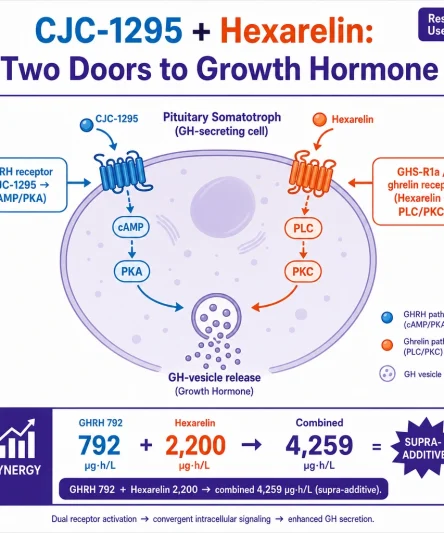
Pituitary growth hormone release can be driven through two separate receptors. CJC-1295 works on the GHRH side: the title finding of Jetté and colleagues was that its albumin conjugates activate the GRF receptor on the anterior pituitary in rats1. The second receptor was cloned in 1996 from pig and human pituitary and hypothalamus as the target of small synthetic growth hormone secretagogues, which its discoverers suspected were imitating a hormone not yet found2. Those secretagogues act on the hypothalamus as well as the pituitary to stimulate and amplify pulsatile growth hormone release, and the receptor was found in the arcuate, ventromedial and infundibular hypothalamus as well as in the pituitary itself2. In 1999 Kojima’s group identified that hormone as ghrelin, a 28-residue stomach peptide that is active only with an n-octanoyl group on serine 3, and concluded that growth hormone release is regulated by ghrelin as well as by hypothalamic GHRH3.
The CJC-1295 component
CJC-1295 was designed as a tetrasubstituted GRF(1-29) extended by a lysine carrying a maleimidopropionamide group; that group binds albumin and kept the compound in rat plasma beyond 72 hours1. The substitutions answer a known weakness of native GHRH, which is a substrate of dipeptidyl peptidase IV; the enzyme strips a dipeptide from the N-terminus, and that small cut can inactivate a regulatory peptide4. In CJC-1295 the residue at position 2 is D-alanine. The CJC-1295 in this vial is the substituted chain without the extra lysine. The human pharmacology published for CJC-1295, including an estimated half-life of 5.8 to 8.1 days in healthy adults, was measured with the albumin-binding form5 and does not carry over to the no-DAC peptide.
The ipamorelin component
Ipamorelin, Aib-His-D-2-Nal-D-Phe-Lys-NH₂, came from a chemistry programme on compounds lacking the central Ala-Trp dipeptide of GHRP-16. It released growth hormone from rat pituitary cells with potency and efficacy similar to GHRP-6, and antagonist experiments showed it acts through a GHRP-type receptor rather than the GHRH receptor6. In swine, GHRP-6 and GHRP-2 raised ACTH and cortisol, while ipamorelin stayed at the levels seen after GHRH even at more than 200 times its ED50 for growth hormone release; none of the compounds altered FSH, LH, prolactin or TSH6.
What is not established
The reason for pairing the two is receptor biology: each acts through a different receptor on the same cells. None of the papers cited here tested them together, so whether the pair releases more growth hormone than either alone, and at what ratio, is not something these references answer. None of the work used this blend or any PrymaLab material. The CJC-1295 and ipamorelin guide covers why the two are combined and how DAC changes the molecule.
How each lot is tested
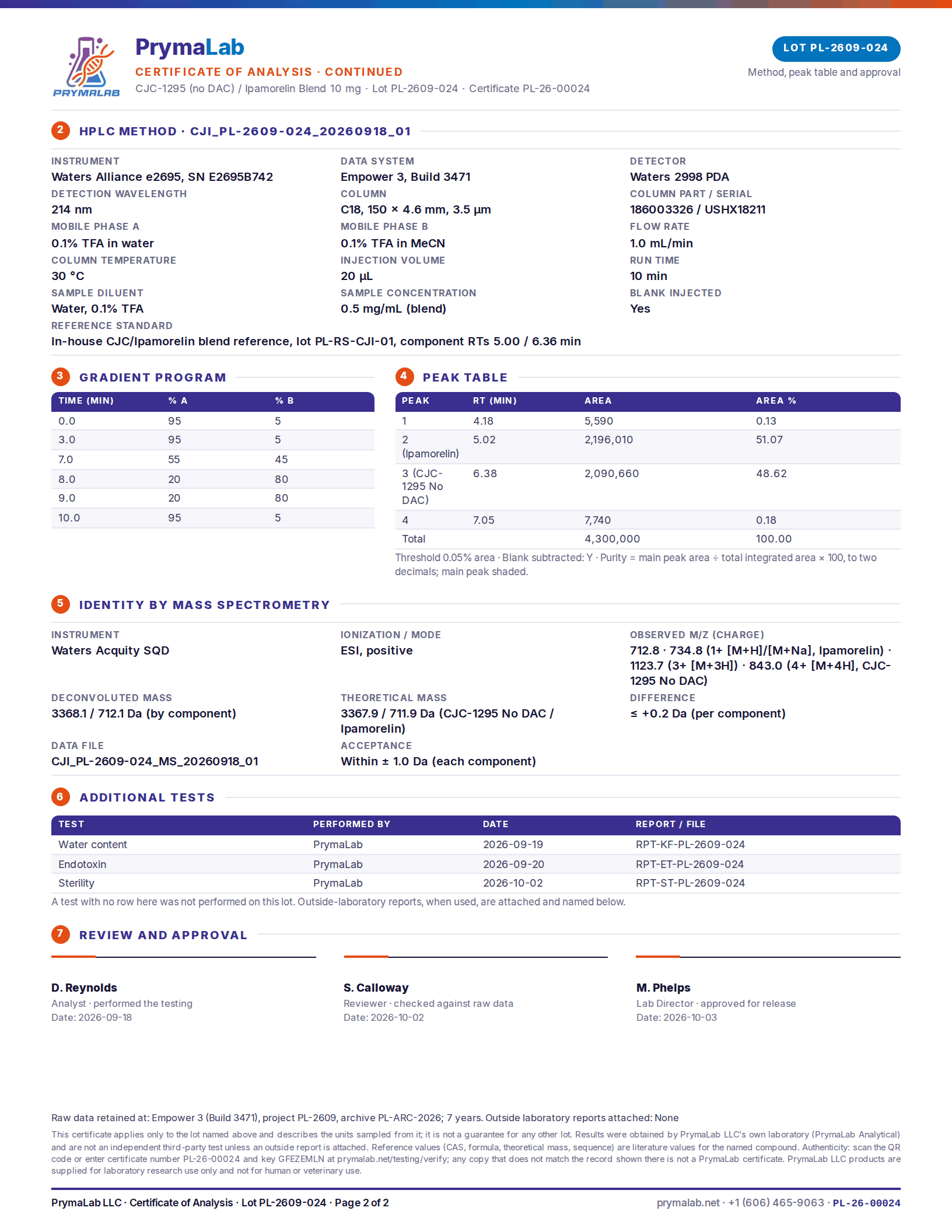
Every lot is tested in PrymaLab’s own laboratory in Ashland, Kentucky before release: RP-HPLC for purity, LC-MS for identity, Karl Fischer titration for water, LAL for endotoxin and USP <71> for sterility. The results for the lot now shipping are in the certificate panel on this page, and the certificate number, key and QR code can be checked on the verify page. These are in-house results from PrymaLab Analytical, not an independent test, and the lab is not accredited to ISO 17025. The third-party testing guarantee on this page still applies: if any independent laboratory finds the wrong compound, or less than the stated purity or amount, the order is refunded and the cost of the test is reimbursed.
Frequently asked questions
How much of each peptide is in the vial?
5 mg of CJC-1295 without DAC and 5 mg of ipamorelin, 10 mg in total. Because ipamorelin is about a fifth the size, that is roughly 1.5 µmol of CJC-1295 and 7.0 µmol of ipamorelin. The reconstitution table on this page gives each component's concentration separately.
Is the CJC-1295 in this blend the DAC form?
No. It is modified GRF(1-29), the 29-residue chain with no albumin-binding lysine. The multi-day half-life reported in healthy adults was measured with the DAC form and does not apply to the peptide in this vial.
How does one certificate cover two peptides?
The blend is tested as one lot. The certificate gives an LC-MS mass for each peptide, one RP-HPLC purity figure, and water, endotoxin and sterility results for the vial contents. Match the lot number on the vial to the panel on this page or check it on the verify page.
Has this combination been studied?
Not in the papers cited here. Each peptide has its own literature, and the rationale for pairing them comes from their separate receptors. No cited study tested a fixed CJC-1295 and ipamorelin blend.
Can this product be used in people or animals?
No. It is sold for laboratory research only, is not approved by the FDA or any other authority for human or veterinary use, and must not be given to people or animals.
References
- Jetté L, Léger R, Thibaudeau K, et al. Human growth hormone-releasing factor (hGRF)1-29-albumin bioconjugates activate the GRF receptor on the anterior pituitary in rats: identification of CJC-1295 as a long-lasting GRF analog. Endocrinology. 2005;146(7):3052-8. DOI · PubMed
- Howard AD, Feighner SD, Cully DF, et al. A receptor in pituitary and hypothalamus that functions in growth hormone release. Science. 1996;273(5277):974-7. DOI · PubMed
- Kojima M, Hosoda H, Date Y, et al. Ghrelin is a growth-hormone-releasing acylated peptide from stomach. Nature. 1999;402(6762):656-60. DOI · PubMed
- Mentlein R. Dipeptidyl-peptidase IV (CD26)–role in the inactivation of regulatory peptides. Regul Pept. 1999;85(1):9-24. DOI · PubMed
- Teichman SL, Neale A, Lawrence B, et al. Prolonged stimulation of growth hormone (GH) and insulin-like growth factor I secretion by CJC-1295, a long-acting analog of GH-releasing hormone, in healthy adults. J Clin Endocrinol Metab. 2006;91(3):799-805. DOI · PubMed
- Raun K, Hansen BS, Johansen NL, et al. Ipamorelin, the first selective growth hormone secretagogue. Eur J Endocrinol. 1998;139(5):552-61. DOI · PubMed
Research use only
For laboratory research use only. CJC-1295 (no DAC), Ipamorelin 10mg (Blend) is not a drug, food, cosmetic or dietary supplement, is not approved by the FDA or any comparable authority for human or veterinary use, and must not be given to people or animals. It is sold to qualified researchers and institutions, and the buyer is responsible for lawful handling and disposal.
Other formats of CJC-1295, Ipamorelin
CJC-1295, Ipamorelin is also stocked as CJC-1295 (NO DAC) 10MG, Ipamorelin 5mg, Ipamorelin 10mg, Ipamorelin 10mg Nasal Spray and CJC-1295 (No DAC) + Ipamorelin 15mg preloaded 3ml pen. Each listing states its own quantity and concentration, and the pen and vial comparison explains what changes between formats.







Reviews
There are no reviews yet.