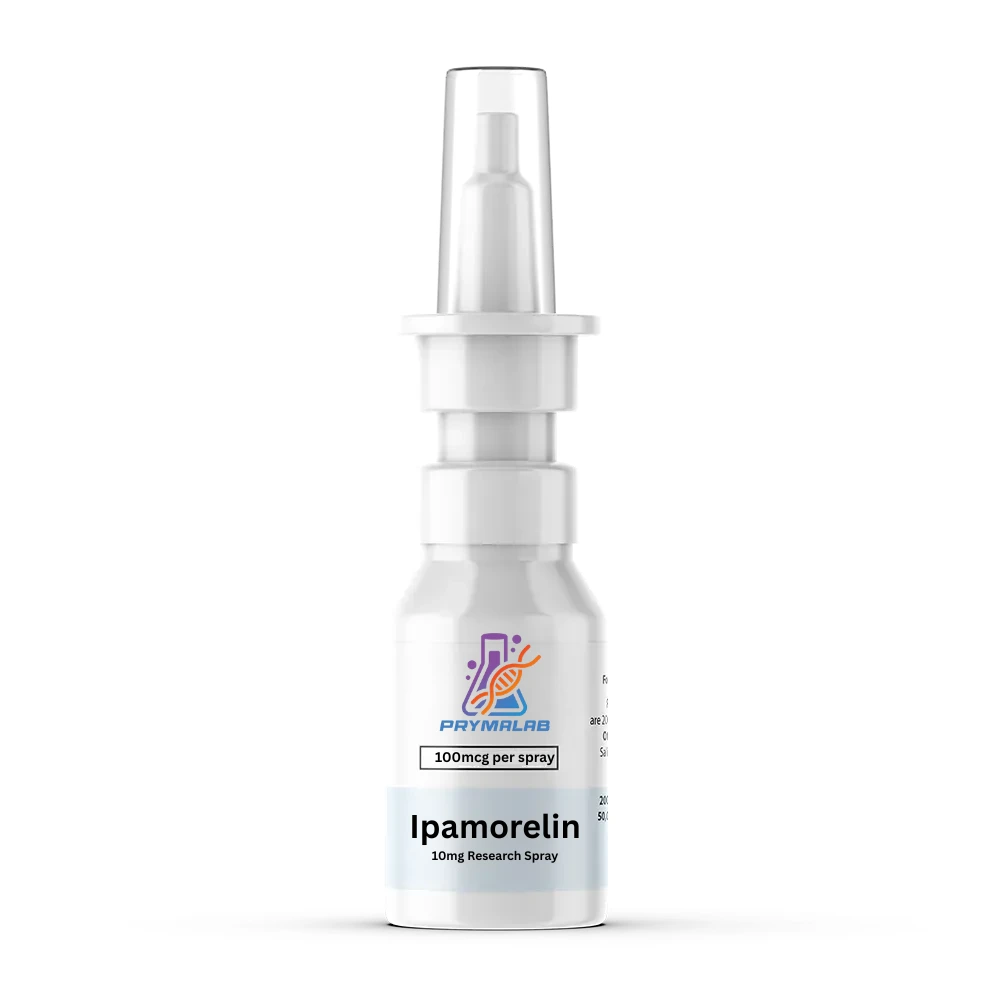
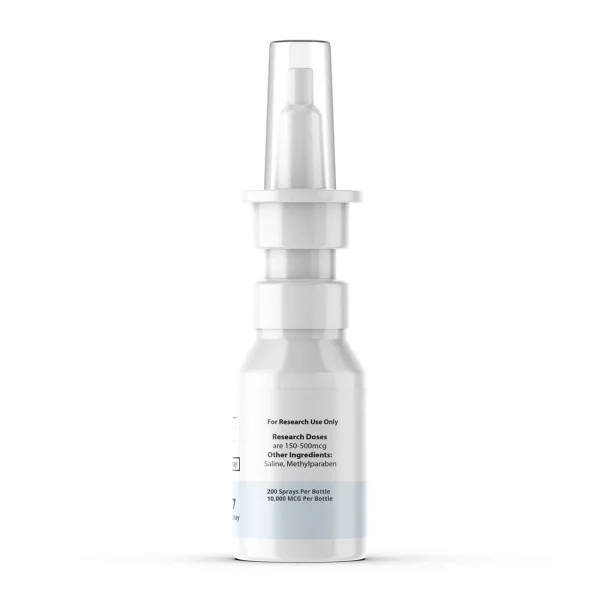
Description
This ipamorelin nasal spray supplies ipamorelin, a synthetic pentapeptide with the sequence Aib-His-D-2-Nal-D-Phe-Lys-NH2, molecular weight 711.85 Da, CAS 170851-70-4. It was developed at Novo Nordisk and introduced to the literature by Raun and colleagues in 1998 under a title that has defined it ever since: the first selective growth hormone secretagogue. Selectivity is the entire reason this compound exists, and it is worth being precise about what the word means here. Supplied for laboratory research use only.
What “selective” actually refers to
Selectivity usually means a compound hits one receptor and not its relatives. That is not quite what is claimed for ipamorelin. It acts at GHS-R1a, the ghrelin receptor, and so do the earlier growth hormone secretagogues. The selectivity being described is at the level of hormonal output, not receptor binding.
Earlier secretagogues released growth hormone but also raised ACTH, cortisol and prolactin. The 1998 report found ipamorelin released GH without elevating ACTH or cortisol beyond what GHRH stimulation produced, and later work describes no significant elevation of prolactin, FSH, LH or TSH even at doses reported as more than 200-fold above the GH-releasing ED50. That last figure is the useful one. A clean profile at a marginally effective concentration would mean little; a clean profile two orders of magnitude above it is a real separation.
The practical consequence for an experiment is that ipamorelin is the appropriate tool when you want to interrogate GH release without a confounding stress-axis response. If your readout is anything downstream of cortisol, running a non-selective secretagogue means you cannot attribute the result to GH signalling. This is the reason to reach for this molecule over the others in the family, and it is a design argument rather than a marketing one.
Why this compound is almost never studied alone
Ipamorelin rarely appears on its own, and understanding why matters for interpreting anything you read about it.
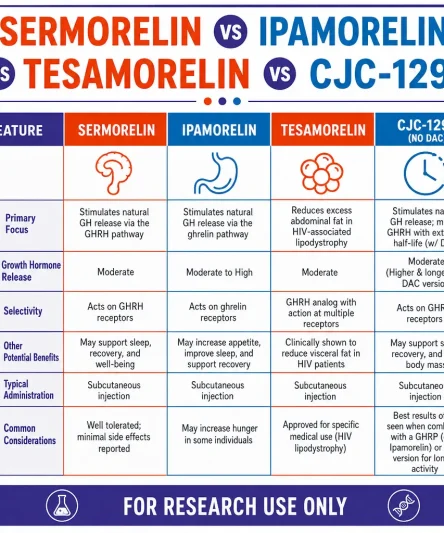
Growth hormone release is governed by two opposing inputs at the pituitary gland. Growth hormone-releasing hormone, GHRH, drives secretion through its own receptor, while somatostatin restrains it. Ghrelin acts through a third route, the ghrelin/growth hormone secretagogue receptor, written GHS-R1a receptor in most papers, and that is where ipamorelin binds. Compounds acting there are collectively the growth hormone-releasing peptide (GHRP) family, and the whole regulatory loop from hypothalamus to pituitary hormones and their downstream mediators is usually called the GH axis. Because the GHRH arm and the secretagogue arm are separate, combining a GHRH analog with a secretagogue produces a larger response than either alone, which is the entire rationale behind the peptide stacks discussed in this space.
Hence the familiar pairings. CJC-1295 no DAC, essentially the same molecule as Mod GRF 1-29, is a short-acting GHRH analog, while CJC-1295 with DAC carries a drug affinity complex that extends its half-life considerably. Either gets combined with a secretagogue, and a CJC-1295 + ipamorelin nasal preparation, sometimes sold as a CJC-1295 + ipamorelin nasal spray, is among the most common peptide blend formats on the market. Other blends bring in unrelated compounds such as BPC-157, or sit alongside a Semax nasal spray in the same order.
For research this creates an attribution problem that is easy to overlook. A result obtained with a blend cannot be assigned to any single component, and if your question is about ipamorelin specifically, a blend is the wrong reagent no matter how well it performs. That is the argument for buying single compounds and combining them yourself under controlled conditions rather than buying a premixed preparation.
The claims made for this compound, and what they rest on
Consumer writing about growth hormone secretagogues converges on a familiar list: muscle growth and lean muscle development, fat loss and fat metabolism, changes in body composition, faster recovery and tendon healing, improved sleep quality, better energy levels, tissue repair, immune system support and anti-aging effects. Some listings place these compounds beside SARMs, describe them as a nootropic, or file them loosely with larger polypeptides and unrelated peptide analogs as though the category were interchangeable. Calling any of it peptide therapy imports a clinical frame that does not apply to research material.
Almost all of that is downstream reasoning. If a compound raises growth hormone, and growth hormone raises IGF-1, and IGF-1 influences tissue growth, then the outcomes follow logically. Logic is not evidence. Those are organism-level endpoints requiring controlled human trials, most of which have not been run for this compound, and none of them is established for research material or claimed here. What is measurable in a laboratory is the receptor step: whether the compound engages GHS-R1a, what it does to signalling, and what a pituitary preparation secretes in response.
Sourcing, and the questions worth asking
Research peptides in this category are supplied as a lyophilized powder, and lyophilized peptides are reconstituted before use, most often with bacteriostatic water, commonly abbreviated BAC water. That step is where a good deal of variability enters, so recording the diluent and the resulting concentration is part of the experiment rather than an afterthought.
On documentation, the questions that separate suppliers are narrow and answerable. Is there a certificate of analysis for the lot in hand. Is the material third-party tested, and does that third-party analytical testing cover identity as well as peptide purity. What is known about peptide stability under the storage conditions offered. Sourcing matters more than branding here, and a compounding pharmacy operates under a different regulatory framework again, which is worth knowing when comparing where material comes from. Everything supplied here is for research and laboratory use.
Two format notes. Claims about nasal delivery improving systemic absorption or peptide absorption across the nasal mucosa are arguments about an organism, not about a dish, and bioavailability comparisons against subcutaneous injection do not transfer to cell culture. Peptide nasal sprays as a category are a packaging decision. Neither changes what the molecule does at a receptor.
The baseline problem with GHS-R1a
Anyone assaying this receptor should know one unusual fact about it before designing the experiment. GHS-R1a has the highest known constitutive activity of any G protein-coupled receptor, reported to signal at roughly 50 percent of its maximal capacity with no agonist present at all, as reviewed in work on GHS-R1a constitutive activity and its physiological relevance.
Your unstimulated baseline is therefore not zero, and it is not close to zero. It sits near the middle of the receptor’s dynamic range. Two things follow. The available window for an agonist to produce a measurable increase is compressed, because half the signal is already spent, so a genuine agonist effect can look smaller than it is. And in a system with high receptor expression the constitutive signal can dominate the ligand-dependent one, which is why an inverse agonist control is more informative here than a plain vehicle control. Vehicle tells you where the constitutive floor sits; an inverse agonist tells you how much of the signal is receptor-dependent at all.
Structural work has caught up with this. Cryo-EM structures of the active receptor with ghrelin and with the small-molecule agonist ibutamoren were published in Nature Communications, with coordinates including PDB 7W2Z, and a polar network plus a hydrophobic cluster have been implicated in both activation and the constitutive activity itself.
In-vitro models and readouts
GHS-R1a couples principally to Gq, so inositol phosphate accumulation and intracellular calcium mobilization are the direct readouts, with recombinant lines expressing human GHS-R1a as the usual system. Where GH secretion itself is the endpoint, primary pituitary cultures or somatotroph-derived lines are used, with GH measured by immunoassay.
For work with this compound specifically, the selectivity claim is testable and worth testing rather than assuming. Measuring ACTH, cortisol or prolactin alongside GH in a pituitary preparation is what converts a marketing statement into your own data, and it is the experiment the 1998 paper effectively invites. Intranasal ipamorelin research exists in the animal literature, though the supplied format here implies nothing about administration to anything.
Ipamorelin nasal spray specifications
Core identity data for this ipamorelin nasal spray. Quote the sequence and CAS number in your methods section rather than the product name.
| Compound | Ipamorelin, selective growth hormone secretagogue |
| Sequence | Aib-His-D-2-Nal-D-Phe-Lys-NH2 |
| Length | Pentapeptide (five residues) |
| Position 1 | Aib, alpha-aminoisobutyric acid, a non-proteinogenic residue |
| C-terminus | Amidated |
| Molecular weight | 711.85 Da |
| CAS number | 170851-70-4 |
| Receptor | GHS-R1a (ghrelin receptor), Gq-coupled class A GPCR |
| Selectivity profile | GH release reported without significant ACTH, cortisol or prolactin elevation |
| Origin | Novo Nordisk; first described by Raun et al., 1998 |
| Format | Metered spray bottle [CONFIRM: fill volume, mg per bottle, concentration] |
| Classification | Research chemical. In-vitro laboratory use only. Not for human or veterinary use. |
Ipamorelin nasal spray storage and handling
Ipamorelin is the most synthetically defended peptide in this family. Position 1 carries Aib, alpha-aminoisobutyric acid, which is not a standard proteinogenic amino acid and is not recognized by the aminopeptidases that trim natural peptides from the N-terminus. The C-terminus is amidated, closing the other exopeptidase route. Two of the five residues are D-configured. The net result is a molecule that resists enzymatic breakdown considerably better than an unmodified sequence.
That stability does not extend to light and oxidation. The D-2-naphthylalanine at position 3 is a bulky aromatic residue, and aromatics are the ones that suffer from light exposure, so keeping the material dark is a specific requirement rather than boilerplate. Sensible ipamorelin nasal spray storage is otherwise routine: cold, sealed, single-use aliquots rather than repeated freeze-thaw on one container, and low-binding plasticware at the low concentrations receptor assays use.
How research grade ipamorelin spray is characterized
Two verification points are specific to this molecule. It contains two D-amino acids, and D and L forms have identical mass, so mass spectrometry cannot confirm stereochemistry on its own. Chiral analysis or a validated synthetic route is what addresses that. And the Aib residue at position 1 is unusual enough that its presence is worth confirming rather than assuming, since it is central to the peptide’s stability.
Beyond that, a research grade ipamorelin spray is characterized by reversed-phase HPLC for purity and mass spectrometry for identity at 711.85 Da. This material is supplied under the same verification PrymaLab applies across its research peptides, HPLC and MS confirmation plus independent third-party testing. No specific lot figures are asserted here; request the certificate of analysis for the lot you receive.
For the receptor pharmacology of this compound class, see the growth hormone-releasing peptides overview in the PrymaLab Research Library.
Frequently asked questions
What is ipamorelin?
Ipamorelin is a synthetic pentapeptide, Aib-His-D-2-Nal-D-Phe-Lys-NH2, 711.85 Da, CAS 170851-70-4, developed at Novo Nordisk and described in 1998 as the first selective growth hormone secretagogue. It acts at GHS-R1a. Material supplied here is a research chemical for in-vitro laboratory use only.
What makes ipamorelin selective?
Selectivity here refers to hormonal output rather than receptor binding. It releases GH without the significant ACTH, cortisol and prolactin elevation reported for earlier secretagogues, and that separation holds at concentrations reported as more than 200-fold above the GH-releasing ED50.
Why does GHS-R1a make assay baselines difficult?
Because it has the highest known constitutive activity of any GPCR, signalling at roughly 50 percent of maximum without any agonist. Your unstimulated baseline is not zero, which compresses the measurable agonist window and makes an inverse agonist a more informative control than vehicle alone.
What does ipamorelin nasal spray storage require?
Cold, sealed and out of light. The Aib residue and C-terminal amide give good resistance to enzymatic breakdown, but the bulky aromatic D-2-naphthylalanine makes light exposure the practical risk. Use single-use aliquots and low-binding plasticware at low working concentrations.
Is ipamorelin nasal spray approved for human use?
No. This material is a research chemical for in-vitro laboratory use only and is not intended for human or veterinary use. It is not an approved drug for any indication. Nothing here is medical advice.
Ordering and compliance
Every PrymaLab research compound ships from the United States and is sold research-use-only. This ipamorelin nasal spray is supplied for in-vitro laboratory research, is not intended for human or veterinary use, is not a drug, supplement or sports product, and has not been evaluated by the FDA for the research-chemical context. Verify the legal status of any research compound in your jurisdiction before ordering. Certificates of analysis are available on request for the lot you receive.


6 reviews for Ipamorelin 10mg Nasal Spray