Description
PrymaLab · Research use only
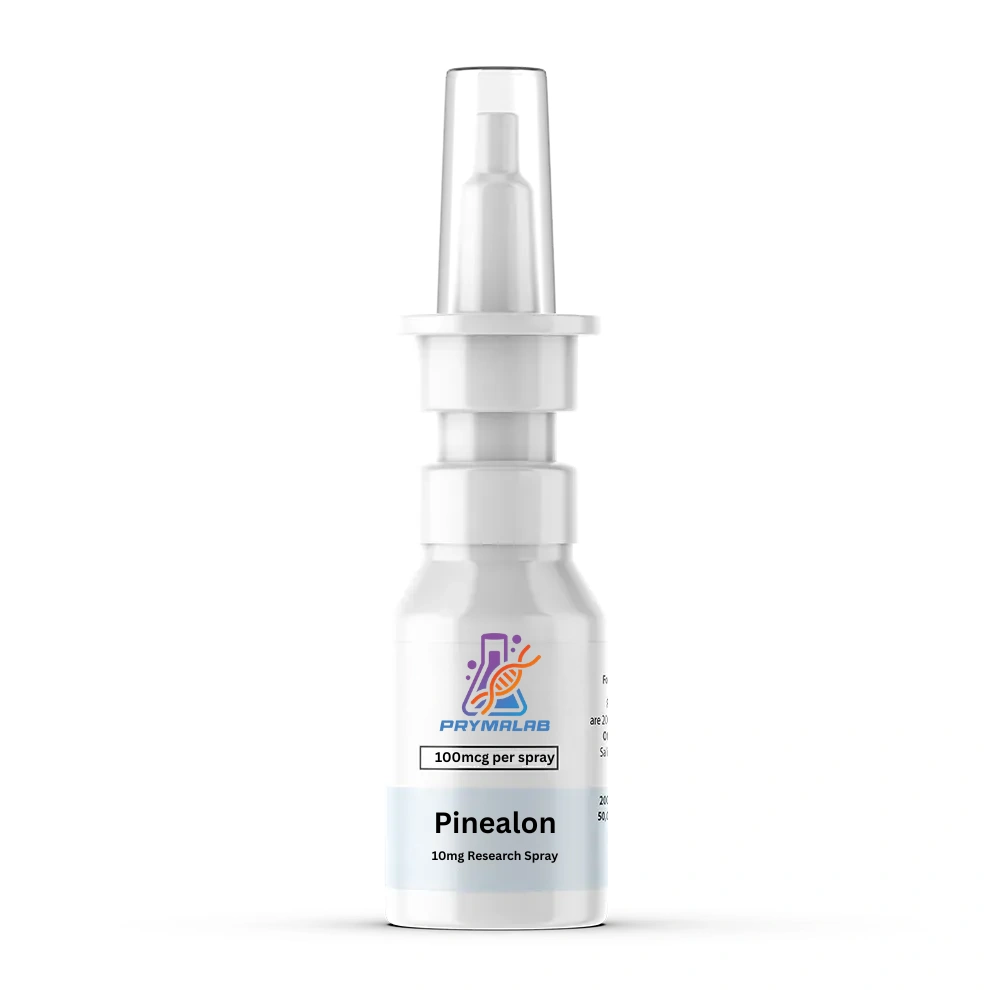
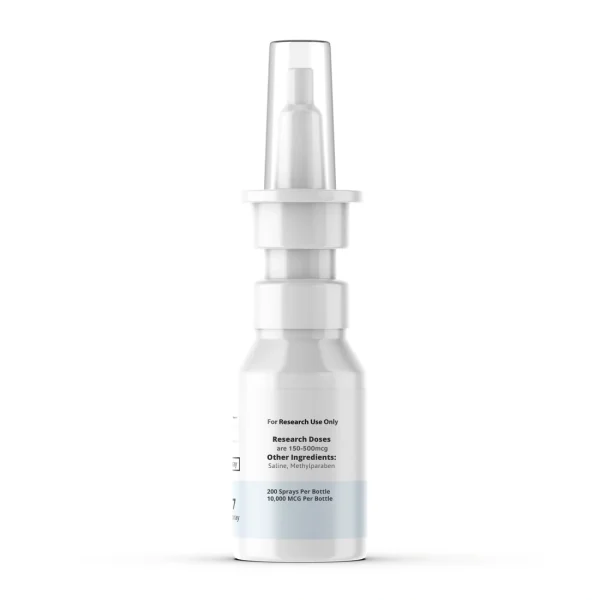
Pinealon 10mg Nasal Spray
Pinealon (EDR) as a sterile solution, 10 mg in a metered nasal spray bottle
Pinealon, or EDR, is the synthetic tripeptide Glu-Asp-Arg from the Khavinson bioregulator programme in St Petersburg. This listing holds it as a sterile solution, 10 mg in a metered nasal spray bottle, ready to use without a powder step. Research on EDR concerns cultured neurons, cortex cell cultures and a proposed DNA-binding mechanism, and none of the cited studies delivered it by the nasal route.
Specifications
| Property | Value |
|---|---|
| Compound | Pinealon (Glu-Asp-Arg (EDR)) |
| CAS number | 175175-23-2 |
| Molecular formula | C15H26N6O8 |
| Contents | Pinealon: 10 mg per bottle (≤ 0.1% w/v) |
| Form | Sterile aqueous solution in bacteriostatic water (0.9% benzyl alcohol), supplied in a metered nasal spray bottle |
| Storage, sealed | Store at 2–8 °C, protected from light; do not freeze |
| Safety data sheet | PL-SDS-130 |
What is in the bottle
The bottle contains 10 mg of Glu-Asp-Arg in bacteriostatic water preserved with 0.9% benzyl alcohol. The safety data sheet gives the peptide concentration as no more than 0.1% w/v and classes the peptide itself as not hazardous. Benzyl alcohol carries hazard statements for harm if swallowed or inhaled, serious eye irritation and possible skin sensitisation.
Keep the bottle upright, capped and at 2 to 8 °C, away from light, and do not freeze it. Solutions this dilute are also where losses to container walls matter most: recovery of radiolabelled peptides differed widely between glass and plastic tubes in a 2011 comparison1. More on keeping peptide solutions is in peptide storage and stability.
What the research covers
The premise behind most EDR research is that short peptides reach the cell nucleus. Fluorescein-labelled Pinealon, Epitalon and Testagen all gave marked fluorescence in the nucleus and nucleolus of HeLa cells, and the unlabelled peptides interacted with DNA fragments in a sequence-dependent way, Pinealon favouring CNG-containing sequences2. The same paper reported that the peptides appeared to recognise whether cytosine in those sequences was methylated2. Working outside the developers’ group, a spectroscopy and molecular dynamics study found that EDR can enter part of the DNA major groove and contact guanine bases, and that magnesium ions promote the contact even in salt solution3. In ageing cortex cell cultures the peptide raised serotonin expression; the link to the tryptophan hydroxylase gene came from a docking model, not from a measured binding event4. The HeLa images used a fluorescein-tagged form of the peptide2, and quenching shows that peptide and DNA interact without showing where; the physics study is what placed EDR in the major groove3.
None of these studies delivered EDR through the nose, and no reference here measures nasal uptake of a three-residue peptide. The biology rests almost entirely on the developers’ own laboratories. The Pinealon (EDR) guide covers the wider record, including the animal work and the open-label human reports.
How each lot is tested
Every lot is tested in PrymaLab’s own laboratory in Ashland, Kentucky before release: RP-HPLC for purity, LC-MS for identity, Karl Fischer titration for water, LAL for endotoxin and USP <71> for sterility. Published certificates are listed on the results page and can be checked by number and key on the verify page. The certificate covers the peptide lot used to fill the bottle, not the finished solution. These are in-house results from PrymaLab Analytical, not an independent test, and the lab is not accredited to ISO 17025. The third-party testing guarantee on this page still applies: if any independent laboratory finds the wrong compound, or less than the stated purity or amount, the order is refunded and the cost of the test is reimbursed.
Frequently asked questions
Is the spray the same peptide as the Pinealon vials?
Yes, Glu-Asp-Arg with the CAS number and formula shown in the specifications. The vials are freeze-dried powder stored frozen; the spray is the peptide already dissolved in preserved water, kept at 2 to 8 °C and never frozen.
Has Pinealon been studied as a nasal spray?
No paper cited here did so. The published work used cultured cells, DNA in solution and a small number of animal studies, and none measured uptake through the nasal lining, so there are no findings specific to this format.
What does testing cover for the spray?
The peptide lot used to fill the bottle is tested; the finished solution is not. The label and the safety data sheet describe what is in the bottle after filling, and the testing section explains the methods used on the peptide.
Is the spray for human use?
No. PrymaLab sells it for laboratory research only. It is not approved by the FDA or any other authority for use in people or animals and must not be given to either.
References
- Goebel-Stengel M, Stengel A, Taché Y, et al. The importance of using the optimal plasticware and glassware in studies involving peptides. Anal Biochem. 2011;414(1):38-46. DOI · PubMed
- Fedoreyeva LI, Kireev II, Khavinson VKh, et al. Penetration of short fluorescence-labeled peptides into the nucleus in HeLa cells and in vitro specific interaction of the peptides with deoxyribooligonucleotides and DNA. Biochemistry (Mosc). 2011;76(11):1210-9. DOI · PubMed
- Silanteva IA, Komolkin AV, Morozova EA, et al. Role of Mono- and Divalent Ions in Peptide Glu-Asp-Arg-DNA Interaction. J Phys Chem B. 2019;123(9):1896-1902. DOI · PubMed
- Khavinson VKh, Lin'kova NS, Tarnovskaya SI, et al. Short peptides stimulate serotonin expression in cells of brain cortex. Bull Exp Biol Med. 2014;157(1):77-80. DOI · PubMed
Research use only
For laboratory research use only. Pinealon 10mg Nasal Spray is not a drug, food, cosmetic or dietary supplement, is not approved by the FDA or any comparable authority for human or veterinary use, and must not be given to people or animals. It is sold to qualified researchers and institutions, and the buyer is responsible for lawful handling and disposal.
Other formats of Pinealon
Pinealon is also stocked as Pinealon 5mg, Pinealon 10mg, Pinealon 20mg and Pinealon 6mg preloaded 3ml pen. Each listing states its own quantity and concentration, and the pen and vial comparison explains what changes between formats.







Reviews
There are no reviews yet.