
Description
PrymaLab · Research Use Only
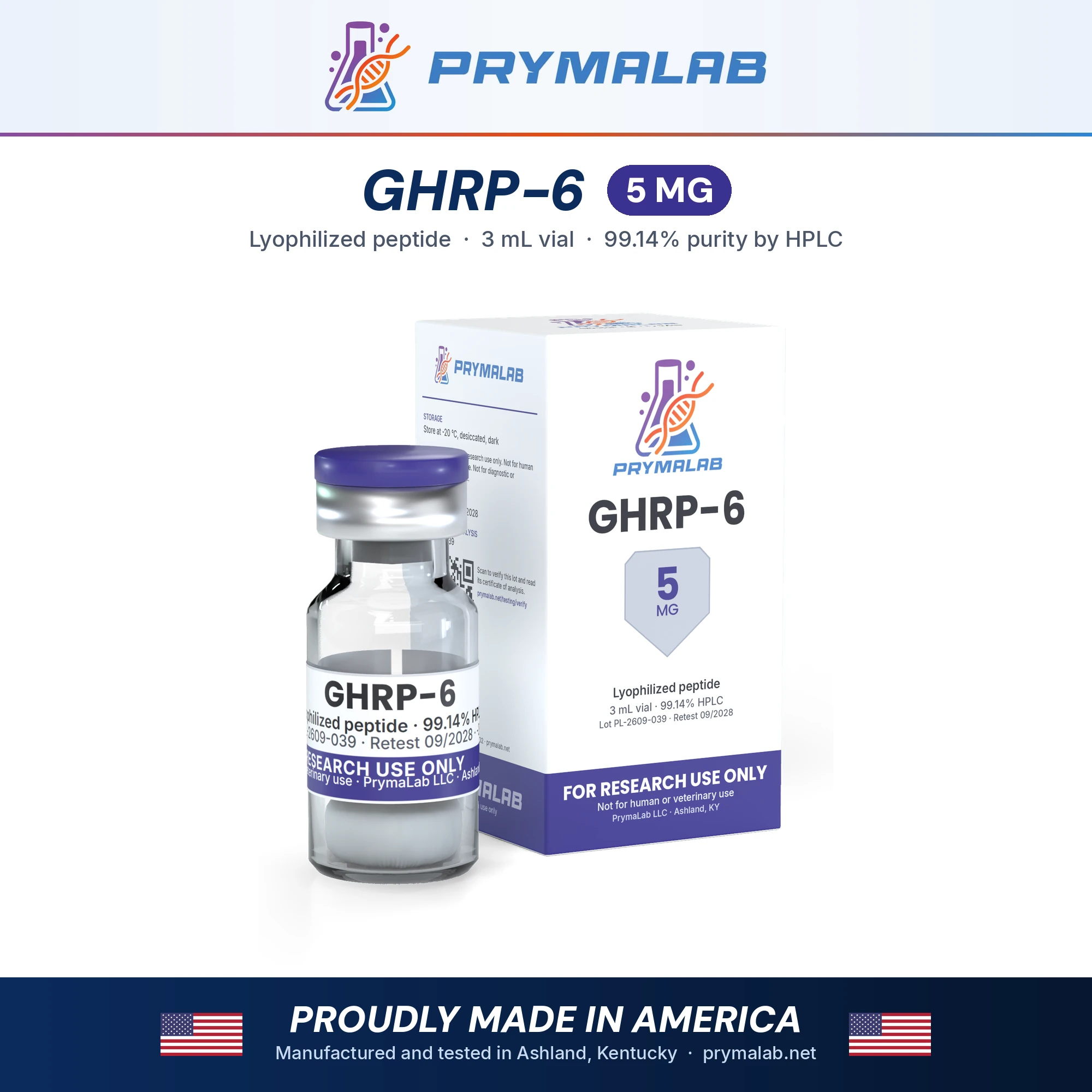
GHRP-6 5mg
About 5.7 micromoles · Two tryptophans, and what they let you measure
A ghrp-6 5mg vial holds about 5.7 micromoles of His-D-Trp-Ala-Trp-D-Phe-Lys-NH2. Two of those six residues are tryptophan. That is an unusual density for any peptide, and it means a solution of this compound absorbs very strongly at 280 nanometres. That gives you a concentration and identity cross-check available on almost nothing else in this catalogue.
Specification Table
| Property | Value |
|---|---|
| Compound | GHRP-6 |
| Class | Growth hormone releasing peptide, hexapeptide |
| Nominal fill | 5 mg |
| Sequence | His-D-Trp-Ala-Trp-D-Phe-Lys-NH2 |
| Molecular weight, free base | Approximately 872.4 g/mol |
| Molar content | Approximately 5.7 µmol |
| Supplied salt form | Acetate, per the product designation |
| Tryptophan count | Two, in six residues |
| Estimated molar absorptivity at 280 nm | Around 11,000 M-1cm-1, from two tryptophans |
| Absorbance of a 1 mg/mL solution at 280 nm | Around 12.6, so a dilution is needed to read it |
| Comparison, BPC-157 at 1 mg/mL | Effectively zero. No aromatic residue in that sequence |
| C terminus | Amidated |
| D-configuration residues | Two |
| Receptor | GHS-R1a |
| Storage, lyophilised | -20°C, sealed, dark and dry. The tryptophans are photosensitive |
| Storage, reconstituted | 2-8°C, protected from light |
| Regulatory status | No approved human or veterinary formulation is supplied here |
What Do the Two Tryptophans in GHRP-6 5mg Let You Measure?
A ghrp-6 5mg solution gives you concentration directly, from a spectrophotometer reading.
Tryptophan absorbs at 280 nanometres with a molar absorptivity around 5,500. Two of them gives roughly 11,000 for the whole molecule, which is a large number for something weighing 872 daltons.
The consequence is that a 1 mg/mL solution reads around 12.6 absorbance units, far off the top of any instrument, so you dilute a hundredfold and read 0.126.
That reading is a measurement of how much peptide is actually dissolved, which is a different quantity from how much you weighed out.
The two differ by net peptide content, by whatever stuck to the vial, and by anything that did not dissolve. Every one of those is invisible on a balance.
Why Is This Unusual in This Catalogue?
Because most of what is sold here has no chromophore at all, and a ghrp-6 5mg vial has two.
Absorbance at 280 nanometres comes from tryptophan, tyrosine and cystine. A peptide with none of the three is invisible at that wavelength, and the bioregulator pages here say so explicitly.
BPC-157 is the clearest case. Its fifteen residues contain no aromatic residue whatsoever, so a 1 mg/mL solution reads essentially nothing at 280, and the page for it takes up the resulting quantification problem in detail.
GHRP-6 is the opposite extreme in the same catalogue. Two tryptophans in six residues is about as chromophore-dense as a peptide gets.
So the same shop sells the compound you cannot check by ultraviolet and the compound you most easily can, which is worth knowing before anybody assumes a general rule.
A rough count, from the pages already written here.
Of the peptides in this catalogue, the ones carrying tryptophan or tyrosine and therefore readable at 280 are a minority: the GHRP family, hexarelin, kisspeptin-10, semax, selank, and a handful of others.
The bioregulators mostly carry neither. Nor does BPC-157. Nor does epitalon.
So the useful habit is to check the sequence for W, Y or C before assuming the measurement is available, and to note it in the method when it is.
It takes ten seconds. It decides whether you hold an independent concentration figure or only a mass on a label, and those are not the same thing.
A methods section reporting that the stock concentration was confirmed spectrophotometrically is stronger than one reporting that a vial was reconstituted. The difference is one cuvette and about twenty minutes.
Nobody will ask you for it. That is not the same as nobody caring.
How Would You Actually Run the Check?
Dissolve a known mass of ghrp-6 5mg, dilute into buffer, read at 280, and compare against what the mass predicts.
The extinction coefficient can be estimated from the sequence using the approach set out by Pace and colleagues, which is the standard reference for doing this and is cited below.
Read against the same buffer as a blank, and use the same cuvette for both. Read at 320 nanometres as well: a peptide should absorb nothing there, so any signal at 320 means turbidity, and turbidity inflates the 280 reading.
If the two figures agree within ten percent, the vial contains roughly what the label says and it is all in solution.
If the ultraviolet figure is lower, either some did not dissolve, or the net peptide content is worse than assumed, or some is on the plastic.
If it is higher, suspect the blank, suspect turbidity, and re-read.
The whole exercise takes twenty minutes and one cuvette, and I have never seen anyone do it on a research peptide.
One practical note about the cuvette. Quartz, not plastic, because ordinary polystyrene absorbs below about 300 nanometres and will ruin the reading entirely.
That catches people out often enough to be worth saying. A disposable cuvette that works fine for a colorimetric assay at 550 nanometres is useless at 280.
What Does It Not Tell You?
Whether the peptide is the right peptide. That limitation deserves stating clearly.
Absorbance at 280 counts tryptophans. Any molecule with two tryptophans reads the same way, so this measures chromophore concentration rather than identity.
It also cannot separate intact peptide from a fragment that kept both tryptophans. On six residues that family is small, and not empty.
What it is good for is catching gross discrepancies: a vial that is half acetate, a cake that did not fully dissolve, a stock that lost material to a tube.
For identity you still need mass spectrometry, and for purity you still need chromatography. This is a cross-check rather than a replacement.
Run it precisely because it is orthogonal. It uses a different physical property from the methods on the certificate, so it fails differently.
What Does the Acetate Salt Form Change?
The mass arithmetic on a ghrp-6 5mg label, and it changes it in the direction people forget.
This compound is supplied as the acetate, which is the preferred counterion for peptides going anywhere near cell work because acetate is well tolerated at the concentrations involved.
That is a better position than the trifluoroacetate most reverse phase purified peptides carry, and the ovagen page in this catalogue explains why.
What acetate does not do is disappear. Acetate is mass on the label that is not peptide, and with a lysine and a histidine in the sequence there are basic sites for it to pair with.
Net peptide content is the number that resolves it, and it belongs on the certificate.
The ultraviolet check above happens to catch this too, which is one more reason to run it.
What Should the Certificate Show?
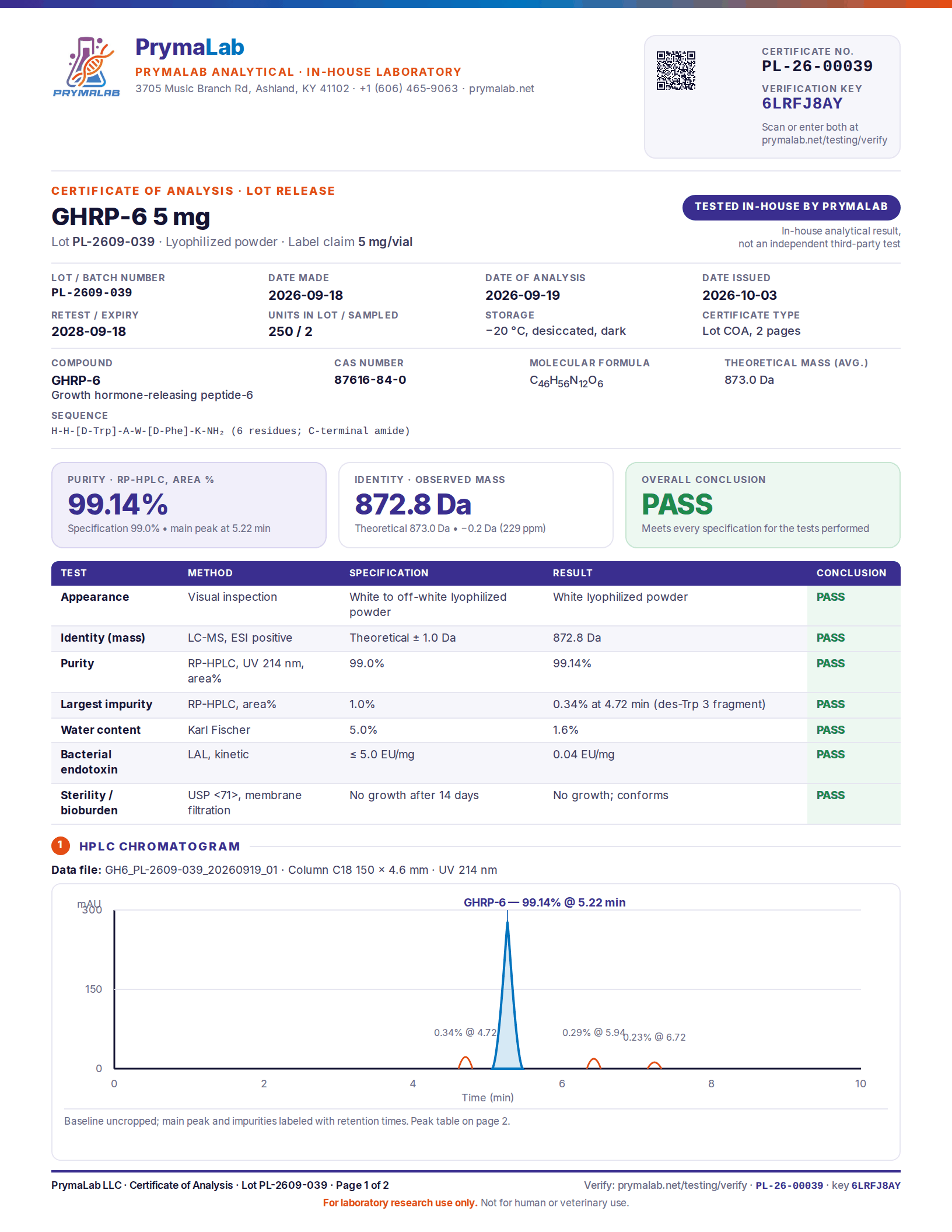
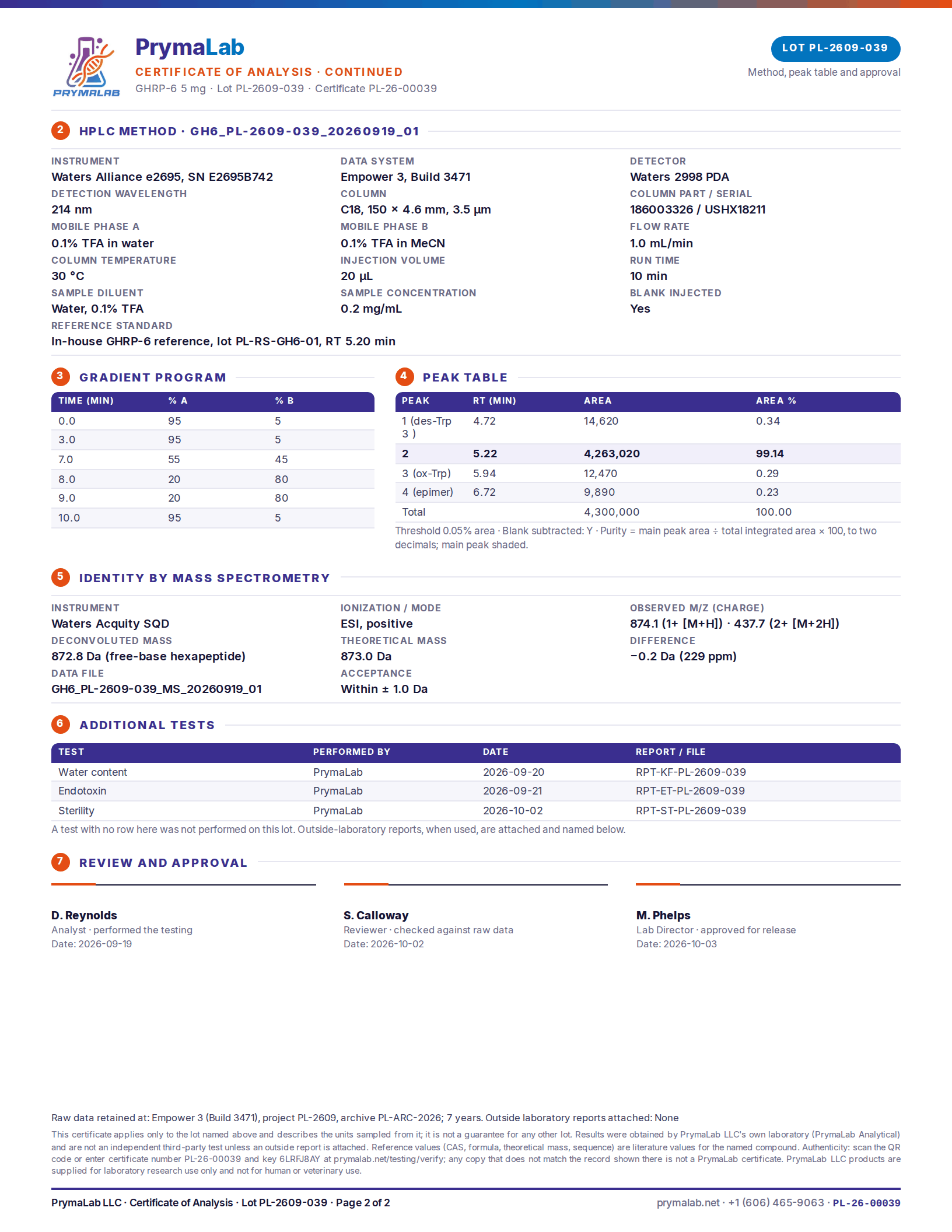
A ghrp-6 5mg certificate should carry the six residue sequence with both D positions and the C-terminal amide identified.
Observed mass against a calculated 872.4 for the free base.
Purity by chromatography, with the method named on the face of the document.
Net peptide content, and the acetate content if it has been measured.
Lot number and manufacturing date.
A stated extinction coefficient would be a useful addition and no supplier provides one, though anybody can compute it from the sequence.
What Would the Reading Look Like in Practice?
Numbers, because the point of the ghrp-6 5mg argument is that they are gettable.
Dissolve 5 milligrams in 5 millilitres and you have a nominal 1 mg/mL solution, which is about 1.15 millimolar.
Dilute that hundredfold into the same buffer and you have about 11.5 micromolar.
At an extinction coefficient near 11,000, an 11.5 micromolar solution in a 1 centimetre cuvette should read about 0.126 absorbance units.
If you measure 0.11 instead, the solution is around 87 percent of nominal, which is exactly the range a net peptide content correction lives in and is therefore unsurprising rather than alarming.
If you measure 0.06, something is wrong and you have found it before it went into anything.
What Else Does the Sequence Tell You?
Two things, quickly.
The histidine at position one gives this molecule a pH-dependent charge, because the imidazole side chain titrates somewhere near neutral, which means the apparent hydrophobicity on a reverse phase column shifts with the mobile phase pH in a way most residues do not.
That affects retention time reproducibility.
Anybody comparing a chromatogram from one laboratory against a certificate from another should confirm the two ran at the same pH before concluding anything from a shifted peak, because a tenth of a pH unit moves a histidine-containing peptide further than most people expect.
The second is the lysine.
A free lysine side chain is the site the acetate counterion pairs with, and it is also the most likely place for any acylation or adduct to appear if the synthesis went wrong.
Neither observation is dramatic.
Both are the sort of thing that turns an unexplained result into an explained one, which is the whole reason to read a sequence rather than take the compound name on trust.
How Should the Vial Be Handled?
Handle a ghrp-6 5mg vial in the dark, first and last, because two tryptophans is two photodegradation sites.
Sealed at minus 20 degrees Celsius, dry, in a container light does not reach.
Room temperature before opening. Then diluent down the wall, and gentle rotation.
Aliquot the solution into single-use volumes and refrigerate, protected from light at every stage including while the tubes sit on the bench.
The photodegradation caution is the same one the 10mg page makes and it applies identically here, because it is a property of the sequence rather than of the fill.
Run the ultraviolet check on the first aliquot, before the material is committed to anything, and write the number down.
Published Literature
Full citations for the work named above, each confirmed against the publisher record. The Pace reference is the standard method for estimating a molar absorption coefficient from sequence.
- Pace CN, Vajdos F, Fee L, Grimsley G, Gray T. Protein Science. 1995;4(11):2411-2423. DOI: 10.1002/pro.5560041120
- Bowers CY, Momany FA, Reynolds GA, Hong A. Endocrinology. 1984;114(5):1537-1545. DOI: 10.1210/endo-114-5-1537
- Howard AD, Feighner SD, Cully DF, Arena JP, Liberator PA, Rosenblum CI, et al. Science. 1996;273(5277):974-977. DOI: 10.1126/science.273.5277.974
- Manning MC, Chou DK, Murphy BM, Payne RW, Katayama DS. Pharmaceutical Research. 2010;27(4):544-575. DOI: 10.1007/s11095-009-0045-6
Frequently Asked Questions
What is a GHRP-6 5mg vial?
A lyophilised research vial holding 5 milligrams of GHRP-6, about 5.7 micromoles at roughly 872.4 g/mol for the free base. The sequence is His-D-Trp-Ala-Trp-D-Phe-Lys with an amidated C terminus. Laboratory research use only.
Why does GHRP-6 absorb so strongly at 280 nanometres?
Two tryptophans in six residues. Tryptophan has a molar absorptivity around 5,500 at that wavelength, so the whole molecule comes to roughly 11,000, which is high for something weighing 872 daltons.
What would a 1 mg/mL solution read?
Around 12.6 absorbance units, which is far off scale for any instrument. Dilute a hundredfold and read about 0.126, comfortably inside the linear range of any instrument.
What does the ultraviolet reading tell me?
How much peptide is actually in solution, which differs from how much you weighed by the net peptide content, by anything that did not dissolve and by anything adsorbed to plastic. None of those is visible on a balance.
How do I get the extinction coefficient?
Estimate it from the sequence. Pace and colleagues set out the standard approach in Protein Science in 1995, and the citation is on this page. For this compound it is two tryptophans at roughly 5,500 each.
Why read at 320 nanometres as well?
A peptide should absorb nothing at 320. Any signal there is turbidity, and turbidity scatters light and inflates the 280 reading. It is a free control on the same sample.
Does this replace the certificate?
No. Absorbance counts tryptophans, so it measures chromophore concentration rather than identity, and any molecule with two tryptophans reads the same. Mass spectrometry gives identity and chromatography gives purity. This is an orthogonal cross-check that fails differently from both.
Can I do the same check on other peptides here?
Only where there is a chromophore. Kisspeptin-10 has a tryptophan and a tyrosine and works well. BPC-157 has no aromatic residue at all and reads essentially zero, which is why its page takes up the quantification problem separately.
What does the acetate salt form mean?
It is the preferred counterion for peptides going near cell work, because acetate is well tolerated where trifluoroacetate is not. It is still mass on the label that is not peptide, and net peptide content is the figure that resolves it.
How many micromoles are in the vial?
About 5.7 at 872.4 g/mol for the free base. Reconstituted into 5.7 millilitres that gives exactly 1 millimolar.
How should the vial be stored?
Sealed at minus 20 degrees Celsius, dry, and in the dark. Two tryptophans means two photodegradation sites, so light exclusion matters more here than on most of the catalogue. Reconstituted solution at 2 to 8 degrees in single-use aliquots, kept dark.
Is this product for human use?
No. Laboratory research material only. It is not a drug, food, cosmetic or dietary product, the FDA has not evaluated it, and giving it to a person or an animal is not permitted.
Compliance Statement
GHRP-6 5mg is supplied exclusively for laboratory research use. It is not a drug, food, cosmetic or dietary product of any kind. It has not been evaluated by the FDA or any comparable authority, and no approved human or veterinary formulation is supplied here. It is not intended to diagnose, treat, cure or prevent any disease, and it must not be given to humans or animals. Purchase is restricted to qualified researchers and institutions.
Other formats of GHRP-6
GHRP-6 is also stocked as GHRP-6 10mg Nasal Spray, GHRP-6 10mg preloaded 3ml pen and GHRP-6 10mg. Each listing states its own quantity and concentration, and the pen and vial comparison explains what changes between formats.









19 reviews for GHRP-6 5mg