
Description
PrymaLab · Research Use Only
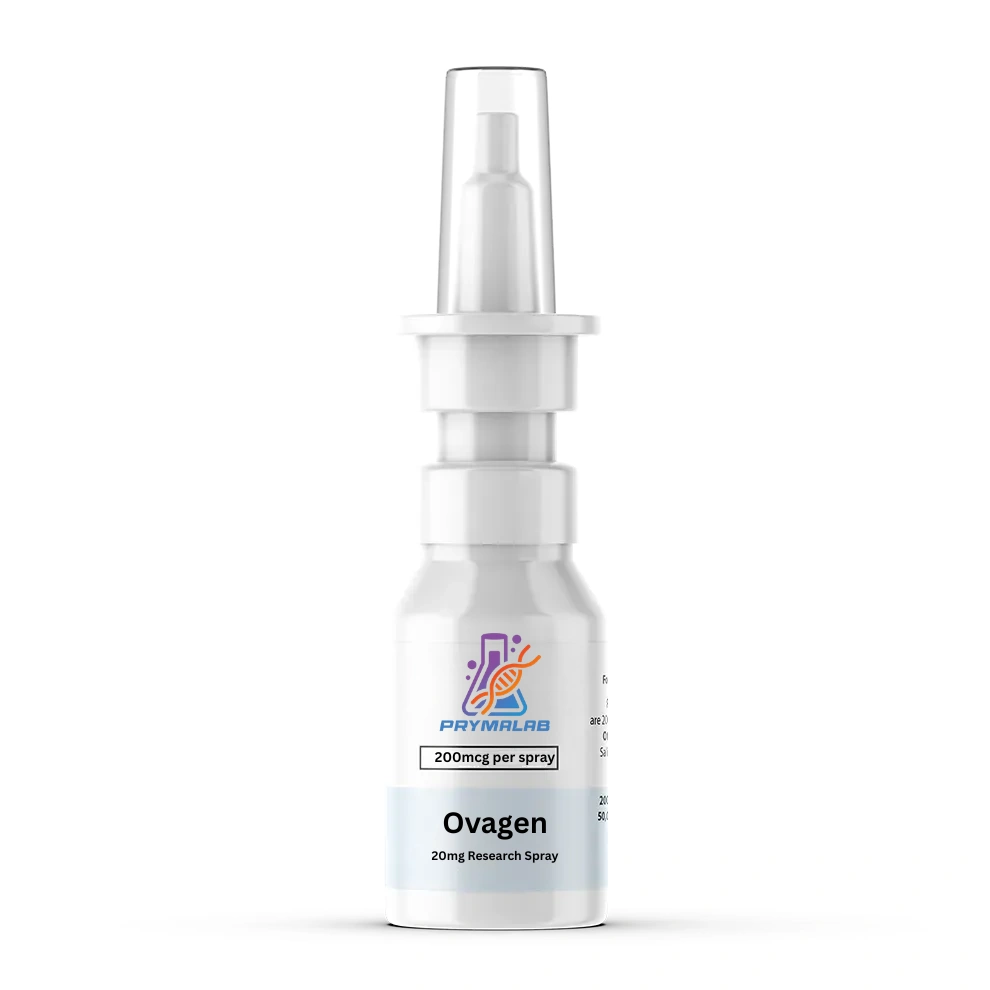
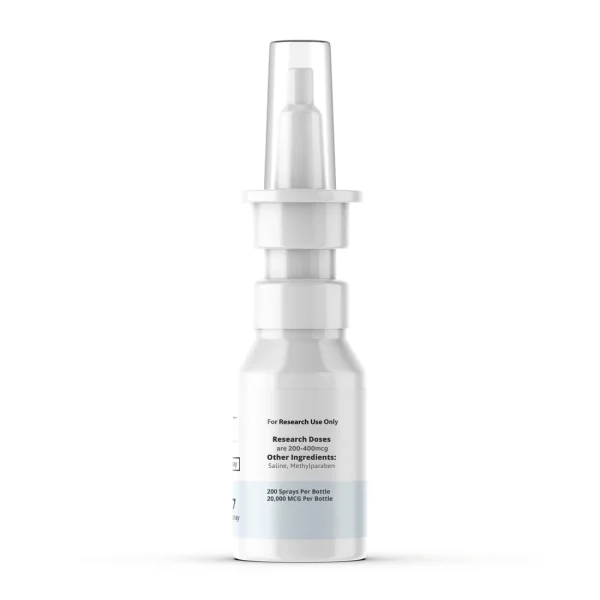
Ovagen Nasal Spray
Glu-Asp-Leu tripeptide · 375.4 Da · Bronchogen minus one residue
Ovagen nasal spray supplies the tripeptide Glu-Asp-Leu in a metered aqueous solution at roughly 375.4 daltons. This compound occupies an odd position in the catalogue: it is sold as a product and it is also the most likely impurity in a different product sold alongside it.
Specification Table
| Property | Value |
|---|---|
| Compound | Ovagen |
| Sequence designation | EDL |
| Amino acid sequence | Glutamate-Aspartate-Leucine |
| Sequence provenance | Secondary sources, converging. Not traced to a single primary citation. Confirm against the lot certificate before relying on it for calculation |
| Residue count | 3 |
| Molecular weight, calculated | Approximately 375.4 g/mol, computed from standard residue masses plus water |
| Parent compound in the catalogue | Bronchogen (Ala-Glu-Asp-Leu) at roughly 446.5 |
| Relationship | Identical to Bronchogen minus its amino-terminal alanine |
| Mass gap from Bronchogen | Roughly 71 daltons, the residue mass of alanine |
| Terminal residue | Leucine, shared with Bronchogen |
| Net charge at neutral pH | Negative. Two acidic residues, no basic residue |
| Chromophore | None. Concentration cannot be determined by 280 nm absorbance |
| Oxidation-prone residues | None |
| Format | Metered nasal spray, solution state |
| Physical state | Aqueous solution, supplied ready to use |
| Purity | Per lot-specific certificate of analysis |
| Storage | 2-8°C, protected from light. Do not freeze |
| Regulatory status | No approved human or veterinary formulation in any jurisdiction |
Why Is Ovagen Nasal Spray Both a Product and an Impurity?
This compound sits in an unusual position, and understanding it explains a quality question that spans two products rather than one.
Solid-phase peptide synthesis assembles a chain from the carboxy terminus backwards, adding one residue at a time.
Bronchogen is Ala-Glu-Asp-Leu, so its alanine is the final residue added. If that last coupling fails on some fraction of chains, those chains stop at Glu-Asp-Leu.
Glu-Asp-Leu is this compound. A failed final coupling on a Bronchogen batch therefore produces Ovagen, not a fragment with no identity.
That is a more useful framing than calling it a deletion impurity, because the truncation product has its own name, its own price and its own page.
For a buyer of Bronchogen it means asking whether the chromatogram shows anything near 375 daltons. That is a specific and answerable question.
For a buyer of this compound the relationship runs the other way and is more comfortable, since incomplete synthesis would leave a shorter species rather than this one.
The two products are separable at roughly 71 daltons apart, so no instrument has an excuse for confusing them once someone looks.
The relationship also carries a commercial implication worth naming.
A manufacturer running both compounds has an incentive to keep them separate that goes beyond ordinary quality control, since cross-contamination degrades one product and adulterates the other.
Dedicated columns, or at minimum a documented cleaning and blank-run procedure between batches, are the ordinary answer.
Asking whether that procedure exists is a reasonable question for any vendor selling structurally nested peptides. This catalogue contains several such pairs.
What Should a Buyer of This Compound Check Instead?
The truncation risk runs away from this compound rather than toward it, which changes which impurities are plausible.
A failed coupling during synthesis of this tripeptide leaves Asp-Leu at roughly 246.3, or Leu alone, both far lighter and trivially resolved.
Those are less likely to reach a finished product than a single missing residue on a longer chain, since a two-residue failure implies a badly controlled synthesis rather than an ordinary yield loss.
The more realistic concern is the opposite direction. Carryover from a Bronchogen batch would introduce a heavier species near 446.5 into this product.
A supplier running both compounds on shared equipment has that exposure, and it is the mirror image of the question a Bronchogen buyer should ask.
So the two products share one quality conversation with the direction reversed, which is a reasonable thing to raise once and have answered for both.
Asking whether the chromatogram for this compound shows anything near 446 costs nothing and covers the realistic case.
Where a vendor stocks both and has never run that comparison, the omission is informative in itself.
What Does a Hydrophobic Terminus Do at Three Residues?
Leucine on a three-residue peptide is proportionally a larger contribution than the same residue on a longer chain.
A branched four-carbon side chain against two small acidic residues means roughly a third of this molecule is non-polar bulk.
That raises hydrophobicity substantially relative to the fully polar members of this family. It shows in chromatographic retention.
A gradient built for the polar bioregulators may hold this compound too long or resolve it poorly at the other end of the run, which is worth knowing before interpreting a purity figure.
For transport across a lipid membrane the hydrophobicity is an advantage, since a transcellular route becomes available that the polar members effectively lack.
Against that, the two acidic residues keep the molecule anionic at physiological pH, and a negatively charged mucosal surface offers no assistance.
The combination of small size, real hydrophobicity and net negative charge is unusual within this family and has not been characterised for nasal delivery in any published work.
It would make an interesting comparison against Chonluten. That is the same size and fully polar, and the two are both stocked here.
Solubility deserves a sentence of its own, since it is the property most often assumed rather than checked.
Two acidic residues carry enough polarity to keep this compound comfortably water soluble despite the leucine, so nothing about ordinary use is affected.
What changes is behaviour at the margins. A concentrated stock held cold may approach its limit where a fully polar tripeptide would not.
Visible haze in a refrigerated bottle is therefore worth a second look here rather than being dismissed, because for this compound it has a plausible physical cause.
What Does the Duplicate URL Problem Mean?
This compound has an issue that is not chemical and that a buyer will not see, but which affects how the product is found at all.
Search Console shows two separate product URLs for this compound receiving impressions for overlapping queries.
Two pages competing for the same terms split whatever authority either would have alone. That is a straightforward and well understood problem.
It also means a visitor arriving from search may land on either, with no guarantee that both carry the same information.
The fix is a redirect from one to the other, chosen on which currently ranks better, with the surviving page carrying the full description.
That decision belongs to whoever runs the store rather than to a product page, but naming it here is more useful than pretending the situation is tidy.
Until it is resolved, anyone comparing information between the two URLs should expect them to differ.
Nothing about the material in the bottle is affected by any of this, which is worth saying plainly so the two issues are not confused.
How Does 375 Daltons Sit for Nasal Delivery?
Size places this compound near the favourable end of a family that is favourably placed throughout.
The route between epithelial cells stops carrying useful quantities somewhere near 1,000 daltons, and this compound sits well under half that.
At roughly 375.4 daltons it falls between Chonluten at roughly 319.3 and Pinealon at roughly 418.4, in the middle of the bioregulator band.
Being small is necessary rather than sufficient, and the remaining variables are charge and lipophilicity.
Here the charge is unhelpful and the lipophilicity is helpful, which is a more interesting combination than most of this family presents.
A molecule that can plausibly use both the paracellular and transcellular routes is a better candidate for the format than one restricted to a single path.
No published study characterises this compound given nasally, so the argument above is structural and should be read as such.
Is Ovagen Nasal Spray an Over-the-Counter Nasal Spray?
No, and the distance between the two categories is much larger than the shared delivery format suggests.
Search results for nasal spray are dominated by products for allergies and congestion. This is not one of them, and treating it as one is the most common mistake made about this product.
The pharmacy shelf holds four classes of nasal spray, and no bioregulator belongs to any of them.
Decongestant nasal sprays such as Afrin, Dristan and Neo-Synephrine work through oxymetazoline or a related vasoconstrictor. They shrink swollen vessels in the nasal passages, which gives fast congestion relief for a stuffy nose.
Those carry a specific problem the peptide sprays do not. Use beyond about three days produces rebound congestion, called rhinitis medicamentosa, where the nose is worse without the drug than it was before it.
Steroid nasal sprays are the second class. Flonase, Nasonex and Nasacort deliver fluticasone, mometasone or triamcinolone, and budesonide appears in the same group. A nasal steroid suppresses inflammation in the mucosa over days rather than minutes.
Those are the products used for allergic rhinitis, hay fever and seasonal allergies, where pollen and dust drive sneezing, a runny nose and watery eyes. Nosebleeds and dryness are the side effects reported most often for that class.
An antihistamine nasal spray is the third. Astepro and its relatives block the histamine released during an allergic reaction, and histamine blockade is a different mechanism again from either class above.
The fourth class is saline. A saline nasal spray, a saline nasal mist, or a nasal rinse using a saline solution of sodium chloride adds no drug at all. Simply Saline, Ayr and Xlear sit here, as does a nasal irrigation system such as a neti pot or a powered nasal suction device.
Nasal irrigation of that kind is mechanical. It flushes mucus, dust and bacteria out of the nasal passages and does nothing pharmacological, which is why it carries almost no side effects beyond irritation. Powered suction is the same idea with a pump behind it.
People reach for nasal irrigation and saline most often for sinus pressure rather than for allergies proper, since neither addresses the histamine response that seasonal allergies produce.
Zicam sits outside those four, as does anything sold on menthol or eucalyptus for the common cold.
This product belongs to none of those categories. It is a tripeptide in water supplied for laboratory research, with no decongestant, no steroid, no antihistamine and no therapeutic claim attached to it.
It is not for sinus congestion, sinus pressure, sinus infections or nasal care of any description, and it must not be sprayed into a human nostril.
The rest of that vocabulary is worth naming once so nobody arrives here expecting it. Post-nasal drip, sinus relief, nonallergic rhinitis, sinus issues, general nasal health and anything sold as a maximum strength nasal spray all belong to sinus medicine rather than to this catalogue.
Reported side effects across those products run to nausea, headache and occasionally a skin rash. None of that record describes this compound, because no such record exists for it.
Where the two categories do overlap is formulation chemistry, and that overlap earns a paragraph because it is the part that transfers.
Preservative choice, tonicity and pH govern how any aqueous solution behaves against nasal mucosa, and the over-the-counter industry has studied those variables far more thoroughly than the peptide market has.
Benzalkonium chloride, the preservative in several of the products named above, is the standard example, since prolonged exposure to it has been examined for effects on ciliary function.
A laboratory building an intranasal protocol around a research peptide would learn more from that formulation literature than from anything published on the bioregulators themselves.
What Research Position Applies?
The published record attaches to the compound and not to this delivery format.
Work from the St Petersburg programme describes observations in aged rodent models, assessed by histology and by markers of tissue-associated gene expression.
Each of those studies worked parenterally without exception. The nasal route appears in none of them.
Cell-culture work across the family reporting chromatin decondensation is advanced in support of the DNA-binding hypothesis rather than of any claim specific to this compound.
No receptor has been identified for any member of this family and no binding constant appears in the record, so no concentration follows from first principles.
Neither this compound nor any of its relatives has been through an adequately powered independent Western trial.
The sequence itself rests on converging secondary sources rather than a traced primary citation, which the specification table states directly.
How Should Ovagen Nasal Spray Be Stored and Recorded?
Three residues with no reactive side chain makes this among the simpler products here to store.
Keep it between 2 and 8 degrees Celsius, shielded from light, and out of the freezer.
No cysteine, methionine or tryptophan means oxidation and photodegradation routes are absent. So light protection is a precaution.
The aspartate is followed by leucine, which slows the succinimide rearrangement relative to an Asp-Gly sequence, so elapsed time is less critical here than for Chonluten.
Slow backbone hydrolysis and microbial growth in an opened container are what remain, which puts aseptic handling ahead of any elaborate storage regime.
The hydrophobic terminus argues mildly for keeping the bottle from prolonged low temperature, since marginal solubility would show as haze rather than as a silent loss.
Log the lot, the stated concentration, the opening date, the storage temperature and how many actuations were drawn.
Record also which URL the product was ordered from, until the duplicate-page situation is resolved, since that is the only way to tie a bottle back to the description it was bought against. That sounds fussy and it is, but two live pages for one compound is a situation where the fussy version is the only one that survives scrutiny. It costs a single field in the purchase record and it removes an ambiguity nobody else will remember.
Published Literature
Selected references. The bioregulator literature originates almost entirely from one research programme and used parenteral routes.
- (‘Khavinson VK, Malinin VV. Gerontological Aspects of Genome Peptide Regulation. Basel: Karger; 2005.’, ‘https://doi.org/10.1159/isbn.978-3-318-01193-6’)
- (‘Anisimov VN, Khavinson VK. Peptide bioregulation of aging. Biogerontology. 2010;11(2):139-149.’, ‘https://doi.org/10.1007/s10522-009-9249-8’)
- (‘Illum L. Nasal drug delivery: new developments and strategies. Drug Discov Today. 2002;7(23):1184-1189.’, ‘https://doi.org/10.1016/S1359-6446(02)02529-1’)
Frequently Asked Questions
What is Ovagen nasal spray?
A metered aqueous solution of the tripeptide Glu-Asp-Leu at roughly 375.4 daltons. Supplied for laboratory research only. It carries no approval in any jurisdiction whatsoever.
Why is it also an impurity?
Because Bronchogen is Ala-Glu-Asp-Leu and synthesis builds backwards from the carboxy terminus. A failed final coupling on a Bronchogen batch leaves chains stopped at Glu-Asp-Leu, which is this compound.
What should a Bronchogen buyer ask?
Whether the chromatogram shows anything near 375 daltons. The two are roughly 71 daltons apart, so no instrument has an excuse for confusing them once someone looks.
What should a buyer of this compound check?
The reverse direction. Carryover from a Bronchogen batch would introduce a heavier species near 446.5, which is the mirror image of the question a Bronchogen buyer should ask.
Are shorter impurities a concern here?
Less so. A failed coupling on this tripeptide leaves Asp-Leu at roughly 246.3 or leucine alone, and a two-residue failure implies a badly controlled synthesis rather than ordinary yield loss.
What does the leucine do at three residues?
Roughly a third of the molecule becomes non-polar bulk. That raises hydrophobicity substantially against the polar members of this family and shows directly in chromatographic retention.
Does that help nasal transport?
It opens a transcellular route across the lipid membrane that the fully polar bioregulators effectively lack. The two acidic residues work against it, so the combination is genuinely mixed.
What is the duplicate URL problem?
Search Console shows two separate product URLs for this compound receiving impressions for overlapping queries. Two pages competing for the same terms split whatever authority either would have alone.
Does that affect the material?
No. Nothing about what is in the bottle is affected. It affects how the product is found and which description a visitor lands on, and the two issues should not be confused.
How does its size sit for delivery?
At roughly 375.4 daltons it falls between Chonluten at roughly 319.3 and Pinealon at roughly 418.4, well under half the roughly 1,000 dalton transition weight.
Is the nasal route supported by published work?
No. Every study in the published record used a parenteral route, and the nasal route appears in none of them.
Is Ovagen nasal spray for allergies or congestion?
No. It contains no decongestant, no steroid and no antihistamine, so it does nothing for allergies, nasal congestion or sinus pressure. It is a tripeptide in water supplied for laboratory research and must not be sprayed into a human nostril.
How does it differ from Flonase, Afrin or a saline spray?
Flonase and Nasacort deliver a steroid that suppresses inflammation over days. Afrin delivers oxymetazoline, which constricts vessels for fast congestion relief and causes rebound congestion after about three days. Saline and nasal irrigation are mechanical. This product is none of those.
Which nasal spray actually treats seasonal allergies?
Steroid sprays and antihistamine sprays are the two classes used for allergies and allergic rhinitis, with saline as an adjunct for dryness. That question belongs to a pharmacist rather than to this page, and none of those products is sold here.
Compliance Statement
Ovagen nasal spray is sold exclusively for laboratory research use. It is not a drug, food, or cosmetic product, and it is not a dietary product of any kind. It is not approved by the FDA or any comparable authority for human or veterinary use, its proposed mechanism has not been independently established, no published study characterises this compound delivered intranasally, and it is also the expected truncation product of another compound sold in this catalogue. This product is not intended to diagnose, treat, cure, or prevent any disease. It must not be given to humans or animals. Purchase is restricted to qualified researchers and institutions operating within applicable laws. All handling is the responsibility of the purchasing laboratory.
Other formats of Ovagen
Ovagen is also stocked as Ovagen Peptide 20mg and Ovagen 6mg preloaded 3ml pen. Each listing states its own quantity and concentration, and the pen and vial comparison explains what changes between formats.











5 reviews for Ovagen 20mg Nasal Spray