

Description
PrymaLab · Research use only
Preloaded Autoinjector | Bronchogen | 3ml Pen | 20mg
Bronchogen (Ala-Glu-Asp-Leu) at 0.67% w/v: 20 mg in a preloaded 3 mL pen
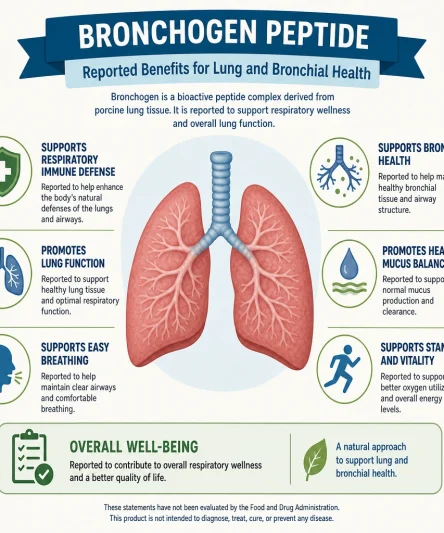
Bronchogen, the Khavinson tetrapeptide Ala-Glu-Asp-Leu (AEDL) that the series assigns to the bronchi and lungs, comes here as a preloaded pen: a 3 mL glass cartridge holding 20 mg of Bronchogen in bacteriostatic water, 0.67% w/v. Its theoretical mass is 446.5 Da. Published work on the peptide is cell culture and biophysics from one research network, chiefly differentiation markers in bronchial epithelial cultures and DNA melting measurements.
Specifications
| Property | Value |
|---|---|
| Compound | Bronchogen Ala-Glu-Asp-Leu (AEDL); Khavinson bronchial peptide bioregulator |
| CAS number | Not assigned |
| Molecular formula | C18H30N4O9 |
| Theoretical mass | 446.5 Da |
| Sequence / structure | H-AEDL-OH (4 residues; free N- and C-termini) |
| Contents | Bronchogen: 20 mg per 3 mL pen (0.67% w/v) |
| Form | Sterile aqueous solution in bacteriostatic water (0.9% benzyl alcohol), supplied in a 3 mL glass cartridge inside a preloaded autoinjector pen fitted with a needle |
| Storage, sealed | Store at 2–8 °C in the original carton, protected from light |
| Safety data sheet | PL-SDS-024 |
What is in the pen
Inside is a 3 mL cartridge of sterile solution containing 20 mg of the AEDL tetrapeptide also sold dry in the Bronchogen 20 mg vial: about 6.7 mg/mL, or roughly 45 µmol in total. The vehicle is bacteriostatic water preserved with 0.9% benzyl alcohol. The safety data sheet lists the peptide as unclassified and gives benzyl alcohol hazard statements for oral and inhalation toxicity, serious eye irritation and skin sensitisation.
Store the pen at 2 to 8 °C in its original carton, out of light and capped once in use. Do not freeze it, and discard a pen whose solution has frozen, turned cloudy or changed colour. For how pens and vials compare in general, see peptide pen vs vial.
What the research covers
The best-measured Bronchogen result is in cells. Khavinson’s group found that the differentiation factors CXCL12 and Hoxa3 declined in late-passage human embryonic bronchial cultures and that bronchogen raised their expression in bronchial epithelial cells, more strongly in the aged cultures1. A separate biophysical study found the peptide raised the melting temperature of isolated DNA by 3.1 °C at low peptide-to-DNA ratios, without preference for AT or GC base pairs2. That paper writes the sequence as Ala-Asp-Glu-Leu, a reminder that the order of the two acidic residues varies between publications.
Neither study kept the peptide in solution for any length of time or looked at its stability in water, and no such data are published in these references. Storage for the pen therefore follows the safety data sheet. The evidence stops at cultures, isolated DNA and docking models, with no lung tissue, animal or human results, and it comes from authors linked to Khavinson’s group. The Bronchogen guide covers the full literature.
How each lot is tested
Every lot is tested in PrymaLab’s own laboratory in Ashland, Kentucky before release: RP-HPLC for purity, LC-MS for identity, Karl Fischer titration for water, LAL for endotoxin and USP <71> for sterility. Published certificates are listed on the results page and can be checked by number and key on the verify page. The certificate covers the peptide lot used to fill the pen, not the finished solution. These are in-house results from PrymaLab Analytical, not an independent test, and the lab is not accredited to ISO 17025. The third-party testing guarantee on this page still applies: if any independent laboratory finds the wrong compound, or less than the stated purity or amount, the order is refunded and the cost of the test is reimbursed.
Frequently asked questions
How does the Bronchogen pen differ from the vial?
The peptide and amount are the same: 20 mg of Ala-Glu-Asp-Leu. The vial holds it as freeze-dried powder at −20 °C; the pen holds it dissolved in bacteriostatic water at about 6.7 mg/mL, kept between 2 and 8 °C. Only the vial leaves the solvent and concentration to the lab.
What does the certificate cover for a pen?
It covers the Bronchogen peptide lot used to fill the pen, tested in PrymaLab's own laboratory, and not the finished solution. Find it by lot number on the testing results page and confirm it on the verify page.
Which Bronchogen sequence is in the pen?
Ala-Glu-Asp-Leu, the same AEDL sequence as in the vial. Some papers give bronchogen as Ala-Asp-Glu-Leu instead. The two orders share a mass, so a mass result alone does not separate them.
Is the Bronchogen pen for human use?
No. The pen is a research material for laboratory work only. It has no approval for human or veterinary use from any regulator and must not be used in people or animals.
References
- Khavinson VKh, Linkova NS, Polyakova VO, et al. Peptides tissue-specifically stimulate cell differentiation during their aging. Bull Exp Biol Med. 2012;153(1):148-51. DOI · PubMed
- Monaselidze JR, Khavinson VKh, Gorgoshidze MZ, et al. Effect of the peptide bronchogen (Ala-Asp-Glu-Leu) on DNA thermostability. Bull Exp Biol Med. 2011;150(3):375-7. DOI · PubMed
Research use only
For laboratory research use only. This product is not a drug, food, cosmetic or dietary supplement, is not approved by the FDA or any comparable authority for human or veterinary use, and must not be given to people or animals. It is sold to qualified researchers and institutions, and the buyer is responsible for lawful handling and disposal.
Other formats of Bronchogen
Bronchogen is also stocked as Bronchogen 20mg Nasal Spray. Each listing states its own quantity and concentration, and the pen and vial comparison explains what changes between formats.







Reviews
There are no reviews yet.