
Description
PrymaLab · Research use only
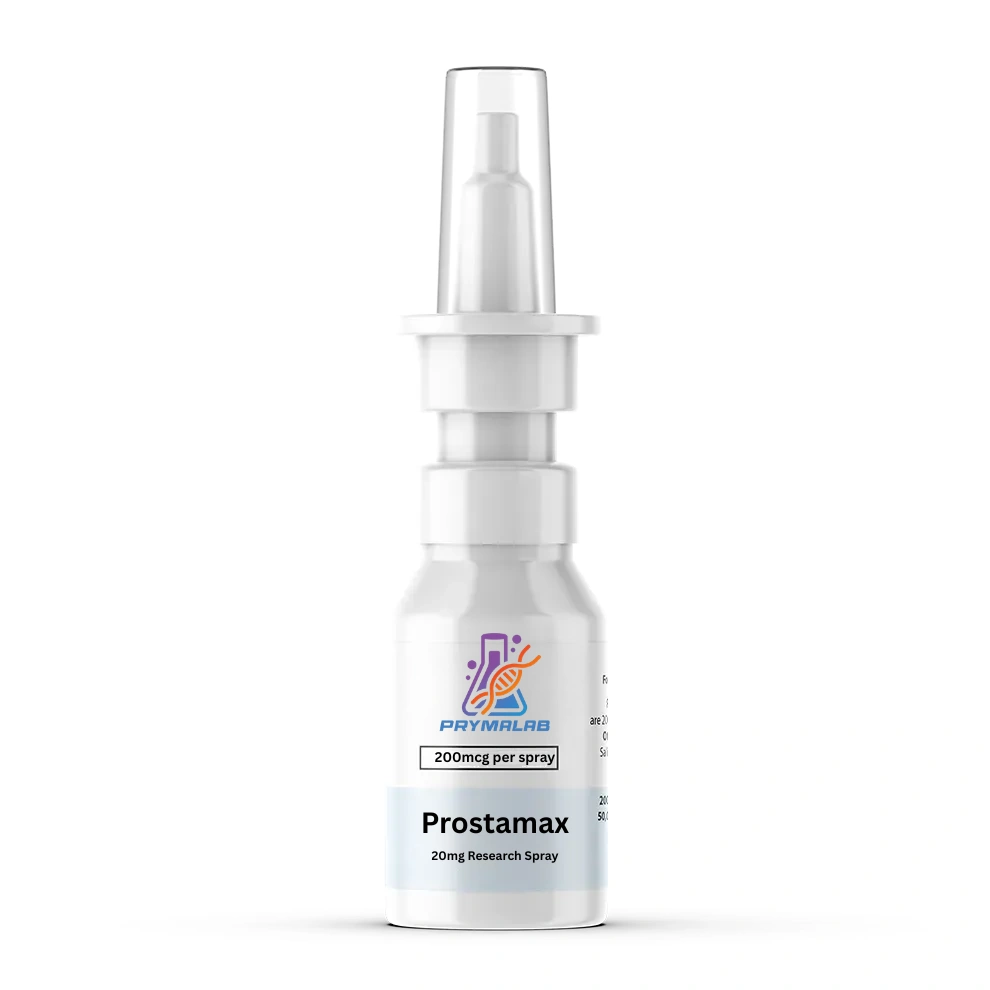
Prostamax 20mg Nasal Spray
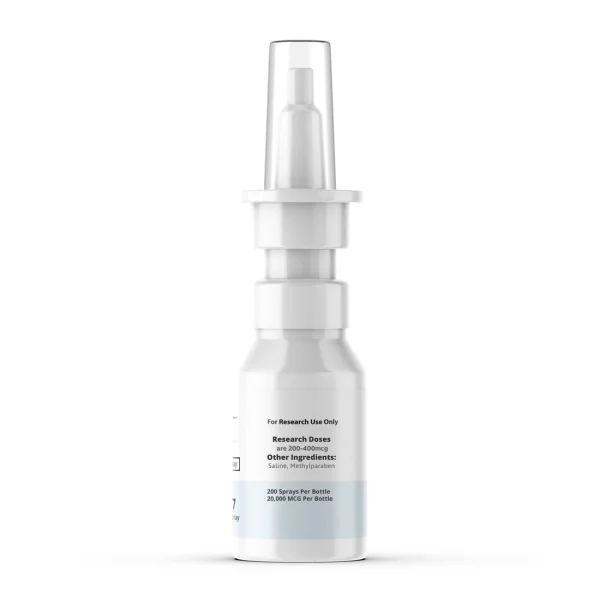
Prostamax (Lys-Glu-Asp-Pro) in bacteriostatic water, 20 mg per spray bottle
Prostamax, the Lys-Glu-Asp-Pro tetrapeptide (KEDP) from Vladimir Khavinson’s bioregulator series, is supplied here as a sterile solution in a metered nasal spray bottle containing 20 mg of peptide. The series’ developers designed it with the prostate in mind. Its research record is small, comes from St Petersburg, and covers chromatin in human leukocytes and the group’s general model of gene regulation by peptides; none of it involved nasal delivery.
Specifications
| Property | Value |
|---|---|
| Compound | Prostamax Lys-Glu-Asp-Pro (KEDP); Khavinson prostate peptide bioregulator |
| CAS number | Not assigned |
| Molecular formula | C20H33N5O9 |
| Theoretical mass | 487.5 Da |
| Sequence / structure | H-KEDP-OH (4 residues; free N- and C-termini) |
| Contents | Prostamax: 20 mg per bottle (≤ 0.2% w/v) |
| Form | Sterile aqueous solution in bacteriostatic water (0.9% benzyl alcohol), supplied in a metered nasal spray bottle |
| Storage, sealed | Store at 2–8 °C, protected from light; do not freeze |
| Safety data sheet | PL-SDS-134 |
What is in the bottle
The bottle holds 20 mg of Prostamax in bacteriostatic water with 0.9% benzyl alcohol as a preservative, at no more than 0.2% w/v. In molar terms that is about 41 µmol, based on the certificate’s theoretical mass of 487.5 Da. The safety data sheet leaves the peptide unclassified. Of the other ingredients only benzyl alcohol is classified: it is harmful if swallowed or inhaled, seriously irritates the eyes and can sensitise skin.
Keep the bottle upright and capped at 2 to 8 °C, protected from light, and do not freeze it. The same peptide is available as dry powder in the Prostamax 20 mg vial, and peptide storage and stability gives general guidance on keeping peptide solutions.
What the research covers
Prostamax is one of the short synthetic analogues that Khavinson’s group made after isolating small peptides from organs and tissues1. In leukocytes from older people, it was among five peptides that activated ribosomal genes and released genes held in condensed chromatin2. It was also one of three, with Epitalon and Livagen, that decondensed the structural heterochromatin beside the centromere of chromosome 12. The abstract does not state how many donors were studied. The nuclear-entry experiments that the group cites for its mechanism used other peptides, Epitalon, Pinealon and Testagen, tracked with fluorescent labels in HeLa cells3. Khavinson is an author of all three papers, and the experimental ones were published in Russian journals in English translation. The mechanism they support is a hypothesis from one programme.
None of these papers studied the nose. No reference on this page addresses whether a 487.5 Da tetrapeptide crosses the nasal lining or what happens to it there, and none measured Prostamax’s stability in solution. This format therefore has no published findings of its own; the storage conditions come from the safety data sheet. The Prostamax guide and the peptide bioregulators research overview give the wider background on the compound and its relatives.
How each lot is tested
Every lot is tested in PrymaLab’s own laboratory in Ashland, Kentucky before release: RP-HPLC for purity, LC-MS for identity, Karl Fischer titration for water, LAL for endotoxin and USP <71> for sterility. Published certificates are listed on the results page and can be checked by number and key on the verify page. The certificate covers the peptide lot used to fill the bottle, not the finished solution. These are in-house results from PrymaLab Analytical, not an independent test, and the lab is not accredited to ISO 17025. The third-party testing guarantee on this page still applies: if any independent laboratory finds the wrong compound, or less than the stated purity or amount, the order is refunded and the cost of the test is reimbursed.
Frequently asked questions
Is the spray the same Prostamax as the vial and pen?
Yes. All three contain the Lys-Glu-Asp-Pro tetrapeptide shown in the specifications. The vial holds it dry and frozen; the pen and the spray bottle hold it dissolved in bacteriostatic water, kept at 2 to 8 °C and never frozen.
Has Prostamax been studied as a nasal spray?
None of the cited papers tested it that way. The Prostamax work used human leukocytes, and the mechanism papers used other peptides in cultured cells. There are no published findings specific to a nasal format.
Which lot does the certificate describe?
It describes the lot of Prostamax peptide that went into the solution rather than the filled bottle itself. Certificates are published on the testing results page, and each one can be checked on the verify page with its number and key.
Is Prostamax nasal spray for human use?
No. Prostamax nasal spray is for laboratory research only. It has no FDA or other regulatory approval for use in humans or animals, and it must not be given to either.
References
- Anisimov VN, Khavinson VKh. Peptide bioregulation of aging: results and prospects. Biogerontology. 2010;11(2):139-49. DOI · PubMed
- Khavinson VKh, Lezhava TA, Malinin VV. Effects of short peptides on lymphocyte chromatin in senile subjects. Bull Exp Biol Med. 2004;137(1):78-81. DOI · PubMed
- Fedoreyeva LI, Kireev II, Khavinson VKh, et al. Penetration of short fluorescence-labeled peptides into the nucleus in HeLa cells and in vitro specific interaction of the peptides with deoxyribooligonucleotides and DNA. Biochemistry (Mosc). 2011;76(11):1210-9. DOI · PubMed
Research use only
For laboratory research use only. Prostamax 20mg Nasal Spray is not a drug, food, cosmetic or dietary supplement, is not approved by the FDA or any comparable authority for human or veterinary use, and must not be given to people or animals. It is sold to qualified researchers and institutions, and the buyer is responsible for lawful handling and disposal.
Other formats of Prostamax
Prostamax is also stocked as Prostamax 20mg preloaded 3ml pen. Each listing states its own quantity and concentration, and the pen and vial comparison explains what changes between formats.







Reviews
There are no reviews yet.