15% SUMMER DISCOUNT APPLIED AUTOMATICALLY AT CHECKOUT FREE USA SHIPPING OVER $100  FREE WORLDWIDE SHIPPING OVER $200

15% SUMMER DISCOUNT APPLIED AUTOMATICALLY FREE USA SHIPPING OVER $100  FREE WORLDWIDE SHIPPING OVER $200

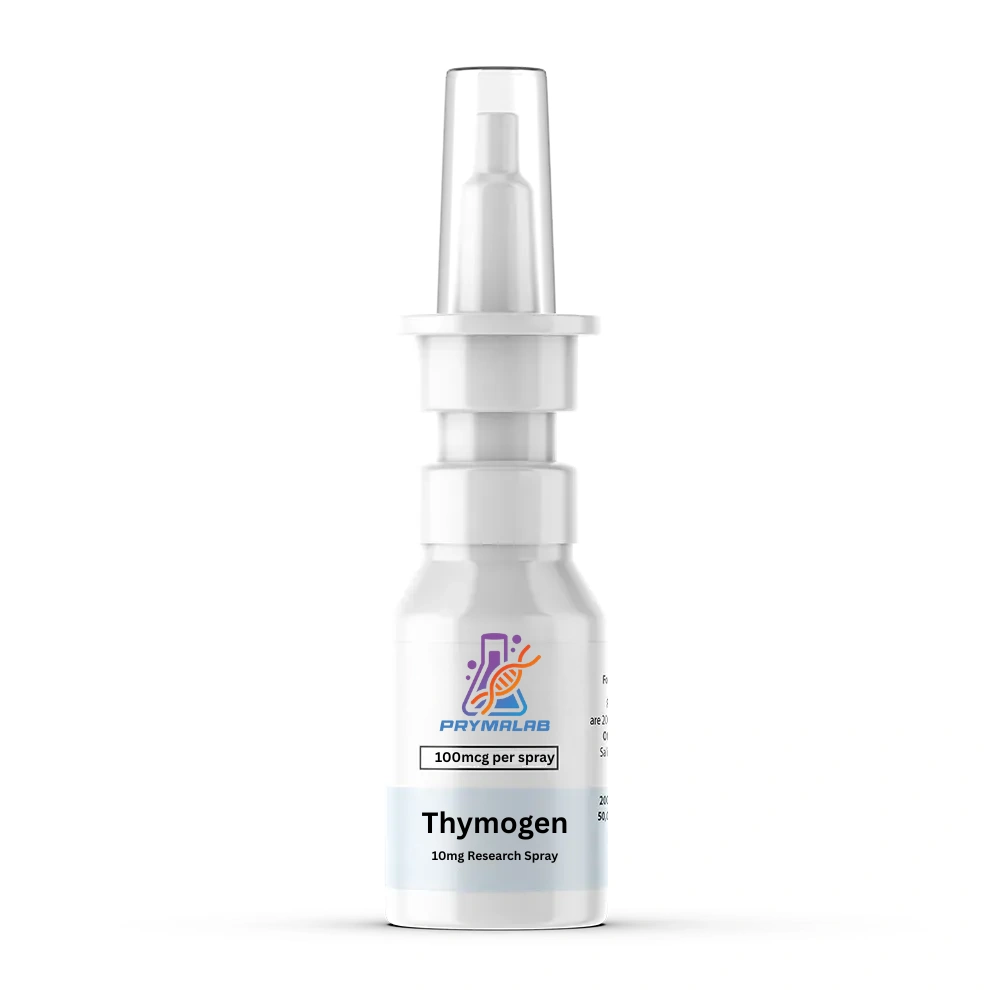
Thymogen 10mg Nasal Spray

(5 customer reviews)

$59.99 or subscribe for $50.99/mo

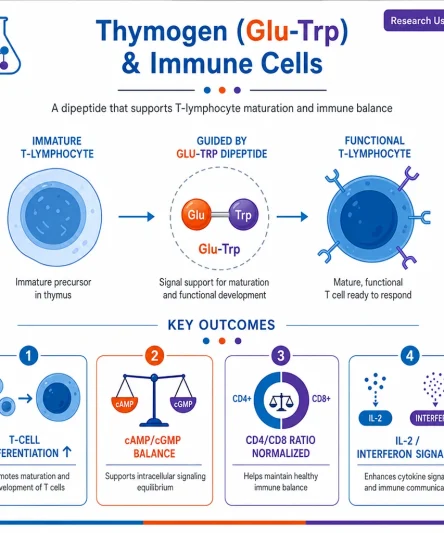
Thymogen nasal spray supplies the synthetic dipeptide Glu-Trp (EW), isolated as the active fragment of the thymic extract thymalin and synthesized by Khavinson and Morozov. It is the one compound in this class carrying an aromatic residue, which makes it far easier to detect analytically than its siblings. Characterized by reversed-phase HPLC for purity and mass spectrometry for identity. In-vitro laboratory research only. Not for human use.

Description

This thymogen nasal spray supplies Thymogen, a synthetic dipeptide with the sequence Glu-Trp, abbreviated EW. It was identified as the active fragment of thymalin, a complex extract of thymus tissue, and synthesized by Khavinson and Morozov at what became the St Petersburg Institute of Bioregulation and Gerontology. Two residues, and yet it differs from every other short peptide in this catalogue in a way that matters at the bench. Supplied for laboratory research use only.

The only one with a chromophore, and why that changes everything

Here is a practical point I have not seen made anywhere else, and it is the most useful thing on this page.

Peptides are usually quantified by ultraviolet absorbance. There are two wavelengths in common use. At 280 nm you detect aromatic side chains, specifically tryptophan and tyrosine, and the signal is strong and reasonably specific because few other things in a buffer absorb there. At 214 nm you detect the peptide bond itself, which works for any peptide but is far less specific, because a great many organic molecules, solvents and buffer components also absorb in that region.

Almost every short bioregulator in this series is built from alanine, glutamate, aspartate, glycine, lysine, leucine and proline. Not one of those has an aromatic ring. So Ovagen, Livagen, Cortagen, Cardiogen, Chonluten, Bronchogen, Vilon, Pinealon, Prostamax and Testagen are all invisible at 280 nm and must be run at 214 nm, where distinguishing a genuine peptide peak from buffer noise is considerably harder.

Thymogen contains tryptophan. It absorbs strongly at 280 nm, and tryptophan is also natively fluorescent, which opens a detection route with even better sensitivity and selectivity than absorbance. That makes this the easiest peptide in the entire bioregulator range to quantify honestly, and it means a certificate of analysis for this compound can be considerably more informative than one for its siblings. If you are comparing suppliers across this class, Thymogen is the compound where the analytics can actually be scrutinised.

Where it came from, and what it was registered for

Thymogen began as a fractionation problem. Thymalin is a thymic extract prepared from thymus gland tissue, and like any tissue extract it is a mixture. Isolating the active component gave the dipeptide Glu-Trp, formally alpha-glutamyl-tryptophan and supplied as the glutamyl-tryptophan monosodium salt, which is why the material is sometimes listed as thymogen sodium and, in transliteration, as Timogen. The work came out of the group associated with the St Petersburg Institute of Bioregulation and Gerontology, and the compound has been manufactured by Cytomed. Its sibling in the same bioregulator series is Lys-Glu, sold as Vilon.

The registered indications reflect what an immunomodulator was expected to do in that system. It was positioned as an immunostimulating agent for secondary immunodeficiency and immunodeficiency states, for infectious and inflammatory diseases where inflammation and a weakened immune system were the concern, including respiratory diseases of the upper respiratory tract, acute respiratory infections and acute respiratory viral infections, abbreviated ARVI, with influenza and rhinitis among the specific presentations and tuberculosis appearing in the older literature. It was also used to support recovery where immune deficiencies followed treatment, including after chemotherapy, radiation therapy, cytostatic drugs, corticosteroids or prolonged antibiotic therapy, and in post-traumatic recovery, sometimes prophylactic rather than reactive. The proposed effects were described as an immunostimulating effect on cellular immunity, raising nonspecific resistance to pathogens, supporting T-cell maturation and the balance of T-helper cells and cytotoxic T-lymphocytes, along with hematopoiesis, cellular metabolism, cellular repair and regeneration processes.

That is a description of a Soviet-era registration, not a demonstration of efficacy by contemporary standards, and none of it transfers to material sold as a research chemical. Comparable immune-modulating peptides such as thymosin alpha-1 exist in the same conceptual space and have their own separate evidence.

The one with a registration

The other distinction is regulatory. The Glu-Trp dipeptide underwent preclinical and clinical study and was registered as a medicine named Thymogen in the USSR in 1990, and it continues to hold a Russian Ministry of Health registration certificate. Among the compounds in this catalogue that is unusual: most of the bioregulator series has no medicinal registration anywhere.

Two qualifications belong with that. A 1990 Soviet registration reflects the evidentiary standards of that regulator at that time, and it is not equivalent to an FDA or EMA approval, neither of which this compound holds. And registration in one jurisdiction has no bearing on material sold elsewhere as a research chemical, which is what this is. The registration is a genuine point of difference from its siblings and it is not a substitute for the evidence you would want before making any therapeutic claim.

In-vitro models for intranasal thymogen research

Given the thymic origin, the models that fit are immune: peripheral blood mononuclear cells, isolated T cell populations, thymocyte preparations, and monocyte or macrophage lines. THP-1, a monocytic line differentiable toward a macrophage phenotype, is a common choice, and short peptides have been examined for effects on proliferative activity and inflammatory pathways in that line, reported in work published in 2022. The broader context of thymic peptides as immune-modulating agents is reviewed in Natural and synthetic thymic peptides as therapeutics for immune dysfunction.

The readouts are the standard immunology panel: proliferation, cytokine output by ELISA or multiplex, surface marker expression by flow cytometry, and transcript changes by qPCR given the proposed transcriptional mechanism. For the immune-cell regulation biology in depth, our research library covers it rather than this page.

Two design points specific to a dipeptide. Serum peptidases consume two-residue peptides readily, so long incubations in serum-containing medium give a declining exposure. And a free amino acid control at matched concentration matters here more than usual: tryptophan is not merely a building block, it is the precursor for serotonin and for kynurenine pathway metabolites, and the kynurenine pathway is itself immunologically active through IDO. A hydrolysed Glu-Trp dipeptide delivers free tryptophan into an immune culture, which is a plausible route to an immune effect that has nothing to do with the intact peptide. Without that control the two cannot be separated.

Thymogen nasal spray specifications

Compound Thymogen, synthetic short peptide bioregulator
Sequence Glu-Trp (EW)
Length Dipeptide (two residues)
Parent material Thymalin, a complex thymic extract; EW is the identified active fragment
Analytical advantage Tryptophan gives UV absorbance at 280 nm and native fluorescence
Origin Khavinson and Morozov, St Petersburg Institute of Bioregulation and Gerontology
Regulatory note Registered as a medicine in the USSR in 1990; holds a Russian MoH certificate. No FDA or EMA approval.
Handling risk Tryptophan is light-sensitive and oxidation-prone
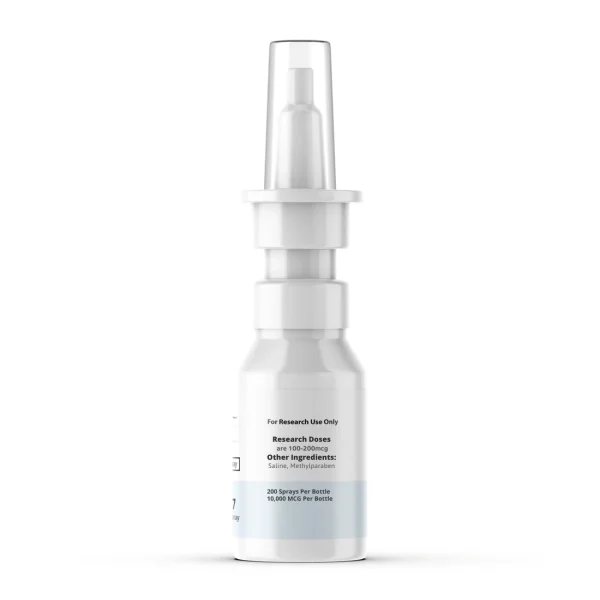
Format Metered spray bottle
Classification Research chemical. In-vitro laboratory use only. Not for human or veterinary use.

Thymogen nasal spray storage and handling

The tryptophan that makes this peptide easy to detect also makes it the most fragile of the short bioregulators. Tryptophan is among the most light-sensitive and oxidation-prone of the amino acids, so light protection here is a specific requirement rather than generic advice. Use amber containers or foil covering, keep bench time short, and treat a solution that has yellowed as spoiled rather than usable.

Two formulation notes if you are comparing this against the pharmaceutical presentations. Peptide nasal sprays prepared as a medicine typically contains excipients: sodium chloride to adjust tonicity and benzalkonium chloride as a preservative, neither of which belongs in a research reagent, both of which would interfere with a cell assay, and benzalkonium chloride in particular being a documented cause of allergic reactions and mucosal irritation. Registered versions were also supplied for subcutaneous use rather than intranasal only, and intranasal administration through the nasal mucosa or nasal passage was one option among several. Unrelated products sharing shelf space, such as the oral antiseptic Hexoral, have nothing to do with this compound. If your material arrives lyophilized, reconstitution with bacteriostatic water is the usual step.

The rest of the bioregulator range is chemically dull by comparison, built from residues that do not degrade in interesting ways. This one is not. Careful thymogen nasal spray storage means cold, sealed, dark, single-use aliquots rather than repeated freeze-thaw on one container, and minimal air exposure. Adsorption is less of a concern than for large hydrophobic peptides, though low-binding plasticware remains sensible at low working concentrations.

How research grade thymogen spray is characterized

This is where the chromophore pays off. A research grade thymogen spray can be characterized by reversed-phase HPLC with detection at 280 nm, which is more specific than the 214 nm detection its aromatic-free siblings require, and mass spectrometry confirms identity. The tryptophan also improves retention on a reversed-phase column relative to a purely polar dipeptide such as Lys-Glu, so the chromatography itself is better behaved.

One thing worth asking about specifically: because tryptophan oxidizes, an oxidized species would be a plausible impurity in poorly stored material, and it is detectable by mass. This material is supplied under the same verification PrymaLab applies across its research peptides, HPLC and MS confirmation plus independent third-party testing. No specific lot figures are asserted here; request the certificate of analysis for the lot you receive.

For the immune-cell regulation biology behind this peptide, see Thymogen and Immune Cell Regulation in the PrymaLab Research Library.

Frequently asked questions

What is Thymogen?

Thymogen is a synthetic dipeptide, Glu-Trp (EW), identified as the active fragment of the thymic extract thymalin and synthesized by Khavinson and Morozov. Material supplied here is a research chemical for in-vitro laboratory use only.

Why is Thymogen easier to analyse than other bioregulators?

Because it contains tryptophan, an aromatic residue that absorbs strongly at 280 nm and is natively fluorescent. The other short bioregulators contain no aromatic residues, so they must be detected at 214 nm, where separating a peptide signal from buffer background is much harder.

Is Thymogen an approved medicine?

It was registered as a medicine in the USSR in 1990 and holds a Russian Ministry of Health certificate. It has no FDA or EMA approval, and a registration in one jurisdiction has no bearing on research-chemical material sold elsewhere.

Why does a tryptophan control matter in immune experiments?

Because free tryptophan feeds the kynurenine pathway, which is immunologically active through IDO. A dipeptide hydrolysed by serum peptidases delivers tryptophan into the culture, so without a matched free amino acid control an immune effect cannot be attributed to the intact peptide.

Is Thymogen nasal spray approved for human use?

No. This material is a research chemical for in-vitro laboratory use only and is not intended for human or veterinary use. Nothing here is medical advice.

Ordering and compliance

Every PrymaLab research compound ships from the United States and is sold research-use-only. This thymogen nasal spray is supplied for in-vitro laboratory research, is not intended for human or veterinary use, is not a drug or supplement, and has not been evaluated by the FDA for the research-chemical context. Verify the legal status of any research compound in your jurisdiction before ordering. Certificates of analysis are available on request for the lot you receive.

Additional information

Weight N/A
Dimensions N/A

5 reviews for Thymogen 10mg Nasal Spray

  1. Spencer Sanders
    August 2, 2026
    Tested good
    Had this order sent off to Janoshik for testing and it just came back with a perfect on the endotoxin testing and a purity of 99.97%. I will be shoppi...More
    Had this order sent off to Janoshik for testing and it just came back with a perfect on the endotoxin testing and a purity of 99.97%. I will be shopping here from now on, no vendor that I trust has better pricing.
    Helpful? 0 0
    Damon Gray
    August 2, 2026
    Thanks.
    Shipping was slow but everything came as it should.
    Helpful? 0 0
    Paula Harper
    August 1, 2026
    quality on point!
    test came back 99.71%. Will be back fs
    Helpful? 0 0
    Beverly Jones
    August 1, 2026
    Already seeing results!
    Shipping was slow but after only a week I am already seeing amazing results. Thank you.
    Helpful? 0 0
    Curtis Harper
    July 30, 2026
    will be back
    thanks
    Helpful? 0 0

Only logged in customers who have purchased this product may leave a review.

Peptide Research Articles

Bacteriostatic Water Peptide Science: Why It Matters in Reconstitution & Research

Bacteriostatic water peptide science is the foundation of safe, accurate peptide reconstitution. This 2026 guide covers bacteriostatic water composition, how to reconstitute peptides using a peptide reconstitution calculator and peptide dosage calculator, bacteriostatic water vs sterile water differences, peptide storage best practices, and a 10-step reconstitution protocol. Expert insights from PrymaLab.

Peptides for Injury Recovery: The Wolverine Stack Peptide Guide (BPC-157 + TB-500)

The Wolverine stack peptide combines BPC-157 and TB-500 for research into tendon, ligament, and joint recovery. This 2026 guide covers BPC-157 peptide where to buy responsibly, BPC 157 peptide side effects, peptides for tendon repair, peptides for joint recovery, peptides for elbow pain, and the BPC-157 TB-500 peptide blend scientific research. Expert insights from PrymaLab.

Are Peptides Good for You? A Complete 2026 Guide

Are peptides good for you? This comprehensive 2026 guide explores peptide therapy benefits, safety, side effects, and how peptides work in the body. Learn about peptide health benefits, research findings, and what you need to know before considering peptide therapy. Expert insights from PrymaLab.

Ovagen peptide capsules for liver health with dosage cycling chart showing 10-20 day protocols repeated 2-3 times per year

Ovagen Peptide Guide: Uses, Research, Safety & Buying Info

Ovagen peptide is a short-chain liver bioregulator developed at the St. Petersburg Institute of Bioregulation and Gerontology under Professor Vladimir Khavinson. It contains the AC-3 peptide complex (glutamic acid and aspartic acid) designed to target hepatocyte gene expression for liver cell repair, bile production, and detoxification. This guide covers dosing protocols, cycling schedules, side effects, a head-to-head comparison with NAC, milk thistle, TUDCA, and BPC-157, cost analysis ($120-360 per year), and how to verify genuine Ovagen products online.

GHK-Cu peptide vial and syringe with dosage chart showing injection protocols for skin rejuvenation and hair growth

GHK-Cu Peptide: Benefits, Dosage, Side Effects & Complete Research Guide (2026)

GHK-Cu peptide is a naturally occurring copper tripeptide that modulates over 4,000 human genes involved in collagen synthesis, wound healing, and tissue regeneration. This comprehensive guide covers injection dosage protocols, clinical research on skin rejuvenation and hair growth, side effects, safety data, and how to reconstitute GHK-Cu 50mg vials. Includes dosage charts, comparison tables, and 10 frequently asked questions answered by a peptide research specialist.

Sermorelin dosage guide for anti-aging muscle growth and weight loss showing GHRH analog pituitary stimulation

Sermorelin Dosage Guide 2025: Complete Protocol for Anti-Aging, Muscle Growth & Weight Loss

Sermorelin acetate is a growth hormone-releasing hormone (GHRH) analog that stimulates natural GH production from the pituitary gland. This comprehensive dosage guide covers protocols for anti-aging, muscle growth, weight loss, and sleep optimization รขโ‚ฌโ€ along with side effects, before-and-after timelines, and comparisons to HGH and ipamorelin.

Customer reviews

4.60
Based on 5 reviews
5
60%
3
4
40%
2
3
0%
0
2
0%
0
1
0%
0
Spencer Sanders
August 2, 2026
Tested good
Had this order sent off to Janoshik for testing and it just came back with a perfect on the endotoxin testing and a purity of 99.97%. I will be shoppi...More
Had this order sent off to Janoshik for testing and it just came back with a perfect on the endotoxin testing and a purity of 99.97%. I will be shopping here from now on, no vendor that I trust has better pricing.
Helpful? 0 0
Damon Gray
August 2, 2026
Thanks.
Shipping was slow but everything came as it should.
Helpful? 0 0
Paula Harper
August 1, 2026
quality on point!
test came back 99.71%. Will be back fs
Helpful? 0 0
Beverly Jones
August 1, 2026
Already seeing results!
Shipping was slow but after only a week I am already seeing amazing results. Thank you.
Helpful? 0 0
Curtis Harper
July 30, 2026
will be back
thanks
Helpful? 0 0
24/7 Online support

support@prymalab.net info@prymalab.net

Money back guarantee

30 Day return window. Satisfaction guaranteed or your money back.

FREE shipping and return

All orders over %150 in value will receive free shipping.