15% fall discount applied automatically at checkoutFree USA shipping over $100Free worldwide shipping over $200Credit/debit checkout disabled for updates
Sign in 0

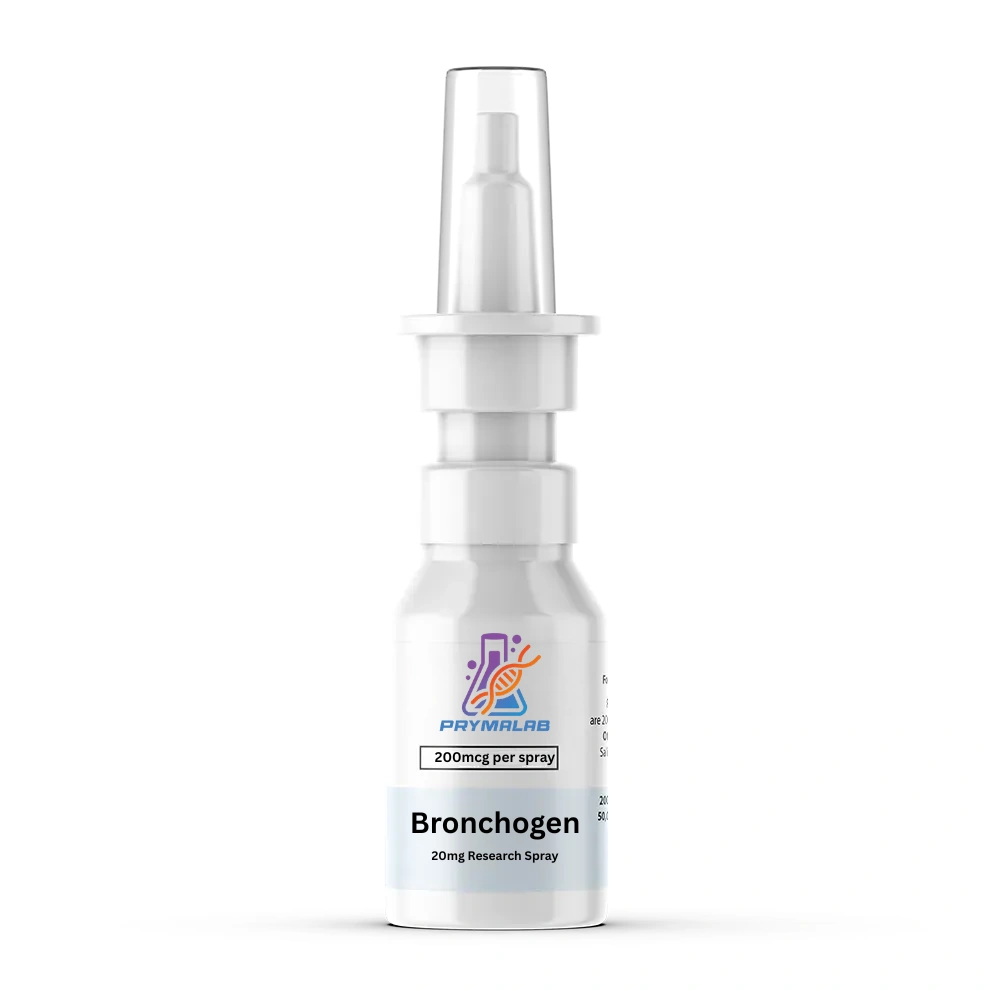
Bronchogen 20mg Nasal Spray

(5 customer reviews)

$119.99 or subscribe for $101.99/mo

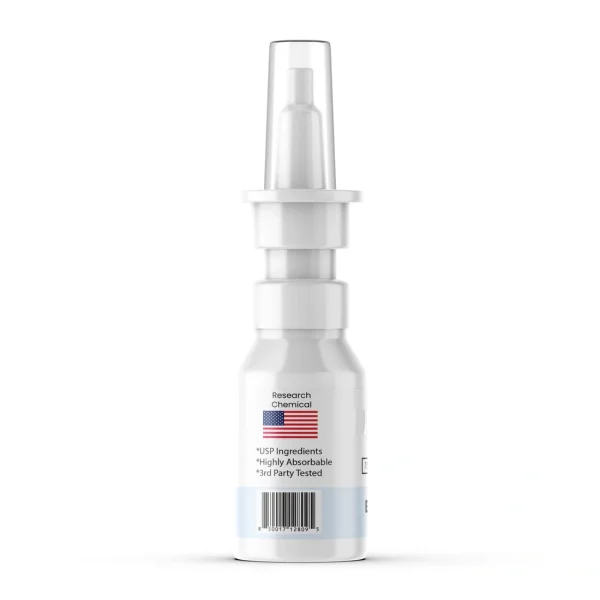
Bronchogen nasal spray supplies the tetrapeptide Ala-Glu-Asp-Leu in a metered solution format. It sits about one dalton from Testagen, which is stocked in the same catalogue, and that gap is the tightest analytical question here. Laboratory research use only.

Description

PrymaLab · Research Use Only

Bronchogen Nasal Spray

Ala-Glu-Asp-Leu tetrapeptide · 446.5 Da · one dalton from Testagen

Bronchogen nasal spray supplies the tetrapeptide Ala-Glu-Asp-Leu in a metered aqueous solution at roughly 446.5 daltons. Another compound sold from the same catalogue sits about a dalton away from that figure, which is close enough that a routine mass measurement cannot tell them apart.

Specification Table

Bronchogen nasal spray format and handling data
Property Value
Compound Bronchogen
Sequence designation AEDL
Amino acid sequence Alanine-Glutamate-Aspartate-Leucine
Sequence provenance Secondary sources, converging. Not traced to a single primary citation. Confirm against the lot certificate before relying on it for calculation
Residue count 4
Molecular formula, calculated C18H30N4O9, derived from the stated sequence rather than from a registry entry
Molecular weight, calculated Approximately 446.5 g/mol, computed from standard residue masses plus water
Also listed as Bronchogen (20mg), Bronchogen peptide, AEDL. Some listings misorder the sequence as Ala-Asp-Glu-Leu
Reconstitution required None. Supplied in solution, so no bacteriostatic water is added
Nearest mass in this catalogue Testagen at roughly 447.5, a gap of about one dalton
Truncation relative Ovagen (Glu-Asp-Leu) is this compound minus its alanine
Terminal residue Leucine, the most hydrophobic terminus in the bioregulator family
Net charge at neutral pH Negative. Two acidic residues, no basic residue
Chromophore None. Concentration cannot be determined by 280 nm absorbance
Oxidation-prone residues None
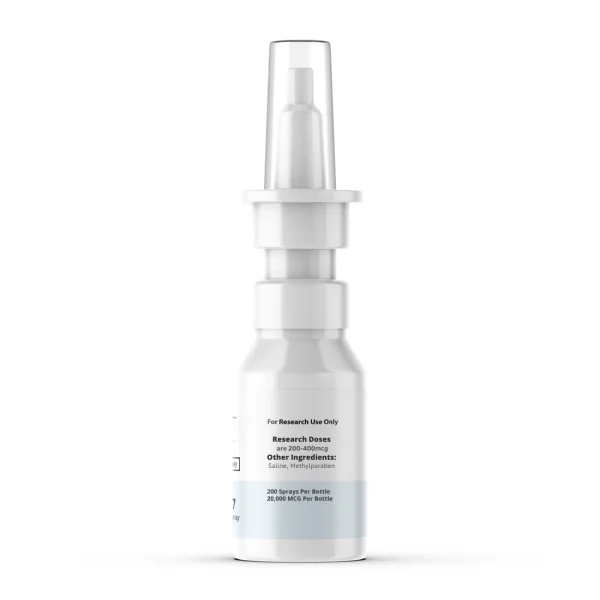
Format Metered nasal spray, solution state
Physical state Aqueous solution, supplied ready to use
Purity Per lot-specific certificate of analysis
Storage 2-8°C, protected from light. Do not freeze
Regulatory status No approved human or veterinary formulation in any jurisdiction

Why Does One Dalton Matter in Bronchogen Nasal Spray?

Two compounds in this catalogue sit roughly a dalton apart, and this is one of them.

Testagen reads Lys-Glu-Asp-Gly and lands at roughly 447.5. This compound reads Ala-Glu-Asp-Leu and lands at roughly 446.5. Two positions differ, and the mass changes very nearly cancel.

A single dalton is inside the range where a nominal-mass instrument reports the same integer for both, and it is at the edge of what an average-mass measurement resolves reliably.

High-resolution mass spectrometry separates them comfortably, but only when the operator is looking for a distinction rather than confirming an expected value.

That difference between a discriminating measurement and a confirmatory one is where most certificates in this market sit, and it is worth naming.

Chromatographically the two are easier. Leucine is strongly hydrophobic and glycine has no side chain at all, so retention differs substantially even though mass does not.

A reversed-phase method with a reference standard for each compound resolves them cleanly, which makes chromatography the better discriminator here and mass spectrometry the weaker one.

That inversion is unusual. Mass is normally the definitive answer here and retention the supporting evidence, and for this pair the two swap places.

What Does the Leucine Terminus Change?

The terminal residue is the most hydrophobic in the bioregulator family, and that has consequences beyond the mass question.

Leucine carries a branched four-carbon side chain, which is bulky and entirely non-polar. No other compound in this family ends in anything comparable.

For a molecule otherwise built from acidic and small residues, that one addition shifts the overall character noticeably.

Chromatographic retention moves later. That is the analytical consequence and the reason separation from Testagen works despite the mass coincidence.

Solubility drops relative to the fully hydrophilic members of the family, though at four residues the compound remains comfortably water soluble.

In a solution-state product that matters at the margins rather than in normal use, and it argues against letting a bottle sit at low temperature for extended periods where a marginal solubility could show as haze.

The hydrophobic terminus also favours transcellular passage across the lipid membrane, which most of this family cannot use since they are too polar for it.

Whether that translates into better nasal transport has not been measured, but it is the one structural argument in this family for a route other than paracellular.

One further consequence of that side chain shows up during synthesis rather than in use.

Branched residues such as leucine couple more slowly than unbranched ones, because the branch point sits close to the reacting centre and gets in the way.

Since this residue is at the carboxy terminus it is the first one loaded onto the resin, where coupling efficiency is easiest to control and easiest to verify.

That placement is fortunate. A slow-coupling residue in the middle of a chain is a far harder manufacturing problem than the same residue at the start.

What Does the Ovagen Relationship Mean in Solution?

This compound has a structural relative in the catalogue, and a spray changes what the relationship implies practically.

Ovagen is Glu-Asp-Leu. Remove the alanine from this compound and Ovagen is exactly what remains.

Since solid-phase synthesis builds a chain backwards from the carboxy terminus, that alanine is the last residue added here, and a failed final coupling produces Ovagen.

The masses differ by roughly 71 daltons, putting Ovagen near 375.4 against roughly 446.5 here, which any instrument resolves without effort.

That makes the truncation question the easy one and the Testagen question the hard one, which is worth stating since they are often lumped together as if both were mass problems.

For a solution product the truncation happened during synthesis or it did not. Nothing in the bottle creates it afterwards.

So the check belongs entirely to the fill-time certificate, and the buyer has no way to repeat it on material they control.

Asking whether the analysis looked for a species near 375 is therefore a question to put once, before material is committed, rather than after a result looks unexpected.

How Does a Spray Change the Verification Question?

A solution-state product concentrates all identity and purity questions into a single moment that has already passed.

With a powder a researcher can weigh out material, run their own analysis, and split a sample before anything is dissolved.

With a spray there is a bottle and a certificate describing what was in it at fill. Everything the buyer can learn independently is downstream of that.

For a compound whose nearest analytical neighbour is one dalton away, that concentration of trust deserves to be named rather than glossed over.

The reasonable response is to ask for the discriminating analysis explicitly, and to ask before rather than after committing material to a study.

A supplier who ran high-resolution mass against both candidate masses, or who ran chromatography against reference standards for both, has done real work.

One who reports a nominal mass and a purity percentage has answered a different and easier question.

That distinction costs nothing to ask about and it separates the careful vendors from the rest more reliably than any purity figure.

There is a partial exception to this. It is worth stating so the position is not overstated.

A buyer holding a spray can still run mass spectrometry on the solution directly, since electrospray tolerates aqueous samples without difficulty.

What they cannot easily do is run a quantitative purity determination, because that requires knowing how much material was injected and the concentration is the uncertain quantity.

So identity remains checkable in principle and purity does not, which is a more precise statement than saying nothing can be verified.

How Does the Size Sit for Nasal Delivery?

The bioregulator family occupies a narrow and favourable band on the variable that governs transnasal transport.

Passage between epithelial cells becomes inefficient somewhere near 1,000 daltons, and every member of this family sits between roughly 246 and 490.

At roughly 446.5 daltons this compound is comfortably inside that window, close to Livagen and Testagen and below Cardiogen at roughly 489.5.

Size therefore is not the limiting factor for any compound in this family, which shifts the question to charge and to surface chemistry.

Two acidic residues and no basic residue give a clearly negative net charge. So the molecule is neither held nor repelled strongly by the mucosal surface.

The leucine adds the hydrophobicity that could open a transcellular route, which distinguishes this compound from its more polar relatives.

No published study characterises this compound given nasally, so all of that is structural argument rather than measurement.

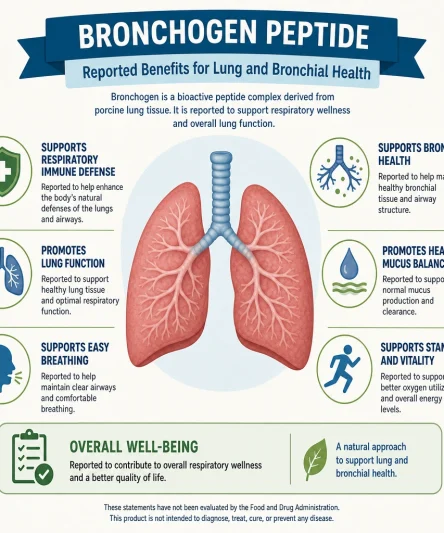
What Does the Respiratory Claim for Bronchogen Peptide Rest On?

This compound is sold as a lung bioregulator, and the claim deserves the same examination as its chemistry.

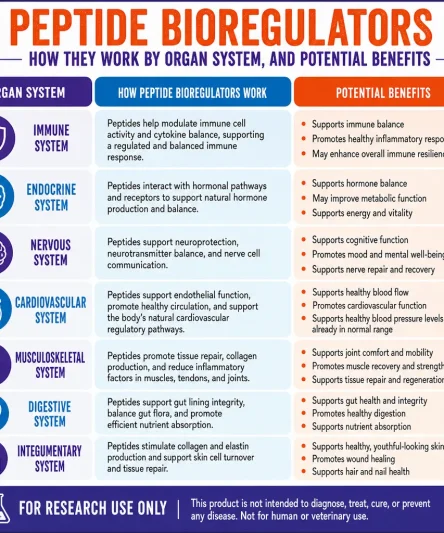
The originating programme, directed by Vladimir Khavinson, assigned each Khavinson bioregulator to an organ. This synthetic tetrapeptide was assigned to the respiratory system.

The assignment traces to the tissue the original extract came from rather than to measured activity in lung tissue, which is the pattern across the family.

Where this compound differs is that the published work on it is more specific than most, and that specificity is worth setting out.

The programme reported effects in cultured bronchial epithelium, using human bronchial epithelial cells taken from donors of different ages.

The readout was expression of differentiation markers rather than any clinical endpoint. SCGB1A1, the club cell secretory protein, and NKX2-1, a transcription factor governing lung cell identity, are the two named most often.

Reported increases in those markers are read as a shift toward a more differentiated bronchial epithelium, which is a cell-biology claim rather than a respiratory health claim.

Related work discusses surfactant production, ciliated cells and goblet cell populations, since those are the cell types a differentiation marker panel distinguishes.

Goblet cell hyperplasia and impaired mucociliary clearance are features of obstructive lung pathology, which is why a differentiation argument gets made in that direction at all.

That is where the reasoning stops in the primary papers, and where vendor copy usually keeps going.

COPD is the condition named most often in that copy. Chronic obstructive pulmonary disease has never been the subject of a controlled trial of this compound.

Asthma, pulmonary fibrosis and lung disease more generally appear in the same listings. No trial supports any of it, and this compound treats no respiratory conditions.

Claims that it can reduce inflammation, lower pro-inflammatory cytokines, raise secretory IgA or protect against environmental stressors come from marker panels rather than from measured outcomes.

Tissue regeneration, cellular repair and cellular regeneration are the three phrases doing most of the work in that copy, and not one is a measured endpoint anywhere in the record.

This is not a bronchodilator and it is not comparable to one. Bronchodilators relax airway smooth muscle within minutes and have a mechanism, a dose and an approval.

Nothing here has any of those. Anyone managing COPD or asthma needs a clinician and a prescribed inhaler.

The family-wide hypothesis is that these short peptides bind DNA and influence transcription factors, with DNA stabilization and increased DNA thermostability offered as the supporting physical evidence.

That binding work is real and it is also the weakest link, since no receptor has been named and no binding constant published for any member of the family.

So the respiratory health language attached to this molecule rests on marker expression in cultured cells, and the distance from there to a claim about a lung is the distance a reader should keep in mind.

What Research Position Applies?

The published work concerns the compound rather than the format, and separating them is what keeps a claim defensible.

The St Petersburg programme published observations in aged rodent models, read out histologically and through markers of tissue-associated gene expression.

Those studies used parenteral routes throughout. The nasal route for this compound appears in no published work at all.

Chromatin decondensation reported in family-wide cell culture is offered for the DNA-binding hypothesis, not for any tissue-specific claim about this compound.

The mechanism has never left hypothesis status. Nobody outside the originating programme has established it, no receptor is named, and no binding constant has been published.

An adequately powered independent Western trial has never been run on the bioregulator range as a whole, and this compound is no exception to that.

Sequence provenance for this compound rests on converging secondary sources rather than a traced primary citation, which is stated in the specification table rather than hidden.

How Does It Compare With the Other Peptide Bioregulators?

Short peptides in this family are only interpretable against each other, and this catalogue stocks enough of them for the comparison to be worth making.

Vesugen is Lys-Glu-Asp, and Pancragen carries the same four-letter designation as Testagen, which is a reminder that the naming here is less orderly than the marketing suggests.

Listings for this compound sometimes give the sequence as Ala-Asp-Glu-Leu. That ordering is wrong. The glutamate sits second and the aspartate third, so the correct reading is Ala-Glu-Asp-Leu.

A swapped pair changes nothing about the mass, so that error survives a mass check and shows up only against a stated sequence.

Vendor pages also call it a respiratory bioregulator, which is the same organ label in different words and carries no more evidence than the first one does.

Outside the family, BPC-157 and GHK-Cu are the peptides shelved beside it most often. Neither belongs to the peptide bioregulators and neither shares the proposed mechanism.

Clinics offering peptide therapy group all of them together. That grouping is commercial and it says nothing about the evidence behind any of them.

Does Bronchogen Nasal Spray Need Reconstitution?

No. This is a solution-state research compound supplied at its fill concentration, so no bacteriostatic water is added and no reconstitution step exists.

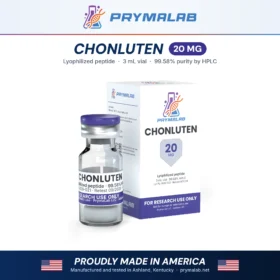
Where the same compound is sold as Bronchogen (20mg) in a vial, that step belongs to the buyer, and the lyophilized powder inside has to be dissolved and recorded before anything else happens.

A freeze-dried peptide weighed at 20mg is not 20mg of peptide once counterion and residual water are subtracted. That is the arithmetic a lyophilized peptide forces and a spray removes.

The trade is that dosing figures quoted for the vial do not transfer. Nothing published establishes nasal dosing for this compound, and none should be inferred from a vial listing.

Purity here is determined by HPLC. High-performance liquid chromatography with a stated gradient and column temperature is the only purity figure worth reading.

For this compound the chromatographic result carries more weight than the mass, since HPLC is what separates it from Testagen and mass spectrometry very nearly does not.

The molecular formula computes to C18H30N4O9 from the stated sequence, giving the roughly 446.5 in the table above. Both are calculated rather than drawn from a registry entry.

Ask for the lot number, the fill date and the storage conditions the material was held under before shipping. That chain is what traceability means for a solution product.

This is a research chemical, supplied for laboratory research only. It is not reconstituted, not injected, and not given to humans or animals.

How Should Bronchogen Nasal Spray Be Stored and Recorded?

Four residues with no reactive side chain makes this an undemanding product to store.

Refrigerate at 2 to 8 degrees Celsius, keep the bottle dark, and never freeze a solution-state product.

There is no cysteine, methionine or tryptophan, so oxidation and photodegradation do not apply and light protection is precautionary.

The aspartate is followed by leucine rather than glycine, which slows the succinimide rearrangement considerably compared with Chonluten.

That is a small structural advantage and it means elapsed time in solution matters less here than for the Asp-Gly members of the family.

What remains is slow backbone hydrolysis and microbial growth in an opened aqueous container, which makes aseptic handling the practical concern.

Record the lot, the stated concentration, the date first opened, the storage temperature and the actuation count.

Record also which analysis distinguished this compound from Testagen, since that is the field most likely to have been assumed rather than established. A note in the sample log naming the method takes one line and preserves the reasoning behind trusting the material. Without it, a result questioned two years later cannot be defended on identity grounds, and the bottle will be long gone.

Published Literature

Selected references. The bioregulator literature originates almost entirely from one research programme and used parenteral routes.

  1. (‘Khavinson VK, Malinin VV. Gerontological Aspects of Genome Peptide Regulation. Basel: Karger; 2005.’, ‘https://doi.org/10.1159/isbn.978-3-318-01193-6’)
  2. (‘Anisimov VN, Khavinson VK. Peptide bioregulation of aging. Biogerontology. 2010;11(2):139-149.’, ‘https://doi.org/10.1007/s10522-009-9249-8’)
  3. (‘Illum L. Nasal drug delivery: new developments and strategies. Drug Discov Today. 2002;7(23):1184-1189.’, ‘https://doi.org/10.1016/S1359-6446(02)02529-1’)

Frequently Asked Questions

What is Bronchogen nasal spray?

A metered aqueous solution of the tetrapeptide Ala-Glu-Asp-Leu at roughly 446.5 daltons. Supplied for laboratory research only. It carries no approval anywhere, for any purpose.

What sits one dalton away?

Testagen, at roughly 447.5. The sequences differ at two positions and the masses very nearly cancel, which puts them inside the range where a nominal-mass instrument reports the same integer.

Can mass spectrometry separate them?

In high-resolution mode, yes, but only when the operator is looking for a distinction rather than confirming an expected value. That gap between discriminating and confirmatory measurement is where most certificates sit.

Is chromatography better here?

Yes, unusually. Leucine is strongly hydrophobic and glycine has no side chain, so retention differs substantially even though mass does not. That inverts the normal situation.

What does the leucine terminus change?

It is the most hydrophobic terminus in this family. Retention moves later, solubility drops slightly, and the molecule gains a transcellular transport route that its more polar relatives cannot use.

What is the Ovagen relationship?

Ovagen is Glu-Asp-Leu, which is this compound minus its alanine. Since synthesis builds backwards from the carboxy terminus, a failed final coupling produces Ovagen.

Is that hard to detect?

No, and that is the point of distinguishing the two questions. The masses differ by roughly 71 daltons, putting Ovagen near 375.4, which any instrument resolves without effort.

How does a spray change verification?

It concentrates every identity question into a moment that has already passed. There is a bottle and a fill-time certificate, and no powder to weigh or sample to split independently.

What should be asked of a supplier?

Whether they ran high-resolution mass against both candidate masses, or chromatography against reference standards for both. A nominal mass with a purity percentage answers an easier question.

Does it share the Chonluten degradation problem?

Not to the same degree. Its aspartate is followed by leucine rather than glycine, which slows the succinimide rearrangement considerably, so elapsed time matters less here.

Is the nasal route supported by published work?

No. The published studies were parenteral throughout, and no work describes this compound reaching tissue by the nasal route.

Is Bronchogen a treatment for COPD or asthma?

No. COPD is the condition named most often in vendor copy about this compound, and chronic obstructive pulmonary disease has never been the subject of a controlled trial of it. Anyone managing COPD or asthma needs a clinician and a prescribed inhaler.

Why is it called a lung bioregulator?

Because the Khavinson programme assigned each peptide to an organ and this one went to the respiratory system. The assignment traces to the tissue the original extract came from, not to measured activity in lung tissue. It is not FDA-approved for anything.

What does the bronchial epithelium work show?

Cultured human bronchial epithelial cells from donors of different ages, scored for differentiation markers including SCGB1A1 and NKX2-1. Related work discusses surfactant production and ciliated cells. Those are marker readouts in cell culture, not respiratory health outcomes.

Does Bronchogen nasal spray need reconstitution?

No. It ships as a solution, so no bacteriostatic water is added. A vial of Bronchogen (20mg) does need that step, and a lyophilized powder weighed at 20mg is not 20mg of peptide once counterion and residual water are subtracted.

How is it told apart from Testagen?

By HPLC rather than by mass. The two sit about a dalton apart, so a nominal-mass instrument reports the same integer for both, while leucine and glycine give very different retention. This is the one pair where chromatography beats mass spectrometry.

Compliance Statement

Bronchogen nasal spray is sold exclusively for laboratory research use. It is not a drug, food, or cosmetic product, and it is not a dietary product of any kind. It is not approved by the FDA or any comparable authority for human or veterinary use, its proposed mechanism has not been independently established, no published study characterises this compound delivered intranasally, and another compound in this catalogue sits within about one dalton of its calculated mass. This product is not intended to diagnose, treat, cure, or prevent any disease. It must not be given to humans or animals. Purchase is restricted to qualified researchers and institutions operating within applicable laws. All handling is the responsibility of the purchasing laboratory.

Other formats of Bronchogen

Bronchogen is also stocked as Bronchogen Peptide 20mg and Bronchogen 20mg preloaded 3ml pen. Each listing states its own quantity and concentration, and the pen and vial comparison explains what changes between formats.
Additional information

Weight N/A
Dimensions N/A

5 reviews for Bronchogen 20mg Nasal Spray

  1. Spencer Sanders
    August 2, 2026
    Tested good
    Had this order sent off to Janoshik for testing and it just came back with a perfect on the endotoxin testing and a purity of 99.97%. I will be shoppi...More
    Had this order sent off to Janoshik for testing and it just came back with a perfect on the endotoxin testing and a purity of 99.97%. I will be shopping here from now on, no vendor that I trust has better pricing.
    Helpful? 0 0
    Damon Gray
    August 2, 2026
    Thanks.
    Shipping was slow but everything came as it should.
    Helpful? 0 0
    Paula Harper
    August 1, 2026
    quality on point!
    test came back 99.71%. Will be back fs
    Helpful? 0 0
    Beverly Jones
    August 1, 2026
    Already seeing results!
    Shipping was slow but after only a week I am already seeing amazing results. Thank you.
    Helpful? 0 0
    Curtis Harper
    July 30, 2026
    will be back
    thanks
    Helpful? 0 0

Only logged in customers who have purchased this product may leave a review.

Peptide Research Articles

Bacteriostatic water depiction

Bacteriostatic Water Peptide Science: Why It Matters in Reconstitution & Research

Bacteriostatic water peptide science is the foundation of safe, accurate peptide reconstitution. This 2026 guide covers bacteriostatic water composition, how to reconstitute peptides using a peptide reconstitution calculator and peptide dosage calculator, bacteriostatic water vs sterile water differences, peptide storage best practices, and a 10-step reconstitution protocol. Expert insights from PrymaLab.

wolverine blend article vial

Peptides for Injury Recovery: The Wolverine Stack Peptide Guide (BPC-157 + TB-500)

The Wolverine stack peptide combines BPC-157 and TB-500 for research into tendon, ligament, and joint recovery. This 2026 guide covers BPC-157 peptide where to buy responsibly, BPC 157 peptide side effects, peptides for tendon repair, peptides for joint recovery, peptides for elbow pain, and the BPC-157 TB-500 peptide blend scientific research. Expert insights from PrymaLab.

are peptides healthy

Are Peptides Good for You? A Complete 2026 Guide

Are peptides good for you? This comprehensive 2026 guide explores peptide therapy benefits, safety, side effects, and how peptides work in the body. Learn about peptide health benefits, research findings, and what you need to know before considering peptide therapy. Expert insights from PrymaLab.

Ovagen peptide capsules for liver health with dosage cycling chart showing 10-20 day protocols repeated 2-3 times per year

Ovagen Peptide Guide: Uses, Research, Safety & Buying Info

Ovagen peptide is a short-chain liver bioregulator developed at the St. Petersburg Institute of Bioregulation and Gerontology under Professor Vladimir Khavinson. It contains the AC-3 peptide complex (glutamic acid and aspartic acid) designed to target hepatocyte gene expression for liver cell repair, bile production, and detoxification. This guide covers dosing protocols, cycling schedules, side effects, a head-to-head comparison with NAC, milk thistle, TUDCA, and BPC-157, cost analysis ($120-360 per year), and how to verify genuine Ovagen products online.

GHK-Cu peptide vial and syringe with dosage chart showing injection protocols for skin rejuvenation and hair growth

GHK-Cu Peptide: Benefits, Dosage, Side Effects & Complete Research Guide (2026)

GHK-Cu peptide is a naturally occurring copper tripeptide that modulates over 4,000 human genes involved in collagen synthesis, wound healing, and tissue regeneration. This comprehensive guide covers injection dosage protocols, clinical research on skin rejuvenation and hair growth, side effects, safety data, and how to reconstitute GHK-Cu 50mg vials. Includes dosage charts, comparison tables, and 10 frequently asked questions answered by a peptide research specialist.

Sermorelin dosage guide for anti-aging muscle growth and weight loss showing GHRH analog pituitary stimulation

Sermorelin Dosage Guide 2025: Complete Protocol for Anti-Aging, Muscle Growth & Weight Loss

Sermorelin acetate is a growth hormone-releasing hormone (GHRH) analog that stimulates natural GH production from the pituitary gland. This comprehensive dosage guide covers protocols for anti-aging, muscle growth, weight loss, and sleep optimization — along with side effects, before-and-after timelines, and comparisons to HGH and ipamorelin.

Customer reviews

4.60
Based on 5 reviews
5
60%
3
4
40%
2
3
0%
0
2
0%
0
1
0%
0
Spencer Sanders
August 2, 2026
Tested good
Had this order sent off to Janoshik for testing and it just came back with a perfect on the endotoxin testing and a purity of 99.97%. I will be shoppi...More
Had this order sent off to Janoshik for testing and it just came back with a perfect on the endotoxin testing and a purity of 99.97%. I will be shopping here from now on, no vendor that I trust has better pricing.
Helpful? 0 0
Damon Gray
August 2, 2026
Thanks.
Shipping was slow but everything came as it should.
Helpful? 0 0
Paula Harper
August 1, 2026
quality on point!
test came back 99.71%. Will be back fs
Helpful? 0 0
Beverly Jones
August 1, 2026
Already seeing results!
Shipping was slow but after only a week I am already seeing amazing results. Thank you.
Helpful? 0 0
Curtis Harper
July 30, 2026
will be back
thanks
Helpful? 0 0
24/7 Online support

support@prymalab.net info@prymalab.net

Money back guarantee

30 Day return window. Satisfaction guaranteed or your money back.

FREE shipping and return

All orders over %150 in value will receive free shipping.