Description
What Is Ovagen Peptide?
Ovagen peptide is a synthetic tripeptide bioregulator with the amino acid sequence Glu-Asp-Leu (EDL), developed by Professor Vladimir Khavinson at the St. Petersburg Institute of Bioregulation and Gerontology. Ovagen belongs to the Khavinson bioregulator peptides class — short control peptides that show tissue-specific gene expression tuning at natural levels. Ovagen’s main targets are hepatic (liver) tissue and gut epithelium, where it has been studied for its capacity to normalize gene expression patterns linked with hepatocyte function, liver detoxification capacity, and GI mucosal barrier integrity in aging and stress models.
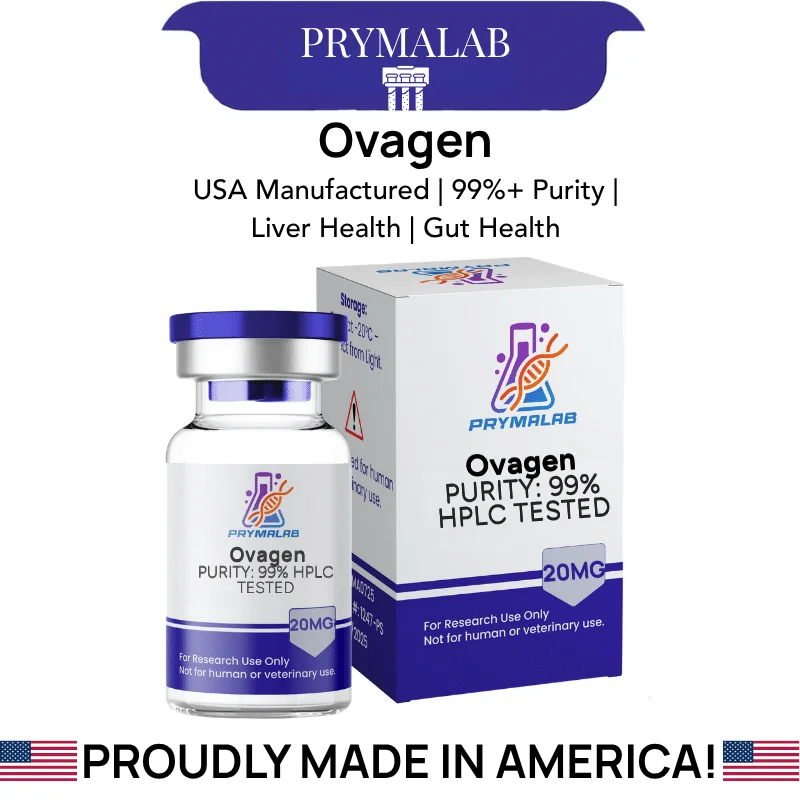
As a liver bioregulator, ovagen operates through the Khavinson epigenetic mechanism — direct interaction with paired DNA sequences in promoter regions of liver-specific and GI-specific genes. This transcription-level tuning differentiates bioregulator peptides from conventional hepatoprotective compounds that act through antioxidant scavenging or body pathway blocking. PrymaLab Ovagen 20mg is manufactured to high purity standards and supplied exclusively for qualified lab research.
Ovagen 20mg: Key Specifications
| Specification |
Detail |
| Compound |
Ovagen (tripeptide bioregulator) |
| Sequence |
Glu-Asp-Leu (EDL) |
| Quantity |
20mg |
| Target Tissue |
Liver (hepatocytes) and gut epithelium |
| Class |
Khavinson bioregulator peptide (short control peptide) |
| Purity |
≥98% (HPLC-verified per batch) |
| Testing |
HPLC, mass spectrometry, identity check |
| Form |
Freeze-dried powder |
| Storage |
Store at −20°C desiccated; protect from light |
| Intended Use |
Lab research only — not for human or veterinary treatment use |
How Ovagen Works: Bioregulator Mechanism of Action
Ovagen operates through the Khavinson model of peptide bioregulation, in which short peptides interact with specific DNA sequences in the promoter regions of target genes. For ovagen, these target gene clusters govern hepatocyte body function, Phase I and Phase II detoxification enzyme expression, bile acid homeostasis, and gut mucosal cell turnover and barrier integrity.
Hepatic Gene Expression Normalization
Research from the Khavinson group shows that ovagen selectively tunes liver-specific gene expression, including genes encoding cytochrome P450 enzymes (CYP family), glutathione S-transferases, and albumin synthesis pathways. In aged liver tissue models, ovagen use restored transcriptional profiles toward patterns characteristic of younger, metabolically active hepatocytes. This gene-level normalization mechanism distinguishes ovagen from conventional hepatoprotective compounds that mainly function as antioxidant scavengers (such as silymarin or N-acetylcysteine) without addressing the underlying transcriptional decline.
Gastrointestinal Mucosal Support
Beyond its hepatic effects, ovagen has been studied for tuning of GI mucosal barrier function. The gut epithelium undergoes continuous renewal and is highly dependent on coordinated gene expression programs governing cell proliferation, differentiation, and tight junction protein expression. Lab data from the St. Petersburg Institute shows that ovagen supports GI mucosal gene expression patterns linked with epithelial barrier integrity, mucin production, and swelling cytokine control in the gut epithelium.
Liver-Gut Axis Integration
Modern hepatology research recognizes the liver-gut axis as a key bidirectional communication pathway where gut barrier integrity directly affects hepatic swelling and liver function directly impacts gut health. Ovagen’s dual targeting of both hepatic and GI tissue positions it uniquely among the Khavinson bioregulator peptides for research into this integrated organ system, very in aging models where both hepatic detoxification capacity and GI barrier function decline simultaneously.
Ovagen Peptide Benefits: What Research Shows
The following reflects published lab and gerontological literature. PrymaLab Ovagen 20mg is supplied exclusively for research purposes.
Hepatic Detoxification and Metabolic Function
Published research from the Khavinson program reports that ovagen use in aged animal models was linked with improved hepatic body markers, including normalized cytochrome P450 enzyme activity, enhanced glutathione conjugation capacity, and improved albumin synthesis rates — all indicators of restored hepatocyte functional competence. These effects support the bioregulation hypothesis that short peptides can restore liver function that declines during natural aging.
Liver Tissue Repair and Anti-aging Effects
In gerontological models examining age-related hepatic decline, ovagen has been studied for its effects on hepatocyte proliferation capacity, liver tissue architecture maintenance, and resistance to oxidant stress-induced hepatocyte damage. Published data shows that bioregulator peptide treatment helped keep liver tissue function at ages where untreated controls showed major structural and functional decline.
Gastrointestinal Barrier and Gut Health
Lab studies have examined ovagen’s effects on gut epithelial barrier markers, including tight junction protein expression (occludin, claudins, ZO-1), goblet cell mucin production, and swelling cytokine profiles in gut tissue. Research shows improved GI barrier function parameters in ovagen-treated aged tissue models, supporting its use in research on age-related gut permeability and gut swelling.
Ovagen vs. Livagen: Liver Bioregulator Comparison
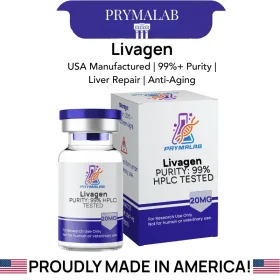
| Feature |
Ovagen (EDL) |
Livagen (Liver Bioregulator) |
| Sequence |
Glu-Asp-Leu |
Lys-Glu-Asp-Ala (KEDA) |
| Main Target |
Liver + gut epithelium |
Liver tissue mainly |
| Research Focus |
Hepatic function + GI barrier integrity (liver-gut axis) |
Hepatocyte gene expression, liver repair, chromatin remodeling |
| Scope |
Broader: dual liver + GI system support |
Focused: liver-specific gene control |
| Unique Feature |
Dual-organ bioregulator (liver-gut axis) |
Chromatin decondensation activity in hepatocytes |
| Combined Use |
Often studied with Livagen for full hepatic support |
Often studied with Ovagen for full hepatic support |
How to Store and Handle PrymaLab Ovagen 20mg
- Store freeze-dried at −20°C. Keep the sealed vial desiccated and protected from light. Stable for 24+ months under these conditions.
- Allow vial to reach room heat before opening to prevent condensation.
- Reconstitute with appropriate sterile solvent. Use sterile water or sterile saline added slowly along the vial wall.
- Use mixed solution within 2–4 weeks. Store at 2–8°C and mark mixing date.
- Avoid repeated freeze-thaw cycles. Aliquot into single-use portions if needed.
- Retain the Certificate of Test for lot traceability and research records.
Why Choose PrymaLab Ovagen 20mg?
PrymaLab supplies Ovagen 20mg as a high-purity research-grade bioregulator peptide verified at ≥98% purity by reverse-phase HPLC and identity-confirmed by mass spectrometry. Each batch ships with a unique lot number and Certificate of Test. Independent third-party analytical testing ensures unbiased results and full traceability for GLP-compliant research environments.
Frequently Asked Questions About Ovagen Peptide
What is ovagen peptide and what does it target?
Ovagen is a synthetic tripeptide bioregulator (Glu-Asp-Leu, EDL) developed by Professor Vladimir Khavinson that targets liver tissue (hepatocytes) and gut epithelium. It belongs to the Khavinson bioregulator peptide class and has been studied for its capacity to tune hepatic and GI gene expression patterns linked with detoxification capacity, body function, and mucosal barrier integrity in aging research models.
What are the reported ovagen peptide benefits?
Published research reports that ovagen peptide benefits include normalization of hepatic detoxification enzyme expression (cytochrome P450 family, glutathione S-transferases), improved albumin synthesis in aged liver models, restored gut barrier integrity markers, and tuning of swelling cytokines in gut tissue. All benefits are from lab and gerontological research settings.
How does ovagen differ from livagen?
Both target hepatic tissue, but ovagen (EDL) is a dual-organ bioregulator targeting both liver and gut epithelium, making it relevant to liver-gut axis research. Livagen (KEDA) is more mainly focused on liver tissue gene control and has showed unique chromatin decondensation activity in hepatocyte models. Researchers often study both peptides together for full hepatic support protocols.
How is ovagen stored and reconstituted?
Store freeze-dried ovagen at −20°C, desiccated and protected from light. After mixing with sterile solvent, store at 2–8°C and use within 2–4 weeks. Avoid repeated freeze-thaw cycles. The freeze-dried form is stable for 24+ months under proper storage conditions.
Is ovagen approved for human use?
No. PrymaLab Ovagen 20mg is a research compound intended exclusively for lab research. It has not been approved by the FDA or any control authority for human treatment use. Researchers are responsible for compliance with all applicable institutional and control requirements.
Research Disclaimer
For Research Use Only. PrymaLab Ovagen 20mg is intended exclusively for qualified lab research use by trained laboratory professionals. This product is not intended for human consumption, treatment use, veterinary treatment, or any use outside controlled research environments. Ovagen has not been approved by the FDA or any equivalent control authority for treatment use. All research uses described are drawn from published lab and gerontological literature. Researchers are solely responsible for control compliance.
Only logged in customers who have purchased this product may leave a review.








Reviews
There are no reviews yet.