
Description
PrymaLab · Research use only
MOTS-C 10MG
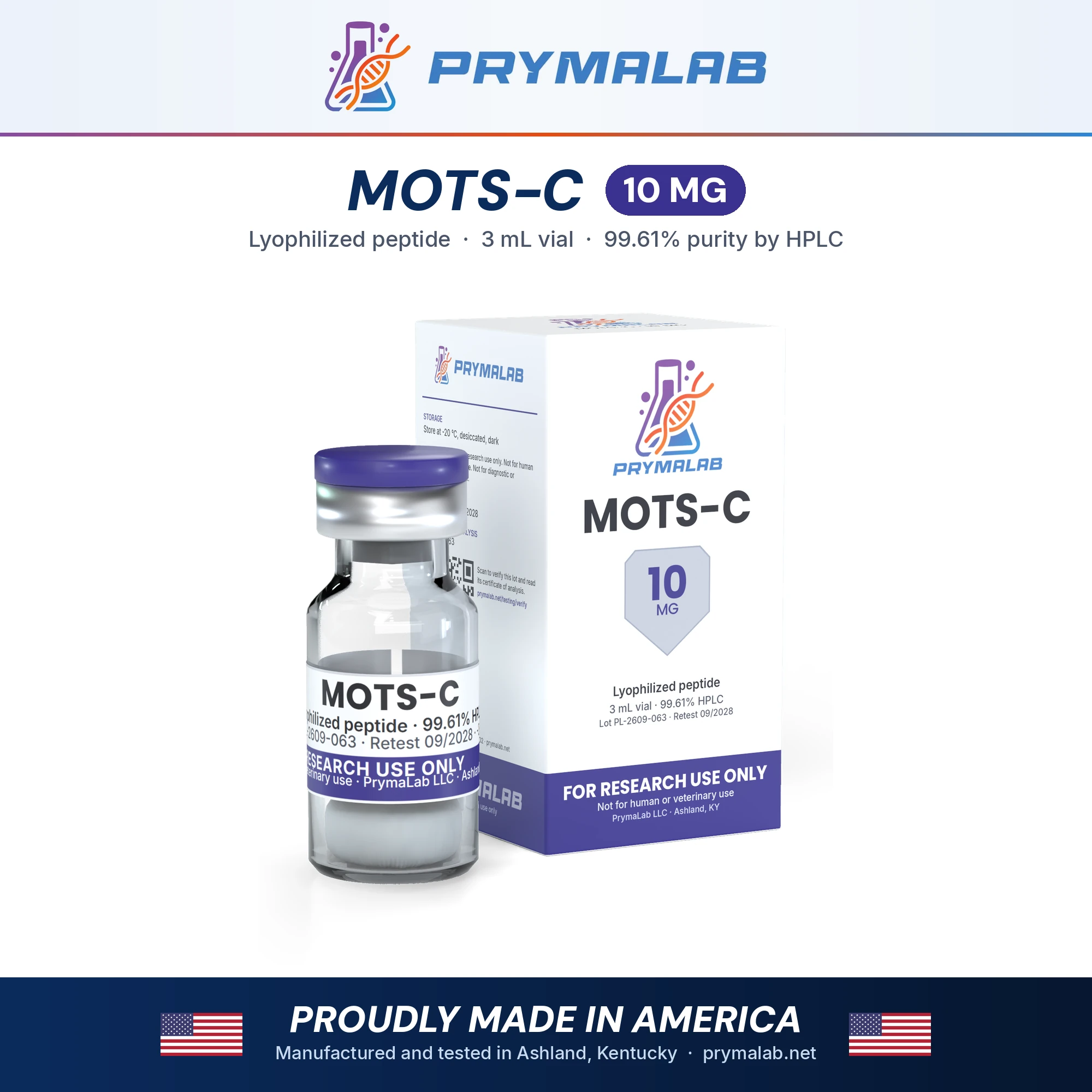
MOTS-c, the 16-residue peptide encoded in mitochondrial DNA, 10 mg freeze-dried
MOTS-c is a 16-residue peptide whose code sits in mitochondrial DNA, inside the gene for the 12S ribosomal RNA, rather than in the nucleus. This listing is the main MOTS-c vial: 10 mg of the synthetic peptide, sequence MRWQEMGYIFYPRKLR with free ends, as a white freeze-dried powder; a 40 mg vial and a preloaded pen are also sold. Research on MOTS-c covers its 2015 discovery, its action on the folate cycle and AMPK in cells, and metabolic and exercise studies in mice.
Specifications
| Property | Value |
|---|---|
| Compound | MOTS-c Mitochondrial open reading frame of the 12S rRNA type-c |
| CAS number | 1627580-64-6 |
| Molecular formula | C101H152N28O22S2 |
| Theoretical mass | 2174.6 Da |
| Sequence / structure | H-MRWQEMGYIFYPRKLR-OH (16 residues; free N- and C-termini) |
| Label claim | 10 mg/vial |
| Form | Lyophilized (freeze-dried) powder or cake in a sealed glass vial with a rubber stopper and aluminium crimp cap |
| Storage, sealed | −20 °C, desiccated, dark |
| Purity specification | 99.0% or higher by RP-HPLC |
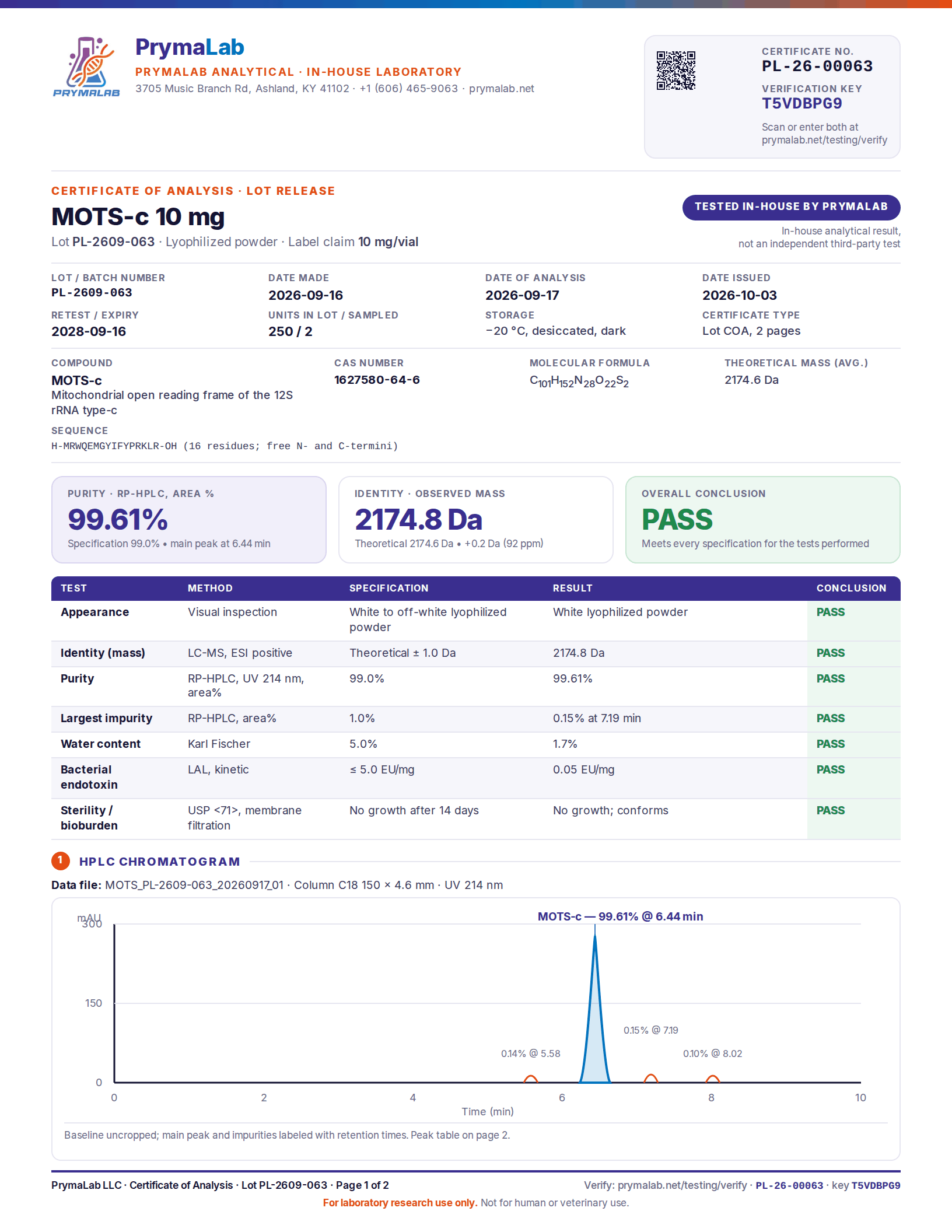
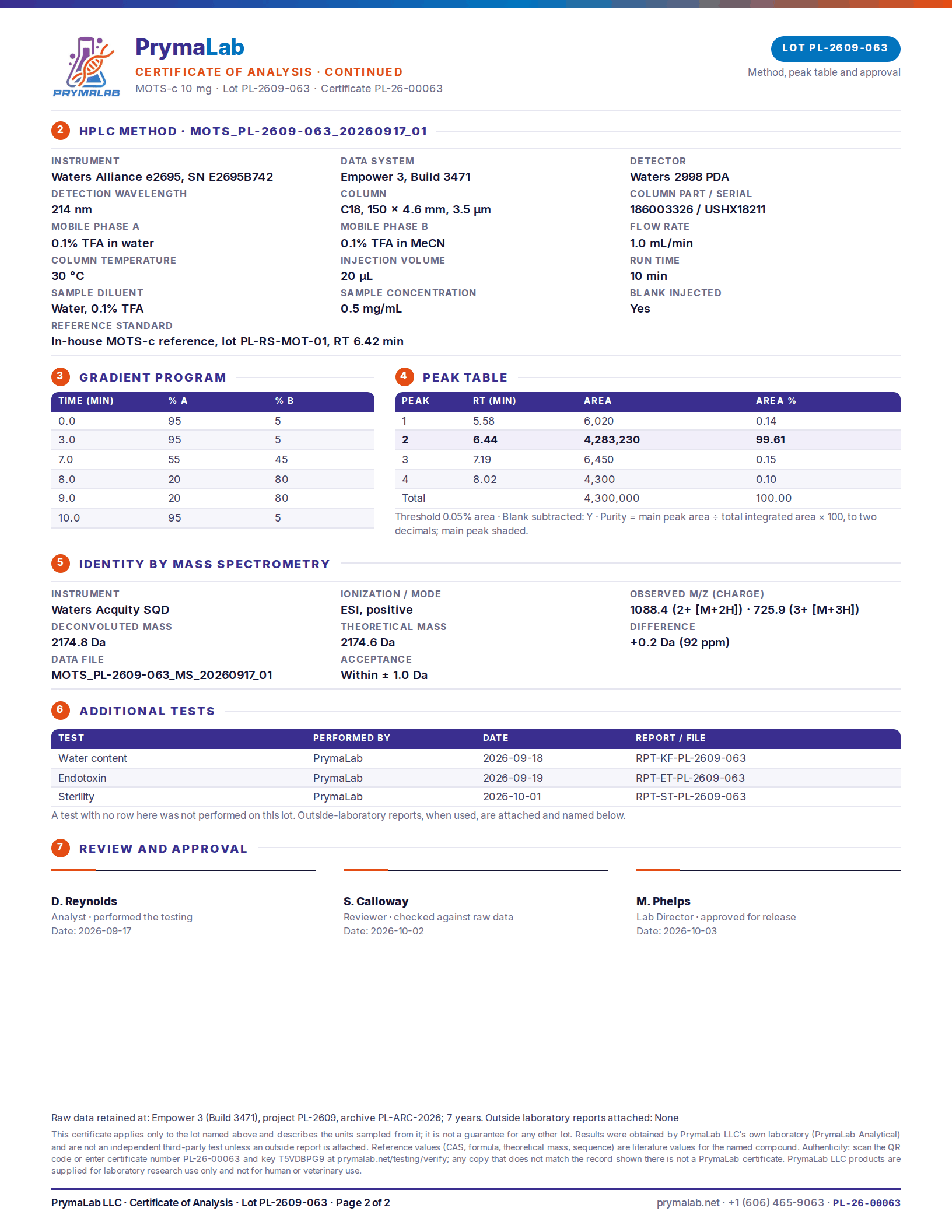
| Lot certificate | Results for the lot now shipping are in the certificate panel on this page |
| Safety data sheet | PL-SDS-112 |
Fills in this range
MOTS-c is sold in 2 fills. The compound and the testing are the same in every fill; only the amount in the vial changes.
| Fill | Listing |
|---|---|
| 10 mg | MOTS-C 10MG (this page) |
| 40 mg | MOTS-C 40MG |
What the vial contains
The certificate gives the sequence as H-MRWQEMGYIFYPRKLR-OH: sixteen residues, a free amine at the N-terminus and a free acid at the C-terminus, formula C101H152N28O22S2 and theoretical mass 2174.6 Da. The LC-MS identity result on the certificate is the figure to compare with that mass. Ten milligrams of a 2174.6 Da peptide is about 4.6 µmol, a little less once the residual water on the certificate is counted.
The sequence has methionines at positions 1 and 6, and each can oxidise to methionine sulfoxide, adding 16 Da. A peak at +16 or +32 Da beside the parent mass would therefore point to oxidised peptide. Storage at −20 °C, desiccated and dark, as the certificate specifies, slows that change, and so does limiting air exposure and repeated freeze-thaw cycles once the peptide is in solution. The same peptide is sold as a MOTS-c 40 mg vial and ready-dissolved in a MOTS-c preloaded pen.
What the research covers
A peptide read from mitochondrial DNA
Human mitochondrial DNA was long described as encoding 37 genes: 22 transfer RNAs, two ribosomal RNAs and 13 messenger RNAs1. Humanin, reported in 2001, showed that the same DNA could also carry short reading frames for signalling peptides1. In 2015 Lee, Cohen and colleagues reported a second one, a short open reading frame inside the 12S rRNA gene that encodes a 16-amino-acid peptide they named MOTS-c, for mitochondrial open reading frame of the 12S rRNA type-c2. A 2016 study then described six small humanin-like peptides encoded in the same 16S rRNA region as humanin3. Together these are known as mitochondrial-derived peptides, which Lee, Kim and Cohen described as mitochondrial-encoded signals acting on cells and on the whole organism1.
How it acts in cells
The 2015 paper named skeletal muscle as the apparent primary target organ and traced the cellular effect to the folate cycle: MOTS-c inhibited the folate cycle and the de novo purine synthesis tied to it, which led to activation of AMPK, the AMP-activated protein kinase2. Kim and colleagues added a second step in 2018. Under metabolic stress, including glucose restriction, MOTS-c moved into the nucleus in an AMPK-dependent way and regulated a broad set of nuclear genes, among them genes with antioxidant response elements4. There it interacted with stress-responsive transcription factors such as NRF24. The authors read this as a factor encoded in mitochondria regulating the nuclear genome, the reverse of the usual direction of control4.
Mouse studies
In mice, MOTS-c treatment prevented both age-dependent and high-fat-diet-induced insulin resistance, and prevented diet-induced obesity2. Reynolds and colleagues reported in 2021 that it improved physical performance in young, middle-aged and old mice, at 2, 12 and 22 months of age5. They found effects on nuclear genes linked to metabolism and proteostasis, on skeletal muscle metabolism and on how myoblasts adapt to metabolic stress5. Intermittent treatment started late in life, at 23.5 months, increased physical capacity and healthspan5. From these results the authors concluded that aging is regulated by genes in both the mitochondrial and the nuclear genome, which co-evolved5.
Human data and open questions
The human part of the 2021 paper was observational: exercise raised natural MOTS-c in skeletal muscle and in the circulation5. That shows the peptide’s own levels respond to exercise; it is not evidence about the synthetic peptide in people. None of the references reports a human trial of MOTS-c, and the trials that do exist, one of them using a modified analogue rather than MOTS-c itself, are discussed in the guide. Most of the primary work cited here comes from one research group, and none of the studies used PrymaLab material. The MOTS-c guide covers the full record, including a human genetic variant in the MOTS-c reading frame.
How each lot is tested
Every lot is tested in PrymaLab’s own laboratory in Ashland, Kentucky before release: RP-HPLC for purity, LC-MS for identity, Karl Fischer titration for water, LAL for endotoxin and USP <71> for sterility. The results for the lot now shipping are in the certificate panel on this page, and the certificate number, key and QR code can be checked on the verify page. These are in-house results from PrymaLab Analytical, not an independent test, and the lab is not accredited to ISO 17025. The third-party testing guarantee on this page still applies: if any independent laboratory finds the wrong compound, or less than the stated purity or amount, the order is refunded and the cost of the test is reimbursed.
Frequently asked questions
What is the sequence and mass of the peptide in this vial?
MRWQEMGYIFYPRKLR, sixteen residues with a free N-terminus and a free C-terminus, formula C101H152N28O22S2 and theoretical mass 2174.6 Da. The certificate for each lot reports an LC-MS mass to compare against that figure, along with HPLC purity.
How do the 10 mg and 40 mg vials differ?
Only in the amount of peptide. Both hold the same freeze-dried MOTS-c, and each fill is a separate lot with its own certificate. The 40 mg vial holds four times as much, so it suits work that needs a larger quantity of the same lot.
How do I find the certificate for the vial I received?
Read the lot number on the vial label and match it to the certificate panel on this page. Older lots are on the results page, and the verify page confirms a certificate from its number and key.
How should MOTS-c be stored?
Sealed at −20 °C, desiccated and away from light. Bring the vial to room temperature before opening. After reconstitution keep the solution at 2 to 8 °C, protected from light, and use it within a period your laboratory has established, since its two methionines can oxidise.
Has MOTS-c been shown to work in humans?
No. The cited studies are in cells and mice, and the only human data among them show that exercise raises natural MOTS-c levels in muscle and blood. No result from a trial of the peptide itself appears in these references.
Is MOTS-c for human use?
No. This vial is sold for laboratory research only. MOTS-c is not approved by the FDA or any other authority for human or veterinary use and must not be given to people or animals.
References
- Lee C, Kim KH, Cohen P. MOTS-c: A novel mitochondrial-derived peptide regulating muscle and fat metabolism. Free Radic Biol Med. 2016;100:182-187. DOI · PubMed
- Lee C, Zeng J, Drew BG, et al. The mitochondrial-derived peptide MOTS-c promotes metabolic homeostasis and reduces obesity and insulin resistance. Cell Metab. 2015;21(3):443-54. DOI · PubMed
- Cobb LJ, Lee C, Xiao J, et al. Naturally occurring mitochondrial-derived peptides are age-dependent regulators of apoptosis, insulin sensitivity, and inflammatory markers. Aging (Albany NY). 2016;8(4):796-809. DOI · PubMed
- Kim KH, Son JM, Benayoun BA, et al. The Mitochondrial-Encoded Peptide MOTS-c Translocates to the Nucleus to Regulate Nuclear Gene Expression in Response to Metabolic Stress. Cell Metab. 2018;28(3):516-524.e7. DOI · PubMed
- Reynolds JC, Lai RW, Woodhead JST, et al. MOTS-c is an exercise-induced mitochondrial-encoded regulator of age-dependent physical decline and muscle homeostasis. Nat Commun. 2021;12(1):470. DOI · PubMed
Research use only
For laboratory research use only. MOTS-C 10MG is not a drug, food, cosmetic or dietary supplement, is not approved by the FDA or any comparable authority for human or veterinary use, and must not be given to people or animals. It is sold to qualified researchers and institutions, and the buyer is responsible for lawful handling and disposal.








Reviews
There are no reviews yet.