
Description
PrymaLab · Research use only
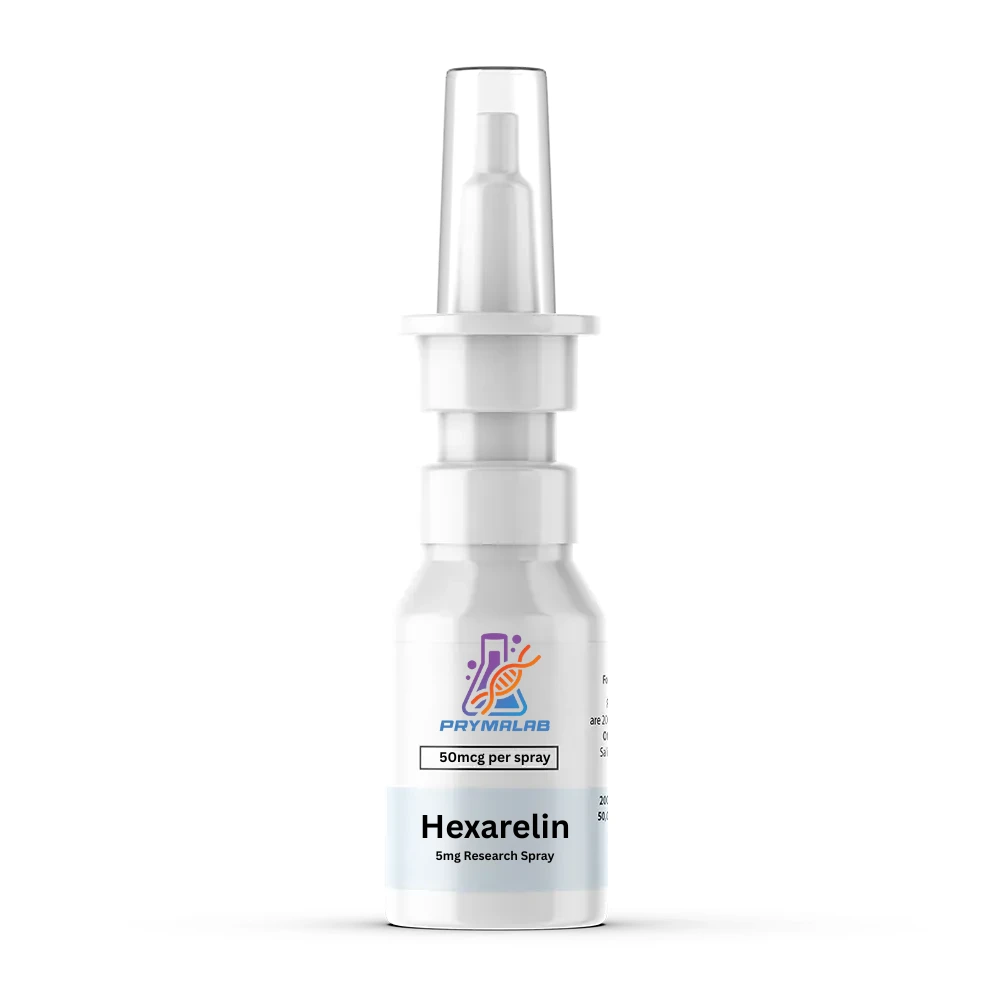
Hexarelin 5mg Nasal Spray
Hexarelin, 5 mg in bacteriostatic water, in a nasal spray bottle
Hexarelin, or examorelin, is a synthetic hexapeptide that releases growth hormone through the ghrelin receptor and also binds the scavenger receptor CD36. This listing is 5 mg of hexarelin in bacteriostatic water, supplied as a sterile solution in a nasal spray bottle. Its research record covers growth hormone release in healthy men and CD36 binding in heart tissue; nothing cited here tested a nasal route.
Specifications
| Property | Value |
|---|---|
| Compound | Hexarelin Examorelin; growth hormone-releasing hexapeptide |
| CAS number | 140703-51-1 |
| Molecular formula | C47H58N12O6 |
| Theoretical mass | 887.1 Da |
| Sequence / structure | H-H-[D-2-MeTrp]-A-W-[D-Phe]-K-NH₂ (6 residues; C-terminal amide) |
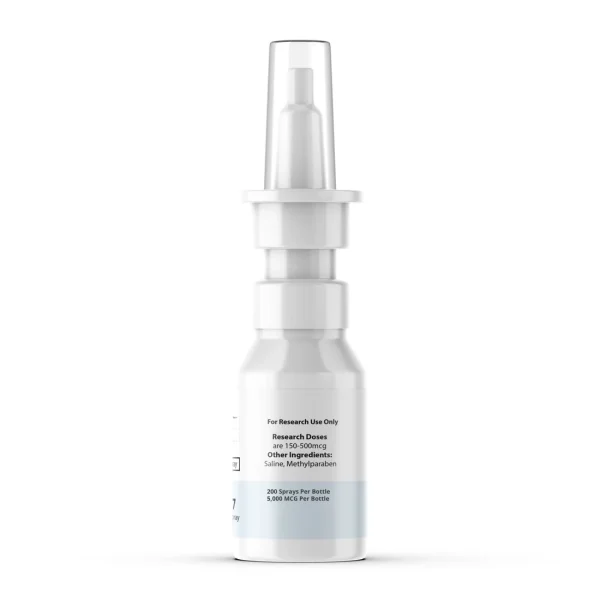
| Contents | Hexarelin: 5 mg per bottle (≤ 0.05% w/v) |
| Form | Sterile aqueous solution in bacteriostatic water (0.9% benzyl alcohol), supplied in a metered nasal spray bottle |
| Storage, sealed | Store at 2–8 °C, protected from light; do not freeze |
| Safety data sheet | PL-SDS-079 |
What is in the bottle
According to the safety data sheet, each bottle contains 5 mg of hexarelin at no more than 0.05% w/v, dissolved in bacteriostatic water: sterile water with 0.9% w/v benzyl alcohol as the preservative. Hexarelin is not classified as hazardous. Benzyl alcohol is listed as harmful if swallowed or inhaled, as a serious eye irritant and as a possible cause of allergic skin reactions. Keep the bottle capped and upright at 2 to 8 °C, out of the light, and do not freeze it. For other concentrations, the hexarelin 2 mg vial supplies dry peptide to dissolve at the strength a study needs.
What the research covers
In the one human study cited here, a placebo-controlled trial in 12 healthy men, hexarelin raised plasma growth hormone in step with the amount used, with peaks around 30 minutes and a return to baseline within 240 minutes1. Responses at the top two levels were similar, which points to a ceiling1.
Outside the pituitary, hexarelin binds CD36. Bodart and colleagues found it on rat heart membranes, where CD36 sits on cardiomyocytes and microvascular endothelial cells, and showed that hexarelin raised coronary perfusion pressure in isolated hearts only when CD36 was present2. In any tissue that expresses CD36, then, a hexarelin effect cannot be put down to the growth hormone receptor without suitable controls.
For a ready-made solution, stability is the open question. Formulation reviews deal with chemical and physical instability in aqueous solution as problems in their own right, separate from those of the dried state3, and none of the abstracts here measured how long hexarelin stays intact in water. None studied nasal delivery either. The CJC-1295 and hexarelin guide and the hexarelin 2 mg vial page cover the wider literature.
How each lot is tested
Every lot is tested in PrymaLab’s own laboratory in Ashland, Kentucky before release: RP-HPLC for purity, LC-MS for identity, Karl Fischer titration for water, LAL for endotoxin and USP <71> for sterility. Published certificates are listed on the results page and can be checked by number and key on the verify page. The certificate covers the peptide lot used to fill the bottle, not the finished solution. These are in-house results from PrymaLab Analytical, not an independent test, and the lab is not accredited to ISO 17025. The third-party testing guarantee on this page still applies: if any independent laboratory finds the wrong compound, or less than the stated purity or amount, the order is refunded and the cost of the test is reimbursed.
Frequently asked questions
How much hexarelin is in the bottle?
5 mg, per the safety data sheet, at a concentration of 0.05% w/v or less. The vials hold 2 mg or 5 mg of dry peptide for work that needs a concentration chosen in the laboratory.
Is the spray the same hexarelin as the vials?
Yes: the same six-residue peptide with D-2-methyltryptophan at position 2 and a theoretical mass of 887.1 Da. The vials are freeze-dried and stored at −20 °C; the spray is already in solution and is kept at 2 to 8 °C, never frozen.
Has hexarelin been tested as a nasal spray?
Not in any study cited on this page. The human data come from a growth hormone study using a different route, and the CD36 work used isolated hearts and membranes, so there are no nasal findings to report for this format.
Is the spray for use in people?
No. It is sold only for laboratory research and is not approved for human or veterinary use by the FDA or any comparable authority. It must not be given to people or animals.
References
- Imbimbo BP, Mant T, Edwards M, et al. Growth hormone-releasing activity of hexarelin in humans. A dose-response study. Eur J Clin Pharmacol. 1994;46(5):421-5. DOI · PubMed
- Bodart V, Febbraio M, Demers A, et al. CD36 mediates the cardiovascular action of growth hormone-releasing peptides in the heart. Circ Res. 2002;90(8):844-9. DOI · PubMed
- Manning MC, Chou DK, Murphy BM, et al. Stability of protein pharmaceuticals: an update. Pharm Res. 2010;27(4):544-75. DOI · PubMed
Research use only
For laboratory research use only. Hexarelin 5mg Nasal Spray is not a drug, food, cosmetic or dietary supplement, is not approved by the FDA or any comparable authority for human or veterinary use, and must not be given to people or animals. It is sold to qualified researchers and institutions, and the buyer is responsible for lawful handling and disposal.
Other formats of Hexarelin
Hexarelin is also stocked as Hexarelin 5mg. Each listing states its own quantity and concentration, and the pen and vial comparison explains what changes between formats.







1 review for Hexarelin 5mg Nasal Spray