Description
PrymaLab · Research use only
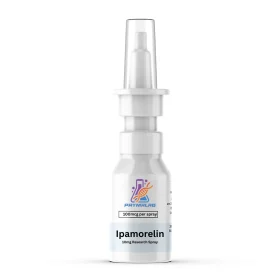
GHRP-2 Nasal Spray
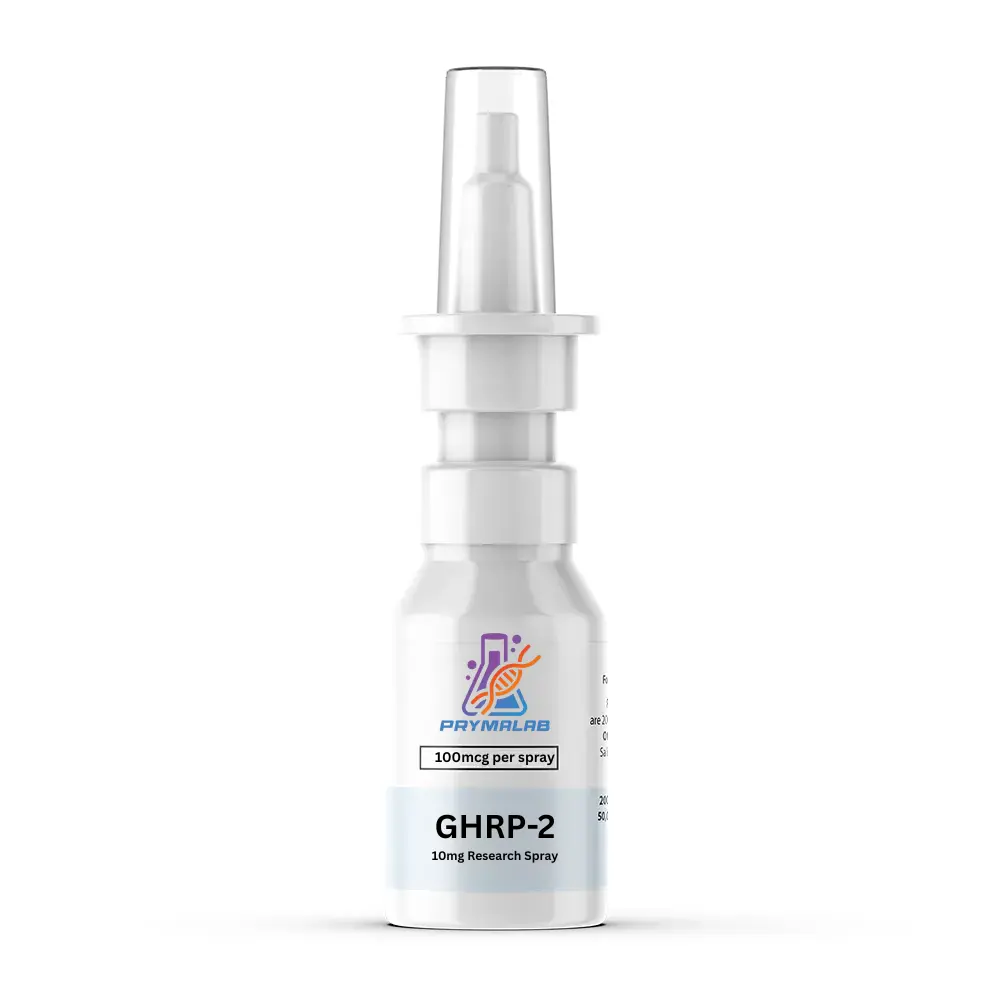
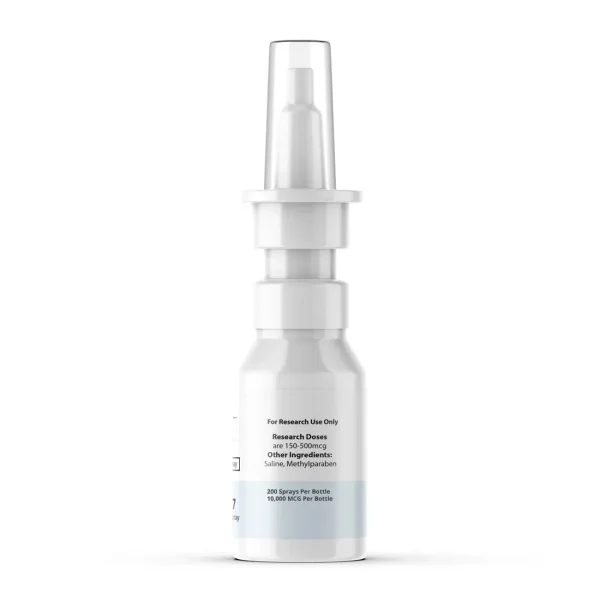
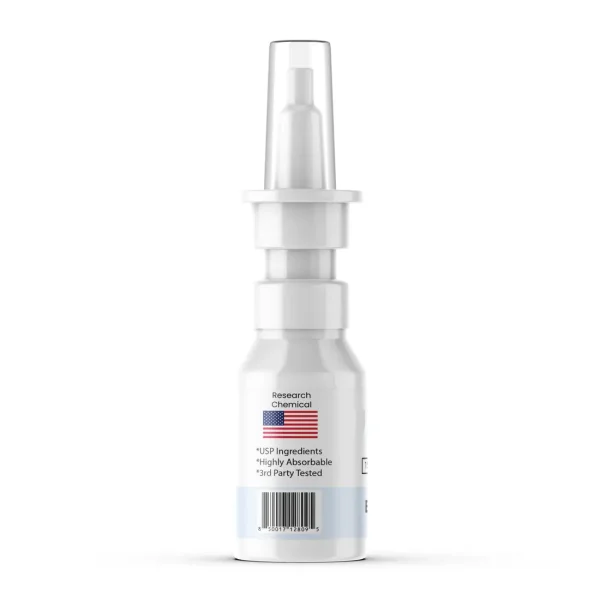
GHRP-2 (pralmorelin) as a sterile solution in bacteriostatic water, in a spray bottle
GHRP-2, or pralmorelin, is a six-residue synthetic peptide that releases growth hormone by binding the ghrelin receptor. Here it is supplied as a sterile solution in bacteriostatic water in a nasal spray bottle, with the peptide amount and concentration given on the label. Research on GHRP-2 has measured growth hormone release, pituitary reserve testing and food intake in human studies, but none of the cited work tested a nasal route.
Specifications
| Property | Value |
|---|---|
| Compound | GHRP-2 Pralmorelin; KP-102; growth hormone-releasing hexapeptide |
| CAS number | 158861-67-7 |
| Molecular formula | C45H55N9O6 |
| Theoretical mass | 818.0 Da |
| Sequence / structure | H-[D-Ala]-[D-2-Nal]-A-W-[D-Phe]-K-NH₂ (6 residues; C-terminal amide) |
| Form | Sterile aqueous solution in bacteriostatic water (0.9% benzyl alcohol), supplied in a metered nasal spray bottle |
| Storage, sealed | Store at 2–8 °C, protected from light; do not freeze |
| Safety data sheet | PL-SDS-063 |
What is in the bottle
The safety data sheet lists GHRP-2 at the labelled concentration (under 10% w/v) in bacteriostatic water, which is sterile water with 0.9% w/v benzyl alcohol as an antimicrobial preservative. The peptide is not classified as hazardous. Benzyl alcohol carries hazard statements for harm if swallowed or inhaled, serious eye irritation and possible skin sensitisation. The GHRP-2 in the bottle has the same sequence as the vials, H-D-Ala-D-2-Nal-Ala-Trp-D-Phe-Lys-NH2.
Keep the bottle upright and capped at 2 to 8 °C, out of the light, and do not freeze it. The peptide storage and stability article covers the general principles for peptide solutions.
What the research covers
The receptor GHRP-2 acts on was known only through synthetic compounds until 1999, when Kojima and colleagues purified its natural ligand from rat stomach and named it ghrelin: a 28-residue peptide whose activity depends on an n-octanoyl group attached to serine 31. Its discovery indicated that growth hormone release may be regulated by a signal from the stomach as well as by hypothalamic GHRH1. GHRP-2 had been made years earlier and is described as a ghrelin mimetic2.
Two lines of human work stand out. As a diagnostic agent, pralmorelin produced a large growth hormone rise in healthy subjects and a much smaller one in growth hormone deficiency2. Like ghrelin, it also acts on eating: seven lean men ate 35.9% more at a buffet meal with GHRP-2 than with saline, while their growth hormone rose as expected3. In growth hormone research that appetite effect is a variable to control for.
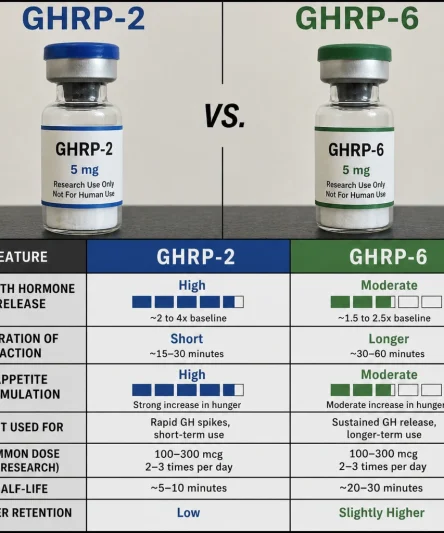
No paper cited here studied GHRP-2 given through the nose, so nothing on this page shows how much of an 818 Da peptide crosses the nasal lining. The GHRP-2 10 mg vial page and the GHRP-2 vs GHRP-6 guide cover the wider literature.
How each lot is tested
Every lot is tested in PrymaLab’s own laboratory in Ashland, Kentucky before release: RP-HPLC for purity, LC-MS for identity, Karl Fischer titration for water, LAL for endotoxin and USP <71> for sterility. Published certificates are listed on the results page and can be checked by number and key on the verify page. The certificate covers the peptide lot used to fill the bottle, not the finished solution. These are in-house results from PrymaLab Analytical, not an independent test, and the lab is not accredited to ISO 17025. The third-party testing guarantee on this page still applies: if any independent laboratory finds the wrong compound, or less than the stated purity or amount, the order is refunded and the cost of the test is reimbursed.
Frequently asked questions
How much GHRP-2 is in the bottle?
The bottle label states the amount and concentration, and the safety data sheet gives the peptide as under 10% w/v. If a study needs a concentration of your own choosing, the 5 mg and 10 mg vials hold a stated mass of freeze-dried GHRP-2 that can be dissolved in any volume.
Is the spray the same GHRP-2 as the vials?
Yes, the same six-residue sequence with the C-terminal amide and a theoretical mass of 818.0 Da. The vials are dry powder stored frozen. The spray is a ready-made solution in bacteriostatic water that is kept at 2 to 8 °C and never frozen.
Has GHRP-2 been studied as a nasal spray?
Not in any paper cited on this page. The human studies here measured growth hormone, plasma levels and food intake using other routes, so there are no published nasal findings for this format to point to.
Is the spray for human use?
No. It is a laboratory research product, not approved by the FDA or any other authority for human or veterinary use, and it must not be given to people or animals.
References
- Kojima M, Hosoda H, Date Y, et al. Ghrelin is a growth-hormone-releasing acylated peptide from stomach. Nature. 1999;402(6762):656-60. DOI · PubMed
- . Pralmorelin: GHRP 2, GPA 748, growth hormone-releasing peptide 2, KP-102 D, KP-102 LN, KP-102D, KP-102LN. Drugs R D. 2004;5(4):236-9. DOI · PubMed
- Laferrère B, Abraham C, Russell CD, et al. Growth hormone releasing peptide-2 (GHRP-2), like ghrelin, increases food intake in healthy men. J Clin Endocrinol Metab. 2005;90(2):611-4. DOI · PubMed
Research use only
For laboratory research use only. GHRP-2 Nasal Spray is not a drug, food, cosmetic or dietary supplement, is not approved by the FDA or any comparable authority for human or veterinary use, and must not be given to people or animals. It is sold to qualified researchers and institutions, and the buyer is responsible for lawful handling and disposal.
Other formats of GHRP-2
GHRP-2 is also stocked as GHRP-2 5mg and GHRP-2 10mg preloaded 3ml pen. Each listing states its own quantity and concentration, and the pen and vial comparison explains what changes between formats.







Reviews
There are no reviews yet.