
Description
PrymaLab · Research Use Only
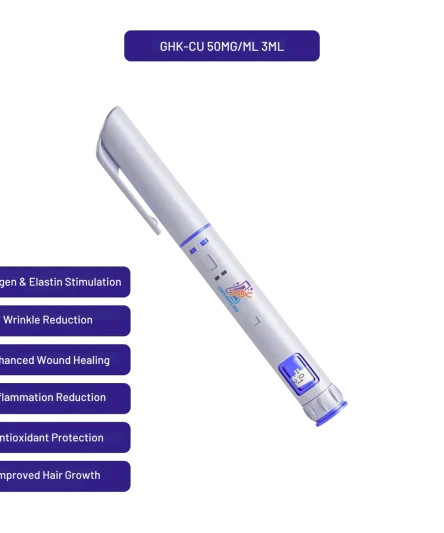
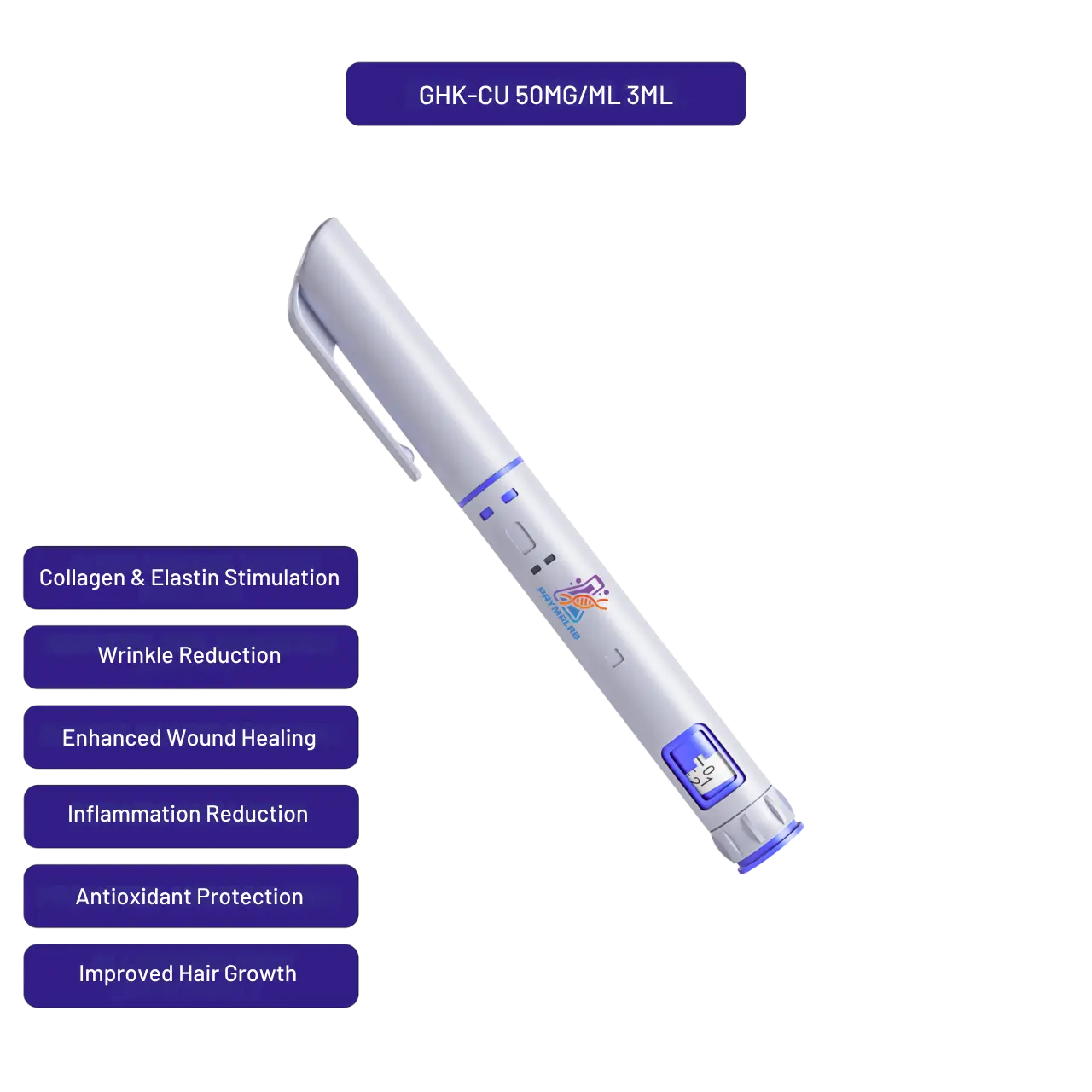
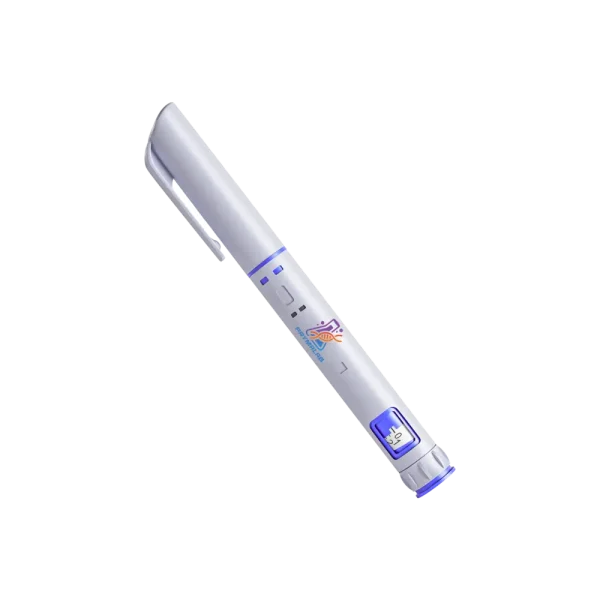
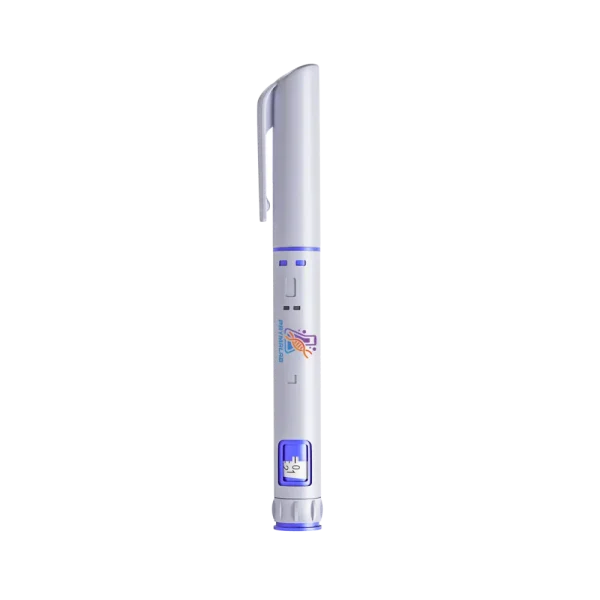
Preloaded Autoinjector | GHK-CU | 3ml Pen | 50mg/ml
Copper tripeptide in solution · 3ml at 50mg/ml · No reconstitution step
The GHK-Cu autoinjector is a preloaded 3ml research device containing glycyl-L-histidyl-L-lysine copper(II) in solution at 50mg/ml, giving 150mg of total peptide. Supplying a photosensitive copper complex as a ready-made solution removes the reconstitution step and introduces a different set of handling considerations.
Specification Table
| Property | Value |
|---|---|
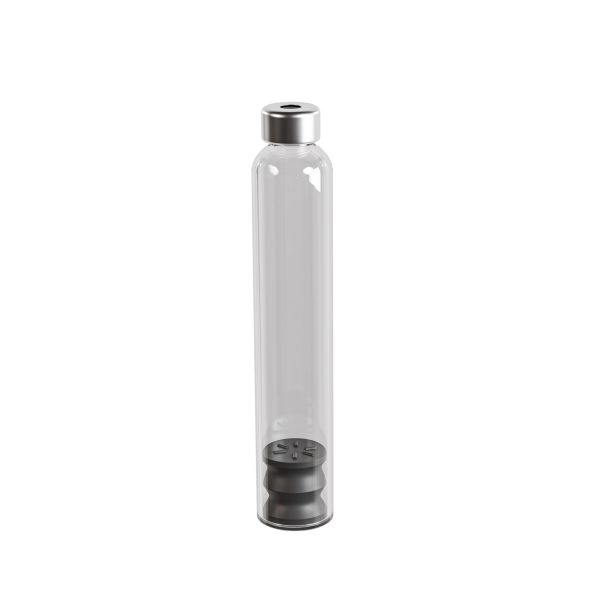
| Device format | Preloaded autoinjector pen, glass cartridge |
| Fill volume | 3 ml |
| Concentration | 50 mg/ml |
| Total compound in device | 150 mg |
| Molar concentration | Approximately 124 mM |
| Compound | GHK-Cu, glycyl-L-histidyl-L-lysine copper(II) complex |
| CAS number | 89030-95-5 |
| Molecular formula | C14H22CuN6O4 |
| Molecular weight | 401.91 g/mol |
| Amino acid sequence | Gly-His-Lys |
| Solution appearance | Clear blue to blue-violet |
| Reconstitution required | None. Supplied as solution |
| Excipient system | Not published on the product record. Confirm against certificate of analysis |
| Solution pH | Not published on the product record |
| Storage | 2-8°C, protected from light |
| Photosensitivity | High. Copper(II) complexes degrade under illumination |
| Solution stability | Not established over device shelf life in published data |
| Buffer incompatibility | EDTA and other chelators strip copper(II) from the complex |
| Purity | Per lot-specific certificate of analysis |
| Regulatory status | No approved human or veterinary formulation in any jurisdiction |
What Changes When a Copper Complex Ships in Solution?
Lyophilization exists because dry material is chemically quiet. Water is largely absent, molecular mobility is low, and degradation slows to a crawl. Putting a compound into solution reverses all three conditions.
For a copper(II) complex this matters more than for a plain peptide. Copper is redox-active. In aqueous solution and under illumination it can shift between oxidation states and generate reactive oxygen species, and those species attack whatever is nearby, including the peptide holding the copper. A lyophilized cake in a sealed vial in a freezer is largely protected from this. A solution in a glass cartridge is not.
The coordination equilibrium is also live in solution in a way it is not in a dry cake. Copper binding is thermodynamically favourable but reversible, and the position of that equilibrium depends on pH and on what else is present. A shift in pH over shelf life shifts the proportion of intact complex.
None of this says the product is unstable. It says the stability question is real and is not answered by the stability behaviour of the lyophilized form.
Why Light Protection Is Not a Formality Here
Most peptide storage guidance mentions protecting from light as a general precaution. For this compound the instruction has a specific mechanism behind it, and the consequence of ignoring it is measurable rather than theoretical.
Copper(II) complexes absorb in the visible region, which is why the solution is blue. Absorbed energy can drive photoreduction of copper(II) to copper(I), and copper(I) in the presence of dissolved oxygen participates in Fenton-type chemistry producing hydroxyl radicals. Those radicals are indiscriminate.
The practical consequence is that a device left on a bench under fluorescent lighting is not simply warming up. It is being illuminated at wavelengths the compound absorbs. Keep the device in its packaging between uses, work under reduced lighting where the procedure allows, and treat cumulative light exposure as something worth recording rather than ignoring.
Colour change is the visible endpoint of this process. A device whose contents have shifted away from clear blue-violet has undergone chemistry that nobody has characterised.
What Does the GHK-Cu Autoinjector Format Suit?
Search demand for this page is device-led rather than compound-led, which is a signal about who arrives here and what they are comparing.
The format suits work needing repeated equivalent draws from one lot, where the alternative is repeatedly reconstituting vials and accepting the variability that introduces. Reconstitution error is real and invisible: diluent volume measurement, incomplete dissolution, shear from over-agitation, adsorptive loss during transfer. A preloaded device eliminates all of them and replaces them with a single fixed concentration determined at manufacture.
It suits work at higher concentrations less well than the low picomolar range reported in the fibroblast literature. At 50 mg/ml the solution is approximately 124 millimolar. Reaching 1 nanomolar from there requires the same 124-million-fold serial dilution as the 50mg vial reconstituted into 1 ml, so the device offers no advantage for that particular arithmetic.
Where it does help is consistency across sessions. Every draw comes from the same solution prepared once under controlled conditions, which removes preparation as a between-experiment variable.
What the Product Record Does Not State
Three things are absent from the available product record, and all three affect experimental use.
The excipient system is unpublished. Whatever buffers, tonicity agents or preservatives are present will enter any assay the solution is added to, and some of them interact with copper. A phosphate-buffered formulation behaves differently from an acetate-buffered one where a copper complex is concerned.
Solution pH is unpublished. Copper coordination to GHK is pH-dependent, and the proportion of intact complex at pH 5 differs from the proportion at pH 7.4. Without knowing the formulation pH, the fraction of material actually present as the complex is unknown.
Solution stability over shelf life is unpublished. Given the photochemistry described above, this is the value most worth having and the one hardest to infer from anything else.
None of these gaps is unusual for a research-format product. All three are worth requesting from the certificate of analysis before quantitative work rather than after an unexplained finding.
Verifying the Device Before Use
Inspect the solution against a white background before each draw. It should be clear and blue to blue-violet with no particulate. Colour that has faded toward colourless indicates copper loss. Colour shifted toward green or brown indicates something else, and neither has been characterised for this formulation.
Allow the device to reach ambient temperature before actuating. Cold solutions are more viscous and viscosity affects delivery volume in a spring-driven mechanism, which is a routine and frequently overlooked source of error with pen devices.
Gravimetric verification is worth running once per device rather than trusting nominal volume. Actuate onto a tared vessel, record the mass, convert using solution density. Repeat across several actuations to capture both accuracy and precision, and treat the first actuation after a rest period as suspect until data shows otherwise.
What Would Confirm the Device Contents Are Intact?
The GHK-Cu autoinjector gives no opportunity to inspect a dry cake before use, so verification has to work from the solution itself.
Visible absorbance is the most accessible measurement. Drawing a small volume and running a spectrum between roughly 500 and 700 nanometres should show the characteristic copper(II) d-d band. Position and intensity both matter. A band that has shifted indicates altered coordination geometry, and one that has weakened indicates loss of complexed copper.
Comparison against a freshly prepared reference gives the measurement meaning. Reconstituting a small quantity from a lyophilized vial of the same compound provides a same-day comparator, which is more informative than comparing against a literature value obtained under unknown buffer conditions.
For quantitative work, atomic absorption or inductively coupled plasma measurement of total copper answers a different and equally useful question: how much copper is present regardless of what it is bound to. Pairing that with peptide quantification by chromatography establishes stoichiometry in the actual device solution rather than at manufacture.
None of this is routine for most purchases. All of it becomes worth doing when a device has been in use for several weeks and an experiment depends on knowing what is still in it.
Handling the Device in Laboratory Practice
Store the GHK-Cu autoinjector at 2-8°C in the dark, and treat the GHK-Cu autoinjector as light-sensitive throughout. Return the device to its packaging between sessions rather than leaving it out, since cumulative light exposure is the specific risk for this compound.
Record device lot number, date of first actuation, storage conditions, and volume drawn at each session. For a device used across weeks, the interval between first use and each subsequent draw is an experimental variable, particularly given the unpublished solution stability.
Where the solution enters a buffered system downstream, check that buffer for chelating agents before use. EDTA will strip copper from the complex regardless of how well the device itself has been handled, and the failure will look like an inactive compound rather than a buffer problem.
Published Literature
Traced to publisher records or primary indexes. Every entry concerns the compound rather than this delivery format, for which nothing has been published.
- Maquart FX, Pickart L, Laurent M, Gillery P, Monboisse JC, Borel JP. FEBS Letters. 1988;238(2):343-346. DOI: 10.1016/0014-5793(88)80509-X
- Pickart L, Margolina A. International Journal of Molecular Sciences. 2018;19(7):1987. PMID: 29986520
- Pickart L, Vasquez-Soltero JM, Margolina A. BioMed Research International. 2015;2015:648108.
- Pickart L, Thaler MM. Nature New Biology. 1973;243(124):85-87.
- Simรฉon A, Emonard H, Hornebeck W, Maquart FX. Life Sciences. 2000;67(18):2257-2265.
Frequently Asked Questions
What is the GHK-Cu autoinjector?
A preloaded 3ml research device containing glycyl-L-histidyl-L-lysine copper(II) in solution at 50mg/ml, giving 150mg total. No reconstitution step is required. Supplied strictly for laboratory research. No approved human or veterinary formulation exists anywhere.
Why does a copper complex in solution need extra care?
Copper is redox-active. In aqueous solution under illumination it can shift between oxidation states and generate reactive oxygen species that attack nearby molecules, including the peptide holding the copper. A lyophilized cake in a freezer is largely protected from this chemistry. A solution in a glass cartridge is not.
How light-sensitive is this product really?
Materially so, with a specific mechanism. Copper(II) complexes absorb visible light, which is why the solution is blue. Absorbed energy can photoreduce copper(II) to copper(I), which in the presence of dissolved oxygen drives Fenton-type chemistry producing hydroxyl radicals. Bench lighting is not neutral exposure here.
What concentration does the device deliver?
Fifty milligrams per millilitre, which is approximately 124 millimolar. Reaching the picomolar range reported in the fibroblast literature requires roughly a 124-million-fold serial dilution, the same arithmetic as a 50mg vial reconstituted into 1 ml. The device offers no dilution advantage for that work.
What is not stated on the product record?
Three things that affect experimental use: the excipient system, the solution pH, and solution stability over shelf life. Copper coordination is pH-dependent, so without the formulation pH the fraction of material present as intact complex is unknown. Request all three from the certificate of analysis.
When is a pen better than a vial?
When the work needs repeated equivalent draws from one lot and the alternative is reconstituting vials repeatedly. Reconstitution introduces invisible variability through diluent measurement, incomplete dissolution, shear and adsorptive loss. A device removes all of it and fixes concentration at manufacture instead.
What should be inspected before each draw?
The solution against a white background. It should be clear and blue to blue-violet with no particulate. Fading toward colourless indicates copper loss from the complex. A shift toward green or brown indicates different chemistry, and neither has been characterised for this formulation.
Why let the device warm before use?
Cold solutions are more viscous, and viscosity affects delivered volume in a spring-driven mechanism. A device actuated straight from refrigeration is a predictable source of volume error. Allowing it to equilibrate costs nothing and removes the variable.
Should delivered volume be verified?
Once per device, gravimetrically. Actuate onto a tared vessel, record delivered mass, convert using solution density, and repeat across several actuations to capture accuracy and precision. Treat the first actuation after a rest period as suspect until gravimetric data establishes otherwise.
Does buffer choice still matter with a preloaded device?
Yes, downstream. EDTA and other chelating agents in any buffer the solution enters will strip copper from the complex regardless of how well the device was handled. The failure presents as an inactive compound rather than a buffer problem, which makes it easy to misdiagnose.
How can device contents be verified without a dry cake to inspect?
Through the solution itself. Draw a small volume and run a visible spectrum between roughly 500 and 700 nanometres, where the copper(II) d-d band appears. A shifted band indicates altered coordination geometry and a weakened one indicates loss of complexed copper.
What makes a good comparator for that measurement?
A freshly reconstituted sample of the same compound from a lyophilized vial, measured the same day. That is more informative than comparing against a literature value obtained under unknown buffer conditions, since the absorbance band position depends on the local chemical environment.
Is elemental analysis worth running on a device?
It becomes worth it once a device has been in use for several weeks and an experiment depends on knowing what remains. Total copper by atomic absorption paired with peptide quantification by chromatography establishes stoichiometry in the actual solution rather than at manufacture.
Compliance Statement
The GHK-Cu autoinjector is sold exclusively for laboratory research use. It is not a drug, food, or cosmetic product, and it is not a dietary product of any kind. It is not approved by the FDA or any comparable authority for human or veterinary use. This product is not intended to diagnose, treat, cure, or prevent any disease. It must not be given to humans or animals. Purchase is restricted to qualified researchers and institutions operating within applicable laws. All handling is the responsibility of the purchasing laboratory.


15 reviews for Preloaded Autoinjector | GHK-CU | 3ml Pen | 50mg/ml