15% SUMMER DISCOUNT APPLIED AUTOMATICALLY AT CHECKOUT FREE USA SHIPPING OVER $100  FREE WORLDWIDE SHIPPING OVER $200

15% SUMMER DISCOUNT APPLIED AUTOMATICALLY FREE USA SHIPPING OVER $100  FREE WORLDWIDE SHIPPING OVER $200

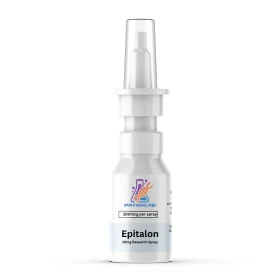
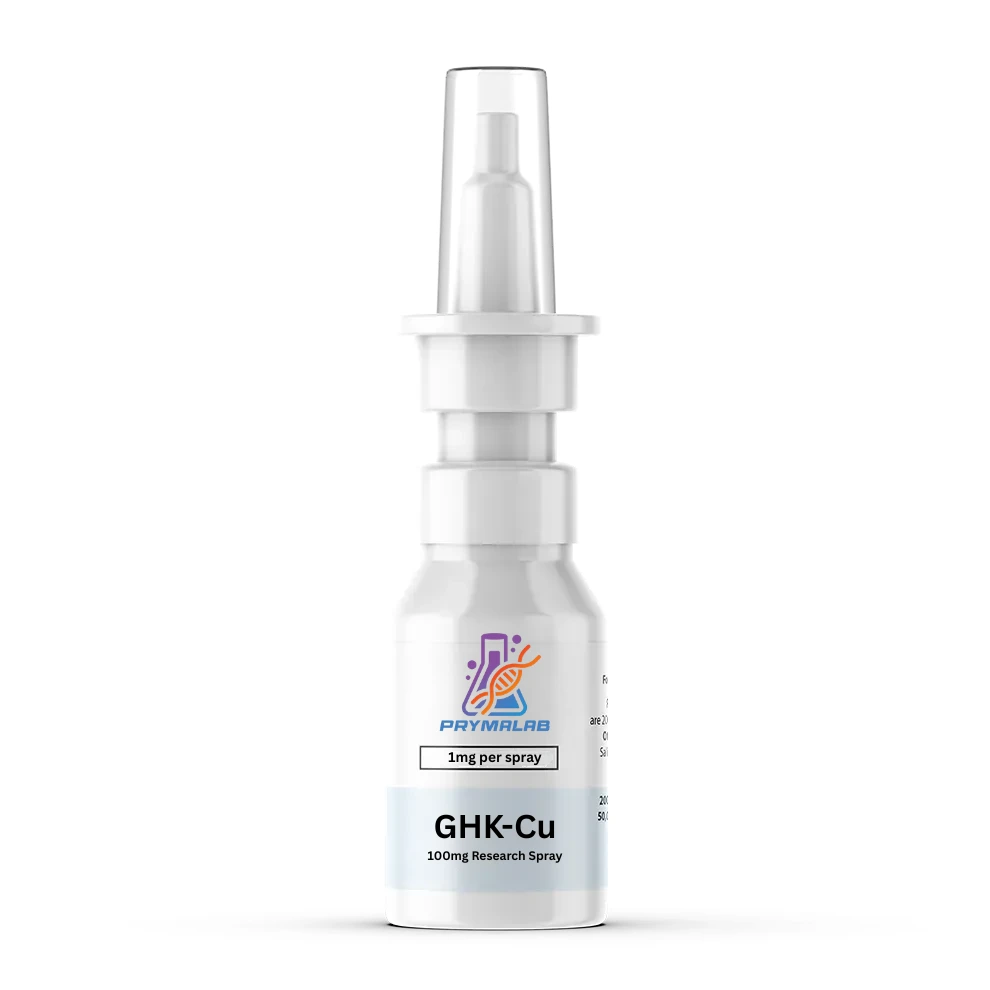
GHK-Cu Nasal Spray

(11 customer reviews)

$59.99 or subscribe for $49.99/mo

GHK-Cu nasal spray supplies the copper(II) complex of glycyl-L-histidyl-L-lysine, bound 1:1 (CAS 89030-95-5, about 403.9 Da; free peptide CAS 49557-75-7, 340.38 Da). Copper is held by the histidine imidazole, the glycine amino group and a deprotonated amide nitrogen. Characterized by reversed-phase HPLC for purity and mass spectrometry for identity, with independent third-party testing. In-vitro laboratory research only. Not for human use.

Description

This GHK-Cu nasal spray supplies the most studied copper peptide in the literature: the copper(II) complex of the tripeptide glycyl-L-histidyl-L-lysine, bound in 1:1 stoichiometry. Copper peptides are a small family, and the GHK-Cu peptide is the one nearly all of the published work concerns. The complex carries CAS 89030-95-5 at roughly 403.9 Da; the metal-free peptide is CAS 49557-75-7 at 340.38 Da. Loren Pickart isolated the GHK sequence from human plasma in 1973, and reported plasma concentrations fall with age, from around 200 ng/mL near age 20 to about 80 ng/mL by age 60, figures repeated in Pickart, Vasquez-Soltero and Margolina (2012). The copper is not a passenger in this molecule, and the coordination chemistry is where any serious in-vitro work with it starts. Supplied for laboratory research use only.

How the copper is actually held, and why the number matters

In the GHK-Cu complex the Cu(II) ion is coordinated by three nitrogen donors: the imidazole side chain of the histidine, the alpha-amino group of the glycine, and the deprotonated amide nitrogen of the glycine-histidine peptide bond. That arrangement is what gives the complex its stability, and it is the reason GHK behaves differently from a copper salt plus a peptide in the same tube.

The affinity has been measured directly. Using isothermal titration calorimetry, Mehr and colleagues (2020) reported copper binding to GHK at 7.0 plus or minus 1.0 x 10¹⁴ M-1, with the related peptide DAHK at 2.6 plus or minus 0.4 x 10¹⁴. Worth flagging: several vendor pages quote a stability constant of log K 16.4 for this complex. The ITC measurement above corresponds to roughly log K 14.8. I am citing the calorimetry rather than the larger figure because I can point at how it was measured.

That same paper is the most interesting current use of this molecule and almost nobody selling it mentions it. Mehr’s group fused GHK to the N-terminus of a GFP variant and an MBP fusion and used the tightly bound copper as a crystallization and phasing tag, with symmetry-related His, Asp and His/Pro residues completing a square-pyramidal coordination sphere. The GHK copper single-wavelength anomalous dispersion approach gave them both crystallization and phasing from one three-residue tag. If you work in structural biology rather than cell biology, that is a real application for this compound.

What the literature covers, and what it does not

Before the chemistry, it is worth being precise about which claims have cell-culture work behind them and which are marketing. The published body of work sits mainly in four areas: wound healing and skin repair models, collagen synthesis and matrix output including elastin and glycosaminoglycans, antioxidant and oxidative stress endpoints, and anti-inflammatory readouts where reducing inflammation is measured as cytokine output rather than assumed. Tissue repair and tissue regeneration are the umbrella terms most of that work is filed under, and nearly all of it is in cultured cells or animal wounds.

What sits outside that evidence base is the consumer vocabulary. Copper peptide marketing leans heavily on fine lines, hair growth and general skin health, and those are cosmetic outcome claims rather than cell-culture findings. Claims about brain health and about the compound crossing the blood-brain barrier turn up as well, and they are weaker still, since a charged metal-peptide complex is not an obvious candidate for passive brain entry and the supporting data is thin. None of those outcomes is established for research material, and none is claimed here. GHK-Cu is also supplied inside multi-component research blends alongside compounds such as BPC-157, which is worth knowing because a blend result cannot be attributed to any single component.

The copper competition problem in culture media

Here is the consideration that changes experiments, and it gets almost no attention on product pages. GHK-Cu is a copper complex, and it goes into media that already contain copper-binding proteins.

In human blood, copper is distributed across ceruloplasmin at roughly 70 percent, albumin at about 15 percent and alpha-2-macroglobulin at around 10 percent, per Scientific Reports (2020). Albumin binds Cu(II) at its N-terminal site with very high affinity, and published estimates for that dissociation constant vary by method across several orders of magnitude, from picomolar down to sub-femtomolar. The honest reading is that reported affinities for the albumin site and for GHK-Cu land in broadly overlapping territory, and the exact ordering depends on which measurement you trust.

The practical implication is straightforward even though the numbers are messy: in serum-containing medium, do not assume the copper stays on the peptide. Serum albumin is present in quantity and it wants copper. If your experimental question depends on the intact complex rather than on delivered copper, that assumption needs testing rather than asserting, and defined or serum-free conditions make the result far easier to interpret. Media formulations also differ in baseline copper content, which is worth checking before comparing across labs.

How do researchers design experiments to test pro-healing peptides on fibroblasts and keratinocytes?

The usual setup is primary human dermal fibroblasts or keratinocytes, or an immortalized keratinocyte line, treated across a concentration range with matched vehicle controls, then read out for proliferation, migration and matrix output. Scratch-wound or gap-closure assays cover migration; proliferation is read by metabolic or DNA-content assays. For a metal complex the vehicle control needs care, since a copper salt at matched copper concentration is the control that separates a peptide-complex effect from a copper effect. Without it, the experiment cannot distinguish the two, which is the most common weakness in this literature.

Concentration range matters as well. Activity in the classic fibroblast work sits at nanomolar to low-micromolar levels, so building a curve rather than testing a single concentration is what makes GHK-Cu fibroblast assays interpretable. Cell donor, passage number and serum lot all move these endpoints, so holding them fixed across a comparison saves a lot of arguing later.

How do labs quantify collagen production when testing pro-healing compounds?

Several ways, and the choice determines what you can claim. Hydroxyproline assays measure total collagen content through an amino acid nearly unique to collagen. Sirius red or picrosirius staining quantifies deposited collagen in the layer. ELISA against procollagen type I C-peptide measures synthesis released into the medium. qPCR for COL1A1 and COL3A1 measures transcript rather than protein, and Western blot or immunofluorescence covers protein directly.

These do not measure the same thing. Transcript changes can appear without matching protein output, and deposited matrix can differ from secreted procollagen. Pairing one transcript readout with one protein or deposition readout is what makes the result hold up. In matrix work the enzymes that degrade collagen matter as much as synthesis, so matrix metalloproteinase and TIMP measurements usually belong in the same panel.

The gene-expression claim, and how to test it properly

You will see it stated everywhere that GHK affects roughly a third of human genes. The number traces to work by Pickart, Vasquez-Soltero and Margolina, reported alongside the regenerative gene data in International Journal of Molecular Sciences (2018), which put it at 31.2 percent of assayed human genes at a threshold of 50 percent or greater expression change.

What matters is where that figure came from. It is an analysis using the Broad Institute’s Connectivity Map, a reference database of gene-expression signatures recorded from cell lines exposed to thousands of compounds. CMap is a screening and hypothesis-generating tool. It tells you which transcriptional signature a compound resembles in the particular cell lines and concentrations that were run, and it is genuinely useful for that. It does not establish that any individual gene changes in your cell type, at your concentration, over your time course.

So the number is real and it is also not the finding people take it for. If a CMap-derived gene is central to your hypothesis, the confirmatory experiment is ordinary: qPCR or RNA-seq in your own system, your own concentration range, with matched vehicle and a copper-salt control. Treating a signature match as a measured result is the most common way this particular claim gets over-read, and separating the two is what makes GHK-Cu in vitro research publishable rather than merely suggestive.

The same caution applies to the phrase gene modulation, which appears on a lot of copper peptide pages as though it described a demonstrated mechanism. What the CMap work supports is a transcriptional signature in specific cell lines at specific concentrations. Whether that constitutes gene modulation in your model is the experiment, not the premise.

GHK-Cu nasal spray specifications

Core identity data for this GHK-Cu peptide nasal spray. Quote the CAS number and the complex stoichiometry in your methods section rather than the product name.

Compound GHK-Cu, copper(II) complex of glycyl-L-histidyl-L-lysine
Peptide sequence Gly-His-Lys (GHK)
Stoichiometry 1:1 peptide to Cu(II)
Copper coordination Histidine imidazole N, glycine alpha-amino N, deprotonated Gly-His amide N
Reported Cu(II) affinity 7.0 ยฑ 1.0 x 10¹⁴ M-1 by ITC (Mehr et al., 2020)
CAS number (complex) 89030-95-5
Molecular weight (complex) Approximately 403.9 Da
CAS / MW (free peptide) 49557-75-7 / 340.38 Da
First isolated Human plasma, Pickart, 1973
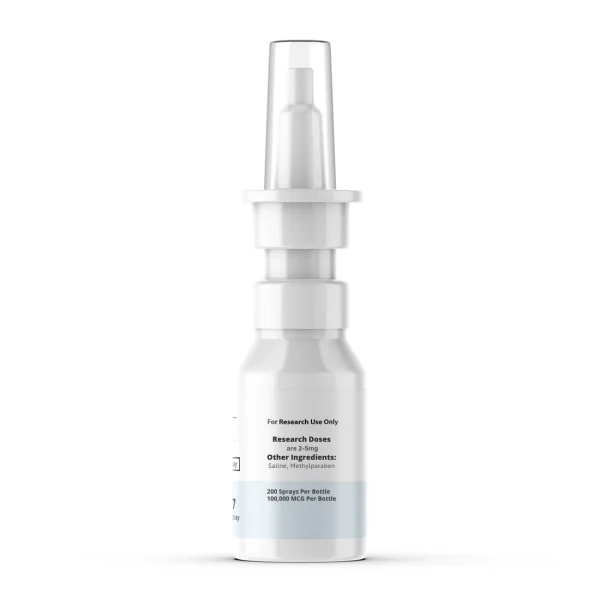
Format Metered spray bottle
Analytical verification Reversed-phase HPLC for purity, mass spectrometry for identity, independent third-party testing
Classification Research chemical. In-vitro laboratory use only. Not for human or veterinary use.

GHK-Cu storage and handling

Two of the three handling risks here are shared with any peptide, and the third is specific to the metal.

The metal-specific one is chelation. Anything in your buffer that competes for copper will strip it, and EDTA is the obvious offender. A trypsinization step, a wash buffer or a stock solution carrying EDTA will not leave the complex intact, so check formulations before they touch the material. Copper is also redox-active, and pH shifts the coordination equilibrium, so buffer choice is a real variable rather than a formality. GHK-Cu copper complex stability is what separates a clean result from an uninterpretable one.

The shared risks: keep the material cold, sealed and out of light, and work from single-use aliquots rather than freezing and thawing one container repeatedly. At low working concentrations, low-binding plasticware reduces adsorption losses that otherwise read as a potency shift.

On reconstitution, if your material arrives lyophilized rather than pre-filled, the solvent choice is not neutral for a metal complex. Bacteriostatic or sterile water is standard for peptides generally, and distilled water is sometimes specified, but whatever you use should be free of chelators and low in trace metals, because both will interfere with copper occupancy before the compound reaches a cell. Record the reconstitution solvent in your methods, since it is a variable other laboratories cannot reconstruct otherwise.

Two format points worth confirming against your own certificate rather than assuming. Per-actuation content on metered sprays in this category is often quoted in the microgram range, with figures such as 625mcg per actuation appearing on comparable listings, so check the number for the lot you receive rather than carrying one across from another product. And claims about intranasal delivery improving bioavailability relative to other routes are generic to the format rather than established for this compound, so treat the delivery format as a packaging fact rather than a pharmacokinetic one.

How this material is characterized

For a metal-peptide complex, verification has to cover the peptide and the metal loading. Reversed-phase HPLC establishes peptide purity and mass spectrometry confirms identity. This GHK-Cu nasal spray is supplied under the same verification PrymaLab applies across its research compounds, HPLC and MS confirmation plus independent third-party testing. No specific lot figures are asserted here; request the certificate of analysis for the lot you receive, and if your work depends on copper occupancy rather than peptide identity alone, ask specifically about metal content rather than inferring it from a purity percentage.

For the fibroblast, matrix and gene-expression literature behind this compound, see the PrymaLab Research Library.

Frequently asked questions

What is GHK-Cu?

GHK-Cu is the copper(II) complex of the tripeptide glycyl-L-histidyl-L-lysine, bound 1:1 (CAS 89030-95-5, about 403.9 Da). The copper is coordinated by the histidine imidazole, the glycine amino group and a deprotonated amide nitrogen. Material supplied here is a research chemical for in-vitro laboratory use only.

How tightly does GHK bind copper?

Isothermal titration calorimetry put copper binding to GHK at 7.0 plus or minus 1.0 x 10 to the 14th per molar (Mehr et al., 2020), roughly log K 14.8. Some sources quote log K 16.4; the calorimetry figure is cited here because the measurement method is stated.

Does serum interfere with GHK-Cu in cell culture?

It can. Serum albumin binds Cu(II) tightly at its N-terminal site, and reported affinities for albumin and GHK-Cu overlap depending on measurement method. In serum-containing medium you cannot assume copper stays on the peptide, so defined or serum-free conditions make results easier to interpret.

Does GHK really affect a third of human genes?

That figure, 31.2 percent of assayed genes at a 50 percent or greater expression change, comes from Connectivity Map analysis reported by Pickart and colleagues in 2018. CMap is a signature-matching screen across cell lines, so it generates hypotheses rather than confirming that a given gene moves in your cell type. Validate any specific gene by qPCR or RNA-seq in your own system.

Why does GHK-Cu storage and handling require avoiding EDTA?

Because EDTA is a strong chelator and will compete for the copper, breaking up the complex. Check trypsinization reagents, wash buffers and stock solutions for EDTA before they contact the material. Copper is also redox-active and the coordination equilibrium is pH-sensitive, so buffer choice matters.

Is GHK-Cu nasal spray approved for human use?

No. This material is a research chemical for in-vitro laboratory use only and is not intended for human, cosmetic or veterinary use. GHK-Cu appears in cosmetic formulations in other contexts, which has no bearing on research-chemical material. Nothing here is medical or cosmetic advice.

Ordering and compliance

Every PrymaLab research compound ships from the United States and is sold research-use-only. This GHK-Cu nasal spray is supplied for in-vitro laboratory research, is not intended for human, cosmetic or veterinary use, is not a drug or supplement, and has not been evaluated by the FDA for the research-chemical context. Verify the legal status of any research compound in your jurisdiction before ordering. Certificates of analysis are available on request for the lot you receive.

Additional information

Weight N/A
Dimensions N/A

11 reviews for GHK-Cu Nasal Spray

  1. Spencer Sanders
    August 2, 2026
    Tested good
    Had this order sent off to Janoshik for testing and it just came back with a perfect on the endotoxin testing and a purity of 99.97%. I will be shoppi...More
    Had this order sent off to Janoshik for testing and it just came back with a perfect on the endotoxin testing and a purity of 99.97%. I will be shopping here from now on, no vendor that I trust has better pricing.
    Helpful? 0 0
    Damon Gray
    August 2, 2026
    Thanks.
    Shipping was slow but everything came as it should.
    Helpful? 0 0
    Paula Harper
    August 1, 2026
    quality on point!
    test came back 99.71%. Will be back fs
    Helpful? 0 0
    Beverly Jones
    August 1, 2026
    Already seeing results!
    Shipping was slow but after only a week I am already seeing amazing results. Thank you.
    Helpful? 0 0
    Curtis Harper
    July 30, 2026
    will be back
    thanks
    Helpful? 0 0
    Elizabeth Reed
    July 19, 2026
    Happy
    Came fast and looks good. Thanks.
    Helpful? 0 0
    Grant Boyd
    July 18, 2026
    Exactly what i needed.
    Cannot recommend enough. Packaging an product were both on point. nasal spray came insulated and with ice pack, was still cold when I received.
    Helpful? 0 0
    Henry Turner
    July 17, 2026
    Super impressed!
    Wasn't really sure what to expect, I couldn't find alot of information on Pryma so I was a little nervous placing an order but I was not let down. The...More
    Wasn't really sure what to expect, I couldn't find alot of information on Pryma so I was a little nervous placing an order but I was not let down. The quality is exactly what i was hoping for. Also last vendor i used had cloudy solution but this reconstituted crystal clear no floaties at all. Thanks again you. Will be back!
    Helpful? 0 0
    Kelly Hughes
    July 17, 2026
    Very pleased :)
    Pretty happy with the quality and packaging. Also other places took forever to even confirm the order but got my order confirmation instantly. Cant wa...More
    Pretty happy with the quality and packaging. Also other places took forever to even confirm the order but got my order confirmation instantly. Cant wait for my next order.
    Helpful? 0 0
    Anthony Clark
    July 14, 2026
    Product great shipping slow.
    The quality was there but took like a week an a half to arrive which is my only gripe. The product is good just a couple small things. With my PT-141 ...More
    The quality was there but took like a week an a half to arrive which is my only gripe. The product is good just a couple small things. With my PT-141 Peptide Nasal Spray i noticed last site i tried had no reviews and felt shady but this place felt way more legit and professional. Not a dealbreaker at all still happy.
    Helpful? 0 0
    Omar Thomas
    May 2, 2026
    Better than any vendor I have used!
    Blown away tbh. These guys really went above and beyond with packaging, shipping, customer service and product quality. Michael was so helpful every s...More
    Blown away tbh. These guys really went above and beyond with packaging, shipping, customer service and product quality. Michael was so helpful every step of the way. I hadd issues placing an order using my card but one phone call with michael and we figured it out in no time. You have a loyal customer from now on. Already telling all my friends about this site lol.
    Helpful? 0 0

Only logged in customers who have purchased this product may leave a review.

Peptide Research Articles

Bacteriostatic Water Peptide Science: Why It Matters in Reconstitution & Research

Bacteriostatic water peptide science is the foundation of safe, accurate peptide reconstitution. This 2026 guide covers bacteriostatic water composition, how to reconstitute peptides using a peptide reconstitution calculator and peptide dosage calculator, bacteriostatic water vs sterile water differences, peptide storage best practices, and a 10-step reconstitution protocol. Expert insights from PrymaLab.

Peptides for Injury Recovery: The Wolverine Stack Peptide Guide (BPC-157 + TB-500)

The Wolverine stack peptide combines BPC-157 and TB-500 for research into tendon, ligament, and joint recovery. This 2026 guide covers BPC-157 peptide where to buy responsibly, BPC 157 peptide side effects, peptides for tendon repair, peptides for joint recovery, peptides for elbow pain, and the BPC-157 TB-500 peptide blend scientific research. Expert insights from PrymaLab.

Are Peptides Good for You? A Complete 2026 Guide

Are peptides good for you? This comprehensive 2026 guide explores peptide therapy benefits, safety, side effects, and how peptides work in the body. Learn about peptide health benefits, research findings, and what you need to know before considering peptide therapy. Expert insights from PrymaLab.

Ovagen peptide capsules for liver health with dosage cycling chart showing 10-20 day protocols repeated 2-3 times per year

Ovagen Peptide Guide: Uses, Research, Safety & Buying Info

Ovagen peptide is a short-chain liver bioregulator developed at the St. Petersburg Institute of Bioregulation and Gerontology under Professor Vladimir Khavinson. It contains the AC-3 peptide complex (glutamic acid and aspartic acid) designed to target hepatocyte gene expression for liver cell repair, bile production, and detoxification. This guide covers dosing protocols, cycling schedules, side effects, a head-to-head comparison with NAC, milk thistle, TUDCA, and BPC-157, cost analysis ($120-360 per year), and how to verify genuine Ovagen products online.

GHK-Cu peptide vial and syringe with dosage chart showing injection protocols for skin rejuvenation and hair growth

GHK-Cu Peptide: Benefits, Dosage, Side Effects & Complete Research Guide (2026)

GHK-Cu peptide is a naturally occurring copper tripeptide that modulates over 4,000 human genes involved in collagen synthesis, wound healing, and tissue regeneration. This comprehensive guide covers injection dosage protocols, clinical research on skin rejuvenation and hair growth, side effects, safety data, and how to reconstitute GHK-Cu 50mg vials. Includes dosage charts, comparison tables, and 10 frequently asked questions answered by a peptide research specialist.

Sermorelin dosage guide for anti-aging muscle growth and weight loss showing GHRH analog pituitary stimulation

Sermorelin Dosage Guide 2025: Complete Protocol for Anti-Aging, Muscle Growth & Weight Loss

Sermorelin acetate is a growth hormone-releasing hormone (GHRH) analog that stimulates natural GH production from the pituitary gland. This comprehensive dosage guide covers protocols for anti-aging, muscle growth, weight loss, and sleep optimization รขโ‚ฌโ€ along with side effects, before-and-after timelines, and comparisons to HGH and ipamorelin.

Customer reviews

4.73
Based on 11 reviews
5
73%
8
4
27%
3
3
0%
0
2
0%
0
1
0%
0
Spencer Sanders
August 2, 2026
Tested good
Had this order sent off to Janoshik for testing and it just came back with a perfect on the endotoxin testing and a purity of 99.97%. I will be shoppi...More
Had this order sent off to Janoshik for testing and it just came back with a perfect on the endotoxin testing and a purity of 99.97%. I will be shopping here from now on, no vendor that I trust has better pricing.
Helpful? 0 0
Damon Gray
August 2, 2026
Thanks.
Shipping was slow but everything came as it should.
Helpful? 0 0
Paula Harper
August 1, 2026
quality on point!
test came back 99.71%. Will be back fs
Helpful? 0 0
Beverly Jones
August 1, 2026
Already seeing results!
Shipping was slow but after only a week I am already seeing amazing results. Thank you.
Helpful? 0 0
Curtis Harper
July 30, 2026
will be back
thanks
Helpful? 0 0
Elizabeth Reed
July 19, 2026
Happy
Came fast and looks good. Thanks.
Helpful? 0 0
Grant Boyd
July 18, 2026
Exactly what i needed.
Cannot recommend enough. Packaging an product were both on point. nasal spray came insulated and with ice pack, was still cold when I received.
Helpful? 0 0
Henry Turner
July 17, 2026
Super impressed!
Wasn't really sure what to expect, I couldn't find alot of information on Pryma so I was a little nervous placing an order but I was not let down. The...More
Wasn't really sure what to expect, I couldn't find alot of information on Pryma so I was a little nervous placing an order but I was not let down. The quality is exactly what i was hoping for. Also last vendor i used had cloudy solution but this reconstituted crystal clear no floaties at all. Thanks again you. Will be back!
Helpful? 0 0
Kelly Hughes
July 17, 2026
Very pleased :)
Pretty happy with the quality and packaging. Also other places took forever to even confirm the order but got my order confirmation instantly. Cant wa...More
Pretty happy with the quality and packaging. Also other places took forever to even confirm the order but got my order confirmation instantly. Cant wait for my next order.
Helpful? 0 0
Anthony Clark
July 14, 2026
Product great shipping slow.
The quality was there but took like a week an a half to arrive which is my only gripe. The product is good just a couple small things. With my PT-141 ...More
The quality was there but took like a week an a half to arrive which is my only gripe. The product is good just a couple small things. With my PT-141 Peptide Nasal Spray i noticed last site i tried had no reviews and felt shady but this place felt way more legit and professional. Not a dealbreaker at all still happy.
Helpful? 0 0
Omar Thomas
May 2, 2026
Better than any vendor I have used!
Blown away tbh. These guys really went above and beyond with packaging, shipping, customer service and product quality. Michael was so helpful every s...More
Blown away tbh. These guys really went above and beyond with packaging, shipping, customer service and product quality. Michael was so helpful every step of the way. I hadd issues placing an order using my card but one phone call with michael and we figured it out in no time. You have a loyal customer from now on. Already telling all my friends about this site lol.
Helpful? 0 0
24/7 Online support

support@prymalab.net info@prymalab.net

Money back guarantee

30 Day return window. Satisfaction guaranteed or your money back.

FREE shipping and return

All orders over %150 in value will receive free shipping.