Description
PrymaLab · Research use only
KPV (10mg)
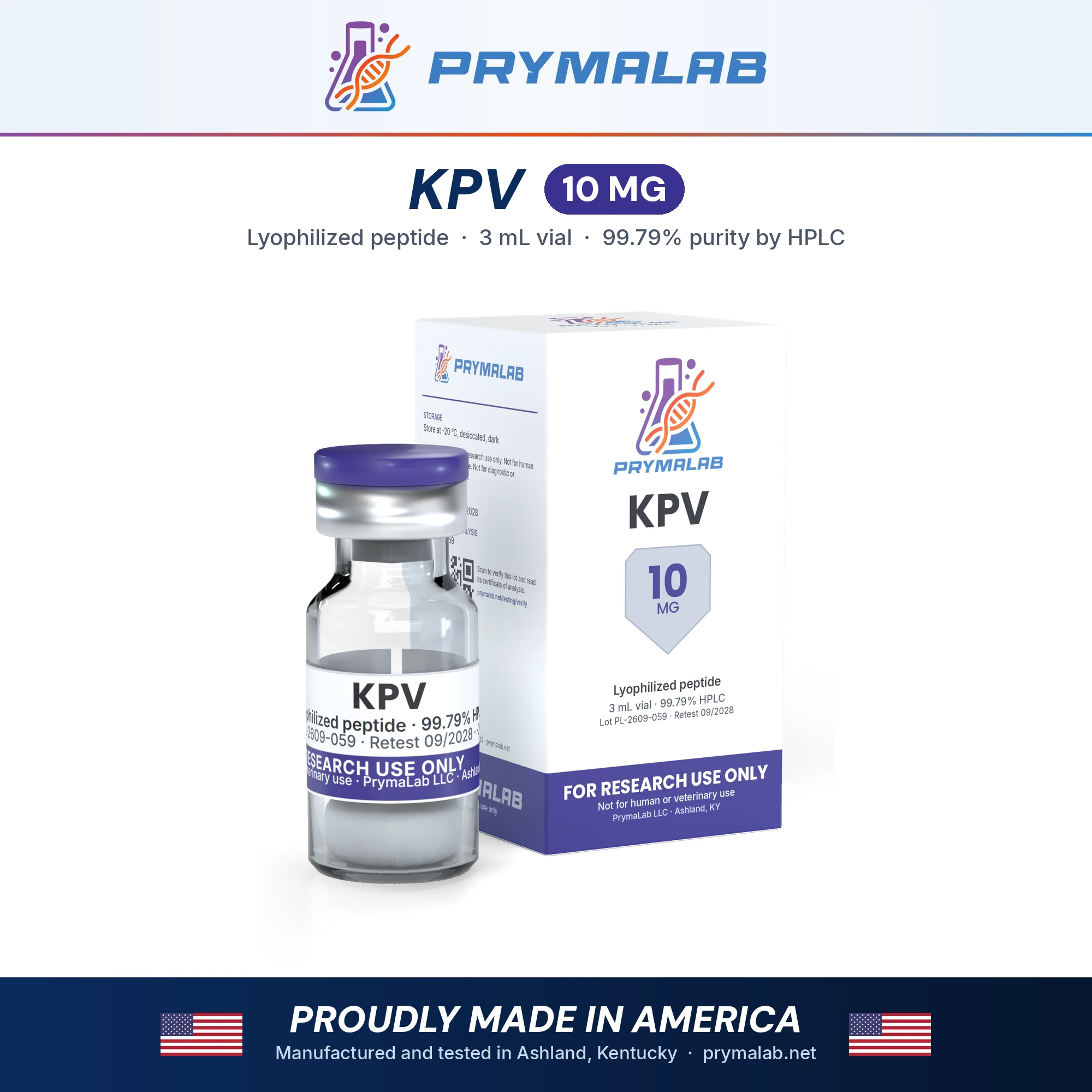
Lys-Pro-Val, the alpha-MSH(11-13) tripeptide, as 10 mg of freeze-dried powder
KPV is the tripeptide lysine-proline-valine, residues 11 to 13 of alpha-melanocyte-stimulating hormone (alpha-MSH). This listing is the 10 mg vial of white freeze-dried powder, the main fill of a range that also includes a 5 mg vial. Most KPV research concerns inflammation: how the peptide enters gut epithelial cells through the PepT1 transporter, how it damps NF-kB signalling once inside, and what it did in mouse models of colitis.
Specifications
| Property | Value |
|---|---|
| Compound | KPV Lys-Pro-Val; α-MSH(11–13) |
| CAS number | 67727-97-3 |
| Molecular formula | C16H30N4O4 |
| Theoretical mass | 342.4 Da |
| Sequence / structure | H-KPV-OH (3 residues; free N- and C-termini) |
| Label claim | 10 mg/vial |
| Form | Lyophilized (freeze-dried) powder or cake in a sealed glass vial with a rubber stopper and aluminium crimp cap |
| Storage, sealed | −20 °C, desiccated, dark |
| Purity specification | 99.0% or higher by RP-HPLC |
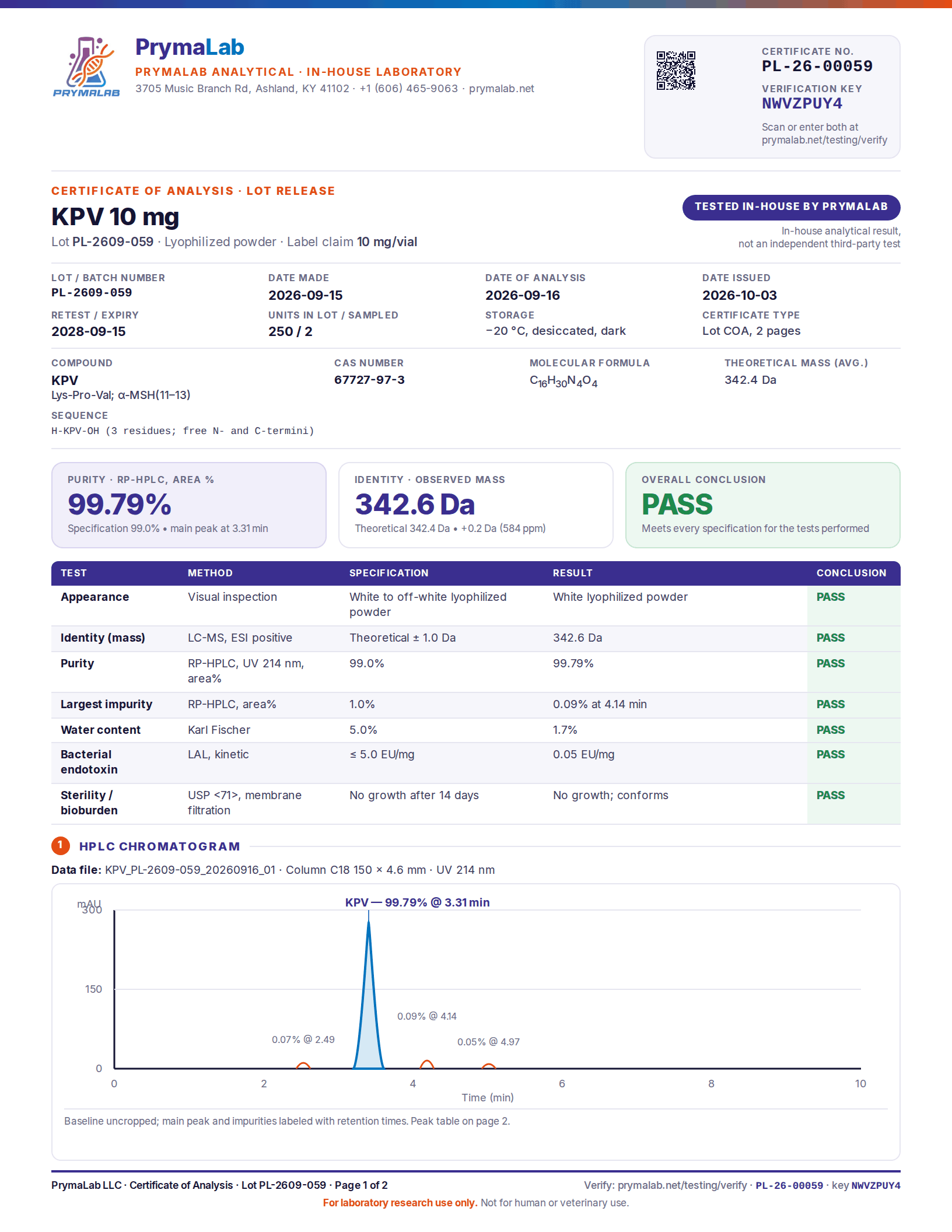
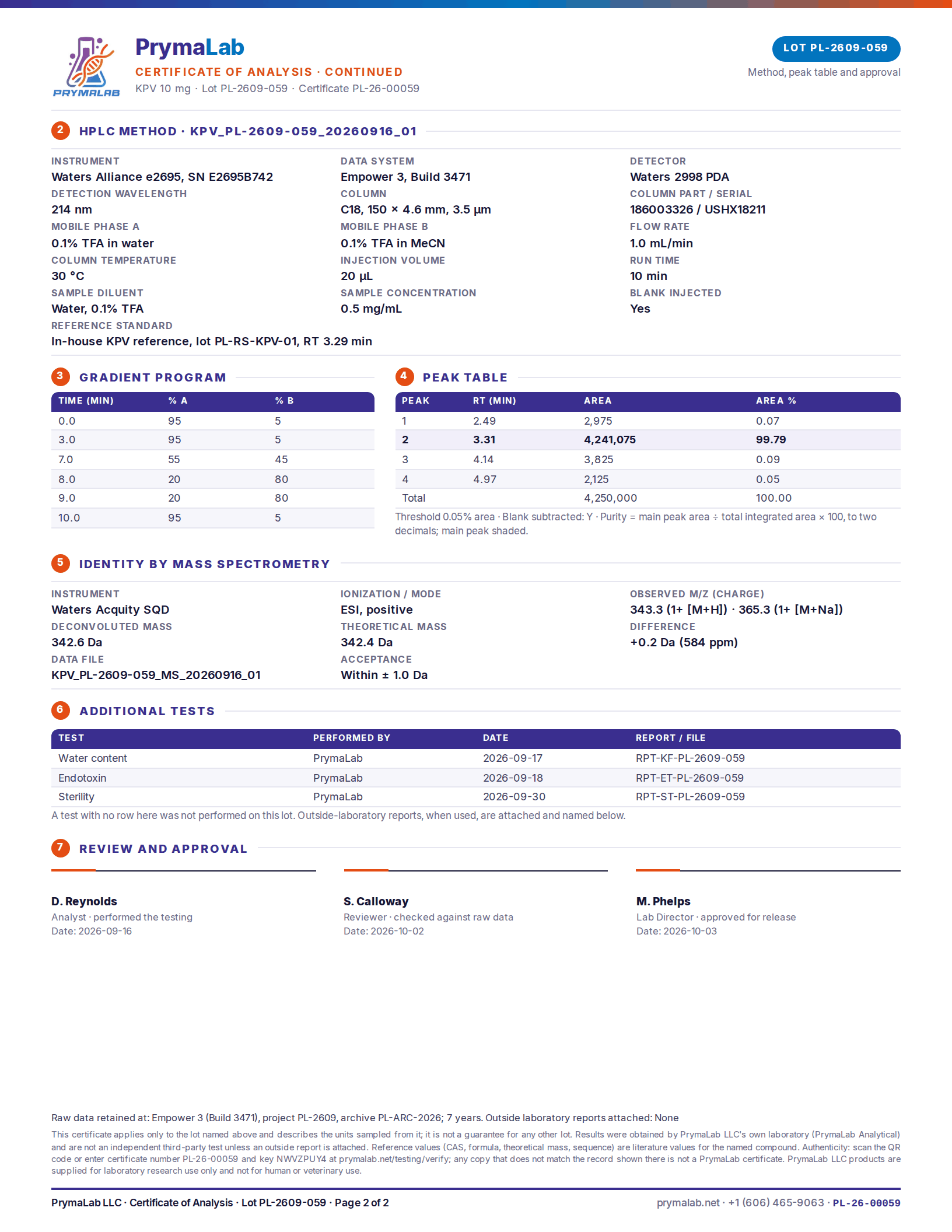
| Lot certificate | Results for the lot now shipping are in the certificate panel on this page |
| Safety data sheet | PL-SDS-097 |
Fills in this range
KPV is sold in 2 fills. The compound and the testing are the same in every fill; only the amount in the vial changes.
| Fill | Listing |
|---|---|
| 5 mg | KPV (5mg) |
| 10 mg | KPV (10mg) (this page) |
Identity and amount in the vial
The certificate gives the structure as H-KPV-OH: three residues with a free amino group at the lysine end and a free carboxyl at the valine end, formula C16H30N4O4 and a theoretical mass of 342.4 Da. For a molecule this small, the LC-MS identity result on the certificate is the quickest check that the vial holds KPV and not a related di- or tetrapeptide.
In molar terms, 10 mg of a 342.4 Da peptide is about 29.2 µmol, so dissolving the vial in 2 mL gives a solution near 14.6 mM, a little less once the residual water reported on the certificate is allowed for. KPV is also sold already in solution, as a KPV preloaded pen at 5 mg/mL and a KPV nasal spray holding 10 mg per bottle.
What the research covers
A fragment of alpha-MSH that keeps the anti-inflammatory activity
Alpha-MSH is a 13-residue peptide processed from proopiomelanocortin. Besides acting on melanocytes it has strong anti-inflammatory and protective effects, reached both through melanocortin receptors in the brain and through direct action on immune and other peripheral cells1. A 2008 review by Brzoska, Luger and colleagues listed its molecular targets as NF-kB activation, adhesion molecules, chemokine receptors, pro-inflammatory cytokines and IL-10 synthesis, and collected animal models in which alpha-MSH reduced inflammation, from contact dermatitis and vasculitis to arthritis and inflammation of the gut, eye, brain and airways1. The same review named its pigmentary effect as one obstacle to using alpha-MSH against inflammatory disease1. Luger and Brzoska attributed most of the hormone’s anti-inflammatory activity to its C-terminal tripeptide, KPV2, and the 2008 review described KPV as keeping that activity without the pigmentary action1. The group also described KdPT, a KPV derivative corresponding to residues 193 to 195 of interleukin-1 beta2.
Entry into cells through PepT1
PepT1 is a proton-coupled transporter in the apical membrane of enterocytes that absorbs the short peptides released by protein digestion3. Daniel’s 2004 review described it as able to carry essentially every possible di- and tripeptide, while free amino acids and peptides of four or more residues are not substrates, a size window KPV falls inside3. PepT1 is normally expressed in the small intestine and is induced in the colon during inflammatory bowel disease4. Dalmasso and colleagues asked whether KPV’s effect depended on it. They stimulated human intestinal epithelial cells (Caco2-BBE and HT29-Cl.19A) and Jurkat T cells with pro-inflammatory cytokines, and followed KPV uptake with tritiated peptide and by competition against a radiolabelled PepT1 substrate4. Nanomolar KPV inhibited activation of the NF-kB and MAP kinase pathways and lowered pro-inflammatory cytokine secretion, and the authors concluded that it acts through PepT1 in both immune and intestinal epithelial cells4.
Colitis in mice
The Dalmasso paper also tested oral KPV in DSS- and TNBS-induced colitis, two chemically induced mouse models, where it reduced the incidence of colitis and the expression of pro-inflammatory cytokines4. Kannengiesser and colleagues used DSS colitis and CD45RBhi transfer colitis5. In the DSS model, KPV-treated mice recovered earlier and regained more body weight, with fewer inflammatory infiltrates in the colon and lower myeloperoxidase activity in colonic tissue5. In transfer colitis, KPV treatment was followed by recovery, weight regain and fewer inflammatory changes on histology5. The group also induced DSS colitis in mice with a nonfunctional melanocortin-1 receptor (MC1R). Every KPV-treated animal in that group survived, and the authors judged the effect to be at least partly independent of MC1R signalling5.
What is not established
The evidence here comes from cell lines and mice. None of the cited papers reports a human study of KPV, and Brzoska’s review presented skin, bowel, lung, eye and joint disease as possible future uses rather than results1. Both reviews come from one group, Luger and Brzoska’s1,2. The papers show that KPV enters cells through PepT1 and that NF-kB signalling falls afterwards, but they do not identify what KPV binds inside the cell, and the MC1R experiment shows only that this receptor is not the whole story5. None of this work used PrymaLab material. Later studies on that intracellular step, and the work on skin, the nervous system and microbes, are discussed in the KPV peptide guide.
How each lot is tested
Every lot is tested in PrymaLab’s own laboratory in Ashland, Kentucky before release: RP-HPLC for purity, LC-MS for identity, Karl Fischer titration for water, LAL for endotoxin and USP <71> for sterility. The results for the lot now shipping are in the certificate panel on this page, and the certificate number, key and QR code can be checked on the verify page. These are in-house results from PrymaLab Analytical, not an independent test, and the lab is not accredited to ISO 17025. The third-party testing guarantee on this page still applies: if any independent laboratory finds the wrong compound, or less than the stated purity or amount, the order is refunded and the cost of the test is reimbursed.
Frequently asked questions
What is in the 10 mg vial?
10 mg of KPV as white freeze-dried powder: the tripeptide Lys-Pro-Val with free termini (H-KPV-OH), formula C16H30N4O4, theoretical mass 342.4 Da. The safety data sheet lists no other ingredient, and the certificate reports the water content of the lot.
How do the 5 mg and 10 mg vials differ?
Only in the amount of peptide. Both hold the same freeze-dried tripeptide, and each fill is made and tested as its own lot with its own certificate. Dissolved in the same volume, the 10 mg vial gives twice the concentration of the 5 mg vial.
How can I check the certificate for my vial?
Read the lot number on the vial label and compare it with the certificate panel on this page, which shows the lot now shipping. Earlier lots are on the testing results page, and the verify page confirms any certificate from its number and key.
How should KPV be stored?
Sealed vials go at −20 °C, kept dry and dark. Bring a vial to room temperature before opening it so that moisture does not condense on the powder. After reconstitution, hold the solution at 2 to 8 °C away from light and use it within the period your laboratory has set.
Does KPV act on melanocortin receptors like alpha-MSH?
Not in the same way. Reviews describe KPV as keeping the parent hormone's anti-inflammatory activity without its pigment effect, and in one mouse study KPV still protected animals whose melanocortin-1 receptor did not work. What it binds inside the cell is not settled in the papers cited here.
Is KPV for human or veterinary use?
No. It is sold for laboratory research only, has no FDA or other regulatory approval for use in people or animals, and must not be given to either. No human study of KPV is among the papers cited on this page.
References
- Brzoska T, Luger TA, Maaser C, et al. Alpha-melanocyte-stimulating hormone and related tripeptides: biochemistry, antiinflammatory and protective effects in vitro and in vivo, and future perspectives for the treatment of immune-mediated inflammatory diseases. Endocr Rev. 2008;29(5):581-602. DOI · PubMed
- Luger TA, Brzoska T. alpha-MSH related peptides: a new class of anti-inflammatory and immunomodulating drugs. Ann Rheum Dis. 2007;66 Suppl 3(Suppl 3):iii52-5. DOI · PubMed
- Daniel H. Molecular and integrative physiology of intestinal peptide transport. Annu Rev Physiol. 2004;66:361-84. DOI · PubMed
- Dalmasso G, Charrier-Hisamuddin L, Nguyen HT, et al. PepT1-mediated tripeptide KPV uptake reduces intestinal inflammation. Gastroenterology. 2008;134(1):166-78. DOI · PubMed
- Kannengiesser K, Maaser C, Heidemann J, et al. Melanocortin-derived tripeptide KPV has anti-inflammatory potential in murine models of inflammatory bowel disease. Inflamm Bowel Dis. 2008;14(3):324-31. DOI · PubMed
Research use only
For laboratory research use only. KPV (10mg) is not a drug, food, cosmetic or dietary supplement, is not approved by the FDA or any comparable authority for human or veterinary use, and must not be given to people or animals. It is sold to qualified researchers and institutions, and the buyer is responsible for lawful handling and disposal.







Reviews
There are no reviews yet.