

Retatrutide reconstitution and research guide: trial results, concentration arithmetic and cost per mg
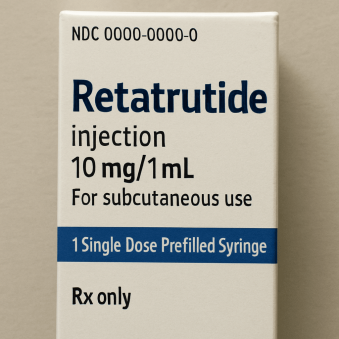
Retatrutide is a triple GLP-1, GIP and glucagon receptor agonist peptide studied in obesity, type 2 diabetes and liver fat trials. PrymaLab supplies it as lyophilised vials from Retatrutide 5mg to Retatrutide 60mg (seven sizes: 5, 10, 20, 30, 40, 50 and 60mg), plus a preloaded 15mg pen, for research use only.
- Molecule: single-chain 39-amino-acid peptide on a GIP backbone with a C20 fatty diacid, about 4.7 kDa, Lilly code LY3437943
- Class: triple agonist at the GIP, GLP-1 and glucagon receptors
- Studied for: obesity (NEJM 2023, phase 3 TRIUMPH), type 2 diabetes (Lancet 2023), MASLD (Nature Medicine 2024)
- Key results in the literature: -24.2% body weight at 48 weeks in the highest-dose group of the phase 2 obesity trial; -28.3% at 80 weeks in the highest-dose arm of TRIUMPH-1; trials ran 36 to 80 weeks
- Storage: lyophilised vials frozen or refrigerated, away from light; reconstituted solution refrigerated, window per product page
- Forms and sizes at PrymaLab: Retatrutide 5mg, 10mg, 20mg, 30mg, 40mg, 50mg, 60mg vials, 15mg pen
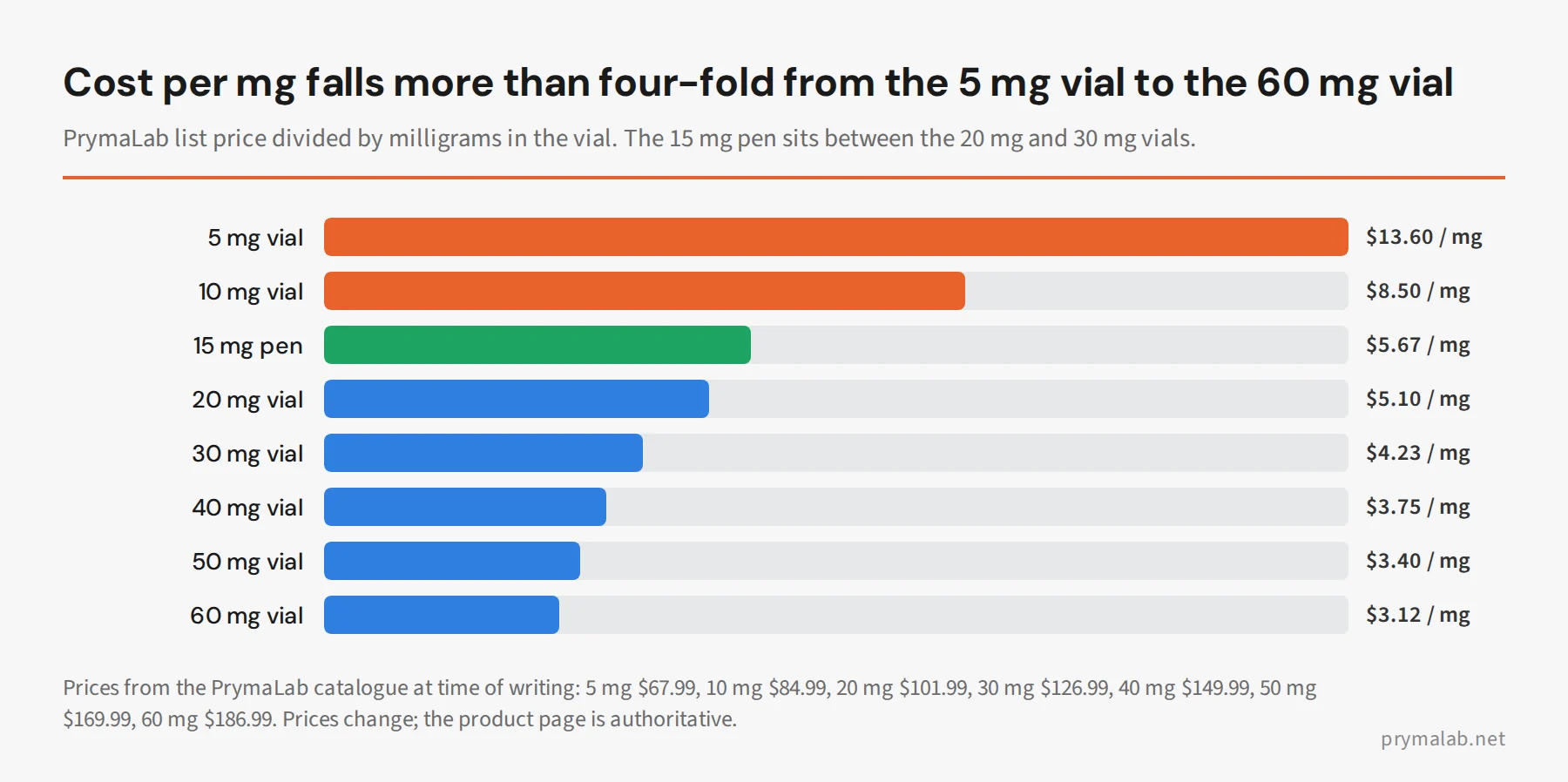
- Cost per mg: $13.60 per mg (5mg vial) down to $3.12 (60mg vial); the pen is $5.67 per mg
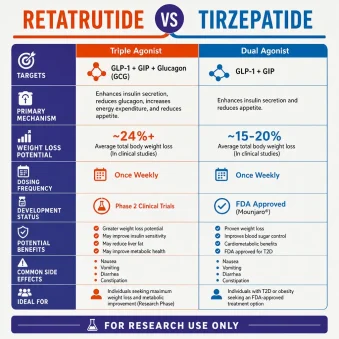
Run any vial size and water volume through the peptide reconstitution calculator, and read the retatrutide vs tirzepatide guide for the receptor mechanism and the phase 3 comparison.
What the phase 2 and phase 3 trials measured
Retatrutide has been tested in a phase 1b study, three phase 2 trials (obesity, type 2 diabetes and liver fat) and the phase 3 TRIUMPH programme. Each randomised participants to several retatrutide dose levels or placebo, and some added an active comparator.
The phase 2 obesity trial (Jastreboff et al., NEJM 2023) randomised 338 adults with a BMI of 30 or higher, or 27 to under 30 with at least one weight-related condition, and without diabetes, to placebo or to one of four retatrutide dose levels for 48 weeks.
The primary endpoint was percent change in body weight at 24 weeks: -7.2%, -12.9%, -17.3% and -17.5% from the lowest to the highest dose level, against -1.6% on placebo. At 48 weeks the figures were -8.7%, -17.1%, -22.8% and -24.2% against -2.1%. Every participant in the two highest dose groups lost at least 5% of body weight, and 26% of the highest-dose group lost 30% or more. Weight was still falling at week 48 in the higher-dose groups.
The phase 2 type 2 diabetes trial (Rosenstock et al., Lancet 2023) randomised 281 adults to placebo, dulaglutide or one of four retatrutide dose levels for 36 weeks. HbA1c at 24 weeks, the primary endpoint, fell by 2.02 percentage points in the highest-dose arm against 0.01 on placebo and 1.41 on dulaglutide. Body weight at 36 weeks fell by 16.94% in the highest-dose arm.
The phase 2a liver trial (Sanyal et al., Nature Medicine 2024) randomised 98 adults with metabolic dysfunction-associated steatotic liver disease (MASLD) to one of four retatrutide dose levels or placebo for 48 weeks. Mean relative liver fat at 24 weeks changed by -42.9%, -57.0%, -81.4% and -82.4% across the four arms against +0.3% on placebo; by 48 weeks 93% of the highest-dose group had liver fat below 5%. The response was steep between the second and third dose levels, then flat.
Phase 3 is Lilly's TRIUMPH programme. TRIUMPH-1 (NCT05929066) randomised 2,339 adults without type 2 diabetes who had obesity or overweight to one of three retatrutide dose arms or placebo. Lilly reported topline results on 21 May 2026: mean weight change at 80 weeks of -19.0%, -25.9% and -28.3% from the lowest to the highest dose arm, against -2.2% on placebo, from an average baseline of 248.5 lb. In the highest-dose arm, 45.3% of participants lost 30% or more. A prespecified blinded extension to 104 weeks enrolled 532 participants who had a baseline BMI of 35 or higher and tolerated their assigned treatment; those in the highest-dose arm reached -30.3%. The other registrations are TRIUMPH-2 (NCT05929079, type 2 diabetes with obesity or overweight), TRIUMPH-3 (NCT05882045, severe obesity with established cardiovascular disease) and TRIUMPH-4 (NCT05931367, obesity or overweight with knee osteoarthritis).
Retatrutide trials in the literature
The table summarises each study's population and design.
| Study | Participants | Design and duration |
|---|---|---|
| Urva et al., Lancet 2022 (phase 1b, multiple ascending dose) | 72 adults with type 2 diabetes | Multiple ascending dose levels with placebo and dulaglutide comparators; 12 weeks |
| Jastreboff et al., NEJM 2023 (phase 2, obesity) | 338 adults with obesity or overweight, without diabetes | Four dose levels against placebo; 48 weeks |
| Rosenstock et al., Lancet 2023 (phase 2, type 2 diabetes) | 281 adults with type 2 diabetes | Four dose levels against placebo and dulaglutide; 36 weeks |
| Sanyal et al., Nature Medicine 2024 (phase 2a, MASLD) | 98 adults with MASLD | Four dose levels against placebo; 48 weeks |
| TRIUMPH-1, NCT05929066 (phase 3, obesity) | 2,339 adults without type 2 diabetes who had obesity or overweight | Three dose arms against placebo; 80 weeks, with a 104-week extension for participants with a baseline BMI of 35 or higher |
Reconstitution arithmetic
PrymaLab ships retatrutide as lyophilised powder. In the lab, a lyophilised peptide is dissolved in a suitable diluent and the concentration recorded. One formula covers every example below: concentration (mg/ml) equals the peptide in the vial (mg) divided by the volume of diluent added (ml).
The diluent goes in slowly down the inside wall of the vial, and the vial is swirled rather than shaken, because agitation can damage a peptide of this length. The volume that can be added is limited by the vial's capacity.
Retatrutide 5mg vial
1 ml of diluent gives 5 mg/ml; 2 ml gives 2.5 mg/ml. Check any other volume on the peptide reconstitution calculator.
Retatrutide 10mg vial
2 ml gives 5 mg/ml; 1 ml gives 10 mg/ml. The peptide reconstitution calculator prints the result for either choice.
Retatrutide 20mg vial
2 ml gives 10 mg/ml; 4 ml gives 5 mg/ml, the same concentration as 10mg in 2 ml. Enter 20mg and any volume in the peptide reconstitution calculator to compare.
Retatrutide 30mg vial
3 ml gives 10 mg/ml; 2 ml gives 15 mg/ml. At higher concentrations a small error in measuring volume is a larger error in mass. The peptide reconstitution calculator handles the 40, 50 and 60mg sizes the same way.
Storage before and after reconstitution
Lyophilised retatrutide is stable as a dry powder when kept cold and dark: a freezer at -20°C for long-term storage, or a refrigerator at 2 to 8°C for vials that will be used within weeks, in the original carton away from light. Vials are brought to room temperature before the seal is punctured, so condensation does not form on cold powder.
After reconstitution the peptide is in solution and its stability window shortens. Reconstituted vials are kept refrigerated at 2 to 8°C, away from light, and are not frozen, since ice crystals damage dissolved peptide. Where bacteriostatic water is the diluent, its benzyl alcohol limits microbial growth but does not stop chemical degradation of the peptide. The solution is used within the window stated on the product page for that vial size; those per-product figures govern the lot in hand.
Retatrutide cost per mg across PrymaLab's seven sizes
Retatrutide cost depends on vial size more than on vendor. The table uses PrymaLab's current "from" prices and divides by the milligrams in the vial.
| Size | Price (from) | Price per mg |
|---|---|---|
| Retatrutide 5mg | $67.99 | $13.60 |
| Retatrutide 10mg | $84.99 | $8.50 |
| Retatrutide 20mg | $101.99 | $5.10 |
| Retatrutide 30mg | $126.99 | $4.23 |
| Retatrutide 40mg | $149.99 | $3.75 |
| Retatrutide 50mg | $169.99 | $3.40 |
| Retatrutide 60mg | $186.99 | $3.12 |
The Preloaded Autoinjector | Retatrutide | 3ml Pen | 15mg is $84.99, or $5.67 per mg. It comes in solution rather than as powder, so it skips the reconstitution step; the product page gives its fill volume and concentration.
Larger vials cost less per mg because most of the cost of a vial is fixed per unit. The glass vial, stopper and crimp, the lyophilisation run, the HPLC and mass spectrometry testing behind the certificate of analysis, labelling, packaging and shipping cost the same whether the vial holds 5 mg or 60 mg; the peptide is the only cost that scales with milligrams. The 60mg vial costs 2.75 times the 5mg price for 12 times the peptide, which is why the per-mg figure falls from $13.60 to $3.12. The smaller sizes make sense when a lot needs to be tested before committing to volume, or when a reconstituted vial would otherwise sit past its storage window.
How to buy retatrutide for research
Retatrutide is an investigational compound with no marketing approval and no prescription product, so "how to get retatrutide" resolves to one route: purchasing research-grade material from a vendor that sells it for laboratory use. PrymaLab is a US vendor in Ashland, Kentucky, veteran owned, and ships lyophilised retatrutide in seven sizes plus a preloaded pen, all for research use only and not for human consumption:
- Retatrutide 5mg, from $67.99
- Retatrutide 10mg, from $84.99
- Retatrutide 20mg, from $101.99
- Retatrutide 30mg, from $126.99
- Retatrutide 40mg, from $149.99
- Retatrutide 50mg, from $169.99
- Retatrutide 60mg, from $186.99
- Preloaded Autoinjector | Retatrutide | 3ml Pen | 15mg, from $84.99
The certificate of analysis (COA) is the document that ties a lab test to the vial. A useful COA lists the product name and lot number, which must match the vial label; the test date; identity confirmation by mass spectrometry, with the observed mass next to the theoretical mass for retatrutide (about 4,731 Da); purity by HPLC as a percentage, with the method noted; net quantity; and appearance (white to off-white lyophilised powder). A COA without a lot number, or one that states purity with no method, is not evidence of anything. Bacteriostatic water is sold separately in 3ML and 10ML sizes, and the longer retatrutide purchase guide covers mechanism and trial history in more depth.
Retatrutide vs tirzepatide vs semaglutide
Each of the three is a long-acting incretin-class agonist developed by a large pharmaceutical company for obesity and type 2 diabetes. They differ in receptors, development stage and the sizes available for research.
| Feature | Retatrutide | Tirzepatide | Semaglutide |
|---|---|---|---|
| Receptors | GIP, GLP-1 and glucagon | GIP and GLP-1 | GLP-1 |
| Reported weight change | -24.2% at 48 weeks (phase 2, highest dose); -28.3% at 80 weeks (TRIUMPH-1, highest dose) | -20.9% at 72 weeks (SURMOUNT-1, highest dose) | -14.9% at 68 weeks (STEP 1) |
| Development stage | Investigational; phase 3 TRIUMPH, first readout May 2026; no marketing approval anywhere at the time of writing | Approved: type 2 diabetes 2022 (Mounjaro), chronic weight management 2023 (Zepbound) | Approved: type 2 diabetes 2017 (Ozempic), chronic weight management 2021 (Wegovy) |
| Research sizes at PrymaLab | 5 to 60mg vials and a 15mg pen | Tirzepatide 5mg to Tirzepatide 100mg | Semaglutide 5mg to Semaglutide 30mg |
The receptor discussion, including why the glucagon receptor matters for liver fat and why the GIP contribution is still debated, is in the retatrutide vs tirzepatide guide.
Frequently asked questions
What did the retatrutide trials measure?
The phase 2 obesity trial measured body weight over 48 weeks across four dose levels against placebo, reaching -24.2% in the highest-dose group. Phase 3 TRIUMPH-1 compared three dose arms with placebo over 80 weeks and reported -28.3% in the highest-dose arm. The phase 2 diabetes trial measured HbA1c, and the phase 2a liver trial measured liver fat. These are trial results, not instructions for research material.
How is retatrutide reconstituted?
Retatrutide arrives as lyophilised powder. A suitable diluent is added slowly down the vial wall and the vial is swirled, not shaken, until the powder dissolves. The concentration is peptide mass divided by diluent volume: a 10mg vial in 2 ml gives 5 mg/ml. PrymaLab's peptide reconstitution calculator does the arithmetic for any size.
How much does retatrutide cost per mg?
At PrymaLab's list prices, retatrutide costs $13.60 per mg in the 5mg vial, $8.50 in the 10mg, $5.10 in the 20mg, $4.23 in the 30mg, $3.75 in the 40mg, $3.40 in the 50mg and $3.12 in the 60mg. The 15mg preloaded pen is $5.67 per mg. Per-vial costs such as testing, lyophilisation and packaging explain why the larger sizes cost less per milligram.
How do you get retatrutide for research?
Retatrutide has no marketing approval and no pharmacy product, so the only route is a research-chemical vendor. PrymaLab, a US vendor in Ashland, Kentucky, ships lyophilised retatrutide in 5, 10, 20, 30, 40, 50 and 60mg vials plus a 15mg preloaded pen, each lot with a certificate of analysis, for laboratory research only and not for human consumption.
Is retatrutide available for sale?
Yes, as a research compound. Retatrutide is sold by research-peptide vendors for laboratory use. It had no marketing approval at the time of writing, so there is no prescription version. PrymaLab lists seven vial sizes from 5mg to 60mg and a preloaded 15mg pen, all labelled for research use only and supplied with a certificate of analysis for the lot.
Key takeaways
- Retatrutide has been tested in a phase 1b study, three phase 2 trials (obesity, type 2 diabetes, liver fat) and the phase 3 TRIUMPH programme, each comparing several dose levels with placebo.
- The phase 2 obesity trial reported -24.2% body weight at 48 weeks in the highest-dose group; TRIUMPH-1 reported -28.3% at 80 weeks in its highest-dose arm, and -30.3% at 104 weeks in an extension limited to participants with a baseline BMI of 35 or higher.
- Reconstitution is arithmetic: concentration is peptide mass divided by diluent volume, so 10mg in 2 ml is 5 mg/ml and 20mg in 2 ml is 10 mg/ml.
- Lyophilised vials are stored frozen or refrigerated away from light; reconstituted solution is refrigerated and used within the window on the product page.
- Cost per mg falls from $13.60 (5mg vial) to $3.12 (60mg vial) because per-vial costs are fixed; the 15mg pen is $5.67 per mg.
Related products
- Retatrutide 5mg
- Retatrutide 10mg
- Retatrutide 20mg
- Retatrutide 30mg
- Retatrutide 40mg
- Retatrutide 50mg
- Retatrutide 60mg
- Preloaded Autoinjector | Retatrutide | 3ml Pen | 15mg
- BAC Water (Bacteriostatic Water) 3ML
- BAC Water (Bacteriostatic Water) 10ML
References
- Jastreboff AM, Kaplan LM, Frias JP, et al. Triple-hormone-receptor agonist retatrutide for obesity: a phase 2 trial. N Engl J Med. 2023;389(6):514-526. https://doi.org/10.1056/NEJMoa2301972
- Rosenstock J, Frias J, Jastreboff AM, et al. Retatrutide, a GIP, GLP-1 and glucagon receptor agonist, for people with type 2 diabetes: a randomised, double-blind, placebo and active-controlled, parallel-group, phase 2 trial conducted in the USA. Lancet. 2023;402(10401):529-544. https://doi.org/10.1016/S0140-6736(23)01053-X
- Sanyal AJ, Kaplan LM, Frias JP, et al. Triple hormone receptor agonist retatrutide for metabolic dysfunction-associated steatotic liver disease: a randomized phase 2a trial. Nat Med. 2024;30(7):2037-2048. https://doi.org/10.1038/s41591-024-03018-2
- Urva S, Coskun T, Loh MT, et al. LY3437943, a novel triple GIP, GLP-1, and glucagon receptor agonist in people with type 2 diabetes: a phase 1b, multicentre, double-blind, placebo-controlled, randomised, multiple-ascending dose trial. Lancet. 2022;400(10366):1869-1881. https://doi.org/10.1016/S0140-6736(22)02033-5
- Coskun T, Urva S, Roell WC, et al. LY3437943, a novel triple glucagon, GIP, and GLP-1 receptor agonist for glycemic control and weight loss: from discovery to clinical proof of concept. Cell Metab. 2022;34(9):1234-1247.e9. https://doi.org/10.1016/j.cmet.2022.07.013
- ClinicalTrials.gov. NCT05929066: a study of retatrutide (LY3437943) in participants who have obesity or overweight (TRIUMPH-1). https://clinicaltrials.gov/study/NCT05929066
- AJMC. Retatrutide achieves up to 30.3% average weight loss in phase 3 TRIUMPH-1 trial. May 2026. https://www.ajmc.com/view/retatrutide-achieves-up-to-30-3-average-weight-loss-in-phase-3-triumph-1-trial
- Jastreboff AM, Aronne LJ, Ahmad NN, et al. Tirzepatide once weekly for the treatment of obesity (SURMOUNT-1). N Engl J Med. 2022;387(3):205-216. https://doi.org/10.1056/NEJMoa2206038
- Wilding JPH, Batterham RL, Calanna S, et al. Once-weekly semaglutide in adults with overweight or obesity (STEP 1). N Engl J Med. 2021;384(11):989-1002. https://doi.org/10.1056/NEJMoa2032183
Everything described on this page is laboratory research. Every compound PrymaLab supplies is for laboratory research use only and is not intended for human or veterinary use. Statements have not been evaluated by the FDA, and nothing here is medical advice.
Mechanistic descriptions are observations from cell and animal models, several from older literature, that may not generalize. Always verify the legal status of any research compound in your jurisdiction before purchase or use.