

Noopept (Omberacetam): The Dipeptide That Is Not a Racetam, the 1,000x Claim Its Developers Made, and the One Human Trial Everyone Quotes Without Reading
Noopept is the brand name of omberacetam, the dipeptide ester N-phenylacetyl-L-prolylglycine ethyl ester (GVS-111, 318.37 Da, CAS 157115-85-0), designed in the early 1990s at the Zakusov Institute of Pharmacology in Moscow by rebuilding the shape of piracetam out of amino acids. It is grouped with the racetams because of that design intent, but it has no pyrrolidone ring and is chemically a proline dipeptide. In rats it is cleared within minutes to the endogenous cyclic dipeptide cycloprolylglycine, raises hippocampal BDNF and NGF mRNA after single and 28-day administration, protects cultured neurons against hydrogen peroxide with an IC50 of 1.2 µM, and is active in memory, stroke and Alzheimer's models at doses the developers describe as roughly 1,000 times lower than piracetam. The human evidence is one open-label Russian comparison against piracetam in 53 patients, plus small open series; no placebo-controlled trial exists anywhere. It is an over-the-counter medicine in Russia, a prescription-only Schedule 4 poison in Australia, and an unapproved, unscheduled compound in the US that the FDA says cannot be sold as a supplement. PrymaLab supplies Noopept (Omberacetam) 30mg capsules for laboratory research use only.
- Structure: Ethyl 1-(phenylacetyl)-L-prolylglycinate, C17H22N2O4, 318.37 g/mol, CAS 157115-85-0, PubChem CID 180496, UNII 4QBJ98683M. A phenylacetyl cap, an L-proline, a glycine and an ethyl ester. The L-isomer is the active one; the D-isomer is described as pharmacologically inactive and, in docking, does not fit the proposed prolyl-hydroxylase site.
- Class: Proline-containing dipeptide designed as a piracetam mimetic ("peptide design" from a non-peptide pharmacophore). Pharmacologically counted among the racetams; chemically it is not one. Acts partly as a prodrug of cycloprolylglycine, an endogenous cyclic dipeptide.
- Studied for: Passive and active avoidance memory in rats; photochemical and middle-cerebral-artery stroke; olfactory bulbectomy and amyloid-infusion Alzheimer's models; oxidative and glutamate neurotoxicity in culture; anxiety in high-anxiety mouse strains; inflammation and immune models. Human data: mild cognitive disorder of vascular or post-traumatic origin, post-stroke cognition, asthenia.
- Study systems in the literature: Cell studies at 10 nM to 100 µM; rat and mouse studies by oral and intraperitoneal routes; open-label Russian clinical series; a registered Russian label. Study-design facts, not guidance.
- Storage: Crystalline solid; the 2025 solid-state study found one stable polymorph and no hygroscopicity problem at room temperature. Keep capsules sealed, dry and out of light. The ethyl ester hydrolyses in solution, so aqueous working solutions are made fresh.
- Forms and sizes at PrymaLab: Noopept (Omberacetam) 30mg Capsules, 60 capsules per bottle, batch certificate of analysis. Related cognitive research compounds: Semax 5mg, Selank 5mg, Cerebrolysin 60mg, P21 5mg.
- Regulatory: Registered medicine in Russia (10 mg tablets, dispensed without prescription). Not FDA approved; not a US controlled substance; named in a 2019 FDA warning letter as an unapproved new drug that cannot be a dietary-supplement ingredient. Schedule 4 (prescription only) in Australia since 1 June 2019. Not a UK controlled drug; untested under the Psychoactive Substances Act 2016. Added to Hungary's new-psychoactive-substances list in 2020. Not named on the WADA Prohibited List.
| Noopept (omberacetam) | Piracetam | Semax | |
|---|---|---|---|
| Chemistry | Dipeptide ethyl ester, 318 Da, no pyrrolidone ring | 2-oxo-pyrrolidine acetamide, 142 Da | Heptapeptide (ACTH 4-7 + Pro-Gly-Pro), 813 Da |
| Route in the literature | Oral tablets 10 mg; rodent i.p. and oral | Oral | Intranasal drops 0.1 to 1 percent |
| Headline mechanism claim | Prodrug of cycloprolylglycine; BDNF/NGF; HIF-1 activation; antioxidant | Membrane fluidity; AMPA modulation | BDNF/TrkB; melanocortin receptors |
| Controlled human trials | One open active-comparator trial (n=53); a few open studies with untreated controls; no placebo arm anywhere | Many; Cochrane review inconclusive | Russian open-label series |
| US status | Unapproved, unscheduled; FDA warning letters | Unapproved; found in supplements by Cohen 2020[84] | Unapproved, unscheduled |
See the Semax versus Selank guide for the two Russian heptapeptides Noopept is most often studied alongside, the Cerebrolysin reference for the neurotrophic-mixture comparator, the Pinealon reference for another short Russian brain peptide with a single-laboratory literature, and the purity testing guide for what a capsule certificate can and cannot show.
Also known as: Noopept, omberacetam (WHO INN, 2018), GVS-111, DVD-111, SGS-111, N-phenylacetyl-L-prolylglycine ethyl ester, ethyl 1-(phenylacetyl)-L-prolylglycinate, Bz-CH2-CO-Pro-Gly-OEt, Ноопепт in Russian; mis-rendered "GBS-111" and "GBC-111" in some early abstracts. Not the same molecule as piracetam, phenylpiracetam, aniracetam or its metabolite cycloprolylglycine.
Noopept is sold as "the racetam that is a thousand times stronger than piracetam," and both halves of that sentence need an asterisk. It is not a racetam in any chemical sense: it has no 2-oxo-pyrrolidine ring, and the Warsaw group that solved its crystal structure in 2025 noted that its structure "is quite different than the other compounds from this group." It was designed to copy piracetam's shape with amino acids, which is why it is filed with the racetams, and that design history is also where the thousand-fold figure comes from. The developers compared their own doses in their own rat models, found Noopept active at far lower doses than piracetam, and wrote "1000 times lower" into their reviews. No independent group has run a dedicated potency study, and the few comparisons done outside Moscow had Zakusov co-authors. Then there is the human record. Almost every page about Noopept cites a 2009 clinical trial as proof that it works in people. That trial enrolled 53 patients with mild vascular or post-traumatic cognitive disorder, compared a Noopept arm with a piracetam arm, had no placebo arm, and recorded raised blood pressure in seven of the 31. It is a real study and a useful one. It is also the only trial against an active comparator, none of the handful of open studies around it was blinded or placebo-controlled, and the people quoting it almost never say either of those things. This reference goes through what the molecule is, what has been measured in cells and animals, what the single comparative trial actually reported, and where it sits legally in 2026.
Research-use-only disclaimer: Noopept (omberacetam) supplied by PrymaLab is intended strictly for laboratory research use and is not intended for human or veterinary use. The cell, animal and open-label human reports described below were conducted by academic and institutional laboratories, mostly the developer's own, and do not describe or support any use in people. Concentrations and study designs are reported as facts about the research. No dosing or administration guidance appears here. Nothing here is medical advice.

TL;DR
Noopept is omberacetam, a 318 Da phenylacetyl-prolyl-glycine ethyl ester built at Moscow's Zakusov Institute as a peptide copy of piracetam. It is not chemically a racetam. In rats it disappears from brain within an hour and the endogenous cyclic dipeptide cycloprolylglycine rises 2.5-fold, so it is at least partly a prodrug. Preclinical record: hippocampal BDNF and NGF mRNA up after single and 28-day administration, neuroprotection against H2O2 with IC50 1.21 µM in human cortical neurons, 34.5 percent smaller infarcts after middle-cerebral-artery occlusion, restored spatial memory in bulbectomised mice, and selective HIF-1 activation that a 100-plus receptor screen could not otherwise explain. Human record: one open-label trial of 53 patients against piracetam, higher responder rates, and blood pressure rises in 7 of 31; no placebo-controlled study exists. The "1,000x piracetam" figure is the developers' own dose ratio. OTC medicine in Russia, Schedule 4 in Australia, unapproved and unscheduled in the US where the FDA has told vendors it cannot be a supplement. Research use only.
Identity: N-phenylacetyl-L-prolylglycine ethyl ester, C17H22N2O4, 318.37 g/mol, CAS 157115-85-0. Developer code GVS-111; US code SGS-111; INN omberacetam (2018). US patent 5,439,930 (Seredenin et al., 1995).
Origin: Zakusov Institute of Pharmacology, Moscow (Gudasheva, Ostrovskaya, Voronina, Seredenin). Designed by reproducing piracetam's pharmacophore with amino acids. Not a pyrrolidone.
Pharmacokinetics: Rat oral Tmax about 7 minutes, half-life about 16 minutes by one reading of Boiko 2000 and 5 to 10 minutes by another; parent undetectable in brain at 1 h with cycloprolylglycine up 2.5-fold. Human: slower elimination, high variability, no metabolites detectable in plasma; label half-life 0.38 h is unpublished.
Mechanism: Hippocampal BDNF and NGF mRNA up after single and 28-day administration; selective HIF-1 activation at 10 µM via prolyl-hydroxylase inhibition; antioxidant IC50 1.21 µM; weak AMPA-site competition (IC50 80 µM); enhances GABAergic interneuron firing through alpha-7 nicotinic receptors. A CEREP screen of over 100 receptors found no primary target.
Animal record: Passive avoidance restored after oral administration; MCA-occlusion infarct 18.6 to 12.2 percent of hemisphere; bulbectomy spatial memory restored; anxiolytic only in high-anxiety BALB/c mice; early-postnatal exposure impaired adult learning.
Human record: Neznamov and Teleshova 2009: 53 enrolled, 41 completed, Noopept versus piracetam over 56 days, open-label, no placebo. Responder rates 42.9 and 70 percent versus 25 and 16.7 percent. Adverse events: sleep disturbance 5/31, irritability 3/31, raised blood pressure 7/31. Amelin 2011: 60 post-stroke patients, open-label. Zero placebo-controlled trials; zero ClinicalTrials.gov registrations found.
Regulatory: Russian OTC medicine; Australia Schedule 4 since 1 June 2019; FDA warning letter February 2019 and Noopept bulk listed under Import Alert 66-66; not a UK controlled drug; Hungary NPS list 2020; not named by WADA.
Status: research use only.
What Noopept is: a dipeptide built to look like piracetam
Start with the molecule, because the name misleads twice. Noopept is ethyl 1-(phenylacetyl)-L-prolylglycinate: a phenylacetyl group capping the nitrogen of L-proline, proline joined to glycine, glycine closed off as an ethyl ester. Formula C17H22N2O4, molecular weight 318.37 g/mol, CAS 157115-85-0, PubChem CID 180496.[1][2] Two amino acids make it a dipeptide, so it qualifies under the definition in the peptide boundary guide, but a capped, esterified dipeptide behaves more like a small lipophilic drug than like the peptides on the rest of this site. The 2025 physicochemical study from the Medical University of Warsaw, which ran thermal analysis, solution and solid-state NMR, single-crystal and powder diffraction and a polymorph screen, put the point plainly: Noopept "is included in the group of racetams, although its chemical structure is quite different than the other compounds from this group, including the most popular one, piracetam."[3] There is no 2-oxo-pyrrolidine ring. The "-racetam" in omberacetam is a pharmacological family name, not a chemical one.
The reason it carries the name anyway is its origin. In the early 1990s Tatiana Gudasheva, Rita Ostrovskaya, Tatiana Voronina and Sergei Seredenin at the Zakusov Institute of Pharmacology in Moscow were pursuing what they called "peptide design": take a known non-peptide psychotropic drug, work out which atoms constitute its pharmacophore, and rebuild that arrangement out of amino-acid residues so the result is a short peptide with the parent's activity.[4] For GVS-111 the parent was piracetam. The group's 2016 paper in Acta Naturae states it in one sentence: "The non-peptide prototype of Noopept is the nootropic drug Piracetam."[5] The originating patent is US 5,439,930, granted to Seredenin and colleagues in 1995, and the first analytical and rat pharmacokinetic papers appeared in 1996 and 1997.[6][7][8]
The cycloprolylglycine connection
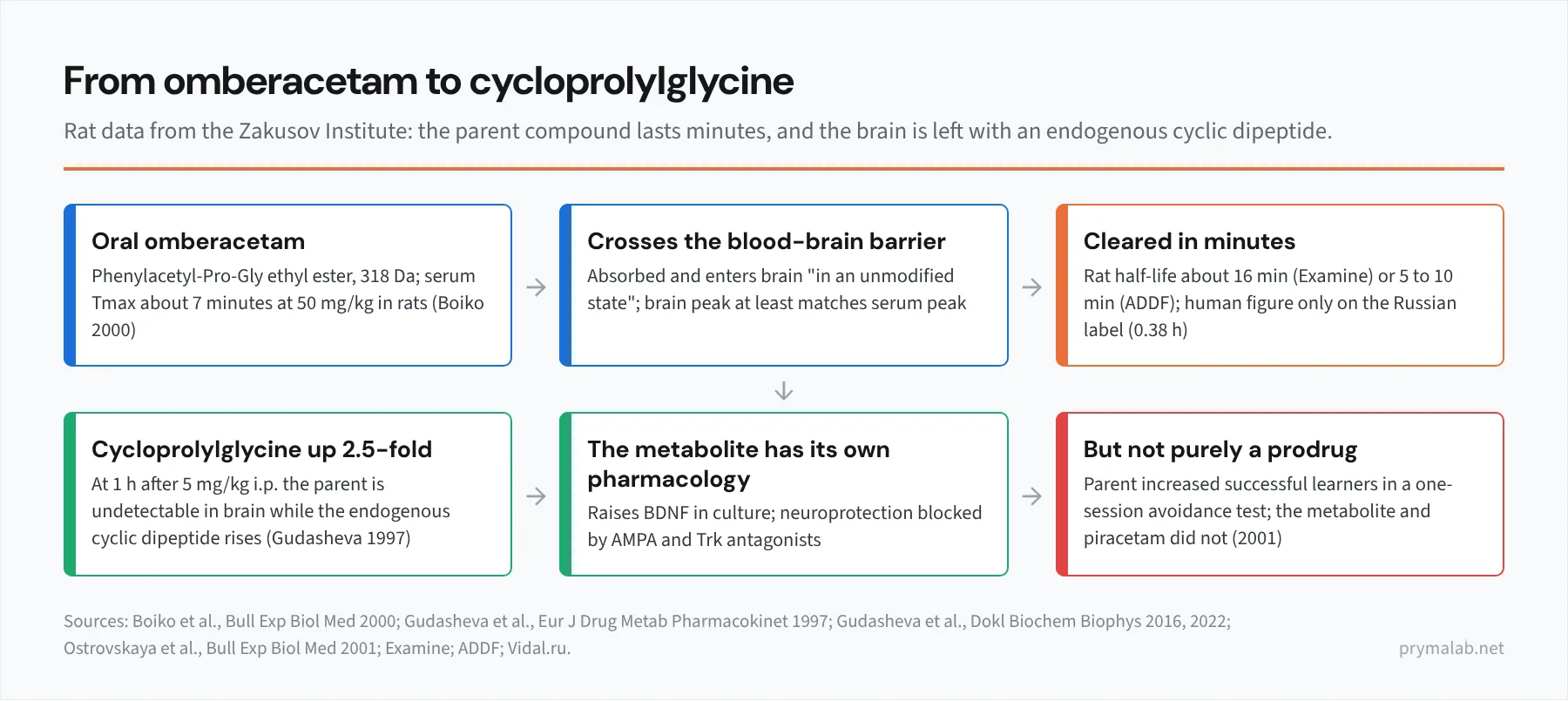
The second thing the design did, perhaps by intent and perhaps by luck, was to make a molecule whose main metabolite is something the brain already makes. Cyclo-prolylglycine, a diketopiperazine formed when proline and glycine close into a six-membered ring, is an endogenous cyclic dipeptide found in rat brain. In 1997 Gudasheva's group gave rats GVS-111 intraperitoneally and went looking for the parent and three candidate metabolites in brain at one hour. The parent was below the detection limit of their HPLC method. Of phenylacetic acid, prolylglycine and cycloprolylglycine, only the cyclic dipeptide rose, by 2.5-fold, and they showed the conversion in vitro with plasma and brain enzymes. Their conclusion: GVS-111 "is prodrug which converts in the body to cyclo-prolylglycine," a compound "identical to the endogenous cyclopeptide that produces the nootropic activity."[9] Secondary summaries quote the absolute brain concentrations as 2.8 rising to 6.7 nmol/g.[10]
That would make Noopept a delivery vehicle for cycloprolylglycine, and the same laboratory has spent years characterising what cycloprolylglycine does on its own: it raised BDNF in neuronal cultures at 10-7 and 10-3 M under normal, glutamate and 6-hydroxydopamine toxicity conditions,[11] and its neuroprotective effect was abolished by AMPA-receptor blockers and by the Trk inhibitor K252a, which is the pattern of a positive AMPA modulator working through TrkB.[12] But the prodrug story is not the whole story, and the developers said so themselves. In a one-session active-avoidance model, repeated Noopept increased the number of rats that learned, while cycloprolylglycine and piracetam did not; the 2001 paper says GVS-111 "principally differs from its main metabolite."[13] So the parent compound, in the minutes it survives, does something the metabolite does not. Which of the two is responsible for which effect is one of the open questions at the end of this article.
The US detour that went nowhere
Russian sources record that the compound was licensed for Western development under the code SGS-111 by a company called Saegis Pharmaceuticals, and the 2003 University of Connecticut paper on oxidative neuroprotection refers to it as "GVS-111 (DVD-111/Noopept)."[14][15] No Western registration followed, and I could not find any record of what the Saegis programme concluded. That absence matters for a reader in 2026: a molecule that was in Western hands twenty years ago and never reached a Phase 2 result outside Russia is a molecule whose Western efficacy has never been tested, not one that was tested and failed, and not one that was tested and passed.
Where it goes: minutes in the blood, cycloprolylglycine in the brain
The pharmacokinetics are mostly rat data from one laboratory, and the numbers are quoted inconsistently in the secondary literature, so it is worth setting them down carefully. The core study is Boiko and colleagues, 2000, in Bulletin of Experimental Biology and Medicine. The abstract establishes the qualitative result: after oral administration to rats, GVS-111 "is absorbed in the gastrointestinal tract, enters the circulation, and penetrates through the blood-brain barrier in an unmodified state."[16] The numbers come from secondary readers of the full paper. Examine's breakdown reports that after oral administration, serum Tmax was 0.116 hours, about seven minutes, with a Cmax of 0.82 µg/mL; brain Cmax was 1.289 µg/g at essentially the same time; the elimination half-life was "around 16 minutes"; and oral exposure was roughly a tenth of an injected dose, which Examine itself flags with the caution that "a true bioavailability study has not been conducted."[10] The Alzheimer's Drug Discovery Foundation, reading the same paper, gives the rodent half-life as 5 to 10 minutes.[17] I could not obtain the primary PDF to adjudicate, so the honest statement is: minutes, not hours, with brain concentration at peak exceeding serum concentration.
Interspecies work from the same group in 2004 adds the only human pharmacokinetic observations I can find. In rats, metabolism after intravenous dosing was "very intensive," with a phenyl-ring hydroxylated metabolite formed presystemically. In rabbits the unchanged drug circulated longer and the hydroxylated metabolite was absent. In humans, elimination was "still slower," with "considerable individual variability," and "no drug metabolites are found in the human blood plasma, probably because of a relatively small dose and low concentration."[18] No numeric human half-life appears in that abstract. The Russian prescribing monograph states a bioavailability of 99.7 percent, a Tmax of about 15 minutes and a plasma half-life of 0.38 hours, roughly 23 minutes, with metabolism to phenylacetic acid, phenylacetylproline and cycloprolylglycine.[19] These are label values with no published method behind them, and 99.7 percent sits uncomfortably beside the ten-percent rat estimate. Wikipedia's summary, that human metabolism and half-life "were not well understood," is the fair one.[1]
The 2018 paper from the same pharmacokinetics group closes the loop on the metabolite: cycloprolylglycine found in rat plasma and brain after Noopept "differed significantly in its pharmacokinetic parameters from noopept" while sharing its spectrum of memory effects.[20] Put together, the picture is a parent compound with a lifetime of minutes that leaves behind a longer-lived active cyclic dipeptide.
How it is thought to work: neurotrophins, HIF-1, antioxidant and the missing receptor
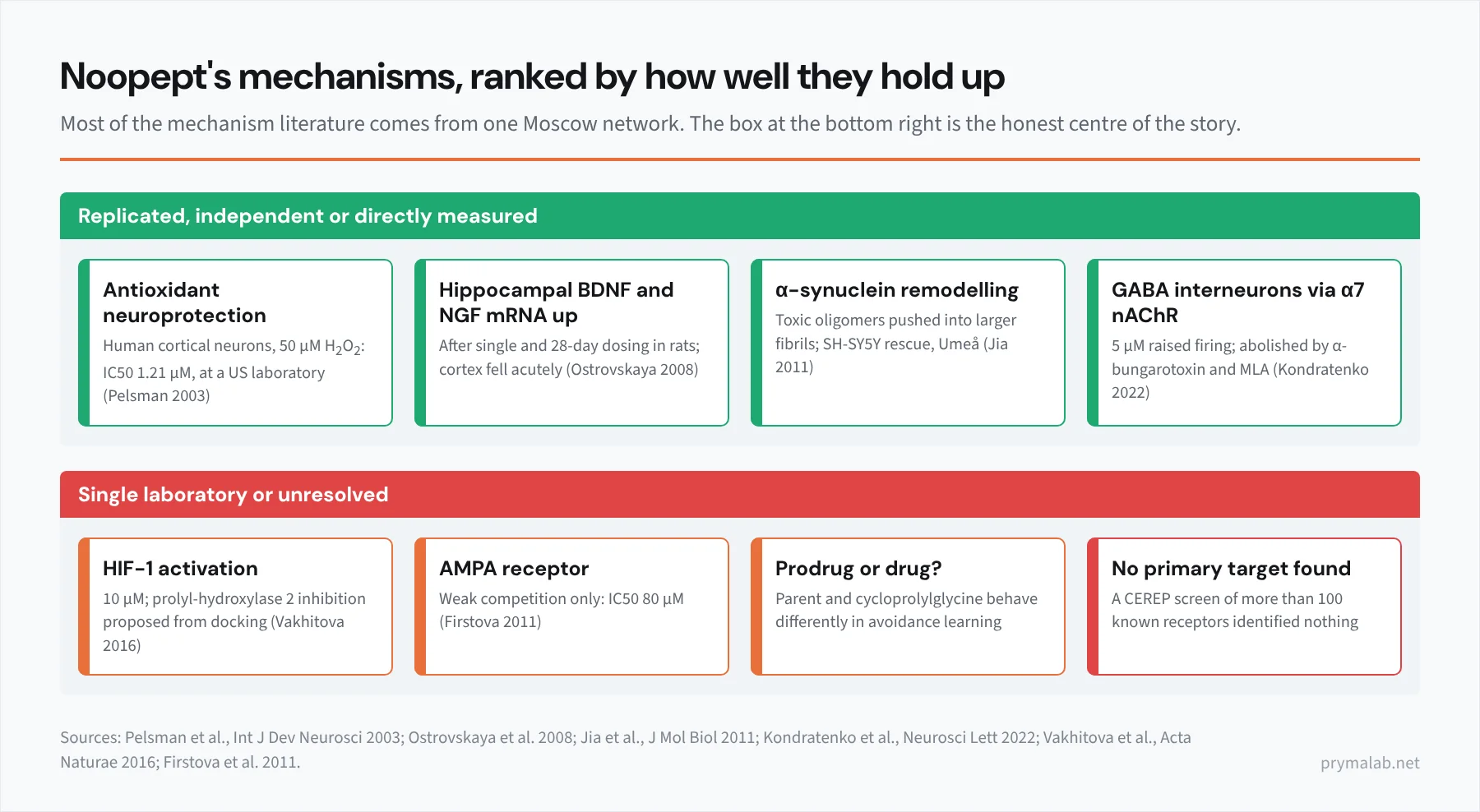
Noopept has been given more mechanisms than most molecules its size, and they are not all equal. I will go through them in rough order of how much they explain, and end with the experiment that failed to find a receptor.
BDNF and NGF
The neurotrophin result is the one most often repeated, and it is a real finding. In 2008 Ostrovskaya's group ran Northern blots on rat brain after Noopept. After a single dose, NGF and BDNF mRNA rose in hippocampus while cortical expression actually fell below control; after 28 days of repeated treatment the hippocampal increase was larger with no tolerance, and cortex showed a slight BDNF rise.[21] A 2010 follow-up with 28 days of intraperitoneal treatment found reduced stress-activated kinases, SAPK/JNK and phosphorylated ERK1/2, in hippocampus alongside higher BDNF mRNA in hippocampus and hypothalamus, with hypothalamic BDNF protein "somewhat increased."[22] Two cautions. First, the acute cortical decrease is almost never mentioned on vendor pages, and it is in the same abstract as the hippocampal increase. Second, a 2021 paper in Heliyon on Noopept and spinal microglial BDNF is sometimes cited as corroboration; it was retracted the same year and should not be used.[23] There is no human BDNF measurement.
HIF-1 and the search for a target
The most interesting mechanistic paper is the 2016 Acta Naturae study, because it reports a negative result most groups would have buried. The authors screened Noopept at the contract laboratory CEREP against more than 100 known receptors, and the screen "did not lead to the expected identification of the primary targets." They then ran a panel of transcription-factor reporter assays in HEK293 cells. At 10 µM, Noopept increased the DNA-binding activity of HIF-1 and of nothing else on the panel: not CREB, NFAT, NF-kappaB, p53, STAT1, GAS, VDR or HSF1. The effect was concentration-dependent and additive with the hypoxia mimetic cobalt chloride; piracetam at 1 mM did nothing; and docking suggested the L-isomer, but not the inactive D-isomer, fits prolyl hydroxylase 2, the oxygen sensor that marks HIF-1alpha for degradation.[5] A 2020 paper confirmed in SH-SY5Y cells that Noopept raised basal and hypoxia-mimetic HIF-1 activity through prolyl-hydroxylase inhibition and increased HIF-1alpha protein.[24] If this holds, Noopept is a mild hypoxia-response inducer, which would unify its neuroprotective, ischaemia and neurotrophin results under one mechanism. It is also, so far, the finding of one network of laboratories.
Antioxidant and anti-apoptotic
This is where the strongest independent data sit. In 2003 Alejandra Pelsman and Jorge Busciglio at the University of Connecticut, with the Moscow group as co-authors but in a US laboratory with its own cultures, exposed human cortical neurons to 50 µM hydrogen peroxide, which killed more than 60 percent of them. GVS-111 was protective from 10 nM up to 100 µM with a half-maximal concentration of 1.21 ± 0.07 µM, blocked free-radical accumulation and lipid peroxidation, outperformed piracetam, vitamin E, propyl gallate and the spin trap s-PBN in the same assay, and reduced degeneration in cortical cultures from Down syndrome fetal tissue.[15] Earlier Moscow work had shown protection of cerebellar granule cells against oxygen-glucose deprivation, glutamate and oxidative stress, where piracetam did not block glutamate toxicity,[25] and a 2016 study protected HT-22 hippocampal cells from 5 mM glutamate across 10-11 to 10-5 M.[26] In PC12 cells pretreated with 10 µM Noopept for 72 hours before amyloid-beta 25-35, viability improved, early and late apoptosis fell, reactive oxygen species and intracellular calcium dropped, mitochondrial potential recovered, and tau phosphorylation at serine 396 was attenuated.[27] An Umeå group found something different with alpha-synuclein: Noopept did not bind a specific site but, through hydrophobic interaction, pushed toxic oligomers into larger, less toxic fibrils, rescuing SH-SY5Y viability.[28]
Glutamate, GABA, acetylcholine and calcium
The remaining mechanisms are smaller pieces. On AMPA receptors, radioligand work found Noopept competes at the [3H]Ro 48-8587 site with an IC50 of 80 µM, an order of magnitude weaker than the reference compound nooglutil; piracetam and phenylpiracetam had no effect at any concentration tested.[29] EEG studies in rats given the compound subcutaneously found increased alpha and beta-1 power with a 30-minute latency; the acute effect was blocked by an NMDA antagonist and the tolerance that developed after eight or nine injections was reversed by an AMPA antagonist.[30][31] In hippocampal slices, 1 µM Noopept increased the frequency of spontaneous inhibitory currents in CA1 pyramidal cells by activating interneurons,[32] and a 2022 paper traced that to alpha-7 nicotinic receptors: 5 µM increased firing of stratum radiatum GABAergic interneurons, and alpha-bungarotoxin at 6 nM or methyllycaconitine at 20 nM abolished it.[33] Behaviourally it reverses scopolamine amnesia in rats and mice and potentiates acetylcholine responses in snail neurons at picomolar to nanomolar concentrations.[34][35][36] On ion channels, 2 µM GVS-111 cut calcium current by 39 percent in snail neurons where 2 mM piracetam managed 19 percent, and 0.1 µM reduced calcium-activated potassium current by 69 percent against 49 percent for 1 mM piracetam.[37]
Finally there is a body of work on inflammation and immunity that rarely makes it into nootropic discussions. Noopept suppressed concanavalin-A inflammation dose-dependently by intravenous and oral routes, cut carrageenan paw oedema by 62 percent at 3 hours after intravenous administration, and reduced adjuvant arthritis scores by 94 percent after intramuscular administration.[38] Five days of intraperitoneal treatment significantly reduced LPS-induced interleukin-6 and roughly halved TNF-alpha.[39] It also has anticoagulant and fibrinolytic activity by intraperitoneal and oral routes, with cycloprolylglycine active in vitro down to 10-10 M.[40] None of these has been examined in people.
The animal record: memory, stroke, amyloid and anxious mice
The animal literature is extensive, almost entirely from the Zakusov Institute and its collaborators, and uses a handful of recurring doses. The Alzheimer's Drug Discovery Foundation's review summarised the problem in one sentence: "Almost all studies have been conducted in a single laboratory that used non-standard animal models and outcome measures."[17] With that in mind, here is what the models showed.
Memory and the non-monotonic response
The anchor result is oral activity in passive avoidance. Ostrovskaya's 2001 paper established that GVS-111 given by mouth retained its antiamnesic activity in rats.[13] Examine's reading of the series is that a low and a higher tested amount worked while two others did not, a non-monotonic pattern the developers have not explained.[10] After frontal lobectomy, nine days of intraperitoneal treatment restored active and passive avoidance and open-field habituation.[41] Against scopolamine, Noopept prevented the spatial-memory deficit in BALB/c mice.[36] And the effect depends on who the mouse is: the same treatment improved long-term memory in BALB/c mice, which learn poorly at baseline, produced no further gain in C57BL/6J mice, which learn well, and did nothing in DBA/2J.[42] That strain dependence is worth holding onto when reading claims about healthy humans.
Stroke models
Photochemical cortical stroke was the group's main ischaemia model. Nine days of intravenous treatment beginning one hour after the lesion attenuated the passive-avoidance deficit and "significantly diminished the volume of the infarcted area."[43] Related papers found improvement across all three memory stages, strongest in the most impaired animals, and activity by both intraperitoneal and oral routes after compression injury.[44][45] In a middle-cerebral-artery occlusion model from a different Moscow laboratory, repeated intraperitoneal treatment over the first 48 hours reduced infarct volume from 18.6 to 12.2 percent of the hemisphere, a 34.5 percent reduction with p below 0.05.[46] In chronic bilateral carotid ligation, seven days of treatment improved survival and behaviour and blocked the build-up of lipid-peroxidation products.[47]
Alzheimer's models
Three models have been used. In olfactory-bulbectomised NMRI mice, a model with amyloid pathology and spatial-memory loss, 21 days of treatment plus five training days restored Morris-maze performance and, unexpectedly, raised serum antibodies to amyloid-beta 25-35 oligomers; this appeared in the Journal of Psychopharmacology in 2007 with a British co-author.[48][49] When amyloid-beta 25-35 was injected into the nucleus basalis of Meynert, seven days of prophylactic intraperitoneal treatment "completely prevented" the memory deficit, and treatment starting at day 15 also normalised it.[50] In the intracerebroventricular streptozotocin model of sporadic Alzheimer's disease, Noopept reversed the loss of NGF and BDNF, the rise in malondialdehyde and the memory deficit.[51] These are models of amyloid toxicity and cholinergic loss, not of the human disease, and none has been replicated outside Russia.
Anxiety, and a developmental warning
The developers describe Noopept as having an "additional selective anxiolytic action,"[4] and the mouse data show where "selective" comes from. Anxiolytic and exploratory effects appeared only in high-anxiety BALB/c mice, not in C57BL/6, were maximal at day 7 of treatment, and tracked prefrontal benzodiazepine-receptor density.[52][53] In learned-helplessness models, Noopept accelerated active-avoidance acquisition and 21 days of treatment eliminated the helplessness signs.[54][55] The result that should be better known is from 2005: rats given Noopept subcutaneously on postnatal days 8 to 20 showed disturbed declarative and procedural learning as adults, with fewer successful learners among males.[56] A companion study found no adult behavioural changes in females.[57] Piracetam given in the same design also reduced the share of successful male learners. The Russian label contraindicates use under 18 without saying whether that reflects this finding or simply the absence of paediatric data, and it is the only place in the literature where Noopept made cognition worse.
The thousand-fold figure
Now the comparison that sells the product. The statement that Noopept is a thousand times more potent than piracetam originates with the developers: the 2002 review by Ostrovskaya, Gudasheva, Voronina and Seredenin says the effective dose is "1000 times lower for noopept than for pyracetam," and the 2016 Acta Naturae paper repeats "doses 1,000 times lower."[4][5] The underlying comparison is their own, built from the effective amounts of each compound in their models and laid out in the manufacturer-affiliated monograph.[58] It is a dose ratio in one laboratory's assays, not an independent potency study, and the ratio moves with the assay: about 1,000-fold on calcium current, about 10,000-fold on calcium-activated potassium current, about 2,000-fold on the EEG dose, and Examine notes figures "between 200 and 50,000" depending on the endpoint.[10][30][37] Potency by weight also says nothing about maximal effect. A drug that does the same thing at a thousandth of the dose is more potent, not more effective, and the only human comparison, below, did not test equivalent effect at matched endpoints. PrymaLab's own product page uses the thousand-fold figure; this article is where the sourcing for it lives.
The human record: one active-comparator trial and a handful of open series
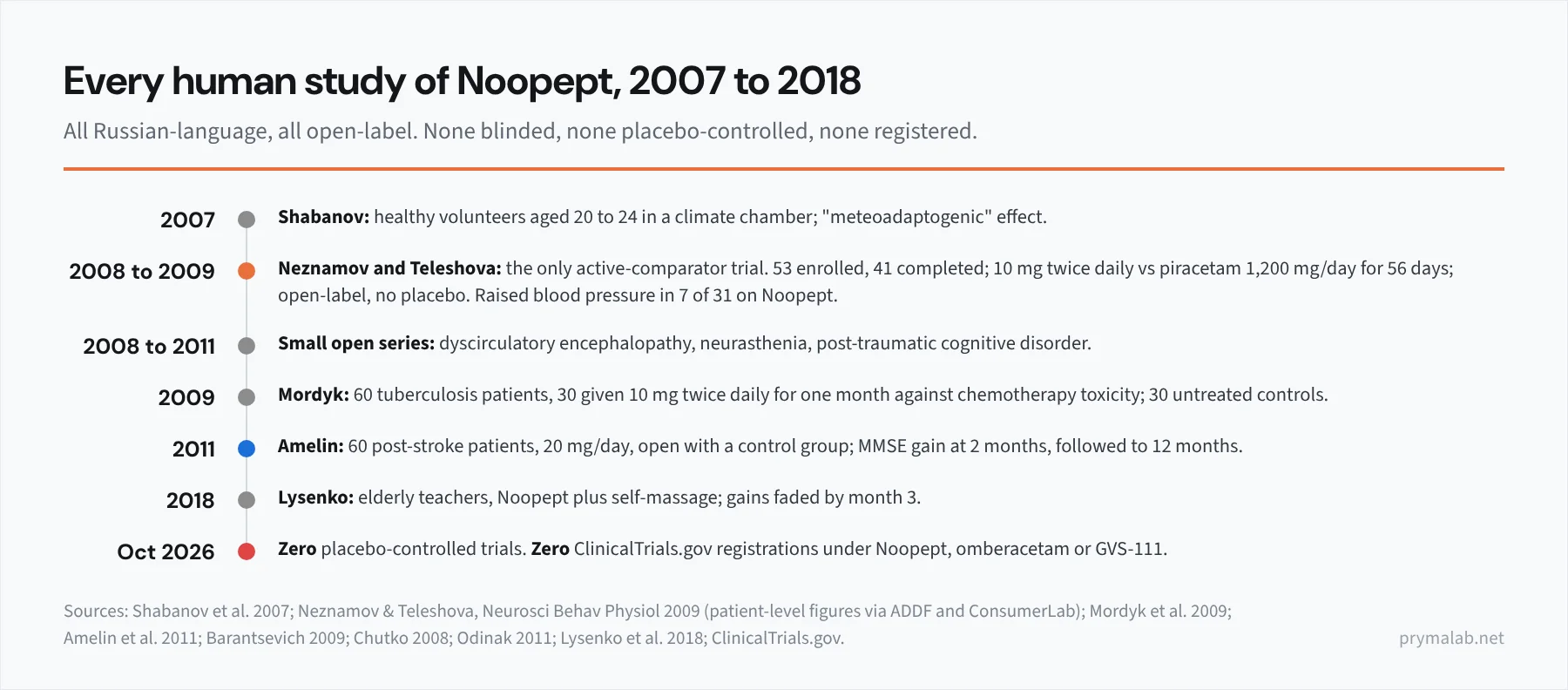
Here is the whole of the human efficacy literature that I could identify, and it is short enough to list.
The study every page cites is Neznamov and Teleshova, published in Russian in 2008 and in English translation in Neuroscience and Behavioral Physiology in 2009.[59][60] It was an open, comparative trial at the Zakusov Institute's clinical laboratory with no placebo arm. Fifty-three patients with mild cognitive disorder of vascular origin, described as dyscirculatory encephalopathy with emotional lability, or of traumatic origin, post-concussion syndrome, were enrolled and 41 completed. Adverse events are reported for 31 Noopept-treated patients; the comparator group received piracetam; treatment ran 56 days. Mini-Mental State scores in the Noopept arm moved from 26 to 29.[17] Responder rates were 42.9 percent in vascular and 70 percent in post-traumatic patients on Noopept, against 25 and 16.7 percent on piracetam.[61] The adverse events recorded on Noopept were sleep disturbance in 5 of 31, irritability in 3 of 31 and raised blood pressure in 7 of 31, two of whom needed antihypertensive treatment; Examine summarises the overall side-effect rate as 1.8-fold lower than piracetam's.[10][17][61] A companion EEG paper reported increased alpha and beta power and reduced delta, interpreted as "nonspecific activation and anxiolytic effect," clearer in the vascular group.[62] Every one of those patient-level numbers reaches me through secondary sources, the ADDF review, ConsumerLab and Examine, because the primary abstract is not indexed and the full text is paywalled; I have not been able to read the trial itself, and neither, I suspect, have most of the people citing it.
The second-largest study is Amelin and colleagues, 2011: an open prospective study of 60 post-stroke patients, followed to 12 months. At two months there was significant improvement on MMSE and an association test against the control group; the authors reported "mild improvement" on global efficacy and a "high level of safety."[63] Around these two sit a cluster of small Russian-language open series: dyscirculatory encephalopathy, neurasthenia, post-traumatic cognitive disorder, 30 tuberculosis patients studied for the neurotoxicity of chemotherapy, healthy volunteers aged 20 to 24 in a climate chamber for a "meteoadaptogenic" effect, and elderly teachers given Noopept plus self-massage, whose gains had faded by month three.[64][65][66][67][68][69]
What is missing is more important than what is present. The Alzheimer's Drug Discovery Foundation counts "Clinical trials: 1 conducted, 0 ongoing" and concludes that "little clinical evidence supports its use."[17] ConsumerLab notes that both human studies "did not include a placebo control" and that there is "no evidence that Noopept will improve cognition and memory in healthy individuals."[61] I searched ClinicalTrials.gov and found no registration under Noopept, omberacetam or GVS-111. There is no Western trial, no double-blind trial, no placebo-controlled trial and no healthy-volunteer cognition trial, and the longest controlled treatment period is about two months (56 days in the comparator trial; two months in the post-stroke series). A reader who sees Noopept described as "clinically proven" should ask: proven against what, in how many people, and blinded by whom.
What Reddit adds, and what it cannot
Because "noopept reddit" is searched more often than "noopept dosage," the community record deserves a paragraph. The largest structured dataset is a 2014 survey of r/nootropics and Longecity users with 162 respondents, in which Noopept ranked in the middle to upper part of 28 substances for perceived benefit.[70] The recurring complaints in community threads are headache, irritability and insomnia, which map closely onto the adverse events the 2009 trial recorded: irritability in 3 of 31, sleep disturbance in 5 of 31.[17] The recurring benefit claims, sharper recall and faster verbal fluency within an hour, map onto nothing in the human literature, because no study has tested memory or cognition in healthy adults; the two healthy-volunteer reports measured climate adaptation and teachers' work performance. A survey of self-selected users who know what they took cannot separate the drug from the expectation, and a trial that could has not been run. That is the whole of what can be said.
What the Noopept studies measured
This section lists the systems the published studies used and what each measured. It is split by system because the gap between the cell, animal and human work is the point.
| System | Concentration or design | Endpoint | Source |
|---|---|---|---|
| Human cortical neurons, H2O2 | 10 nM to 100 µM | Neuroprotection, IC50 1.21 µM | Pelsman 2003[15] |
| HEK293 reporter cells | 10 µM | HIF-1 DNA binding up; other factors unchanged | Vakhitova 2016[5] |
| Hippocampal slices | 1 to 5 µM | Interneuron firing and sIPSC frequency up | Kondratenko 2010, 2022[32][33] |
| AMPA radioligand binding | IC50 80 µM | Weak competition at the Ro 48-8587 site | Firstova 2011[29] |
| Bulbectomised mice | 21 days | Morris-maze memory restored | Ostrovskaya 2007[48] |
| Rats, EEG | Subcutaneous | Alpha and beta-1 power up | Vorobyov 2011[30] |
| Rats, stroke, amyloid, neurotrophins | i.p. or i.v. (stroke, amyloid); i.p. for 28 days (BDNF, 2010) | Infarct volume; memory; neurotrophin mRNA | Gavrilova 2006; Ostrovskaya 2008; Ostrovskaia 2010[22][46][50] |
| Rats, passive avoidance, oral | Oral | Antiamnesic; non-monotonic response | Ostrovskaya 2001[13] |
| Rats, inflammation models | i.v. and oral | Oedema, arthritis, cytokines down | Kovalenko 2002; Alekseeva 2012[38][39] |
| Rabbits, 6-month toxicology | 10 or 100 mg/kg oral | No irreversible pathology | Kovalenko 2002[71] |
| Patients, comparator trial | Open-label, 56 days | Responder rate vs piracetam; BP rise 7/31 | Neznamov 2009[60] |
| Post-stroke patients, open | Open, 2 to 12 months | MMSE at 2 months | Amelin 2011[63] |
| Russian label | Label exists; regimen not reproduced | Registered indication | Vidal monograph[19] |
Three things stand out. The in-vitro effects span five orders of magnitude, from 10 nM protection to 80 µM receptor competition, and the concentration that activates HIF-1 is ten thousand times the lowest protective one. No bridging pharmacology between the rodent and human studies has been published. And the human studies all trace to the Russian label. Sublingual, intranasal and other routes discussed in forums have no peer-reviewed human source at all; the only intranasal data are in rats, in a forskolin co-formulation at 20 nM, from a laboratory with a declared industry interest.[72] PrymaLab's 30 mg capsules are a research format; the studies above describe other people's experiments, not a use for them.
Noopept side effects and what toxicology exists
The human adverse-event data come from the trial already described: sleep disturbance in 5 of 31, irritability in 3 of 31, and raised blood pressure in 7 of 31, two requiring treatment.[17][61] The blood-pressure finding, nearly a quarter of the treated group, has never been followed up in a dedicated study. The Russian label lists allergic reactions and possible blood-pressure elevation in people with severe hypertension; contraindicates severe hepatic or renal impairment, pregnancy, lactation, age under 18 and lactose intolerance; and lists insomnia among its cautions.[19] The 2011 post-stroke series reported a "high level of safety" over a year of observation, in open-label conditions.[63]
Toxicology is thinner than the marketing suggests and comes from two kinds of source. The peer-reviewed piece is a 2002 study in Experimental and Clinical Pharmacology: six months of oral Noopept at 10 or 100 mg/kg in rabbits produced "no irreversible pathologic changes," and no allergenic, immunotoxic or mutagenic activity, with no effect on reproduction or offspring development.[71] The other figures circulate from a manufacturer-affiliated monograph: an intraperitoneal LD50 of 5,080 mg/kg in rodents, no deaths at oral doses up to 10,000 mg/kg, and reversible hepatic parenchymal changes at 100 mg/kg for 180 days, with no allergenicity, mutagenicity or reproductive toxicity.[73] I have found no peer-reviewed LD50, and I flag the monograph as promotional. Drug-interaction data are essentially absent; the ADDF lists interactions as "unknown," and the one published interaction is potentiation of valproate's anticonvulsant effect in mice.[17][74] No human exposure has ever been blinded; the longest controlled treatment period is about two months; and the one early-life animal study found lasting impairment.[56][60]
| Finding | Figure | Source type | Caveat |
|---|---|---|---|
| Raised blood pressure | 7 of 31 treated; 2 needed treatment | Open comparator trial[17][61] | Never followed up |
| Sleep disturbance | 5 of 31 | Same trial | Label lists insomnia among its cautions |
| Irritability | 3 of 31 | Same trial | Matches community reports |
| Rabbit 6-month oral toxicity | 10 and 100 mg/kg: no irreversible pathology | Peer-reviewed[71] | Developer laboratory |
| LD50 | 5,080 mg/kg i.p. (rodents) | Manufacturer monograph[73] | No peer-reviewed LD50 found |
| Early-life exposure | Postnatal days 8 to 20: adult learning impaired | Peer-reviewed[56] | Label also contraindicates under-18s; piracetam did the same in that study |
| Drug interactions | Valproate potentiated in mice; otherwise unknown | Peer-reviewed; ADDF[17][74] | No human interaction data |
| Product quality (US market) | Up to 40.6 mg per serving; 9 of 12 label claims inaccurate | Cohen 2021[75] | Supplements, not research-grade |
Noopept vs piracetam, Semax, Selank and Cerebrolysin
Noopept is usually discussed alongside four other compounds: the drug it was designed from and the three Russian neuropeptides it is most often grouped with. The comparison below is about evidence shape, not about which "works better," because no head-to-head other than the piracetam trial exists.
Piracetam is a 142 Da pyrrolidone acetamide; it has decades of trials and a Cochrane review that found the evidence for dementia inconclusive. Noopept's relationship to it is one of design intent, developer-stated potency ratio and a single open trial. In that trial, Noopept produced higher responder rates than piracetam with fewer adverse events; the trial was unblinded and run by the developer's institute.[60][61] The mechanistic contrast is cleaner: in the same assays, piracetam at millimolar concentrations does nothing to HIF-1 and does not block glutamate toxicity, where Noopept does both at micromolar.[5][25]
Semax and Selank are heptapeptides from the Institute of Molecular Genetics in Moscow, given intranasally, with their own Russian open-label records and the same absence of Western placebo-controlled trials; the Semax versus Selank guide goes through them. Where Noopept differs is route and chemistry: it is an orally active small lipophilic ester that survives the gut, where the heptapeptides are given by nose precisely because they would not. Cerebrolysin is a porcine brain-peptide mixture given by injection, with a far larger stroke and dementia trial record, including placebo-controlled studies, and a correspondingly more contested interpretation; the Cerebrolysin reference covers it. If a reader wants the compound in this group with controlled human data, it is Cerebrolysin, not Noopept.
| Noopept | Piracetam | Semax / Selank | Cerebrolysin | |
|---|---|---|---|---|
| Size, class | 318 Da dipeptide ester | 142 Da pyrrolidone | 813 / 751 Da heptapeptides | Peptide mixture, under 10 kDa |
| Route in studies | Oral | Oral | Intranasal drops | i.v. or i.m. infusion |
| Placebo-controlled trials | None | Many | None in English literature | Several, contested |
| Approved anywhere | Russia (OTC) | Many countries, not US | Russia | Russia, parts of Asia and Europe |
| US status | Unapproved; FDA letters | Unapproved; found in supplements | Unapproved, unscheduled | Unapproved, unscheduled |
| PrymaLab format | 30mg capsules | Not supplied | Semax 5mg, Selank 5mg | 60mg vial |
Regulatory status: OTC in Russia, Schedule 4 in Australia, unapproved in the US
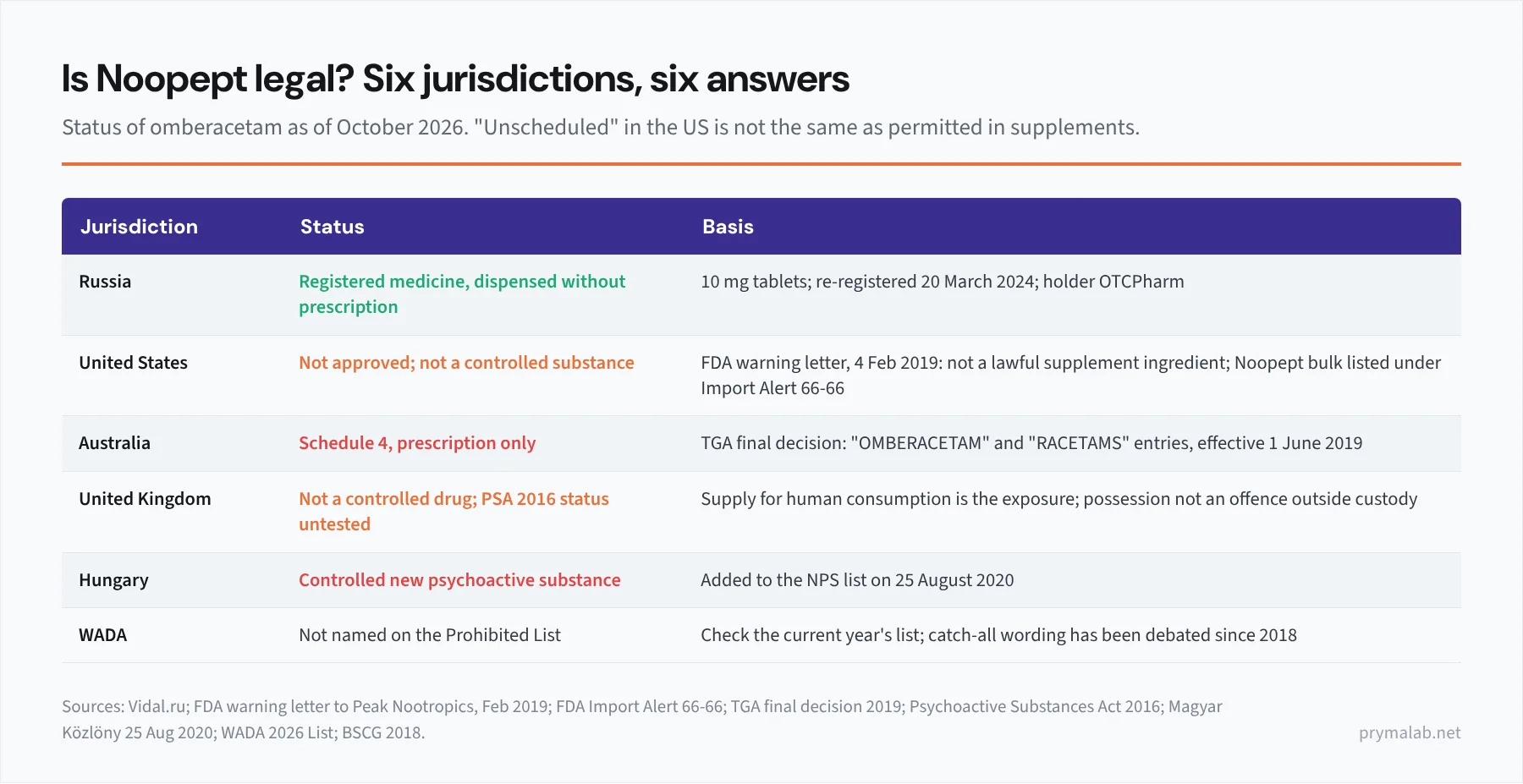
Noopept's legal position is unusually scattered, which is why "is noopept legal" is a question people search for. Country by country, as of October 2026:
Russia. Noopept is a registered medicine, 10 mg tablets, developed at the Zakusov Institute and currently held by OTCPharm with a re-registration dated 20 March 2024; the label states it is dispensed without prescription.[5][19] Indications are memory and attention disorders and emotional lability after brain injury, post-concussion syndrome, cerebrovascular insufficiency and asthenic states.[19] The original approval year is often given as the late 1990s, but the developers' own 2002 review describes the tablets as still "under clinical assessment," so registration more plausibly dates to the mid-2000s.[4]
United States. Not FDA approved and not a controlled substance. The FDA's position is that it is an unapproved new drug that cannot be a dietary-supplement ingredient. A warning letter to Peak Nootropics dated 4 February 2019 named Noopept among thirteen products marketed with disease claims, including Alzheimer's claims, and listed it among eight that "are not dietary supplements or conventional foods" and are unapproved and misbranded drugs.[76] Import Alert 66-66, which covers bulk active ingredients that appear misbranded because they do not meet the research and manufacturing labelling exemptions in 21 CFR 201.122, lists Noopept from at least one Chinese supplier with the note that it "is an analog of Piracetam."[77] The practical consequence showed up in Pieter Cohen's 2021 analysis of ten over-the-counter "cognitive enhancement" supplements: omberacetam was detected at up to 40.6 mg per serving, about four times what the paper calls a typical pharmacologic dose, and nine of twelve declared quantities were inaccurate.[75] Research-grade material sold with a certificate of analysis for laboratory use is a different category from those supplements, and the FDA judges intended use from labelling, marketing and the circumstances of sale together, so a "research use only" label does not settle the question by itself.
Australia. Prescription only. After a November 2018 referral, the TGA created new Schedule 4 entries for "RACETAMS except when separately specified" and for "OMBERACETAM" by name, effective 1 June 2019.[78][79] A 2025 market-surveillance study by twelve official medicines control laboratories from the European network and Australia reported Noopept intercepted "as large bulk quantities of raw material" among "non-authorised drugs only available on prescription in Russia."[80]
United Kingdom. Not a controlled drug under the Misuse of Drugs Act. The Psychoactive Substances Act 2016 makes it an offence to produce, supply or import a substance that stimulates or depresses the central nervous system for human consumption; simple possession is not an offence except in a custodial institution, and medicinal products are exempt.[81] No Home Office determination on Noopept exists, and the frequently repeated claim that it falls outside the Act is unsourced. The honest wording is that its status is untested.
Elsewhere. Hungary added omberacetam to its controlled new-psychoactive-substances list on 25 August 2020.[1] The World Health Organization recommended the INN "omberacetam" in 2018.[82] WADA does not name Noopept or omberacetam on the Prohibited List; a 2018 anti-doping commentary argued it "could perhaps be interpreted as prohibited" under catch-all language, but it has not been added by name as far as the lists I checked show, and the 2027 list should be re-checked before relying on that.[83]
Research-grade omberacetam: what to verify
A research buyer has three practical questions about a Noopept lot, and the literature answers all three.
Identity and chirality. Omberacetam has one stereocentre, at the proline alpha-carbon, and the 2016 docking work found only the L-isomer fits the proposed prolyl-hydroxylase site while the D-isomer is inactive.[5] A certificate should therefore confirm not just mass, 318.37 by HPLC-MS, but identity against a reference standard; the 2025 crystallographic paper provides the solid-state fingerprint, a single stable polymorph with characteristic powder-diffraction and solid-state NMR signatures, that a well-equipped laboratory can match.[3] The purity testing guide explains why an HPLC trace alone does not establish identity.
Quantity. Cohen's 2021 finding that nine of twelve declared drug quantities in US supplements were inaccurate, and that recommended servings could deliver up to 40.6 mg of omberacetam, about four times what the paper calls a typical pharmacologic dose, is the reason to insist on a batch assay rather than a label.[75] PrymaLab's 30mg capsules ship with a certificate of analysis for the lot; a laboratory planning quantitative work should still verify content on receipt.
Stability and handling. The solid is stable; the Warsaw group found no polymorphic transitions or hygroscopic behaviour of concern at ambient conditions.[3] In solution the ethyl ester hydrolyses and the dipeptide cyclises, which is after all the point of the molecule, so aqueous solutions for cell work should be prepared immediately before use, and DMSO stocks kept frozen and used within the day once thawed. The general rules in the storage and stability guide apply, with the added note that the relevant degradation product here, cycloprolylglycine, is itself bioactive and will confound an assay that assumes the parent is what is in the well.
What this article does not settle
I would rather list the gaps than paper over them.
- What Noopept binds first. A screen of more than 100 targets found nothing; the HIF-1 and prolyl-hydroxylase hypothesis comes from one group; AMPA affinity is weak.[5][29]
- Prodrug or drug. The parent is undetectable in brain at one hour yet behaves differently from its metabolite in avoidance tests.[9][13]
- Human pharmacokinetics. One qualitative paper and a set of label values with no published method.[18][19]
- The potency ratio. "1,000x" is a developer-stated dose ratio across their own models, ranging from 200 to 50,000 depending on endpoint.[4][10]
- Efficacy in anyone. No blinded or placebo-controlled trial; no test of memory or cognition in healthy adults; outcome measures in open Russian series.[17][61]
- Blood pressure. Seven of 31 treated patients; never studied again.[17]
- The bent response curve. Active at two tested amounts and inactive at two others in between and above, unexplained.[10][13]
- Long-term and developmental safety. No long-term human data; one rodent early-life study showing impairment.[56]
- Replication. Nearly every in-vivo result is from one institute in Moscow.[17]
Noopept, omberacetam, GVS-111 and "racetam": what the names refer to
Noopept is the registered Russian brand name and the term almost everyone searches for. Omberacetam is the international nonproprietary name recommended by the World Health Organization in 2018; it is the term used in the Australian Poisons Standard, the Hungarian schedule and Pieter Cohen's supplement analyses, and the one AI systems increasingly use.[75][78][82] GVS-111 is the Zakusov Institute's development code and the name in the 1990s and early 2000s primary literature, occasionally mis-rendered as GBS-111 or GBC-111 in translated abstracts.[8] SGS-111 and DVD-111 were codes used during the abandoned US development programme.[14][15] N-phenylacetyl-L-prolylglycine ethyl ester and ethyl 1-(phenylacetyl)-L-prolylglycinate are the chemical names. Cycloprolylglycine is the metabolite, not a synonym. Racetam is a pharmacological family label that includes Noopept by convention but not by chemistry; a search for racetams on this site leads to the nootropics and cognitive compounds category, which is where the product sits.
Why this is not in the same category as stimulants
Omberacetam gets filed with modafinil, caffeine and amphetamine in most places it is discussed, and the pharmacology has nothing in common with any of them. Stimulants work on monoamine transmission: amphetamine reverses the dopamine transporter, methylphenidate blocks it, modafinil acts on it weakly, caffeine blocks adenosine receptors and raises arousal indirectly. None of that is proposed for this dipeptide. No monoamine transporter or receptor affinity has been reported for it or for its metabolite, and the subjective and physiological signatures of a stimulant, raised heart rate, suppressed appetite, delayed sleep onset, are not what the Russian literature reports.
What is proposed instead is neurotrophic. The recurring finding from the originating institute is that nerve growth factor and brain-derived neurotrophic factor expression rise in rat hippocampus, reported in 2008. Two details of that paper are usually dropped. It measured mRNA by Northern blot, not protein by western blot, so the result is a transcription finding and the protein-level confirmation a western blot would give was not part of it. And the hippocampal rise followed a single dose, with 28 days of dosing potentiating rather than producing it, while cortical expression after a single dose fell below control. Nerve growth factor supports cholinergic neurons and brain-derived neurotrophic factor supports synaptic plasticity, so a compound working this way would not produce an acute stimulant-like effect, which is one reason the subjective reports around it are so inconsistent.
The receptor question is less empty than it is often described, and also less settled than a single named target would be. No monoamine receptor or transporter affinity has been reported for omberacetam or for cycloprolylglycine, which is the pharmacological basis for saying this is not a stimulant. Several other sites have been proposed. A 2022 electrophysiology paper concluded that alpha-7 nicotinic acetylcholine receptors are an important site of action, because the compound's effects on CA1 interneuron firing and inhibitory current frequency were abolished by alpha-bungarotoxin and methyllycaconitine. The 2016 transcription-factor work docked it to prolyl hydroxylase 2. And cycloprolylglycine, the proposed metabolite, has been characterised separately as a positive modulator of AMPA receptors, enhancing transmembrane AMPA currents in rat cerebellar Purkinje cells. NMDA receptor involvement rests on weaker evidence: altered Bmax in radioligand binding to the NMDA receptor channel site and to benzodiazepine sites in hippocampus and prefrontal cortex, which is a change in receptor density rather than a demonstrated direct affinity.
The neuroprotection claims: amyloid, HIF-1 and the inflammation data
The animal work extends beyond memory tasks into models of neurodegeneration, and the findings are worth separating from what they would need to show to support claims about brain health in a person.
The amyloid work is routinely described backwards, so it is worth stating what it found. In rats given beta-amyloid 25-35 into the Meynert basal nuclei, not intracerebroventricularly, the compound prevented a long-term memory deficit, and the mechanism the authors proposed was stimulation of antibodies to the peptide rather than removal of it. In olfactory-bulbectomised mice it raised serum antibodies to prefibrillar beta-amyloid 25-35, a result the 2007 paper puts in its own title. No study of this compound has measured amyloid plaque burden at all, and the intracerebroventricular model in this literature uses streptozotocin rather than beta-amyloid. Anyone citing reduced amyloid burden here is citing something that was not measured.
Hypoxia-inducible factor 1 is the group's proposed primary mechanism and it is the best-supported part of the account. A 2016 screen of nine transcription factors found the compound raised DNA-binding activity of HIF-1 alone, with molecular docking to prolyl hydroxylase 2, and a 2020 paper repeated the HIF-1 activation finding. What does not follow, and what is often asserted anyway, is angiogenesis. HIF-1 drives vascular endothelial growth factor transcription in general biology, so new vessel growth is a reasonable thing to look for, but no published study has reported angiogenesis or a VEGF effect for this compound. The nearest relevant result points the other way: a 2019 paper titled to say so found no stimulation of cell proliferation, with no effect on Ki-67 or on cell-cycle distribution in two cell lines. Angiogenesis here is an untested inference from general HIF-1 biology, not a finding.
The anti-inflammatory data are real but belong to a different compartment than they are usually placed in. A 2012 mouse study reported that the compound cut serum interleukin-6 roughly 1.8-fold after concanavalin A and halved serum tumour necrosis factor alpha after lipopolysaccharide, in peripheral inflammation models including carrageenan paw oedema. Those are pro-inflammatory cytokines measured in blood, in peripheral models, not in brain tissue in an injury model. The one paper that claimed spinal microglial effects in an inflammation model was retracted in 2021 and should not be cited. None of these results has been reproduced outside the originating network, and none involves a model of a human neurodegenerative disease that progresses on its own rather than being induced.
The step the whole body of work does not take is into measured cognitive function in a healthy person. Cognitive performance in the human record comes from one active-comparator trial against piracetam in patients with mild cognitive disorders following vascular or traumatic brain injury, conducted at the compound's originating institute and published without an indexed abstract, so its sample size, randomisation and blinding cannot be verified from the published record. Brain health, as a phrase, does not correspond to any endpoint in any of it.
Frequently asked questions
What is Noopept?
Noopept is the brand name of omberacetam, N-phenylacetyl-L-prolylglycine ethyl ester, a 318 Da dipeptide designed at Moscow's Zakusov Institute of Pharmacology in the early 1990s as a peptide copy of piracetam. It is a registered over-the-counter medicine in Russia, a prescription-only substance in Australia, and an unapproved, unscheduled compound in the United States. PrymaLab supplies it as 30 mg capsules for laboratory research only.
Is Noopept a racetam?
Chemically, no. Racetams share a 2-oxo-pyrrolidine ring and Noopept has none; it is a capped dipeptide ethyl ester. It is grouped with the racetams because it was designed to reproduce piracetam's pharmacophore with amino acids, and the 2025 crystallographic study notes its structure is "quite different" from the rest of the group. The INN omberacetam carries the family suffix for pharmacological, not structural, reasons.
Is Noopept legal in the US?
It is not a controlled substance, but it is not FDA approved and the FDA considers it an unapproved new drug that cannot be sold as a dietary supplement. A 2019 warning letter to a nootropics vendor named Noopept explicitly, and imported Noopept bulk material has been listed under Import Alert 66-66 for not meeting the research and manufacturing labelling exemptions. The FDA judges intended use from labelling, marketing and the circumstances of sale, so a "research use only" label does not settle it by itself.
How does Noopept compare with piracetam?
Noopept was designed from piracetam and its developers report it active at doses about 1,000 times lower in their own rat models; that figure is a dose ratio from one laboratory and varies from 200 to 50,000-fold depending on the assay. In the only human comparison, an open-label 2009 trial of 53 patients, Noopept produced higher responder rates than piracetam with fewer side effects. In cell assays piracetam at millimolar concentrations does not activate HIF-1 or block glutamate toxicity, where Noopept does at micromolar.
What is Noopept's half-life?
In rats, minutes: Boiko 2000 is read as giving about 16 minutes by one secondary source and 5 to 10 minutes by another, with the parent compound undetectable in brain at one hour. In humans the only published paper describes slower elimination with high individual variability and gives no number; the Russian label states 0.38 hours, roughly 23 minutes, without a published method. Its metabolite cycloprolylglycine persists longer.
Does Noopept increase BDNF?
In rats, yes in the hippocampus: BDNF and NGF mRNA rose after a single dose and more so after 28 days of dosing, while cortical expression fell below control after the acute dose. There is no human BDNF measurement. A 2021 paper on spinal BDNF often cited in support was retracted and should not be used.
Is Noopept a prodrug of cycloprolylglycine?
Partly. After intraperitoneal administration in rats the parent compound was undetectable in brain at one hour while the endogenous cyclic dipeptide cycloprolylglycine rose 2.5-fold, and the developers described GVS-111 as a prodrug. But the parent also produces effects in avoidance learning that the metabolite does not, so it is not purely a delivery vehicle.
How were the human Noopept studies designed?
The comparator trial was open-label, compared Noopept with piracetam over 56 days and had no placebo arm; the post-stroke series was an open study followed to 12 months. A Russian drug label exists for the registered medicine. These are study-design facts about a registered Russian medicine, not guidance for research-grade material, which is sold for laboratory use only.
What are Noopept's side effects?
In the one active-comparator trial, 7 of 31 treated patients had raised blood pressure, two needing treatment, 5 had sleep disturbance and 3 had irritability. The Russian label adds allergic reactions, contraindicates pregnancy, lactation, under-18s and severe hepatic or renal impairment, and lists insomnia among its cautions. No long-term human safety data exist, and an early-postnatal rodent study found lasting learning impairment.
Is Noopept banned by WADA?
Not by name. Omberacetam does not appear on the WADA Prohibited List; a 2018 anti-doping commentary suggested it might fall under catch-all language but it has not been added. Athletes should check the current-year list, since lists are revised each autumn.
Is Noopept available over the counter in Russia?
Yes. It is a registered medicine in 10 mg tablets, re-registered in March 2024 and held by OTCPharm, and the label states it is dispensed without a prescription. Its indications are cognitive and emotional disturbances after brain injury, cerebrovascular insufficiency and asthenic states.
What does the evidence say about Noopept experiences reported on Reddit?
A 2014 survey of 162 forum users ranked Noopept in the middle to upper range of 28 substances for perceived benefit, and the complaints that recur in threads, headache, irritability and insomnia, match the adverse events in the 2009 trial. The benefits users describe have never been tested: no study has measured memory or cognition in healthy adults (the only healthy-volunteer studies looked at climate adaptation and work performance in small open designs), and no placebo-controlled trial of it exists in any population.
Is Noopept a stimulant?
No. Stimulants act on monoamine transmission, by reversing or blocking the dopamine transporter or, for caffeine, blocking adenosine receptors. No monoamine transporter or receptor affinity has been reported for this dipeptide or its metabolite, and raised heart rate, appetite suppression and delayed sleep onset are not what the literature reports for it. Other targets have been proposed, including alpha-7 nicotinic acetylcholine receptors and, for the metabolite, AMPA receptors.
What does it do to BDNF and nerve growth factor?
A 2008 paper from its originating institute reported that nerve growth factor and brain-derived neurotrophic factor mRNA rose in rat hippocampus. It was measured by Northern blot rather than by western blot, so it is a transcription result without protein-level confirmation, the hippocampal rise followed a single dose with chronic dosing potentiating it, and cortical expression fell below control after a single dose.
Does it act on the NMDA receptor?
Only weakly. The NMDA receptor evidence is a change in Bmax on radioligand binding in hippocampus and prefrontal cortex, which is receptor density rather than direct affinity. Better-supported proposed sites exist: alpha-7 nicotinic acetylcholine receptors, from a 2022 study where the effects were abolished by alpha-bungarotoxin and methyllycaconitine, prolyl hydroxylase 2 by docking, and AMPA receptors for the metabolite cycloprolylglycine.
What has been reported in models of neurodegeneration?
Not what is usually claimed. In rats given beta-amyloid 25-35 into the Meynert basal nuclei it prevented a long-term memory deficit, with antibody stimulation as the proposed mechanism, and in olfactory-bulbectomised mice it raised serum antibodies to prefibrillar beta-amyloid. No study has measured amyloid plaque burden. Hypoxia-inducible factor 1 activation is well supported, but no study reports angiogenesis or a VEGF effect, and the one proliferation study found none. The pro-inflammatory cytokine reductions were serum interleukin-6 and tumour necrosis factor alpha in peripheral mouse models, not brain tissue.
Is there evidence for cognitive performance in healthy people?
No. The human record is one active-comparator trial against piracetam in patients with mild cognitive disorders after vascular or traumatic brain injury, run at the compound's originating institute and published without an indexed abstract, so sample size, randomisation and blinding cannot be verified. No study has measured cognitive function in a healthy person.
References
- Wikipedia. Omberacetam: chemical identifiers, legal status by country, pharmacokinetic summary. Used for orientation and cross-checked against primary sources where cited. Wikipedia
- PubChem. Noopept (omberacetam), CID 180496: formula, molecular weight 318.37, CAS 157115-85-0, UNII 4QBJ98683M. PubChem
- Araj SK, Szeleszczuk Ł, et al. Physicochemical characterisation of Noopept: thermal analysis, solution and solid-state NMR, X-ray diffraction, DFT and polymorph screening. J Pharm Biomed Anal. 2025;252:116474. PMID 39298839
- Ostrovskaia RU, Gudasheva TA, Voronina TA, Seredenin SB. The original novel nootropic and neuroprotective agent noopept. Eksp Klin Farmakol. 2002;65(5):66-72. PMID 12596521
- Vakhitova YV, Sadovnikov SV, Borisevich SS, et al. Molecular mechanism underlying the action of substituted Pro-Gly dipeptide Noopept. Acta Naturae. 2016;8(1):82-89. PMID 27099787
- Bukanova JV, Solntseva EI, Skrebitsky VG. Selective suppression of the slow-inactivating potassium currents by nootropics in molluscan neurons. Int J Neuropsychopharmacol. 2002;5(3):229-237. Cites US Patent 5,439,930 (Seredenin et al., 1995). PMID 12366875
- Boiko SS, Zherdev VP, et al. HPLC determination of the dipeptide GVS-111 in biological samples. Eksp Klin Farmakol. 1996. PMID 8974563
- Boiko SS, Zherdev VP, et al. Pharmacokinetics of the nootropic dipeptide GVS-111 in rats. Eksp Klin Farmakol. 1997;60(2):53-55. PMID 9206571
- Gudasheva TA, Boyko SS, Ostrovskaya RU, et al. The major metabolite of dipeptide piracetam analogue GVS-111 in rat brain and its similarity to endogenous neuropeptide cyclo-L-prolylglycine. Eur J Drug Metab Pharmacokinet. 1997;22(3):245-252. PMID 9358206
- Examine.com. Noopept: research breakdown, pharmacokinetic figures from Boiko 2000, potency ratios and trial summary. Examine
- Gudasheva TA, et al. Cycloprolylglycine increases BDNF in neuronal cultures under normal and toxic conditions. Dokl Biochem Biophys. 2016;469(1):273-276. PMID 27599510
- Gudasheva TA, et al. Neuroprotective effect of cycloprolylglycine depends on AMPA and TrkB receptor activation. Dokl Biochem Biophys. 2022;507(1):264-267. PMID 36786983
- Ostrovskaya RU, Mirsoev TK, et al. Proline-containing dipeptide GVS-111 retains nootropic activity after oral administration. Bull Exp Biol Med. 2001;132(4):959-962. PMID 11782792
- medi.ru. Noopept monograph, introduction (manufacturer-affiliated; Saegis SGS-111 history). medi.ru
- Pelsman A, Hoyo-Vadillo C, Gudasheva TA, Seredenin SB, Ostrovskaya RU, Busciglio J. GVS-111 prevents oxidative damage and apoptosis in normal and Down's syndrome human cortical neurons. Int J Dev Neurosci. 2003;21(3):117-124. PMID 12711349
- Boiko SS, Ostrovskaya RU, Zherdev VP, et al. Pharmacokinetics of new nootropic drug GVS-111 and its penetration across the blood-brain barrier after oral administration. Bull Exp Biol Med. 2000;129(4):359-361. PMID 10977920
- Alzheimer's Drug Discovery Foundation. Cognitive Vitality report: Noopept (for researchers). Trial count, adverse-event tallies, laboratory-concentration critique. ADDF (PDF)
- Boiko SS, Korotkov SA, Zherdev VP, et al. Interspecies pharmacokinetics of noopept in rats, rabbits and humans. Eksp Klin Farmakol. 2004;67(1):40-43. PMID 15079908
- Vidal.ru. Noopept (Ноопепт) Russian prescribing monograph: dosage, pharmacokinetic values, contraindications, OTC status, registration ЛП-№(004920)-(РГ-RU) of 20 March 2024. Vidal
- Boyko SS, Zherdev VP, Shevchenko RV. Pharmacokinetics of cycloprolylglycine after noopept administration. Biomed Khim. 2018;64(5):455-458. PMID 30378564
- Ostrovskaya RU, Gudasheva TA, Zaplina AP, et al. Noopept stimulates the expression of NGF and BDNF in rat hippocampus. Bull Exp Biol Med. 2008;146(3):334-337. PMID 19240853
- Ostrovskaia RU, Vakhitova IuV, et al. Neuroprotective effect of noopept on stress-activated kinases and BDNF after 28-day administration. Eksp Klin Farmakol. 2010;73(12):2-5. PMID 21395007
- Retraction notice: Taghizadeh M, et al. Heliyon 2021 (Noopept and spinal microglial BDNF). PMID 34041381
- Zainullina LF, et al. Noopept activates HIF-1 in SH-SY5Y cells via prolyl hydroxylase inhibition. Dokl Biochem Biophys. 2020;494(1):256-260. PMID 33119829
- Andreeva NA, et al. Neuroprotective properties of nootropic dipeptide GVS-111 in in vitro oxygen-glucose deprivation, glutamate toxicity and oxidative stress. Bull Exp Biol Med. 2000;130(10):969-972. PMID 11177296
- Antipova TA, et al. Noopept protects HT-22 hippocampal neurons from glutamate toxicity. Bull Exp Biol Med. 2016;161(1):58-60. PMID 27265136
- Ostrovskaya RU, Vakhitova YV, Kuzmina USh, et al. Neuroprotective effect of novel cognitive enhancer noopept on AD-related cellular model involves the attenuation of apoptosis and tau hyperphosphorylation. J Biomed Sci. 2014;21:74. PMID 25096780
- Jia X, Gharibyan AL, et al. Neuroprotective and nootropic drug Noopept rescues alpha-synuclein amyloid cytotoxicity. J Mol Biol. 2011;414(5):699-712. PMID 21986202
- Firstova IuIu, Vasil'eva EV, Kovalev GI. Effects of nootropic drugs on hippocampal and cortical AMPA receptor binding. Eksp Klin Farmakol. 2011;74(1):6-10. PMID 21476267
- Vorobyov V, Kaptsov V, Kovalev G, Sengpiel F. Effects of nootropics on the EEG in conscious rats and their modification by glutamatergic inhibitors. Brain Res Bull. 2011;85(3-4):123-132. PMID 21414388
- Kovalev GI, Vorob'ev VV. EEG effects of noopept in rats. Eksp Klin Farmakol. 2002;65(6):6-9. PMID 12596524
- Kondratenko RV, et al. Noopept enhances spontaneous inhibitory synaptic currents in CA1 pyramidal cells. Neurosci Lett. 2010;476(2):70-73. PMID 20382202
- Kondratenko RV, et al. Alpha-7 nicotinic receptors mediate noopept's activation of hippocampal GABAergic interneurons. Neurosci Lett. 2022;790:136898. PMID 36195298
- Ostrovskaia RU, Mirzoev TKh, et al. Cholinergic component of noopept's action: potentiation of acetylcholine responses and reversal of scopolamine deficits. Eksp Klin Farmakol. 2001;64(2):11-14. PMID 11548439
- Radionova KS, Belnik AP, Ostrovskaya RU. Noopept abolishes scopolamine- and mecamylamine-induced amnesia. Bull Exp Biol Med. 2008;146(1):59-62. PMID 19145351
- Belnik AP, Ostrovskaya RU, Poletaeva II. Noopept prevents scopolamine-induced spatial memory deficit in BALB/c mice. Bull Exp Biol Med. 2007;143(4):431-433. PMID 18214292
- Solntseva EI, et al. The effects of piracetam and its novel peptide analogue GVS-111 on neuronal voltage-gated calcium and potassium channels. Gen Pharmacol. 1997;29(1):85-89. PMID 9195198
- Kovalenko LP, Miramedova MG, et al. Anti-inflammatory properties of noopept. Eksp Klin Farmakol. 2002;65(2):53-55. PMID 12109295
- Alekseeva SV, et al. Noopept reduces LPS- and concanavalin-A-induced cytokines. Eksp Klin Farmakol. 2012;75(9):25-27. PMID 23156084
- Ostrovskaia RU, Liapina LA, et al. Antithrombotic, anticoagulant and fibrinolytic effects of noopept and cycloprolylglycine. Eksp Klin Farmakol. 2002;65(2):34-37. PMID 12109290
- Ostrovskaya RU, Romanova GA, et al. The nootropic and neuroprotective proline-containing dipeptide GVS-111 restores learning after frontal lobectomy. Behav Pharmacol. 1997;8(2-3):261-268. PMID 9833021
- Bel'nik AP, Ostrovskaya RU, Poletaeva II. Genotype-dependent memory effects of noopept in BALB/c, C57BL/6J and DBA/2J mice. Neurosci Behav Physiol. 2009;39(1):81-86. PMID 19089630
- Ostrovskaya RU, Romanova GA, et al. Memory restoring and neuroprotective effects of GVS-111 in photochemical stroke. Behav Pharmacol. 1999;10(5):549-553. PMID 10780261
- Romanova GA, et al. Noopept improves memory stages after cortical photothrombosis. Bull Exp Biol Med. 2002;134(6):528-530. PMID 12660828
- Romanova GA, et al. Oral and intraperitoneal GVS-111 after compression injury. Bull Exp Biol Med. 2000;130(9):846-848. PMID 11177261
- Gavrilova SA, Us KS, Ostrovskaia RU, Koshelev VB. Neuroprotective effect of noopept in middle cerebral artery occlusion in rats. Eksp Klin Farmakol. 2006;69(4):16-18. PMID 16995431
- Zarubina IV, Shabanov PD. Noopept in chronic bilateral carotid ligation. Bull Exp Biol Med. 2009;147(3):339-344. PMID 19529857
- Ostrovskaya RU, Gruden MA, Bobkova NA, Sewell RD, et al. The nootropic and neuroprotective proline-containing dipeptide noopept restores spatial memory and increases immunoreactivity to amyloid in an Alzheimer's disease model. J Psychopharmacol. 2007;21(6):611-619. PMID 17092975
- Bobkova NV, et al. Noopept in olfactory bulbectomised mice. Eksp Klin Farmakol. 2005;68(5):11-15. PMID 16277202
- Ostrovskaya RU, Belnik AP, Storozheva ZI. Noopept efficiency in experimental Alzheimer disease (amyloid-beta 25-35 into the nucleus basalis of Meynert). Bull Exp Biol Med. 2008;146(1):77-80. PMID 19145356
- Ostrovskaia RU, Tsaplina AP, et al. Noopept in the intracerebroventricular streptozotocin model of sporadic Alzheimer's disease. Eksp Klin Farmakol. 2010;73(1):2-6. PMID 20184279
- Vasil'eva EV, Salimov RM, Kovalev GI. Strain-dependent anxiolytic effects of noopept in BALB/c and C57BL/6 mice. Eksp Klin Farmakol. 2012;75(7):3-7. PMID 23025044
- Kovalev GI, Kondrakhin EA, Salimov RM, Neznamov GG. Noopept's anxiolytic effect and benzodiazepine receptor density in high-anxiety mice. Eksp Klin Farmakol. 2014;77(12):3-9. PMID 25739185
- Uyanaev AA, Fisenko VP, Khitrov NK. Noopept in learned helplessness. Bull Exp Biol Med. 2003;136(2):162-164. PMID 14631499
- Uyanaev AA, Fisenko VP. Twenty-one-day noopept and learned helplessness. Bull Exp Biol Med. 2006;142(2):202-204. PMID 17369939
- Trofimov SS, Voronina TA, Guzevatykh LS. Early postnatal noopept impairs adult learning in rats. Bull Exp Biol Med. 2005;139(6):683-687. PMID 16224581
- Voronina TA, Guzevatykh LS, Trofimov SS. Early postnatal noopept and piracetam: adult behaviour in female rats. Eksp Klin Farmakol. 2005;68(2):3-7. PMID 15934357
- medi.ru. Advantages of noopept over piracetam (manufacturer-affiliated monograph; dose comparison). medi.ru
- Neznamov GG, Teleshova ES. Comparative studies of Noopept and piracetam in the treatment of patients with mild cognitive disorders in organic brain diseases of vascular and traumatic origin. Zh Nevrol Psikhiatr Im S S Korsakova. 2008;108(3):33-42. PMID 18697252
- Neznamov GG, Teleshova ES. Comparative studies of Noopept and piracetam in the treatment of patients with mild cognitive disorders in organic brain diseases of vascular and traumatic origin. Neurosci Behav Physiol. 2009;39(3):311-321. PMID 19234797
- ConsumerLab. Can Noopept really improve memory and cognition, and is it safe? Summary of the two human studies and their lack of placebo control. ConsumerLab
- Bochkarev VK, Teleshova ES, et al. EEG effects of noopept in patients with mild cognitive disorders. Zh Nevrol Psikhiatr Im S S Korsakova. 2008;108(11):47-54. PMID 19008801
- Amelin AV, Iliukhina AIu, Shmonin AA. Noopept in the treatment of mild cognitive impairment in patients with stroke. Zh Nevrol Psikhiatr Im S S Korsakova. 2011;111(10 Pt 1):44-46. PMID 22500312
- Barantsevich ER, et al. Noopept in dyscirculatory encephalopathy. Zh Nevrol Psikhiatr Im S S Korsakova. 2009;109(5):62-64. PMID 19938275
- Chutko LS, et al. Noopept in neurasthenia. Zh Nevrol Psikhiatr Im S S Korsakova. 2008;108(12):51-52. PMID 19253467
- Odinak MM, et al. Noopept in post-traumatic cognitive disorders. Zh Nevrol Psikhiatr Im S S Korsakova. 2011;111(9):73-76. PMID 22027674
- Mordyk AV, et al. Noopept to reduce neuro- and cardiotoxicity of tuberculosis chemotherapy: 60 patients. Klin Med (Mosk). 2009;87(5):59-62. PMID 19565831
- Shabanov PD, Ganapol'skii VP, Aleksandrov PV. Meteoadaptogenic effect of noopept in healthy volunteers in a climate chamber. Eksp Klin Farmakol. 2007;70(6):41-47. PMID 18318195
- Lysenko AV, et al. Noopept and self-massage in elderly teachers. Adv Gerontol. 2018;31(6):996-1001. PMID 30877834
- Slate Star Codex. Nootropics survey results and analysis, 16 February 2014 (n=162; community data). Slate Star Codex
- Kovalenko LP, Smol'nikova NM, et al. Preclinical safety of noopept: six-month oral toxicity in rabbits, allergenicity, immunotoxicity, mutagenicity, reproduction. Eksp Klin Farmakol. 2002;65(1):62-64. PMID 12025790
- Dagda RK, et al. Intranasal noopept with forskolin in a PINK1-knockout rat model of Parkinson's disease (conflict of interest declared). Int J Mol Sci. 2023;24(1):690. PMID 36614135
- medi.ru. Toxicological study of noopept (manufacturer-affiliated monograph; LD50 and chronic toxicity figures). medi.ru
- Kravchenko EV, et al. Noopept potentiates the anticonvulsant effect of valproate in mice. Eksp Klin Farmakol. 2009. PMID 20095393
- Cohen PA, Avula B, Wang YH, Zakharevich I, Khan I. Five unapproved drugs found in cognitive enhancement supplements. Neurol Clin Pract. 2021;11(3):e303-e307. PMID 34484905
- US Food and Drug Administration. Warning letter to Peak Nootropics LLC (Advanced Nootropics), February 2019, naming Noopept among unapproved new drugs marketed as supplements. FDA
- US Food and Drug Administration. Import Alert 66-66: APIs that appear to be misbranded under 502(f)(1) because they do not meet the requirements for the labeling exemptions in 21 CFR 201.122 (Noopept entry, Suzhou MyLand, 17 November 2014). FDA
- Therapeutic Goods Administration (Australia). Consultation: proposed amendments to the Poisons Standard, ACMS meeting November 2018 (omberacetam and racetams proposed for Schedule 4). TGA
- Therapeutic Goods Administration (Australia). Final decisions: new Schedule 4 entries for racetams and omberacetam, implementation 1 June 2019. TGA
- Vanhee C, Deconinck E, et al. Illegal nootropics and other non-authorised drugs intercepted by European OMCLs and the TGA. J Xenobiot. 2025;15(3):88. PMID 40558871
- UK Parliament. Psychoactive Substances Act 2016 (c.2). legislation.gov.uk
- World Health Organization. International Nonproprietary Names, Recommended List 79: omberacetam. WHO Drug Information. 2018;32(1):144.
- Banned Substances Control Group. Noopept could be the next big banned substance in sport after meldonium, 30 April 2018 (commentary on WADA status). BSCG
- Cohen PA, Zakharevich I, Gerona R. Presence of piracetam in cognitive enhancement dietary supplements. JAMA Intern Med. 2020;180(3):458-459. PMID 31764936
Final disclaimer: This article is an educational research reference. Noopept (omberacetam) supplied by PrymaLab is sold and studied for laboratory research use only and is not approved by any regulatory authority in the United States for human or veterinary use. Its registration as a medicine in Russia does not extend to research-grade material sold elsewhere. Statements have not been evaluated by the FDA. Nothing here is medical advice, and no dosing or administration guidance is given or implied.
All cell, animal and human findings described above were produced in academic, institutional or developer laboratories with their own materials and do not describe or support any use of research-grade material. Always verify the legal status of any research compound in your jurisdiction before purchase or use.