Mazdutide vs Survodutide vs Tirzepatide: The Glucagon Receptor Everyone Said Would Raise Blood Sugar, the China-Only Approval, and Why the Press-Release Numbers Never Match the Journals
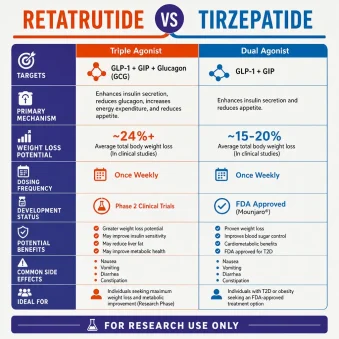
Mazdutide (IBI362, LY3305677) and survodutide (BI 456906) are GLP-1/glucagon receptor dual agonists: mazdutide is a fatty-acylated analogue of the gut hormone oxyntomodulin, survodutide a modified 29-residue glucagon with a C18 diacid. Tirzepatide (LY3298176) pairs GLP-1 with GIP instead, and retatrutide (LY3437943) hits all three receptors. The glucagon arm adds energy expenditure and liver-fat oxidation; the GLP-1 arm offsets its glucose-raising effect, and in every trial to date mean HbA1c fell rather than rose. Mazdutide became the first GLP-1/glucagon dual agonist approved anywhere when China's NMPA cleared it for weight management on 27 June 2025 and for type 2 diabetes on 19 September 2025; its 9 mg dose produced 16.65 percent weight loss at 60 weeks in the JAMA-published GLORY-2 trial. Survodutide completed its pivotal SYNCHRONIZE obesity trials in 2026 with 13.0 percent at 76 weeks in SYNCHRONIZE-1 and roughly one in four participants stopping for adverse events; it is not approved anywhere. Tirzepatide's benchmark is 20.9 percent at 72 weeks and retatrutide's 25.0 percent at 80 weeks, both in heavier, multinational populations. No head-to-head trial among the four exists. PrymaLab supplies Mazdutide 10mg and Survodutide 10mg for laboratory research use only.
- Structure: Mazdutide, oxyntomodulin analogue with a C20 fatty-acid side chain, formula C210H322N46O67, about 4,563 Da; survodutide, 29-amino-acid glucagon backbone with Ac4c at position 2, C-terminal amide and a C18 diacid on a glycine-serine linker at position 24; tirzepatide, 39 residues on a GIP backbone with a C20 diacid at lysine 20; retatrutide, GIP-based triple agonist. All four are lipidated for albumin binding.
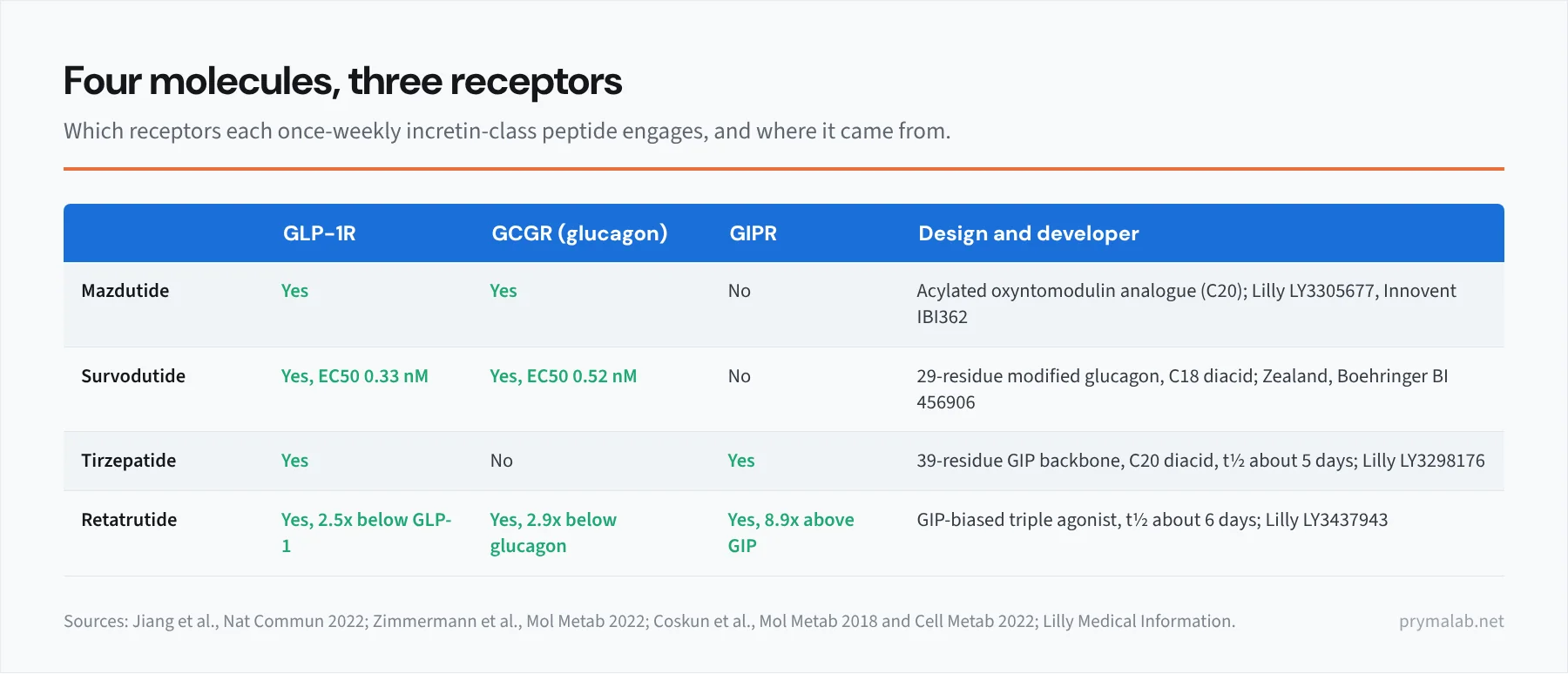
- Class: Mazdutide and survodutide are GLP-1R/GCGR dual agonists; tirzepatide a GLP-1R/GIPR dual agonist; retatrutide a GLP-1R/GIPR/GCGR triple agonist. Survodutide's cAMP EC50 is 0.33 nM at GLP-1R and 0.52 nM at GCGR; retatrutide is 8.9 times more potent than GIP at GIPR and 2.5 and 2.9 times less potent than the native hormones at GLP-1R and GCGR.
- Studied for: Chronic weight management, type 2 diabetes, MASLD and MASH, obstructive sleep apnoea, cardiovascular outcomes. Pivotal programmes: GLORY and DREAMS (mazdutide), SYNCHRONIZE and LIVERAGE (survodutide), SURMOUNT and SURPASS (tirzepatide), TRIUMPH (retatrutide).
- Storage: Lyophilized peptides at −20 °C, desiccated and dark; reconstituted solutions refrigerated and used within the window the certificate specifies. Lipidated peptides aggregate if frozen and thawed repeatedly. See the storage guide.
- Forms and sizes at PrymaLab: Mazdutide 10mg and Survodutide 10mg lyophilized vials. Comparators: Tirzepatide 10mg (5 to 100 mg sizes), Retatrutide 10mg (5 to 60 mg sizes), Cagrilintide 10mg.
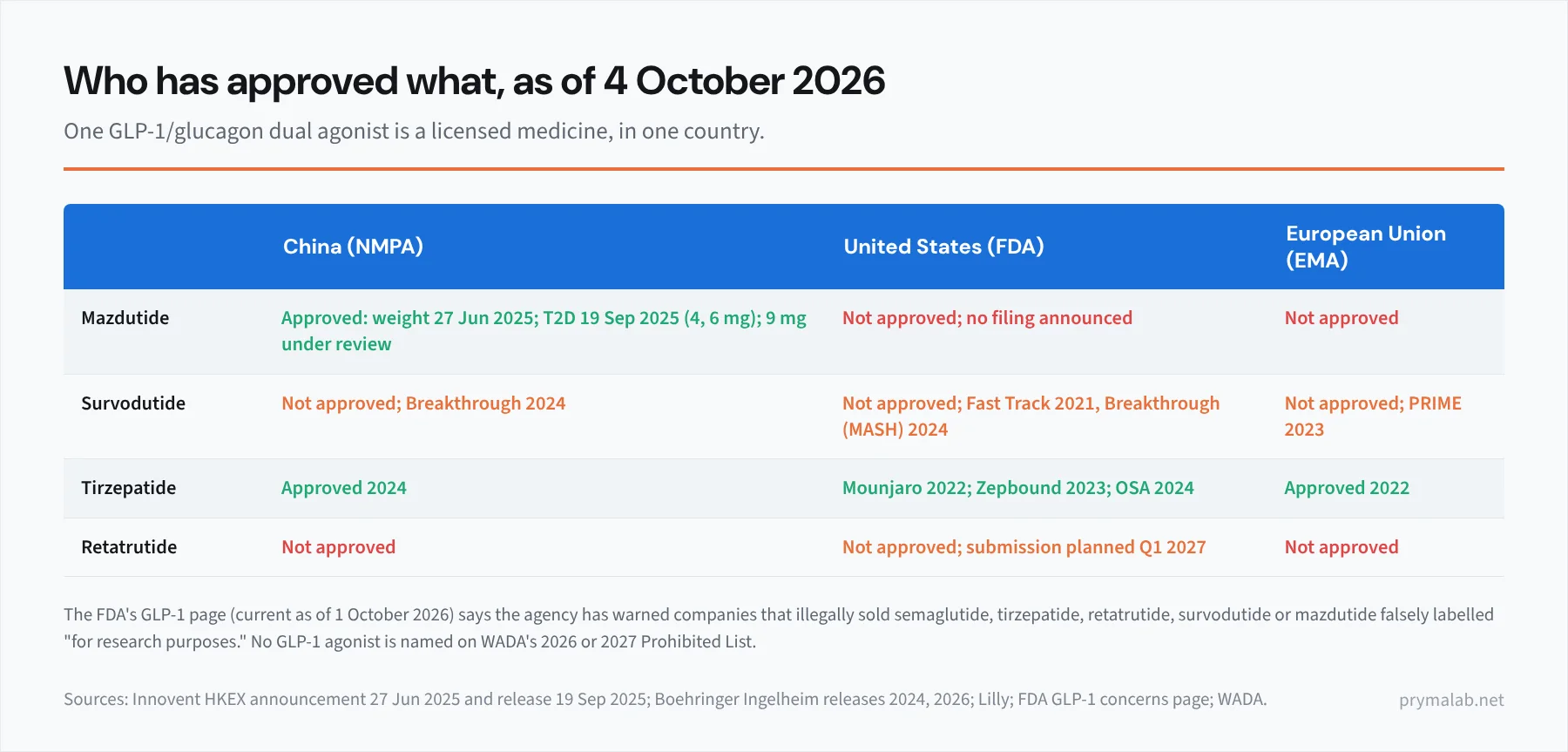
- Regulatory: Mazdutide approved in China only (NMPA, June and September 2025); not FDA or EMA approved, with Eli Lilly holding ex-China rights. Survodutide approved nowhere; FDA Fast Track and Breakthrough Therapy (MASH), EMA PRIME, NMPA Breakthrough. Tirzepatide approved by FDA (2022, 2023, 2024), EMA and NMPA. Retatrutide unapproved; US submission planned for the first quarter of 2027. The FDA's GLP-1 concerns page (current as of 1 October 2026) says the agency has warned companies that illegally sold unapproved semaglutide, tirzepatide, retatrutide, survodutide or mazdutide falsely labelled "for research purposes." No GLP-1 agonist is named on the WADA Prohibited List; unapproved survodutide and retatrutide may fall under S0.
| Mazdutide | Survodutide | Tirzepatide | Retatrutide | |
|---|---|---|---|---|
| Receptors | GLP-1 + glucagon | GLP-1 + glucagon | GLP-1 + GIP | GLP-1 + GIP + glucagon |
| Pivotal weight loss (journal estimand) | −16.65% at 60 wk, 9 mg (GLORY-2) | −13.0% at 76 wk, 6.0 mg (SYNCHRONIZE-1) | −20.9% at 72 wk, 15 mg (SURMOUNT-1) | −25.0% at 80 wk, 12 mg (TRIUMPH-1) |
| Baseline BMI in that trial | 34.3 (China) | 37.9 (multinational) | 38.0 (multinational) | 40.0 (multinational) |
| Stopped for adverse events | 2.9% vs 0% (JAMA) | About 25% (6.0 mg) vs 5.4%, press-reported | 6.2% vs 2.6% (4.3 to 7.1% across doses) | 11.3% vs 4.9% |
| Approval status, Oct 2026 | China (weight, T2D) | None | US, EU, China and others | None; US filing planned Q1 2027 |
See the retatrutide versus tirzepatide reference for the triple-agonist comparison in depth, the tirzepatide reference and semaglutide reference for the approved benchmarks, the cagrilintide reference for the amylin route to the same endpoint, and the supplier verification guide for what to check before buying any GLP-1-class research peptide.
Also known as: Mazdutide, IBI362, LY3305677, "oxyntomodulin analogue" in the early literature; survodutide, BI 456906; tirzepatide, LY3298176, Mounjaro, Zepbound; retatrutide, LY3437943, "triple G" in the lay press. The class is written GLP-1/GCGR dual agonist, GLP-1/glucagon co-agonist or glucagon-based dual agonist. Not the same as cotadutide (MEDI0382, discontinued), pemvidutide (ALT-801) or efinopegdutide (MK-6024), which are other glucagon-containing dual agonists not covered here.
For a decade the objection to putting a glucagon receptor agonist in a weight-loss drug was obvious to anyone who had taken first-year physiology: glucagon raises blood sugar. The counter-argument was that glucagon also raises energy expenditure and burns liver fat, and that enough GLP-1 activity in the same molecule would cover the glucose. In 2026 the argument is being answered by data rather than by physiology. Mazdutide lowered HbA1c by 2.15 percentage points against 0.14 for placebo in treatment-naive diabetics; survodutide lowered it by 0.8 to 0.9 points against 0.2 over 76 weeks by the journal analysis. On average, HbA1c fell rather than rose in every trial reported, and the reason it was added, the liver, showed up exactly where it should: liver-fat reductions of 63 to 73 percent with mazdutide and a 30 percent or greater reduction in 84 percent of survodutide patients. What the field has not settled is whether the extra receptor buys more weight loss than tirzepatide's GIP arm, and here the comparison is harder than any headline suggests. Mazdutide's pivotal trials enrolled Chinese adults with a mean BMI of 31 to 34; tirzepatide's and survodutide's enrolled multinational cohorts at BMI 38; retatrutide's at BMI 40. The companies lead their press releases with the efficacy estimand, the journals lead with the treatment-regimen estimand, and the gap between the two is three to four percentage points for every drug with high discontinuation. Survodutide lost 16.6 percent in the press release and 13.0 percent in the New England Journal; those are the same trial. This reference lays out the molecules, every pivotal number with its estimand attached, the tolerability picture that has split the two dual agonists, and the regulatory map as of October 2026, in which one of them is a prescription drug in China and both appear on the FDA's list of drugs it has warned companies for illegally selling under "research purposes" labels in the United States.
Research-use-only disclaimer: Mazdutide and survodutide supplied by PrymaLab are intended strictly for laboratory research use and are not intended for human or veterinary use. The clinical trial results described below were produced with pharmaceutical-grade investigational or approved products under medical supervision and do not describe or support any use of research-grade material. Trial arms are reported as study-design facts. No dosing or administration guidance appears here. Nothing here is medical advice.

TL;DR
Mazdutide and survodutide both activate the GLP-1 and glucagon receptors; tirzepatide uses GIP instead of glucagon and retatrutide uses all three. Journal-reported weight loss: mazdutide 9 mg −16.65 percent at 60 weeks (GLORY-2, Chinese adults, BMI 34); survodutide 6.0 mg −13.0 percent at 76 weeks (SYNCHRONIZE-1, BMI 38); tirzepatide 15 mg −20.9 percent at 72 weeks (SURMOUNT-1, BMI 38); retatrutide 12 mg −25.0 percent at 80 weeks (TRIUMPH-1, BMI 40). On average the glucagon arm did not raise blood sugar: HbA1c fell by up to 2.15 points with mazdutide and 0.8 to 0.9 with survodutide (journal analysis). It did cut liver fat by 63 to 73 percent. Tolerability split the two dual agonists: adverse-event discontinuation was 2.9 percent with mazdutide 9 mg and about 25 percent with survodutide 6.0 mg (press-reported; 26 percent in SYNCHRONIZE-2). Mazdutide is approved in China for weight management and type 2 diabetes; of the four, only mazdutide (China) and tirzepatide are approved. The FDA's GLP-1 page (current as of 1 October 2026) lists mazdutide and survodutide among drugs it has warned companies for illegally selling under "research purposes" labels. No head-to-head trial among the four exists. Research use only.
Molecules: Mazdutide is an acylated oxyntomodulin analogue (C20 side chain, about 4,563 Da) discovered by Lilly and developed in China by Innovent. Survodutide is a 29-residue modified glucagon with Ac4c at position 2 and a C18 diacid at position 24, discovered by Zealand and developed by Boehringer Ingelheim. Tirzepatide and retatrutide are 39-residue GIP-based peptides from Lilly.
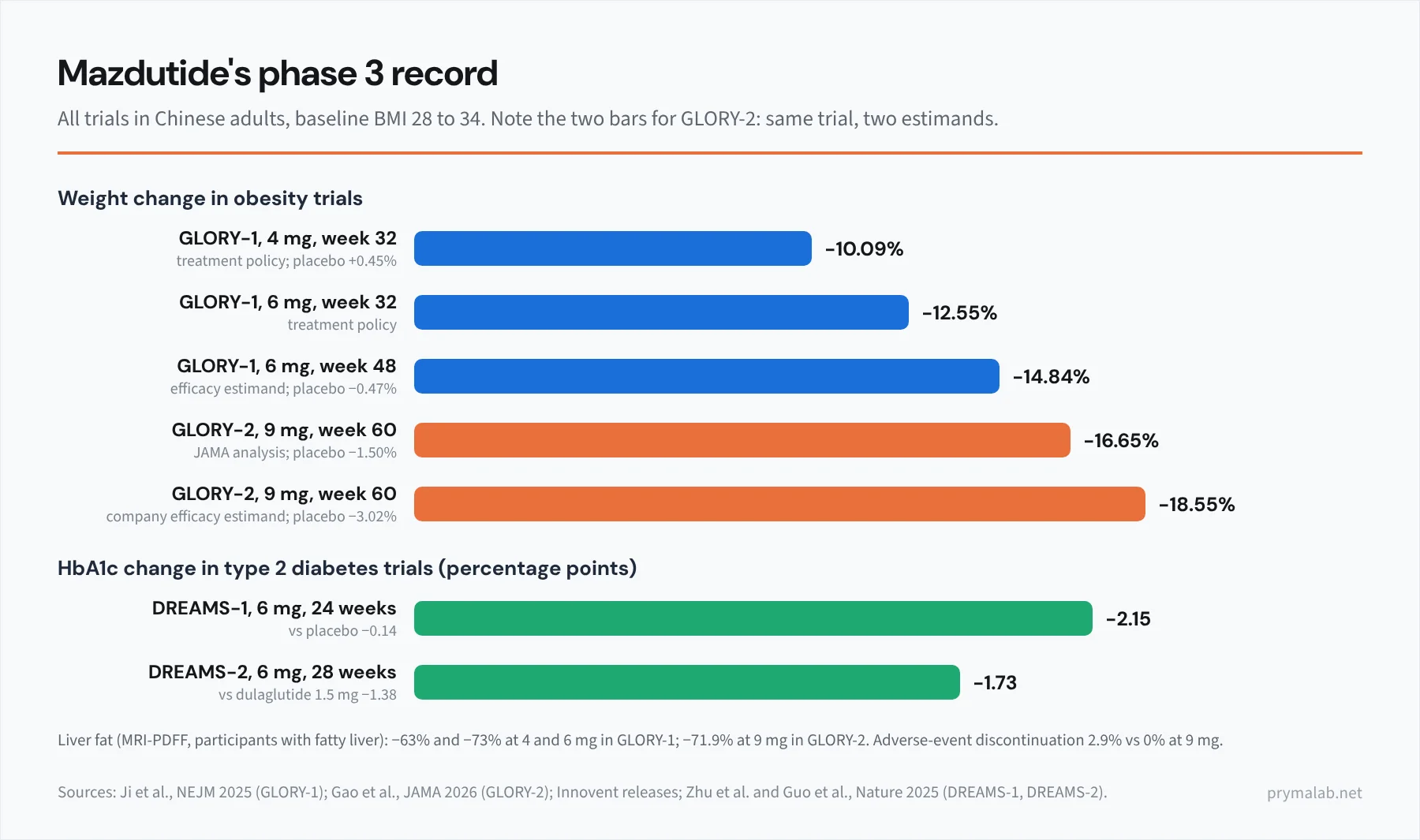
Mazdutide record: GLORY-1 (N=610, 48 wk): −10.09 and −12.55 percent at week 32 for 4 and 6 mg vs +0.45 placebo. GLORY-2 (N=461, 60 wk, 9 mg): −16.65 vs −1.50 percent (JAMA); −18.55 vs −3.02 efficacy estimand. DREAMS-1: HbA1c −2.15 points. DREAMS-2: superior to dulaglutide. DREAMS-3: 48 vs 21 percent reached HbA1c under 7 plus 10 percent weight loss against semaglutide 1 mg. Liver fat −63 to −73 percent.
Survodutide record: Phase 2: −14.9 percent at 46 wk, 60 percent completion. SYNCHRONIZE-1 (N=725, 76 wk): −12.2 and −13.0 percent vs −5.4 placebo (NEJM); up to −16.6 efficacy estimand. SYNCHRONIZE-2 (N=752, T2D): −9.8 vs −3.9 percent; HbA1c −0.9 and −0.8 vs −0.2 (journal); up to −1.21 efficacy estimand. SYNCHRONIZE-MASLD: 84.2 vs 24.3 percent achieved 30 percent liver-fat reduction. MASH phase 2: histological improvement in 62 percent at 4.8 mg vs 14 percent placebo. CVOT completed June 2026, results pending.
Benchmarks: Tirzepatide SURMOUNT-1 −20.9 percent at 72 wk; SURMOUNT-5 −20.2 vs −13.7 for semaglutide. Retatrutide TRIUMPH-1 −25.0 percent at 80 wk, −28.3 efficacy estimand, −30.3 at 104 wk in BMI 35-plus; TRIUMPH-2 (T2D) −18.8; TRIUMPH-3 (CVD) −22.6 (efficacy estimand, topline).
Tolerability: AE discontinuation: mazdutide 2.9 percent (9 mg), tirzepatide 6.2 (15 mg), retatrutide 11.3, survodutide about 25 percent (6.0 mg, SYNCHRONIZE-1; 26 in SYNCHRONIZE-2). Vomiting: mazdutide 9 mg 53.1 percent, survodutide 39 to 45 percent. Heart rate: mazdutide +2.6 bpm at 48 wk; retatrutide dose-dependent rise peaking at 24 wk.
Regulatory: Mazdutide NMPA-approved 27 June 2025 (weight) and 19 September 2025 (T2D); 9 mg under review since November 2025; no US or EU filing. Survodutide unapproved everywhere. FDA GLP-1 page (current 1 October 2026): companies warned for illegally selling semaglutide, tirzepatide, retatrutide, survodutide or mazdutide labelled "for research purposes." Retatrutide US submission planned Q1 2027. No GLP-1 agonist named on WADA's 2026 or 2027 lists; survodutide and retatrutide may fall under S0.
Status: research use only.
Four molecules, three receptors: what each one is
The four peptides in this article are variations on one engineering idea: take a gut or pancreatic hormone, swap residues so it survives in the blood, hang a fatty acid off it so it rides on albumin for a week, and tune which of three receptors it hits. The receptors are the GLP-1 receptor, which suppresses appetite, slows gastric emptying and drives glucose-dependent insulin release; the GIP receptor, the other incretin, whose contribution to weight loss is still debated; and the glucagon receptor, which raises hepatic glucose output but also raises energy expenditure and drives fat oxidation in the liver.[24][46] How a molecule balances those three defines what it is.
Mazdutide: an oxyntomodulin with a tail
Oxyntomodulin is a 37-amino-acid product of the proglucagon gene, made in the gut after meals; it contains the full 29-residue glucagon sequence plus an eight-residue C-terminal extension, and in its native form it activates both the glucagon and GLP-1 receptors weakly and is destroyed within minutes.[24] Mazdutide's developers describe it as "a long-acting synthetic peptide analogue of mammalian oxyntomodulin (OXM), with a fatty-acyl moiety to extend the half-life," which "potently bound to human and mouse GLP-1 receptors and glucagon receptors in vitro."[16] Public structural summaries give a C20 fatty-acid side chain, molecular formula C210H322N46O67 and a mass of about 4,563 Da.[59] I was not able to confirm the residue count, the acylation position or a peer-reviewed receptor potency ratio from a primary source; Innovent's papers describe the agonism only as "balanced."[13][16] In mice it reduced body weight in both glucagon-receptor-knockout and GLP-1-receptor-knockout animals, meaning each arm works on its own, and it increased energy expenditure.[16] In a phase 1b study in Chinese patients with type 2 diabetes, absorption was slow with a median Tmax of about 72 hours and the terminal half-life ranged from 147 to 673 hours, six to 28 days, across participants; four of 24 developed anti-drug antibodies, none neutralizing.[16] The molecule was discovered by Eli Lilly as LY3305677, licensed for China to Innovent Biologics as IBI362, and Lilly retains rights everywhere else.[22]
Survodutide: a glucagon taught to behave like GLP-1
Survodutide came from the opposite direction. Zimmermann and colleagues at Boehringer Ingelheim describe BI 456906 as "a 29-amino-acid peptide optimized to balance the degree of agonism for the human GCGR and GLP-1R by introducing various modifications to the human glucagon sequence."[24] Position 2, where DPP-4 would cleave it, carries the non-coded amino acid 1-aminocyclobutane-1-carboxylic acid; the C-terminus is amidated; and "a glycine-serine linker in position 24, carrying a C18 di-acid," provides the albumin binding that extends the half-life.[24] In CHO cells the cAMP EC50 was 0.33 nM at the GLP-1 receptor and 0.52 nM at the glucagon receptor, roughly 5- and 26-fold less potent than native GLP-1 (60 pM) and glucagon (20 pM) respectively but near-equipotent at the two targets.[24] In diet-induced obese mice it produced greater weight loss than a maximal dose of semaglutide, "driven by increased energy expenditure and reduced food intake," with glucagon-receptor engagement confirmed by hepatic gene expression, circulating amino acids and FGF-21.[24] It was discovered at Zealand Pharma and is developed by Boehringer.[34]
Tirzepatide and retatrutide: the GIP-first designs
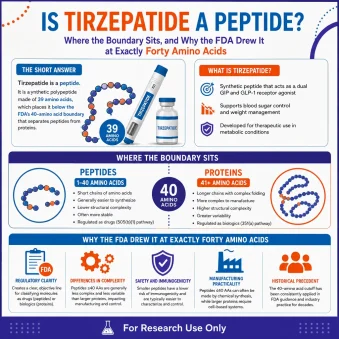
Tirzepatide is "a fatty acid modified peptide with dual GIP and GLP-1 receptor agonist activity," 39 residues on a GIP backbone with a C20 diacid at lysine 20 and a half-life of about five days.[43][44] Retatrutide extends the same scaffold to a third receptor: "LY3437943 shows balanced GCGR and GLP-1R activity but more GIPR activity," with Lilly's own figures giving GIPR potency 8.9 times that of GIP, GLP-1R potency 2.5 times lower than GLP-1, and GCGR potency 2.9 times lower than glucagon, and a half-life of about six days.[46][47] The retatrutide versus tirzepatide reference covers that pair in detail; here they are the yardsticks.
How survodutide was chosen from 19 dual agonists
Survodutide was one of 19 dual glucagon receptor and GLP-1 receptor agonists put through a biomarker-led selection programme, described by Thomas and colleagues in 2024 (Thomas et al. 2024). The team measured cAMP potency in CHO-K1 cells stably expressing the human glucagon and GLP-1 receptors, and checked activity at receptors expressed naturally, using mouse MIN6 insulinoma cells for the GLP-1 receptor and rat primary hepatocytes for the glucagon receptor (Thomas et al. 2024). In mice, improvement in oral glucose tolerance was the read-out for GLP-1 receptor engagement, while rises in plasma fibroblast growth factor-21 (FGF21) and in liver nicotinamide N-methyltransferase (NNMT) mRNA were the read-outs for glucagon receptor engagement (Thomas et al. 2024).
After acute exposure in lean mice, these target engagement markers correlated significantly with the in vitro potencies across all 19 compounds (Thomas et al. 2024). Three candidates, survodutide, BI 456908 and BI 456897, went on to fuller pharmacological profiling, with body weight studied in diet-induced obese mice and glucose lowering in diabetic db/db mice, and survodutide was qualified as the clinical development candidate (Thomas et al. 2024). The liver NNMT marker also appears in the discovery paper by Zimmermann and colleagues as evidence that BI 456906 engages the glucagon receptor in vivo (Zimmermann et al. 2022). The selection work therefore rests on mouse and rat systems, and the abstracts do not give the potency ratio between the two receptors that set survodutide apart from the other 18 compounds.
Why add glucagon, and what happened to blood sugar
The rationale is stated plainly in the survodutide discovery paper. Oxyntomodulin "reduces bodyweight by increasing energy expenditure and reducing energy intake in humans," and "at pharmacological doses, glucagon increases energy expenditure." But "glucagon is the key counter-regulatory hormone" to insulin, so the design goal is to pair glucagon-receptor agonism with enough GLP-1-receptor agonism to cancel the glucose rise.[24] Lilly's retatrutide paper frames the same trade: glucagon-receptor-mediated energy expenditure is added on top of incretin-driven intake reduction.[46] In mice all three glucagon-containing molecules raised energy expenditure, and survodutide outperformed maximally effective semaglutide.[16][24][46]
Two things follow in the clinic. The first is the liver. Glucagon-receptor agonism drives hepatic lipid oxidation, and liver fat is where the dual agonists look most different from everything else. In GLORY-1, participants with at least five percent liver fat at baseline lost 63.26 percent of it on 4 mg and 73.18 percent on 6 mg, against an 8.20 percent gain on placebo, at 48 weeks.[2] In GLORY-2, participants without diabetes and with at least 10 percent baseline liver fat lost 71.9 percent on 9 mg against a 5.1 percent gain.[5] Survodutide's SYNCHRONIZE-MASLD trial reached a 30 percent or greater liver-fat reduction in 84.2 percent of participants against 24.3 percent on placebo by the efficacy estimand, and its phase 2 MASH study produced histological improvement in 62 percent at 4.8 mg against 14 percent on placebo.[27][36]
The second is glucose, and the fear did not materialise. In treatment-naive Chinese adults with type 2 diabetes, mazdutide 6 mg lowered HbA1c by 2.15 percentage points against 0.14 for placebo at 24 weeks.[9] In SYNCHRONIZE-2, survodutide lowered it by 0.9 points on 3.6 mg and 0.8 on 6.0 mg against 0.2 on placebo over 76 weeks by the journal analysis, and by up to 1.21 against 0.03 by the efficacy estimand.[32][33] The developers attribute this to GLP-1-receptor-driven insulin secretion and weight loss outweighing glucagon-driven hepatic glucose output.[24] The mazdutide 9 and 10 mg phase 1b study recorded no hypoglycaemia at all.[14] What the glucagon arm did cost, at least early, was heart rate: in mazdutide's phase 2 the 24-week change was +5.82, +5.38 and +8.75 beats per minute at 3, 4.5 and 6 mg against +4.81 on placebo, and the authors noted that earlier dual agonists cotadutide, SAR425899 and JNJ-64565111 had produced rises of 5 to 15 bpm.[13] By 48 weeks in GLORY-1 the increase was +2.6 bpm in both active arms.[2] Retatrutide's heart-rate rise peaked at 24 weeks and declined thereafter.[45]
One caveat the whole field shares: none of the pivotal trials measured human energy expenditure by calorimetry. The thermogenic contribution of glucagon in people is inferred from mice and from the shape of the weight curves, not measured.[24][46]
Mazdutide: GLORY, DREAMS and the first approval in the class
Mazdutide is the only GLP-1/glucagon dual agonist that is a licensed medicine anywhere, and its entire pivotal record is Chinese. That matters for both the numbers and their interpretation.
Phase 2
The 24-week phase 2 in 248 Chinese adults with overweight or obesity compared three dose levels with placebo and reported weight changes of −6.7, −10.4 and −11.3 percent against a 1.0 percent gain on placebo, with early discontinuation of 10.2 versus 8.1 percent and no drug-related serious adverse events.[13] A second part, in 80 participants at 9 mg, reported a placebo-adjusted 18.6 percent loss at 48 weeks, with liver fat down 73.3 percent at 24 weeks and ALT down 45.5 percent against placebo in those with fatty liver; that 48-week result circulated through company announcement and conference, and I could not find a peer-reviewed 48-week paper.[15] A separate 20-week phase 2 in type 2 diabetes lowered HbA1c by 1.41 to 1.67 points against 1.35 for dulaglutide 1.5 mg.[17]
GLORY-1, the approval trial
GLORY-1 was published in the New England Journal of Medicine in 2025. Six hundred and ten Chinese adults aged 18 to 75 with a BMI of at least 28, or 24 to 28 with a weight-related condition, and without diabetes, were randomised to mazdutide 4 mg, mazdutide 6 mg or placebo for 48 weeks. Baseline weight was 87.2 kg and BMI 31.1.[1][3] At the week-32 primary endpoint, by the treatment-policy estimand, weight fell 10.09 percent on 4 mg and 12.55 percent on 6 mg against a 0.45 percent gain on placebo; 73.9, 82.0 and 10.5 percent lost at least five percent.[1] At week 48 the efficacy estimand gave −12.05 and −14.84 percent against −0.47, with half the 6 mg arm losing 15 percent or more, waist down 9.48 and 10.96 cm, and blood pressure, lipids, uric acid and transaminases all improved.[2] The most frequent adverse events were nausea, diarrhoea and vomiting, mostly mild or moderate.[2] China's NMPA approved mazdutide for chronic weight management on 27 June 2025, for adults with a BMI of 28 or more, or 24 or more with a comorbidity, the Chinese thresholds.[18][19]
GLORY-2, the 9 mg trial
GLORY-2 moved to the higher dose and a heavier population. Four hundred and sixty-two Chinese adults (461 treated) with a BMI of at least 30, 16.1 percent of them with type 2 diabetes, baseline weight 94.0 kg and BMI 34.3, were randomised two to one to 9 mg or placebo for 60 weeks across 27 hospitals.[4][6] The JAMA paper, published in August 2026, reports −16.65 percent (95 percent CI −18.19 to −15.12) against −1.50 percent, a 15.15-point difference, in participants who received at least one dose.[4] Innovent's efficacy-estimand figures were −18.55 against −3.02 percent overall and −20.08 in participants without diabetes, with 44.0 percent losing 20 percent or more, liver fat down 71.9 percent in the fatty-liver subgroup, and discontinuation for adverse events in 2.9 percent against none on placebo, a figure the JAMA abstract also reports.[4][5] The JAMA authors' conclusion was measured: clinically meaningful weight reduction, "but participants receiving the drug experienced gastrointestinal adverse reactions."[4] A supplementary application for 9 mg was accepted by the NMPA on 24 November 2025; I found no approval announcement in sources through early October 2026.[21]
DREAMS: the diabetes programme
Two phase 3 diabetes trials appeared back to back in Nature on 17 December 2025. DREAMS-1 randomised 320 treatment-naive adults, baseline HbA1c 8.24 percent and BMI 28.2, to 4 mg, 6 mg or placebo for 24 weeks: HbA1c fell 1.57 and 2.15 points against 0.14, and the 6 mg arm lost 7.81 percent of body weight.[9] DREAMS-2 randomised 731 adults on oral agents to mazdutide 4 mg, 6 mg or dulaglutide 1.5 mg for 28 weeks and showed HbA1c non-inferior and then superior to dulaglutide, with differences of −0.24 and −0.30 points, and weight differences of −3.78 and −5.76 percent, at the cost of more gastrointestinal events.[10] Those two trials earned the second NMPA approval, for glycaemic control in type 2 diabetes, on 19 September 2025.[20] DREAMS-3, an open-label head-to-head in 349 adults with early diabetes and obesity, reported in October 2025 that 48.0 percent on mazdutide 6 mg against 21.0 percent on semaglutide 1 mg reached both HbA1c under 7 percent and 10 percent weight loss at 32 weeks, with weight down 10.29 against 6.00 percent.[11] Two caveats attach: the comparator was semaglutide at its diabetes strength, not its higher obesity strength, and the trial was open-label and is published only as a design paper.[12] The trial that would answer the obesity question properly, GLORY-3 against semaglutide 2.4 mg in 479 adults with obesity and fatty liver, is active and not recruiting with primary completion estimated for 31 December 2026. No GLORY-3 results exist, and any circulating online should be treated as unverified.[7][8]
Survodutide: SYNCHRONIZE, the liver, and a tolerability problem
Survodutide arrived at phase 3 with the stronger liver story and left it with the weaker weight story, and the reason is tolerability.
Phase 2: a signal and a warning
The phase 2 obesity trial, published in Lancet Diabetes and Endocrinology in 2024, randomised 387 adults with a BMI of 27 or more across 43 centres in 12 countries to 0.6, 2.4, 3.6 or 4.8 mg survodutide or placebo for 46 weeks. Weight fell 6.2, 12.5, 13.2 and 14.9 percent against 2.8 percent.[25] Only 233 of 386 treated participants, 60.4 percent, completed the 46 weeks; those who reached and stayed on 4.8 mg lost 18.7 percent in an actual-treatment analysis; and discontinuation for adverse events ran at about 25 percent against 4 percent on placebo, mostly during escalation.[25][26] The MASH phase 2 published in the New England Journal the same year was the one that drew attention: in 293 adults with biopsy-confirmed MASH and F1 to F3 fibrosis, 48 weeks of 2.4, 4.8 or 6.0 mg produced histological improvement without worsening fibrosis in 47, 62 and 43 percent against 14 percent on placebo by the planned-treatment analysis. The widely quoted "83 percent versus 18.2 percent" figure is the on-treatment analysis from the topline release.[27][28] That result brought FDA Breakthrough Therapy designation for non-cirrhotic MASH with F2 to F3 fibrosis in 2024, on top of Fast Track from 2021.[38]
SYNCHRONIZE-1 and -2
SYNCHRONIZE-1, published in the New England Journal in June 2026, randomised 726 adults without diabetes (725 analysed), BMI 30 or more or 27 with a complication, baseline weight 108.8 kg and BMI 37.9, to survodutide 3.6 mg, survodutide 6.0 mg or placebo for 76 weeks. By the treatment-regimen estimand, which "incorporates the effects of any early discontinuation, protocol-prohibited obesity medications, and a prolonged dose-escalation period," weight fell 12.2 percent on 3.6 mg and 13.0 percent on 6.0 mg against 5.4 percent on placebo; 72.6, 71.9 and 46.3 percent lost at least five percent.[29][35] Boehringer's efficacy-estimand figures were up to 16.6 percent against 3.2, with 85.1 percent five-percent responders.[30] Two features of that result stand out: the placebo response of 5.4 percent is unusually large, and the two active doses produced nearly identical results.[29] Body-composition data presented at ADA 2026 showed visceral fat down 34 percent against 12 and liver fat down 63.1 percent against 25, with lean mass making up no more than 10.8 percent of tissue lost.[31] Discontinuation for adverse events, as reported by the trade press from the ADA presentation, was about 24 percent on 3.6 mg and 25 percent on 6.0 mg against 5.4 percent on placebo, with vomiting in 45 percent on the high dose.[31][34]
SYNCHRONIZE-2, in 752 adults with type 2 diabetes and a BMI of 27 or more, baseline HbA1c 7.4 percent, was published on 1 October 2026 alongside its EASD presentation. Weight fell 8.2 and 9.8 percent against 3.9 by the treatment-regimen estimand, up to 13.1 percent by the efficacy estimand, and HbA1c fell 0.9 and 0.8 points against 0.2 by the journal analysis, up to 1.21 against 0.03 by the efficacy estimand.[32][33] Trade reports gave vomiting in 39 percent and adverse-event discontinuation of 26 percent; one analyst called the profile "less competitive vs other agents" and Zealand's shares fell 11 percent on the day.[34] Those discontinuation and vomiting figures reach me through press coverage of the presentations and should be verified against the journal supplements.
The liver programme
SYNCHRONIZE-MASLD, in Nature Medicine in June 2026, randomised 216 adults with obesity and at-risk MASLD two to one to 6.0 mg or placebo for 48 weeks: 84.2 percent against 24.3 achieved a 30 percent or greater liver-fat reduction by the efficacy estimand, 68.5 against 28.6 by treatment-regimen, with liver fat normalising in about 61 percent against 5.7.[36][39] The phase 3 MASH programme, LIVERAGE in about 1,800 adults with F2 to F3 fibrosis and LIVERAGE-Cirrhosis in about 1,590 with compensated cirrhosis, runs to roughly 2031.[38][39] A Chinese phase 3, SYNCHRONIZE-CN, is testing 3.6 and 4.8 mg against placebo in 306 adults at the Chinese BMI thresholds over 76 weeks, with results pending.[40] The cardiovascular outcomes trial, SYNCHRONIZE-CVOT, randomised 5,508 participants across 34 countries and is listed as completed on 30 June 2026 with no results public as this is written.[37] Survodutide is approved nowhere, holds FDA Fast Track and Breakthrough designations, EMA PRIME and NMPA Breakthrough status, and Boehringer has not announced a filing date.[30][34][38]
The benchmarks: tirzepatide and retatrutide in 2026
Any comparison needs the approved standard and the molecule everyone is waiting for. Tirzepatide's SURMOUNT-1 randomised 2,539 adults without diabetes, baseline weight 104.8 kg and BMI 38.0, to 5, 10 or 15 mg or placebo for 72 weeks; by the treatment-regimen estimand weight fell 15.0, 19.5 and 20.9 percent against 3.1.[41] SURMOUNT-5, open-label, put maximum-tolerated tirzepatide against maximum-tolerated semaglutide in 751 adults for 72 weeks and found 20.2 against 13.7 percent.[42] Tirzepatide is approved by the FDA as Mounjaro for diabetes (May 2022) and Zepbound for weight management (November 2023) and sleep apnoea (December 2024), by the EMA, and in China for both indications in 2024.[19][44] The tirzepatide reference has the full record.
Retatrutide's phase 2 produced 24.2 percent loss at 48 weeks on 12 mg.[45] The phase 3 results landed in 2026. TRIUMPH-1, in the New England Journal on 29 September 2026, randomised 2,339 adults without diabetes to 4, 9 or 12 mg or placebo for 80 weeks: by treatment-regimen, −17.6, −23.7 and −25.0 percent against −3.9, with co-primary endpoints in knee osteoarthritis pain and sleep apnoea also met.[48] Lilly's efficacy-estimand figures were up to −28.3 percent, with a 104-week extension in 532 participants with a BMI of 35 or more reaching −30.3 percent; adverse-event discontinuation was 4.1, 6.9 and 11.3 percent against 4.9; and a new adverse event, dysesthesia, appeared in 12.5 percent against 0.9.[49] TRIUMPH-2, in the Lancet the same week, found −18.8 percent at 12 mg in 1,152 adults with type 2 diabetes, and TRIUMPH-3 reported −22.6 percent in adults with established cardiovascular disease by the efficacy estimand in topline results (TRIUMPH-3 registry enrolment about 1,946).[50][51][52] Lilly has said it will submit in the US in the first quarter of 2027.[51] The retatrutide versus tirzepatide reference covers the molecule in depth.
Mazdutide vs tirzepatide vs survodutide vs retatrutide: the honest comparison
Here is the table everyone wants, with the columns that make it honest.
| Mazdutide 9 mg | Survodutide 6.0 mg | Tirzepatide 15 mg | Retatrutide 12 mg | |
|---|---|---|---|---|
| Trial, journal | GLORY-2, JAMA 2026[4] | SYNCHRONIZE-1, NEJM 2026[29] | SURMOUNT-1, NEJM 2022[41] | TRIUMPH-1, NEJM 2026[48] |
| N, duration | 461, 60 wk | 725, 76 wk | 2,539, 72 wk | 2,339, 80 wk |
| Population | China; BMI 34.3; 16% with T2D | Multinational; BMI 37.9; no T2D | Multinational; BMI 38.0; no T2D | Multinational; BMI 40.0; no T2D |
| Journal estimand | −16.65% vs −1.50% | −13.0% vs −5.4% | −20.9% vs −3.1% | −25.0% vs −3.9% |
| Company efficacy estimand | −18.55% vs −3.02% | −16.6% vs −3.2% | −22.5% vs −2.4% (Lilly topline)[60] | −28.3% vs −2.2% |
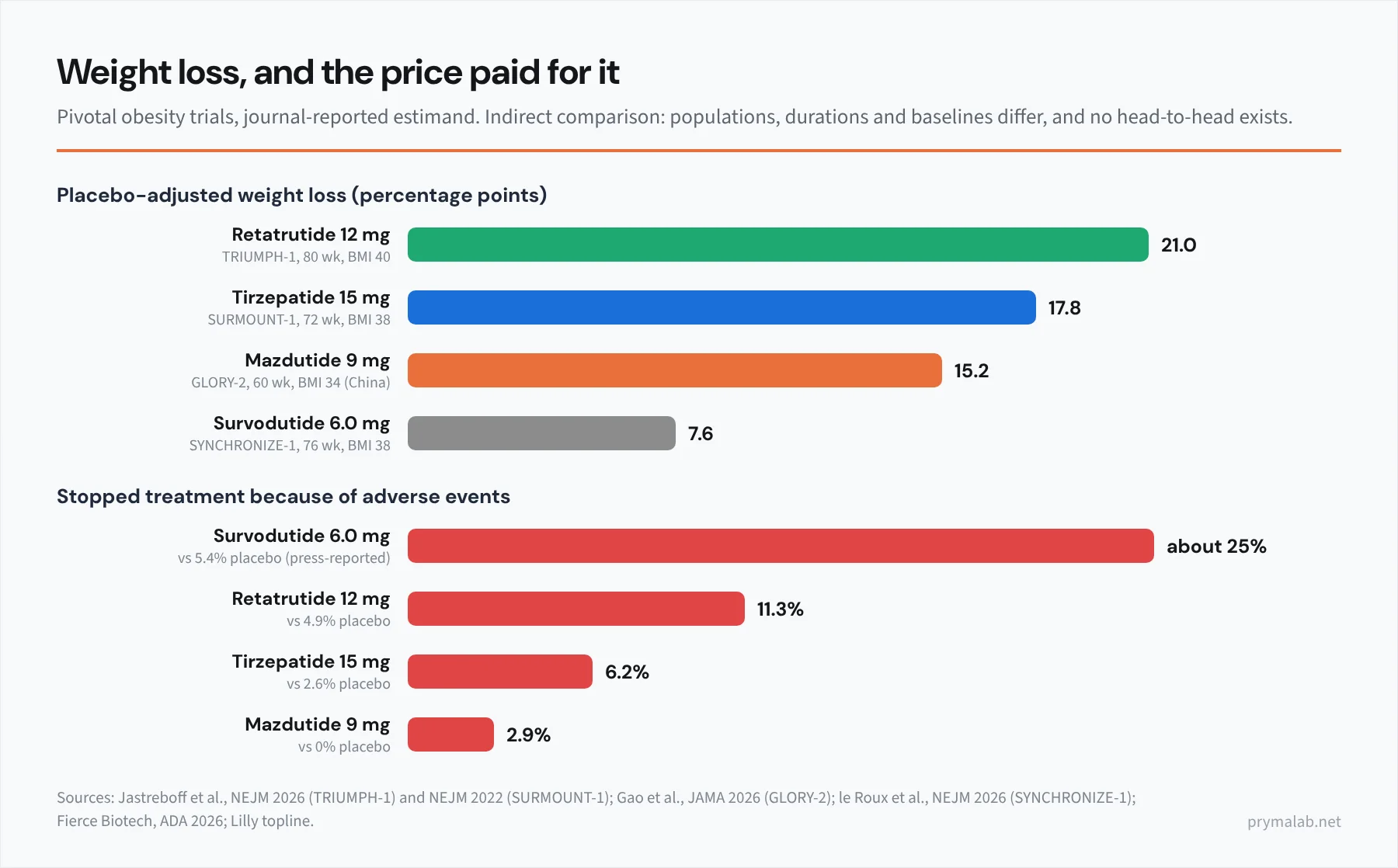
| Placebo-adjusted (journal) | −15.2 points | −7.6 points | −17.8 points | −21.0 points |
| Stopped for adverse events | 2.9% vs 0%[4] | About 25% vs 5.4%[31] | 6.2% vs 2.6%[41] | 11.3% vs 4.9%[49] |
| Liver fat | −71.9% vs +5.1%[5] | −63.1% vs −25% (ADA sub-analysis)[31] | Reported in SURMOUNT sub-studies | Not in TRIUMPH-1 primary report |
| Approved for obesity | China (higher dose under review) | No | US, EU, China | No; US filing planned Q1 2027 |
Read the placebo-adjusted row and the population row together. Survodutide's placebo-adjusted loss of 7.6 points is less than half of tirzepatide's, but its placebo arm lost 5.4 percent where tirzepatide's lost 3.1, and its treatment-regimen estimand counts the quarter of participants who stopped. Mazdutide's 15.2 points look close to tirzepatide's 17.8, but its participants started 10 kg lighter at a BMI four units lower, were followed 12 weeks less, and were all enrolled in China; percentage weight loss does not transfer across those baselines, and a 2026 systematic review of mazdutide notes the generalisability problem directly.[23] Retatrutide's number is the largest in the class and comes with the heaviest population and the longest follow-up. A 2026 network meta-analysis of 58 trials in BMJ Medicine made the indirect comparison formally and found "low certainty evidence" for higher discontinuation with retatrutide, "whereas mazdutide showed better tolerability."[53] That is as far as anyone can go without a head-to-head, and no head-to-head among these four has been run.
Mazdutide vs tirzepatide
No trial compares them. Mazdutide's best journal figure is 16.65 percent at 60 weeks in a BMI-34 Chinese cohort; tirzepatide's is 20.9 percent at 72 weeks in a BMI-38 multinational cohort.[4][41] Mazdutide's reported adverse-event discontinuation is lower, 2.9 against 6.2 percent at tirzepatide's 15 mg dose.[5][41] Mazdutide has a liver-fat dataset tirzepatide's primary trials did not report; tirzepatide has outcomes data, a cardiovascular programme and approvals on three continents. The only thing that would settle "which is better" is a trial neither company has announced.
Mazdutide vs retatrutide
Both are Lilly molecules, and Lilly's decision to develop retatrutide globally while licensing mazdutide to China is itself a data point. Retatrutide 12 mg: −25.0 percent treatment-regimen, −28.3 efficacy, at 80 weeks, with 11.3 percent stopping for adverse events and dysesthesia in one in eight.[48][49] Mazdutide 9 mg: −16.65 and −18.55 at 60 weeks, 2.9 percent stopping.[4][5] The triple agonist loses more weight and more patients.
Survodutide vs retatrutide, and survodutide vs mazdutide
Survodutide 6.0 mg against retatrutide 12 mg is 13.0 against 25.0 percent by the journal estimands, with discontinuation of about 25 against 11.3 percent, in populations of similar baseline BMI; on every axis the triple agonist leads.[29][31][48][49] Survodutide against mazdutide is the within-class comparison: same receptors, opposite problems. Mazdutide lost more weight at a lower discontinuation rate in a lighter population; survodutide has the biopsy-proven MASH data, the dedicated MASLD trial and a completed cardiovascular outcomes trial that mazdutide does not.[4][5][27][29][36][37] If the question is weight, the indirect data lean toward mazdutide; if it is liver histology, they favour survodutide; on adverse-event discontinuation, mazdutide by a wide margin, although vomiting was frequent with both.
Why the press-release number never matches the journal
Every drug in this article has two headline numbers, and the difference is not spin, it is statistics. The treatment-regimen or treatment-policy estimand asks what happened to everyone randomised, including people who stopped the drug, took prohibited medications or never reached the target dose. The efficacy estimand, sometimes called hypothetical or on-treatment, asks what would have happened had everyone stayed on the drug as planned. Journals lead with the first; press releases lead with the second. When almost nobody drops out the two agree; when a quarter of participants stop, they diverge sharply. SYNCHRONIZE-1: 16.6 percent in the press release, 13.0 in the journal.[29][30] SYNCHRONIZE-2: 13.1 against 9.8.[32][33] TRIUMPH-1: 28.3 against 25.0.[48][49] GLORY-2: 18.55 against 16.65.[4][5] A reader comparing mazdutide's 18.55 to tirzepatide's 20.9 is comparing an efficacy estimand to a treatment-regimen one and should stop. The same applies to placebo: GLORY-1's placebo arm gained 0.45 percent, SYNCHRONIZE-1's lost 5.4, so placebo-adjusted differences move with the trial as much as with the drug.[1][29] And milligram figures do not translate: the four drugs are different molecules with different potencies and half-lives, so the arm labels say nothing about relative strength.
Trial design and tolerability
The pivotal trials raised each investigational drug in steps before participants reached their assigned dose, and that escalation period is where much of the tolerability record sits.[3][4][9][10][11][25][27][29][32][41][48][49] Slower escalation or a lower starting dose was the main lever programmes used for tolerability (retatrutide's phase 2 found a lower start reduced GI events), and survodutide's discontinuation did not improve despite a "prolonged" schedule: 24.6 percent stopped in phase 2 and about 25 percent in phase 3.[25][31] The headline results were reached only by participants who tolerated the climb; the efficacy estimand describes them, the treatment-regimen estimand describes everyone. PrymaLab's Mazdutide 10mg and Survodutide 10mg vials are research formats; the trials above describe other people's work with pharmaceutical products, not a use for them. The reconstitution guide covers laboratory handling of lyophilized peptides generally.
Safety: GI events, heart rate, and the discontinuation gap
Gastrointestinal events dominate for all four drugs and cluster during escalation.[1][25][29][45] Retatrutide's TRIUMPH-1 rates at 12 mg were nausea 42.4 percent against 14.8, vomiting 25.3 against 4.8, diarrhoea 32.0 against 13.5, constipation 26.1 against 10.9, plus dysesthesia in 12.5 against 0.9.[49] Vomiting was frequent with both dual agonists: 53.1 percent against 1.3 with mazdutide 9 mg in GLORY-2, alongside nausea in 46.9 against 3.2 and diarrhoea in 39.4 against 6.5, and 45 percent with survodutide 6.0 mg in SYNCHRONIZE-1 and 39 percent in SYNCHRONIZE-2 by press report.[4][31][34] Where they differ is how many people stopped. Survodutide's adverse-event discontinuation, about 25 percent at 6.0 mg and 24 percent at 3.6 mg in SYNCHRONIZE-1 and 26 percent in SYNCHRONIZE-2, is essentially unchanged from phase 2.[25][31][34] Mazdutide's was 2.9 percent at 9 mg in GLORY-2, 1.5 and 0.5 percent at 4 and 6 mg in GLORY-1 against 1.0 on placebo, and none drug-related in phase 2.[1][4][13] Tirzepatide's SURMOUNT-1 discontinuation was 6.2 percent at 15 mg (4.3 to 7.1 across doses) against 2.6.[41]
Heart rate is the glucagon-specific question and the data are incomplete. Mazdutide: +5.4 to +8.8 bpm at 24 weeks in phase 2, +2.6 bpm at 48 weeks in GLORY-1.[2][13] Retatrutide: dose-dependent increase peaking at 24 weeks and declining.[45] Survodutide: systolic blood pressure fell 6.2 mmHg placebo-corrected in phase 2, but heart-rate data by dose are not in the summaries I could access.[26] Transaminases fell rather than rose with mazdutide, consistent with the liver-fat effect, and no hepatotoxicity signal appears in the cited trials.[2][15] Hypoglycaemia was absent in the mazdutide 9 and 10 mg phase 1b; rates in the diabetes trials, where background insulin or sulfonylureas matter, were not extracted here.[14] Both companies report no new safety signals beyond the GLP-1 class, whose approved labels carry warnings for rodent thyroid C-cell tumours, pancreatitis and gallbladder disease; whether the Chinese mazdutide label carries identical warnings is something I could not confirm from the insert.[5][20][30]
| Mazdutide 9 mg | Survodutide 6.0 mg | Tirzepatide 15 mg | Retatrutide 12 mg | |
|---|---|---|---|---|
| Stopped for adverse events | 2.9% vs 0% | About 25% vs 5.4% | 6.2% vs 2.6% (4.3 to 7.1% across doses) | 11.3% vs 4.9% |
| Vomiting | 53.1% vs 1.3% | 45% (press report) | Reported in label range | 25.3% vs 4.8% |
| Heart rate | +2.6 bpm at 48 wk (GLORY-1) | Not extracted | Class increase | Peaks at 24 wk, then declines |
| Drug-specific signal | None reported | High GI discontinuation | None beyond class | Dysesthesia 12.5% vs 0.9% |
| Sources | [1][4][13] | [25][31][34] | [41] | [45][49] |
Regulatory status: China, the FDA's October 2026 statement, and WADA
Mazdutide is approved by China's NMPA for chronic weight management in adults with a BMI of 28 or more, or 24 or more with a weight-related comorbidity, since 27 June 2025, and for glycaemic control in type 2 diabetes since 19 September 2025.[18][20] The 9 mg supplementary application was accepted on 24 November 2025 and had not been approved in any source I found.[21] It is not approved by the FDA or EMA; Lilly states that it "retains the rights to develop mazdutide outside of China and continues to advance its clinical development globally," listing obesity and alcohol use disorder as study areas, but no US phase 3 has been announced.[22] A Chinese trade name circulates online but I could not confirm it from an Innovent or NMPA document.
Survodutide is approved nowhere. It holds FDA Fast Track (2021), FDA Breakthrough Therapy for non-cirrhotic MASH with F2 to F3 fibrosis (2024), EMA PRIME (November 2023), NMPA Breakthrough (June 2024) and Taiwan FDA Breakthrough (September 2024).[38][58] Boehringer has not dated a submission.[34]
Tirzepatide is approved in the US, EU, China and elsewhere; retatrutide is approved nowhere, with a US submission planned for the first quarter of 2027.[19][44][51]
The US grey market. On 1 October 2026 the FDA updated its statement "FDA's Concerns with Unapproved GLP-1 Drugs Used for Weight Loss." It warns against products "falsely labeled 'for research purposes' or 'not for human consumption'" that are sold with human dosing instructions; reports 990 adverse-event reports for compounded semaglutide and more than 730 for compounded tirzepatide as of 31 May 2026; states that retatrutide and cagrilintide cannot legally be compounded; and states that the "FDA has warned companies that have illegally sold unapproved drugs containing semaglutide, tirzepatide, retatrutide, survodutide or mazdutide that are falsely labeled 'for research purposes' or 'not for human consumption,'" adding that "these products have been sold directly to consumers for human use with dosing instructions."[54] On 24 August 2026 the agency sent warning letters to five peptide websites, stating that "despite statements on your product labelling marketing your products 'for research use only'... your products are intended to be drugs for human use."[55] A Public Citizen review published in June 2026 counted more than 100 companies selling retatrutide online, found that 71 of 179 vendors tested by a third-party laboratory rated poor, bad or fraudulent, and tallied 26 FDA adverse-event reports for retatrutide in the first five months of 2026, including 11 hospitalisations.[56] The regulatory line is intended use, not the label. PrymaLab sells mazdutide and survodutide as research materials with certificates of analysis, this article gives no dosing information, and it describes clinical trials of pharmaceutical products, not a use for research-grade peptide; the supplier verification guide explains what the certificate should show.
WADA. GLP-1 receptor agonists, including semaglutide and tirzepatide, are not prohibited on the 2026 list or the 2027 list effective 1 January 2027; semaglutide has been on the Monitoring Program since 2024 and tirzepatide has been added to it, and WADA's expert group found insufficient evidence to conclude with confidence that these substances meet the criteria for inclusion, while it considers a possible weight-management category.[57] Mazdutide, survodutide and retatrutide are not named. Because survodutide and retatrutide are approved nowhere, they may fall under S0 (non-approved substances); mazdutide's Chinese approval takes it outside S0's wording.
Research-grade mazdutide and survodutide: what to verify
Three points for laboratories handling these peptides.
Identity is harder than purity. Mazdutide is about 4,563 Da and survodutide is a lipidated 29-mer with a non-coded residue; both are close in mass and chromatographic behaviour to other acylated proglucagon-family peptides. An HPLC trace shows how much of one thing is present, not which thing it is. A certificate should carry mass-spectrometric identity against the expected monoisotopic mass, and the purity testing guide explains why sequence confirmation matters more for lipidated peptides than for short ones.
Lipidated peptides behave differently in solution. The C18 and C20 fatty-acid chains that bind albumin in vivo drive self-association in vitro. Reconstituted solutions should be made in the buffer the experiment requires, kept cold, not repeatedly frozen and thawed, and used within the window the certificate specifies; the storage guide and reconstitution guide cover the general principles.
Know what the data describe. Every efficacy number in this article comes from pharmaceutical-grade product in a monitored trial. The FDA's October 2026 statement is a reminder that research labelling does not change the legal analysis if the material is intended for people. Research-grade vials are for laboratory work on receptor pharmacology, formulation, analytical method development and the like.
What this article does not settle
- Which is better. No head-to-head trial among mazdutide, survodutide, tirzepatide and retatrutide exists; everything above is indirect.[53]
- Mazdutide outside China. All phase 3 data are from Chinese adults at BMI 28 to 34; generalisability to other ethnic groups and heavier populations is untested.[23]
- GLORY-3. The only trial against semaglutide 2.4 mg in obesity reads out after December 2026.[7]
- Survodutide's future. Whether Boehringer files for obesity with 13 percent treatment-regimen loss and 25 percent discontinuation, and what SYNCHRONIZE-CVOT showed.[29][34][37]
- Energy expenditure in humans. Never measured in a pivotal trial; the glucagon thermogenesis story is still a mouse story.[24][46]
- Durability. No withdrawal or maintenance trial for either dual agonist.
- Long-term heart rate and cardiovascular effects of chronic glucagon-receptor agonism.[13][45]
- Lean mass. The "no more than 10.8 percent" figure awaits peer review and comparison with tirzepatide and retatrutide DXA sub-studies.[31]
- Molecular detail. Mazdutide's residue count, acylation site and receptor potency ratio were not confirmable from primary sources.
Mazdutide, IBI362, survodutide, BI 456906 and "dual agonist": what the names refer to
Mazdutide is the international nonproprietary name; IBI362 is Innovent's code and LY3305677 Lilly's, and early papers call it simply an oxyntomodulin analogue.[16][22] Survodutide is the INN for BI 456906, Boehringer Ingelheim's code for the Zealand-discovered molecule.[24][34] Tirzepatide is LY3298176, sold as Mounjaro for diabetes and Zepbound for obesity and sleep apnoea.[43][44] Retatrutide is LY3437943, "triple G" in the lay press. The term GLP-1/glucagon dual agonist, also written GLP-1R/GCGR co-agonist or glucagon-based dual agonist, covers mazdutide and survodutide along with discontinued or earlier molecules such as cotadutide, efinopegdutide and pemvidutide; dual agonist on its own is ambiguous, since tirzepatide is also a dual agonist of a different pair. The trial acronyms: GLORY and DREAMS for mazdutide; SYNCHRONIZE and LIVERAGE for survodutide; SURMOUNT and SURPASS for tirzepatide; TRIUMPH for retatrutide.
The approved comparators, and why their labels keep moving
Three of the four molecules in this comparison are investigational and one is approved only in China, so most readers arrive having used or read about a different drug entirely. The approved GLP-1 medications that frame the whole conversation are worth naming precisely, because the brand names carry different indications and doses even when the molecule is the same.
Semaglutide is sold as Ozempic for type 2 diabetes, as Wegovy for chronic weight management at a higher dose, and as Rybelsus in an oral tablet for type 2 diabetes. One molecule, three products, three dose ranges, and the Wegovy indication is the one people mean when they talk about weight loss. Semaglutide is a pure glucagon-like peptide-1 receptor agonist: one receptor, no glucagon arm, no glucose-dependent insulinotropic polypeptide arm.
Tirzepatide is the GIP and GLP-1 dual agonist and its label has moved twice recently in ways that matter for any comparison. Zepbound now carries two indications: chronic weight management, and moderate to severe obstructive sleep apnea in adults with obesity, the latter approved in December 2024. Mounjaro covers type 2 diabetes including paediatric patients aged 10 and over, and from late August 2026 also carries an indication for reducing major adverse cardiovascular events in adults with type 2 diabetes at high risk, on the SURPASS-CVOT result. Any table that lists tirzepatide as a weight-loss drug alone is now out of date in three separate ways.
That matters for reading the dual-agonist data. Mazdutide is FDA-approved nowhere; it is approved by China's NMPA, for chronic weight management from June 2025 at a body mass index threshold of 28, or 24 with a weight-related comorbidity, and for type 2 diabetes from September 2025. Survodutide and retatrutide are FDA-approved for nothing at all. A reader comparing a Chinese-approved drug and two investigational ones against a molecule whose own label gained a cardiovascular outcome indication in 2026 is comparing things at four different stages of evidence.
Blood sugar, insulin sensitivity and the glucagon problem
Adding a glucagon receptor agonist to a GLP-1 agonist creates a specific tension that does not arise with tirzepatide, and it is the most interesting pharmacology in this comparison. Glucagon raises hepatic glucose output. That is its job. So a drug that deliberately activates the glucagon receptor in people with impaired glucose handling is pushing in two directions at once, and the question every dual-agonist programme had to answer was whether the GLP-1 arm wins.
It does, in the trials run so far. Mazdutide lowered HbA1c in the DREAMS programme and beat dulaglutide on both HbA1c and weight in DREAMS-2, and survodutide lowered HbA1c by up to 1.21 percentage points in SYNCHRONIZE-2 from a baseline of 7.4 per cent, with 29.5 per cent of participants reaching a level below the pre-diabetes threshold against 4.0 per cent on placebo. Blood sugar levels went down, not up. Insulin sensitivity and insulin resistance were not measured directly by clamp in any of these programmes, so the improvement is inferred from glycaemia and weight rather than demonstrated at the tissue level.
Hypoglycemia is the risk that framing raises and it was not a prominent finding. GLP-1 receptor agonists stimulate insulin in a glucose-dependent way, which is why hypoglycemia with this class is largely confined to combination with insulin or a sulfonylurea rather than to monotherapy, and the dual agonists behaved the same way. What the glucagon arm has not demonstrated in humans is the thermogenic contribution it is credited with: no trial in this class has measured human energy expenditure by calorimetry, so the extra weight loss attributed to glucagon is inferred from the comparison rather than measured.
Side effects: the numbers that get left out
Gastrointestinal events dominate this class and the headline weight-loss figures are usually quoted without the tolerability figures that sit beside them in the same paper. Three numbers are worth carrying.
Mazdutide at 9 mg in GLORY-2: vomiting in 53.1 per cent, nausea in 46.9 per cent and diarrhea in 39.4 per cent of participants, with 2.9 per cent discontinuing for adverse events against none on placebo. High event rates, low discontinuation, which is the pattern of side effects that are unpleasant and manageable.
Survodutide tells a different story twice. In the phase two obesity trial, 75 per cent of participants on the drug had gastrointestinal events and only 60.4 per cent completed the 46-week treatment period at all. In phase three SYNCHRONIZE-2, gastrointestinal discontinuations ran at 18 per cent against 1.2 per cent on placebo, concentrated during dose escalation. That is the single most important number in the survodutide file and the one least likely to appear in a summary of it.
Retatrutide added a signal the GLP-1 class had not previously shown. In TRIUMPH-4, in participants with knee osteoarthritis, dysesthesia was reported in 8.8 per cent at 9 mg and 20.9 per cent at 12 mg against 0.7 per cent on placebo, with adverse-event discontinuations of 12.2 and 18.2 per cent against 4.0 per cent. Altered skin sensation at one in five on the top dose is a new finding for this class and belongs in any honest comparison of it.
What FDA has said about these three molecules being sold for research
This is the most directly relevant regulatory statement available for anything in this comparison, and it names three of the four molecules explicitly. FDA's page on unapproved GLP-1 drugs used for weight loss, content current as of 1 October 2026, states that retatrutide and cagrilintide cannot be used in compounding under federal law, being neither components of approved drugs nor found safe and effective for any condition. It then records that the agency has warned companies that illegally sold unapproved drugs containing semaglutide, tirzepatide, retatrutide, survodutide or mazdutide while labelling them for research purposes or not for human consumption, and selling them directly to consumers for human use with dosing instructions.
That is worth reading slowly, because it describes a specific pattern rather than the existence of research-grade material. What FDA objected to was the combination: research-use labelling on a product being marketed to consumers with instructions for taking it. The agency's position, stated in the same family of warning letters, is that research use only labelling does not determine intended use when the surrounding conduct points at human consumption. The same page reports Import Alert 66-80 covering GLP-1 active ingredients and, as of 31 May 2026, 990 adverse-event reports for compounded semaglutide and more than 730 for compounded tirzepatide.
The compounding route for the approved molecules closed earlier and has since closed further. FDA declared the tirzepatide shortage resolved in October 2024 and the semaglutide shortage resolved in February 2025, ending the enforcement discretion that had made compounded copies lawful, with the last deadlines passing in May 2025. Then in a Federal Register notice published 1 May 2026 the agency proposed not to add semaglutide, tirzepatide or liraglutide to the 503B bulks list at all, finding no basis to conclude the approved products are medically unsuitable and stating that a drug shortage does not constitute clinical need. Mazdutide, survodutide and retatrutide are not in that notice; they are covered by the alerts page instead.
On anti-doping, the position is narrower than many assume. No GLP-1 receptor agonist is on the WADA Prohibited List. Markers of semaglutide and tirzepatide are item 6 of the 2026 Monitoring Programme, in and out of competition, which carries no sanction but does mean prevalence data is being collected. WADA published the 2027 List on 8 October 2026 leaving that unchanged, citing insufficient evidence and a second study under way.
Frequently asked questions
What is a GLP-1/glucagon dual agonist?
A single engineered peptide that activates both the GLP-1 receptor, which suppresses appetite and drives glucose-dependent insulin release, and the glucagon receptor, which increases energy expenditure and liver-fat oxidation. The design is modelled on the gut hormone oxyntomodulin. Mazdutide is an acylated oxyntomodulin analogue; survodutide is a modified 29-amino-acid glucagon. Tirzepatide is also a dual agonist but of GLP-1 and GIP, and retatrutide engages all three receptors.
Does the glucagon component raise blood sugar?
Not on average in any trial reported so far. Mazdutide 6 mg lowered HbA1c by 2.15 percentage points against 0.14 for placebo in treatment-naive type 2 diabetes, and survodutide lowered it by 0.8 to 0.9 points against 0.2 over 76 weeks by the journal analysis (up to 1.21 by the efficacy estimand). The GLP-1 arm's insulin effect and the weight loss outweigh glucagon's effect on hepatic glucose output.
Is mazdutide FDA approved?
No. Mazdutide is approved only in China, for weight management since 27 June 2025 and for type 2 diabetes since 19 September 2025. Eli Lilly holds rights outside China and has not announced a US filing. The FDA's GLP-1 concerns page, current as of 1 October 2026, lists mazdutide among the drugs it has warned companies for illegally selling under "for research purposes" labels.
Is mazdutide better than tirzepatide?
No trial has compared them. Mazdutide 9 mg produced 16.65 percent weight loss at 60 weeks by the journal estimand in Chinese adults with a mean BMI of 34; tirzepatide 15 mg produced 20.9 percent at 72 weeks in a heavier multinational population with a BMI of 38. Mazdutide's adverse-event discontinuation was lower, 2.9 against 6.2 percent for tirzepatide 15 mg. Different populations, durations and estimands make the comparison indirect.
How does mazdutide compare with retatrutide for weight loss?
Retatrutide 12 mg produced 25.0 percent weight loss at 80 weeks by the treatment-regimen estimand and 28.3 percent by the efficacy estimand, rising to 30.3 percent at 104 weeks in participants with a BMI of 35 or more. Mazdutide 9 mg produced 16.65 and 18.55 percent at 60 weeks. Retatrutide had higher adverse-event discontinuation, 11.3 against 4.9 percent for placebo, than mazdutide's 2.9 against 0. The comparison is indirect.
How does survodutide compare with retatrutide?
Survodutide 6.0 mg produced 13.0 percent weight loss at 76 weeks by the journal estimand and up to 16.6 by the efficacy estimand, with about 25 percent of participants on 6.0 mg stopping for adverse events by press report. Retatrutide 12 mg produced 25.0 and 28.3 percent at 80 weeks with 11.3 percent stopping. Both populations had a baseline BMI near 38 to 40. No head-to-head exists.
How do survodutide and mazdutide compare with each other?
Both are GLP-1/glucagon dual agonists. Mazdutide 9 mg achieved more weight loss, 16.65 percent at 60 weeks, with 2.9 percent adverse-event discontinuation, in a Chinese population with a BMI of 34. Survodutide 6.0 mg achieved 13.0 percent at 76 weeks with about 25 percent discontinuation in a multinational BMI-38 population. Survodutide has the stronger liver dataset, with biopsy-proven MASH improvement in phase 2 and a dedicated MASLD phase 3, plus a completed cardiovascular outcomes trial.
When will survodutide be approved?
Unknown. Its pivotal SYNCHRONIZE-1 and -2 trials were published in June and October 2026, its cardiovascular outcomes trial completed in June 2026 with results pending, and Boehringer Ingelheim has not announced a submission date. The MASH phase 3 programme, LIVERAGE, runs to about 2031. It holds FDA Fast Track and Breakthrough Therapy designations and EMA PRIME status.
How much weight did mazdutide produce in GLORY-1?
At the week-32 primary endpoint, 10.09 percent on 4 mg and 12.55 percent on 6 mg against a 0.45 percent gain on placebo, by the treatment-policy estimand, in 610 Chinese adults. At week 48 the efficacy estimand gave 12.05 and 14.84 percent against 0.47. Liver fat fell 63 and 73 percent in participants with fatty liver at baseline.
What did survodutide show in MASH and liver fat?
In the phase 2 MASH trial of 293 adults with biopsy-confirmed disease, 48 weeks of 2.4, 4.8 or 6.0 mg produced histological improvement without worsening fibrosis in 47, 62 and 43 percent against 14 percent on placebo by planned-treatment analysis; the often-quoted 83 percent figure is the on-treatment analysis. In SYNCHRONIZE-MASLD, 84.2 percent against 24.3 achieved at least a 30 percent liver-fat reduction.
Are mazdutide, survodutide and tirzepatide banned in sport?
No GLP-1 receptor agonist is named on WADA's 2026 or 2027 Prohibited Lists; semaglutide and tirzepatide are on the Monitoring Program. Survodutide and retatrutide are approved nowhere, so they may fall under the S0 non-approved-substances clause; mazdutide is approved in China, which takes it outside S0's wording.
Can mazdutide or survodutide vials be bought legally for research?
Research-grade peptides are sold for laboratory use, and intended use is what regulators examine. The FDA's October 2026 statement says products labelled for research but sold for human use are unapproved drugs, says it has warned companies that illegally sold semaglutide, tirzepatide, retatrutide, survodutide or mazdutide under such labels, and issued warning letters to peptide vendors in August 2026. PrymaLab supplies both peptides with certificates of analysis for laboratory research only, and this article gives no dosing information.
How do Ozempic, Wegovy and Rybelsus relate to these molecules?
They are all semaglutide, a pure glucagon-like peptide-1 receptor agonist: Ozempic for type 2 diabetes, Wegovy for chronic weight management at a higher dose, Rybelsus as an oral tablet. One molecule, three products, three dose ranges. None has a glucagon or GIP arm, which is what separates them from the dual and triple agonists here.
What is tirzepatide approved for now?
More than most comparisons record. Zepbound carries chronic weight management and, since December 2024, moderate to severe obstructive sleep apnea in adults with obesity. Mounjaro covers type 2 diabetes including paediatric patients aged 10 and over and, from late August 2026, reduction of major adverse cardiovascular events in high-risk adults with type 2 diabetes.
Does adding glucagon raise blood sugar?
Not in the trials. Glucagon raises hepatic glucose output, so a dual agonist pushes in two directions, but the GLP-1 arm won: mazdutide beat dulaglutide on HbA1c in DREAMS-2, and survodutide lowered HbA1c by up to 1.21 points in SYNCHRONIZE-2 with 29.5 per cent of participants reaching below the pre-diabetes threshold. Insulin sensitivity and insulin resistance were not measured by clamp, so that improvement is inferred rather than demonstrated at tissue level.
What is the risk of hypoglycemia?
Low as monotherapy. These agents stimulate insulin in a glucose-dependent way, so hypoglycemia with the class is largely confined to combination with insulin or a sulfonylurea, and the dual agonists behaved the same way.
What are the side effects, with the numbers usually omitted?
Mazdutide 9 mg in GLORY-2: vomiting 53.1 per cent, nausea 46.9 per cent, diarrhea 39.4 per cent, but only 2.9 per cent discontinued. Survodutide is the harder case: 75 per cent had gastrointestinal events in phase two with only 60.4 per cent completing 46 weeks, and gastrointestinal discontinuations ran at 18 per cent against 1.2 per cent placebo in SYNCHRONIZE-2. Retatrutide added a dysesthesia signal, 20.9 per cent at 12 mg against 0.7 per cent placebo in TRIUMPH-4.
Has FDA commented on these molecules being sold as research chemicals?
Yes, explicitly. FDA's page on unapproved GLP-1 drugs, current as of 1 October 2026, says retatrutide and cagrilintide cannot be used in compounding under federal law, and records warnings to companies that sold unapproved drugs containing semaglutide, tirzepatide, retatrutide, survodutide or mazdutide while labelling them for research purposes or not for human consumption and marketing them to consumers with dosing instructions.
Are GLP-1 agonists banned in sport?
No. None is on the WADA Prohibited List. Markers of semaglutide and tirzepatide are item 6 of the 2026 Monitoring Programme, in and out of competition, which carries no sanction but does mean prevalence data is being gathered. The 2027 List, published 8 October 2026, left that unchanged, citing insufficient evidence and a second study under way.
References
- Ji L, Jiang H, Bi Y, et al. Once-weekly mazdutide in Chinese adults with obesity or overweight (GLORY-1). N Engl J Med. 2025;392:2215-2225. PMID 40421736
- Innovent Biologics. Phase 3 clinical study of mazdutide in Chinese adults with overweight or obesity (GLORY-1) published in the New England Journal of Medicine. Press release, 2025. BioSpace
- ClinicalTrials.gov. NCT05607680: GLORY-1, arms, titration and eligibility. ClinicalTrials.gov
- Gao L, Jiang H, Cai H, et al. Treatment with 9-mg mazdutide for weight reduction in Chinese adults with obesity: the GLORY-2 randomized clinical trial. JAMA. 2026. PMID 42251595
- Innovent Biologics. GLORY-2 topline results, 20 November 2025, as reported by Bariatric News. Bariatric News
- ClinicalTrials.gov. NCT06164873: GLORY-2. ClinicalTrials.gov
- ClinicalTrials.gov. NCT06884293: GLORY-3, mazdutide versus semaglutide in Chinese adults with overweight or obesity and fatty liver disease; N=479; active, not recruiting; primary completion 31 December 2026. ClinicalTrials.gov
- Innovent Biologics. Second head-to-head phase 3 study of mazdutide versus semaglutide completes first participant dosing (GLORY-3). Press release. BioSpace
- Zhu D, Zhao J, Cai H, et al. Mazdutide versus placebo in Chinese adults with type 2 diabetes (DREAMS-1). Nature. 2025. PMID 41407859
- Guo L, Zhang B, Xue X, et al. Mazdutide versus dulaglutide in Chinese adults with type 2 diabetes (DREAMS-2). Nature. 2025. PMID 41407860
- Patient Care Online. Mazdutide demonstrates superior glycemic control and weight loss vs semaglutide in head-to-head trial (DREAMS-3 topline), 28 October 2025. Patient Care Online
- DREAMS-3 design paper. Contemp Clin Trials. 2025;108150. PMID 41260459
- Ji L, Jiang H, Cheng Z, et al. A phase 2 randomised controlled trial of mazdutide in Chinese overweight adults or adults with obesity. Nat Commun. 2023;14:8289. PMID 38092790
- Ji L, Gao L, Jiang H, et al. Safety and efficacy of mazdutide (IBI362) 9 mg and 10 mg in Chinese adults with overweight or obesity: phase 1b. EClinicalMedicine. 2022;54:101691. PMID 36247927
- Clinical Trials Arena. Innovent's mazdutide offers weight loss in phase II obesity trial (9 mg, 48 weeks), 30 October 2023. Clinical Trials Arena
- Jiang H, Pang S, Zhang Y, et al. A phase 1b randomised controlled trial of a GLP-1 and glucagon receptor dual agonist IBI362 (LY3305677) in Chinese patients with type 2 diabetes. Nat Commun. 2022;13:3613. PMID 35750681
- Zhang B, Cheng Z, Chen J, et al. Efficacy and safety of mazdutide in Chinese patients with type 2 diabetes: phase 2. Diabetes Care. 2024;47:160-168. PMID 37943529
- Innovent Biologics. Voluntary announcement: NMPA approval of mazdutide for chronic weight management, 27 June 2025. HKEX (PDF)
- Fierce Pharma. With China approval, Lilly and Innovent's mazdutide breaks into new class, June 2025. Fierce Pharma
- Innovent Biologics. Mazdutide received approval from China's NMPA for glycemic control in adults with type 2 diabetes, 19 September 2025. BioSpace
- Bariatric News. Innovent's mazdutide 9 mg accepted for review by China's NMPA, 25 November 2025. Bariatric News
- Eli Lilly Medical Information. Who is developing mazdutide and for which potential indications. Lilly
- Kamrul-Hasan ABM, et al. Efficacy and safety of mazdutide in predominantly Chinese adults: systematic review and meta-analysis. Diabetes Obes Metab. 2026;28:8777-8794. PMID 42410325
- Zimmermann T, Thomas L, Baader-Pagler T, et al. BI 456906: discovery and preclinical pharmacology of a novel GCGR/GLP-1R dual agonist. Mol Metab. 2022;66:101633. PMID 36356832
- le Roux CW, Steen O, Lucas KJ, et al. Glucagon and GLP-1 receptor dual agonist survodutide for obesity: a phase 2 trial. Lancet Diabetes Endocrinol. 2024;12:162-173. PMID 38330987
- HCPLive. ADA 2023: survodutide impresses in phase 2 dose-finding trial (responder rates, blood pressure, discontinuation). HCPLive
- Sanyal AJ, Bedossa P, Fraessdorf M, et al. A phase 2 randomized trial of survodutide in MASH and fibrosis. N Engl J Med. 2024;391:311-319. PMID 38847460
- HCPLive. Survodutide, a glucagon/GLP-1 RA, reduces MASH in phase 2 trial (83 percent on-treatment figure), February 2024. HCPLive
- le Roux CW, Wharton S, Startseva E, et al. Survodutide once weekly for the treatment of adults with obesity (SYNCHRONIZE-1). N Engl J Med. 2026. PMID 42253238
- Boehringer Ingelheim. SYNCHRONIZE-1 topline results and designation history, press release, April 2026, as reported by PharmaTimes. PharmaTimes
- Fierce Biotech. ADA: Boehringer points to survodutide's targeted weight loss, tolerability questions linger, 8 June 2026. Fierce Biotech
- Wharton S, le Roux CW, Startseva E, et al. Survodutide once weekly in adults with obesity and type 2 diabetes (SYNCHRONIZE-2). N Engl J Med. 2026. PMID 42820639
- HCPLive. SYNCHRONIZE-2: survodutide outperforms placebo in weight loss, blood sugar control, 1 October 2026. HCPLive
- Fierce Biotech. Zealand's stock slides as Boehringer-partnered obesity drug underwhelms again in phase 3, October 2026. Fierce Biotech
- ClinicalTrials.gov. NCT06066515 (SYNCHRONIZE-1) and NCT06066528 (SYNCHRONIZE-2). ClinicalTrials.gov
- Kaplan LM, Startseva E, le Roux CW, et al. Survodutide in adults with obesity and MASLD: the SYNCHRONIZE-MASLD phase 3 trial. Nat Med. 2026. PMID 42252333
- ClinicalTrials.gov. NCT06077864: SYNCHRONIZE-CVOT; N=5,531; completed 30 June 2026. Platz et al., baseline characteristics paper. ClinicalTrials.gov
- Boehringer Ingelheim. Boehringer receives US FDA Breakthrough Therapy designation and initiates two phase III trials in MASH for survodutide, 8 October 2024. BioSpace
- Managed Healthcare Executive. Survodutide reduces liver fat in 84 percent of patients in phase 3 trial, 26 June 2026. Managed Healthcare Executive
- Ji L, Chen L, Cheng Z, et al. Survodutide for obesity in Chinese adults: SYNCHRONIZE-CN design and baseline. Diabetes Ther. 2026;17:1519-1535. PMID 42599381
- Jastreboff AM, Aronne LJ, Ahmad NN, et al. Tirzepatide once weekly for the treatment of obesity (SURMOUNT-1). N Engl J Med. 2022;387:205-216. PMID 35658024
- Aronne LJ, Horn DB, le Roux CW, et al. Tirzepatide as compared with semaglutide for the treatment of obesity (SURMOUNT-5). N Engl J Med. 2025;393:26-36. PMID 40353578
- Coskun T, Sloop KW, Loghin C, et al. LY3298176, a novel dual GIP and GLP-1 receptor agonist for the treatment of type 2 diabetes mellitus. Mol Metab. 2018;18:3-14. PMID 30473097
- Wikipedia. Tirzepatide: structure, half-life and approval dates (secondary; cross-checked against the US prescribing information). Wikipedia
- Jastreboff AM, Kaplan LM, Frías JP, et al. Triple-hormone-receptor agonist retatrutide for obesity: a phase 2 trial. N Engl J Med. 2023;389:514-526. PMID 37366315
- Coskun T, Urva S, Roell WC, et al. LY3437943, a novel triple glucagon, GIP, and GLP-1 receptor agonist for glycemic control and weight loss. Cell Metab. 2022;34:1234-1247. PMID 35985340
- Eli Lilly Medical Information. What is retatrutide (receptor potency ratios; half-life). Lilly
- Jastreboff AM, Kaplan LM, Davies MJ, et al. Retatrutide, a triple hormone receptor agonist, for treatment of obesity (TRIUMPH-1). N Engl J Med. 2026. PMID 42814954
- AJMC. Retatrutide achieves up to 30.3 percent average weight loss in phase 3 TRIUMPH-1 trial (Lilly topline, adverse-event rates), 21 May 2026. AJMC
- Bellido V, le Roux CW, Ekinci EI, et al. Retatrutide in adults with obesity and type 2 diabetes (TRIUMPH-2). Lancet. 2026. PMID 42810372
- HCPLive. Retatrutide meets phase 3 weight loss endpoints in two obesity trials (TRIUMPH-2 and -3 topline; US submission planned Q1 2027), 23 July 2026. HCPLive
- ClinicalTrials.gov. NCT05929066 (TRIUMPH-1), NCT05929079 (TRIUMPH-2), NCT05882045 (TRIUMPH-3). ClinicalTrials.gov
- Chen D, Ma B, Sun H, et al. Comparative efficacy and safety of GLP-1 based drugs for weight loss: network meta-analysis of 58 trials. BMJ Med. 2026;e003026. PMID 42688617
- US Food and Drug Administration. FDA's concerns with unapproved GLP-1 drugs used for weight loss, updated 1 October 2026. FDA
- Pharmaphorum. FDA issues warning letters to five unapproved GLP-1 websites, 24 August 2026. Pharmaphorum
- Public Citizen. Retatrutide report, 16 June 2026. Public Citizen (PDF)
- Athletics Illustrated. World Anti-Doping Agency publishes its 2027 list of banned substances and methods (GLP-1 receptor agonists not included; semaglutide on the Monitoring Program). Athletics Illustrated
- Boehringer Ingelheim. Designation history for survodutide (FDA Fast Track May 2021; FDA Breakthrough Therapy 2024; EMA PRIME November 2023; NMPA Breakthrough June 2024; Taiwan FDA Breakthrough September 2024), as listed in the April 2026 SYNCHRONIZE-1 release. PharmaShots
- Wikipedia. Mazdutide: oxyntomodulin analogue, C20 fatty acid, molecular formula, approval date (secondary; cross-checked against the Innovent announcement). Wikipedia
- Eli Lilly and Company. Lilly's tirzepatide delivered up to 22.5% weight loss in adults with obesity or overweight in SURMOUNT-1 (topline, efficacy estimand), 28 April 2022. Lilly
Final disclaimer: This article is an educational research reference. Mazdutide and survodutide supplied by PrymaLab are sold and studied for laboratory research use only and are not approved by any regulatory authority for human or veterinary use; pharmaceutical mazdutide is approved only in China. The approval of a pharmaceutical product in China does not extend to research-grade material sold elsewhere. Statements have not been evaluated by the FDA. Nothing here is medical advice, and no dosing or administration guidance is given or implied.
All clinical findings described above were produced with investigational or approved pharmaceutical products in monitored trials and do not describe or support any use of research-grade material. Always verify the legal status of any research compound in your jurisdiction before purchase or use.
Formats stocked for the compounds in this article
Tirzepatide: Tirzepatide 5mg, Tirzepatide 15mg, Tirzepatide 20mg, Tirzepatide 30mg, Tirzepatide 40mg and Tirzepatide 50mg. Every listing is supplied for laboratory research use with a batch certificate of analysis.