Tesofensine Peptide: Why It Is Not a Peptide, What the Trials Showed, and Why Mexico Still Has Not Approved It
Tesofensine (development code NS2330), the compound people search for as a "tesofensine peptide", is a 328 Da small-molecule triple monoamine reuptake inhibitor that blocks the noradrenaline, dopamine and serotonin transporters. It is not a peptide: it is a phenyltropane, a rigid bicyclic amine with a dichlorophenyl ring and an ethoxymethyl arm, with no amino acids and no peptide bonds anywhere in it, and it is about 90% orally bioavailable. Every human trial gave it as an oral tablet. In the only peer-reviewed obesity trial, published in The Lancet in 2008, its three dose arms showed 4.5%, 9.2% and 10.6% placebo-subtracted weight loss over 24 weeks, with a 7.4 beats-per-minute heart-rate increase in the middle arm. It is approved nowhere: the Mexican application filed in December 2019 was explicitly not approved in November 2024 and remains pending in the August 2026 interim report. PrymaLab supplies tesofensine 500 mcg capsules for laboratory research use only.
- Structure: (1R,2R,3S,5S)-3-(3,4-dichlorophenyl)-2-(ethoxymethyl)-8-methyl-8-azabicyclo[3.2.1]octane. C17H23Cl2NO, 328.3 g/mol free base; the tartrate salt is C21H29Cl2NO7, 478.36 g/mol. CAS 195875-84-4.
- Class: Phenyltropane (tropane core, the same 8-azabicyclo[3.2.1]octane scaffold as cocaine) acting as a noradrenaline, dopamine and serotonin reuptake inhibitor. The 2026 WADA Prohibited List names it under S6.B, specified stimulants, prohibited in competition.
- Studied for: Parkinson's disease and Alzheimer's disease first (both programmes failed on efficacy), then obesity, then, combined with metoprolol as Tesomet, hypothalamic obesity and Prader-Willi syndrome.
- Trials in the literature: Oral tablets in a 24-week Lancet Phase 2 with three dose arms and placebo; a Mexican Phase 3 with two dose arms and placebo; tesofensine combined with metoprolol in the Tesomet trial. Elimination half-life about 220 hours; metabolite NS2360 about 374 hours. Study design facts, not guidance.
- Storage: Capsules: sealed, dry, room temperature, away from light. Tesofensine is a stable small molecule and does not need the cold chain or reconstitution that lyophilised peptides need.
- Forms and sizes at PrymaLab: Tesofensine 500 mcg capsules, 30 count, supplied as capsules with identity and content-uniformity documentation. Sold for laboratory research use only.
- Regulatory: Not approved by the FDA, the EMA or COFEPRIS. No NDA has ever been filed in the US. FDA cleared a Phase 3 protocol around 2010 that was never run, and told the sponsor in 2020 that a tesofensine-containing product for the general obese population would need a cardiovascular outcomes study. Not a controlled substance in the US.
| Tesofensine | Semaglutide | Sibutramine | |
|---|---|---|---|
| Molecule | Small molecule, 328 Da | Peptide, about 4,114 Da | Small molecule |
| Mechanism | NET, DAT and SERT reuptake inhibitor | GLP-1 receptor agonist | NET and SERT reuptake inhibitor |
| Route in trials | Oral | Subcutaneous | Oral |
| Best published result vs placebo | 9.2% in the middle dose arm, 24 weeks (n=203) | About 12.4 points at 68 weeks (n=1,961) | A few kilograms at one year |
| Heart-rate effect | +7.4 bpm in the middle dose arm | Small increase reported | Increase; SCOUT showed excess cardiovascular events |
| Status | Approved nowhere; Mexico pending since 2019 | FDA approved 2021 (Wegovy) | Withdrawn from the US market in 2010 |
See the what counts as a peptide reference for the definition this article applies, the purity testing guide for how identity and content uniformity are verified, and the semaglutide reference for the GLP-1 comparator.
Also known as: NS2330, NS-2330, NS 2330, tesofensine tartrate, TIPO (trial acronym), Tesomet (tesofensine plus metoprolol). There is no approved brand name anywhere; any trade name you see attached to tesofensine is unverified.
Tesofensine gets sold alongside research peptides, priced like a peptide, and searched for as 'tesofensine peptide' about 2,900 times a month. It is not one. It is a 328 dalton oral small molecule from a Danish neurology programme that failed twice, whose weight-loss effect was first recorded as a side effect, whose original developer went insolvent before running a single Phase 3 trial, and whose only registrational study, in Mexico, has spent nearly seven years failing to clear one national regulator. I have read every company disclosure through the 27 August 2026 interim report, the Lancet abstract verbatim, and the 2026 human excretion study, and this is what the record actually supports.
Research-use-only disclaimer: Tesofensine supplied by PrymaLab is intended strictly for laboratory research use and is not intended for human or veterinary use. The clinical trials described below were conducted by pharmaceutical sponsors under regulatory oversight and do not describe or support any use of research-grade material. Trial designs are reported as study facts. No dosing or administration guidance appears here. Nothing here is medical advice.

TL;DR
Tesofensine is a 328 Da small molecule, C17H23Cl2NO, a phenyltropane with no amino acids and no peptide bonds. It inhibits the noradrenaline, dopamine and serotonin transporters and is about 90% orally bioavailable, which is why every human trial used a tablet. The one peer-reviewed obesity trial (Lancet 2008, n=203) reported 4.5%, 9.2% and 10.6% placebo-subtracted weight loss across its three dose arms over 24 weeks; those are percentages, not kilograms. Heart rate rose 7.4 bpm in the middle dose arm, and the developer's answer was to co-formulate a beta-blocker (Tesomet). The elimination half-life is about nine days, the main metabolite's about 16 days. It is approved nowhere: COFEPRIS explicitly withheld approval in November 2024 and the resubmission was still pending on 27 August 2026. The 'approved in Mexico' claim is a misreading of a non-binding 2023 committee opinion, and the 'tesofensine peptide' label is a catalogue habit, not chemistry. Research use only.
Identity: Phenyltropane small molecule, CAS 195875-84-4, C17H23Cl2NO, 328.3 g/mol. Tartrate salt 478.36 g/mol, a 1.457-fold difference that matters when a label says 500 mcg.
Not a peptide: No amino acids, no amide backbone, and 90% oral bioavailability. Injectable peptides are injectable because the gut destroys them; tesofensine was a tablet in every trial.
Mechanism: Triple monoamine reuptake inhibitor. Two incompatible sets of dopamine transporter potencies circulate (8 nM and 65 nM); PET shows 18 to 77% striatal DAT occupancy across the doses tested. Weight loss is appetite-driven; total 24-hour energy expenditure did not change in the controlled human study.
Trial record: Lancet 2008: 4.5 / 9.2 / 10.6% over placebo at 24 weeks, 79% completion, 13% withdrew for adverse events vs 6% on placebo. Mexican Phase 3 (n=372): sponsor-reported only, never peer-reviewed, no placebo figure disclosed.
Safety signal: Heart rate +7.4 bpm in the middle dose arm. The highest arm's vitals are not in the abstract. FDA told the sponsor in 2020: a cardiovascular outcomes trial, or restrict distribution to a rare-disease population. Neither has happened.
Regulatory: Never approved anywhere. Mexico filed December 2019, refused November 2024, resubmitted February 2025, still pending August 2026. No brand name exists.
Status: research use only.
What tesofensine is, and why it is not a peptide
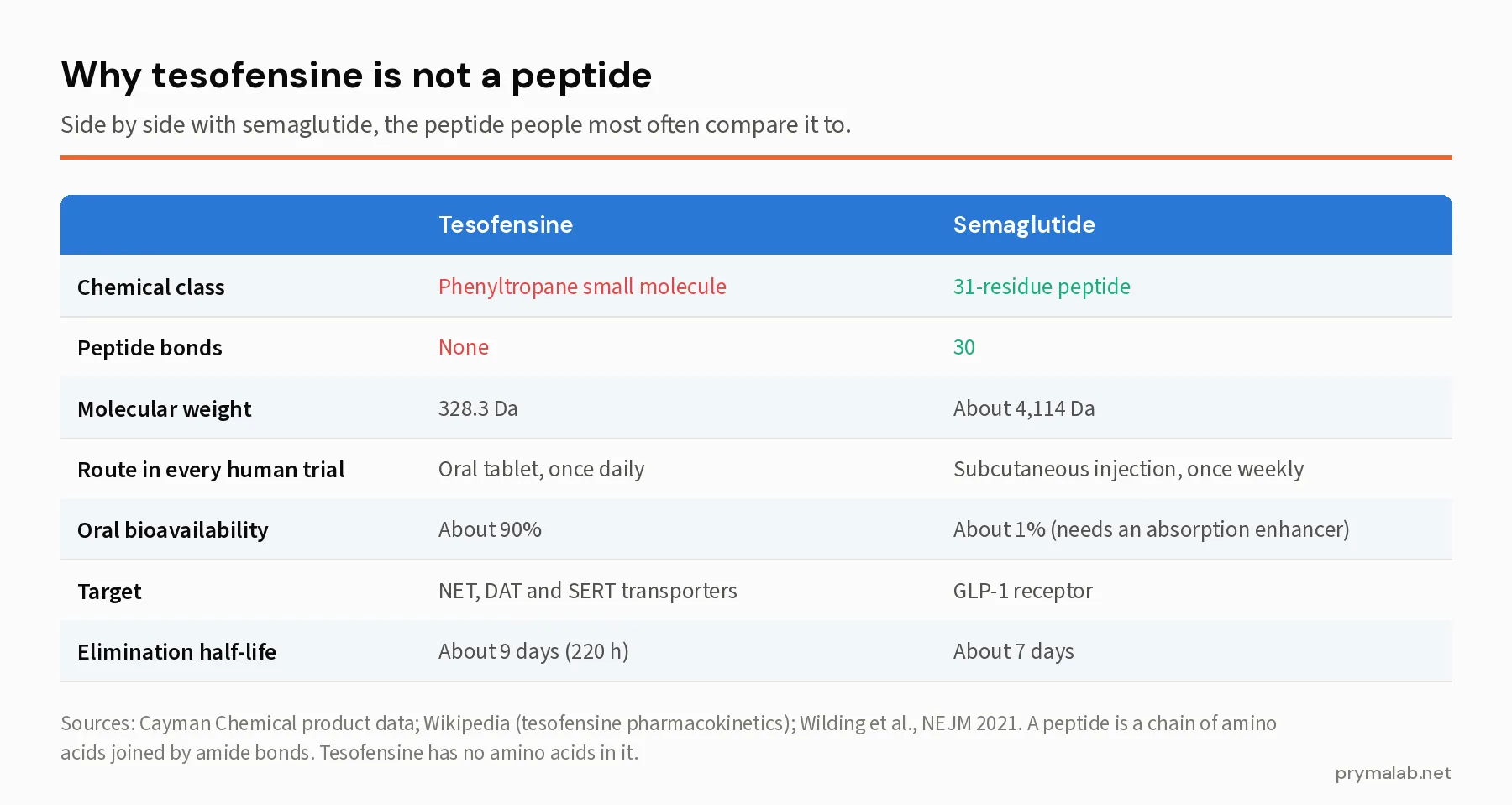
Start with the molecule, because the molecule settles the question in the search box. Tesofensine is (1R,2R,3S,5S)-3-(3,4-dichlorophenyl)-2-(ethoxymethyl)-8-methyl-8-azabicyclo[3.2.1]octane, molecular formula C17H23Cl2NO, molecular weight 328.3 g/mol, CAS 195875-84-4.[1] Read that name slowly. There is a bicyclic tropane ring with a methyl on the nitrogen, a dichlorinated benzene ring hanging off one carbon, and an ethoxymethyl group on the next. That is the whole molecule. There is no amino acid in it, no amide bond, no N-terminus, no C-terminus.
A peptide, by the definition I apply in the what counts as a peptide reference, is a chain of amino acids joined by peptide bonds. Semaglutide is 31 amino acids and about 4,114 Da. Tirzepatide is 39 and about 4,813 Da. Tesofensine weighs a tenth of either and contains zero of the thing that makes a peptide a peptide. Chemically it is a phenyltropane, the same 8-azabicyclo[3.2.1]octane scaffold found in cocaine and in the RTI series of research compounds, and that scaffold is the reason it binds all three monoamine transporters rather than one.[2]
The second disqualifying fact is oral bioavailability. Tesofensine is reported at about 90% orally bioavailable.[2] Peptides studied in people are usually given by injection because stomach acid and gut proteases cut them apart. A molecule that survives the gut nine times out of ten is telling you it is not a peptide. Every human trial of tesofensine, from the Parkinson's studies in the early 2000s through the Mexican Phase 3 completed in 2018, gave it as an oral tablet. No injectable form has ever been studied in a human being. Anyone selling tesofensine as a reconstituted vial is selling a dosage form with no clinical record at all.
So why does the phrase 'tesofensine peptide' exist? Because tesofensine is sold by peptide vendors, sits in peptide catalogues next to semaglutide and AOD-9604, and gets discussed in the same forums. A 2026 paper in Drug Testing and Analysis put it plainly: tesofensine is 'still under regulatory review' and yet 'has been marketed online as a dietary supplement promoted for weight management and metabolic enhancement'.[3] The category confusion is commercial, not chemical.
Free base or tartrate: the label question
Tesofensine is supplied as the free base and as a tartrate salt. The tartrate is C21H29Cl2NO7 at 478.36 g/mol, against 328.3 for the free base, a factor of 1.457.[4] A capsule labelled 500 mcg contains 500 mcg of active moiety if it is free base, and about 343 mcg of active moiety if the 500 mcg refers to the salt. Catalogue listings frequently do not say which. When I write product documentation for our own tesofensine 500 mcg capsules, the form is the first thing that has to be stated, and it is the first thing I would ask any other supplier.
A failed Parkinson's drug that made people lose weight
Tesofensine was synthesised by NeuroSearch A/S, a Danish biotechnology company, under the code NS2330.[2] It was never designed as an obesity drug. The rationale was neurological: a compound that raised synaptic dopamine, noradrenaline and serotonin at the same time might improve motor function in Parkinson's disease and cognition in Alzheimer's disease.[5]
Both programmes failed on efficacy. Hauser and colleagues randomised 261 patients with early, untreated Parkinson's disease to one of three tesofensine doses or placebo for 14 weeks. The primary endpoint was change in total UPDRS score. Adjusted mean differences from placebo were -0.7, -1.3 and -1.7 points; the highest dose arm looked better at week six but 'this effect was not sustained', and the authors concluded that NS 2330 'did not provide significantly greater benefit than placebo'.[6] A second controlled trial in advanced Parkinson's disease with motor fluctuations, the ADVANS study, was published in Archives of Neurology in 2008 and the programme was not advanced.[7] The Alzheimer's trials, at the same dose ladder over 16 weeks, showed at most modest effects and were abandoned.[2]
Here is the sentence that created the obesity programme. In the early Parkinson's trial, decreased body weight and elevated heart rate were reported as common in the highest dose group.[6] Both the efficacy signal that made tesofensine an obesity candidate and the safety signal that has constrained it ever since were first recorded, in the same trial arm, as adverse events of a drug that did not work for the disease it was built for. Astrup and colleagues formalised the observation in a 2008 analysis titled 'Weight Loss Produced by Tesofensine in Patients With Parkinson's or Alzheimer's Disease', and the obesity trials followed.[8]
NeuroSearch did not survive to finish the job. By 2012 the company 'was no longer able to attract funding for continuing its R&D activities'; it sold pridopidine to Teva and halted development across its pipeline. Tesofensine's rights transferred to Saniona on 30 October 2014, and NeuroSearch itself was eventually taken over by a transport company in 2018.[5] This matters for how you read the rest of the story. The reason tesofensine never completed a Phase 3 programme in the United States or Europe is, in the first instance, corporate insolvency. It is not a hidden safety finding, and it is not a conspiracy. The money ran out.
How tesofensine works, and the dopamine number nobody agrees on
Tesofensine inhibits presynaptic reuptake of noradrenaline, dopamine and serotonin by binding their transporters, NET, DAT and SERT. The Lancet trial describes it as 'an inhibitor of the presynaptic uptake of noradrenaline, dopamine, and serotonin', and that description has not changed in eighteen years.[9] What has changed is the numbers attached to it.
Two sets of potency values circulate. The original set gives IC50 values of 3.2 nM at NET, 8.0 nM at DAT and 11.0 nM at SERT: a roughly balanced triple inhibitor with a slight noradrenaline bias, spanning about 3.4-fold. A revised set gives 1.7 nM at NET, 65 nM at DAT and 11 nM at SERT: a strong noradrenaline and serotonin inhibitor with comparatively weak dopamine activity, a 38-fold spread.[2] Commercial catalogues still print figures close to the original set.[1]
| Transporter | Original IC50 | Revised IC50 | What changes |
|---|---|---|---|
| NET (noradrenaline) | 3.2 nM | 1.7 nM | Still the most potent target |
| DAT (dopamine) | 8.0 nM | 65 nM | Eight-fold weaker under the revised set |
| SERT (serotonin) | 11.0 nM | 11 nM | Unchanged |
| Potency order | NET > DAT > SERT | NET > SERT > DAT | From 'balanced triple' to 'NET/SERT with weak DAT' |
The revised set is the more coherent one, because it explains the clinical record. A compound that inhibited DAT at 8 nM should have done something in early Parkinson's disease, and it did not. Weak DAT inhibition also fits the low abuse liability reported in animal work.[2] But I could not trace the revised values to the primary paper that generated them, and the in-human data cut the other way: a PET study across a range of doses found mean striatal DAT occupancy of 18% to 77%, with maximum achievable occupancy estimated at about 80%.[10] Substantial in-vivo occupancy sits awkwardly beside a 65 nM in-vitro potency, and the public literature has not reconciled the two. I report both and flag the gap rather than pick a side.
Appetite, not thermogenesis
The supplement copy says tesofensine 'increases metabolic fat burn'. The controlled human data say something narrower. In the TIPO-2 study, 32 overweight or moderately obese men received tesofensine or placebo for two weeks and were studied in a metabolic chamber. Tesofensine produced higher ratings of satiety and fullness and lower prospective food intake. Twenty-four-hour fat oxidation rose by 18 g against placebo. Total 24-hour energy expenditure was essentially unchanged; only night-time energy expenditure rose, by 4.6%, after adjusting for body composition. Weight fell 1.8 kg more than placebo in two weeks despite instructions to keep eating normally.[11] Tesofensine is, in the words of its own Wikipedia summary, primarily an appetite suppressant that 'possibly also' raises resting energy expenditure.[2] The appetite effect was large in that study. The thermogenic effect was small and nocturnal.
Circuit-level work in rodents adds detail without changing the conclusion. Tesofensine silences GABAergic neurons in the lateral hypothalamus that promote feeding, produced more weight loss in obese than lean rats, showed an additive effect with 5-HTP, and caused fewer stereotypic behaviours than phentermine.[12] All of that is rodent data. The phentermine comparison in particular has never been made in people.
One more mechanistic claim needs a warning label. Tesofensine is said to potentiate cholinergic transmission and raise brain-derived neurotrophic factor. Those claims descend from the Alzheimer's rationale, and the Alzheimer's programme tested them in humans and was abandoned for insufficient efficacy.[2] Supplement marketing resurrects the cholinergic and BDNF language as a nootropic selling point while leaving out that the clinical programme it came from failed. State the mechanism and the failed test in the same breath.
What the Lancet trial showed, in percent and not kilograms
There is exactly one peer-reviewed, placebo-controlled obesity trial of tesofensine. Astrup and colleagues published it in The Lancet in 2008 as TIPO-1, registered as NCT00394667. After a two-week run-in, 203 adults with a BMI of 30 to 40 at five Danish obesity centres were put on an energy-restricted diet and randomised to one of three tesofensine doses (n=52, 50 and 49) or placebo (n=52) for 24 weeks. The primary outcome was percentage change in body weight. 161 of 203 completed, a 79% completion rate.[9]
Here is the result as the abstract reports it: mean weight loss with diet and placebo was 2.0% (SE 0.60), and the three tesofensine arms with diet showed mean weight loss of 4.5% (0.87), 9.2% (0.91) and 10.6% (0.84) greater than diet and placebo (p<0.0001).[9]
Those numbers are percentages of body weight, placebo-subtracted. They are not kilograms. The confusion is everywhere, including in NEJM Journal Watch's contemporaneous summary, because mean baseline weight in the trial was close to 100 kg, so the absolute kilogram losses (about 12.8, 11.3 and 6.7 kg against 2.2 kg on placebo) happen to be numerically almost identical to the percentages.[2] The near-identity of '10.6%' and '10.6 kg' is a coincidence of baseline weight, not the same measurement twice.
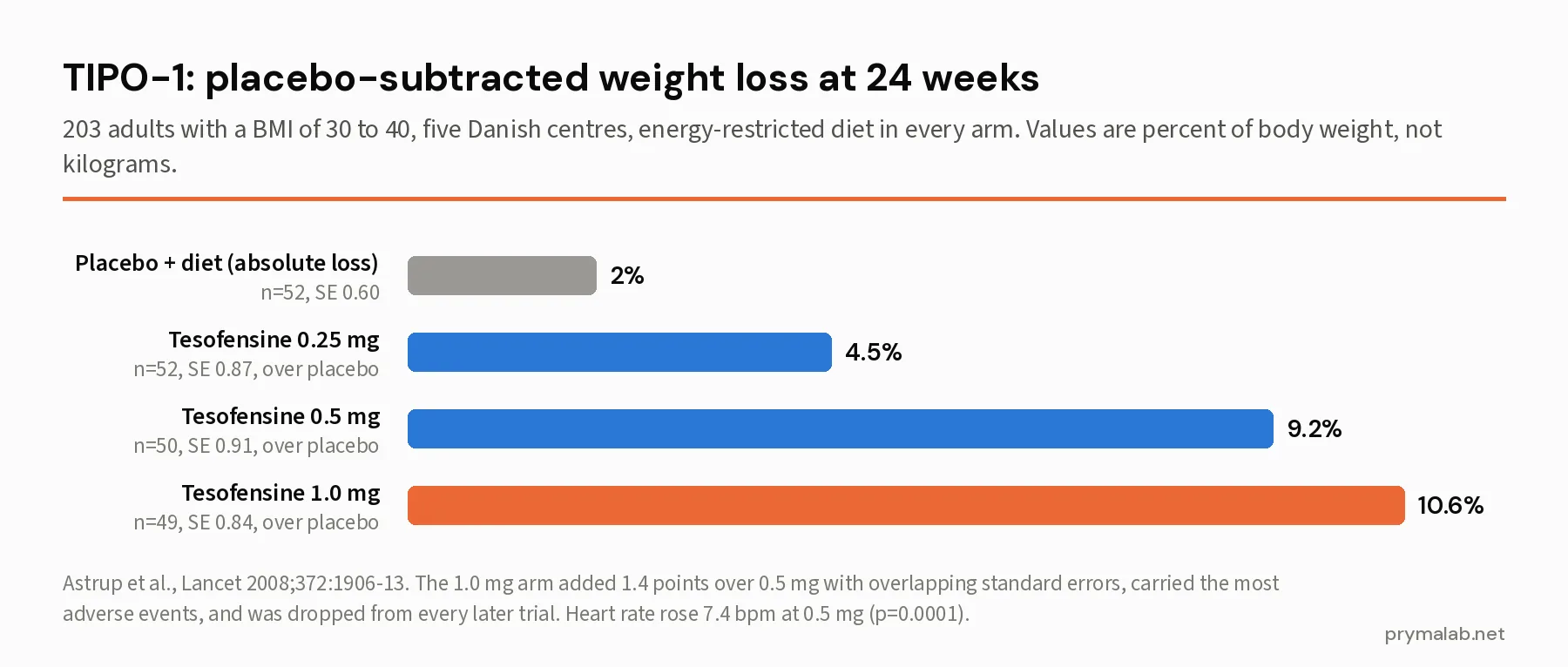
The adverse events, verbatim: 'dry mouth, nausea, constipation, hard stools, diarrhoea, and insomnia'. Dry mouth and insomnia were dose-dependent, and 13% of tesofensine patients withdrew for adverse events against 6% on placebo.[9][2] The authors' conclusion was unusually restrained: they wrote that the middle dose might have the potential to produce weight loss twice that of then-approved drugs, and that the efficacy and safety findings needed confirmation in phase III trials.[9] Eighteen years later, that confirmation has not been delivered in a form any stringent regulator has accepted.
The open-label extension, and the Phase 3 that never ran
TIPO-4 was a 48-week open-label extension enrolling 140 patients from TIPO-1. Patients from the middle dose arm reached a cumulative 13 to 14 kg over 48 weeks; former placebo patients lost about 9 kg in their first 24 weeks on drug.[2][14] Open-label and uncontrolled, so treat those as descriptive.
NeuroSearch planned a conventional registrational programme: a first Phase 3 protocol cleared by the FDA in the first half of 2010, four placebo-controlled studies enrolling 5,000 to 7,000 patients from 2011, including patients with diabetes and hypertension, running one to two years.[14] None of it ran. The company lost its funding in 2012, and there has never been a New Drug Application for tesofensine in the United States.[5]
The Mexico approval that has not happened
Saniona licensed tesofensine to Productos Medix in 2016 for Mexico and Argentina, keeping rights everywhere else and the right to use any data the Phase 3 generated.[15] Medix ran a randomised, double-blind, placebo-controlled trial in 372 ambulatory adults with obesity, 124 per arm, with two tesofensine doses and placebo, for 24 weeks. Recruitment finished in February 2018; topline results came on 17 December 2018: about 10% weight loss in the higher dose arm, more than half of patients losing over 10% of baseline, p<0.001 against placebo in both analysis populations, a 'low but statistically significant' heart-rate increase and no significant blood-pressure effect at either dose.[16]
Four things about that trial that every promotional summary leaves out. Every number comes from company press releases and annual reports; I found no peer-reviewed publication of a 372-patient registrational study completed eight years ago. The press release gives no placebo figure, so 'about 10%' cannot be read as absolute or placebo-subtracted; TIPO-1's placebo arm lost 2.0%, which makes the distinction worth roughly a fifth of the headline. The heart-rate finding is qualitative, with no beats-per-minute figure, in contrast to TIPO-1's published 7.4. And the highest Lancet dose was dropped entirely.
Then came the application, and the confusion that now fills the first page of search results.
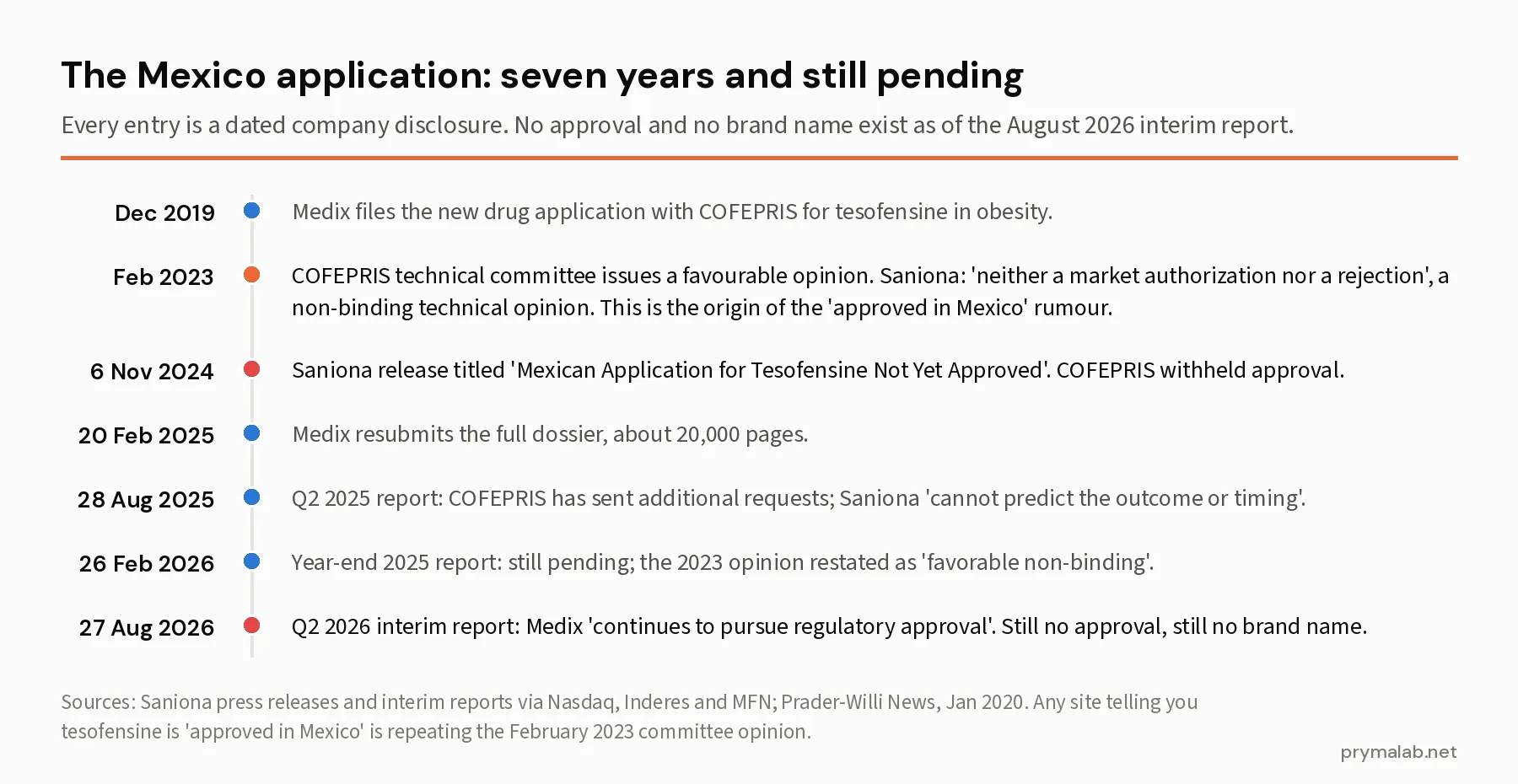
Medix filed with COFEPRIS in December 2019. In February 2023 the agency's technical committee on new molecules issued a favourable opinion, and Saniona went out of its way to say it was 'neither a market authorization nor a rejection', but a non-binding technical opinion and one step in the review.[17] On 6 November 2024 Saniona published a release titled 'Mexican Application for Tesofensine Not Yet Approved', confirming that Medix 'has not received approval from the Mexican regulatory agency (Cofepris) for tesofensine for the treatment of obesity' and would enter a dialogue with the agency, because the decision appeared not to rest on the full data package.[18] Medix resubmitted the entire dossier, about 20,000 pages, on 20 February 2025.[19] By August 2025 COFEPRIS had sent additional requests and Saniona wrote that it 'cannot predict the outcome or timing' of a potential approval.[20] The year-end 2025 report restated the 2023 opinion as 'favorable non-binding' and reported no decision. The interim report for the second quarter of 2026, published 27 August 2026, says only that Medix 'continues to pursue regulatory approval for tesofensine in obesity'.[21]
No approval. No brand name, in any jurisdiction. The trade names that circulate online for tesofensine have no source I could find, and I would not print one even with a hedge.
That market reaction is documented by Biostock.[22] It is the clearest illustration I have of how the rumour propagates: a favourable committee opinion becomes 'approved', a refusal becomes 'update', and by the time the story reaches a product page the hedges are gone. As of 23 September 2026, tesofensine is approved nowhere on earth.
Heart rate, blood pressure, and the beta-blocker the developer added
The safety record is smaller than the marketing implies and more specific than the scare stories claim. Start with the number that is published: in TIPO-1, heart rate rose by 7.4 beats per minute in the middle dose group (p=0.0001), while the two lower dose groups showed no significant increases in systolic or diastolic blood pressure compared with placebo.[9] Note what the abstract does not say. It reports vitals only for the two lower arms. It is silent on heart rate and blood pressure in the highest arm. The widely repeated claim that the highest dose raised blood pressure does not come from the abstract; reviews describe dose-dependent heart-rate and blood-pressure elevation at the higher doses tested, and Wikipedia gives 1 to 3 mmHg and up to 8 bpm for the two lower doses.[23][2]
| Study | Arm | Heart rate | Blood pressure |
|---|---|---|---|
| TIPO-1, obese, 24 wk (peer-reviewed) | Middle dose | +7.4 bpm, p=0.0001 | No significant change |
| TIPO-1 | Highest dose | Not in the abstract | Not in the abstract |
| Early Parkinson's, 14 wk (peer-reviewed) | Highest dose | 'Elevated heart rate ... common' | Not stated |
| Mexican Phase 3, 24 wk (sponsor-reported) | Two lower doses | 'Low but statistically significant', no figure | 'No significant effect at any dose' |
| Tesomet HO Phase 2, 24 wk (peer-reviewed) | Tesofensine + metoprolol | No difference vs placebo | No difference vs placebo |
The most telling fact in the whole dossier is what the developer did about the heart-rate signal. Tesomet is a fixed-dose combination of tesofensine and metoprolol, a cardioselective beta-blocker approved in the US since 1978, and Saniona states that the combination 'has demonstrated a significantly improved cardiovascular safety profile compared to tesofensine alone'.[24] In the only peer-reviewed Tesomet trial, 21 adults with hypothalamic obesity were randomised 2:1 to tesofensine plus metoprolol or placebo for 24 weeks; the primary endpoint was safety and it was met, with 'no significant differences in heart rate or blood pressure' between groups, and a 6.3% additional weight loss against placebo (p=0.017).[25] Adding the beta-blocker abolished the heart-rate signal in that trial. Tesofensine on its own is the half of that combination the sponsor judged needed cardiovascular protection.
Two honesty notes on that trial. Saniona's press release headlined 6.8% (p<0.001), while the peer-reviewed paper reports 6.3% (p=0.017); the company's own annual report later split the difference at 6.28%.[26][25] And the single serious adverse event was anxiety requiring discontinuation, which the press release described as 'anxiety/paranoia'. In a 13-patient treatment arm that is roughly one in twelve. Sleep disturbance affected 50%, dry mouth 43%, headache 36%.[25][26]
What the FDA said in 2020
The clearest US regulatory record on tesofensine is the pre-IND feedback Saniona announced on 9 October 2020 for Tesomet. FDA endorsed a 505(b)(2) pathway for hypothalamic obesity, asked for a Phase 2b before Phase 3, and then addressed the elephant directly: it 'expressed concerns about off-label use in the general obese population' and recommended either a cardiovascular outcomes study or controls to 'restrict distribution of Tesomet exclusively to the rare HO population'.[27] Read that again with the grey market in mind. In 2020 the FDA looked at a tesofensine-containing product and said: if this reaches the general obese population, you need a cardiovascular outcomes trial. The Phase 2b studies opened in 2021 and were 'put on hold and subsequently closed in 2022 due to lack of funding'.[24] The outcomes trial has never been run. There is no Phase 3 of Tesomet and there never was one.
The sibutramine shadow
Sibutramine (Meridia) is the correct comparator and the reason this class carries a regulatory shadow. It inhibited noradrenaline and serotonin reuptake; tesofensine adds dopamine. In the SCOUT trial, 9,804 overweight or obese patients with cardiovascular disease or diabetes were followed for a mean of 3.4 years, and the primary composite of cardiovascular death, heart attack, stroke or resuscitated arrest occurred in 11.4% on sibutramine against 10.0% on placebo (p=0.02), driven by non-fatal heart attack and stroke.[28] FDA withdrew approval of Meridia in December 2010.[29]
The fair reading is neither alarmist nor dismissive. Sibutramine's absolute excess was 1.4 percentage points over 3.4 years in a high-risk population, and it took 9,804 patients to detect it. The largest tesofensine trial ever run enrolled 372 patients for 24 weeks. 'No significant blood-pressure effect at 24 weeks in 372 patients' and 'no cardiovascular risk' are different statements. The specific harm that ended sibutramine has not been ruled out for tesofensine, because the study that could rule it out has never been run, and the FDA said so.
Why the top arm disappeared
No sponsor document states a formal reason for abandoning the highest dose, so I will not invent one. What the record shows is that it added only 1.4 percentage points of weight loss over the middle dose, with overlapping standard errors, while carrying the heaviest adverse-event burden and being the arm in which elevated heart rate was flagged in the Parkinson's programme, and that every trial after 2008 dropped it.[9][6][24] The Lancet authors' own conclusion singled out the middle dose. The inference is straightforward. The explicit rationale was never published.
A nine-day half-life changes everything
If you take one pharmacological fact away from this article, make it this one. Tesofensine's elimination half-life is about 220 hours, roughly nine days, with hepatic metabolism through CYP3A4 and 15 to 20% renal elimination. Its principal metabolite, NS2360, formed by N-desalkylation, has a half-life of about 374 hours, roughly 16 days, reaches 31 to 34% of parent exposure at steady state, and contributes about 6% of the reuptake activity.[2] Those figures trace to a population pharmacokinetic analysis in Alzheimer's patients by Lehr and colleagues in 2007.[30]
The 2026 human excretion study corroborates the long tail independently. Six volunteers received a single dose; urinary detection windows ran up to 500 hours, about three weeks, with peak urinary concentrations of 1 to 4 ng/mL reached anywhere between 4 and 46 hours and marked variation between individuals. The same study identified four principal urinary metabolites, three dealkylated (M1 to M3) and one hydroxylated and glucuronidated (M4), and noted that structural information on metabolites beyond NS2360 had previously been limited.[3]
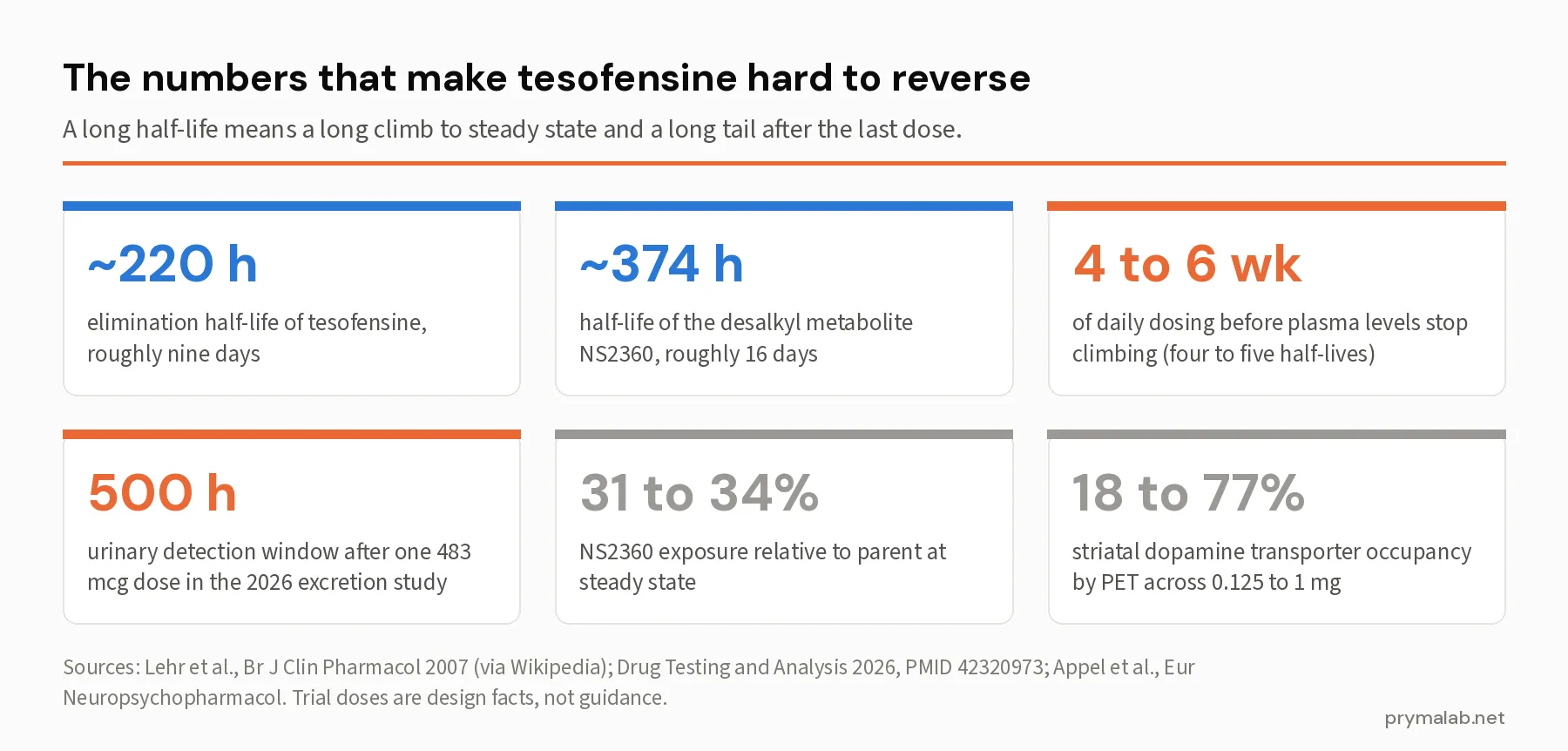
What the half-life implies, in four points.
Steady state takes about a month. Four to five half-lives at nine days each is four to six weeks, so with repeated exposure plasma levels keep rising for weeks. The trials used fixed doses without escalation.[15]
Washout is slow. Roughly half of the parent compound is still present nine days after the last exposure, and the active metabolite has a half-life over two weeks. That property is almost never mentioned in consumer-facing material.
CYP3A4 metabolism matters for interactions. Azole antifungals, macrolide antibiotics, ritonavir-boosted regimens and grapefruit inhibit CYP3A4, so co-exposure would add to an exposure that already accumulates for a month.[2]
Exposure varies between people. Tmax spanning 4 to 46 hours across six people is a wide spread.[3] Population averages describe nobody in particular.
Tesofensine vs semaglutide, and other comparisons people ask about
Every tesofensine-versus-anything comparison is cross-trial. There is no head-to-head against any GLP-1 receptor agonist, any older obesity drug, or anything else, and the trials being compared differ in era, population, duration and diet.[15] Here are the numbers anyway, stated the way their sources state them.
| Tesofensine (TIPO-1) | Semaglutide (STEP 1) | Tesomet (HO Phase 2) | |
|---|---|---|---|
| Population | 203 adults, BMI 30 to 40 | 1,961 adults, BMI 30+ or 27+ with comorbidity | 21 adults with hypothalamic obesity |
| Duration | 24 weeks | 68 weeks | 24 weeks |
| Weight change | 9.2% over placebo (middle dose arm) | 14.9% vs 2.4% on placebo | 6.3% over placebo |
| Route | Oral | Subcutaneous | Oral |
| Notable adverse effects | Dry mouth, insomnia, +7.4 bpm | Nausea, diarrhoea, vomiting | Sleep disturbance 50%, one anxiety SAE |
| Peer-reviewed | Yes, Lancet 2008 | Yes, NEJM 2021 | Yes, Eur J Endocrinol 2022 |
Saniona's pipeline page describes tesofensine's result as 'in the same ballpark of some of the best GLP-1 analogs'.[15] That is a sponsor claim, and it depends on comparing 24 weeks of one drug with 68 weeks of another. The mechanisms could hardly be more different: semaglutide is a peptide acting on a gut-hormone receptor with well-characterised effects on gastric emptying and appetite; tesofensine is a stimulant-class small molecule acting on three monoamine transporters in the brain, with a heart-rate signal semaglutide does not share at the same size. If you want the GLP-1 side of that comparison in detail, the semaglutide reference covers it, and the peptides and weight loss guide puts the whole class in context.
The comparison people should be making, and rarely do, is with sibutramine, because that is the mechanistic family tesofensine belongs to and the one with a completed cardiovascular outcomes trial. That comparison is in the safety section above, and it is not flattering to the argument that 24-week vitals settle the question.
What research-grade tesofensine is, and what a capsule label means
Tesofensine is not a controlled substance in the United States, and it is not an approved drug anywhere, so it sits in the same regulatory space as most of the research compounds this site documents: legal to sell and hold for laboratory research, not legal to market for human consumption, and not something any regulator has evaluated for safety. The legal status guide walks through that framework for peptides, and the logic is the same for a small molecule.
Because tesofensine is a stable small molecule with high oral bioavailability, it is supplied differently from peptides. There is no lyophilised powder to dissolve. Our tesofensine 500 mcg capsules are a solid presentation, thirty capsules per bottle, and the verification questions are the ones that matter for any capsule: identity (is it tesofensine, by mass spectrometry or a reference standard), content (how much per capsule), and content uniformity (how much capsule-to-capsule variation). Those are the tests I describe in the purity testing guide, adapted for a capsule rather than a vial.
Three things to ask any supplier of tesofensine, in order. Whether the stated amount refers to free base or tartrate salt, because the two differ by 1.457-fold and the label rarely says.[4] Whether they have per-lot identity and content data for the capsule, rather than a certificate for the raw powder that went into it. And whether they describe it as a peptide, because a supplier who cannot get the chemical class right is telling you how much scrutiny the rest of their documentation received.
On the compound itself, I would leave you with the version of the story the record supports: a potent appetite suppressant with a real, measured heart-rate signal, orphaned by its developer's insolvency, never tested at the scale that would settle its cardiovascular safety, rescued for one national market where it has now spent seven years failing to clear the regulator, and sold in the meantime, by mail order, as a peptide it is not.
What this article does not settle
Whether the Mexican Phase 3 results hold up. Every number from the 372-patient trial is sponsor-reported. There is no journal publication, no disclosed placebo figure and no heart-rate figure. Until the trial is published, 'about 10%' is a press-release number.
Cardiovascular safety over years. The cumulative exposure database is about 1,600 patients for up to one year.[24] Obesity pharmacotherapy is taken for years. SCOUT needed 9,804 patients and 3.4 years to find sibutramine's signal. No tesofensine study has approached either figure.
The dopamine transporter potency. Two incompatible in-vitro values (8 nM and 65 nM) coexist with PET occupancy of 18 to 77%. I could not trace the revised value to its primary paper.
The highest arm's vitals. The Lancet abstract does not report them. Anyone stating a specific blood-pressure figure for that arm is citing something other than the abstract, and I would want to see the full text before repeating it.
Any non-oral route. No injectable, sublingual or nasal presentation of tesofensine has ever been studied in humans.
What is well established: the structure, formula and molecular weight; that it is a small molecule and not a peptide; the Lancet efficacy and adverse-event figures as the abstract states them; the 7.4 bpm heart-rate increase in the middle dose arm; the nine-day half-life and the 16-day metabolite; the FDA's 2020 request for a cardiovascular outcomes study; and that, as of the company's 27 August 2026 report, tesofensine is approved nowhere and carries no brand name.
NS2330 (tesofensine): what the development code refers to
NS2330, also written NS-2330 or NS 2330, is the internal compound code NeuroSearch A/S gave tesofensine during development; the 'NS' prefix is the company's initials and the number is a series identifier, so the code carries no chemical information.[2] You will see it on the Parkinson's and Alzheimer's papers from the 2000s, on the population pharmacokinetic paper, and on chemical supplier listings. NS2360 is the desalkyl metabolite. TIPO is the trial-series acronym used for the obesity studies (TIPO-1, the Lancet trial; TIPO-2, the metabolic-chamber study; TIPO-4, the open-label extension). Tesomet is the fixed-dose combination of tesofensine with the beta-blocker metoprolol. None of these is a brand name, and tesofensine has no approved brand name in any country.
Frequently asked questions
Is tesofensine a peptide?
No. It is a 328 Da phenyltropane small molecule with no amino acids and no peptide bonds, about 90% orally bioavailable, given as a tablet in every human trial. It is sold by peptide vendors, which is where the phrase comes from.
Is tesofensine approved anywhere, including Mexico?
No. The Mexican application filed in December 2019 was explicitly not approved in November 2024, was resubmitted in February 2025, and was still pending in Saniona's 27 August 2026 report. The 'approved in Mexico' claim is a misreading of a non-binding 2023 committee opinion.
What did the tesofensine clinical trial show?
The 2008 Lancet trial in 203 adults reported 4.5%, 9.2% and 10.6% placebo-subtracted weight loss across three dose arms over 24 weeks, plus a 7.4 bpm heart-rate rise in the middle arm. The Mexican Phase 3 has never been published.
What are the side effects of tesofensine in the trials?
Dry mouth, nausea, constipation, hard stools, diarrhoea and insomnia in the Lancet trial, with 13% withdrawing for adverse events vs 6% on placebo, plus a 7.4 bpm heart-rate rise in the middle dose arm. The Tesomet trial added sleep disturbance in 50% and one serious anxiety event.
What is the half-life of tesofensine?
About 220 hours (nine days), with the metabolite NS2360 at about 374 hours (16 days). Steady state takes four to six weeks and the 2026 excretion study found urinary detection out to 500 hours after one dose.
How does tesofensine compare with semaglutide?
Only cross-trial. Tesofensine: 9.2% over placebo at 24 weeks in 203 adults. Semaglutide: 14.9% vs 2.4% at 68 weeks in 1,961 adults. Different molecules, mechanisms, routes and regulatory status.
Why did the developer add a beta-blocker to tesofensine?
Because of the 7.4 bpm heart-rate increase. Tesomet pairs tesofensine with metoprolol, and in the one peer-reviewed Tesomet trial the combination showed no heart-rate or blood-pressure difference from placebo.
Does tesofensine raise metabolism or just suppress appetite?
Mostly appetite. The controlled metabolic-chamber study found higher satiety, 18 g more daily fat oxidation and no significant change in total 24-hour energy expenditure; only night-time expenditure rose, by 4.6%.
What did the FDA say about tesofensine?
It cleared a Phase 3 protocol around 2010 that never ran, and in 2020 it told the sponsor that a tesofensine-containing product reaching the general obese population would need a cardiovascular outcomes study. No NDA has ever been filed.
Is tesofensine banned in sport?
Yes. WADA lists it as an S6 stimulant, prohibited in competition, and the 2026 excretion study found it detectable in urine for about 500 hours after one dose.
Why does a 500 mcg tesofensine label need to say free base or tartrate?
Because the tartrate salt is 478.36 g/mol against 328.3 for the free base, a 1.457-fold difference, so 500 mcg of salt contains about 343 mcg of active tesofensine. Most listings do not say which form they mean.
References
- Cayman Chemical. Tesofensine product data: CAS 195875-84-4, C17H23Cl2NO, 328.3, IUPAC name and transporter IC50 values. Cayman Chemical
- Wikipedia. Tesofensine. Chemical class, oral bioavailability, original and revised IC50 sets, pharmacokinetics (220 h; NS2360 374 h, 31 to 34% exposure, 6% activity), TIPO-4 extension, adverse-event rates and CYP3A4 metabolism. Wikipedia
- Investigations Into the Metabolism and Elimination of Tesofensine in Human Urine. Drug Testing and Analysis. 2026. PMID 42320973. Online marketing as a supplement, WADA S6 status, metabolites M1 to M4, single-dose design and the 500-hour detection window. PubMed
- MedKoo Biosciences. Tesofensine tartrate: C21H29Cl2NO7, 478.36 g/mol. MedKoo
- Wikipedia. NeuroSearch. Loss of R&D funding in 2012, transfer of tesofensine to Saniona on 30 October 2014, and the 2018 takeover. Wikipedia
- Hauser RA, et al. Randomized trial of the triple monoamine reuptake inhibitor NS 2330 (tesofensine) in early Parkinson's disease. Mov Disord. 2007;22(3):359-365. doi:10.1002/mds.21258. n=261, negative primary endpoint, weight loss and elevated heart rate common in the highest dose group. Wiley
- Rascol O, et al. Tesofensine (NS 2330), a monoamine reuptake inhibitor, in patients with advanced Parkinson disease and motor fluctuations: the ADVANS study. Arch Neurol. 2008;65(5):577-583. PMID 18474731. PubMed
- Astrup A, et al. Weight loss produced by tesofensine in patients with Parkinson's or Alzheimer's disease. Obesity. 2008;16(6):1363-1369. doi:10.1038/oby.2008.56. Wiley
- Astrup A, Madsbad S, Breum L, Jensen TJ, Kroustrup JP, Larsen TM. Effect of tesofensine on bodyweight loss, body composition, and quality of life in obese patients: a randomised, double-blind, placebo-controlled trial. Lancet. 2008;372(9653):1906-1913. PMID 18950853. NCT00394667. Abstract quoted verbatim. The Lancet
- Appel L, et al. Tesofensine, a novel triple monoamine re-uptake inhibitor with anti-obesity effects: dopamine transporter occupancy as measured by PET. Eur Neuropsychopharmacol. 2014;24(2):251-261. Striatal DAT occupancy 18 to 77% across the doses tested. ScienceDirect
- Sjödin A, et al. The effect of the triple monoamine reuptake inhibitor tesofensine on energy metabolism and appetite in overweight and moderately obese men. Int J Obes. 2010;34(11):1634-1643. PMID 20479765. TIPO-2: appetite, 18 g fat oxidation, 4.6% night-time energy expenditure, 1.8 kg in two weeks. Nature
- Tesofensine, a novel antiobesity drug, silences GABAergic hypothalamic neurons. Rodent circuit study; obese versus lean rats, 5-HTP synergy, phentermine comparison. OUCI record
- Wilding JPH, et al. Once-weekly semaglutide in adults with overweight or obesity (STEP 1). N Engl J Med. 2021;384(11):989-1002. doi:10.1056/NEJMoa2032183. 14.9% vs 2.4% at 68 weeks, n=1,961. NEJM
- Clinical Trials Arena. Tesofensine market data: TIPO-1, TIPO-2, TIPO-4 and the planned NeuroSearch Phase 3 programme (FDA protocol clearance H1 2010, four studies, 5,000 to 7,000 patients). Clinical Trials Arena
- Saniona AB. Tesofensine pipeline page: Medix licence, fixed doses, and the GLP-1 comparison claim. Retrieved 23 September 2026. Saniona
- Saniona AB. Tesofensine Phase 3 topline results in obesity, 17 December 2018. n=372, about 10% weight loss, heart-rate and blood-pressure statements. Euroland IR
- Saniona AB. Saniona's partner Medix receives favorable opinion for tesofensine for the treatment of obesity and weight management in Mexico. February 2023. 'Neither a market authorization nor a rejection'. Nasdaq
- Saniona AB. Mexican Application for Tesofensine Not Yet Approved. 6 November 2024. Nasdaq
- Saniona AB. Medix to submit final version of tesofensine application following interaction with COFEPRIS. 10 February 2025; resubmission of about 20,000 pages on 20 February 2025 per the Q1 2025 interim report. Inderes
- Saniona AB. Interim report January to June 2025, published 28 August 2025. Additional COFEPRIS requests; 'cannot predict the outcome or timing'. Nasdaq
- Saniona AB. Interim report January to June 2026, published 27 August 2026. Medix 'continues to pursue regulatory approval for tesofensine in obesity'; the 2023 opinion restated as 'favorable non-binding'. MFN (PDF)
- Biostock. Saniona provided a tesofensine update. November 2024. Share price up 34% then 28% below the pre-announcement level. Biostock
- Review of anti-obesity pharmacotherapy including tesofensine's dose-dependent heart-rate and blood-pressure findings. World J Clin Cases. 2014;2(4):135. WJCC
- Saniona AB. Annual Report 2023. Tesomet cardiovascular profile statement, Phase 2b closure in 2022 for lack of funding, the 1,600-patient exposure database, and the 6.28% figure. Saniona (PDF)
- Huynh K, et al. Randomized controlled trial of Tesomet for weight loss in hypothalamic obesity. Eur J Endocrinol. 2022;186(6):687-700. n=21, safety primary endpoint, 6.3% vs placebo (p=0.017), no heart-rate or blood-pressure difference, adverse-event rates. Oxford Academic
- Saniona AB. Saniona reports positive topline results from Phase 2 trial of Tesomet in hypothalamic obesity. 22 April 2020. 6.8% headline and the 'anxiety/paranoia' serious adverse event. GlobeNewswire
- Saniona AB. Saniona receives pre-IND feedback from FDA on regulatory path for Tesomet in Prader-Willi syndrome and hypothalamic obesity. 9 October 2020. The cardiovascular outcomes study or restricted-distribution recommendation. GlobeNewswire
- James WPT, et al. Effect of sibutramine on cardiovascular outcomes in overweight and obese subjects (SCOUT). N Engl J Med. 2010;363:905-917. Summary via the American College of Cardiology. ACC
- Federal Register. Abbott Laboratories, Inc.; Withdrawal of Approval of a New Drug Application for Meridia. 21 December 2010. Federal Register
- Lehr T, et al. Population pharmacokinetic modelling of NS2330 (tesofensine) and its major metabolite in patients with Alzheimer's disease. Br J Clin Pharmacol. 2007;64(1):36-48. PMID 17324246. Source of the 220 h and 374 h half-lives; full text behind a paywall, figures taken from the summary in reference 2. PubMed
Figures come from the published papers, company disclosures and regulatory documents named above, current to 23 September 2026. Where a primary paper sits behind a paywall and a figure was taken from a secondary summary, the reference says so.
Final disclaimer: This article is an educational research reference on the chemistry, pharmacology, clinical record and regulatory status of tesofensine. Compounds supplied by PrymaLab are sold for laboratory research use only and are not approved by any regulator for human or veterinary use. Statements have not been evaluated by the FDA. Nothing here is medical advice or a treatment claim.
Clinical trial designs and outcomes are reported as study facts about prescription-grade material given under medical supervision, and do not describe or support any use of research-grade material. Always verify the legal status of any research compound in your jurisdiction before purchase or use.