

Retatrutide vs tirzepatide: mechanism, trial results and evidence compared
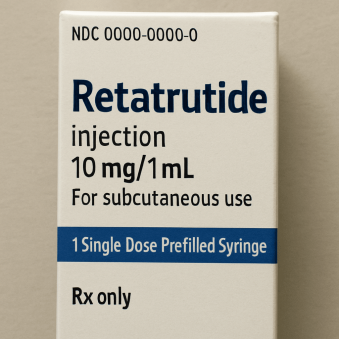
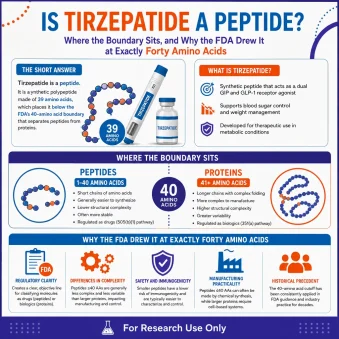
Retatrutide and tirzepatide are both long-acting, lipidated 39-amino-acid incretin peptides built on the GIP backbone. Tirzepatide is a dual GIP and GLP-1 receptor agonist that is already an approved prescription drug; retatrutide adds glucagon receptor agonism and is in phase 3. PrymaLab supplies Retatrutide 10mg and Tirzepatide 10mg vials, among other sizes, for research use.
| Property | Retatrutide | Tirzepatide |
|---|---|---|
| Receptors | GLP-1, GIP and glucagon (triple agonist) | GLP-1 and GIP (dual agonist) |
| Development stage | Phase 3 (TRIUMPH program); TRIUMPH-1 read out 21 May 2026 | FDA-approved: Mounjaro (2022) and Zepbound (2023) |
| Largest-trial weight change | 28.3% at 80 weeks in the highest-dose arm (TRIUMPH-1, 2,339 participants); 30.3% at 104 weeks in an extension limited to a baseline BMI of 35 or higher | 20.9% at 72 weeks in the highest-dose arm (SURMOUNT-1) |
| Forms at PrymaLab | Lyophilized vials from 5mg to 60mg and a 15mg preloaded pen | Lyophilized vials from 5mg to 100mg |
- Molecules: both 39 residues on a GIP backbone with a C20 fatty diacid, at Lys17 (retatrutide) and Lys20 (tirzepatide).
- Third receptor: glucagon agonism raises energy expenditure and hepatic fat oxidation; mean relative liver fat fell 82.4% at 24 weeks in the highest-dose arm in phase 2a.
- Not head to head: TRIUMPH-1 and SURMOUNT-1 differ in population, duration and estimand, so 28.3 and 20.9 are not directly comparable.
- Tolerability signal: discontinuation for adverse events on the lowest-dose retatrutide arm was 4.1%, below the 4.9% on placebo.
- Storage: lyophilized vials frozen or refrigerated, protected from light; reconstituted solution at 2 to 8°C.
- Forms and sizes at PrymaLab: Retatrutide 10mg and Tirzepatide 10mg vials, with other sizes on each product page.
The peptide reconstitution calculator converts vial size and diluent volume into concentration; retatrutide vial sizes are covered in the retatrutide reconstitution guide.
Most pages comparing these two still quote 24.2 percent for retatrutide. That number came from a Phase 2 trial and a modelling paper. Phase 3 read out on 21 May 2026 and the figure is now 28.3 percent at 80 weeks, with 30.3 percent in a two-year extension. I checked a dozen competitor pages while writing this and found one that had updated. The rest are three months stale on the single number their whole article is built around.
Research-use-only disclaimer: Retatrutide and tirzepatide supplied as research chemicals are intended strictly for in-vitro and laboratory research use and are not intended for human or veterinary use in that context. Clinical trial results described below concern investigational or approved drug products administered under medical supervision, and they do not describe or support any use of research-grade material. No dosing or administration guidance appears in this article, and trial arms are described without doses. Nothing here is medical advice.

TL;DR
Tirzepatide hits two receptors, GIP and GLP-1. Retatrutide hits three, adding glucagon. Glucagon receptor activation drives hepatic fat oxidation and raises energy expenditure, which is a different lever from appetite suppression, and its glucose-raising effect is offset by the other two components. TRIUMPH-1 (21 May 2026, 2,339 participants) reported 28.3 percent mean weight loss at 80 weeks in the highest-dose arm, and 30.3 percent at 104 weeks in a prespecified extension. You cannot compare that directly to tirzepatide's 20.9 percent from SURMOUNT-1, because the trials differ in duration, population and estimand. The one modelled comparison put retatrutide at 24.2 percent against tirzepatide's 17.8 percent. Retatrutide is still investigational. Research use only.
Tirzepatide: dual agonist, GIP and GLP-1. Approved.
Retatrutide: triple agonist, GIP, GLP-1 and glucagon. Investigational.
TRIUMPH-1, 80 weeks, highest-dose arm: 70.3 lb, 28.3 percent of body weight.
104-week extension, highest-dose arm: 85.0 lb, 30.3 percent.
Liver fat, Phase 2a MASLD: 82.4 percent mean relative reduction in the highest-dose arm by 24 weeks.
The open question: blocking the GIP receptor also produces weight loss.
Status: research use only.
Two Receptors Versus Three
The entire difference between these two molecules is a receptor count, so start there and the rest follows.
Tirzepatide is a dual agonist. It activates the receptor for glucose-dependent insulinotropic polypeptide (GIP) and the receptor for glucagon-like peptide-1 (GLP-1).
Retatrutide, development code LY3437943, activates those two and adds the glucagon receptor.[1]
Both are long-acting peptides from Eli Lilly. Both descend from the same medicinal chemistry programme. The third receptor is what separates them, and it is why the mechanism is genuinely different rather than incrementally stronger.
Here is the part that trips people up. Glucagon and GLP-1 do opposite things to blood sugar. Glucagon raises it. So the obvious question is why anyone would build a molecule that deliberately activates both, and the answer takes a section of its own further down.
PrymaLab supplies retatrutide as reference material in 5mg through 60mg vials, and tirzepatide across a similar range. The full GLP-1 category covers the rest of the class.
There is a third architecture, and it changes how you read the comparison
Framing this as dual against triple makes it sound like a ladder where more receptors is further up. It is not a ladder, because a different two-receptor combination exists.
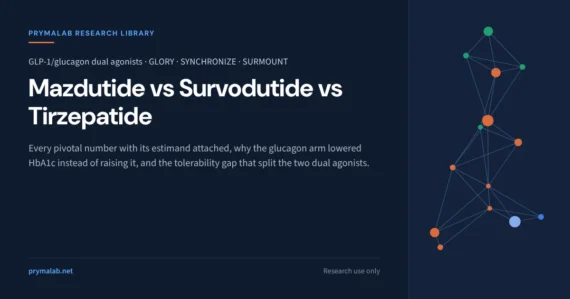
Survodutide and mazdutide are dual glucagon and GLP-1 agonists. They take the glucagon component that separates retatrutide from tirzepatide and pair it with GLP-1, leaving GIP out entirely.
So the class contains at least four architectures, and the receptors are being mixed rather than stacked:
- GLP-1 alone: semaglutide
- GIP plus GLP-1: tirzepatide
- Glucagon plus GLP-1: survodutide, mazdutide
- All three: retatrutide
The dual glucagon and GLP-1 molecules are the useful control condition nobody uses when discussing retatrutide. If you want to know what the glucagon component contributes on its own, they are the comparison, not tirzepatide. Their liver outcomes in particular are where I would look first, and survodutide's development has leaned toward hepatic indications rather than weight alone, which is consistent with the mechanism.
Where the triple agonist idea came from
Retatrutide was not the first peptide designed to act on all three receptors. In 2015 Finan and colleagues reported a monomeric triple agonist with matched potency at the GLP-1, GIP and glucagon receptors and no cross-reactivity at related receptors (Finan et al. 2015). In rodent models of obesity it lowered body weight, improved glycaemic control and reversed hepatic steatosis, and the authors reported that it outperformed the dual co-agonists and the best single-receptor agonists they compared it with (Finan et al. 2015). They used genetic knockout, pharmacological blockade and selective chemical knockout to show that each receptor contributed in vivo, and attributed the overall effect mainly to glucagon raising energy expenditure, GLP-1 reducing calorie intake and improving glucose control, and GIP potentiating the incretin effect while buffering the glucose-raising action of glucagon (Finan et al. 2015).
Retatrutide applies the same principle with a different balance. The 2022 discovery paper by Coskun and colleagues described LY3437943 as having balanced glucagon and GLP-1 receptor activity but more GIP receptor activity in vitro (Coskun et al. 2022). In obese mice, the paper reported that energy expenditure raised through the glucagon receptor added to the intake reduction from the two incretin receptors (Coskun et al. 2022). Whether an evenly matched triagonist and a GIP-weighted one behave differently in people has not been tested, and the receptor-by-receptor knockout evidence exists only in rodents (Finan et al. 2015).
TRIUMPH-1, and the Number That Moved
On 21 May 2026 Lilly announced topline results from TRIUMPH-1 (NCT05929066), the registrational Phase 3 obesity trial.[2]
The design: randomised, double-blind, placebo-controlled, 2,339 participants, 80 weeks, adults with obesity or overweight plus at least one weight-related comorbidity and without diabetes. There were three active dose arms and a placebo arm. All three active arms met the primary and key secondary endpoints.[2]
Primary efficacy results at 80 weeks, from an average baseline of 248.5 lb and BMI 40.0:
- Highest-dose arm: 70.3 lb, or 28.3 percent of body weight
- Middle-dose arm: 64.4 lb, or 25.9 percent
- Lowest-dose arm: 47.2 lb, or 19.0 percent
Distribution numbers matter more than means here, and they were unusual. In the highest-dose arm, 45.3 percent of participants lost 30 percent or more of body weight, a threshold historically associated with bariatric surgery. 65.3 percent finished with a BMI below 30, meaning they were no longer in the obese range at all, and that included 37.5 percent of those who entered the trial with class 3 obesity at BMI 40 or above.[2]
The highest-dose arm also showed a mean waist circumference reduction of 24.1 cm, about 9.5 inches, with improvements in non-HDL cholesterol, triglycerides, systolic blood pressure and high-sensitivity C-reactive protein.[2]
The two-year extension
TRIUMPH-1 carried a prespecified, blinded extension to 104 weeks for 532 participants who had a baseline BMI of at least 35 and tolerated their assigned treatment. They continued on their maximum tolerated dose.
By week 104, participants originally randomised to the highest dose had lost 85.0 lb on average, 30.3 percent from a baseline of 268.3 lb and BMI 42.8.[2]
People were still losing weight at two years. That is the finding I would flag to anyone reading this, because the plateau question is the one that has followed every incretin drug since exenatide, and an extension arm that keeps going at 104 weeks is a partial answer to it.
Why You Cannot Put 28.3 Next to 20.9
Tirzepatide's headline obesity figure comes from SURMOUNT-1: 20.9 percent mean weight change at 72 weeks in the highest-dose arm, against 3.1 percent on placebo, published in the New England Journal of Medicine in 2022.[3]
So 28.3 versus 20.9, and retatrutide wins by seven and a half points. Every comparison page on the internet does this arithmetic. It is not a valid comparison and here is why.
The durations differ. 80 weeks against 72. Eight weeks is not nothing on a curve that is still descending.
The populations differ. Both enrolled adults with obesity or overweight plus comorbidity and without diabetes, which is closer than most cross-trial comparisons manage, but baseline BMI, geography and enrolment period all differ.
The estimands differ, and this is the one that gets skipped. A trial can report a treatment-regimen estimand, which counts everyone as randomised including people who stopped, or an efficacy estimand, which asks what happens in people who stay on drug. Lilly reported SURMOUNT-1 as a range of 16.0 to 22.5 percent across doses under one estimand and 20.9 percent for the highest dose under another. Quoting the biggest number from one trial against a different estimand from another trial is how you manufacture a gap that is partly statistical bookkeeping.
The closest thing to a fair comparison is a network meta-analysis published in Annals of Internal Medicine covering 12 GLP-1 receptor agonists and co-agonists across 26 randomised controlled trials and 15,491 adults without diabetes. Modelled on a common basis it put retatrutide at 24.2 percent at its highest evaluated dose, tirzepatide at 17.8 percent at its maximum evaluated dose, and subcutaneous semaglutide at 13.9 percent.[2][4]
That 24.2 percent figure is where every stale competitor page is stuck. It was the best available number until 21 May 2026. It is now the conservative modelled estimate, and TRIUMPH-1 came in above it.
What the Glucagon Receptor Buys You
This is the section I care about, because it is the actual mechanistic difference and most pages reduce it to "it hits three receptors so it works better," which explains nothing.
GLP-1 and GIP agonism work largely through reduced intake. Slowed gastric emptying, increased satiety, central appetite signalling. The person eats less.
Glucagon receptor activation does something categorically different. It acts on the output side:
- Hepatic fatty acid oxidation. The liver oxidises fat rather than storing it, and hepatic lipogenesis falls.
- Lipolysis. Stored triglyceride is mobilised out of adipose tissue.
- Thermogenesis. Resting energy expenditure rises. This is the effect neither GLP-1 nor GIP produces.
- Amino acid catabolism increases, which has its own consequences that I have not seen adequately studied in this context.
So retatrutide reduces intake through two receptors and increases expenditure through a third. Eat less and burn more, from one molecule, which is why the weight loss curve is steeper rather than merely longer.
The problem with glucagon, and how the design solves it
Glucagon's day job is raising blood glucose. It drives hepatic glycogenolysis and gluconeogenesis, which is exactly what you want when blood sugar drops and exactly what you do not want in someone being treated for a metabolic condition. Glucagon agonism alone would worsen glycaemic control.
The resolution is dose balance. At the ratios retatrutide engages the three receptors, the glucose-lowering action of the GLP-1 and GIP components offsets the glucagon-driven rise, leaving the thermogenic and lipolytic activity without net hyperglycaemia.[1]
I want to be clear that this is a balance rather than a cancellation, and it is why a triple agonist is a harder molecule to build than a dual one. You are not adding a third activity, you are tuning three activities against each other so that two desirable effects survive and one undesirable effect is neutralised. Get the ratio wrong and you have built a drug that raises blood sugar.
TRIUMPH-2, in participants with type 2 diabetes, met its primary endpoint on 23 July 2026, which is the direct test of whether the balance holds in the population where it matters most.[5]
The Liver Fat Data Almost Nobody Cites
If the glucagon component does what the mechanism says, the liver is where you would see it most clearly, because hepatic fat oxidation is a direct readout of glucagon receptor activity. Somebody ran that experiment and the result barely appears in the comparison content.
A randomised, double-blind, placebo-controlled Phase 2a trial in 98 participants with metabolic dysfunction-associated steatotic liver disease, published in Nature Medicine in 2024, compared four retatrutide dose levels with placebo over 48 weeks.[6]
Mean relative change in liver fat at 24 weeks:
| Arm | Mean relative liver fat change | Reached normal liver fat (<5%) |
|---|---|---|
| Lowest dose | −42.9% | 27% |
| Second dose | −57.0% | 52% |
| Third dose | −81.4% | 79% |
| Highest dose | −82.4% | 86% |
| Placebo | +0.3% | 0% |
All active arms were significant against placebo at P below 0.001.[6] By 48 weeks, 93 percent of the highest-dose group had liver fat below 5 percent.
Two things about that table. The dose response is steep between the second and third dose levels and then flat, which suggests the liver effect saturates well below the top dose. And placebo moved by 0.3 percent in the wrong direction over 24 weeks, which tells you the effect is not regression to the mean or lifestyle drift in the trial population.
I would rank this as the most mechanistically informative dataset on retatrutide, above the weight numbers, because it isolates the thing the third receptor is supposed to do. It is also the dataset that gets left out of every comparison article I have read, presumably because liver fat is less marketable than pounds.
The GIP Problem, and Why I Think It Is the Most Interesting Thing Here
Everything above assumes GIP receptor agonism is good for weight loss. Both molecules do it. Tirzepatide's approval rests partly on it.
Then there is MariTide, maridebart cafraglutide, from Amgen. It is a bispecific: a fully human monoclonal antibody that antagonises the GIP receptor, conjugated through amino acid linkers to two GLP-1 analogue agonist peptides. Once-monthly subcutaneous.[7]
It blocks the receptor the other two activate. In Phase 2 it produced mean weight reductions of up to 20 percent in participants with obesity without type 2 diabetes, and up to 17 percent in those with both.[7]
So agonising the GIP receptor produces weight loss, and antagonising it produces weight loss, and both effects are amplified by GLP-1 agonism.
It gets stranger. Human genetic data cuts toward the antagonists: GIP receptor variants associated with reduced signalling track with lower body mass index in population studies.[7] If you had only the genetics you would conclude that less GIP signalling is what you want, and then tirzepatide came along and did the opposite thing successfully.
I do not have a resolution and I have not found one that convinces me. The candidate explanations I have seen are that sustained agonism produces functional receptor desensitisation, so a long-acting agonist eventually behaves like an antagonist at the tissue level, or that GIP receptor signalling in adipose tissue and in the central nervous system pull in different directions and the two drug classes are hitting different compartments. Both are plausible. Neither is settled.
Anybody selling you a clean story about how these molecules work is telling you the marketing version. The honest version is that we have two drug classes doing opposite things to the same receptor and both working, and nobody has published a mechanism that accounts for it.
Imbalanced and biased agonism
Tirzepatide is usually described as a dual GIP and GLP-1 receptor agonist, but it does not act on the two receptors equally. Willard and colleagues developed a way to calculate the occupancy of each receptor at clinically effective drug exposure and found greater engagement of the GIP receptor than of the GLP-1 receptor, which they termed an imbalanced mechanism (Willard et al. 2020). The receptors also differ in how they signal in response. At the GIP receptor tirzepatide mimicked native GIP, whereas at the GLP-1 receptor it favoured cAMP generation over β-arrestin recruitment and drove less receptor internalisation than GLP-1 (Willard et al. 2020). In primary islets, β-arrestin1 limited the insulin response to GLP-1 but not to GIP or tirzepatide, and the authors interpreted this as evidence that the bias raises insulin secretion (Willard et al. 2020).
Structural work gives a consistent picture. Sun and colleagues combined cryogenic electron microscopy with molecular dynamics simulations and reported that tirzepatide closely resembles native GIP in the way it activates the GIP receptor but differs markedly from GLP-1 at the GLP-1 receptor, with less agonist-induced receptor desensitisation (Sun et al. 2022). Their analysis set out how much the fatty acid modification, combined with the amino acid sequence, determines how a multireceptor agonist acts (Sun et al. 2022). Both groups presented the imbalance and the bias as a possible explanation for the clinical profile. Neither study measured how much each receptor contributes in people.
What the Trial Reported as Adverse Events
Reported here as TRIUMPH-1 study findings for an investigational drug under medical supervision. This is trial data, not guidance, and it does not describe research-grade material.
The profile was consistent with other incretin-based therapies and driven by gastrointestinal effects. Across the three active arms against placebo:[2]
| Event | Lowest dose | Middle dose | Highest dose | Placebo |
|---|---|---|---|---|
| Nausea | 28.6% | 38.4% | 42.4% | 14.8% |
| Diarrhoea | 25.2% | 34.1% | 32.0% | 13.5% |
| Constipation | 23.8% | 25.9% | 26.1% | 10.9% |
| Vomiting | 10.6% | 22.8% | 25.3% | 4.8% |
| Discontinued for AE | 4.1% | 6.9% | 11.3% | 4.9% |
Upper respiratory tract infections, urinary tract infections and mild to moderate dysesthesia were also observed, with the majority of the urinary and neurological cases resolving during active treatment.[2]
The dysesthesia is the entry I would want explained. Altered or unpleasant sensation is not a standard incretin finding, and it appears in a trial of a molecule that adds a receptor the others do not touch. I have not seen a mechanistic account of it and the topline release does not offer one. It may be nothing. It is the sort of thing that turns out to matter once a full publication lands.
The other line worth reading twice: discontinuation for adverse events on the lowest-dose arm was 4.1 percent, lower than the 4.9 percent on placebo. That is a strange and useful result. It suggests the tolerability problem is concentrated at the top of the dose range rather than intrinsic to the molecule, and the lowest-dose arm still produced 19 percent weight loss.
Full data is due at the 86th annual American Diabetes Association Scientific Sessions.[2]
Side by Side
| Retatrutide | Tirzepatide | |
|---|---|---|
| Receptors | GIP, GLP-1, glucagon | GIP, GLP-1 |
| Class | Triple agonist | Dual agonist |
| Energy expenditure effect | Yes, via glucagon | No |
| Phase 3 obesity trial | TRIUMPH-1, 80 weeks | SURMOUNT-1, 72 weeks |
| Headline weight result | 28.3% (highest-dose arm) | 20.9% (highest-dose arm) |
| Modelled comparison | 24.2% | 17.8% |
| Longest reported duration | 104 weeks, 30.3% | 72 weeks |
| Dedicated liver fat trial | Yes, Phase 2a MASLD | Studied separately |
| Regulatory status | Investigational | Approved |
What Is Still Coming
Three readouts change this comparison and two of them are close.
TRIUMPH-2, in participants with type 2 diabetes, met its primary endpoint on 23 July 2026.[5] Detailed data has not been presented at the time of writing. This is the trial that tests whether the glucagon balance holds in a glycaemically compromised population.
TRIUMPH-3, in participants with established cardiovascular disease, is expected later in 2026.[2] Cardiovascular outcome data is what moves a metabolic drug from effective to standard of care, and it is the gap tirzepatide and semaglutide have been closing for years.
A head-to-head trial against tirzepatide has not been announced as far as I can tell, which is unsurprising given both are Lilly molecules and the commercial logic of running one is poor. A company with an approved dual agonist selling well has no reason to fund a study whose most likely outcome is a press cycle about its own drug being second best.
There is also a second PCAC meeting expected in February 2027 to consider five further peptides.[8] None of the GLP-1 class was on the July 2026 agenda, and I would not expect these molecules to appear on a 503A bulks list, because compounding pathways exist for approved and shortage drugs rather than for investigational ones. The regulatory conversation around retatrutide will be a new drug application, not a compounding vote. The separate question of what the July 2026 votes did and did not change is covered in the peptide legality reference.
What Research Has Not Established
No randomised head-to-head comparison of retatrutide and tirzepatide has been published. Every efficacy comparison in circulation, including the one in this article, assembles separate trials or models them, and cross-trial inference is weak evidence even when the trials are well matched.
The mechanism by which GIP receptor agonism and GIP receptor antagonism both produce weight loss is unresolved. That is a gap in the explanation of both molecules.
No cardiovascular outcome data exists for retatrutide. TRIUMPH-3 is running.
The dysesthesia signal in TRIUMPH-1 has no published mechanistic explanation.
Nothing in the clinical literature describes research-grade material from any supplier. Every figure in this article was generated with pharmaceutical-grade drug product manufactured under GMP for a registered trial. Lot-to-lot equivalence between that material and laboratory reference material is not established and should not be assumed.
What is well established: the receptor pharmacology of both molecules, the TRIUMPH-1 and SURMOUNT-1 designs and results, the Phase 2a liver fat figures, and the MariTide Phase 2 result. Those are checkable against the sources below.
How These Are Characterised
Both are large synthetic peptides with lipid modifications for albumin binding and a long half-life, which makes them harder to characterise than the short peptides elsewhere in our library.
Two specifics worth asking any supplier about. Purity by HPLC on a molecule this size does not resolve everything. Deletion sequences differing by one residue out of roughly forty can co-elute, and a single-wavelength purity figure will not separate them. Ask whether identity was confirmed by mass spectrometry, and at what resolution.
And the lipid side chain is a separate failure point. These molecules carry a fatty acid moiety that is essential to the half-life. Incomplete conjugation produces material that has the right peptide backbone and the wrong pharmacokinetics, and a purity assay run on the peptide alone will not catch it.
At PrymaLab, every lot is tested in PrymaLab's own laboratory (RP-HPLC purity, LC-MS identity), and certificates can be checked on the certificate verification page. The third-party testing guarantee refunds the order and reimburses the test if any independent laboratory finds the wrong compound or less than the stated purity or amount.
What the retatrutide and tirzepatide trials measured
The table lists the main studies, who they enrolled, how long they ran and what they reported. The rows are not comparable to each other, and none of them describes research material.
| Trial | Participants | Design and duration | Reported result |
|---|---|---|---|
| TRIUMPH-1, phase 3 (NCT05929066; reported 21 May 2026) | 2,339 adults with obesity or overweight, without type 2 diabetes | Three retatrutide dose arms against placebo; 80 weeks, with a 104-week extension for participants with a baseline BMI of 35 or higher | Mean weight change of 19.0%, 25.9% and 28.3% across the three arms at 80 weeks against 2.2% on placebo; 30.3% at 104 weeks in the highest-dose arm of the extension; 45.3% of the highest-dose arm lost 30% or more |
| Retatrutide phase 2 in obesity (NEJM 2023) | 338 adults with obesity or overweight, without diabetes | Four dose levels against placebo; 48 weeks | Mean weight change of 8.7%, 17.1%, 22.8% and 24.2% across the four dose levels versus 2.1% on placebo |
| Retatrutide phase 2a in MASLD (Nature Medicine 2024) | 98 adults with metabolic dysfunction-associated steatotic liver disease | Four dose levels against placebo; 48 weeks | Liver fat at 24 weeks fell 42.9%, 57.0%, 81.4% and 82.4% across the four dose levels against a 0.3% rise on placebo; 93% of the top-dose group below 5% liver fat at 48 weeks |
| SURMOUNT-1 (NEJM 2022) | 2,539 adults with obesity or overweight, without diabetes | Three tirzepatide dose arms against placebo; 72 weeks | Mean weight change of 15.0%, 19.5% and 20.9% across the three arms versus 3.1% on placebo; 16.0 to 22.5% under a second estimand |
| SURPASS-2 (NEJM 2021) | 1,879 adults with type 2 diabetes on metformin | Three tirzepatide dose arms against semaglutide; 40 weeks | HbA1c fell 2.01, 2.24 and 2.30 percentage points against 1.86 for semaglutide, and body weight fell more in all three tirzepatide arms |
Two details in the table matter more than the headline numbers. The lowest-dose retatrutide arm still produced a 19.0% mean change at 80 weeks, and its discontinuation rate for adverse events (4.1%) was below placebo (4.9%), so the tolerability problem concentrates at the top of the dose range. And the liver-fat response was steep between the second and third dose levels and flat above it, suggesting that effect saturates well below the top dose. PrymaLab supplies both molecules as lyophilized research vials, and Retatrutide 10mg and Tirzepatide 10mg are the matching sizes. The peptide reconstitution calculator converts vial size and diluent volume into concentration, and the retatrutide reconstitution guide and the how to reconstitute tirzepatide guide cover the same arithmetic for each molecule.
Frequently Asked Questions
What is the difference between retatrutide and tirzepatide?
Both are 39-amino-acid lipidated peptides built on the GIP sequence. Tirzepatide activates two receptors, GIP and GLP-1, and is an approved prescription drug. Retatrutide activates three, adding the glucagon receptor, which raises energy expenditure and hepatic fat oxidation, and is still in phase 3. Both are supplied by PrymaLab as research-grade lyophilized vials.
Is retatrutide better than tirzepatide for weight loss?
The trials are not head to head. TRIUMPH-1 reported a 28.3% mean weight change at 80 weeks in the highest-dose retatrutide arm, and SURMOUNT-1 reported 20.9% at 72 weeks in the highest-dose tirzepatide arm, but the two studies differ in population, duration and statistical estimand. No trial has compared the two molecules directly, so the gap between those two numbers cannot be read as the difference between the two drugs.
Is retatrutide FDA approved?
No. Retatrutide is in phase 3 (the TRIUMPH program), and its first phase 3 readout came on 21 May 2026. Tirzepatide has been approved as Mounjaro for type 2 diabetes and Zepbound for chronic weight management. Retatrutide sold for research is an unapproved investigational compound, and neither research peptide is a substitute for a prescription product.
How were the retatrutide and tirzepatide trials designed?
TRIUMPH-1 was a randomised, double-blind, placebo-controlled trial of three retatrutide dose arms over 80 weeks in 2,339 adults without diabetes. SURMOUNT-1 compared three tirzepatide dose arms with placebo over 72 weeks in 2,539 adults. The phase 2a liver study compared four retatrutide dose levels with placebo over 48 weeks in 98 adults.
What side effects were reported for retatrutide and tirzepatide?
Gastrointestinal events, nausea, vomiting and diarrhea, were the most common adverse events in both programs and were dose related. In TRIUMPH-1 the lowest-dose retatrutide arm had a lower discontinuation rate for adverse events (4.1%) than placebo (4.9%), while the tolerability problem concentrated in the two higher-dose arms. Research-grade material carries no clinical safety data of its own.
What is the difference between retatrutide and tirzepatide?
Receptor count. Tirzepatide activates GIP and GLP-1 receptors. Retatrutide adds the glucagon receptor, which brings increased energy expenditure and hepatic fat oxidation into the mechanism alongside appetite suppression.
How much weight did retatrutide produce in Phase 3?
TRIUMPH-1 reported 28.3 percent at 80 weeks in the highest-dose arm, from a baseline average of 248.5 lb, and 30.3 percent at 104 weeks in a 532-participant extension.
Can you compare 28.3 percent to tirzepatide's 20.9 percent?
Not directly. Different trials, durations, populations and estimands. The Annals of Internal Medicine network meta-analysis modelled them on a common basis at 24.2 against 17.8 percent.
Why add glucagon when glucagon raises blood sugar?
Because it also drives hepatic fat oxidation, lipolysis and thermogenesis. The glucose-raising effect is offset by the GLP-1 and GIP components at the ratios the molecule engages them.
What does the liver fat data show?
In a 98-participant Phase 2a MASLD trial, mean relative liver fat fell 82.4 percent in the highest-dose arm by 24 weeks against a 0.3 percent rise on placebo, with 86 percent of that arm reaching normal liver fat below 5 percent.
Is GIP receptor agonism or antagonism better?
Unresolved. Tirzepatide and retatrutide activate it. MariTide blocks it and produced up to 20 percent weight loss in Phase 2. Human genetics showing reduced-signalling GIP receptor variants tracking with lower BMI points the other way.
What adverse events did TRIUMPH-1 report?
Mostly gastrointestinal and dose-dependent, plus upper respiratory infections, urinary tract infections and mild to moderate dysesthesia. Discontinuation for adverse events was 4.1 percent in the lowest-dose arm, lower than the 4.9 percent on placebo, rising to 11.3 percent in the highest-dose arm.
Is retatrutide approved?
No. It is investigational. Tirzepatide is approved. Material supplied here is for laboratory research use only.
Related reading
- Cagrilintide and CagriSema: mechanism, trial data and safety
- Tesofensine: trials, half-life and approval status
References
- Retatrutide (LY3437943) receptor pharmacology as a GIP, GLP-1 and glucagon receptor triple agonist, and the rationale for balancing glucagon receptor activity against the incretin components.
- Eli Lilly and Company news release reporting TRIUMPH-1 topline results, 21 May 2026. Summarised with full efficacy and safety figures in AJMC. Trial registration NCT05929066
- Jastreboff AM, et al. Tirzepatide once weekly for the treatment of obesity. N Engl J Med. 2022. NEJM
- Network meta-analysis of 12 GLP-1 receptor agonists and co-agonists across 26 randomised trials and 15,491 adults without diabetes. Ann Intern Med.
- TRIUMPH-2 met its primary endpoint in participants with type 2 diabetes, 23 July 2026.
- Sanyal AJ, et al. Triple hormone receptor agonist retatrutide for metabolic dysfunction-associated steatotic liver disease: a randomized phase 2a trial. Nat Med. 2024. Nature Medicine
- Véniant MM, et al. A GIPR antagonist conjugated to GLP-1 analogues promotes weight loss with improved metabolic parameters in preclinical and phase 1 settings. PubMed 38316982. MariTide Phase 2 results reported June 2025. On the genetic argument for GIP receptor antagonism see also GIP receptor antagonists in the pharmacotherapy of obesity, Diabetes 2025;74(8):1334.
- Pharmacy Compounding Advisory Committee meeting, 23 to 24 July 2026, with a second meeting on five further peptides expected February 2027. FDA meeting materials
Trial figures are taken from published reports and company announcements and should be verified against the primary publications before being relied upon. TRIUMPH-1 detailed data was not yet published at the time of writing. Status current as of 19 August 2026.
Final disclaimer: This article is an educational research reference. Retatrutide and tirzepatide supplied by PrymaLab are sold and studied for laboratory research use only and are not approved by any regulatory authority for human or veterinary use in that form. Retatrutide is an investigational compound that has not received marketing authorisation anywhere. Statements have not been evaluated by the FDA. Nothing here is medical advice, administration guidance, or a treatment claim for obesity, type 2 diabetes, steatotic liver disease or any other condition.
All clinical results described above were produced with pharmaceutical-grade drug product administered under medical supervision in registered clinical trials, and they do not describe or support any use of research-grade material. Always verify the legal status of any research compound in your jurisdiction before purchase or use.
Formats stocked for the compounds in this article
Retatrutide: Retatrutide 20mg, Retatrutide 30mg, Retatrutide 40mg and Retatrutide 15mg preloaded 3ml pen. Tirzepatide: Tirzepatide 15mg, Tirzepatide 20mg, Tirzepatide 30mg, Tirzepatide 40mg, Tirzepatide 50mg and Tirzepatide 60mg. Every listing is supplied for laboratory research use with a batch certificate of analysis.