15% SUMMER DISCOUNT APPLIED AUTOMATICALLY AT CHECKOUT FREE USA SHIPPING OVER $100  FREE WORLDWIDE SHIPPING OVER $200

15% SUMMER DISCOUNT APPLIED AUTOMATICALLY FREE USA SHIPPING OVER $100  FREE WORLDWIDE SHIPPING OVER $200

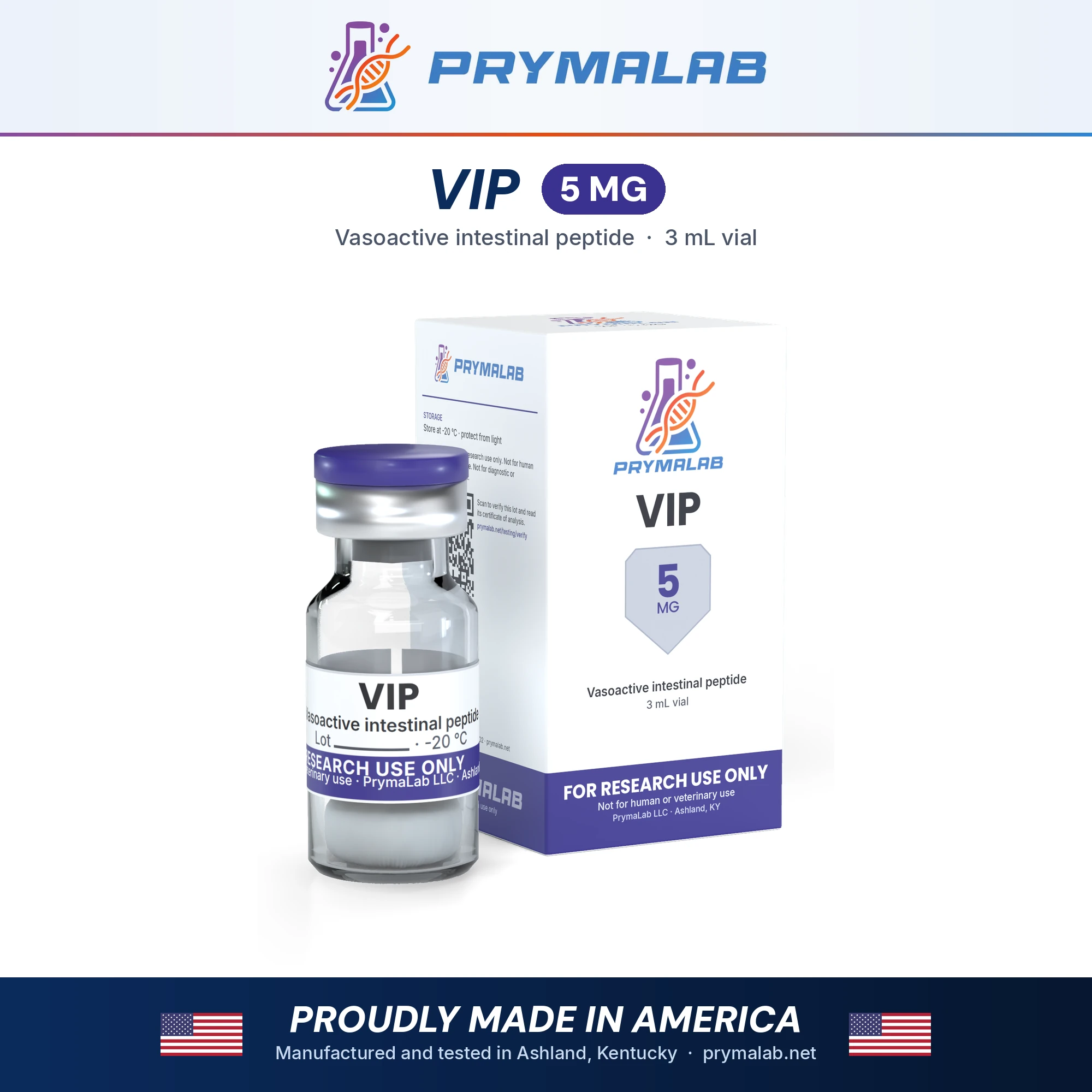
VIP5 5MG (Vasoactive Intestinal Peptide)

(19 customer reviews)

$49.99 or subscribe for $41.99/mo

Buy VIP5 5mg – vasoactive intestinal peptide for immune modulation, anti-inflammatory effects, and neuroprotection research. Available as nasal spray or injection. 99% purity, USA-made, same day shipping.

Description

PrymaLab · Research Use Only

VIP5 5MG (Vasoactive Intestinal Peptide)

28-residue neuropeptide · VPAC1 and VPAC2 · CAS 37221-79-7

VIP5 5mg is a lyophilized vial of vasoactive intestinal peptide, CAS 37221-79-7, a 28-residue neuropeptide with molecular weight 3326.83. It was isolated from porcine intestine by Said and Mutt in 1970 and acts principally at two class B G-protein-coupled receptors, VPAC1 and VPAC2.

Specification Table

Vasoactive intestinal peptide verified data, 5mg format
Property Value
Compound Vasoactive intestinal peptide (VIP)
Vial content 5 mg lyophilized powder
Molar content of vial Approximately 1.5 µmol
Stock at 1 ml diluent Approximately 1.5 mM
Alternative names Vasoactive intestinal polypeptide, VIP5
CAS number 37221-79-7
Molecular formula C147H237N43O43S
Molecular weight 3326.83 g/mol
Residue count 28
Single-letter sequence HSDAVFTDNYTRLRKQMAVKKYLNSILN
Peptide family Secretin/glucagon superfamily
Primary receptors VPAC1 and VPAC2, class B G-protein-coupled receptors
Secondary receptor PAC1, with substantially lower affinity than PACAP
Principal signalling route Gαs, adenylyl cyclase, cyclic AMP, protein kinase A
Discovery Said and Mutt, isolated from porcine intestine, 1970
Known degradation route Dipeptidyl peptidase-IV and other plasma peptidases
Appearance White lyophilized cake
Purity Per lot-specific certificate of analysis
Solubility Soluble in sterile and bacteriostatic water
Storage, lyophilized -20°C, protected from light and moisture
Storage, reconstituted 2-8°C, protected from light
Regulatory status No approved human or veterinary formulation in any jurisdiction

What Are VPAC1 and VPAC2?

VIP acts at two closely related receptors, and distinguishing between them is where most of the useful experimental design in this area happens.

VPAC1 and VPAC2 are class B G-protein-coupled receptors, the family that also contains the receptors for secretin, glucagon and GHRH. Both bind VIP with high affinity and both couple principally through Gαs to adenylyl cyclase, raising cyclic AMP and activating protein kinase A.

Their tissue distributions differ substantially, and that is the source of most functional divergence. VPAC1 predominates in lung, intestinal epithelium, liver and much of the immune compartment. VPAC2 is more prominent in smooth muscle, pancreatic islets, and parts of the central nervous system including the suprachiasmatic nucleus.

A third receptor, PAC1, binds VIP but with substantially lower affinity than it binds PACAP, its preferred ligand. In most systems VIP is not usefully described as a PAC1 agonist, though at sufficient concentration the interaction exists.

The IUPHAR nomenclature review by Harmar and colleagues remains the authoritative reference for this receptor family and is worth reading before designing selectivity experiments (Harmar et al., British Journal of Pharmacology, 2012).

Why Does the Sequence Make VIP Fragile?

The sequence is HSDAVFTDNYTRLRKQMAVKKYLNSILN, and two features of it govern how the peptide behaves in any biological matrix.

The amino terminus begins His-Ser-Asp. Dipeptidyl peptidase-IV cleaves dipeptides from the N-terminus of peptides with suitable residues in the first two positions, and VIP is a substrate. Since class B receptor binding depends heavily on the N-terminal region, removing two residues does not merely shorten the peptide, it removes the part responsible for receptor activation.

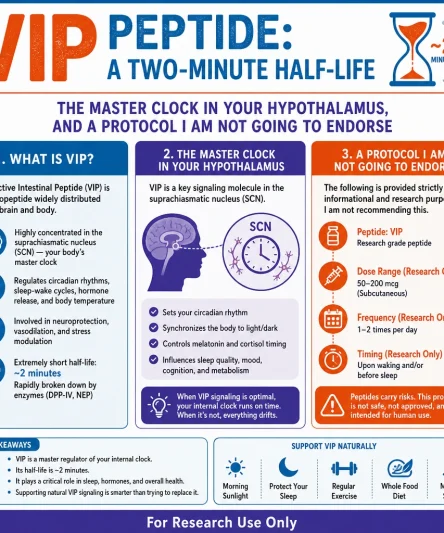
What follows is a short circulating half-life, generally reported in the low single-digit minutes range in plasma. That is not a formulation defect. It is a property of the native molecule, and it is why VIP analogues with protease-resistant modifications exist as a separate research category.

The single methionine at position 17 is the second consideration. It is oxidation-prone, and oxidation in that region can reduce receptor affinity. For a peptide already vulnerable to enzymatic loss, adding chemical degradation on top compounds the problem.

In practice this means VIP experiments should account for degradation explicitly. Serum-containing media contain peptidases. A DPP-IV inhibitor in the incubation, or a matched degradation control, converts an assumption into a measurement.

How Much Diluent Does VIP5 5mg Need?

VIP5 5mg divided by a molecular weight of 3326.83 gives approximately 1.5 micromoles. Reconstituted into 1 ml that produces roughly a 1.5 millimolar stock.

Working concentrations prepared from VIP5 5mg typically sit in the low nanomolar range, since both VPAC receptors bind with high affinity. Reaching 1 nM from a 1.5 mM stock is a 1.5-million-fold dilution, achievable in three serial steps of roughly 100-fold each with reasonable accuracy.

Dilute acidic conditions favour solubility and stability for this peptide, so a mildly acidic diluent is a common choice for the initial stock. Where the downstream assay requires neutral pH, the dilution into buffer accomplishes that, but the stock itself keeps better acidified.

Adsorptive loss deserves attention at nanomolar working concentrations. VIP is basic and will bind to glass and some plastics. Low-binding consumables and a carrier protein where the assay permits both reduce the loss, and neither is optional at the low end of the range.

What Is VIP5 5mg Suited to Studying?

The five-milligram format suits receptor-level work: binding assays, cyclic AMP accumulation, receptor selectivity comparison against PACAP, and antagonist characterisation.

For cyclic AMP measurement the readout is direct, since both VPAC receptors couple through Gαs. Concentration-response curves in cells expressing one receptor subtype at a time give clean selectivity data, and cell lines with defined single-subtype expression are available for exactly this purpose.

Smooth muscle relaxation assays are the classical functional readout and the origin of the compound name, since the vasoactive designation came from the vasodilatory effect observed in the original characterisation. Isolated tissue preparations remain a standard approach.

Immunological work forms a large and separate literature, reviewed by Delgado and Ganea (Amino Acids, 2013). VIP has been examined extensively as a modulator of inflammatory signalling, and VPAC1 expression on immune cells is the mechanistic basis for that line of work.

How Should Receptor Selectivity Be Established?

VIP binds VPAC1 and VPAC2 with comparable affinity, so any experiment attributing an effect to one subtype needs a design that can distinguish them. Most published work that fails to do this reaches conclusions it has not earned.

Single-subtype cell lines are the cleanest approach. Cells engineered to express one receptor without the other allow a concentration-response curve to be attributed unambiguously, and lines of this kind exist commercially for exactly this purpose.

Selective ligands provide an alternative where a native system must be used. Several subtype-preferring agonists and antagonists have been described in the literature, though selectivity is relative rather than absolute and the margin should be checked against the concentration in use.

Genetic approaches, whether knockout animals or targeted knockdown, remove a subtype rather than avoiding it. That is more definitive and more work, and it carries the usual caveat that a system developing without a receptor may compensate in ways an acutely blocked system does not.

PACAP is the natural comparator for any of these designs. Because PACAP binds PAC1 with much higher affinity than VIP does while binding both VPAC subtypes comparably, running the two ligands in parallel separates PAC1-mediated effects from VPAC-mediated ones without needing a selective antagonist at all.

Why Peptide Family Membership Matters

VIP belongs to the secretin and glucagon superfamily, which is more than a taxonomic detail. Family membership predicts receptor architecture, and receptor architecture predicts how ligands behave.

Class B G-protein-coupled receptors share a large extracellular N-terminal domain that captures the C-terminal portion of the peptide ligand, after which the N-terminal portion of the peptide engages the transmembrane core and triggers activation. This is the two-domain binding model, and it holds across the family.

It explains why N-terminal truncation is so damaging to VIP activity while C-terminal modifications are better tolerated. Removing two residues from the amino terminus removes the activation trigger while leaving the affinity anchor intact, producing a molecule that binds and does not activate.

It also explains cross-reactivity within the family. Secretin, glucagon, GHRH, PACAP and VIP all engage structurally related receptors, and selectivity between them is a matter of degree rather than absolute discrimination.

Reconstitution and Storage in Laboratory Practice

Add diluent slowly against the vial wall, swirl gently, do not shake. At 5mg the reconstitution volume determines the entire working range downstream, so fix it before opening rather than after.

Aliquot before freezing. VIP is a 28-residue peptide with no stabilising modifications, and repeated freeze-thaw degrades it measurably. Aliquot volume should match single-experiment consumption.

Hold lyophilized material at -20°C sealed against light and moisture. Reconstituted solution at 2-8°C protected from light for short-term use, frozen aliquots for anything longer. Record lot, diluent identity, volume, concentration and date, and note whether a protease inhibitor was included, since that detail changes what the findinging data means.

Published Literature

Cross-checked against publisher records or primary indexes. The 1970 Science paper is the original isolation report and the 2012 review is the current nomenclature authority.

  1. Said SI, Mutt V. Science. 1970;169(3951):1217-1218.
  2. Harmar AJ, Fahrenkrug J, Gozes I, Laburthe M, May V, Pisegna JR, Vaudry D, Vaudry H, Waschek JA, Said SI. British Journal of Pharmacology. 2012;166(1):4-17.
  3. Couvineau A, Laburthe M. British Journal of Pharmacology. 2012;166(1):42-50.
  4. Delgado M, Ganea D. Amino Acids. 2013;45(1):25-39.
  5. Dickson L, Finlayson K. Pharmacology and Therapeutics. 2009;121(3):294-316.

Frequently Asked Questions

What is VIP5 5mg?

A lyophilized vial of vasoactive intestinal peptide, CAS 37221-79-7, twenty-eight residues at molecular weight 3326.83, isolated from porcine intestine in 1970. It acts at the class B receptors VPAC1 and VPAC2. Laboratory research use only, with no approved formulation anywhere.

What is the difference between VPAC1 and VPAC2?

Both are class B G-protein-coupled receptors binding VIP with comparable affinity and coupling through G-alpha-s to raise cyclic AMP, so the difference is not pharmacological but anatomical. VPAC1 predominates in lung, intestinal epithelium, liver and much of the immune compartment. VPAC2 is more prominent in smooth muscle, pancreatic islets and parts of the central nervous system.

Does VIP act on the PAC1 receptor?

Weakly. PAC1 binds VIP with substantially lower affinity than it binds PACAP, its preferred ligand, so in most experimental systems VIP is not usefully described as a PAC1 agonist. At sufficiently high concentration the interaction can still be demonstrated.

Why does VIP have such a short half-life?

Dipeptidyl peptidase-IV cleaves dipeptides from the amino terminus and VIP begins His-Ser-Asp, which makes it a substrate. Because class B receptor activation depends heavily on that N-terminal region, losing two residues removes the activation trigger rather than merely shortening the chain.

How much diluent should a 5mg vial receive?

Five milligrams is approximately 1.5 micromoles, so 1 ml produces roughly a 1.5 millimolar stock. Working concentrations in VPAC pharmacology are typically low nanomolar. Reaching 1 nanomolar therefore needs about a 1.5-million-fold dilution, which three serial steps of roughly 100-fold will accomplish with acceptable accuracy.

Should a protease inhibitor be used?

It should be considered and the decision recorded either way, because serum-containing media carry peptidases and VIP is a DPP-IV substrate. Including a DPP-IV inhibitor turns an assumption about peptide survival into something measured. A matched degradation control achieves the same end.

Why is adsorptive loss a concern?

VIP is basic and binds readily to glass and to some plastics, and the proportion lost rises as working concentration falls because adsorption scales with surface area rather than solution mass. At low nanomolar concentrations the loss is material. Low-binding consumables and a carrier protein both help.

What does the methionine at position 17 affect?

Oxidation susceptibility, principally. Methionine converts to the sulfoxide under atmospheric oxygen or metal catalysis, and oxidation in that region has been reported to reduce receptor affinity. For a peptide already vulnerable to enzymatic loss, chemical degradation compounds the problem.

What assays suit this format?

Receptor-level work of most kinds. Binding assays, cyclic AMP accumulation in cells expressing a single subtype, selectivity comparison against PACAP, and antagonist characterisation all fit comfortably within 5mg. Smooth muscle relaxation in isolated tissue is the classical functional readout.

How should the vial be stored?

Keep the dry cake at minus 20 Celsius, sealed against both light and moisture. Reconstituted material sits at 2 to 8 Celsius protected from light for short-term use, with frozen aliquots for anything longer. Aliquot before the first freeze, since repeated freezing measurably degrades an unmodified 28-residue peptide.

How should VPAC subtype selectivity be established?

Single-subtype cell lines give the cleanest answer, allowing a concentration-response curve to be attributed without ambiguity. Subtype-preferring ligands work in native systems, though their selectivity is relative rather than absolute. Genetic knockout is more definitive and carries the usual developmental-compensation caveat.

Why run PACAP as a comparator?

Because PACAP binds PAC1 with far higher affinity than VIP does while binding both VPAC subtypes comparably, running the two ligands side by side separates PAC1-mediated effects from VPAC-mediated ones. No selective antagonist is needed. It is often the simplest available design.

Can effects be attributed to VPAC1 or VPAC2 without these controls?

Not without one of those controls. VIP binds both subtypes with comparable affinity, so an experiment in a system expressing both cannot assign an effect to either. A good deal of published work reaches subtype conclusions it has not earned.

Compliance Statement

VIP5 5mg is sold exclusively for laboratory research use. It is not a drug, food, or cosmetic product, and it is not a dietary product of any kind. It is not approved by the FDA or any comparable authority for human or veterinary use. This product is not intended to diagnose, treat, cure, or prevent any disease. It must not be given to humans or animals. Purchase is restricted to qualified researchers and institutions operating within applicable laws. All handling is the responsibility of the purchasing laboratory.

Additional information

Weight N/A
Dimensions N/A

19 reviews for VIP5 5MG (Vasoactive Intestinal Peptide)

  1. Spencer Sanders
    August 2, 2026
    Tested good
    Had this order sent off to Janoshik for testing and it just came back with a perfect on the endotoxin testing and a purity of 99.97%. I will be shoppi...More
    Had this order sent off to Janoshik for testing and it just came back with a perfect on the endotoxin testing and a purity of 99.97%. I will be shopping here from now on, no vendor that I trust has better pricing.
    Helpful? 0 0
    Damon Gray
    August 2, 2026
    Thanks.
    Shipping was slow but everything came as it should.
    Helpful? 0 0
    Paula Harper
    August 1, 2026
    quality on point!
    test came back 99.71%. Will be back fs
    Helpful? 0 0
    Beverly Jones
    August 1, 2026
    Already seeing results!
    Shipping was slow but after only a week I am already seeing amazing results. Thank you.
    Helpful? 0 0
    Curtis Harper
    July 30, 2026
    will be back
    thanks
    Helpful? 0 0
    Brandon Owens
    July 12, 2026
    Best source ive found
    So happy i found this place.
    Helpful? 0 0
    Beverly Powell
    July 11, 2026
    Legit...
    Cannot recommend enough.
    Helpful? 0 0
    Sophia Berry
    July 8, 2026
    My new go to!
    Repeat customer here. The quality is exactly what i was hoping for, consistent and pure. Also most companies overcharge for the same thing but the pri...More
    Repeat customer here. The quality is exactly what i was hoping for, consistent and pure. Also most companies overcharge for the same thing but the pricing here beat everyone else i checked.
    Helpful? 0 0
    Maria Kim
    July 6, 2026
    Super impressed!
    Happy with the order. Quality was there fasho.
    Helpful? 0 0
    Tara West
    July 1, 2026
    Blown away honestly
    Honestly cant complain at all. The quality is exactly what i was hoping for. Also other brands packaging shows up crushed but this came double boxed w...More
    Honestly cant complain at all. The quality is exactly what i was hoping for. Also other brands packaging shows up crushed but this came double boxed with ice packs. These guys got a customer for life.
    Helpful? 0 0
    Grant Thomas
    July 1, 2026
    Def worth it
    happy wit the order. No real issues with the product. Will def order again. just wish shipping was faster
    Helpful? 0 0
    Karen Weaver
    June 25, 2026
    10/10 would buy again
    First time ordering and im impressed. Everything showed up perfect and sealed. I switched over after corepeptides sent the powder wus half melted but ...More
    First time ordering and im impressed. Everything showed up perfect and sealed. I switched over after corepeptides sent the powder wus half melted but the lyophilized powder here was a perfect intact puck. You can tell the difference when a company actually cares. Cant wait for my next order.
    Helpful? 0 0
    Janet Harrison
    June 24, 2026
    went smoothly
    Honestly cant complain at all. Everything arrived as expected and I feel amazing. Thank you.
    Helpful? 0 0
    Marie Collins
    June 16, 2026
    Love you guys ❤️
    Wont be buying from anywhere else. Tested 3 products from pryma through janoshik myself, all came back 99.96+ pure, swiss chems only came back 96 at t...More
    Wont be buying from anywhere else. Tested 3 products from pryma through janoshik myself, all came back 99.96+ pure, swiss chems only came back 96 at the highest.
    Helpful? 0 0
    Craig Gomez
    June 12, 2026
    Perfect
    Packaging an product were both on point. Keep it up guys.
    Helpful? 0 0
    Janet Harrison
    June 8, 2026
    no issues
    u can tell they actually care about what they send out.
    Helpful? 0 0
    Denise Turner
    June 2, 2026
    Repeat customer for life!
    I used to order from penguin peptides but I kept getting vials that were sealed bad and leaked but every vial here was sealed perfect. Gonna be my mai...More
    I used to order from penguin peptides but I kept getting vials that were sealed bad and leaked but every vial here was sealed perfect. Gonna be my main source from now on for sure. Much love
    Helpful? 0 0
    Edward Berry
    May 14, 2026
    very pleased
    Good stuff no doubt.
    Helpful? 0 0
    Eric Smith
    April 3, 2026
    Legit and high quality!
    Ordered again an its the same great quality.
    Helpful? 0 0

Only logged in customers who have purchased this product may leave a review.

Peptide Research Articles

Bacteriostatic Water Peptide Science: Why It Matters in Reconstitution & Research

Bacteriostatic water peptide science is the foundation of safe, accurate peptide reconstitution. This 2026 guide covers bacteriostatic water composition, how to reconstitute peptides using a peptide reconstitution calculator and peptide dosage calculator, bacteriostatic water vs sterile water differences, peptide storage best practices, and a 10-step reconstitution protocol. Expert insights from PrymaLab.

Peptides for Injury Recovery: The Wolverine Stack Peptide Guide (BPC-157 + TB-500)

The Wolverine stack peptide combines BPC-157 and TB-500 for research into tendon, ligament, and joint recovery. This 2026 guide covers BPC-157 peptide where to buy responsibly, BPC 157 peptide side effects, peptides for tendon repair, peptides for joint recovery, peptides for elbow pain, and the BPC-157 TB-500 peptide blend scientific research. Expert insights from PrymaLab.

Are Peptides Good for You? A Complete 2026 Guide

Are peptides good for you? This comprehensive 2026 guide explores peptide therapy benefits, safety, side effects, and how peptides work in the body. Learn about peptide health benefits, research findings, and what you need to know before considering peptide therapy. Expert insights from PrymaLab.

Ovagen peptide capsules for liver health with dosage cycling chart showing 10-20 day protocols repeated 2-3 times per year

Ovagen Peptide Guide: Uses, Research, Safety & Buying Info

Ovagen peptide is a short-chain liver bioregulator developed at the St. Petersburg Institute of Bioregulation and Gerontology under Professor Vladimir Khavinson. It contains the AC-3 peptide complex (glutamic acid and aspartic acid) designed to target hepatocyte gene expression for liver cell repair, bile production, and detoxification. This guide covers dosing protocols, cycling schedules, side effects, a head-to-head comparison with NAC, milk thistle, TUDCA, and BPC-157, cost analysis ($120-360 per year), and how to verify genuine Ovagen products online.

GHK-Cu peptide vial and syringe with dosage chart showing injection protocols for skin rejuvenation and hair growth

GHK-Cu Peptide: Benefits, Dosage, Side Effects & Complete Research Guide (2026)

GHK-Cu peptide is a naturally occurring copper tripeptide that modulates over 4,000 human genes involved in collagen synthesis, wound healing, and tissue regeneration. This comprehensive guide covers injection dosage protocols, clinical research on skin rejuvenation and hair growth, side effects, safety data, and how to reconstitute GHK-Cu 50mg vials. Includes dosage charts, comparison tables, and 10 frequently asked questions answered by a peptide research specialist.

Sermorelin dosage guide for anti-aging muscle growth and weight loss showing GHRH analog pituitary stimulation

Sermorelin Dosage Guide 2025: Complete Protocol for Anti-Aging, Muscle Growth & Weight Loss

Sermorelin acetate is a growth hormone-releasing hormone (GHRH) analog that stimulates natural GH production from the pituitary gland. This comprehensive dosage guide covers protocols for anti-aging, muscle growth, weight loss, and sleep optimization — along with side effects, before-and-after timelines, and comparisons to HGH and ipamorelin.

Customer reviews

4.89
Based on 19 reviews
5
89%
17
4
11%
2
3
0%
0
2
0%
0
1
0%
0
1 2
Spencer Sanders
August 2, 2026
Tested good
Had this order sent off to Janoshik for testing and it just came back with a perfect on the endotoxin testing and a purity of 99.97%. I will be shoppi...More
Had this order sent off to Janoshik for testing and it just came back with a perfect on the endotoxin testing and a purity of 99.97%. I will be shopping here from now on, no vendor that I trust has better pricing.
Helpful? 0 0
Damon Gray
August 2, 2026
Thanks.
Shipping was slow but everything came as it should.
Helpful? 0 0
Paula Harper
August 1, 2026
quality on point!
test came back 99.71%. Will be back fs
Helpful? 0 0
Beverly Jones
August 1, 2026
Already seeing results!
Shipping was slow but after only a week I am already seeing amazing results. Thank you.
Helpful? 0 0
Curtis Harper
July 30, 2026
will be back
thanks
Helpful? 0 0
Brandon Owens
July 12, 2026
Best source ive found
So happy i found this place.
Helpful? 0 0
Beverly Powell
July 11, 2026
Legit...
Cannot recommend enough.
Helpful? 0 0
Sophia Berry
July 8, 2026
My new go to!
Repeat customer here. The quality is exactly what i was hoping for, consistent and pure. Also most companies overcharge for the same thing but the pri...More
Repeat customer here. The quality is exactly what i was hoping for, consistent and pure. Also most companies overcharge for the same thing but the pricing here beat everyone else i checked.
Helpful? 0 0
Maria Kim
July 6, 2026
Super impressed!
Happy with the order. Quality was there fasho.
Helpful? 0 0
Tara West
July 1, 2026
Blown away honestly
Honestly cant complain at all. The quality is exactly what i was hoping for. Also other brands packaging shows up crushed but this came double boxed w...More
Honestly cant complain at all. The quality is exactly what i was hoping for. Also other brands packaging shows up crushed but this came double boxed with ice packs. These guys got a customer for life.
Helpful? 0 0
Grant Thomas
July 1, 2026
Def worth it
happy wit the order. No real issues with the product. Will def order again. just wish shipping was faster
Helpful? 0 0
Karen Weaver
June 25, 2026
10/10 would buy again
First time ordering and im impressed. Everything showed up perfect and sealed. I switched over after corepeptides sent the powder wus half melted but ...More
First time ordering and im impressed. Everything showed up perfect and sealed. I switched over after corepeptides sent the powder wus half melted but the lyophilized powder here was a perfect intact puck. You can tell the difference when a company actually cares. Cant wait for my next order.
Helpful? 0 0
1 2
24/7 Online support

support@prymalab.net info@prymalab.net

Money back guarantee

30 Day return window. Satisfaction guaranteed or your money back.

FREE shipping and return

All orders over %150 in value will receive free shipping.