Description
PrymaLab · Research Use Only
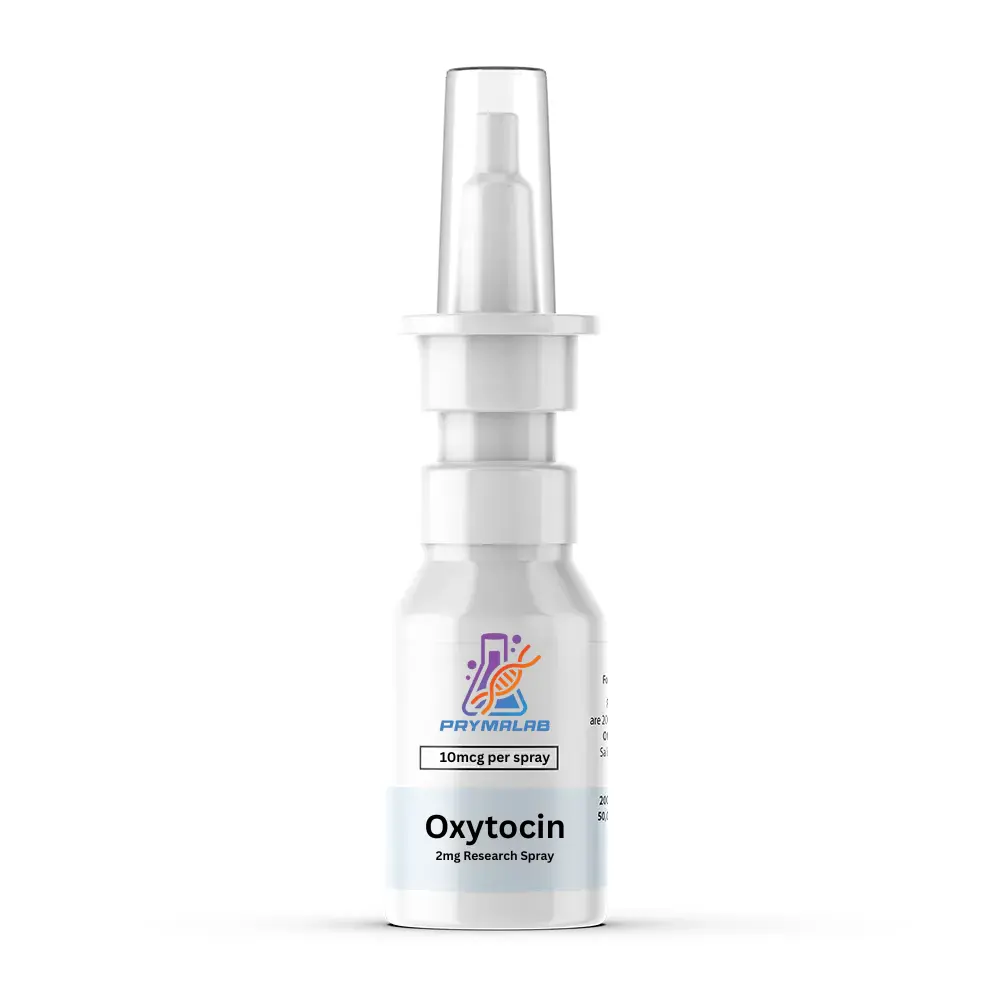
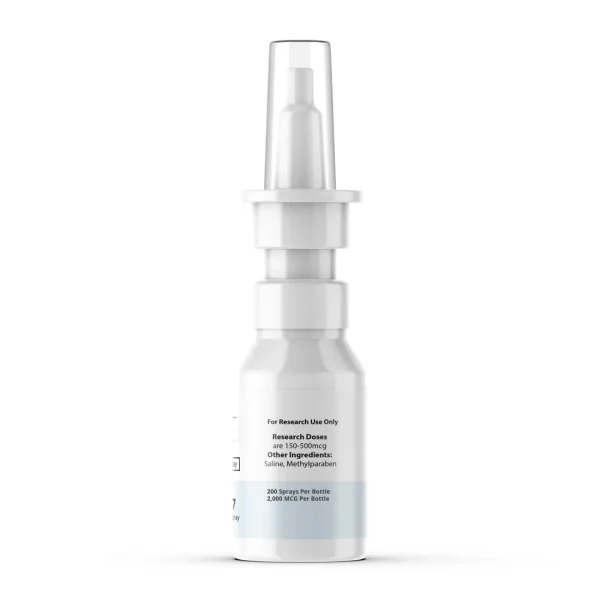
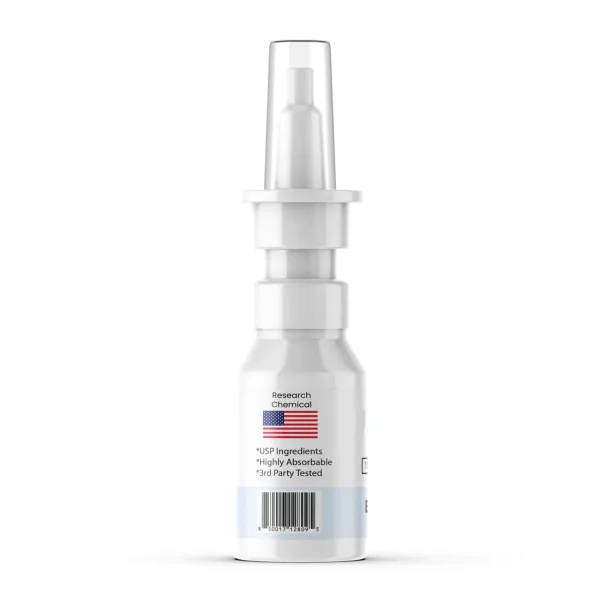
Oxytocin Nasal Spray
CYIQNCPLG-NH2 · CAS 50-56-6 · 1007.19 Da
Oxytocin nasal spray supplies the nonapeptide Cys-Tyr-Ile-Gln-Asn-Cys-Pro-Leu-Gly-NH2, CAS 50-56-6, molecular weight 1007.19, in a metered spray. A disulfide bridge between cysteines 1 and 6 closes six residues into a ring, leaving a three-residue tail.
Specification Table
| Property | Value |
|---|---|
| Compound | Oxytocin |
| CAS number | 50-56-6 |
| Molecular formula | C43H66N12O12S2 |
| Molecular weight | 1007.19 g/mol |
| Residue count | 9 |
| Single-letter sequence | CYIQNCPLG-NH2 |
| Three-letter sequence | Cys-Tyr-Ile-Gln-Asn-Cys-Pro-Leu-Gly-NH2 |
| Ring closure | Disulfide bond, cysteine 1 to cysteine 6 |
| Ring size | Six residues, with a three-residue acyclic tail |
| C-terminus | Amidated |
| Molecular target | Oxytocin receptor (OXTR), a class A G protein-coupled receptor |
| Principal coupling | Gq, activating phospholipase C |
| Cross-reactivity | Binds vasopressin receptors V1a, V1b and V2 at higher concentrations |
| Closest structural relative | Vasopressin, differing at two of nine positions |
| Endogenous origin | Synthesised in hypothalamic neurons, released from the posterior pituitary |
| Oxidation-prone residues | The two cysteines, through disulfide exchange |
| Format | Metered nasal spray, solution state |
| Purity | Per lot-specific certificate of analysis |
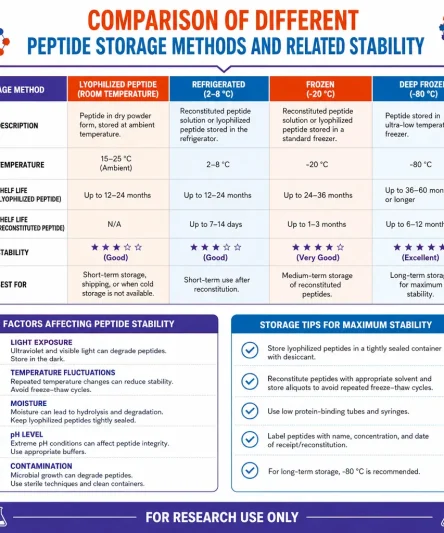
| Storage | 2-8°C, protected from light. Do not freeze |
| Regulatory status | Approved injectable formulations of oxytocin exist for obstetric use. No intranasal formulation is approved in the United States |
What Oxytocin Nasal Spray Dosage Appears in Published Trials?
Intranasal oxytocin has been studied more than any other peptide delivered by this route, so the amount question has a genuinely large evidence base behind it.
The overwhelming convention in published human trials is 24 international units, usually delivered as three puffs per nostril. That figure appears across hundreds of studies and became standard largely by inheritance rather than by dose-finding.
Studies using 12, 16, 32 and 48 IU also appear. Comparative work has repeatedly failed to find a clean monotonic relationship between amount and effect, and some studies report inverted-U shapes where a middle amount produces larger effects than a higher one.
Rodent work uses mass units rather than international units, typically in the microgram range per animal, which makes cross-species comparison awkward without converting through the IU definition first.
The important qualification is that 24 IU is a convention, not an optimum. Its dominance in the literature reflects citation lineage, and treating it as an established figure overstates what the published amount-ranging studies actually support.
What Do Oxytocin Nasal Spray Benefits Studies Measure, and Do They Replicate?
This is where intranasal oxytocin differs from every other compound in this catalogue, because the replication record is unusually well documented and unusually sobering.
The measured endpoints across the literature are behavioural and physiological: gaze patterns toward faces, performance on emotion-recognition tasks, trust-game economic decisions, salivary cortisol, and functional imaging signals in amygdala and related regions.
Early studies reported striking effects. Subsequent large replication efforts and meta-analyses have found substantially smaller effects, and in several cases no effect, once publication bias and small-sample inflation are accounted for.
The field has produced explicit methodological critiques of itself, including analyses showing that the typical study in this area was underpowered by a wide margin and that reported effect sizes shrink as sample size grows.
For a researcher this is the most useful thing on the page. Designing intranasal oxytocin work without accounting for that history means repeating a known error, and any new study in this area should be powered against the meta-analytic effect size rather than the early literature.
What Does the Disulfide Ring Do?
Nine residues with six of them closed into a ring is a distinctive architecture and it determines both the pharmacology and the handling.
The bond runs between cysteine 1 and cysteine 6, forming a six-membered macrocycle with Pro-Leu-Gly-NH2 extending as a tail. Both parts contribute to receptor recognition, and the amidated terminus is required for full activity.
Vasopressin shares this architecture and differs at only two of nine positions. That similarity is the source of the cross-reactivity noted in the specification: at higher concentrations oxytocin engages vasopressin receptors, and any effect attributed to the oxytocin receptor at high concentration needs a selective antagonist to support it.
The disulfide is also the compound handling weakness. Under conditions permitting thiol-disulfide exchange the bond can reduce or scramble, and a reduced peptide has lost the ring that defines its shape.
Reducing agents therefore exclude this compound. Dithiothreitol, beta-mercaptoethanol and tris(2-carboxyethyl)phosphine all break the bond, and they appear routinely in buffers chosen for unrelated reasons.
How Does Intranasal Oxytocin Compare With Injection?
Both routes are used in the literature and they answer different questions, with the nasal route carrying a specific and much-debated claim.
Intravenous oxytocin has a well-characterised profile with a circulating half-life measured in minutes. Delivery is complete and the plasma concentration achieved is predictable.
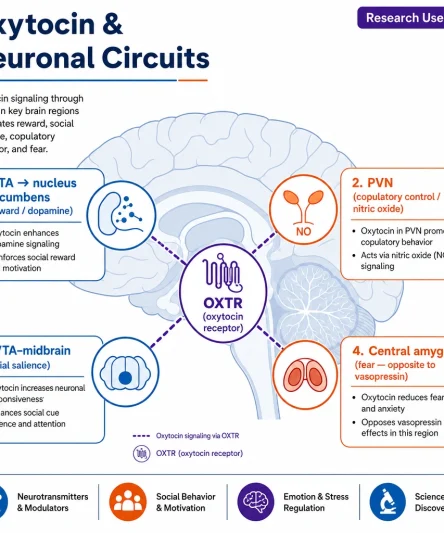
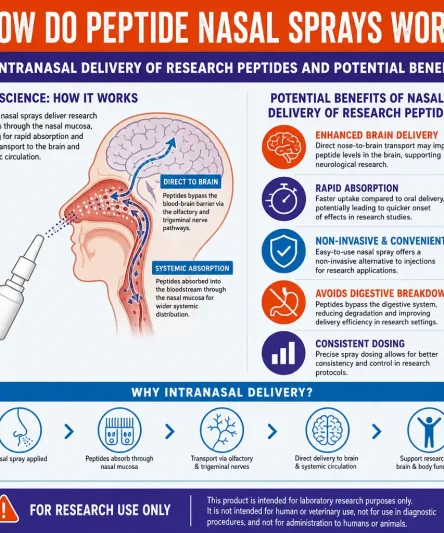
The argument for the nasal route is central access. Oxytocin crosses the blood-brain barrier poorly, so a peripheral injection raises plasma concentration without necessarily raising concentration in brain tissue, and the olfactory and trigeminal pathways offer a route that bypasses the barrier.
Whether a behaviourally relevant quantity actually arrives centrally has been contested throughout the field. Studies measuring cerebrospinal fluid concentration after intranasal delivery report increases, though the magnitude relative to plasma changes is modest and the interpretation is disputed.
That unresolved question sits underneath a large share of the literature, which is part of why the replication record looks as it does. A field can generate a great many findings on a delivery assumption that has not been settled.
Why Does Formulation pH Matter for Oxytocin?
Oxytocin stability in aqueous solution is unusually pH-sensitive, and the formulation choice sits underneath every stability claim made about a spray product.
The dominant degradation routes are deamidation at the asparagine and glutamine residues, and disulfide-mediated dimerisation. Both accelerate as pH rises above neutral.
Slightly acidic conditions, broadly in the pH 4 to 5 band, slow both routes considerably. Commercial injectable formulations of oxytocin have historically used acidic buffers for exactly this reason.
Nasal mucosa tolerates a narrower and slightly higher range, roughly pH 5.5 to 6.5, so an intranasal formulation is a compromise between what the peptide prefers and what the tissue tolerates.
That compromise is why buffer composition belongs on the certificate rather than being treated as proprietary. A product formulated at pH 6.5 and a product formulated at pH 4.5 will not have the same shelf behaviour.
Where a bottle has been held warm or has aged, dimer content is the thing to measure, and size-exclusion chromatography detects it directly.
What Does the Oxytocin Nasal Spray Format Require Analytically?
A cyclic disulfide nonapeptide in solution has a specific set of failure modes, and the certificate should speak to them.
Mass confirmation against 1007.19 by high-resolution mass spectrometry. A reduced preparation weighs two daltons more, because breaking the disulfide adds two hydrogens, and that two dalton difference is the single most informative number on the spectrum.
Free thiol quantification using Ellman reagent measures the reduced fraction directly. It is a fifteen minute assay and it answers the question mass spectrometry answers indirectly.
Purity by reversed-phase chromatography, run with attention to whether the method separates the cyclic form from the linear one. They differ enough in hydrophobicity to resolve on a competent gradient.
Solution concentration determined analytically at fill rather than calculated from a batch weight, plus buffer composition and pH, since oxytocin stability is pH-dependent and the formulation choice is a real variable.
Fill date, because degradation runs from the moment the solution exists rather than from delivery.
How Should the Spray Be Stored?
Refrigerated, dark, unfrozen, and kept away from reducing conditions.
Hold at 2 to 8 degrees Celsius continuously. Oxytocin in solution is more stable than many peptides at neutral to slightly acidic pH, but the disulfide remains the vulnerable feature and temperature accelerates exchange.
Protect from light and return the bottle promptly after each use. A pump draws fresh air into the headspace with every actuation, and dissolved oxygen participates in thiol chemistry.
Do not freeze. The pump assembly tolerates the volume change poorly and a failed seal ends the unit.
Check buffer composition before combining this compound with anything else. A reducing agent present for an unrelated purpose will inactivate it silently, and the failure looks like a negative result rather than a handling error.
Mark the date of first actuation on the bottle, since in-use interval appears on no label and is what a later anomaly gets checked against.
A closing note on sourcing. Because approved injectable oxytocin exists, research-grade material sits alongside a pharmaceutical supply chain, and the difference between them is manufacturing standard and documentation rather than chemistry.
Ask what the purity figure was measured against and whether a reference standard was used. For a compound with a pharmacopoeial monograph, a supplier who cannot answer that is telling you something about their process.
Ask specifically for the dimer content. It is the impurity this molecule generates on storage, it is invisible to a clarity check, and it is the number that tells you how the material has actually been held.
Ask for the buffer pH as a number rather than a description. The gap between pH 4.5 and pH 6.5 is the difference between a formulation built for the peptide and one built for the tissue, and both choices are defensible provided you know which was made.
Nothing else on a certificate for this compound carries as much predictive weight about how the material will behave over its shelf life.
A last note on units. International units and milligrams are not interchangeable for this compound, and the conversion depends on the potency definition rather than on mass alone.
Studies reporting in IU and studies reporting in micrograms cannot be compared without converting through that definition first, and a surprising number of secondary summaries skip the step entirely.
Published Literature
References verified against the publisher record. The intranasal oxytocin literature is large, independent and includes substantial self-critical methodological work, which is rare in this catalogue.
- Born J, Lange T, Kern W, McGregor GP, Bickel U, Fehm HL. Nature Neuroscience. 2002;5(6):514-516.
- Walum H, Waldman ID, Young LJ. Biological Psychiatry. 2016;79(3):251-257.
- Leng G, Ludwig M. Biological Psychiatry. 2016;79(3):243-250.
- Quintana DS, Lischke A, Grace S, Scheele D, Ma Y, Becker B. Molecular Psychiatry. 2021;26(1):80-91.
- Striepens N, Kendrick KM, Hanking V, Landgraf R, Wullner U, Maier W, Hurlemann R. Scientific Reports. 2013;3:3440.
- Illum L. Journal of Pharmacy and Pharmacology. 2004;56(1):3-17.
- Lochhead JJ, Thorne RG. Advanced Drug Delivery Reviews. 2012;64(7):614-628.
Frequently Asked Questions
What is oxytocin nasal spray?
A metered spray supplying the nonapeptide Cys-Tyr-Ile-Gln-Asn-Cys-Pro-Leu-Gly-NH2, CAS 50-56-6, molecular weight 1007.19. A disulfide bridge closes six of the nine residues into a ring. Laboratory research use only.
What dosage appears in published trials?
Twenty-four international units is the overwhelming convention, usually three puffs per nostril. It appears across hundreds of studies. Amounts of 12, 16, 32 and 48 IU also appear in the literature.
Is 24 IU an established optimum?
No. It is a convention that spread by citation lineage rather than by systematic amount-finding work. Comparative work has repeatedly failed to find a clean monotonic relationship, and some studies report inverted-U shapes where a middle amount outperforms a higher one.
What do the studies actually measure?
Gaze patterns toward faces, emotion-recognition task performance, trust-game economic decisions, salivary cortisol, and functional imaging signals in amygdala and related regions. All are behavioural or physiological endpoints in participants.
Does the literature replicate?
Poorly, and this is well documented. Early studies reported striking effects. Large replication efforts and meta-analyses find substantially smaller effects and in several cases none, once publication bias and small-sample inflation are accounted for.
What should a new study do differently?
Power against the meta-analytic effect size rather than the early literature. The field has produced explicit analyses showing the typical study was underpowered by a wide margin, so repeating that design repeats a known error.
What does the disulfide ring do?
It closes cysteines 1 and 6 into a six-membered macrocycle with a three-residue tail. Both the ring and the tail contribute to receptor recognition, and the amidated carboxy terminus is required for full activity.
Why does vasopressin matter here?
Because it shares the same architecture and differs at only two of nine positions. At higher concentrations oxytocin engages vasopressin receptors, so attributing a high-concentration effect to the oxytocin receptor requires a selective antagonist.
Which reagents must be avoided?
Reducing agents. Dithiothreitol, beta-mercaptoethanol and tris(2-carboxyethyl)phosphine all break the disulfide, and they appear routinely in buffers chosen for unrelated purposes. The resulting failure looks like a negative result.
Why use the nasal route at all?
Because oxytocin crosses the blood-brain barrier poorly, so a peripheral injection raises plasma concentration without necessarily raising brain tissue concentration. The olfactory and trigeminal pathways offer a route that bypasses the barrier.
Is central delivery established?
Contested throughout the field. Studies measuring cerebrospinal fluid concentration after intranasal delivery report increases, though the magnitude relative to plasma changes is modest and the interpretation remains disputed.
Compliance Statement
Oxytocin nasal spray is sold exclusively for laboratory research use. It is not a drug, food, or cosmetic product, and it is not a dietary product of any kind. It is not approved by the FDA or any comparable authority for human or veterinary use, approved injectable oxytocin formulations exist for obstetric use and this intranasal research material is not one of them, and amounts cited are figures from published studies. This product is not intended to diagnose, treat, cure, or prevent any disease. It must not be given to humans or animals. Purchase is restricted to qualified researchers and institutions operating within applicable laws. All handling is the responsibility of the purchasing laboratory.


11 reviews for Oxytocin 2mg Nasal Spray