Description
PrymaLab · Research use only
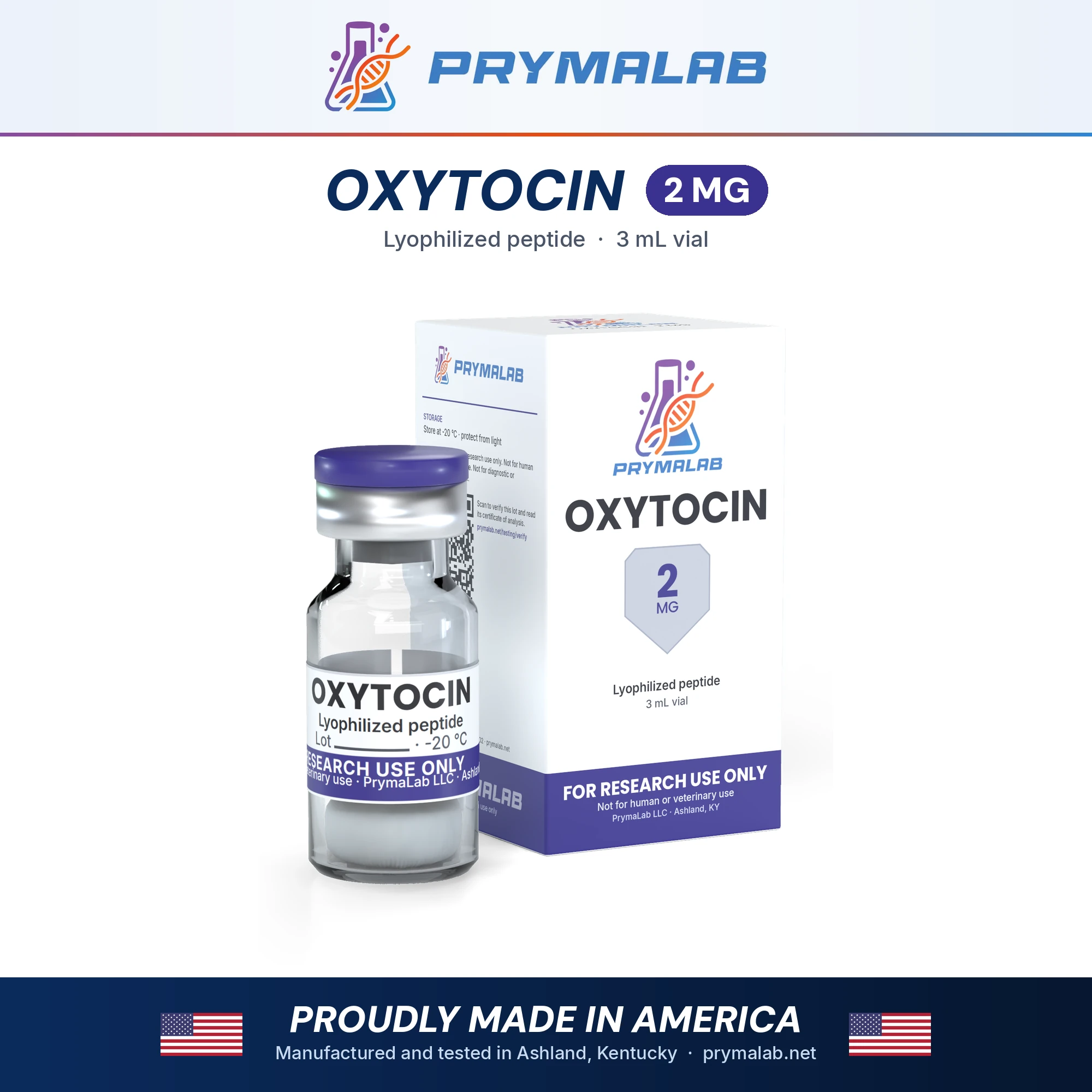
Oxytocin 2mg
Oxytocin, the cyclic nonapeptide hormone with a Cys1 to Cys6 disulfide, in a 2 mg vial
Oxytocin is a nine-residue peptide hormone, CYIQNCPLG-NH2, whose first and sixth cysteines are joined by a disulfide bond to form a six-residue ring with a three-residue amidated tail. This listing is a sealed vial of 2 mg of freeze-dried oxytocin, supplied as the acetate salt. Research on it spans the 1953 synthesis, the oxytocin receptor and its signalling, the chemistry of its breakdown in solution, and the quality of oxytocin sold as a medicine.
Specifications
| Property | Value |
|---|---|
| Compound | Oxytocin (acetate salt as supplied) |
| CAS number | 50-56-6 |
| Molecular formula | C43H66N12O12S2 |
| Label claim | 2 mg per vial |
| Form | Lyophilized (freeze-dried) powder or cake in a sealed glass vial with a rubber stopper and aluminium crimp cap |
| Safety data sheet | PL-SDS-121 |
Handling notes
Unlike most peptides in this catalogue, oxytocin carries a hazard classification of its own. The safety data sheet lists it as toxic if swallowed (H301) and toxic if inhaled (H331), able to cause allergy or asthma symptoms or breathing difficulties if inhaled (H334), able to cause an allergic skin reaction (H317), and as a category 1A reproductive toxicant that may damage fertility or the unborn child (H360). It also carries H413 for long-lasting harmful effects to aquatic life, and the SDS says to store it locked up.
Those statements apply to the powder in this vial. The precautionary statements and protective equipment are on the safety data sheet linked in the specifications. Keep the sealed vial frozen, desiccated and dark, at the temperature given in section 9 of the SDS, and let it reach room temperature before opening so moisture does not condense on the powder.
What the research covers
Structure and synthesis
Oxytocin is a cyclic nonapeptide with one internal disulfide bond, between the cysteines at positions 1 and 61. In the sequence Cys-Tyr-Ile-Gln-Asn-Cys-Pro-Leu-Gly-NH2, glutamine sits at position 4, asparagine at 5 and an amidated glycine at 9, the three sites where deamidation has been found in acidic solution2. The first synthesis was reported in 1953 by du Vigneaud’s group, who described their product as an octapeptide amide with the hormonal activity of oxytocin3; the older convention counted the two bridged cysteines as a single cystine residue.
Where it is made and how the receptor signals
Gimpl and Fahrenholz’s 2001 review describes oxytocin as made mainly in magnocellular neurons of the hypothalamic paraventricular and supraoptic nuclei and released from the posterior pituitary into the circulation in response to stimuli such as suckling, parturition and certain kinds of stress4. Oxytocinergic neurons also project widely within the central nervous system, and the peptide is synthesised in peripheral tissues including the uterus, placenta, corpus luteum, testis and heart4. The oxytocin receptor is a class I G protein-coupled receptor coupled mainly through Gq to phospholipase C-beta. Its high-affinity state requires both magnesium and cholesterol, and its agonist-binding region differs from the site where antagonists bind4. The review also stresses that the system’s regulation depends strongly on steroids4.
The oxytocin receptor has close relatives in the vasopressin V1a, V1b and V2 receptors, and Manning and colleagues reviewed the peptide and non-peptide agonists and antagonists used to separate them in research5. Peptide ligands remained in very wide use as research tools, and several non-peptide compounds that failed in clinical trials were proving useful in the laboratory5.
Breakdown in solution
Hawe and colleagues followed oxytocin degradation at pH 2.0, 4.5, 7.0 and 9.0 and at temperatures from 40 to 80 °C2. Loss of intact peptide was fastest at pH 9.0, then 7.0, then 2.0, and slowest at pH 4.52. At pH 2.0 the products were deamidated forms; at pH 4.5 and above they included tri- and tetrasulfides and dimers linked through disulfide or dityrosine bonds, with beta-elimination and larger aggregates also observed2. Those experiments concerned solutions, and dry powder was not part of them.
Quality of medicinal oxytocin
Oxytocin is a widely used obstetric medicine, and its quality has been studied directly6. A 2016 systematic review pooled eight studies covering 559 samples from 15 low- and middle-income countries and found a median of 45.6% of samples failing quality tests, mostly because they held too little active ingredient6. Over a third of the samples had less than 90% of the stated content, and two contained none6. Those were finished medicines in their own supply chains, not research material.
What is not established
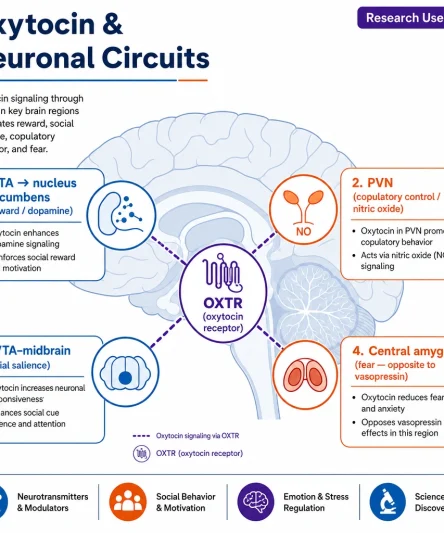
Most of what is known about oxytocin signalling in the brain comes from animal and cell work, and the oxytocin and neuronal circuits guide summarises those rodent circuit studies. The human behavioural literature, almost all of it from intranasal studies, is discussed on the oxytocin nasal spray page. None of the cited studies used PrymaLab material.
How each lot is tested
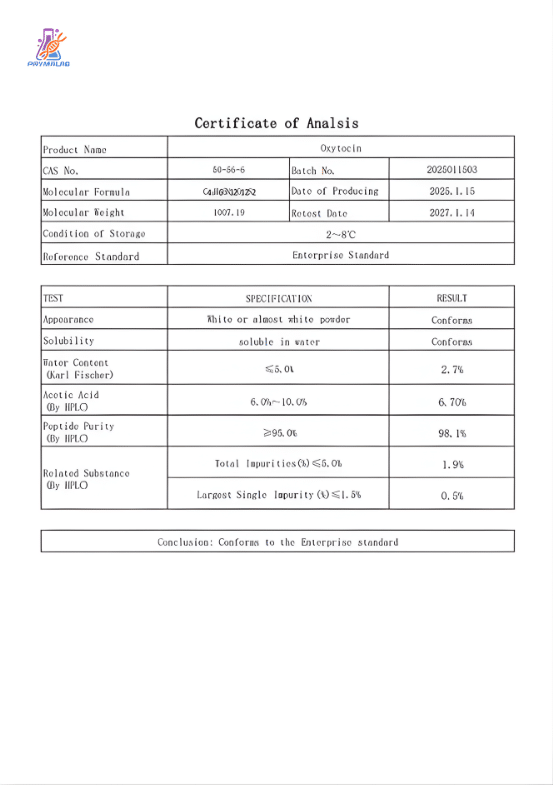
Every lot is tested in PrymaLab’s own laboratory in Ashland, Kentucky before release: RP-HPLC for purity, LC-MS for identity, Karl Fischer titration for water, LAL for endotoxin and USP <71> for sterility. Published certificates are listed on the results page and can be checked by number and key on the verify page. These are in-house results from PrymaLab Analytical, not an independent test, and the lab is not accredited to ISO 17025. The third-party testing guarantee on this page still applies: if any independent laboratory finds the wrong compound, or less than the stated purity or amount, the order is refunded and the cost of the test is reimbursed.
Frequently asked questions
What is the structure of oxytocin?
Nine residues, CYIQNCPLG-NH2, with a disulfide bond between the cysteines at positions 1 and 6 that closes a six-residue ring, followed by an amidated Pro-Leu-Gly tail. The formula is C43H66N12O12S2, the CAS number 50-56-6, and the molecular weight about 1007 Da. This vial holds it as the acetate salt.
How is oxytocin related to vasopressin?
Both are nine-residue hormones of the posterior pituitary, and their receptors form one family: the oxytocin receptor alongside the vasopressin V1a, V1b and V2 receptors. Much of the research toolkit in this field consists of agonists and antagonists designed to tell those receptors apart.
Why does the safety data sheet classify oxytocin as hazardous?
The SDS lists the peptide as toxic if swallowed or inhaled, a respiratory and skin sensitiser, and a category 1A reproductive toxicant that may damage fertility or the unborn child. It is a potent hormone, so the powder is handled with the protective measures the SDS sets out and stored locked up.
How should the vial be stored?
Sealed, frozen, desiccated and away from light, at the temperature in section 9 of the safety data sheet, and locked up. Let the vial warm to room temperature before opening. Reconstituted solutions are kept at 2 to 8 °C, protected from light, for a period your laboratory has established.
Is this vial for human use?
No. This oxytocin is sold for laboratory research only. It is not a medicine, is not approved by the FDA or any other authority for human or veterinary use, and must not be given to people or animals.
References
- Wiśniewski K, Finnman J, Flipo M, et al. On the mechanism of degradation of oxytocin and its analogues in aqueous solution. Biopolymers. 2013;100(4):408-21. DOI · PubMed
- Hawe A, Poole R, Romeijn S, et al. Towards heat-stable oxytocin formulations: analysis of degradation kinetics and identification of degradation products. Pharm Res. 2009;26(7):1679-88. DOI · PubMed
- Vigneaud VD, Ressler C, Swan CJM, et al. THE SYNTHESIS OF AN OCTAPEPTIDE AMIDE WITH THE HORMONAL ACTIVITY OF OXYTOCIN. Journal of the American Chemical Society. 1953;75(19):4879-4880. DOI
- Gimpl G, Fahrenholz F. The oxytocin receptor system: structure, function, and regulation. Physiol Rev. 2001;81(2):629-83. DOI · PubMed
- Manning M, Misicka A, Olma A, et al. Oxytocin and vasopressin agonists and antagonists as research tools and potential therapeutics. J Neuroendocrinol. 2012;24(4):609-28. DOI · PubMed
- Torloni MR, Gomes Freitas C, Kartoglu UH, et al. Quality of oxytocin available in low- and middle-income countries: a systematic review of the literature. BJOG. 2016;123(13):2076-2086. DOI · PubMed
Research use only
For laboratory research use only. Oxytocin 2mg is not a drug, food, cosmetic or dietary supplement, is not approved by the FDA or any comparable authority for human or veterinary use, and must not be given to people or animals. It is sold to qualified researchers and institutions, and the buyer is responsible for lawful handling and disposal.
Other formats of Oxytocin
Oxytocin is also stocked as Oxytocin 10mg preloaded 3ml pen. Each listing states its own quantity and concentration, and the pen and vial comparison explains what changes between formats.








Reviews
There are no reviews yet.