

Description
PrymaLab · Research use only
Preloaded Autoinjector | Oxytocin | 3ml Pen | 10mg
Oxytocin in bacteriostatic water, 10 mg in a preloaded 3 mL pen (3.33 mg/mL)
Oxytocin is the nine-residue neurohypophysial hormone CYIQNCPLG-NH2, its ring closed by a disulfide between cysteines 1 and 6. This preloaded pen holds 10 mg of oxytocin acetate in 3 mL of bacteriostatic water, about 3.33 mg/mL, made up in advance with no powder to dissolve. Research on the peptide covers the oxytocin receptor and its circuits in animal models, and a body of formulation work on how oxytocin degrades in water, which bears directly on a solution product.
Specifications
| Property | Value |
|---|---|
| Compound | Oxytocin (acetate salt as supplied) |
| CAS number | 50-56-6 |
| Molecular formula | C43H66N12O12S2 |
| Contents | Oxytocin: 10 mg per 3 mL pen (0.33% w/v) |
| Form | Sterile aqueous solution in bacteriostatic water (0.9% benzyl alcohol), supplied in a 3 mL glass cartridge inside a preloaded autoinjector pen fitted with a needle |
| Storage, sealed | Store at 2–8 °C in the original carton, protected from light |
| Safety data sheet | PL-SDS-122 |
What is in the pen
The 3 mL glass cartridge holds a sterile solution of oxytocin, supplied as the acetate salt, at 0.33% w/v: 10 mg per pen according to the safety data sheet. The solvent is bacteriostatic water with 0.9% benzyl alcohol as an antimicrobial preservative, and the SDS lists no buffer or other excipient. The oxytocin ingredient is classified as toxic if swallowed or inhaled, a respiratory and skin sensitiser, and a category 1A reproductive toxicant that may damage fertility or the unborn child; benzyl alcohol adds its own statements for harm if swallowed or inhaled, eye irritation and skin sensitisation.
Store the pen at 2 to 8 °C in its carton, protected from light, capped once opened and locked up. Do not freeze it, and discard a pen whose solution has frozen, discoloured or become cloudy. The freeze-dried oxytocin 2 mg vial is the alternative, and peptide pen vs vial compares the two formats.
What the research covers
Oxytocin has been studied closely in aqueous solution because a heat-stable liquid formulation has long been a goal for the medicine1. Its weak point is the disulfide. Wiśniewski and colleagues incubated oxytocin and a series of labelled and modified analogues at 40 °C and proposed that degradation begins with beta-elimination at the disulfide, giving a persulfide intermediate that passes a sulfur atom to intact oxytocin to form trisulfides and higher polysulfides2. Hawe’s group found that loss of intact peptide was slowest at pH 4.5, with tri- and tetrasulfides and disulfide- or dityrosine-linked dimers forming at pH 4.5 and above1.
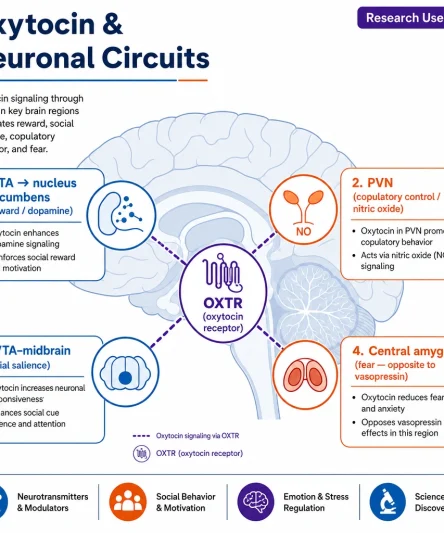
Formulation can slow this. Avanti and colleagues showed that citrate buffer combined with at least 2 mM calcium, magnesium or zinc chloride improved the stability of oxytocin solutions at pH 4.5 over four weeks of storage, while the same ions in acetate buffer did not3. The pen’s solution contains none of these: the safety data sheet lists only oxytocin, benzyl alcohol and water. No cited study tested oxytocin in bacteriostatic water, so its shelf life in the pen is not established, and the SDS conditions are the ones to follow. The receptor and circuit research is in the oxytocin and neuronal circuits guide.
How each lot is tested
Every lot is tested in PrymaLab’s own laboratory in Ashland, Kentucky before release: RP-HPLC for purity, LC-MS for identity, Karl Fischer titration for water, LAL for endotoxin and USP <71> for sterility. Published certificates are listed on the results page and can be checked by number and key on the verify page. The certificate covers the peptide lot used to fill the pen, not the finished solution. These are in-house results from PrymaLab Analytical, not an independent test, and the lab is not accredited to ISO 17025. The third-party testing guarantee on this page still applies: if any independent laboratory finds the wrong compound, or less than the stated purity or amount, the order is refunded and the cost of the test is reimbursed.
Frequently asked questions
How does the pen differ from the oxytocin 2 mg vial?
The vial holds 2 mg of freeze-dried oxytocin kept frozen. The pen holds 10 mg already dissolved in 3 mL of bacteriostatic water and is kept at 2 to 8 °C. Oxytocin breaks down in water through its disulfide, so the pen is the format where storage conditions matter most.
Why does pH matter for an oxytocin solution?
In accelerated studies oxytocin degraded fastest at pH 9.0 and slowest at pH 4.5, with deamidation dominating in strong acid and sulfur-linked products and dimers forming at higher pH. The safety data sheet does not state the pH of the pen's solution.
Is the pen hazardous to handle?
The safety data sheet classifies oxytocin as toxic if swallowed or inhaled, a respiratory and skin sensitiser, and a reproductive toxicant that may damage fertility or the unborn child, and benzyl alcohol carries its own warnings. Handle the pen with the precautions in the SDS and keep it locked up.
Is the pen for human use?
No. The oxytocin pen is a laboratory research product, not a medicine. It has no approval for human or veterinary use and must not be given to people or animals.
References
- Hawe A, Poole R, Romeijn S, et al. Towards heat-stable oxytocin formulations: analysis of degradation kinetics and identification of degradation products. Pharm Res. 2009;26(7):1679-88. DOI · PubMed
- Wiśniewski K, Finnman J, Flipo M, et al. On the mechanism of degradation of oxytocin and its analogues in aqueous solution. Biopolymers. 2013;100(4):408-21. DOI · PubMed
- Avanti C, Amorij JP, Setyaningsih D, et al. A new strategy to stabilize oxytocin in aqueous solutions: I. The effects of divalent metal ions and citrate buffer. AAPS J. 2011;13(2):284-90. DOI · PubMed
Research use only
For laboratory research use only. This product is not a drug, food, cosmetic or dietary supplement, is not approved by the FDA or any comparable authority for human or veterinary use, and must not be given to people or animals. It is sold to qualified researchers and institutions, and the buyer is responsible for lawful handling and disposal.
Other formats of Oxytocin
Oxytocin is also stocked as Oxytocin 2mg Nasal Spray. Each listing states its own quantity and concentration, and the pen and vial comparison explains what changes between formats.







Reviews
There are no reviews yet.