Description
PrymaLab · Research Use Only
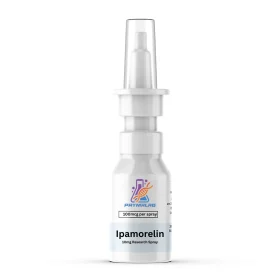
Preloaded Autoinjector | Sermorelin | 3ml Pen | 6mg
GHRH(1-29) amide in solution · 3ml at 2mg/ml · No reconstitution step
The sermorelin peptide pen is a preloaded 3ml research autoinjector holding GHRH(1-29)-NH2 in solution at 2 mg/ml, giving 6mg of total peptide. This is one of the few research compounds whose aqueous decay has been measured and published: Asn8 deamidation, with products 400 to 500 times less potent than the parent.
Specification Table
| Property | Value |
|---|---|
| Device format | Preloaded autoinjector pen, glass cartridge |
| Fill volume | 3 ml |
| Concentration | 2.0 mg/ml |
| Total compound in device | 6 mg |
| Molar concentration | 0.596 mM (596 uM) |
| Compound | Sermorelin (INN); GHRH(1-29)-NH2, the N-terminal 29 residues of human GHRH(1-44) |
| CAS number | 86168-78-7 (free peptide). The acetate number 114466-38-5 appears on supplier pages only and is unverified against a primary registry |
| Molecular formula | C149H246N44O42S |
| Molecular weight | 3357.9 g/mol average; 3355.82 Da monoisotopic |
| Amino acid sequence | YADAIFTNSYRKVLGQLSARKLLQDIMSR-NH2 (29 residues, C-terminal primary amide) |
| Solution appearance | Clear and colourless expected; not published on the product record |
| Reconstitution required | None. Supplied as solution |
| Excipient system | Not published on the product record. Confirm against certificate of analysis |
| Solution pH | Not published on the product record. Published stability optimum is pH 4 to 5 |
| Storage | 2-8°C, protect from light, do not freeze |
| Light sensitivity | Tyr1 and Tyr10 are photo-oxidation sites, as is Met27 |
| Solution stability | Friedman 1991 reports 150 to 202 h half-lives for Asn-containing GRF analogues in neutral aqueous solution; no study of this device format exists |
| Deamidation site | Asn8 (Asn8-Ser9), giving beta-Asp8 and Asp8 in about a 4:1 ratio |
| Acid-labile site | Asp3-Ala4: isomerisation above pH 4, backbone cleavage below pH 4 |
| Net charge at pH 7.4 | About +4; calculated pI approximately 10.8 |
| Salt form | Not published on the product record. Acetate or trifluoroacetate is usual for research material |
| Purity | Per lot-specific certificate of analysis |
| Regulatory status | No sermorelin product is currently approved. GEREF (sermorelin acetate) held NDA 19-863 from December 28, 1990 and NDA 20-443 from September 26, 1997; both approvals were withdrawn on June 18, 2009. This research preparation is not GEREF. WADA prohibits GHRH analogues under S2.2 and names sermorelin |
What Changes When The Sermorelin Peptide Pen Ships GHRH(1-29) In Solution?
More than for almost any other compound in this catalogue, and the reason is published rather than inferred. Friedman and colleagues showed in 1991 that loss of activity in GRF analogues held in neutral aqueous solution is caused by deamidation of asparagine, and that replacing the asparagine extends the solution half-life from 150 to 202 hours out to 746 to 1550 hours. The same paper puts the potency of the deamidated products at 400 to 500 fold below the parent.
Sermorelin has that asparagine at position 8, in an Asn8-Ser9 pair. Bongers and colleagues characterised the products in 1992: beta-aspartate at position 8, which is the iso-aspartate rearrangement, and ordinary aspartate, in roughly a 4 to 1 ratio. Both are formed through the same cyclic succinimide intermediate, and both are peptides of the same molecular weight as the parent to within one dalton.
Deamidation converts an amide to a carboxylate and adds 0.98 daltons. On an average-mass readout it is invisible. A cartridge in which a substantial fraction of the peptide has become iso-Asp8 material will still show the expected mass, still look clear and colourless, and still pass a purity assay that does not separate isomers. The chemistry is silent and the potency loss is not.
Asp3 gives a second route, and it works in the opposite direction on the pH axis. Bongers found that the Asp3-Ala4 bond isomerises above pH 4 and cleaves outright below pH 4. Combined with the deamidation chemistry, that leaves a narrow window: GRF(1-29)-NH2 is most stable between pH 4 and 5, with degradation increasing on both sides of it.
Met27 is the third route, oxidising to the sulfoxide in the ordinary way for a methionine held in an oxygenated aqueous solution. Unlike deamidation, that one adds a clean 16 daltons. Tyr1 and Tyr10 are photo-oxidation sites, and Gln16 and Gln24 deamidate slowly. The C-terminal amide at Arg29 is required for full intrinsic activity, so its loss is not a cosmetic change either.
The formulation decision made for the approved product tells the same story from the other end. GEREF was a sterile lyophilised powder containing 0.5 or 1.0 mg of sermorelin base with 5 mg mannitol and a sodium phosphate buffer, reconstituted with sodium chloride injection to pH 5.0 to 5.5 and stored at 2-8°C. A powder held at the middle of the published stability window is exactly what the Asn8 and Asp3 chemistry predicts a formulator would build.
Calculated net charge is about +4 with a pI near 10.8, and the helix carries a hydrophobic face of Ile5, Phe6, Val13, Leu14, Leu17, Leu22, Leu23, Ile26 and Met27. Cationic plus amphipathic predicts adsorption to anionic glass and to hydrophobic polymers at dilute concentrations. No adsorption study was located.
Sermorelin Solution Stability: What The Published Numbers Say
Sermorelin solution stability is unusual in this catalogue because real figures exist, though none of them was measured on a pen. Friedman 1991 gives 150 to 202 hours as the neutral-solution half-life range for asparagine-containing GRF analogues, which is between six and eight days. Bongers 1992 identifies the products and shows in pituitary-cell release assays that all of them have markedly reduced activity. Stevenson 1993 links the deamidation rate to local secondary structure, which is why a number measured on one analogue does not transfer cleanly to another.
None of that is a shelf life for this device. It is a rate constant measured at neutral pH on related molecules; a formulation buffered at pH 4.5 would sit elsewhere on that curve.
The question worth asking a supplier is therefore specific: at what pH is the solution buffered, and is there any lot-specific data on the iso-Asp8 fraction at release and at expiry. Without both, sermorelin solution stability in a given cartridge is an assumption. General principles are covered in the peptide storage and stability notes.
Concentration And Increment Arithmetic For The Sermorelin Peptide Pen
Six milligrams in 3 ml gives 2.0 mg/ml, and dividing by the 3357.9 g/mol average mass gives 0.596 mM, or 596 micromolar. Per increment, 0.01 ml delivers 0.02 mg, which is 20 micrograms, and 0.1 ml delivers 0.2 mg, which is 200 micrograms.
Against the published record, the fill sits in a familiar range. GEREF vials held 0.5 or 1.0 mg of base, and the diagnostic ampoule held 0.05 mg. Corpas 1992 used 0.5 to 1 mg per injection in older men, Thorner 1996 used 30 micrograms per kilogram daily in children, and the diagnostic assessment used 1 microgram per kilogram intravenously. The 2 mg/ml in this device is of the same order as reconstituted GEREF, though the diluent volume on the original label copy was not confirmed.
For receptor work the arithmetic is the usual long one. Reaching 1 nanomolar from 596 micromolar needs a dilution of about 596,000 fold, and the dilution calculator handles the series. The device fixes concentration at manufacture; it does not shorten that chain.
Does Sermorelin Come In A Pen, And What Does That Format Suit?
Does sermorelin come in a pen: yes, as a preloaded research device, and the format question for this molecule is more interesting than for most because the chemistry argues with it. A pen removes reconstitution error and dissolution variability and fixes concentration at fill, the general case set out in the pen versus vial article and across the preloaded autoinjector range.
Against that, the compound has a published aqueous decay route whose products are 400 to 500 fold less potent and whose mass is indistinguishable from the parent. A lyophilized cake does not deamidate at any appreciable rate; a solution does. The sermorelin pen vs vial decision for this peptide is therefore not the usual convenience trade. It is a choice between removing preparation variance and accepting a degradation route that the approved product was formulated specifically to avoid.
The sermorelin peptide pen suits short, intensive work from one lot where the interval since fill is recorded. It suits nothing that assumes potency is constant across months of use.
Where the work needs a defined starting point rather than a defined concentration, the lyophilized 10mg presentation and the smaller 5mg vial keep the peptide dry until the moment it is needed.
Sermorelin Pen Storage And What It Cannot Fix
Sermorelin pen storage is 2-8°C, protected from light, without freezing. Freezing a sermorelin peptide pen risks concentration gradients and damage to the glass cartridge.
What refrigeration does is slow the Asn8 chemistry; what it does not do is stop it. Deamidation is a hydrolytic rearrangement that proceeds in the cold, and the published half-lives were measured in neutral solution at controlled temperature rather than on a bench. Cold storage moves the number, not the mechanism.
Light protection matters for named residues rather than as a formality: Tyr1 and Tyr10 photo-oxidise to dityrosine species and Met27 to the sulfoxide, so bench lighting between sessions adds an input the packaging removes for free.
For a peptide with a six-to-eight-day literature half-life at neutral pH, elapsed time since fill is the variable most likely to explain a drifting result, so record the fill date and the date of first actuation.
What The Product Record Does Not State
Solution pH is the first gap and the largest. The published stability window is pH 4 to 5, isomerisation dominates above it and backbone cleavage below it, so a formulation pH is not a detail here. It is the number that decides which degradation route is running.
The excipient system is unpublished. GEREF used mannitol and a phosphate buffer, but that was built for a lyophilisate and says nothing about a liquid cartridge.
Salt form is unpublished. Acetate and trifluoroacetate both circulate in research material, and the CAS number for the acetate that appears on supplier pages could not be traced to a primary registry.
Fill date and any release or expiry data on the deamidated fraction are unpublished. For this compound that fraction is the assay result that matters, and it is not one a laboratory can infer from appearance or from total mass.
Verifying The Device And Confirming The Contents Are Intact
Inspect the solution against a white background before each draw and check for haze or particulate. Let the sermorelin peptide pen reach ambient temperature before actuating, since a cold solution is more viscous and viscosity changes delivered volume. Verify delivered mass gravimetrically once per device.
For contents, this peptide gives a genuine ultraviolet handle that many research peptides do not. Tyr1 and Tyr10 absorb at 280 nm, so an absorbance reading at that wavelength is a valid concentration estimate against a molar extinction coefficient calculated for two tyrosines and no tryptophan. What that reading cannot do is distinguish intact peptide from deamidated peptide, since both tyrosines survive the rearrangement untouched.
Mass spectrometry separates some of the routes and not the important one. Met27 oxidation adds 16 daltons and is easy. Deamidation adds 0.98 daltons, which needs high-resolution instrumentation to see at all, and iso-Asp8 has the identical mass to Asp8, so mass alone cannot report the 4 to 1 split that Bongers described.
Resolving the isomers takes chromatography. Reverse-phase separation under shallow gradients, ion-exchange, or an isoaspartate-specific enzymatic assay are the practical options, and a supplier who can report an iso-Asp fraction is reporting something meaningful about a liquid formulation of this peptide. One that reports only total purity by area is reporting that the molecule is still the right size.
What The Sermorelin Literature Actually Reports
A short, old and mostly paediatric human record, plus pharmacokinetics that explain why the injections were frequent. Sermorelin is a GHRH receptor agonist at pituitary somatotrophs, signalling through Gs and cAMP to release growth hormone in pulses; residues 1 to 29 are the shortest fragment retaining full intrinsic activity of GHRH(1-44).
The pharmacokinetics are severe. Plasma half-life is 11 to 12 minutes after intravenous or subcutaneous injection, Tmax is 5 to 20 minutes after subcutaneous administration, and mean absolute subcutaneous bioavailability is about 6 percent, so more than nine tenths of an injected amount never reaches the circulation intact. Wilton 1993 measured intranasal bioavailability at 3 to 5 percent in 30 healthy men with growth hormone elevation lasting about 3 hours.
Thorner 1996 is the substantial human study: 110 growth hormone deficient children enrolled and 86 evaluable on 30 micrograms per kilogram subcutaneously once daily, with height velocity moving from 4.1 plus or minus 0.9 cm per year at baseline to 8.0 plus or minus 1.5 at six months and 7.2 plus or minus 1.3 at twelve months. Corpas 1992 gave 0.5 or 1 mg twice daily for 14 days to 10 men of about 68 years, and the 1 mg arm restored growth hormone and IGF-1 to the levels seen in 9 young controls.
What has not been studied is equally specific. There is no long-term controlled trial in healthy adults for body composition, sleep or cognition; the older-adult work runs to about 10 subjects over two to six weeks. No controlled trial has used a pen or any multi-dose solution presentation, and no modern pharmacokinetic study of research-grade material exists. Adverse findings on the GEREF label were local injection reactions in about one in six patients, with headache, flushing and dysphagia each under 1 percent, and anti-GRF antibodies in a large proportion of children, usually transient. How this compound sits against related molecules is covered in the comparison of GHRH and ghrelin-receptor analogues.
Regulatory Position: GEREF, Withdrawal And WADA
No sermorelin product is approved today, and the history behind that is more specific than most listings state. GEREF (sermorelin acetate) injection at 0.05 mg base per ampoule was approved under NDA 19-863 on December 28, 1990 for evaluating pituitary growth hormone secretory capacity. GEREF at 0.5 and 1.0 mg base per vial was approved under NDA 20-443 on September 26, 1997 for idiopathic growth hormone deficiency in children with growth failure. The holder was EMD Serono.
Discontinuation was notified on July 11, 2008 for the ampoule and December 2, 2008 for the vials, and FDA withdrew both approvals on June 18, 2009. A Federal Register notice of March 4, 2013 determined that the products were not withdrawn from sale for reasons of safety or effectiveness, which is the finding US compounders rely on when treating sermorelin acetate as a component of a formerly approved drug under section 503A. This research preparation is not GEREF.
No current approval was located at EMA, PMDA, the TGA or Health Canada. The compound is not on the FDA Category 2 bulk-substance page. WADA prohibits it at all times under section S2.2, where growth hormone releasing hormone analogues are listed by name: CJC-1293, CJC-1295, sermorelin and tesamorelin. That is an individual naming rather than a category catch-all, which is worth knowing before any work involving sport samples.
What Does the Sermorelin Literature Report, and What Did GEREF Treat?
Sermorelin has more clinical history than almost anything else in this catalogue, because it was an approved medicine. GEREF 0.5 and 1.0 mg was licensed in the United States for the treatment of idiopathic GH deficiency in children with growth failure, with a separate product, Geref Diagnostic 0.05 mg, for evaluating pituitary somatotroph function, and the paediatric trials behind the treatment indication measured height velocity over months. It was withdrawn from the US market in 2008 for commercial reasons rather than safety findings, which is a distinction worth keeping straight.
Those trials measured what a synthetic analog of GHRH(1-29) does to the growth axis in children who were deficient. They did not measure anti-aging endpoints, muscle mass, muscle growth, cognitive function or sleep quality in healthy adults, and no registrational trial has. The adult literature that exists is small, mostly open-label, and concentrated on IGF-1 response rather than on outcomes. HGH itself, given as recombinant somatropin, is what the anti-aging clinics of the 1990s actually studied, and reading those results across to a GHRH analog is a step the data does not support.
IGF-1 is the marker that matters. Growth hormone leaves the pituitary gland in pulses, so a single serum sample catches an arbitrary point on a curve, while IGF-1 integrates exposure over hours and is what the published work tracks. A rise in that marker is evidence of sustained axis stimulation. It is not evidence of any downstream outcome, and no trial of this compound has followed the chain further.
Sermorelin and the Ghrelin Receptor Agonists Are Not One Class
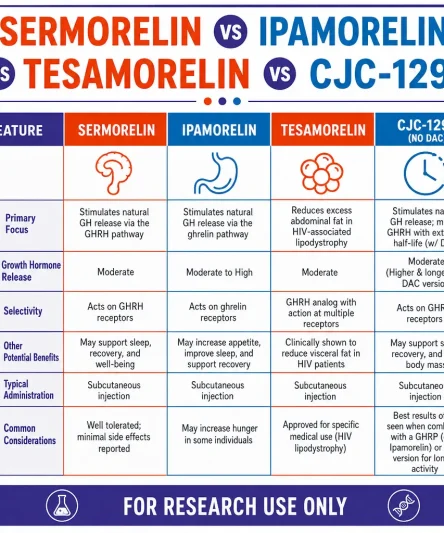
Sermorelin is a GHRH analog acting at the GHRH receptor. The other two are ghrelin receptor agonists acting at GHS-R1a. Those are two different receptors on the same cell, and the practical differences follow from that. A GHRH analog preserves the negative feedback loop and produces no appetite effect. Agonists at the ghrelin receptor produce hunger, and the less selective ones raise prolactin and cortisol as well.
Clinics combine them for that reason, and compounding pharmacy preparations pairing the two classes have been common in the United States. The regulatory picture is more particular than most summaries allow. Sermorelin acetate sits in Category 1 of FDA’s interim 503A bulk drug substances list, the group under evaluation against which the agency does not currently intend to act, so compounding pharmacies have not been shut out of it in the way they have with several neighbouring peptides. GHRP-2, GHRP-6, ipamorelin acetate and kisspeptin-10 are all named in Category 2, the group FDA considers may present significant safety risks. A pairing of this compound with one of those faces a harder position than this compound alone, and anyone reading older clinic material should check its date.
What Do the Format and the Certificate Settle?
Dosing in this catalogue is arithmetic rather than instruction. The published schedule in the paediatric trials was weight-based, given nightly, and set for a diagnosed deficiency in children under specialist supervision. None of it transfers to a research context, so this page states what each increment contains and stops there. A dose figure taken from a clinic protocol is not a dose derived from a trial of this device.
On format, a pre-mixed pen removes the reconstitution step that a peptide vial requires. A vial of dry synthetic peptide is brought into solution with bacteriostatic water at the bench, the concentration is chosen there, and the solid keeps well until it is opened. Pre-mixed pens fix the concentration, remove the arithmetic, and start the stability clock at a fill date that is not on the product record. Pre-mixed pens also travel better, since there is nothing to prepare and nothing to spill, and a pre-mixed pen entered through a fresh needle each time has a different contamination profile from a multi-entry vial. What a pre-mixed pen cannot do is let the concentration follow the experiment, and hormone balance work that needs a molar series will want the vial. For a compound whose aqueous behaviour is as well characterised as this one’s, that missing date is the main thing standing between the published stability numbers and a usable estimate for the device in hand.
Side effects on record come from the paediatric programme and are mostly local: injection site pain, redness and swelling, with flushing and headache reported less often. The compound is prohibited in sport at all times under WADA category S2. It is supplied here for laboratory research only, and no approved product containing it is currently marketed in the United States.
Published Literature
Every entry below was checked against Crossref, a PubMed listing or the issuing agency’s own record before it was included.
- Thorner M, Rochiccioli P, Colle M, et al. Once daily subcutaneous growth hormone-releasing hormone therapy accelerates growth in growth hormone-deficient children during the first year of therapy. J Clin Endocrinol Metab. 1996;81(3):1189-1196. DOI: 10.1210/jcem.81.3.8772599. PMID: 8772599
- Corpas E, Harman SM, Pineyro MA, et al. Growth hormone (GH)-releasing hormone-(1-29) twice daily reverses the decreased GH and insulin-like growth factor-I levels in old men. J Clin Endocrinol Metab. 1992;75(2):530-535. DOI: 10.1210/jcem.75.2.1379256. PMID: 1379256
- Wilton P, Chardet Y, Danielson K, et al. Pharmacokinetics of growth hormone-releasing hormone(1-29)-NH2 and stimulation of growth hormone secretion in healthy subjects after intravenous or intranasal administration. Acta Paediatr Suppl. 1993;388:10-15. DOI: 10.1111/j.1651-2227.1993.tb12827.x. PMID: 8329825
- Rafferty B, Poole S, Clarke R, et al. Growth hormone-releasing factor analogue (hGRF1-29NH2): immunoreactive-GRF plasma levels after intravenous and subcutaneous administration. J Endocrinol. 1985;107(3):R5-R8. DOI: 10.1677/joe.0.107r005. PMID: 2866222
- Bongers J, Heimer EP, Lambros T, et al. Degradation of aspartic acid and asparagine residues in human growth hormone-releasing factor. Int J Pept Protein Res. 1992;39(4):364-374. DOI: 10.1111/j.1399-3011.1992.tb01596.x
- Friedman AR, Ichhpurani AK, Brown DM, et al. Degradation of growth hormone releasing factor analogs in neutral aqueous solution is related to deamidation of asparagine residues. Int J Pept Protein Res. 1991;37(1):14-20. DOI: 10.1111/j.1399-3011.1991.tb00727.x. PMID: 1904406
- Federal Register. Determination that GEREF (sermorelin acetate) injection and related products were not withdrawn from sale for reasons of safety or effectiveness. 78 FR, March 4, 2013, document 2013-04827.
Frequently Asked Questions
What is the sermorelin peptide pen?
A preloaded 3ml research autoinjector holding GHRH(1-29)-NH2 in solution at 2 mg/ml, giving 6mg in total, with no reconstitution step. It is supplied strictly for laboratory research. No sermorelin product is currently approved in any jurisdiction, and this preparation is not the former GEREF product.
Does sermorelin come in a pen?
Does sermorelin come in a pen: yes, as a preloaded research device holding 6mg in 3 ml at 2 mg/ml. The approved product that once existed, GEREF, was a lyophilised powder reconstituted to pH 5.0 to 5.5, so the solution format is a research-supply decision rather than a regulatory precedent.
Which degradation route dominates in solution?
Asn8 deamidation. Friedman 1991 attributed activity loss in neutral aqueous GRF analogues to that residue and measured 150 to 202 hour half-lives, while analogues without the asparagine ran to 746 to 1550 hours. Bongers 1992 identified beta-Asp8 and Asp8 products in roughly a 4 to 1 ratio.
Why is deamidation hard to detect?
Because it adds only 0.98 daltons and the iso-aspartate product has the same mass as the aspartate one. A cartridge with a large deamidated fraction still shows the expected molecular weight, still looks clear, and still passes a purity assay that does not resolve isomers. Potency falls 400 to 500 fold.
What is known about sermorelin solution stability?
Rates exist for related GRF analogues in neutral solution, not for this device. Sermorelin solution stability figures of 150 to 202 hours come from Friedman 1991, and Bongers 1992 puts the optimum window at pH 4 to 5. Neither was measured on a pen or on this formulation.
What pH is best for this peptide?
Between pH 4 and 5, according to Bongers 1992. Above pH 4 the Asp3-Ala4 bond isomerises; below pH 4 it cleaves outright. GEREF was reconstituted to pH 5.0 to 5.5, which sits in that window. The pH of this research solution is not published on the product record.
How does the sermorelin pen vs vial choice look here?
The sermorelin pen vs vial decision is unusually consequential for this compound. A pen removes reconstitution variance and fixes concentration; a lyophilized vial keeps the peptide out of water, which is where the Asn8 chemistry happens. The approved product was formulated as a powder for exactly that reason.
What concentration does the device hold?
2.0 mg/ml, from 6 mg in a 3 ml fill, which is 0.596 mM or 596 micromolar against the 3357.9 g/mol average mass. That is the same order as reconstituted GEREF vials, which held 0.5 or 1.0 mg of base, though the label diluent volume was not confirmed.
How much peptide is in one 0.01 ml increment?
0.02 mg, which is 20 micrograms, and 0.2 mg or 200 micrograms in 0.1 ml. Graduation resolution sets the floor on the smallest reproducible delivery. Reaching 1 nanomolar in a receptor assay from 596 micromolar requires a dilution of roughly 596,000 fold.
What are the correct sermorelin pen storage conditions?
Sermorelin pen storage is 2-8°C, protected from light, without freezing. Cold slows the Asn8 rearrangement rather than stopping it, since deamidation proceeds in the refrigerator. Light protection is specific rather than generic here: Tyr1, Tyr10 and Met27 are all photo-oxidation sites on this sequence.
Can a 280 nm reading confirm the contents?
It confirms concentration, not integrity. Tyr1 and Tyr10 absorb at 280 nm with no tryptophan present, so an extinction coefficient for two tyrosines gives a usable concentration estimate. Both tyrosines survive deamidation unchanged, so the same reading is returned by degraded material.
What analysis would show the deamidated fraction?
Chromatography rather than mass. Shallow-gradient reverse-phase separation, ion exchange, or an isoaspartate-specific enzymatic assay can resolve beta-Asp8 from Asp8 and from the parent. High-resolution mass spectrometry sees the 0.98 dalton shift but cannot separate the two isomeric products from each other.
What is not published on the product record?
Solution pH, excipient system, salt form and fill date. The pH gap is the largest, because the published window is narrow and the routes on either side of it differ. Request the pH and any lot data on the deamidated fraction against the certificate of analysis.
What did the paediatric trial report?
Thorner 1996 enrolled 110 growth hormone deficient children with 86 evaluable on 30 micrograms per kilogram daily. Height velocity moved from 4.1 plus or minus 0.9 cm per year at baseline to 8.0 plus or minus 1.5 at six months and 7.2 plus or minus 1.3 at twelve months.
Was any sermorelin product ever approved?
Yes, twice, and both approvals are gone. GEREF held NDA 19-863 from December 28, 1990 as a 0.05 mg diagnostic ampoule and NDA 20-443 from September 26, 1997 as 0.5 and 1.0 mg vials. FDA withdrew both on June 18, 2009 after commercial discontinuation in 2008.
What is the anti-doping position?
Prohibited at all times. WADA section S2.2 lists growth hormone releasing hormone analogues by name, including CJC-1293, CJC-1295, sermorelin and tesamorelin. That is an individual naming rather than reliance on a general clause, which matters for any laboratory handling samples connected to sport.
What was GEREF approved to treat?
Idiopathic growth hormone deficiency in children with growth failure, in the United States. A separate product, Geref Diagnostic, was indicated for evaluating pituitary somatotroph function. Paediatric trials measured height velocity over months. It was withdrawn in 2008 for commercial reasons rather than safety findings. No registrational trial measured anti-aging endpoints, muscle growth, cognitive function or sleep quality in healthy adults.
Why do studies track IGF-1 rather than growth hormone?
Because growth hormone leaves the pituitary gland in pulses and a single serum sample catches an arbitrary point on the curve. IGF-1 integrates exposure over hours. A rise there shows sustained axis stimulation and nothing about any downstream outcome, and no trial of this compound followed the chain further.
How does sermorelin differ from ipamorelin and GHRP-2?
Different receptors. This is a synthetic analog of GHRH acting at its own receptor, which preserves negative feedback and produces no appetite effect. The other two are ghrelin receptor agonists at GHS-R1a; they produce hunger, and the less selective ones raise prolactin and cortisol as well.
What is the compounding pharmacy position?
More particular than most summaries allow. Sermorelin acetate sits in Category 1 of FDA’s interim 503A bulk drug substances list, the group under evaluation that the agency does not currently intend to act against. The secretagogues it is commonly paired with do not: GHRP-2, GHRP-6, ipamorelin acetate and kisspeptin-10 are named in Category 2, which FDA considers may present significant safety risks. Compounding pharmacies face a harder position on the pairing than on this compound alone.
What dosing and side effects are on record?
The published schedule was weight-based, given nightly, for diagnosed deficiency in children under specialist supervision, and none of it transfers to research use, so this page gives increment arithmetic instead. Side effects from the paediatric programme were mostly local: injection site pain, redness and swelling, with flushing and headache less often. A pre-mixed pen fixes the concentration a peptide vial would let you choose with bacteriostatic water, and peptide therapy protocols circulating online are not derived from trials of this device.
Compliance Statement
The sermorelin peptide pen is sold exclusively for laboratory research use. It is not a drug, food, or cosmetic product, and it is not a dietary product of any kind. It is not approved by the FDA or any comparable authority for human or veterinary use. This product is not intended to diagnose, treat, cure, or prevent any disease. It must not be given to humans or animals. Purchase is restricted to qualified researchers and institutions operating within applicable laws. All handling is the responsibility of the purchasing laboratory.


Reviews
There are no reviews yet.