Description
PrymaLab · Research Use Only
Preloaded Autoinjector | Tesamorelin | 3ml Pen | 10mg
Acylated GHRH(1-44) amide in solution · 3ml at 10/3 mg/ml · No reconstitution step
The tesamorelin pen is a preloaded 3ml research autoinjector holding an acylated 44-residue growth-hormone-releasing factor analogue in solution at 10/3 mg/ml, giving 10mg in the device. Every approved presentation of this molecule is a lyophilized powder, and the longest in-solution period any of those labels permits is seven days.
Specification Table
| Property | Value |
|---|---|
| Device format | Preloaded autoinjector pen, glass cartridge |
| Fill volume | 3 ml |
| Concentration | 10/3 mg/ml |
| Total compound in device | 10 mg |
| Molar concentration | 10 x 0.0649 mM; a 10 mg fill gives 0.649 mM |
| Compound | Tesamorelin, N-(trans-3-hexenoyl)-human GHRH(1-44) amide; development code TH9507 |
| CAS number | 218949-48-5 for the free base. Acetate 901758-09-6, supplier-sourced and unconfirmed |
| Molecular formula | C221H366N72O67S (free base) |
| Molecular weight | 5135.9 Da average (label); 5132.72 monoisotopic |
| Amino acid sequence | Acyl-YADAIFTNSYRKVLGQLSARKLLQDIMSRQQGESNQERGARARL-NH2, 44 residues, C-terminal amide, no cysteine and no tryptophan |
| Solution appearance | Clear and colourless |
| Reconstitution required | None. Supplied as solution |
| Excipient system | Not published on the product record. Confirm against certificate of analysis |
| Solution pH | Not published on the product record. The approved powder specifies pH 4.5 to 7.4 once mixed |
| Storage | 2-8°C, protected from light, do not freeze |
| Light sensitivity | Moderate. Met27 and the two tyrosines are the photo-oxidation targets; both approved labels require light protection |
| Solution stability | Not established. The most permissive approved in-solution period is 7 days at 20-25°C in a cyclodextrin and bacteriostatic-water matrix |
| Deamidation sites | Asn8 and Asn35, with slower routes at Gln16, Gln24, Gln30, Gln31 and Gln36; isoaspartate at Asp3 and Asp25 |
| Oxidation site | Met27, the single sulfur atom in the formula |
| Salt form | Acetate in the approved product; research suppliers acetate or TFA. Not stated on the product record |
| Purity | Per lot-specific certificate of analysis |
| Regulatory status | An approved product of this compound exists: Egrifta, application 022505, Theratechnologies, approved by the FDA on 10 November 2010 for reduction of excess abdominal fat in adults with HIV-associated lipodystrophy, with Egrifta SV in 2019 and Egrifta WR on 25 March 2025. This research preparation is not that product. WADA 2026 Prohibited List S2, GHRH analogues, prohibited at all times |
What Changes When Tesamorelin Ships in Solution?
The sponsor answered this question by never shipping it in solution. Egrifta, Egrifta SV and Egrifta WR are all lyophilized powders, and the most generous in-solution period any of those labels allows is seven days at 20-25°C, in a matrix specifically engineered to support it.
The reason sits in the sequence. Tesamorelin is native human GHRH(1-44) with a C-terminal amide and a six-carbon acyl chain on the N-terminal tyrosine. That acyl group blocks dipeptidyl peptidase-IV cleavage at the Tyr1-Ala2 bond and removes the free alpha-amine, which also rules out any diketopiperazine route. What it does not do is touch the interior of the molecule, and the interior is where the chemistry lives.
Asn8 is the residue that matters most. Friedman and colleagues showed in 1991 that degradation of growth-hormone-releasing factor analogues in neutral aqueous solution is governed by asparagine deamidation, and demonstrated it by replacing the asparagine with serine and watching the analogue stabilise. Tesamorelin kept the native asparagine. Bongers and colleagues characterised the same family of routes in 1992, including isomerisation at Asp3. Deamidation runs through a succinimide intermediate that reopens to aspartate and isoaspartate, adding 1 Da; the isoaspartate that follows adds nothing further, so part of the damage moves mass and part of it does not. Asn35 provides a second site, and five glutamines add slower ones.
Met27 is the only sulfur atom in C221H366N72O67S, and it oxidises to the sulfoxide with dissolved oxygen, peroxide impurities in polysorbate, or light. That is a clean 16 Da addition and the easiest of the routes to watch. Asp3 sits at the receptor-critical N-terminal segment, so isomerisation there costs activity out of proportion to the number of molecules affected.
Aggregation and surface loss are the third problem, and the formulations show how seriously the sponsor took them. This is an amphipathic helix-forming peptide with six arginines and two lysines against two aspartates and two glutamates, both termini blocked, giving a formal net charge near +4. Egrifta SV carries polysorbate 20 at 0.05 mg per vial; Egrifta WR carries 145 mg of hydroxypropyl betadex, a cyclodextrin. Neither excipient is decorative.
One label instruction deserves attention because it runs against instinct. Egrifta SV directs that its reconstituted solution be injected immediately and states that it should not be frozen or refrigerated. The reason is not given. Egrifta WR takes the opposite approach, allowing seven days at room temperature in the cyclodextrin and bacteriostatic-water matrix. Two presentations of the same molecule, two different in-solution rules, and neither of them describes a cartridge held cold for weeks.
What Does the Tesamorelin Pen Deliver Per Increment?
Concentration is 10/3 mg/ml, and dividing by the labelled mass of 5135.9 Da gives 10 multiplied by 0.0649 mM.
Worked at a 10 mg fill: 3.33 mg/ml, which is 0.649 mM. A 5 mg fill gives 0.325 mM. Mass per 0.01 ml, the smallest increment on a standard insulin-graduated barrel, is 10 multiplied by 3.33 microgram, or 33.3 microgram at a 10 mg fill; per 0.1 ml the figure is 10 multiplied by 33.3 microgram.
Against the approved products this is not an unusual concentration. Egrifta SV reconstitutes to 4 mg/ml, which is 0.78 mM, and Egrifta WR to 8 mg/ml, which is 1.56 mM. A 10 mg fill in 3 ml is 0.83 times the SV concentration and 0.42 times the WR concentration. The difference is not strength but duration: those solutions exist for minutes or for a maximum of seven days, and a pen holds its contents dissolved for as long as the device is in use.
For receptor work the arithmetic is steep. GHRH receptor assays run at nanomolar agonist concentrations, so reaching 10 nM from 0.649 mM is a 64,900-fold serial dilution. Every trial that reported a positive result used 2 mg daily by subcutaneous injection, which is the figure to keep in view when reading any concentration comparison.
Tesamorelin Pen vs Vial: What the Format Settles
The tesamorelin pen vs vial question has an unusually clear answer for this compound, and it does not favour the pen on stability grounds.
A pen fixes concentration at manufacture and removes reconstitution error, and the pen versus vial comparison together with the preloaded autoinjector category page set out that general case.
What is compound-specific is that the sponsor of the approved product never validated a solution beyond seven days, and in one presentation validated only immediate use. A lyophilized vial of the same compound holds the deamidation and oxidation routes essentially still until water is added, which is what the approved formulations were designed to exploit.
That does not make the pen unusable; it makes the trade explicit. On the tesamorelin pen vs vial decision, the pen buys fixed concentration and repeated equivalent draws, and it spends the one advantage the approved formulation was built around.
CJC 1295 vs Tesamorelin: What Actually Separates Them?
The comparison people search for is usually about potency, and the real separation is regulatory and evidential: one of these compounds has an approved product and five controlled trials behind it, and the other does not.
Both are GHRH-receptor agonists, and both were built by modifying the native sequence to resist dipeptidyl peptidase-IV. That is where the similarity ends. Tesamorelin is the full 44-residue GHRH sequence with an acyl group; CJC-1295 without DAC is a modified GHRH(1-29) fragment, a shorter molecule with a different set of residues and therefore a different degradation map.
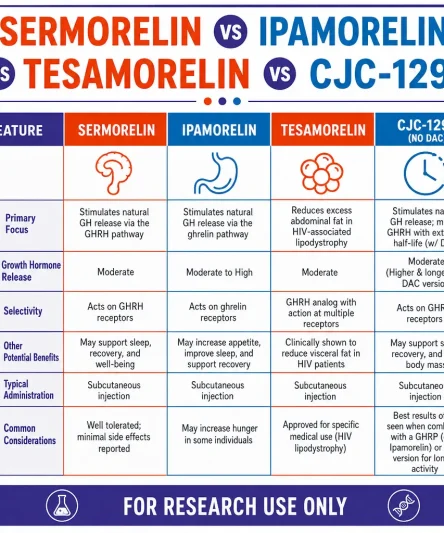
On evidence the gap is wide. Tesamorelin has phase 3 data in 412 and 404 participants, two later randomised trials in 50 and 61, and an approved label. Nothing comparable exists for the other compound. Anyone weighing CJC 1295 vs tesamorelin on published human outcomes is comparing a registered product against a research peptide. The comparison article on growth-hormone secretagogues and the signalling background piece cover the pharmacology further.
What the Product Record Does Not State
Four values are absent, and for this molecule the first is more consequential than usual.
The excipient system is unpublished. Both approved presentations include a solubiliser or surfactant chosen to keep this peptide in solution and off surfaces: polysorbate 20 in one, 145 mg of hydroxypropyl betadex in the other. Whether the pen contains anything equivalent decides how much material is adsorbed to glass over weeks, and polysorbate carries its own problem, since peroxide impurities in it oxidise Met27.
Solution pH is unpublished. The approved powder specifies 4.5 to 7.4 once mixed, a wide window, and deamidation rate varies substantially across it.
Salt form is unpublished. The approved product is the acetate with roughly seven acetate equivalents per molecule; research suppliers ship acetate or trifluoroacetate, and the latter is invisible in an area-percent purity figure. Solution stability at this fill is unpublished, and no tesamorelin-specific forced-degradation study was located at all.
Verifying the Tesamorelin Pen and Confirming Its Contents
A 44-residue peptide gives more analytical handles than a tetrapeptide, and the useful point is which of its degradation routes move mass and which do not.
Ultraviolet quantification works but weakly. There is no tryptophan in the sequence, so absorbance at 280 nm comes from Tyr1 and Tyr10 alone and the extinction coefficient is correspondingly low. A280 will give a concentration estimate on a stock at this strength, though it is a poor purity indicator.
Mass spectrometry is where the real information is. Met27 sulfoxide adds a clean 16 Da. Deamidation of Asn8 or Asn35 adds 1 Da, which on a 5135.9 Da molecule requires resolution good enough to separate the +1 species from the natural isotope envelope, so a low-resolution instrument will miss it. Isoaspartate formed from Asp3 or Asp25 adds nothing at all and is invisible by mass, exactly as it is in the shorter bioregulator peptides. Peptide mapping after enzymatic digestion is the method that separates these, because the individual fragments are small enough for the mass differences to be unambiguous.
Inspect the solution against a white background for haze, fibres or opalescence rather than only particulate, since this is a helix-forming amphipathic peptide with a documented self-association risk and an unpublished excipient system. Thioflavin T fluorescence is the direct assay if aggregation is suspected.
What the Tesamorelin Literature Actually Reports
All the positive human data comes from one population, HIV-associated lipodystrophy, and every trial used 2 mg subcutaneously once daily.
Falutz and colleagues reported the first phase 3 in the New England Journal of Medicine in 2007: 412 participants over 26 weeks, with visceral adipose tissue falling by 27 cm2, or 18 percent, against a rise of 4 cm2, or 2 percent, on placebo. The second phase 3, published in 2010, randomised 404 participants and reported a visceral fat change of -10.9 percent against -0.6 percent, with the gains “rapidly lost” after participants switched to placebo at 26 weeks. A pooled 52-week analysis followed in the Journal of Clinical Endocrinology and Metabolism the same year.
Two later trials moved to the liver. Stanley and colleagues reported in JAMA in 2014 on 50 participants over six months, with visceral fat falling 34 cm2 against a rise of 8 cm2 (P = 0.005) and liver lipid falling 2.0 percent against a rise of 0.9 percent. Their 2019 trial in Lancet HIV followed 61 participants with HIV-associated fatty liver disease for twelve months and reported an absolute reduction in hepatic fat fraction of 4.1 percent (P = 0.018) with less fibrosis progression.
Baker and colleagues published a placebo-controlled trial in Archives of Neurology in 2012 in adults with mild cognitive impairment and healthy older adults, reporting a favourable cognitive signal. No confirmatory phase 3 followed.
Disposition is fast and bioavailability is poor. The labelled half-life is 8 minutes for Egrifta SV and 11 minutes for Egrifta WR, down from the 26 and 38 minutes quoted in the 2010 labelling; subcutaneous bioavailability is below 4 percent, Tmax is 0.15 h, and Cmax is 2956 pg/ml for SV and 3831 pg/ml for WR. Never studied: any use outside HIV-associated lipodystrophy, any multi-week aqueous solution, and long-term cancer outcomes.
Tesamorelin Pen Storage and Solution Stability
Tesamorelin pen storage is 2-8°C, protected from light and never frozen, and the light instruction is on both approved labels rather than being a general precaution.
Refrigeration slows deamidation but does not stop it, and the Egrifta SV instruction against refrigerating its reconstituted solution is a reminder that the sponsor’s own reasoning about solution handling is not simply colder is better. Light protection addresses Met27 and the two tyrosines. Freezing is prohibited because freeze-concentration raises local solute concentration and shifts pH in the unfrozen fraction, which accelerates deamidation and pushes an aggregation-prone helical peptide toward self-association.
Published tesamorelin solution stability data at research fill strengths does not exist. The only validated in-solution figure anywhere is the seven-day limit for Egrifta WR at 20-25°C in bacteriostatic water with 145 mg of cyclodextrin, and it cannot be transferred to a different matrix. Treat any claim about tesamorelin solution stability across a device’s working life as unsupported until a certificate addresses it, and record the fill date and cumulative time in solution as experimental variables.
What Is the Safety and Regulatory Position?
An approved product of this compound exists, and this research preparation is not it.
Egrifta (tesamorelin for injection), application 022505 from Theratechnologies, was approved by the FDA on 10 November 2010 for reduction of excess abdominal fat in adults with HIV-associated lipodystrophy. Egrifta SV, a 2 mg vial, followed in 2019, and Egrifta WR, an 11.6 mg multi-dose vial, on 25 March 2025. Canada authorised the 2 mg presentation in April 2014 and the 1 mg in March 2015. Europe never approved it: the application was withdrawn on 21 June 2012 after the CHMP judged the fat reduction not clinically meaningful and raised IGF-1 safety concerns covering cancer risk and diabetic retinopathy. All of those products are lyophilized powders in vials, at different strengths and under a different legal framework from this device.
The WADA 2026 Prohibited List names tesamorelin explicitly under S2 among GHRH analogues, prohibited at all times in and out of competition. The compound does not appear on the FDA 503B category lists published 21 March 2025; as an approved-product ingredient it sits outside the nominated-bulks question, and research-labelled material sits outside the compounding framework entirely.
Adverse findings from the trials and labelling include injection-site reactions, arthralgia, myalgia, oedema, paraesthesia and carpal tunnel syndrome, glucose intolerance and new-onset diabetes at 5 percent against 1 percent, hypersensitivity at about 4 percent, and sustained IGF-1 elevation. It is contraindicated in active malignancy, in disrupted hypothalamic-pituitary axis function and in pregnancy, and carries the class warning on mortality in acute critical illness. None of that was generated with a research solution. This device is supplied for laboratory research only and must not be given to humans or animals.
What Was Tesamorelin Approved For, and On What Evidence?
This is one of the few compounds in the catalogue with a real registrational file behind it. Tesamorelin is FDA-approved under the brand Egrifta for the reduction of excess visceral abdominal fat in adults with HIV-associated lipodystrophy, and that indication is narrow by design. The two phase three trials randomised adults with HIV and central fat accumulation to daily injection or placebo for a 26-week main phase, re-randomised at week 26 into a 26-week extension, and measured visceral adipose tissue by CT scan at the L4-L5 level.
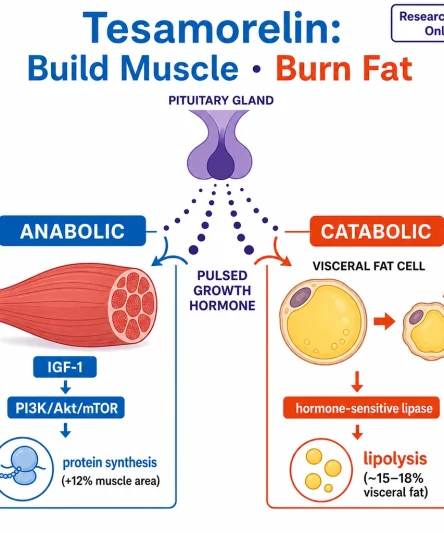
Visceral adipose tissue fell by about 18 per cent in one study and 14 per cent in the other, measured from baseline; against placebo the treatment differences were roughly 31 and 21 square centimetres of cross-sectional area. Subcutaneous fat was largely unchanged, which is the point: visceral fat reduction was compartment-specific rather than general weight loss. Total body weight moved by less than half a kilogram in either direction. Anyone reading this synthetic analogue as a general fat-loss agent is reading past the primary endpoint, and the label does not support that use.
Two findings from the programme deserve attention. First, the effect reversed when treatment stopped, with visceral adipose tissue returning toward baseline within six months, so the benefit was maintenance-dependent. Second, glucose handling worsened modestly in some participants, consistent with growth hormone’s known counter-regulatory effect, and the label carries monitoring language for it. A compound that drives the pituitary gland to release growth hormone will produce that trade in some people.
What Side Effects Does the Approved Label Carry?
Because there is a label, there is a real adverse event table rather than an absence of one, and this is the clearest example in the catalogue of what that difference is worth. The commonest reported side effects are arthralgia, local erythema and pruritus at the injection site, muscle pain, peripheral oedema and paraesthesia. Hypersensitivity reactions including rash and hives were reported and are the reason the label instructs discontinuation on a suspected reaction.
Glucose intolerance is the finding with the most clinical weight. Increases in fasting glucose and in HbA1c appeared in the trials, and the label directs periodic monitoring. Growth hormone excess more broadly produces carpal tunnel symptoms, fluid retention and reduced insulin sensitivity, and this compound sits inside that class effect rather than outside it. Metabolic health, taken as a whole, is not uniformly improved by the drug: visceral fat falls and glucose handling can worsen at the same time.
None of this transfers automatically to the material in this device. The approved product is a specific formulation with a specific manufacturing history, supplied with its own syringes and reconstitution diluent, and its dosage has changed with the formulation: the original 2010 product was 2 mg once daily, Egrifta SV is 1.4 mg, and Egrifta WR, the current United States presentation, is 1.28 mg once daily. This is a research preparation of the tesamorelin peptide, sold for research use only, and the label belongs to the medicine rather than to the compound in general.
How Does It Compare With the Secretagogues?
Tesamorelin is a growth-hormone-releasing factor analogue and acts at the GHRH receptor. Ipamorelin is a ghrelin receptor agonist acting at GHS-R1a, a different receptor on the same cell, and produces appetite stimulation that a releasing-factor analogue does not. The two are frequently listed together as growth hormone options, which flattens the difference that matters most here: one has completed phase three trials with a CT-measured primary endpoint, and one has not been through a registrational trial at all.
On verification, ask for a lot-specific CoA that names the 44-residue sequence with its trans-3-hexenoyl modification, gives purity by HPLC with the gradient described, and reports an accurate mass and counter-ion percentage. A generic HPLC figure without the method behind it is not a purity claim that can be compared between suppliers. Body composition work using this synthetic peptide should record the lot, since a synthetic peptide of nominal purity is defined by what the method could see, since two lots of the same nominal purity can differ in their impurity profile.
Published Literature
The entries below were confirmed against publisher records or PubMed while this page was researched. None of them used a solution held beyond the approved limits.
- Falutz J, Allas S, Blot K, et al. Metabolic effects of a growth hormone-releasing factor in patients with HIV. New England Journal of Medicine. 2007;357(23):2359-2370. PMID: 18057338
- Falutz J, Potvin D, Mamputu JC, et al. Effects of tesamorelin, a growth hormone-releasing factor, in HIV-infected patients with abdominal fat accumulation: a randomized placebo-controlled trial with a safety extension. Journal of Acquired Immune Deficiency Syndromes. 2010;53(3):311-322. PMID: 20101189
- Stanley TL, Feldpausch MN, Oh J, et al. Effect of tesamorelin on visceral fat and liver fat in HIV-infected patients with abdominal fat accumulation: a randomized clinical trial. JAMA. 2014;312(4):380-389. PMID: 25038357
- Stanley TL, Fourman LT, Feldpausch MN, et al. Effects of tesamorelin on non-alcoholic fatty liver disease in HIV: a randomised, double-blind, multicentre trial. Lancet HIV. 2019;6(12):e821-e830. PMID: 31611038
- Baker LD, Barsness SM, Borson S, et al. Effects of growth hormone-releasing hormone on cognitive function in adults with mild cognitive impairment and healthy older adults: results of a controlled trial. Archives of Neurology. 2012;69(11):1420-1429. DOI: 10.1001/archneurol.2012.1970
- Friedman AR, Ichhpurani AK, Brown DM, et al. Degradation of growth hormone releasing factor analogs in neutral aqueous solution is related to deamidation of asparagine residues. International Journal of Peptide and Protein Research. 1991;37(1):14-20. DOI: 10.1111/j.1399-3011.1991.tb00727.x
- Bongers J, Heimer EP, Lambros T, et al. Degradation of aspartic acid and asparagine residues in human growth hormone-releasing factor. International Journal of Peptide and Protein Research. 1992;39(4):364-374. DOI: 10.1111/j.1399-3011.1992.tb01596.x
Frequently Asked Questions
What is the tesamorelin pen?
A preloaded 3ml research autoinjector holding the acylated 44-residue GHRH analogue in solution at 10/3 mg/ml, giving 10mg in the device. No reconstitution is needed. An approved product of this compound exists in the United States as a lyophilized powder, and this research preparation is not that product.
Why does the approved product ship as a powder?
Because the sequence carries the routes that dry material suppresses: Asn8 and Asn35 deamidation, Met27 oxidation, and isoaspartate formation at Asp3 and Asp25. Friedman and colleagues showed in 1991 that asparagine deamidation governs degradation of these analogues in neutral solution, and tesamorelin retained the native asparagine.
How long may the approved solution be kept?
Seven days at 20-25°C for Egrifta WR, in bacteriostatic water with 145 mg of hydroxypropyl betadex per vial. The single-dose Egrifta SV presentation is stricter still: inject immediately after mixing, and neither freeze nor refrigerate the reconstituted solution. Those are the only validated in-solution figures that exist.
What does the device deliver per 0.01 ml increment?
10 multiplied by 3.33 microgram, and 10 multiplied by 33.3 microgram per 0.1 ml. At a 10 mg fill that is 3.33 mg/ml, 33.3 microgram per increment and a molar concentration of 0.649 mM, calculated on the labelled molecular weight of 5135.9 Da.
Is this pen more concentrated than the approved product?
No. Egrifta SV reconstitutes to 4 mg/ml, which is 0.78 mM, and Egrifta WR to 8 mg/ml, which is 1.56 mM. A 10 mg fill in 3 ml is 0.83 times the first and 0.42 times the second. The difference is how long the material stays dissolved, not how concentrated it is.
How does the tesamorelin pen vs vial choice look?
The pen fixes concentration and removes reconstitution error; the vial keeps deamidation and oxidation nearly still until water is added, which is precisely what the approved formulations were designed around. For work finished soon after receipt the pen trade is reasonable, and for a device used across months it is not.
What does tesamorelin pen storage require?
2-8°C, protected from light, never frozen. Light protection is specified on both approved labels and addresses Met27 and the two tyrosines. The freezing prohibition matters because freeze-concentration raises local solute concentration and shifts pH, accelerating deamidation and pushing a helix-forming peptide toward self-association.
What is known about tesamorelin solution stability at this strength?
Nothing specific. No tesamorelin-specific forced-degradation study was located, and the only validated figure anywhere is the seven-day room-temperature limit for a cyclodextrin matrix. The available chemistry comes from class studies of growth-hormone-releasing factor analogues published in 1991 and 1992.
Which degradation products can mass spectrometry find?
Met27 sulfoxide adds a clean 16 Da and is easy to see. Deamidation adds 1 Da, which on a 5135.9 Da molecule needs enough resolution to separate it from the isotope envelope. Isoaspartate adds nothing and stays invisible. Peptide mapping after digestion is what separates all three reliably.
Does ultraviolet absorbance work for this peptide?
Weakly. The sequence contains no tryptophan, so 280 nm absorbance comes from Tyr1 and Tyr10 alone and the extinction coefficient is low. It gives a workable concentration estimate on a stock at this strength but is a poor indicator of purity or of whether degradation has occurred.
Why do the approved formulations contain a surfactant or cyclodextrin?
To keep an amphipathic helix-forming peptide in solution and off surfaces. Egrifta SV carries polysorbate 20 at 0.05 mg per vial; Egrifta WR carries 145 mg of hydroxypropyl betadex. Formal net charge is near +4 with a hydrophobic N-terminal segment, so adsorption and self-association are real risks.
What should be inspected before each draw?
The solution against a white background, looking for haze, fibres or opalescence rather than only particulate, because this peptide has a documented self-association risk and the excipient system here is unpublished. Thioflavin T fluorescence is the direct assay if aggregation is suspected in a stored device.
How does CJC 1295 vs tesamorelin compare on evidence?
They are not close. Tesamorelin has phase 3 trials in 412 and 404 participants, later randomised trials in 50 and 61, and an approved label. CJC-1295 has no comparable human outcome data. Both are GHRH-receptor agonists resistant to dipeptidyl peptidase-IV, but the evidence bases are not equivalent.
What did the liver studies find?
Stanley and colleagues reported in JAMA in 2014 that liver lipid fell 2.0 percent against a rise of 0.9 percent in 50 participants over six months, with visceral fat down 34 cm2 (P = 0.005). Their 2019 Lancet HIV trial in 61 participants reported hepatic fat fraction down 4.1 percent absolute (P = 0.018).
What adverse findings appear in the trials and labelling?
Injection-site reactions, arthralgia, myalgia, oedema, paraesthesia and carpal tunnel syndrome, glucose intolerance and new-onset diabetes at 5 percent against 1 percent, hypersensitivity at about 4 percent, and sustained IGF-1 elevation. Contraindicated in active malignancy, disrupted hypothalamic-pituitary axis function and pregnancy.
What is the anti-doping position?
The WADA 2026 Prohibited List names tesamorelin explicitly under S2, among GHRH and its analogues alongside CJC-1293, CJC-1295 and sermorelin. It is prohibited at all times, in and out of competition, for athletes in any sport governed by the Code. There is no permitted-use threshold.
What is tesamorelin approved to treat?
Reduction of excess visceral abdominal fat in adults with HIV-associated lipodystrophy, marketed as Egrifta. The phase three programme randomised adults to daily injection or placebo for a 26-week main phase, re-randomised them into a 26-week extension, and measured visceral adipose tissue by CT at L4-L5. That is the whole of the FDA-approved indication.
Is this a weight loss drug?
No. Visceral adipose tissue fell about 18 per cent in one study and 14 per cent in the other from baseline, with subcutaneous fat largely unchanged and total body weight moving by less than half a kilogram. The effect was compartment-specific rather than general weight loss, it reversed within six months of stopping, and the label does not support a weight loss use.
What side effects does the approved label list?
Arthralgia, erythema and pruritus where it was given, muscle pain, peripheral oedema and paraesthesia most commonly, with hypersensitivity reactions including rash and hives prompting discontinuation. Increases in fasting glucose and HbA1c appeared in the trials and the label directs periodic monitoring, so insulin sensitivity can worsen while visceral fat falls.
Does the Egrifta label apply to this device?
No. The approved product is a specific formulation with its own manufacturing history, supplied with its own syringes and diluent, and its dosage has changed across formulations: 2 mg once daily in the original product, 1.4 mg for Egrifta SV and 1.28 mg for the current Egrifta WR. This is a research preparation of the tesamorelin peptide supplied for research use only.
How does it differ from ipamorelin?
Different receptors. This synthetic analogue acts at the GHRH receptor; ipamorelin is a ghrelin receptor agonist at GHS-R1a and produces appetite stimulation that a releasing-factor analogue does not. The larger difference is evidentiary: one has completed phase three trials with a CT-measured primary endpoint and one has never been through a registrational trial.
Compliance Statement
The tesamorelin pen is sold exclusively for laboratory research use. It is not a drug, food, or cosmetic product, and it is not a dietary product of any kind. It is not approved by the FDA or any comparable authority for human or veterinary use. This product is not intended to diagnose, treat, cure, or prevent any disease. It must not be given to humans or animals. Purchase is restricted to qualified researchers and institutions operating within applicable laws. All handling is the responsibility of the purchasing laboratory.


Reviews
There are no reviews yet.