

Tesamorelin and Cellular Signaling: How a GHRH Analog Drives Anabolic Growth and Catabolic Fat Metabolism
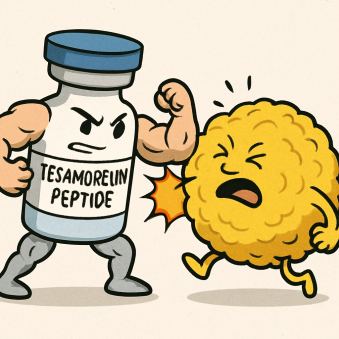
Tesamorelin is a stabilized 44–amino-acid analog of growth hormone-releasing hormone (GHRH) studied for how it signals through pituitary cells. This research-use-only review traces its two-sided biology: an anabolic arm running through IGF-1 and the PI3K/Akt/mTOR pathway to support muscle growth, and a catabolic arm that activates lipolysis in visceral fat — two effects from one peptide, in published in-vitro and clinical models.
Research-use-only disclaimer: Tesamorelin supplied as a research chemical is intended strictly for in-vitro and laboratory research use and is not intended for human or veterinary use. Tesamorelin is separately approved in some jurisdictions (as Egrifta) for a specific medical indication; that clinical context is cited here for mechanism only and is not a dosing recommendation. Nothing here is medical advice.

TL;DR
Tesamorelin is a DPP-IV-resistant, 44–amino-acid GHRH analog that binds pituitary GHRH receptors (Gs→cAMP→PKA) to boost pulsatile GH and downstream IGF-1. Its anabolic arm drives PI3K/Akt/mTOR muscle protein synthesis; its catabolic arm activates hormone-sensitive lipase in visceral fat — clinically, ~15–18% visceral-fat reduction over 26 weeks with preserved lean mass. Supplied research-use-only.
Structure: full 44-aa GHRH sequence + trans-3-hexenoyl on Tyr1 (DPP-IV resistance) + amidated C-terminus; half-life ~25–40 min vs ~7–10 min for native GHRH.
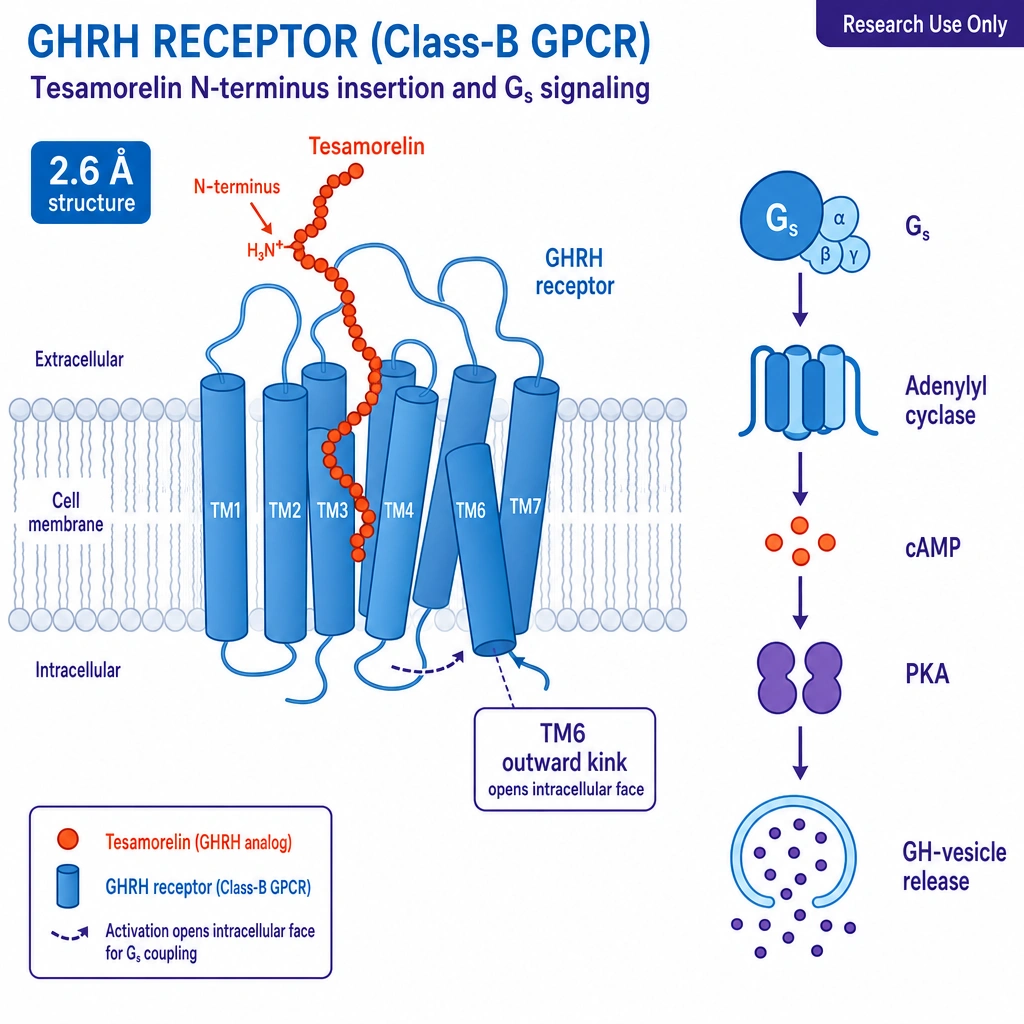
Receptor: class B GPCR; 2.6 Å cryo-EM shows a TM6 outward kink opening the Gs pocket, raising cAMP.
GH/IGF-1 output: ~69% rise in 12-h GH AUC (+366 µg/L·h), ~55% larger pulse area, IGF-1 to ~122% of baseline — with pulsatility and insulin sensitivity preserved short-term.
Anabolic: IGF-1 → PI3K/Akt/mTORC1 → muscle protein synthesis; ~+12.1% muscle area reported, with lean body mass preserved.
Catabolic: GH-driven hormone-sensitive lipase → visceral-fat lipolysis; ~15–18% VAT reduction over 26 weeks, the body composition shift behind its FDA-approved indication.
What Is Tesamorelin and How Is It Structured?
Tesamorelin is a synthetic analog of growth hormone-releasing hormone (GHRH) that reproduces the full 44-amino-acid endogenous sequence, GHRH(1-44), but adds modifications for stability. It is a synthetic peptide built to survive in plasma long enough to reach the anterior pituitary gland and prompt release of endogenous growth hormone. According to González-Sales et al. (2015), whose population model covered the pharmacokinetics and pharmacodynamics of the peptide in HIV-infected patients and healthy subjects, the peptide has a half-life of roughly 25–40 minutes — considerably longer than native GHRH's 7–10 minutes — and pituitary exposure can raise GH synthesis within 30–60 minutes.
The key structural trick is at the N-terminus. As described by Ferdinandi et al. (2007), tesamorelin carries a trans-3-hexenoyl group, written in the source literature as a trans-3-hexenoic acid group, attached to the terminal nitrogen of Tyr1. This modification sterically hinders dipeptidyl aminopeptidase-IV (DPP-IV), blocking cleavage of the first two N-terminal residues (Tyr1–Ala2) that would otherwise rapidly deactivate the peptide. The C-terminus ends in an amidated –Leu44-CONH2, which further contributes to stability. Together these give tesamorelin its longer, more consistent receptor engagement.
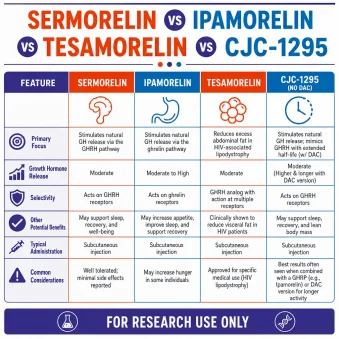
That stability is what separates tesamorelin from the wider family of growth hormone secretagogues it gets grouped with. Sermorelin reproduces only GHRH(1-29) and clears in minutes. CJC-1295 buys its half-life through a different chemistry. Ipamorelin does not touch the GHRH receptor at all, acting instead through the ghrelin receptor. Tesamorelin is the GHRH analog with the deepest clinical dataset behind it, which is why it keeps turning up as the reference compound in peptide therapy and regenerative medicine literature.
How Does Tesamorelin Activate the GHRH Receptor?
Tesamorelin works by binding GHRH receptors (GHRHRs), which are class B G-protein-coupled receptors on the somatotroph cells of the pituitary. The most detailed structural picture comes from the cryo-EM study by Zhou et al. (2020, Nature Communications), which resolved the human GHRHR–Gs complex at 2.6 Å.
In that structure, the peptide's N-terminus (e.g., Tyr1, Asp3) inserts deeply into the transmembrane core, forming hydrogen bonds, salt bridges, and hydrophobic contacts that stabilize the active conformation. The defining activation event is a large outward kink at TM6 at the cytoplasmic face, which opens the intracellular pocket for Gs coupling. Downstream, Gs activates adenylate cyclase to raise cAMP, which activates protein kinase A (PKA); PKA-driven phosphorylation then promotes calcium entry and the exocytosis of GH-containing secretory vesicles. Molecular-dynamics work in the same study indicated that extracellular-domain flexibility aids this process, and truncating that domain abolished signaling.
How Much Does Tesamorelin Raise GH and IGF-1?
Tesamorelin increases growth-hormone output while preserving the body's natural pulsatile rhythm. In the study by Stanley et al. (2011), the peptide produced an "overall increase in GH secretion… comprised of both increased basal GH secretion… and increased average pulse area."
That last point matters: raising GH without disrupting pulse frequency or short-term insulin sensitivity is one reason tesamorelin is studied as a comparatively "physiologic" way to elevate the GH–IGF-1 axis in research models, rather than flooding cells with continuous GH.
The route matters as much as the size of the change. Tesamorelin elevates IGF-1 levels by driving the pituitary rather than by supplying insulin-like growth factor-1 from outside, so the rise stays inside the range the feedback loop can still act on. Across the two-week window Stanley's group measured, glucose homeostasis held.
What Anabolic Signaling Does Tesamorelin Trigger in Muscle?
The anabolic arm runs through IGF-1. By raising GH, tesamorelin increases hepatic and local IGF-1, and IGF-1 is one of the principal anabolic signals to cells — driving hypertrophy and proliferation. According to the same Stanley et al. data and the muscle-focused work of Makimura et al. (2014), this tissue-level IGF-1 may trigger the canonical PI3K/Akt/mTOR cascade that governs muscle hypertrophy and repair.
Mechanistically, IGF-1 binds muscular IGF-1 receptors and recruits PI3K, generating PIP3; PIP3 recruits Akt for PDK1/TORC2 phosphorylation (Thr308/Ser473). Activated pAkt phosphorylates TSC2, relieving mTORC1 suppression via the Rheb GTPase, and mTORC1 then boosts ribosomal biogenesis and translation initiation through 4E-BP1/eIF4E. As reviewed by Yoshida & Delafontaine (2020), this is the core axis of IGF-1-mediated muscle hypertrophy (and its counter-regulation).
IGF-1 receptors are dense in the hippocampus and prefrontal cortex, so the same axis has been probed well outside muscle. In a 20-week controlled trial of 152 adults aged 55 to 87, Baker et al. (2012) reported improved executive function in healthy older adults and in those with amnestic mild cognitive impairment, along with a smaller gain in short-term verbal memory. That trial is cited here as an IGF-1 signaling observation. It is not a claim that cognitive function is a research-chemical application.
What Catabolic Fat-Metabolism Signaling Is Linked to Tesamorelin?
Here is where tesamorelin earns the "catabolic" half of its profile. Restoring GH-axis signaling activates lipolysis, and it does so with a striking preference for visceral adipose tissue (VAT) — the metabolically active fat around the organs.
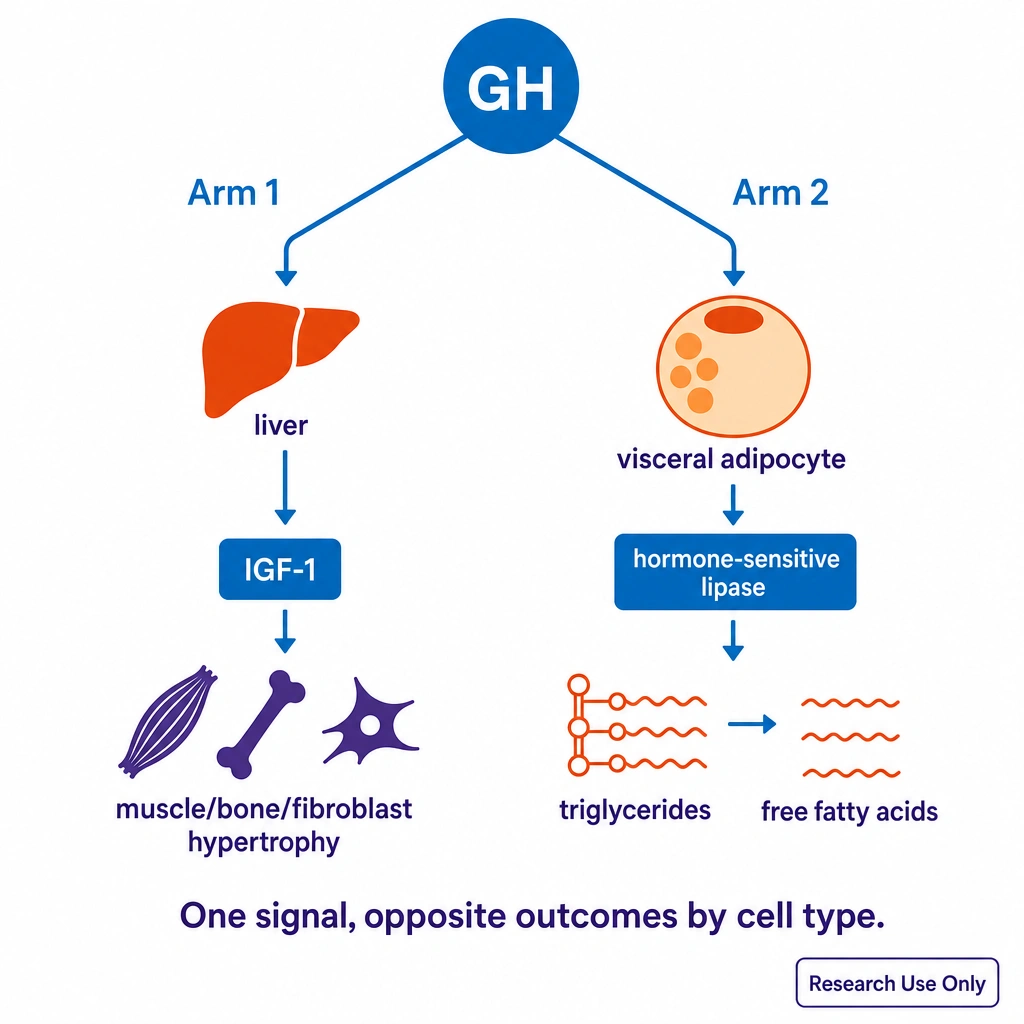
The selectivity has a cellular basis: visceral adipocytes express high levels of GH receptors and respond robustly to restored GH signaling, whereas subcutaneous fat is comparatively less responsive. GH and IGF-1 signaling activates hormone-sensitive lipase (HSL), which hydrolyzes stored triglycerides and mobilizes fatty acids preferentially from those visceral depots. This is the opposite face of the same GH-axis coin that drives muscle anabolism.
The metabolic read-outs move with the fat. The pooled phase-3 analysis by Falutz et al. (2010), run in patients with human immunodeficiency virus (HIV) on antiretroviral therapy, reported waist circumference falling roughly 4–5 cm alongside the VAT loss, with lipid profiles and cholesterol ratios improving in proportion to how much visceral adiposity each participant shed. Later analyses tied that same reduction in visceral adiposity to improved lipid metabolism and lower inflammatory markers. It is the reason abdominal adiposity, rather than scale weight or generic fat loss, is the variable researchers track for a read on metabolic function, and why tesamorelin shows up in metabolic health literature well outside its approved indication.
The trade-offs are documented too. Stimulating the GH axis is not metabolically free: phase-3 data showed more glucose intolerance on tesamorelin than on placebo (HbA1c above 6.5% in 4.5% of participants versus 1.3% at week 26), so insulin resistance is a monitored variable rather than an assumed non-issue, and the same caution carries into research models of type 2 diabetes or metabolic syndrome. The most frequently reported adverse events were arthralgia, myalgia, and injection site reactions, with transaminases followed as part of routine liver monitoring.
The liver has a trial of its own. Stanley et al. (2019, Lancet HIV) randomized 61 adults with HIV-associated nonalcoholic fatty liver disease to tesamorelin or placebo for 12 months and reported roughly a 32% relative reduction in hepatic fat fraction, with less fibrosis progression than placebo. Follow-up transcriptomic work found tesamorelin down-regulated hepatic gene sets tied to inflammation and tissue repair, which puts NAFLD among the metabolic pathways the GH axis reaches directly. Whether shifting lipid oxidation in the liver translates into durable changes in cardiovascular risk factors is still open.
There is a hepatic-lipid angle too. Work by Machado et al. (2003) showed that growth hormone can increase LDL-receptor and HMG-CoA reductase mRNA expression in mesangial cells, illustrating that GH-axis activation reaches cholesterol- and lipid-handling machinery beyond adipocytes — part of why tesamorelin's metabolic footprint is studied at the level of liver and lipid metabolism, not just fat mass.
Anabolic vs. Catabolic: Two Arms, One Peptide
The defining feature of tesamorelin is that a single stimulus to the GH → IGF-1 axis produces opposite-seeming outcomes in different cell types: building muscle while breaking down visceral fat. Body composition moves in two directions at once, which is what makes the peptide a useful model of metabolic regulation rather than a simple fat-loss tool. The table below contrasts the two arms.
| Feature | Anabolic arm (muscle) | Catabolic arm (fat) |
|---|---|---|
| Primary mediator | IGF-1 | Growth hormone (GH) |
| Key pathway | PI3K → Akt → mTORC1 → 4E-BP1/eIF4E | GH receptor → hormone-sensitive lipase |
| Target cells | Myofibers, fibroblasts, osteoblasts | Visceral adipocytes (high GH-R) |
| Net effect | Protein synthesis, hypertrophy | Triglyceride lipolysis, fat mobilization |
| Reported magnitude | ~+12.1% muscle area | ~15–18% VAT reduction (26 wk) |
| Tissue selectivity | Broad anabolic tissues | Visceral > subcutaneous fat |
How is research-grade tesamorelin characterized?
Because tesamorelin is a long, modified 44-mer, identity and purity verification matter especially. Research-grade material is typically confirmed by reversed-phase HPLC for purity and mass spectrometry for identity (including the N-terminal modification and C-terminal amidation), shipped as a lyophilized powder, handled cold, and supplied for laboratory use only. PrymaLab tests every lot in its own laboratory (RP-HPLC purity, LC-MS identity), and certificates can be checked at https://prymalab.net/testing/verify/. Under the third-party testing guarantee, if any independent laboratory finds the wrong compound or less than the stated purity or amount, the order is refunded and the test reimbursed. No specific lot data are asserted in this general reference.
Frequently Asked Questions
What is tesamorelin?
Tesamorelin is a stabilized 44-amino-acid GHRH analog with a trans-3-hexenoyl group on Tyr1 that resists DPP-IV, giving it a longer half-life than native GHRH. It stimulates pituitary GHRH receptors to promote pulsatile GH release and is supplied for research use only.
How much does tesamorelin raise GH and IGF-1?
Stanley et al. reported roughly a 69% increase in 12-hour GH AUC (+366 µg/L·h), ~55% larger pulse area with preserved pulse frequency, and IGF-1 rising to about 122% of baseline (~148→181 µg/L).
Is tesamorelin anabolic or catabolic?
Both. IGF-1 drives anabolic PI3K/Akt/mTOR muscle signaling, while GH activates hormone-sensitive lipase for catabolic visceral-fat lipolysis — clinically ~15–18% VAT reduction over 26 weeks with lean mass preserved.
Why does tesamorelin target visceral fat?
Visceral adipocytes express high GH-receptor levels and respond strongly to restored GH signaling, while subcutaneous fat is less responsive, so the lipolytic effect concentrates in visceral depots and liver fat, which is why the NAFLD trial used hepatic fat fraction as its primary endpoint.
Is tesamorelin approved for human use?
Tesamorelin is approved in some jurisdictions for HIV-associated lipodystrophy. It was FDA-approved in the United States in November 2010 as Egrifta and later reformulated as Egrifta SV. Material sold as a research chemical is for laboratory use only and is not intended for human or veterinary administration.
What is the structural basis of GHRHR activation?
A 2.6 Å cryo-EM structure (Zhou et al., 2020) shows the peptide N-terminus inserting into the transmembrane core and a large TM6 outward kink that opens the intracellular face for Gs coupling and cAMP generation.
References
- González-Sales M, Barrière O, Tremblay PO, et al. Population pharmacokinetic and pharmacodynamic analysis of tesamorelin in HIV-infected patients and healthy subjects. J Pharmacokinet Pharmacodyn. 2015;42(3):287–299. doi:10.1007/s10928-015-9416-2
- Ferdinandi ES, Brazeau P, High K, et al. Non-clinical pharmacology and safety evaluation of TH9507, a human growth hormone-releasing factor analog. Basic Clin Pharmacol Toxicol. 2007;100(1):49–58. doi:10.1111/j.1742-7843.2007.00008.x
- Zhou F, Zhang H, Cong Z, et al. Structural basis for activation of the growth hormone-releasing hormone receptor. Nat Commun. 2020;11(1):5205. PMC7567103
- Stanley TL, Chen CY, Branch KL, Makimura H, Grinspoon SK. Effects of a growth hormone-releasing hormone analog on endogenous GH pulsatility and insulin sensitivity in healthy men. J Clin Endocrinol Metab. 2011;96(1):150–158. PMC3038486
- Makimura H, Murphy CA, Feldpausch MN, Grinspoon SK. The effects of tesamorelin on phosphocreatine recovery in obese subjects with reduced GH. J Clin Endocrinol Metab. 2014;99(1):338–343. doi:10.1210/jc.2013-3436
- Yoshida T, Delafontaine P. Mechanisms of IGF-1-Mediated Regulation of Skeletal Muscle Hypertrophy and Atrophy. Cells. 2020;9(9):1970. doi:10.3390/cells9091970
- Adrian S, Scherzinger A, Sanyal A, et al. The Growth Hormone Releasing Hormone Analog, Tesamorelin, Decreases Muscle Fat and Increases Muscle Area in Adults with HIV. J Frailty Aging. 2019;8(3):154–159. doi:10.14283/jfa.2018.45
- Dehkhoda F, Lee CMM, Medina J, Brooks AJ. The Growth Hormone Receptor: Mechanism of Receptor Activation, Cell Signaling, and Physiological Aspects. Front Endocrinol. 2018;9:35. doi:10.3389/fendo.2018.00035
- Machado MO, Hirata RD, Hirata MH, et al. Growth hormone increases low-density lipoprotein receptor and HMG-CoA reductase mRNA expression in mesangial cells. Nephron Exp Nephrol. 2003;93(4):e134–e140. doi:10.1159/000070237
- NIH LiverTox. Tesamorelin. LiverTox: Clinical and Research Information on Drug-Induced Liver Injury. NBK548730
- Falutz J, Mamputu JC, Potvin D, et al. Effects of tesamorelin (TH9507), a growth hormone-releasing factor analog, in human immunodeficiency virus-infected patients with excess abdominal fat: a pooled analysis of two multicenter, double-blind placebo-controlled phase 3 trials with safety extension data. J Clin Endocrinol Metab. 2010;95(9):4291–4304. doi:10.1210/jc.2010-0490
- Stanley TL, Fourman LT, Feldpausch MN, et al. Effects of tesamorelin on non-alcoholic fatty liver disease in HIV: a randomised, double-blind, multicentre trial. Lancet HIV. 2019;6(12):e821–e830. doi:10.1016/S2352-3018(19)30338-8
- Baker LD, Barsness SM, Borson S, et al. Effects of growth hormone-releasing hormone on cognitive function in adults with mild cognitive impairment and healthy older adults: results of a controlled trial. Arch Neurol. 2012;69(11):1420–1429. doi:10.1001/archneurol.2012.1970
Final disclaimer: This article is an educational research reference. Tesamorelin supplied as a research chemical is for laboratory research use only and is not intended for human or veterinary use. Where clinical data are cited, they describe the separately approved medicinal product and are provided for mechanistic context only — not as dosing guidance. Statements have not been evaluated by the FDA in the research-chemical context.
Mechanistic descriptions combine in-vitro, animal, and clinical observations that may not generalize across models. Always verify the legal status of any research compound in your jurisdiction before purchase or use.
Formats stocked for the compounds in this article
Tesamorelin: Tesamorelin 10mg and Tesamorelin 10mg preloaded 3ml pen. Every listing is supplied for laboratory research use with a batch certificate of analysis.