

Sermorelin vs ipamorelin vs tesamorelin: key differences in receptor, half-life and approval
Sermorelin, ipamorelin and tesamorelin are growth hormone secretagogue peptides that split by receptor: sermorelin and tesamorelin are GHRH analogues acting on the pituitary GHRH receptor, while ipamorelin is a ghrelin mimetic acting on GHS-R1a. PrymaLab supplies Sermorelin 5mg, Ipamorelin 5mg and Tesamorelin 10mg vials for research use.
- Receptors: sermorelin and tesamorelin on the GHRH receptor; ipamorelin and other ghrelin mimetics on GHS-R1a
- Half-lives: minutes for sermorelin and tesamorelin, about 2 hours for ipamorelin, 5.8 to 8.1 days for CJC-1295 with DAC
- Studied for: GH and IGF-1 restoration; abdominal fat in HIV lipodystrophy (tesamorelin); postoperative ileus (ipamorelin)
- Trial designs: tesamorelin in 26-week placebo-controlled phase 3 trials in HIV lipodystrophy; sermorelin in small older-adult trials
- Approval status: tesamorelin (Egrifta) FDA approved; sermorelin (Geref) approved then withdrawn; ipamorelin and CJC-1295 never approved
- Forms and sizes at PrymaLab: Sermorelin 5mg, Sermorelin 10mg, Ipamorelin 5mg, Ipamorelin 10mg, Tesamorelin 10mg
| Feature | Sermorelin | Ipamorelin | Tesamorelin |
|---|---|---|---|
| Receptor | GHRH receptor | GHS-R1a (ghrelin receptor) | GHRH receptor |
| Structure | GHRH (1-29) | Synthetic pentapeptide | GHRH (1-44) with an N-terminal hexenoyl group |
| Half-life | Minutes; cleared rapidly by DPP-4, with no established human figure | About 2 hours (Gobburu 1999) | 26 minutes in healthy subjects and 38 minutes in HIV-infected patients (Egrifta label, subcutaneous) |
| Approval | Approved as Geref, then withdrawn | Never approved | Approved as Egrifta |
| Main research use | GH and IGF-1 in older adults, pediatric GH deficiency | Selective GH release; postoperative ileus | Visceral fat in HIV lipodystrophy; cognition in older adults |
Single-compound detail: sermorelin benefits and sermorelin studies. Vial arithmetic: peptide reconstitution calculator.
Every comparison question in this corner of the catalogue has the same answer underneath it. These four compounds split into two groups that hit two different receptors, and once you know which group a compound belongs to, most of the confusion clears. What is left after that is a spread of half-lives running from ten minutes to eight days, and one compound that actually went through FDA approval while the others did not.
Research-use-only disclaimer: Material supplied by PrymaLab is intended strictly for in-vitro and laboratory research use and is not intended for human or veterinary use in that context. Approval status is discussed below because it is a real difference between these compounds, and it describes separate pharmaceutical products rather than research-grade material. No dosing or administration guidance appears in this article, and nothing here is medical advice.

TL;DR
Two receptors, not four compounds. Sermorelin, tesamorelin and CJC-1295 are GHRH analogues that bind the GHRH receptor. Ipamorelin is a ghrelin mimetic that binds GHS-R1a. That split explains why combining one of each has a real pharmacological rationale and why comparing sermorelin to ipamorelin is comparing two different mechanisms rather than two strengths of the same thing. Half-lives: sermorelin 10 to 20 minutes, tesamorelin about 26 minutes, CJC-1295 without DAC 30 to 60 minutes, CJC-1295 with DAC 6 to 8 days. Approval: tesamorelin is FDA-approved as Egrifta, with a newer F8 formulation, EGRIFTA WR, approved 25 March 2025. Sermorelin was approved as Geref and discontinued in 2008. Ipamorelin and CJC-1295 never completed development. Research use only.
GHRH analogues: sermorelin, tesamorelin, CJC-1295. They bind the GHRH receptor.
Ghrelin mimetic: ipamorelin. It binds GHS-R1a, a different receptor entirely.
Half-life spread: 10 minutes to 8 days across four compounds.
Only FDA-approved compound here: tesamorelin, for HIV-associated lipodystrophy.
Ipamorelin selectivity: no significant ACTH or cortisol release at doses over 200-fold above the ED50 for GH.
Combination rationale: genuine, because two receptors are involved. Comparative evidence for the combination: absent.
Status: research use only.
The receptor split that answers everything
Growth hormone comes out of somatotroph cells in the anterior pituitary, and those cells carry two separate receptors that both increase growth hormone release when activated.
The first is the GHRH receptor. Its natural ligand is growth hormone releasing hormone, a 44-residue peptide from the hypothalamus. Sermorelin, tesamorelin and CJC-1295 are all analogues of that molecule. They are structurally related to each other and to the natural hormone, and they all bind the same receptor.
The second is GHS-R1a, the growth hormone secretagogue receptor. Its natural ligand is ghrelin, a hormone produced mainly in the stomach. Ipamorelin binds here, as do GHRP-2, GHRP-6 and hexarelin. These compounds are not GHRH analogues and are not structurally related to GHRH at all.
So the question "sermorelin or ipamorelin" is not a question about strength or generation. It is a question about which of two receptors you want to engage. That framing is missing from almost every comparison page I have read on this subject, and without it the rest of the discussion becomes a list of adjectives.
Half-life is the second axis
Once you have sorted by receptor, the next thing that separates these compounds is how long they persist, and the spread here is larger than most people expect.
Sermorelin runs roughly 10 to 20 minutes.[1] Tesamorelin is around 26 minutes.[1] CJC-1295 without DAC sits at roughly 30 to 60 minutes.[2] CJC-1295 with DAC is roughly 6 to 8 days.[2]
That last figure is not a typo and it is worth pausing on. Between CJC-1295 without DAC and CJC-1295 with DAC, the same base peptide changes from an hour to a week. Two orders of magnitude, from one chemical modification.
Half-life is not a quality ranking. It determines the shape of the signal. A short half-life produces a discrete pulse that rises and falls. A long half-life produces sustained elevation. Endogenous growth hormone secretion is pulsatile, with most output occurring in bursts, so a compound that flattens that pattern is doing something structurally different from one that adds an extra pulse, whatever the total exposure works out to.
Which shape is preferable depends entirely on the research question, and anyone who tells you longer is simply better has skipped the part where physiology is pulsatile for a reason.
One Enzyme Explains All Three GHRH Analogues
Sermorelin, tesamorelin and CJC-1295 look like three separate design decisions. They are closer to three answers to the same problem.
Native GHRH is cleared extremely fast, with a circulating half-life usually reported in single-digit minutes. The reason is dipeptidyl peptidase-4, an enzyme that clips two residues from the N-terminus of susceptible peptides. GHRH has an alanine at position 2, which is exactly the residue DPP-IV recognises, and removing the first two residues destroys receptor activity.
So every practical GHRH analogue is, at bottom, an attempt to survive that enzyme. The three compounds took different routes:
- Sermorelin truncates to residues 1 to 29, keeping the active region and discarding the rest. It does not solve the DPP-IV problem, which is why its half-life remains short at 10 to 20 minutes.
- Tesamorelin keeps the full 44-residue sequence and attaches a trans-3-hexenoyl group at the N-terminus.[1] That group physically obstructs the cleavage site, which is why tesamorelin outlasts the shorter sermorelin despite being the larger molecule. Size is not what determines persistence here; protection of one specific bond is.
- CJC-1295 substitutes residues within the 1-29 fragment to resist cleavage, and in the DAC form adds albumin tethering on top of that.[2]
Seen this way the family makes more sense than a list of names does. It also explains why the half-life ordering is not what molecular size would predict, and why the DAC modification produces such a disproportionate jump: it stops solving the enzyme problem and starts solving the clearance problem instead, which is a different bottleneck entirely.
There is a practical consequence for analysis, covered further down. Because these compounds are defined by modifications rather than by their backbone sequence, a certificate of analysis that confirms only the peptide backbone has not confirmed which compound you have.
Tesamorelin, the Only Approved One
Tesamorelin is the outlier in this group and it is the one I would point to first when someone asks which of these has real human data.
Structurally it is the full 44-residue GHRH sequence carrying a trans-3-hexenoyl modification at the N-terminus.[1] That modification is not decorative. It protects the molecule against dipeptidyl peptidase-4, the enzyme that clips native GHRH within minutes, and it is the reason tesamorelin survives longer than sermorelin despite being the larger molecule.
The approval, and what it was for
Tesamorelin is FDA-approved for the reduction of excess visceral abdominal fat in adults with HIV and lipodystrophy, marketed as Egrifta and later Egrifta SV.[1][3] That is a narrow indication and it is worth reading precisely: the approval is for visceral adipose tissue reduction in a specific patient population, not for growth hormone deficiency and not for general use.
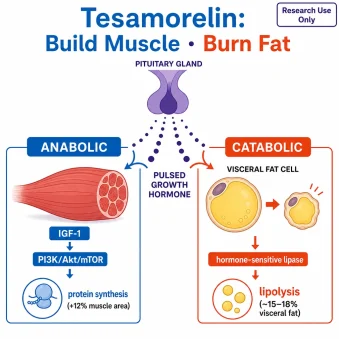
The clinical programme showed significant visceral adipose tissue reduction against placebo, which is what earned the approval.[1] Among the four compounds on this page, that is the only controlled human efficacy result that ended in a marketed product.
The 2025 reformulation
On 25 March 2025 the FDA approved an F8 formulation of tesamorelin, marketed as EGRIFTA WR.[3] The change is a formulation improvement rather than a new molecule: the F8 formulation replaces the earlier F4 formulation sold as Egrifta SV.[3]
I mention this partly because it is current and partly because it illustrates something about the difference between a pharmaceutical product and a research chemical. Somebody spent years and a regulatory submission on reformulating a molecule that was already approved. That is the level of formulation work behind an approved product, and it is not the level of work behind most material in this category.
PrymaLab supplies tesamorelin reference material for laboratory use, which is a separate thing from the approved medicine in every respect that matters legally.
What the tesamorelin trials measured
In the first phase III trial, 412 people with HIV who had accumulated abdominal fat on antiretroviral therapy were randomised to tesamorelin or placebo for 26 weeks. Visceral adipose tissue on CT fell 15.2% with tesamorelin and rose 5.0% with placebo, triglycerides and the total-to-HDL cholesterol ratio improved, and IGF-I rose 81% (Falutz et al. 2007). A second trial in 404 patients ran for 12 months with re-randomisation at six: the visceral fat change at six months was −10.9% against −0.6%, patients who stayed on tesamorelin reached about 18%, and those switched to placebo lost the change quickly (Falutz et al. 2010). Neither trial found significant changes in glucose measures (Falutz et al. 2007) (Falutz et al. 2010).
A post hoc analysis of the two phase III trials divided treated patients by whether visceral fat fell by at least 8%. Responders had larger falls in triglycerides, better adiponectin and preserved glucose homeostasis over 52 weeks compared with non-responders, and the lipid and glucose changes tracked the percentage change in visceral fat (Stanley et al. 2012). Two later trials measured liver fat. A 6-month study of 50 patients found reductions in visceral and liver fat, with a transient rise in fasting glucose at two weeks (Stanley et al. 2014), and a 12-month multicentre trial of 61 people with HIV and non-alcoholic fatty liver disease found a 37% relative fall in hepatic fat fraction against placebo (Stanley et al. 2019). Every one of these trials enrolled people with HIV, so they say little about other populations.
Sermorelin, Approved and Then Withdrawn
Sermorelin is GHRH(1-29), the first 29 residues of the natural hormone.[1] That truncated fragment retains receptor activity, which is a useful fact in itself: the business end of GHRH is at the N-terminus and the remaining fifteen residues are not required for the receptor to fire.
Its half-life is the shortest here at roughly 10 to 20 minutes, and it produces discrete pulses rather than sustained elevation.[1]
Sermorelin was FDA-approved as Geref for pediatric growth hormone deficiency, and the brand was discontinued in 2008.[1] The distinction between a withdrawal for safety and a discontinuation for commercial reasons matters, and this was the latter. A niche pediatric indication with a short-half-life injectable is a difficult product to sustain commercially once recombinant growth hormone became widely available.
So sermorelin sits in an unusual position: a compound with a genuine approval history that is no longer marketed under its original brand. It is the second-best-credentialed molecule on this page and most comparison articles treat it as a cheaper alternative to tesamorelin rather than as a drug that cleared FDA review in its own right.
CJC-1295, and What DAC Actually Does
CJC-1295 is a GHRH analogue built on the same 1-29 fragment as sermorelin, with substitutions that resist enzymatic degradation. It exists in two forms and the difference between them is the largest single variable on this page.
Without DAC
Sometimes sold as modified GRF(1-29). Half-life roughly 30 to 60 minutes.[2] It behaves broadly like a longer-lasting sermorelin, still producing a pulse rather than sustained elevation.
With DAC
DAC stands for Drug Affinity Complex. It is a maleimide group that reacts with a free thiol on serum albumin, covalently tethering the peptide to a protein that circulates for weeks.[2] The peptide is no longer cleared as a small peptide, because it is no longer travelling as one.
The result is a half-life of roughly 6 to 8 days.[2]
That changes the compound's character entirely. A GHRH analogue with a week-long half-life does not add pulses to a pulsatile system, it raises the baseline. Whether that is desirable is a real question and not a settled one, because the physiological pattern it replaces is pulsatile by design.
PrymaLab lists both forms separately, as CJC-1295 DAC and CJC-1295 without DAC, and if you take one thing from this section, it is that those are not two strengths of the same product. Confusing them is the most common error in this entire compound family.
Ipamorelin, and the Selectivity Data
Ipamorelin is the only compound here that is not a GHRH analogue. It binds GHS-R1a, the ghrelin receptor, and it was described in 1998 as the first selective growth hormone secretagogue.[4]
The word selective is doing real work in that description and it is backed by a specific finding rather than a vague claim.
The number that earned the description
Earlier ghrelin mimetics had a problem. GHRP-6 and hexarelin raise growth hormone, and they also raise ACTH, cortisol and prolactin, and GHRP-6 stimulates appetite noticeably. Those are separate effects on the same receptor system, and for a research tool intended to isolate growth hormone signalling they are noise.
Ipamorelin did not release ACTH or cortisol at levels significantly different from those seen after GHRH stimulation, and that held at doses more than 200-fold above the ED50 for growth hormone release.[4]
A 200-fold margin between the dose that does the intended thing and the dose that starts doing an unintended thing is a wide separation, and it is why ipamorelin displaced the earlier ghrelin mimetics as the default choice in this category. Compare it against the GHRP-2 and GHRP-6 comparison, where that separation does not exist.
What ipamorelin does not have
Human efficacy evidence. Its human data are a 1999 pharmacokinetic and pharmacodynamic study, which gave the half-life of about 2 hours (Gobburu 1999), and the development programme ended before approval.[4] Ipamorelin also appeared in a rodent model of postoperative ileus, where the ghrelin receptor's role in gut motility rather than growth hormone was the point of interest.[5]
So the position is: excellent receptor-level characterisation, a clean selectivity profile with a specific number behind it, and no approval. That combination is unusual and it is worth stating plainly rather than letting the selectivity data imply more than it supports.
A receptor that signals without a ligand
The receptor ipamorelin acts on was identified before its natural ligand. Howard and colleagues cloned it in 1996 from the pituitary and hypothalamus of pigs and humans, showed that it was the target of the synthetic growth hormone secretagogues, and proposed that those compounds were mimicking a hormone nobody had yet found (Howard et al. 1996). Kojima's group isolated that hormone from rat stomach three years later and named it ghrelin: a 28-residue peptide that is active only with an n-octanoyl group on serine 3 (Kojima et al. 1999).
The receptor has an unusual property. Holst and colleagues expressed it in COS-7 and HEK293 cells and found strong signalling with no ligand present, measured both as inositol phosphate turnover and with a cAMP-responsive reporter (Holst et al. 2003). Ghrelin and several non-peptide secretagogues raised that signalling further. A substance P analogue previously known as a weak ghrelin antagonist turned out to be a potent full inverse agonist, bringing activity down to the level of cells without the receptor, while the related motilin receptor showed no constitutive activity at all (Holst et al. 2003). The authors concluded that the ghrelin receptor is highly constitutively active and that this may matter for both growth hormone secretion and appetite (Holst et al. 2003). In cell systems that express it, an untreated control therefore already carries receptor signal, and an agonist such as ipamorelin adds to an existing baseline rather than switching on a silent receptor (Holst et al. 2003).
The Other Ghrelin Mimetics, and Why Ipamorelin Displaced Them
Ipamorelin is not the only GHS-R1a agonist in this catalogue, and understanding what it improved on makes the selectivity data more meaningful.
Three earlier compounds share the receptor. GHRP-6 was among the first, and it raises growth hormone alongside a pronounced appetite effect and measurable increases in cortisol and prolactin. GHRP-2 is more potent for growth hormone release with a somewhat smaller appetite effect, but the cortisol and prolactin rises are still present. Hexarelin is the most potent of the three for acute growth hormone release and carries the strongest cortisol and prolactin response, with published reports of receptor desensitisation on continued exposure.
All three work. The issue is that they do several things at once, and if the research question is about growth hormone signalling specifically, the accompanying ACTH, cortisol and prolactin changes are confounders rather than features. An experiment using GHRP-6 cannot cleanly separate a growth hormone effect from a cortisol effect, because both are moving.
That is the problem ipamorelin solved, and it is why the 200-fold separation figure matters rather than being a marketing statistic. It means you can push the growth hormone signal hard without dragging the stress axis along with it, which makes the compound usable as a tool for isolating one variable.
PrymaLab lists GHRP-2, GHRP-6 and hexarelin separately, and the practical selection rule is straightforward: if the study design needs the stress axis to stay still, ipamorelin is the compound with published evidence that it does.
Why Pulsatility Matters
This section exists because "longer half-life is better" is the most common unexamined assumption in this compound family, and it deserves examining.
Endogenous growth hormone is not secreted at a steady rate. It comes out in discrete bursts, with the largest occurring during slow-wave sleep and long troughs between them where circulating levels fall very low. That pattern is produced by the interaction of GHRH driving release and somatostatin suppressing it, and the troughs are as much a part of the system as the peaks.
The reason this matters is that downstream receptors respond to pattern, not only to total exposure. Sustained elevation of a hormone that is normally pulsatile is a well-recognised route to receptor downregulation across endocrinology, and it is why several hormone therapies are deliberately delivered in pulses rather than continuously.
So a compound with a 6 to 8 day half-life is not a more convenient version of a compound with a 20 minute half-life. It produces a categorically different signal. Whether that difference is desirable depends on what is being studied, and I would treat any source that ranks these compounds on half-life alone as having skipped the question.
Why the Combinations Exist
Combinations such as tesamorelin with ipamorelin, CJC-1295 with ipamorelin, and tesamorelin with sermorelin come up often, and the three have different answers.
A GHRH analogue plus ipamorelin
This has a real rationale. Two receptors, two signalling pathways converging on the same cell. Activating both is not the same as activating one twice, and the argument does not depend on any claim about synergy that needs demonstrating: the receptors are simply different.
What has not been published is a controlled comparison showing that the combination outperforms either compound alone under matched conditions. The mechanism is sound. The comparative evidence is missing. Those are separate statements and the industry routinely runs them together.
Two GHRH analogues together
Pairing tesamorelin with sermorelin has a cleaner answer. Both bind the same receptor. Combining two agonists of one receptor is not the same category of proposition as combining agonists of two receptors, and the rationale that justifies the first pairing does not carry over.
There may be arguments based on differing half-lives producing a particular exposure profile. That is a formulation argument, not a receptor argument, and it should be labelled as such.
Side by side
| Sermorelin | Tesamorelin | CJC-1295 (no DAC) | CJC-1295 DAC | Ipamorelin | |
|---|---|---|---|---|---|
| Receptor | GHRH-R | GHRH-R | GHRH-R | GHRH-R | GHS-R1a |
| Class | GHRH analogue | GHRH analogue | GHRH analogue | GHRH analogue | Ghrelin mimetic |
| Structure | GHRH(1-29) | Full 44-mer, hexenoyl-modified | Modified GRF(1-29) | As left, plus maleimide DAC | Pentapeptide |
| Half-life | 10 to 20 min | ~26 min | 30 to 60 min | 6 to 8 days | Short |
| Signal shape | Pulse | Pulse, sustained longer | Pulse | Sustained baseline | Pulse |
| Cortisol / prolactin | Not characteristic | Not characteristic | Not characteristic | Not characteristic | No significant rise to 200x ED50 |
| FDA approval | Geref, discontinued 2008 | Egrifta / Egrifta SV / EGRIFTA WR | None | None | None |
What Research Has Not Established
No published controlled comparison places these four compounds head to head under matched conditions. Every ranking you will find, including the qualitative one implied by this article, is assembled from separate studies with separate designs, populations and endpoints.
No published study demonstrates that a GHRH analogue combined with ipamorelin outperforms either alone in a controlled comparison, despite the receptor rationale being sound.
No human efficacy trial has completed for ipamorelin or for either form of CJC-1295. Tesamorelin's approval covers a specific indication in a specific population, and it does not generalise to other uses. Sermorelin's approval was for pediatric growth hormone deficiency and the brand no longer exists.
What is well established is narrower and more useful than the marketing suggests. The receptor split is real and structural. The half-life figures are measured. Ipamorelin's selectivity margin is a specific published number. Tesamorelin reduced visceral adipose tissue against placebo in the trials that supported its approval. Those four facts survive scrutiny, and most of what surrounds them in this category does not.
How These Are Characterised
All four are synthesised peptides and all four are confirmed the same way: reversed-phase HPLC for purity and mass spectrometry for identity. Two specific points are worth asking about.
For tesamorelin, the trans-3-hexenoyl modification is the difference between tesamorelin and plain GHRH(1-44), and it adds a defined mass. Mass spectrometry should confirm the modified species rather than the unmodified backbone.
For CJC-1295, the presence or absence of DAC is the single most consequential specification on the certificate of analysis, and it changes the mass. If a certificate does not distinguish them, it is not telling you which product you have.
At PrymaLab, every lot is tested in its own laboratory (RP-HPLC purity, LC-MS identity), and certificates can be checked at prymalab.net/testing/verify. Under PrymaLab's third-party testing guarantee, if any independent laboratory finds the wrong compound or less than the stated purity or amount, the order is refunded and the test reimbursed. No lot-specific figures are asserted in this general reference.
Sermorelin vs tesamorelin
| Feature | Sermorelin | Tesamorelin |
|---|---|---|
| Structure | GHRH (1-29), the shortest fully active fragment | GHRH (1-44) with a trans-3-hexenoic acid group on the N-terminus |
| What the modification does | None; cleaved quickly by DPP-4 | The hexenoyl group protects the N-terminus from DPP-4, extending action |
| Half-life | Minutes; cleared rapidly by DPP-4, with no established human figure | 26 minutes in healthy subjects and 38 minutes in HIV-infected patients (Egrifta label, subcutaneous) |
| Trial designs | Small older-adult trials measuring GH, IGF-1, body composition and sleep | Placebo-controlled phase 3 trials in HIV lipodystrophy (Falutz 2007, Falutz 2010); a cognition trial in older adults (Baker 2012) |
| Approval | Geref, approved for pediatric GH deficiency and later withdrawn | Egrifta, approved for excess abdominal fat in HIV-associated lipodystrophy |
| PrymaLab vials | Sermorelin 5mg, Sermorelin 10mg | Tesamorelin 10mg |
The two compounds act on the same pituitary receptor, so the comparison comes down to what the acylation adds. Sermorelin is the bare fragment and is cleaved by DPP-4 within minutes. Tesamorelin carries a hexenoyl group on its N-terminus that blocks that cleavage, giving a longer window of receptor activity and a more sustained IGF-1 rise. In the first phase 3 trial, 412 patients treated for 26 weeks showed a 15.2 percent fall in visceral adipose tissue against a 5.0 percent rise on placebo, and that result is the basis of its approval.
The evidence bases differ in kind as well as in size. Tesamorelin has multi-centre, placebo-controlled phase 3 data and an approved label with a defined population. Sermorelin has a pediatric label that no longer exists in the US market and a handful of small older-adult trials measuring GH, IGF-1, body composition and sleep. Neither has been tested head to head against the other, so claims that one is stronger rest on half-life and potency figures rather than on a comparative trial. PrymaLab supplies both as lyophilized research vials.
Frequently Asked Questions
What is the difference between sermorelin and ipamorelin?
They act on different receptors. Sermorelin is a GHRH fragment that stimulates the pituitary GHRH receptor; ipamorelin is a synthetic pentapeptide that mimics ghrelin at GHS-R1a. Both produce a GH pulse, but ipamorelin was selected for selectivity: in Raun et al. 1998 it released GH in swine without raising cortisol, ACTH or prolactin at GH-releasing doses, and left ACTH and cortisol unchanged at doses more than 200-fold above the ED50 for GH release. Ipamorelin's half-life is longer, about 2 hours against minutes.
What is the difference between sermorelin and tesamorelin?
Both are GHRH analogues acting on the same receptor. Sermorelin is the bare 1-29 fragment and is cleaved by DPP-4 within minutes; tesamorelin is the 1-44 sequence with an N-terminal hexenoyl group that protects it, giving a longer half-life and a more sustained IGF-1 response. Tesamorelin is FDA approved as Egrifta for HIV-associated abdominal fat; sermorelin's pediatric approval was later withdrawn.
Why are sermorelin and ipamorelin combined in research?
Because they act on two different receptors, a GHRH analogue and a ghrelin mimetic given together produce a larger GH pulse than either alone, an effect first shown in humans by Bowers et al. 1990, where submaximal doses of GHRP-6 plus GHRH released GH synergistically in normal men. PrymaLab supplies a CJC-1295 (no DAC) and ipamorelin blend built on the same principle.
Is tesamorelin FDA approved?
Yes. Tesamorelin is approved as Egrifta for the reduction of excess abdominal fat in HIV-infected patients with lipodystrophy, on the strength of two placebo-controlled phase 3 trials with a 26-week efficacy phase. It is not approved for any other use, and research-grade tesamorelin vials, including the Tesamorelin 10mg vial PrymaLab supplies, are not the approved product.
What does DAC do in CJC-1295?
DAC, the drug affinity complex, is a reactive group added to the CJC-1295 peptide that binds covalently to albumin in the blood after injection. Bound to albumin, the peptide escapes kidney filtration and enzyme cleavage, which stretches its half-life to 5.8 to 8.1 days in healthy adults; the DAC-free version has no albumin anchor and is cleared quickly, though no human half-life for it has been published. The cost is a continuous rather than pulsatile GH signal.
What is the difference between sermorelin and ipamorelin?
Different receptors. Sermorelin is a GHRH analogue binding the GHRH receptor. Ipamorelin is a ghrelin mimetic binding GHS-R1a. Both raise growth hormone output by separate routes.
Which of these compounds is FDA-approved?
Only tesamorelin, for HIV-associated lipodystrophy, as Egrifta and Egrifta SV, with the F8 formulation EGRIFTA WR approved on 25 March 2025. Sermorelin was approved as Geref and discontinued in 2008. Ipamorelin and CJC-1295 have no approval.
Why is a GHRH analogue paired with ipamorelin?
Because they act on two different receptors on the same pituitary cell. The rationale is receptor biology rather than marketing. A controlled comparison showing the combination beats either alone has not been published.
What makes ipamorelin selective?
It did not release ACTH or cortisol at levels significantly different from GHRH stimulation, even at doses more than 200-fold above the ED50 for growth hormone release. Earlier ghrelin mimetics such as GHRP-6 and hexarelin do not have that separation.
What is the difference between CJC-1295 with DAC and without?
DAC tethers the peptide to serum albumin, extending the half-life from roughly 30 to 60 minutes to roughly 6 to 8 days. They are different products, not different strengths.
How do the half-lives compare?
Sermorelin 10 to 20 minutes, tesamorelin about 26 minutes, CJC-1295 without DAC 30 to 60 minutes, CJC-1295 with DAC 6 to 8 days.
Are any of these approved for human use as research material?
No. Research-grade material is for in-vitro and laboratory use only, whether or not the same molecule exists as an approved medicine in another formulation.
Related reading
- MK-677 (ibutamoren): mechanism, trials and side effects
- CJC-1295: DAC modification and half-life explained
References
- Comparative reviews of tesamorelin and sermorelin as GHRH analogues, covering structure, half-life and approval history.
- CJC-1295 with and without Drug Affinity Complex: albumin binding and half-life comparisons.
- Theratechnologies. FDA approval of EGRIFTA WR (tesamorelin F8) for excess visceral abdominal fat in adults with HIV and lipodystrophy, 25 March 2025.
- Raun K, et al. Ipamorelin, the first selective growth hormone secretagogue. European Journal of Endocrinology. 1998. PubMed 9849822
- Efficacy of ipamorelin, a novel ghrelin mimetic, in a rodent model of postoperative ileus. PubMed 19289567
Half-life figures are approximate values reported in the secondary literature and vary with formulation, route and assay method. Regulatory status is current as of 19 August 2026 and subject to change; verify against FDA sources before relying on it.
Final disclaimer: This article is an educational research reference. Compounds discussed are sold and studied for laboratory research use only and are not approved by any regulatory authority for human or veterinary use in that form. Statements have not been evaluated by the FDA. Nothing here is medical advice, administration guidance, or a treatment claim.
Approval information relates to specific pharmaceutical products in specific indications and populations, and does not describe or support any use of research-grade material. Always verify the legal status of any research compound in your jurisdiction before purchase or use.
Formats stocked for the compounds in this article
Sermorelin: Sermorelin 6mg preloaded 3ml pen. Tesamorelin: Tesamorelin 10mg preloaded 3ml pen. CJC-1295 (No DAC) + Ipamorelin: CJC-1295 (No DAC) + Ipamorelin 15mg preloaded 3ml pen. Ipamorelin: Ipamorelin 10mg Nasal Spray. Every listing is supplied for laboratory research use with a batch certificate of analysis.