
Description
PrymaLab · Research Use Only
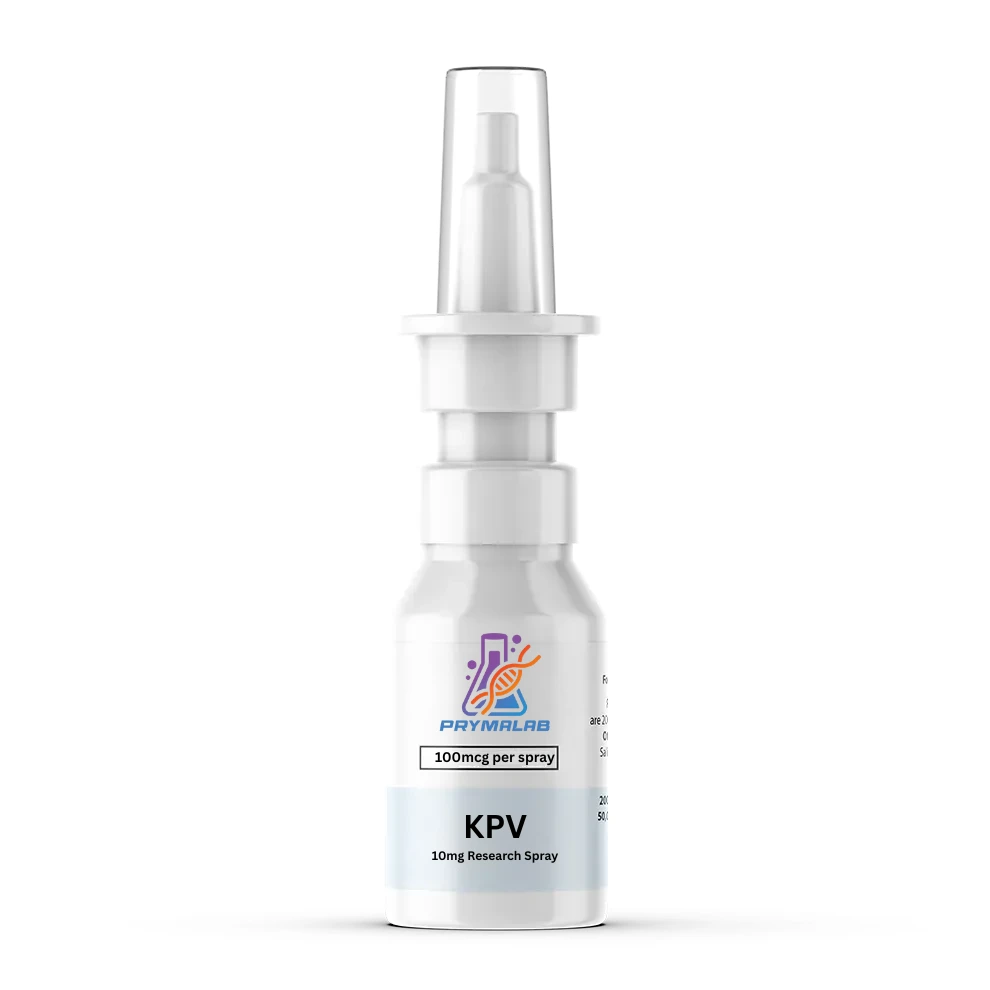
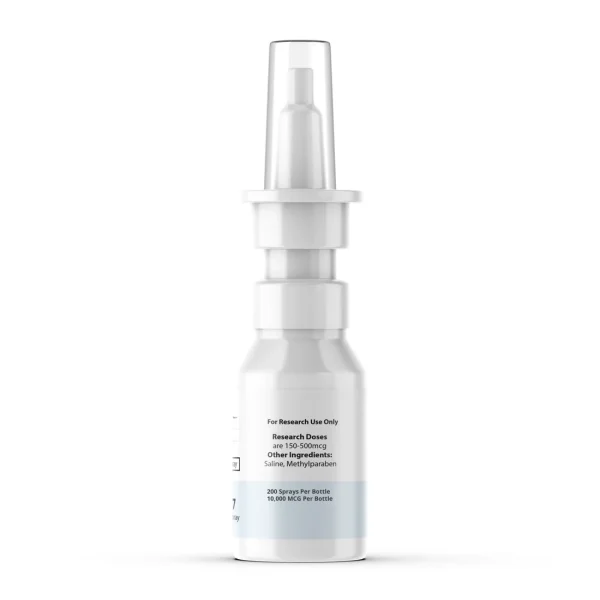
KPV Nasal Spray
Lys-Pro-Val · CAS 67727-97-3 · 342.4 Da
KPV nasal spray supplies the tripeptide Lys-Pro-Val, CAS 67727-97-3, molecular weight 342.4, as a metered aqueous solution. Three residues make it one of the smallest compounds in this catalogue, and it corresponds to the final three residues of alpha-melanocyte stimulating hormone.
Specification Table
| Property | Value |
|---|---|
| Compound | KPV |
| CAS number | 67727-97-3 |
| Molecular formula | C16H30N4O4 |
| Molecular weight | 342.4 g/mol |
| Residue count | 3 |
| Single-letter sequence | KPV |
| Three-letter sequence | Lys-Pro-Val |
| Parent hormone | Alpha-melanocyte stimulating hormone, residues 11 to 13 |
| Central residue | Proline, which restricts backbone geometry and can broaden chromatographic peaks |
| Melanocortin receptor activity | Reported as absent. The fragment lacks the core melanocortin pharmacophore |
| Net charge at neutral pH | Positive. One lysine, no acidic residue |
| Chromophore | None. Concentration cannot be determined by 280 nm absorbance |
| Oxidation-prone residues | None |
| Format | Metered nasal spray, solution state |
| Physical state | Aqueous solution, supplied ready to use |
| Purity | Per lot-specific certificate of analysis |
| Storage | 2-8°C, protected from light. Do not freeze |
| Regulatory status | No approved human or veterinary formulation in any jurisdiction |
What Does the Alpha-MSH Fragment Relationship Mean?
The compound is the tail end of a larger hormone, and understanding what was left behind explains what the fragment is and is not.
Alpha-melanocyte stimulating hormone is a 13-residue peptide. This tripeptide corresponds to its last three residues, positions 11 through 13.
The melanocortin pharmacophore, the core sequence responsible for receptor engagement, sits earlier in the parent and is absent here.
Published work accordingly reports no meaningful melanocortin receptor activity for this fragment, which is the central structural fact about it.
That makes it an unusual case. The fragment retains research interest for reasons unconnected to the receptor family its parent belongs to.
The contrast with Melanotan II elsewhere in this range is instructive, since that compound was engineered to maximise melanocortin engagement and this one has none.
Two compounds derived from the same hormone therefore sit at opposite ends of the receptor question. That is a useful pairing for anyone studying that family.
Citing alpha-MSH literature in support of a claim about this tripeptide requires an argument about which part of the parent was responsible, and that argument is rarely made.
What Does the Central Proline Do?
A proline in the middle of a three-residue peptide has a proportionally larger effect than it would in a longer chain.
Proline is the only proteinogenic residue whose side chain bonds back to the backbone nitrogen, forming a ring that removes the amide hydrogen and restricts the permitted backbone geometry.
In a tripeptide that constraint applies to the central position, so the whole molecule adopts a limited set of shapes rather than sampling freely.
The bond preceding a proline also interconverts between cis and trans geometries slowly enough to happen on a chromatographic timescale.
That produces peak broadening and sometimes an outright split peak. So a chemically pure preparation can produce a chromatogram that looks contaminated.
Raising the column temperature speeds the interconversion and merges a split peak, which distinguishes isomerisation from a genuine second species.
A supplier should be asked what column temperature was used before a broad peak is read as a purity failure on this compound.
The proline also obstructs some proteolytic cleavage, since enzymes handle the constrained residue poorly, which contributes to stability in solution.
The proline has one more consequence that shows up in synthesis rather than in use.
Coupling onto a proline nitrogen is slower than onto an ordinary backbone amine, because the ring makes that nitrogen a secondary rather than a primary amine.
That slows the addition of the lysine at the final step and raises the chance of an incomplete coupling, which is where the deletion impurity described below comes from.
It is a small example of a general pattern in peptide chemistry, where the residue that confers stability is also the residue that complicates manufacture.
The same ring is why this tripeptide holds up better in an aqueous format than its size alone would suggest. Short peptides are usually the least stable things in a catalogue, since two of their three bonds sit adjacent to a terminus and exopeptidases work inward from both ends.
Here the central proline obstructs that approach from the carboxy side, and the result is a molecule that behaves more durably in solution than a Lys-Ala-Val or Lys-Gly-Val of identical length would.
Nobody appears to have measured that comparison directly, though it would take one afternoon and three vials to settle.
How Does 342 Daltons Affect the Nasal Route?
KPV nasal spray holds among the smallest compounds in this range, which places it favourably on the variable that most reliably predicts transnasal transport.
Nasal absorption declines steeply with molecular weight, with the practical transition around 1,000 daltons where paracellular passage becomes inefficient.
At 342.4 daltons this compound sits far below that transition, comparable to glutathione at 307.32 and GHK-Cu at roughly 404.
Charge is the complicating factor. A single lysine with no acidic residue gives a net positive charge at physiological pH, and a negatively charged mucosal surface binds cationic molecules rather than passing them.
That interaction can work either way. Mucoadhesion increases residence time at the surface, which is not purely a disadvantage for a molecule that must cross a barrier.
No intranasal pharmacokinetic data for this compound has been established in print. The size argument therefore remains a prediction.
What the format does deliver is a metered volume, removing the reconstitution arithmetic that a lyophilized vial requires.
How Is KPV Nasal Spray Verified?
KPV nasal spray is the simplest analytical case available in this range, and that simplicity cuts both ways.
Mass spectrometry against 342.4 confirms the molecular weight, but a three-residue compound has little mass to distinguish it from anything else in that region.
Tandem mass spectrometry sequencing has limited material to work with, since a tripeptide fragments into a small number of pieces.
Amino acid analysis after hydrolysis is more informative here than for longer peptides. It returns a lysine to valine ratio that should be one to one, with proline quantified separately.
Reversed-phase retention is early, since a small peptide with one hydrophobic residue has modest affinity for a C18 stationary phase.
A gradient optimised for longer peptides may push this compound close to the void volume, where resolution from salts and small-molecule impurities collapses.
Asking what gradient was used therefore carries more information than the purity number attached to it.
Counterion correction is proportionally large. At 342.4 daltons a single trifluoroacetate at 114 is roughly 25 percent of the associated mass, so net peptide content is a substantial part of the answer.
What KPV Spray Dosage Figures Are Published?
Each figure below was used in a published study, in whichever species and by whichever route that study worked with.
Cell-culture work has generally used micromolar to millimolar concentrations. That is a concentration rather than an amount and does not convert to a delivered figure.
Rodent work has used parenteral and oral routes with amounts in the microgram to milligram per kilogram range depending on the endpoint.
Intranasal figures for this compound are not established in the peer-reviewed record, so no honest conversion from the parenteral literature can be made.
Moving a figure between species calls for allometric scaling on body surface area, not arithmetic on body weight.
A spray introduces variables a vial never carries. Metered volume, concentration, plume geometry and drainage all stand between one actuation and whatever actually lands on the mucosa.
No published figure is a recommendation. They are reference points from studies conducted under specific conditions.
What Impurity Profile Should Be Expected?
A three-residue peptide has a short list of plausible impurities, which makes the list worth stating in full.
Deletion sequences are the first category. A failed coupling gives Pro-Val at roughly 214.3 or Lys-Pro at roughly 243.3, both far lighter than the intended 342.4 and trivially resolved.
Because synthesis builds from the carboxy terminus backwards, the lysine is the last residue added, making Pro-Val the more likely of the two.
Incomplete side-chain deprotection is the second category. The lysine side chain carries a protecting group during synthesis, and residual protection adds mass in a predictable increment.
Racemisation is the third and the hardest to see, since a D-residue substitution leaves the mass unchanged and requires chiral analysis to detect.
Proline is relatively resistant to racemisation during coupling, and valine is sterically hindered. So this particular sequence is less exposed to that failure than many.
Counterion and residual solvent make up the remainder, and both should appear on a certificate as quantified figures rather than as statements of compliance.
For a compound this small the whole panel is inexpensive to run, which makes an incomplete certificate harder to excuse than it would be for a longer peptide.
How Should KPV Nasal Spray Be Stored and Recorded?
Three residues with no oxidation-prone side chain makes KPV nasal spray among the least demanding products in this range to store.
Keep the bottle in the dark between 2 and 8 degrees Celsius, and do not put a solution-state product in a freezer.
There is no cysteine, no methionine, no tryptophan and no asparagine-glycine motif, so the thiol, thioether, photodegradation and deamidation routes all fail to apply.
What remains is slow backbone hydrolysis, which the proline partly obstructs, and microbial growth in an opened aqueous container.
That makes aseptic handling and the opening date the two things worth attending to rather than an elaborate storage regime.
Adsorption is worth a thought at low working concentrations, since the net positive charge promotes binding to negatively charged surfaces including ordinary glass.
Low-binding consumables address that cheaply where the concentration is low enough for it to matter.
Keep a record of the lot, the stated concentration, the opening date, the storage temperature and the actuations drawn for each experiment.
Published Literature
Selected references verified against the publisher record.
- (‘Luger TA, Brzoska T. alpha-MSH related peptides: a new class of anti-inflammatory and immunomodulating drugs. Ann Rheum Dis. 2007;66 Suppl 3:iii52-55.’, ‘https://doi.org/10.1136/ard.2007.079780’)
- (‘Dalmasso G, Charrier-Hisamuddin L, Nguyen HT, et al. PepT1-mediated tripeptide KPV uptake reduces intestinal inflammation. Gastroenterology. 2008;134(1):166-178.’, ‘https://doi.org/10.1053/j.gastro.2007.10.026’)
- (‘Brzoska T, Luger TA, Maaser C, et al. Alpha-melanocyte-stimulating hormone and related tripeptides. Endocr Rev. 2008;29(5):581-602.’, ‘https://doi.org/10.1210/er.2007-0027’)
Frequently Asked Questions
What is KPV nasal spray?
A metered aqueous solution of the tripeptide Lys-Pro-Val, CAS 67727-97-3, molecular weight 342.4. Supplied for laboratory research only. It holds no approval in any jurisdiction.
What is the alpha-MSH relationship?
This tripeptide corresponds to residues 11 through 13 of alpha-melanocyte stimulating hormone, which is a 13-residue peptide. It is the final three residues of that parent.
Does it act at melanocortin receptors?
Published work reports no meaningful activity there. The melanocortin pharmacophore responsible for receptor engagement sits earlier in the parent sequence and is absent from this fragment.
How does that compare with Melanotan II?
They sit at opposite ends of the same question. Melanotan II was engineered to maximise melanocortin engagement, and this fragment has none, despite both deriving from the same hormone.
What does the central proline do?
It restricts backbone geometry. Proline is the only proteinogenic residue whose side chain bonds back to the backbone nitrogen, and in a tripeptide that constraint applies to the central position.
Why can the chromatogram look wrong?
Because the bond preceding a proline interconverts between cis and trans geometries on a chromatographic timescale, producing peak broadening or a split peak. A pure preparation can look contaminated.
How is that distinguished from impurity?
By raising the column temperature, which speeds interconversion and merges a split peak. A genuine second species stays separate regardless of temperature.
How does its size affect nasal transport?
At 342.4 daltons it sits far below the roughly 1,000 dalton transition where paracellular passage becomes inefficient, comparable to glutathione at 307.32 and GHK-Cu at roughly 404.
Does its charge work against it?
Partly. A single lysine with no acidic residue gives a net positive charge, and a negatively charged mucosal surface binds cationic molecules. That mucoadhesion also increases residence time, so the effect is not purely negative.
How large is the counterion correction?
Proportionally large. At 342.4 daltons a single trifluoroacetate at 114 is roughly 25 percent of the associated mass, so net peptide content is a substantial part of what is weighed.
What dosage figures are published?
Cell-culture work at micromolar to millimolar concentrations, and rodent work by parenteral and oral routes in the microgram to milligram per kilogram range. Intranasal figures are not established.
What are the storage requirements?
Refrigerated between 2 and 8 degrees Celsius, kept dark, and never frozen. With no cysteine, methionine, tryptophan or asparagine-glycine motif, the usual degradation routes do not apply.
Compliance Statement
KPV nasal spray is sold exclusively for laboratory research use. It is not a drug, food, or cosmetic product, and it is not a dietary product of any kind. It is not approved by the FDA or any comparable authority for human or veterinary use, no approved human or veterinary formulation exists in any jurisdiction, intranasal pharmacokinetic data for this compound is not established, and amounts cited are figures from published studies in the species and by the route those studies used. This product is not intended to diagnose, treat, cure, or prevent any disease. It must not be given to humans or animals. Purchase is restricted to qualified researchers and institutions operating within applicable laws. All handling is the responsibility of the purchasing laboratory.
Other formats of KPV
KPV is also stocked as KPV (5mg), KPV (10mg) and KPV 5mg/ml preloaded 3ml pen. Each listing states its own quantity and concentration, and the pen and vial comparison explains what changes between formats.









11 reviews for KPV 10mg Nasal Spray