Description
PrymaLab · Research Use Only
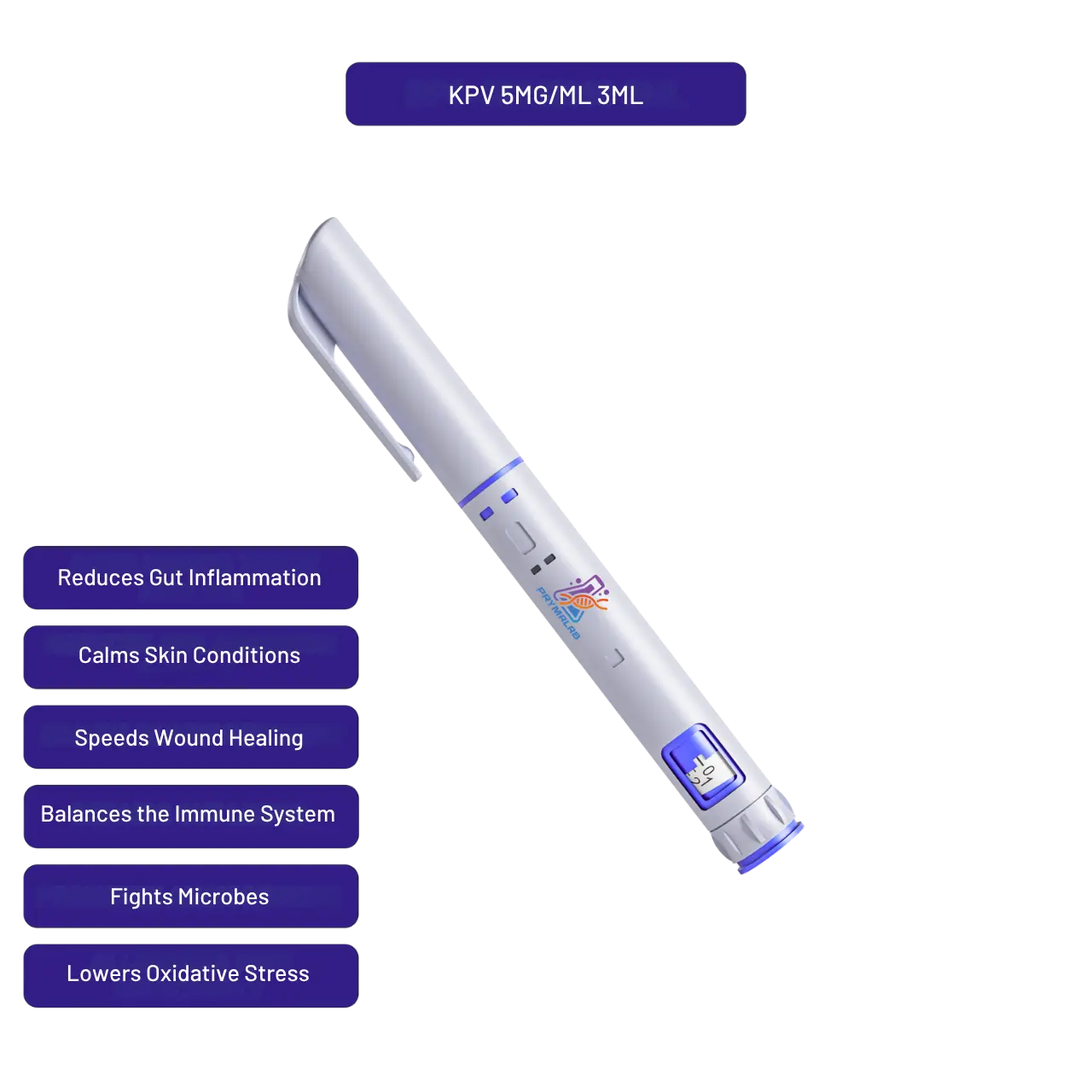
Preloaded Autoinjector | KPV | 3ml Pen | 5mg/ml
Lys-Pro-Val tripeptide in solution · 3ml at 5mg/ml
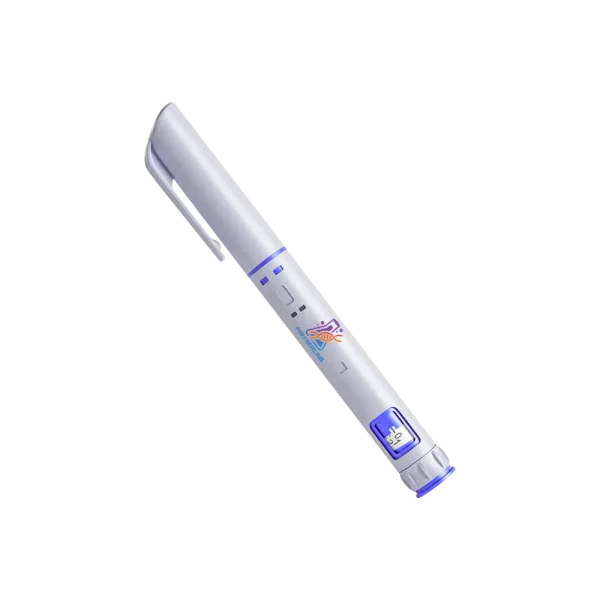
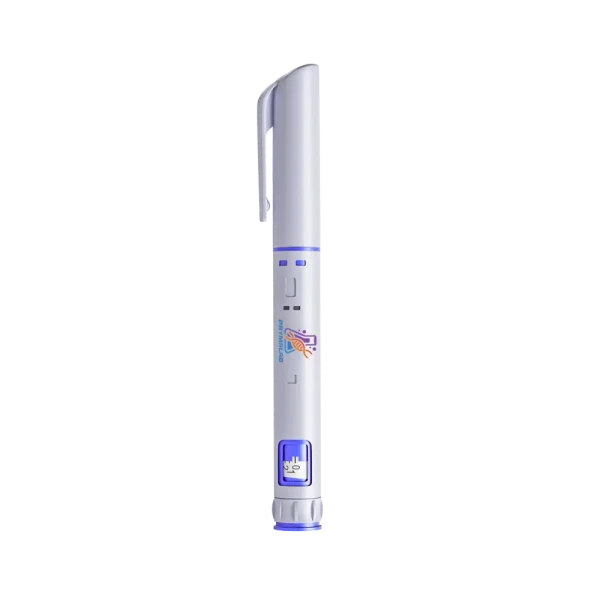
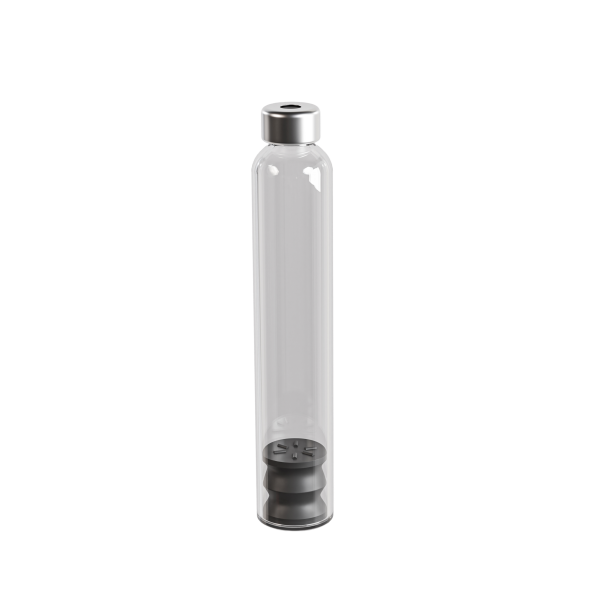
The KPV autoinjector is a preloaded 3ml research device containing the Lys-Pro-Val tripeptide in solution at 5mg/ml, giving 15mg of total peptide and approximately 14.6 millimolar. Among the solution-state devices in this catalogue, a three-residue peptide carrying no oxidation-prone residues is the least demanding to hold stable.
Specification Table
| Property | Value |
|---|---|
| Device format | Preloaded autoinjector pen, glass cartridge |
| Fill volume | 3 ml |
| Concentration | 5 mg/ml |
| Total compound in device | 15 mg |
| Molar concentration | Approximately 14.6 mM |
| Compound | KPV, Lys-Pro-Val |
| CAS number | 67727-97-3 |
| Molecular formula | C16H30N4O4 |
| Molecular weight | 342.43 g/mol |
| Parent molecule | α-MSH residues 11 to 13 |
| Transport route | PepT1 (SLC15A1) |
| Reported downstream target | NF-κB signalling |
| Oxidation-prone residues | None. No cysteine, methionine, tryptophan, tyrosine or histidine |
| Disulfide bonds | None |
| Reconstitution required | None. Supplied as solution |
| Excipient system | Not published on the product record |
| Solution pH | Not published on the product record |
| Solution stability | Not established over device shelf life, though composition is favourable |
| Storage | 2-8°C, protected from light |
| Purity | Per lot-specific certificate of analysis |
| Regulatory status | No approved human or veterinary formulation in any jurisdiction |
Why Is a Tripeptide Comparatively Safe in Solution?
Solution-state supply worries most peptides. The KPV autoinjector is a genuine exception. The reasons read straight off the sequence.
Lys-Pro-Val contains no cysteine whatsoever, so no disulfide bonds exist to scramble or reduce. It contains none of methionine, tryptophan, tyrosine or histidine, which are the residues most vulnerable to oxidative attack. There is essentially no secondary structure to lose. Three residues cannot form a stable fold.
Aggregation, the failure mode that dominates for larger peptides in solution, requires extended hydrophobic surface to drive association. A tripeptide with a charged lysine and a polar backbone has very little of that.
What remains is hydrolysis of the two amide bonds, which proceeds slowly at neutral pH and refrigerated temperature, and the proline in the central position confers some resistance to enzymatic cleavage though not to chemical hydrolysis.
None of this means shelf-life data is unnecessary. It means the prior expectation for this compound in solution is more favourable than for anything else supplied this way in the catalogue.
What Does the Device Concentration Support?
Five milligrams per millilitre is approximately 14.6 millimolar, which sits in a convenient range for cell-based work.
Published KPV work uses concentrations spanning roughly the micromolar range in cell systems. Reaching 10 micromolar from a 14.6 millimolar stock is a 1,460-fold dilution, comfortably achievable in two serial steps with good accuracy.
That compares favourably with the picomolar arithmetic GHK-Cu demands, where reaching the published active range from a concentrated stock requires several steps and accumulates error at each one.
For work needing lower concentrations the device still serves, it simply requires one additional dilution step. For work needing higher concentrations than the device provides, a lyophilized vial reconstituted to a stronger stock is the better route, since concentrating a solution is not practical.
How Should the KPV Autoinjector Be Verified?
Visual inspection is less informative for the KPV autoinjector than for the copper-containing devices, because a colourless solution gives no colour cue to degradation. That places more weight on the other checks.
Before each draw, inspect for particulate and haze against light and dark backgrounds in turn. Clarity is the available visual signal and it should be complete.
Gravimetric verification of delivered volume is the substantive check. Actuate onto a tared weighing vessel, record delivered mass, convert using solution density, and repeat across several actuations to capture accuracy against nominal volume and precision between draws. Perform it at the temperature of intended use.
Discard the first actuation after any rest period rather than measuring it, since air ingress and seal relaxation both cause under-delivery on first use.
Where the work is quantitative, periodic concentration confirmation by chromatography is worth considering for a device used over many weeks, since it substitutes measurement for the absent shelf-life data.
Does PepT1 Competition Affect Device Use?
It affects the experiment rather than the device, but it belongs in any discussion of how this compound reaches its target.
PepT1 carries a broad range of di- and tripeptides without strong sequence selectivity. Anything else small and peptidic in the same system competes for transport, and serum-containing media contain peptide fragments that qualify.
For a single-component device this is simpler than for a blend, since the only competing peptides are whatever the assay medium contributes rather than three other deliberately added compounds. A device delivering only KPV avoids the transporter competition that a four-component blend introduces.
That is a genuine advantage of the single-compound format for mechanism work. Where the research question concerns PepT1-mediated uptake specifically, a preparation containing one transportable peptide is the cleaner tool.
Serum-free or defined-medium conditions reduce the background further, and where serum is required its batch becomes a variable worth recording.
What Concentration Range Does the Literature Use?
Matching the device concentration to the published work is worth doing deliberately rather than by default, and the numbers make the exercise straightforward.
Published cell work with KPV generally operates in the micromolar range. The device holds approximately 14.6 millimolar, so reaching 10 micromolar requires roughly a 1,460-fold dilution and reaching 1 micromolar roughly 14,600-fold.
Two serial steps of about 40-fold each, or one of 100-fold followed by one of about 15-fold, cover the first case comfortably. The second needs three steps or two larger ones, and each additional step adds pipetting error.
Working from a written dilution scheme rather than improvising at the bench is worth the two minutes it takes. Serial dilutions performed from memory are where concentration errors originate, and a factor-of-ten mistake in a three-step scheme is easy to make and hard to detect afterward.
Where the design needs concentrations far below the micromolar range, preparing an intermediate stock and storing it briefly is preferable to a long chain of transfers on the day.
What Does the Device Not Solve?
A preloaded format removes preparation variability and leaves everything else exactly as it was. Worth stating, so the format is not credited with more than it delivers.
It does nothing about transporter dependence. A device delivering a precise volume into a system lacking PepT1 delivers precision into a null.
Adsorptive loss occurring downstream remains entirely untouched by any of this. Once drawn, the solution meets whatever plasticware the assay uses. Losses there are unaffected by storage.
Nor does it address the absence of shelf-life data, which applies here as much as to any solution-state format.
What it does address is real. No reconstitution, no dissolution uncertainty, no shear, and no variable interval between preparation and use. That is a meaningful reduction in variance and it is not the whole problem.
Handling the Device in Laboratory Practice
Store at 2-8°C protected from light. The light requirement is precautionary here rather than mechanism-specific, since the compound carries no chromophore and no photosensitive metal.
Allow the device to reach ambient temperature before actuating. Cold solution is more viscous and viscosity affects delivered volume in a spring-driven mechanism, which is the most common avoidable error with pen devices.
Log the device lot, the date it was first actuated, storage conditions and the volume taken at each session. Shelf-life stability is unpublished, so the interval between first use and each later draw remains a variable even here.
Where downstream work involves measuring PepT1 expression or activity, record that alongside, since transport capacity is part of what determines whether the delivered compound reaches its target at all.
A Note on Vehicle Controls
The excipient system in this device is unpublished, which makes a matched vehicle control more important than it would be with a known formulation.
Whatever buffer, tonicity agent or preservative the solution contains enters the assay alongside the peptide. Benzyl alcohol, common in multi-use peptide preparations, is not inert in cell culture at all concentrations.
A vehicle arm requires the same formulation without the active compound, which a supplier may or may not be able to provide. Where they cannot, the fallback is to test the highest planned dilution of the device solution against a known-inactive comparator.
Neither is perfect. Both are better than assuming the excipients sit there doing nothing at all. Both are better than assuming the excipients are silent.
Published Literature
Traced to publisher records or primary indexes. All concern the compound and its transport biology rather than this delivery format, which has no published data.
- Dalmasso G, Charrier-Hisamuddin L, Nguyen HT, Yan Y, Sitaraman S, Merlin D. Gastroenterology. 2008;134(1):166-178.
- Kannengiesser K, Maaser C, Heidemann J, et al. Inflammatory Bowel Diseases. 2008;14(3):324-331. DOI: 10.1002/ibd.20334
- Brzoska T, Luger TA, Maaser C, Abels C, Böhm M. Endocrine Reviews. 2008;29(5):581-602.
- Getting SJ, Perretti M. Trends in Pharmacological Sciences. 2000;21(9):327-329.
- Daniel H. Annual Review of Physiology. 2004;66:361-384.
Frequently Asked Questions
What is the KPV autoinjector?
A preloaded 3ml research device holding the Lys-Pro-Val tripeptide in solution at 5mg/ml, giving 15mg in total and roughly 14.6 millimolar in the cartridge. No reconstitution needed. Laboratory research use only. No approved human or veterinary formulation exists anywhere in the world.
Why is a tripeptide safer in solution than larger peptides?
The sequence carries none of the vulnerabilities that normally cause trouble in solution. No cysteine, so nothing to scramble. No methionine, tryptophan, tyrosine or histidine, so oxidation is largely closed off. Three residues cannot fold, so there is no structure to lose.
What about aggregation?
Unlikely for the KPV autoinjector, and the reason is structural. Aggregation requires extended hydrophobic surface to drive association between molecules, and a tripeptide carrying a charged lysine on a polar backbone offers very little of it. The dominant failure mode for larger peptides is a minor one here.
What degradation route does remain?
Hydrolysis of the two amide bonds, proceeding slowly at neutral pH and refrigerated temperature. The proline in the central position confers some resistance to enzymatic cleavage. It offers nothing against chemical hydrolysis, which is an entirely separate process operating on a different timescale.
What concentrations does the device support?
Roughly 14.6 millimolar in the cartridge. Published KPV work operates at micromolar concentrations in cell systems, so reaching 10 micromolar means a 1,460-fold dilution, comfortably done in two serial steps with good accuracy.
How does that compare with other compounds here?
Favourably, and the contrast with GHK-Cu is instructive. That compound is active at picomolar concentrations, so reaching its published range from a concentrated stock takes several dilution steps with error accumulating at each. The KPV autoinjector needs two steps from cartridge to working concentration.
How should the device be verified?
Gravimetrically, since a colourless solution gives no visual cue to degradation the way a copper-containing one does. Actuate onto a tared vessel, record delivered mass, convert by density, and repeat at the temperature of intended use.
Does a single-compound device avoid transporter competition?
It reduces it. PepT1 carries a broad range of di- and tripeptides without strong sequence selectivity, so any small peptide present competes. A device delivering only KPV avoids the deliberate competition a four-component blend introduces, leaving only whatever the medium contributes.
Is that an advantage for mechanism work?
Yes, materially so. Where the question concerns PepT1-mediated uptake, one transportable peptide beats four. Serum-free conditions reduce background further. Where serum is required, its batch becomes a variable worth recording explicitly.
What should be recorded per session?
Lot number, first-actuation date, storage conditions, and volume taken. Where the downstream work involves PepT1 expression or activity, record that too, since transport capacity determines whether the delivered compound reaches its target at all.
What dilution does the device require?
Published cell work generally operates in the micromolar range. The device holds approximately 14.6 millimolar, so reaching 10 micromolar requires roughly a 1,460-fold dilution and reaching 1 micromolar roughly 14,600-fold, which needs three steps or two larger ones.
Why write the dilution scheme down?
Because serial dilutions performed from memory are where concentration errors originate. A factor-of-ten mistake in a three-step scheme is easy to make and very hard to detect afterward, and the two minutes spent writing it out stops that class of error.
What if very low concentrations are needed?
Prepare an intermediate stock and store it briefly rather than running a long chain of transfers on the day. Each additional transfer adds pipetting error, and the error compounds multiplicatively rather than averaging out across steps.
Why does the unpublished excipient system matter?
Because whatever buffer, tonicity agent or preservative the solution contains travels into the assay alongside the peptide and nothing on the record says what that is. Benzyl alcohol is common in multi-use preparations. It is not inert in cell culture at all concentrations.
What vehicle control is possible?
Ideally the same formulation without the active compound, which a supplier may or may not provide. Where they cannot, test the highest planned dilution of the device solution against a known-inactive comparator. Neither is perfect and both beat assuming the excipients are silent.
Compliance Statement
The KPV autoinjector is sold exclusively for laboratory research use. It is not a drug, food, or cosmetic product, and it is not a dietary product of any kind. It is not approved by the FDA or any comparable authority for human or veterinary use. This product is not intended to diagnose, treat, cure, or prevent any disease. It must not be given to humans or animals. Purchase is restricted to qualified researchers and institutions operating within applicable laws. All handling is the responsibility of the purchasing laboratory.


11 reviews for Preloaded Autoinjector | KPV | 3ml Pen | 5mg/ml