
Description
PrymaLab · Research Use Only
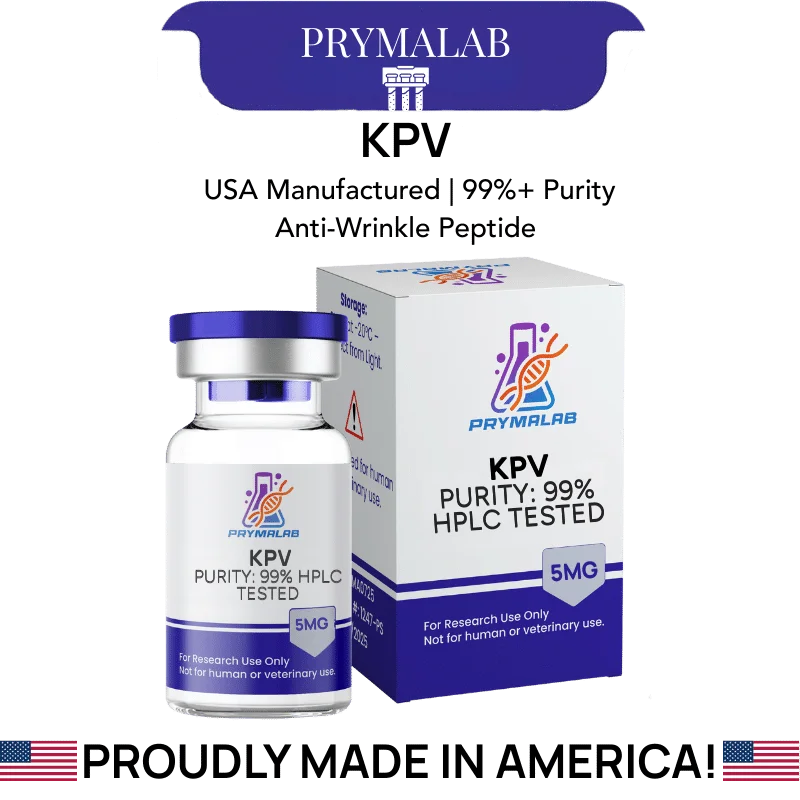
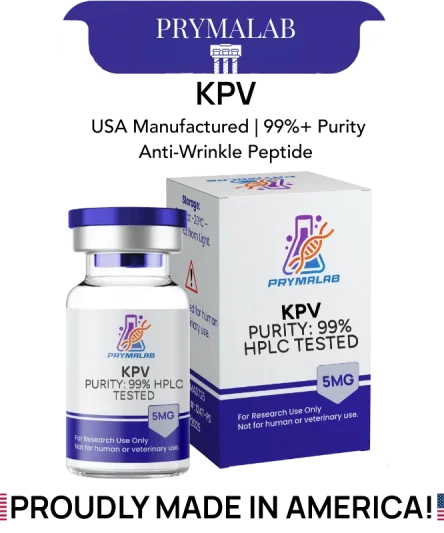
KPV 5mg
Lys-Pro-Val tripeptide · α-MSH(11-13) · CAS 67727-97-3
KPV peptide is the three-residue C-terminal fragment of alpha-melanocyte-stimulating hormone, sequence Lys-Pro-Val, CAS 67727-97-3, molecular weight 342.43. Published work characterises its entry into cells through PepT1, the di- and tripeptide transporter, and reports reduced NF-κB activation as the downstream consequence.
Specification Table
| Property | Value |
|---|---|
| Compound | KPV |
| Vial content | 5 mg lyophilized powder |
| Molar content of vial | Approximately 14.6 µmol |
| Stock at 1 ml diluent | Approximately 14.6 mM |
| Stock at 5 ml diluent | Approximately 2.9 mM |
| Systematic description | Lysine-proline-valine tripeptide |
| Alternative designation | α-MSH(11-13) |
| CAS number | 67727-97-3 |
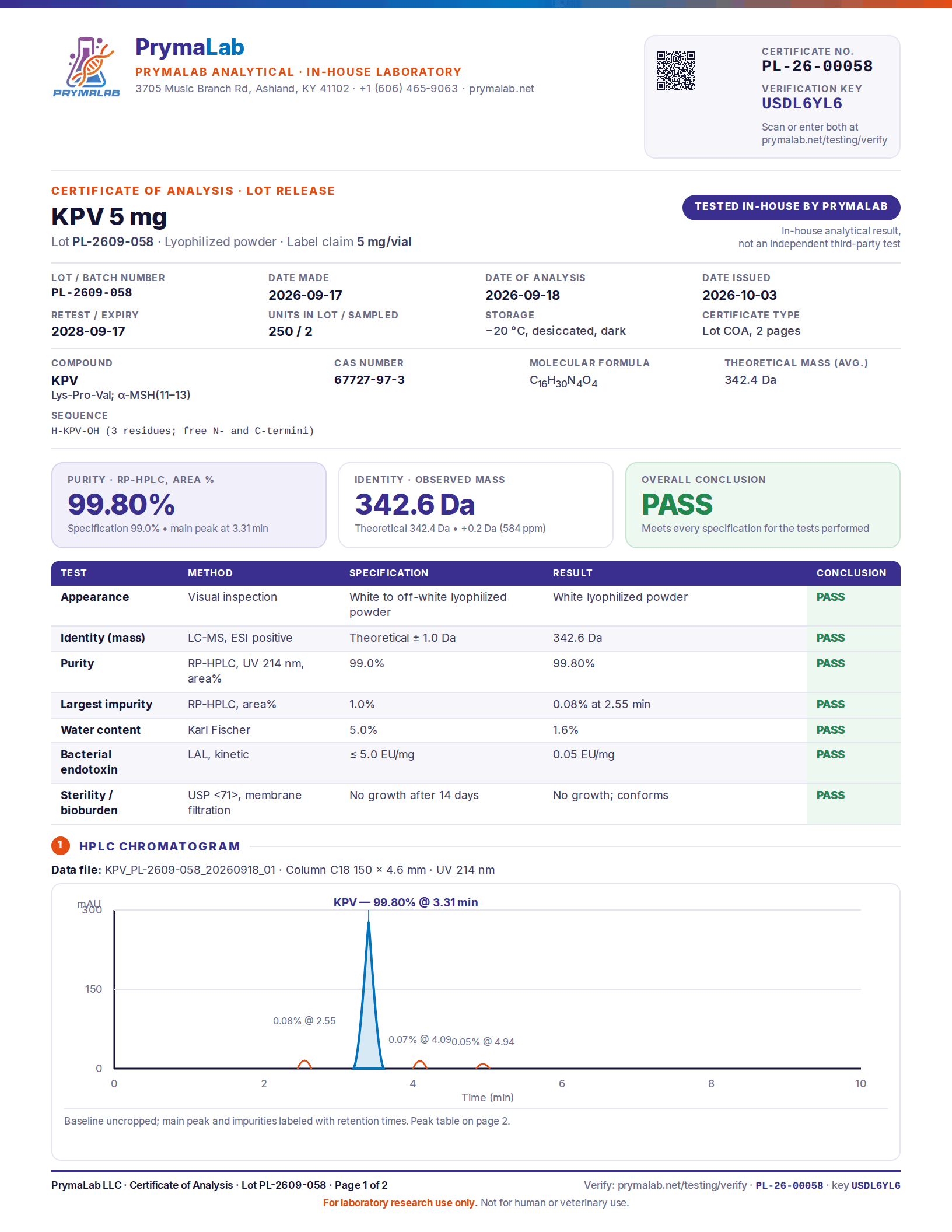
| Molecular formula | C16H30N4O4 |
| Molecular weight | 342.43 g/mol |
| Amino acid sequence | Lys-Pro-Val |
| Residue count | 3 |
| Parent molecule | Alpha-melanocyte-stimulating hormone, residues 11 to 13 |
| Transport route | PepT1 (SLC15A1), the di- and tripeptide transporter |
| Reported downstream target | NF-κB signalling |
| Appearance | White lyophilized cake |
| Purity | Per lot-specific certificate of analysis |
| Solubility | Water soluble. Compatible with bacteriostatic and sterile water |
| Storage, lyophilized | -20°C, protected from light and moisture |
| Storage, reconstituted | 2-8°C, protected from light |
| Regulatory status | No approved human or veterinary formulation in any jurisdiction |
What Is KPV Peptide Used For in Published Research?
Inflammatory signalling, and specifically the NF-κB pathway. The work is unusually well defined for a compound this small.
Dalmasso and colleagues examined KPV uptake and activity across three cell systems: Caco2-BBE and HT29-Cl.19A intestinal epithelial lines, and Jurkat T cells (Dalmasso et al., Gastroenterology, 2008). Using NF-κB luciferase reporter assays alongside immunoblot and quantitative PCR, they reported reduced NF-κB activation and established that the effect depended on PepT1.
Kannengiesser and colleagues took the same compound into two separate murine colitis models and reported reduced colonic damage scores and lower inflammatory cytokine concentrations (Kannengiesser et al., Inflammatory Bowel Diseases, 2008).
Those two papers, published the same year, are the backbone of the KPV literature. Between them they cover the mechanism in cells and the phenotype in animals, which is more than most compounds in this catalogue can claim.
No interventional human data exists. No interventional clinical study of KPV has been published.
Why Does a Three-Residue Peptide Have Activity At All?
It is a fair question to ask. Three residues is barely a peptide, and intuition says a molecule that small should not carry specific biological information.
The answer is that KPV is not an arbitrary tripeptide. It is the C-terminal end of alpha-melanocyte-stimulating hormone, a thirteen-residue hormone with a long-established role in inflammatory and pigmentary signalling. Work across the melanocortin field attributes a substantial part of the anti-inflammatory activity of α-MSH to this C-terminal region specifically, which is why the isolated fragment became interesting.
Brzoska and colleagues reviewed that literature in depth, covering α-MSH and its related tripeptides across in vitro and in vivo systems (Brzoska et al., Endocrine Reviews, 2008).
Studying the fragment rather than the full hormone has a specific advantage. Alpha-MSH engages melanocortin receptors including MC1R, which drives pigmentation. The tripeptide appears to act through a route that does not require classical melanocortin receptor engagement, which separates the inflammatory signal from the pigmentary one.
What Does PepT1 Transport Mean Experimentally?
PepT1, gene name SLC15A1, is a proton-coupled transporter that moves di- and tripeptides across cell membranes. It is expressed constitutively in small intestine and is induced in colonic tissue during inflammation, which is the detail that makes it interesting here.
Daniel reviewed the transporter biology comprehensively (Daniel, Annual Review of Physiology, 2004). Two features matter for experimental design.
First, PepT1 is promiscuous. It carries a very broad range of di- and tripeptides rather than recognising specific sequences, which means any other small peptide in the same system competes for transport. In a blend containing multiple peptides, or a medium containing peptide fragments from serum, KPV uptake may be reduced by competition.
Second, PepT1 expression is not constant. Because it is induced during inflammation, a cell system in an inflamed state transports more KPV than the same system at baseline. That produces an unusual situation: the transporter delivering the anti-inflammatory compound is upregulated by the inflammation itself.
Any design measuring KPV activity should measure or at least consider PepT1 expression, because a null finding may reflect absent transport rather than absent activity.
Working With a Small, Water-Soluble Peptide
KPV is easier to handle than most compounds here, and understanding why saves a good deal of unnecessary caution at the bench.
At 342.43 daltons it is smaller than plenty of conventional small molecules. No cysteine, so no disulfide bonds to misfold. None of methionine, tryptophan or tyrosine is present either, which closes off oxidation as a significant degradation route. Free water solubility means no organic co-solvent enters the picture at any point.
The proline occupying the middle position contributes one further useful property. Proline restricts backbone conformational freedom and confers some resistance to aminopeptidase cleavage, which is part of why the fragment survives long enough to be transported.
Five milligrams works out at roughly 14.6 micromoles. Reconstituted into 1 ml that gives a 14.6 mM stock, comfortable for most designs. The main handling caution is the one that applies to all peptides at low working concentrations: adsorptive loss to container surfaces, which low-binding consumables reduce.
How Does KPV Compare With the Parent Hormone?
Studying a fragment rather than the whole hormone is a deliberate choice, and understanding the trade-off explains why the tripeptide has its own literature.
Alpha-melanocyte-stimulating hormone runs to thirteen residues and engages the melanocortin receptor family: principally MC1R, MC3R, MC4R and MC5R. Those receptors each do several quite different things at once. MC1R drives pigmentation. MC4R influences central circuits. The hormone therefore bundles several activities into one molecule. The hormone therefore carries multiple activities bundled together.
The C-terminal tripeptide separates one of them. Published work attributes a substantial part of the anti-inflammatory activity of the parent hormone to this region, and the isolated fragment appears to act without requiring classical melanocortin receptor engagement.
That separation is the point. A researcher studying inflammatory signalling with the full hormone has pigmentary and central melanocortin activity as confounders. The same researcher using the tripeptide does not.
The trade-off is potency and duration. A three-residue peptide binds less tightly and clears faster than a thirteen-residue hormone, so the concentrations required are higher and the exposure window shorter. Cleaner pharmacology, weaker signal.
What Would a Well-Controlled KPV Experiment Include?
Four elements. The published KPV peptide mechanism dictates every one of them.
PepT1 expression measurement comes first, because the mechanism depends on a transporter that many cell systems lack. Quantitative PCR for SLC15A1 or immunoblot for the protein establishes presence before the experiment.
An NF-kappa-B readout is the direct measure, most conveniently a luciferase reporter carrying kappa-B binding elements, which is the construct used throughout this literature.
A transport-competition arm confirms the route. Excess of a known PepT1 substrate should reduce KPV activity if uptake is transporter-mediated, and no reduction points elsewhere.
A stimulus control establishes the assay window. Without a positive inflammatory stimulus producing measurable NF-kappa-B activation, there is nothing for the compound to suppress and a null finding means only that the system was quiet.
Reconstitution and Storage in Laboratory Practice
Add diluent slowly down the vial wall, then swirl gently until the cake has dissolved completely. Shaking is unnecessary and introduces shear to no purpose. Dissolution is quick.
Bacteriostatic water suits multi-draw work, while sterile water covers single-use preparations. Record whichever was used, since the choice affects working stability downstream.
Hold lyophilized material at -20°C sealed against light and moisture. Reconstituted solution goes to 2-8°C protected from light, and aliquoting before freezing remains sensible practice even though a tripeptide tolerates freeze-thaw better than a longer sequence would.
Record lot number, diluent, volume, concentration and date. Where the work involves a system whose PepT1 expression matters, record that too, because it is part of what determines whether the compound reaches its target.
A Note on Reading This Literature
Two 2008 papers carry most of the weight in the KPV peptide field, and knowing that shapes how the rest should be read.
Secondary sources frequently describe KPV activity in terms broader than either paper supports, extending from the specific NF-kappa-B and PepT1 findings to general claims about inflammatory processes.
The primary work is narrower and better. It establishes a transporter-dependent mechanism in defined cell systems and a phenotype in two murine colitis models. That is a clear, bounded finding.
Reading the primary sources rather than the summaries is worth the effort for this compound specifically, because the gap between what was shown and what is repeated is unusually wide.
Published Literature
Every reference below was confirmed against a publisher record or a primary index before it was included here. Two papers from 2008 form the backbone of this field.
- Dalmasso G, Charrier-Hisamuddin L, Nguyen HT, Yan Y, Sitaraman S, Merlin D. Gastroenterology. 2008;134(1):166-178.
- Kannengiesser K, Maaser C, Heidemann J, et al. Inflammatory Bowel Diseases. 2008;14(3):324-331. DOI: 10.1002/ibd.20334
- Brzoska T, Luger TA, Maaser C, Abels C, Böhm M. Endocrine Reviews. 2008;29(5):581-602.
- Getting SJ, Perretti M. Trends in Pharmacological Sciences. 2000;21(9):327-329.
- Daniel H. Annual Review of Physiology. 2004;66:361-384.
Frequently Asked Questions
What is KPV peptide?
The three-residue C-terminal fragment of alpha-melanocyte-stimulating hormone, Lys-Pro-Val, CAS 67727-97-3, molecular weight 342.43. Published work reports uptake through PepT1 and reduced NF-kappa-B activation downstream. Supplied for laboratory research use only.
What is KPV peptide used for in research?
Inflammatory signalling work centred on the NF-kappa-B pathway, with a literature unusually well defined for a compound of three residues. Published studies span intestinal epithelial and Jurkat T cell lines. Two separate murine colitis models reported reduced colonic damage scores alongside lower inflammatory cytokine concentrations.
Why does such a small peptide have activity?
Because KPV peptide is not an arbitrary tripeptide but the C-terminal end of a thirteen-residue hormone with a long-established role in inflammatory signalling. Work across the melanocortin field attributes a substantial share of that activity to this specific region of the hormone. Studying the isolated fragment separates one activity out from several.
What is PepT1 and why does it matter?
A proton-coupled transporter, gene SLC15A1, carrying di- and tripeptides across the cell membrane. Expression is constitutive in small intestine and induced in colon during inflammation. Published work established that KPV activity depends on it.
Can other peptides interfere with KPV uptake?
Plausibly, because PepT1 is promiscuous. It carries a very broad range of di- and tripeptides rather than recognising specific sequences, so any other small peptide in the same system competes for transport. That applies to blends and to media containing serum-derived peptide fragments.
Why is PepT1 induction significant?
It produces an unusual arrangement where the transporter delivering the anti-inflammatory compound is upregulated by inflammation itself. A cell system in an inflamed state transports more KPV than the same system at baseline, which means transport capacity varies with the condition being studied.
Is KPV easier to handle than most peptides?
Considerably, and the sequence explains why. No cysteine means no disulfide bonds to misfold or scramble during handling. No methionine, tryptophan or tyrosine means oxidation is not a significant route, and free water solubility removes any need for an organic co-solvent.
What does the proline contribute?
Conformational restriction and some resistance to aminopeptidase cleavage. Proline limits backbone flexibility, and its presence in the middle position is part of why the fragment survives long enough in a biological environment to be transported into cells.
Is there human clinical data on KPV?
No interventional clinical study has been published for this compound. The evidence base consists of cell culture work and murine colitis models, drawn principally from two papers appearing in 2008. That is more than many compounds in this catalogue can claim. It is still not human data.
How should the vial be reconstituted?
Five milligrams is approximately 14.6 micromoles, so 1 ml gives a 14.6 millimolar stock. Add diluent slowly down the vial wall and swirl until dissolved, which is usually rapid given water solubility. Record diluent identity, volume and date.
Why study the fragment rather than alpha-MSH?
To separate one activity from several. The full hormone engages multiple melanocortin receptors driving pigmentation and central effects alongside inflammatory signalling. The C-terminal tripeptide appears to act without requiring classical melanocortin receptor engagement, removing those confounders.
What is the trade-off?
Potency and duration. A three-residue peptide binds less tightly and clears faster than a thirteen-residue hormone, so required concentrations are higher and the exposure window shorter. The pharmacology is cleaner and the signal is weaker.
Which melanocortin receptors does alpha-MSH engage?
Principally MC1R, MC3R, MC4R and MC5R. MC1R drives pigmentation, MC4R influences central circuits, and the hormone therefore carries several activities bundled together. Bundling of exactly that kind is what studying the isolated fragment allows a researcher to avoid.
What would a well-controlled experiment include?
Four elements, each one dictated by the published KPV peptide mechanism itself. PepT1 expression measurement, since many systems lack the transporter. An NF-kappa-B readout, usually a luciferase reporter. A transport-competition arm confirming the route. And a stimulus control, establishing that an assay window exists at all.
Why does the stimulus control matter?
Because without a positive inflammatory stimulus producing measurable NF-kappa-B activation, there is nothing for the compound to suppress. A null finding in a quiet system reports that the system was quiet, which is a different statement from the compound being inactive.
Compliance Statement
KPV 5mg is sold exclusively for laboratory research use. It is not a drug, food, or cosmetic product, and it is not a dietary product of any kind. It is not approved by the FDA or any comparable authority for human or veterinary use. This product is not intended to diagnose, treat, cure, or prevent any disease. It must not be given to humans or animals. Purchase is restricted to qualified researchers and institutions operating within applicable laws. All handling is the responsibility of the purchasing laboratory.
Other formats of KPV
KPV is also stocked as KPV 10mg Nasal Spray, KPV 5mg/ml preloaded 3ml pen and KPV (10mg). Each listing states its own quantity and concentration, and the pen and vial comparison explains what changes between formats.










19 reviews for KPV (5mg)