Description
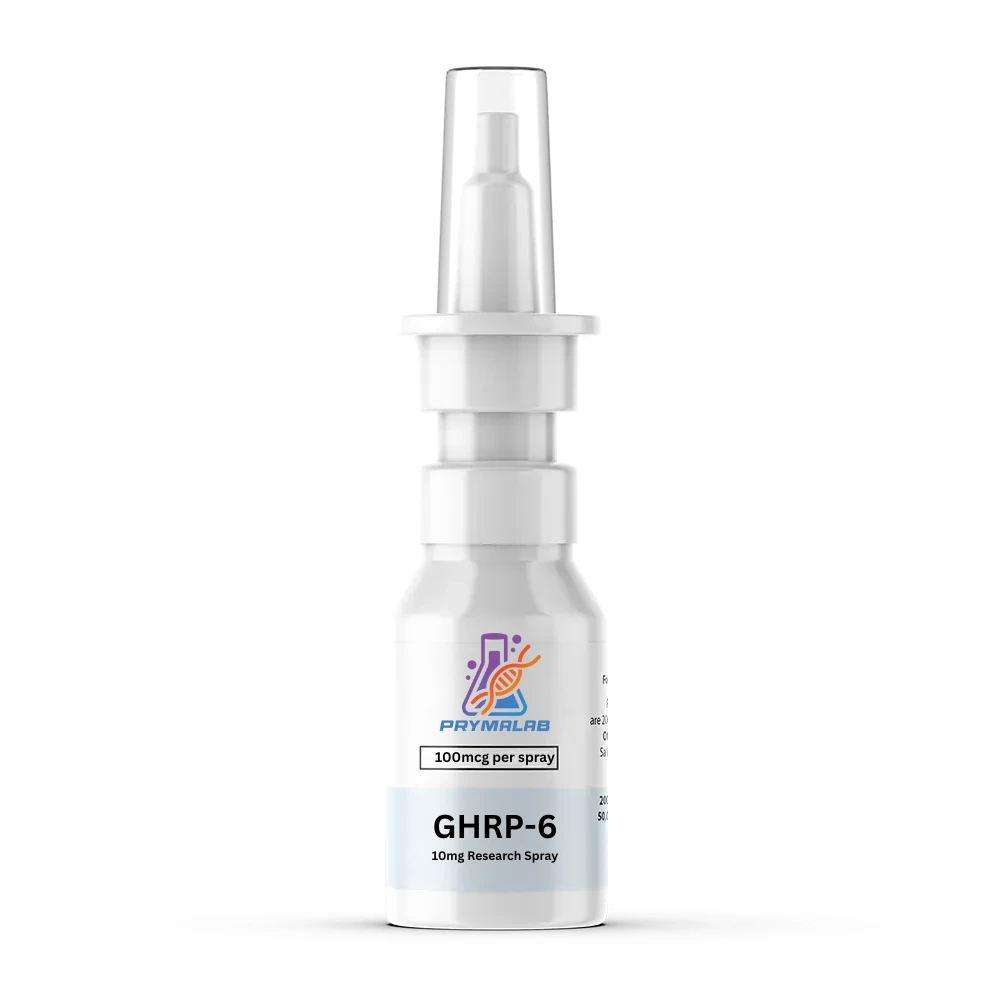
This GHRP-6 nasal spray supplies GHRP-6, also known as SKF-110679, a synthetic hexapeptide nasal spray with the sequence His-D-Trp-Ala-Trp-D-Phe-Lys-NH 2 , and serves as a reference peptide nasal spray with a molecular formula: C46H56N12O6, molecular weight approximately 873.01 Da (molecular weight: 873.0 g/mol), CAS 87616-84-0. It is the prototype of the growth hormone-releasing peptide family, and every other compound in the category of peptide sprays exists because this one worked. Where it came from is genuinely odd and is the most interesting thing about it. Supplied for laboratory research use only.
A growth hormone peptide that came out of opioid chemistry
GHRP-6 was not designed from growth hormone or from growth hormone-releasing hormone. It came from met-enkephalin, an endogenous opioid peptide.
Cyril Bowers and Frank Momany were running structure-activity work on met-enkephalin analogs when they found that certain modified sequences released growth hormone from pituitary tissue. The prototype that became GHRP-6 was characterized by Bowers and colleagues in 1984, described as a new synthetic hexapeptide acting on the pituitary to specifically stimulate growth hormone release, in vitro and in vivo.
Two things about that origin still matter. The sequence bears no resemblance to GHRH, which is why it acts through a completely separate receptor rather than the GHRH receptor. And the receptor it acts on was unknown at the time: GHRP-6 was a ligand in search of a receptor for over a decade. GHS-R1a, a subtype of the GHS-R, was cloned in 1996, and its endogenous ligand ghrelin was not identified until 1999. The peptide preceded the biology it revealed, which is unusual and is a large part of why it remains a standard reference agonist.
The appetite effect, and the hormones that come with it
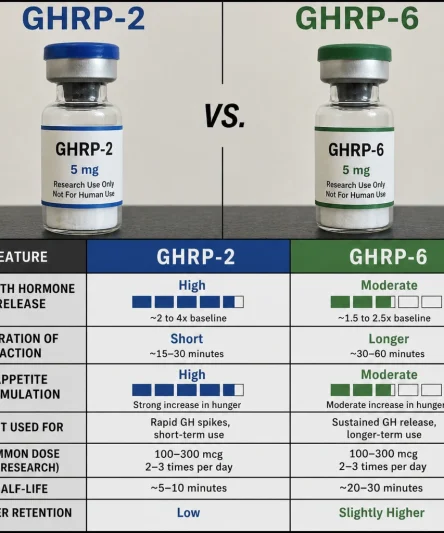
Among the growth hormone secretagogues, GHRP-6 is the one most associated with hunger, and that is not incidental. This synthetic peptide acts at the receptor for ghrelin, formally the growth hormone secretagogue receptor and informally the receptor for the ghrelin hormone, widely nicknamed the hunger hormone, so appetite stimulation is a predictable consequence of engaging that pathway rather than an off-target surprise. In animal work it is one of the more reliable observations attached to this compound, and it is the main behavioural difference between GHRP-6 and the more selective members of the family such as ipamorelin.
The endocrine spillover is the other distinguishing feature. Unlike ipamorelin, GHRP-6 is reported to raise cortisol and prolactin alongside growth hormone, and ACTH sits upstream of the cortisol response. Water retention appears in user reports and is consistent with growth hormone physiology. For an experiment, those additional hormones are confounds rather than side effects: if your readout is influenced by cortisol, you cannot attribute a result to growth hormone signaling without measuring both.
The wider physiology of this axis and its role in hormone regulation runs from the hypothalamus, where GHRH stimulates and somatostatin restrains, through the anterior pituitary gland, where pituitary somatotrophs release human growth hormone, usually written HGH, and on to hepatic production of insulin-like growth factor-1. Endocrinology textbooks treat insulin-like growth factor I (IGF-1) rather than GH as the practical readout because its levels are more stable. Effects attributed to that axis include anabolic protein synthesis, lipolysis and fat metabolism, and shifts in body composition and body fat.
What gets claimed, and what is measurable
Listings for this compound reach well beyond growth hormone. The claims include muscle building, muscle growth and fat loss, weight management, tissue repair, recuperation, tissue regeneration and cell regeneration, wound healing, improved skin elasticity, anti-inflammatory activity, better sleep quality, and anti-aging effects. Some extend into cognitive function, neuroprotective properties, brain health and cognitive research, occasionally arguing that the compound crosses the blood-brain barrier, and file it among nootropics alongside a Selank nasal spray or a MOTS-c nasal spray. Others place it beside SARMs, which are a different class entirely.
Very little of that has controlled human evidence behind it, and none of it is established for research material or claimed here. The measurable questions are narrower: receptor engagement, signaling output, and hormone secretion from a pituitary preparation.
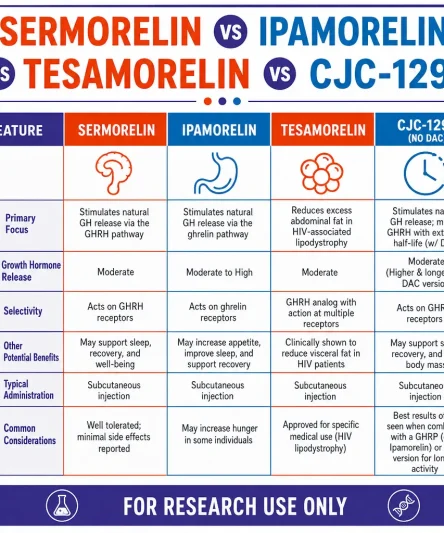
On formats, this material is supplied as a lyophilized peptide requiring reconstitution, usually with bacteriostatic water, and appears elsewhere as a GHRP-6 peptide vial, a GHRP-6 pre mixed peptide, a pre-mixed peptide pen, or inside a GHRP-6 & CJC-1295 DAC blend. A blend cannot tell you what any single component did. Claims that the nasal mucosa route improves bioavailability compared to intravenous administration describe an organism rather than a culture well. Related compounds worth comparing against directly rather than assuming equivalence include GHRP-2, hexarelin, sermorelin and, for a different mechanism entirely, BPC-157. All of it is supplied for laboratory research use as a research chemical.
Why the baseline is the hardest part of this assay
GHS-R1a has the highest known constitutive activity of any G protein-coupled receptor. It signals at roughly 50 percent of its maximal capacity with no agonist present at all, as reviewed in work on GHS-R1a constitutive activity and its physiological relevance.
This is not a footnote, it is the dominant experimental problem with the whole compound class. Your unstimulated well is already producing half the signal the receptor can produce, so the room an agonist has to demonstrate an effect is compressed to the upper half of the range. A real agonist response can therefore look modest, and in a system with high receptor expression the constitutive signal can swamp the ligand-dependent one entirely.
The fix is a second control. Vehicle alone tells you where the constitutive floor sits but not how much of that floor is receptor-dependent. An inverse agonist, which suppresses constitutive signalling rather than merely blocking agonist binding, gives you the true bottom of the range and lets you express an agonist response against a meaningful zero. Structural work including cryo-EM of the active receptor, deposited as PDB 7W2Z and reported in Nature Communications, has started to explain where that basal activity comes from, implicating a polar network and a hydrophobic cluster in both activation and constitutive signaling.
GHRP-6 as a reference agonist
Because it is the prototype, GHRP-6 is used less as an object of study and more as a comparator. If you are characterizing novel ghrelin analogs or a secretagogue, GHRP-6 is the compound your dose-response curve gets compared against, and much of the older literature is calibrated to it.
The readouts follow from Gq coupling: inositol phosphate accumulation and intracellular calcium mobilization in recombinant lines expressing human GHS-R1a, and GH secretion by immunoassay in primary pituitary cultures or somatotroph-derived lines. GHRP-6 also has a well-documented effect on food intake in animal models, which reflects the receptorโs ghrelin biology rather than anything specific to this peptide, and which appears in the literature as a behavioural readout.
One design point for intranasal GHRP-6 research and cell work generally: this peptide carries no stabilizing modification at position 2, unlike the methylated and naphthylalanine-substituted members of the family, so it is the least protease-resistant of the group. In serum-containing medium over a long incubation the effective concentration falls, which makes it a poor choice for extended exposures unless that decline is accounted for.
GHRP-6 nasal spray specifications
Core identity data for this GHRP-6 nasal spray, a foundational growth hormone-releasing hexapeptide. Quote the sequence and CAS number in your methods section rather than the product name.
| Compound | GHRP-6, growth hormone-releasing peptide 6 |
| Sequence | His-D-Trp-Ala-Trp-D-Phe-Lys-NH2 |
| Length | Hexapeptide (six residues) |
| C-terminus | Amidated |
| Molecular formula | C46H56N12O6 |
| Molecular weight | Approximately 873.01 Da |
| Naming | The IUPAC name spells out the full hexapeptide; cite the sequence in methods |
| CAS number | 87616-84-0 |
| Receptor | GHS-R1a (ghrelin receptor), Gq-coupled class A GPCR |
| Origin | Derived from met-enkephalin analog work, Bowers and Momany; prototype characterized 1984 |
| Stabilizing modification | None at position 2; least protease-resistant of the family |
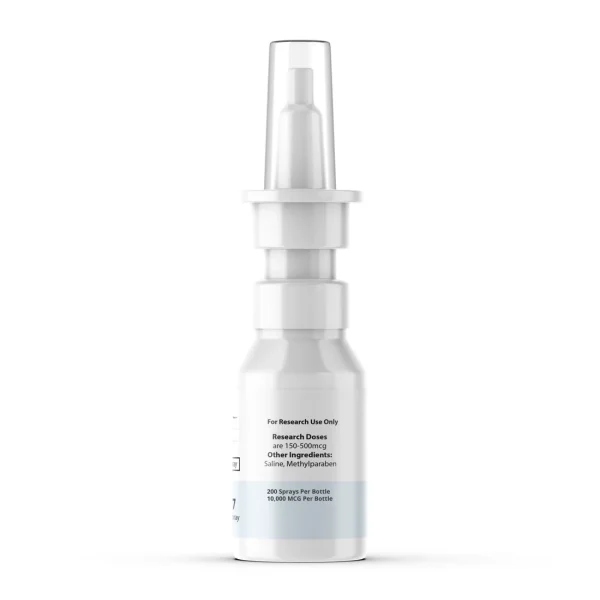
| Format | Metered spray bottle |
| Classification | Research chemical. In-vitro laboratory use only. Not for human or veterinary use. |
GHRP-6 nasal spray storage and handling
This peptide contains two tryptophan residues, one L at position 4 and one D at position 2. Tryptophan is among the most light-sensitive and oxidation-prone amino acids, so protecting the material from light is the specific requirement here rather than generic advice. Amber containers or foil covering, short bench time, and discarding any solution that has discolored are all justified.
The C-terminal amide blocks carboxypeptidase attack, but nothing protects the N-terminal histidine or the internal bonds, and unlike the modified members of this family there is no methylation or bulky substitution at position 2 to slow proteolysis. Treat this as the least stable peptide of the group in a biological matrix and prefer shorter incubations where the design allows.
Otherwise sensible GHRP-6 nasal spray storage is routine: cold, sealed, dark, single-use aliquots rather than repeated freeze-thaw on one container, and low-binding plasticware at the low concentrations receptor assays use.
How research grade GHRP-6 spray is characterized
The verification point specific to this molecule is stereochemistry. Two of the six residues are D-configured, at positions 2 and 5, and D and L amino acids have identical mass, so mass spectrometry alone cannot confirm the configuration is correct. Chiral analysis or a validated synthetic route is what addresses that, and it is a reasonable question to ask any supplier of this compound.
Beyond that, a research grade GHRP-6 spray is characterized by reversed-phase HPLC to ensure high purity and mass spectrometry for identity near 873.01 Da. This material is supplied under the same verification PrymaLab applies across its research peptides, HPLC and MS confirmation plus independent third-party testing. No specific lot figures are asserted here; request the certificate of analysis for the lot you receive.
For the receptor pharmacology of this compound class, see the growth hormone-releasing peptides overview in the PrymaLab Research Library.
Frequently asked questions
What is GHRP-6?
GHRP-6 is a synthetic hexapeptide belonging to the class of oligopeptides, His-D-Trp-Ala-Trp-D-Phe-Lys-NH2, about 873.01 Da, CAS 87616-84-0, and the prototype of the growth hormone-releasing peptide family. It acts at GHS-R1a. Material supplied here is a research chemical for in-vitro laboratory use only.
Where did GHRP-6 come from?
From opioid chemistry. Bowers and Momany derived it from structure-activity work on analogs of met-enkephalin, and the prototype was characterized in 1984. It bears no resemblance to GHRH and acts through a separate receptor, which was not cloned until 1996.
Why does GHS-R1a make agonist assays difficult?
Because it has the highest known constitutive activity of any GPCR, signaling at around 50 percent of maximum with no agonist present. That compresses the window available for an agonist response, so an inverse agonist control is more informative than vehicle alone.
Is GHRP-6 less stable than other peptides in its family?
Yes. It carries no stabilizing substitution at position 2, unlike the methylated tryptophan in hexarelin or the naphthylalanine in GHRP-2. In serum-containing medium over long incubations the effective concentration falls, so shorter exposures are preferable where the design allows.
Is GHRP-6 nasal spray approved for human use?
No. This material is a research chemical for in-vitro laboratory use only and is not intended for human or veterinary use. It is not an approved drug for any indication. Nothing here is medical advice.
Ordering and compliance
Every PrymaLab research compound ships from the United States and is sold research-use-only. This GHRP-6 nasal spray is supplied for in-vitro laboratory research, is not intended for human or veterinary use, is not a drug, supplement, doping, or sports product, and has not been evaluated by the FDA for the research-chemical context. Verify the legal status of any research compound in your jurisdiction before ordering. Certificates of analysis are available on request for the lot you receive.


11 reviews for GHRP-6 10mg Nasal Spray