Description
PrymaLab · Research Use Only
Preloaded Autoinjector | GHRP-6 | 3ml Pen | 10mg
Hexapeptide secretagogue in solution · 3ml at 3.33mg/ml · No reconstitution step
The GHRP-6 pen is a preloaded 3ml autoinjector holding growth hormone-releasing peptide-6 in solution at 3.33 mg/ml, 10 mg of hexapeptide in total, delivered in 0.01 ml graduations of 33.3 µg each. Two tryptophan residues in a six-residue sequence make indole photo-oxidation, rather than deamidation or aggregation, the chemistry that decides how the sealed solution ages between the fill line and the last draw.
Specification Table
| Property | Value |
|---|---|
| Device format | Preloaded autoinjector pen, glass cartridge |
| Fill volume | 3 ml |
| Concentration | 3.33 mg/ml (10 mg in 3 ml) |
| Total compound in device | 10 mg nominal. Base versus salt content per certificate of analysis |
| Molar concentration | Approximately 3.82 mM (3,818 µM) |
| Compound | GHRP-6, growth hormone-releasing peptide-6, development code SKF-110679 |
| CAS number | 87616-84-0, registered to the free peptide base. Acetate salt CAS unverified |
| Molecular formula | C46H56N12O6 |
| Molecular weight | 873.0 g/mol average; 872.44 Da monoisotopic |
| Amino acid sequence | His-D-Trp-Ala-Trp-D-Phe-Lys-NH2 (6 residues, two D-residues, C-terminal amide) |
| Solution appearance | Clear and colourless when intact. Yellowing indicates indole photo-oxidation |
| Reconstitution required | None. Supplied as solution, ready to draw |
| Excipient system | Not published on the product record. Confirm against certificate of analysis |
| Solution pH | Not published on the product record |
| Storage | 2-8°C, protected from light, do not freeze |
| Light sensitivity | High. Two indole side chains absorb near 280 nm and photo-oxidise |
| Solution stability | No published forced-degradation or photostability study exists. Not established over device shelf life |
| Net charge at pH 7 | +2.0 calculated. No isoelectric point below roughly pH 11 |
| Salt form | Acetate or trifluoroacetate. Counter-ion for this pen not published |
| Purity | Per lot-specific certificate of analysis |
| Regulatory status | No approved human or veterinary formulation in any jurisdiction. FDA 503B Category 2 (29 September 2023). WADA prohibited at all times, S2.2.4 |
What Changes When GHRP-6 Ships in Solution?
Dissolving GHRP-6 exposes two tryptophan indoles, an N-terminal histidine and a C-terminal amide to water, oxygen and light for the whole shelf life, while the usual deamidation routes do not apply because the sequence has no asparagine or glutamine.
The two tryptophans dominate. D-Trp2 and Trp4 make a third of a six-residue chain indole, the most oxidation-prone and photo-labile side chain in the proteinogenic set. Peroxide traces from excipients, metal traces leached from glass, and near-UV light all take indole to the same products: hydroxytryptophan (+16 Da), N-formylkynurenine (+32 Da) and kynurenine (+4 Da). Kynurenine-type products are yellow, which makes colour a usable endpoint here. In a lyophilized cake at -20°C the indoles sit in a rigid, nearly anhydrous matrix and the same reactions run at a fraction of the rate.
His1 is the second oxidation site. Metal-catalysed oxidation of histidine gives 2-oxo-histidine, a +16 Da product, and the free N-terminal amine beside it gives a copper or iron ion both an imidazole and an amine to coordinate. The product record does not say whether a chelator is present.
The C-terminal lysinamide is the slow route. Hydrolysis to the free acid, des-amido GHRP-6, is acid- and base-catalysed and slowest near neutral pH. The product is 0.98 Da heavier with one fewer positive charge, so it separates on reversed-phase chromatography and on any modern mass spectrometer.
What the sequence lacks matters as much. No asparagine or glutamine, so no deamidation. No Asp-Gly or Asp-Pro, so no isomerisation or acid-catalysed cleavage. No methionine, cysteine, disulfide or tyrosine. Six residues is too short for the beta-sheet that fibrils need, and nobody has reported GHRP-6 fibrils. Diketopiperazine cyclisation is documented for di- and tripeptides, not for this hexapeptide, so it stays unverified rather than ruled out.
Charge decides where the material goes instead. With no acidic side chain and an amidated C-terminus, the calculated net charge is +2.00 at pH 7.0 and +2.91 at pH 5.0, cationic to roughly pH 11. There is no isoelectric point in the usable range: no pH at which it precipitates, and every pH at which it binds ionised silanols on borosilicate glass and partitions into polypropylene, PVC and silicone lubricant. At 3.33 mg/ml the fractional wall loss inside the cartridge is small; it reaches double-digit percentages once the solution is diluted toward nanomolar assay concentrations in plastic.
None of this has been measured on GHRP-6 itself. No peer-reviewed forced-degradation, photostability or multi-dose formulation study of the compound was located; the chemistry is residue-level inference from Manning et al. 2010 and Kerwin and Remmele 2007. The nearest regulatory precedent points away from a stored solution: the only approved compound in the class, the Japanese pralmorelin (GHRP-2) diagnostic, is a single-use unit reconstituted immediately before use, and the people who formulated it chose not to keep it in water.
Why GHRP-6 Tryptophan Oxidation Makes Light Protection a Mechanism
GHRP-6 tryptophan oxidation is driven by light absorbed at about 280 nm by the two indole rings, which both generate singlet oxygen and react with it, so a cartridge left in bench light degrades by a route a lyophilized cake largely avoids.
The photochemistry is self-accelerating. N-formylkynurenine, the first product, absorbs beyond 320 nm, where borosilicate glass transmits and bench lighting carries measurable output, so each oxidised residue photosensitises the tryptophans still intact. GHRP-6 photo-oxidation would therefore be expected to run slowly and then quickly, with cross-linked dimers appearing as a doubled mass on LC-MS.
Kerwin and Remmele 2007 identified tryptophan as the primary photolabile residue in protein biologics and argued that “protect from light” should be read as a mechanism rather than a default. GHRP-6 light sensitivity follows from that finding, and it has never been measured under controlled illumination.
Concentration and Increment Arithmetic for the GHRP-6 Pen
The GHRP-6 pen holds 10 mg in 3 ml, which is 3.33 mg/ml, 3.82 mM, and 33.3 µg (38.2 nmol) of peptide in each 0.01 ml graduation on a U-100 scale.
The working is short. 10 mg divided by 3 ml is 3.3333 mg/ml; divided by 873.01 g/mol and multiplied by 1,000 that is 3.818 mM, or 3,818 µM. One 0.01 ml graduation carries 33.3 µg, 38.2 nmol; ten graduations, 0.1 ml, carry 333 µg or 382 nmol. The peptide calculator reproduces these figures for any fill. The 10 mg is a salt fill unless the certificate of analysis states net peptide content; counter-ions and bound water commonly put the base content several percent below nominal.
Against the published human pharmacokinetics the pen is small. Cabrales et al. 2013 gave intravenous boluses of 100, 200 and 400 µg/kg to nine healthy men. For a 70 kg subject the lowest of those is 7 mg, or 2.1 ml, 70 percent of the cartridge, and the highest is 28 mg, nearly three pens; one graduation is about 0.5 µg/kg at 70 kg, one two-hundredth of the lowest quantity in that study. Against the receptor pharmacology the pen is enormous: GHSR-1a agonism operates in the low nanomolar range, and reaching 10 nM from 3.82 mM is a 382,000-fold dilution, the same series a 10 mg vial reconstituted into 3 ml would need.
GHRP-6 Pen vs Vial: What Does the Format Suit?
The GHRP-6 pen vs vial question turns on whether the work needs many equivalent draws of a cationic, light-sensitive hexapeptide from one lot over weeks, or a few freshly dissolved samples measured on the day they are made.
The format suits the first case. A lot fixed at 3.33 mg/ml at manufacture removes diluent measurement, incomplete dissolution and transfer loss from every session, and those errors compound fastest for a peptide that sticks to plastic. The preloaded autoinjector category page covers the general case and the six fields to check before ordering.
It suits the second case less well. For a single assay against a reference standard, the lyophilized 10 mg vial reconstituted that morning has spent minutes in water rather than months, so the GHRP-6 solution vs lyophilized comparison favours the dry cake wherever residence time in water is the variable. A vial also lets buffer, pH and chelator be chosen for the assay.
The GHRP-6 pen or vial decision is not unique to this compound, and the pen-versus-vial article sets out the general trade-offs. For GHRP-6 the deciding fact is that no stability study of the solution exists, so a pen used across weeks runs an uncharacterised experiment alongside the intended one.
What the Product Record Does Not State
The product record does not state the excipient system, the solution pH, the counter-ion, the net peptide content or the fill date, and each of the five changes what the 3.33 mg/ml figure means in practice.
Excipients come first because of the indoles. Polysorbates carry peroxide, and peroxide oxidises tryptophan; a preservative such as phenol or benzyl alcohol, common in multi-draw cartridges, enters every assay the solution is added to; a chelator such as EDTA would suppress the metal-catalysed route at His1. Whether any of these is present is unknown.
Solution pH controls two rates. Amide hydrolysis is slowest near neutral, and the histidine imidazole, with a pKa near 6, changes protonation between pH 5 and pH 7, moving the net charge from +2.9 to +2.0 and with it the adsorption behaviour.
The counter-ion and net peptide content decide how much GHRP-6 base is in the 10 mg. The fill date decides how far the degradation clock has already run on arrival. Solution stability over shelf life is the figure most worth having and the one nobody has published for this compound in any formulation. Request all five from the certificate of analysis before quantitative work.
GHRP-6 Pen Storage: What the Indoles Require
GHRP-6 pen storage is 2-8°C in the dark, never frozen, with the device returned to its carton between draws, because the two tryptophans rather than temperature alone set the rule.
Freezing is excluded for a specific reason. As ice forms, solutes concentrate into a shrinking liquid phase whose pH shifts as buffer salts crystallise, and that freeze concentrate accelerates oxidation and drives the peptide onto ice and glass interfaces. A frozen cartridge also risks its seal. GHRP-6 pen refrigeration at 2-8°C avoids both.
GHRP-6 pen shelf life is not published by any manufacturer or pharmacopoeia, because none exists for this compound. The guidance follows from Kerwin and Remmele 2007 and Manning et al. 2010, and the storage and stability article covers the common ground. Record the date of first actuation and cumulative time out of the carton; for this molecule the light log is as informative as the temperature log.
Verifying the Device and Confirming the Contents Are Intact
Inspect the solution against a white background before each draw; intact GHRP-6 solution is clear and colourless, and any yellow tint is the kynurenine chromophore of oxidised tryptophan rather than harmless colour drift.
Ultraviolet absorbance is unusually informative for this peptide. With no tyrosine in the sequence, everything at 280 nm comes from the two indoles, so a drawn sample gives a clean concentration estimate, and a falling A280 with a rising shoulder between 320 and 360 nm is the signature of photo-oxidation. Tryptophan fluorescence, excited at 280 nm and read near 350 nm, drops earlier still.
Mass spectrometry settles what absorbance suggests. Every plausible chemical route on this molecule changes mass: +4, +16 and +32 Da at the tryptophans, +16 Da at histidine, +0.98 Da at the amide, doubled mass for a photo-crosslinked dimer. The mass-silent losses are epimerisation at the D-residues, which nobody has measured, and adsorption, which appears as a shortfall in peak area against a freshly reconstituted vial standard run the same day. Thioflavin T has no use here, since a hexapeptide does not form the fibrils the dye reports.
Allow the device to reach room temperature before actuating; cold, more viscous solution delivers less per stroke through a spring mechanism. Verify delivered volume gravimetrically once per device across five or more strokes.
What Is GHRP 6 and What Does the Literature Report?
GHRP-6 is a synthetic met-enkephalin-derived hexapeptide, coded SKF-110679, that Bowers described in 1984 as a growth hormone secretagogue acting on the pituitary by a route separate from GHRH, fifteen years before ghrelin, the natural ligand of its receptor, was identified in 1999.
The short answer to what is GHRP 6 at the receptor: an agonist at the growth hormone secretagogue receptor 1a, GHSR-1a, signalling through Gq and phospholipase C to raise intracellular calcium in somatotrophs and release GH independently of, and synergistically with, GHRH. A second target is established: Bodart et al. 2002 showed the cardiovascular action of GHRPs in the perfused heart runs through CD36 and disappears in CD36-null mice.
The human record is four short physiology studies. Ilson et al. 1989 gave the compound to healthy subjects for the first time, as SKF-110679, and recorded selective GH release. Bellone et al. 1995 reported that oral GHRP-6 at 300 µg/kg raised GH in children with short stature. Frieboes et al. 1995 found GH release in normal men came with ACTH and cortisol release and more stage-2 and slow-wave sleep. Cabrales et al. 2013 is the only pharmacokinetic study: nine healthy men, intravenous boluses, a distribution half-life of 7.6 ± 1.9 minutes, a terminal elimination half-life of 2.5 ± 1.1 hours, an LC-MS lower limit of quantification of 5 ng/ml, and unexplained late concentration spikes in 4 of the 9 subjects. The 15-to-20-minute half-life repeated on vendor pages is the distribution phase.
The animal record is older. Bowers et al. 1984 is the founding paper. Cibrián et al. 2006 reported an approximately 3-fold increase in gut epithelial cell migration in vitro and a 50 to 85 percent reduction in ischaemia-reperfusion organ injury in rats. What does GHRP 6 do beyond GH release is therefore answered in rats and isolated hearts, not in people.
The unstudied list is longer: no controlled human trial of chronic subcutaneous GHRP-6, no human trial with a body-composition, muscle, healing or longevity endpoint, no safety data beyond single administrations, no study of delivery from a multi-draw pen. Registry status could not be verified for this page. Adverse findings are reproducible: ACTH and cortisol release in humans, appetite stimulation as a class effect of GHSR agonism, transient flushing and sweating, and coronary vasoconstriction through CD36 in rodents. The differences from its 2-naphthylalanine relative are set out in the GHRP-2 versus GHRP-6 article.
What Is the Safety and Regulatory Position?
No GHRP-6 product is approved in any jurisdiction, the FDA placed the compound in Category 2 of the section 503B bulk drug substances list on 29 September 2023, and WADA prohibits it at all times under S2.2.4.
There is no marketing authorisation in the United States, the European Union, Japan, Australia or Canada, in any formulation, and no FDA application on record. Category 2 is the list of bulk substances FDA has identified as presenting significant safety risks for outsourcing facilities; GHRP-6 entered it on the same day as GHRP-2, ipamorelin acetate and kisspeptin-10, and it is absent from the 503A list, so no lawful compounded preparation exists in the US. The WADA entry sits under S2.2.4, growth hormone releasing factors, which names GHRP-2 (pralmorelin), GHRP-3, GHRP-4, GHRP-5 and GHRP-6.
The safety record is single-administration physiology in small groups: ACTH and cortisol release alongside GH, appetite stimulation, transient flushing and sweating, and no chronic exposure data in humans. The pralmorelin diagnostic approved in Japan is a different molecule and a different product, and this research preparation is neither. The GHRP-6 autoinjector is supplied for laboratory research only and is not for administration to humans or animals.
What Is the GHRP-6 Peptide and How Does It Trigger GH Pulses?
GHRP-6 is one of the synthetic peptides in the Bowers series, a synthetic hexapeptide with the formula C46H56N12O6 and the first member of the numbered growth-hormone-releasing hexapeptide series to be widely studied. Like the other gh secretagogues in its family it binds GHS-R1a rather than the GHRH receptor. Growth hormone release follows by two routes: direct agonism on pituitary somatotrophs, and suppression of somatostatin tone in the hypothalamus, which removes the brake between gh pulses.
Two tryptophans in six residues make this the most light-sensitive compound in the secretagogue group, which the section above sets out in full. The receptor consequence of that sequence is separate: the D-tryptophan at position two and the D-phenylalanine at position five give the molecule its resistance to peptidases and its affinity for the receptor, while the pituitary gland reads the signal exactly as it reads ghrelin.
Appetite is the most reproducible effect in the human literature and the one that separates the GHRP-6 peptide from CJC-1295 and from the GHRH analogues generally. A releasing-hormone analogue does not touch the hunger pathway. An agonist at GHS-R1a does, because that receptor evolved to signal hunger, and the effect appears at doses below those needed for a growth hormone response.
What Do the Reported Effects Rest On?
Chiefly on endocrine measurements, and only rarely on the outcomes people are searching for. Published human studies measured growth hormone and IGF-1 after single or short courses of the compound in small groups. Muscle growth has never been an endpoint in a controlled human trial of this hexapeptide. Nor has tissue repair, despite the frequency with which this molecule is listed beside BPC-157 in recovery-oriented catalogues, and those two have neither a shared receptor nor a shared literature.
Water retention is the side effect most consistently reported across growth hormone secretagogues, presenting as peripheral oedema and joint discomfort, and it is dose-related. This compound also raises prolactin and cortisol measurably, in common with GHRP-2 and unlike the selective member of the series. Dosing in the published work was set by the investigators for endocrine testing rather than derived from any efficacy study, so there is no established schedule to import, and this page gives increment arithmetic instead.
What Should the CoA Show and What Does the Format Settle?
Ask for purity by HPLC with the gradient described and with detection at both 214 and 280 nm, since two indole rings give this molecule a strong chromophore at the longer wavelength. Ask for an accurate mass against the stated formula, water content, and the counter-ion percentage. Oxidation products sit sixteen and thirty-two daltons above the parent for each tryptophan affected, so a mass check that resolves properly will see them.
Format decides what the certificate can honestly describe. A peptide vial arrives dry, is reconstituted with bacteriostatic water at the bench, and lets the solid sit cold and dark until wanted; its CoA describes a solid and remains accurate for as long as the solid is kept properly. This pen arrives in solution, so the certificate should state concentration, pH, excipient system and the fill date. A peptide vial CoA supplied with a solution device is describing material that no longer exists in that form.
Regulatory position is unchanged from the rest of the class. No regulator anywhere has approved this compound for any indication, it is prohibited in sport at all times under WADA category S2, and it is supplied for laboratory research only.
Published Literature
Each entry was traced to a publisher record or primary index. All concern the compound or tryptophan photochemistry; nothing has been published on this delivery format.
- Bowers CY, Momany FA, Reynolds GA, et al. Endocrinology. 1984;114(5):1537-1545. DOI: 10.1210/endo-114-5-1537 PMID: 6714155
- Ilson BE, Jorkasky DK, Curnow RT, et al. J Clin Endocrinol Metab. 1989;69(1):212-214. DOI: 10.1210/jcem-69-1-212 PMID: 2543692
- Frieboes RM, Murck H, Maier P, et al. Neuroendocrinology. 1995;61(5):584-589. DOI: 10.1159/000126883 PMID: 7617137
- Bodart V, Febbraio M, Demers A, et al. Circ Res. 2002;90(8):844-849. DOI: 10.1161/01.res.0000016164.02525.b4
- Cabrales A, Gil J, Fernández E, et al. Eur J Pharm Sci. 2013;48(1-2):40-46. DOI: 10.1016/j.ejps.2012.10.006 PMID: 23099431
- Kerwin BA, Remmele RL. J Pharm Sci. 2007;96(6):1468-1479. DOI: 10.1002/jps.20815
Frequently Asked Questions
What is the GHRP-6 pen?
A preloaded 3ml autoinjector containing growth hormone-releasing peptide-6 in solution at 3.33 mg/ml, 10 mg in total, about 3.82 mM. No reconstitution step is needed. It is supplied strictly for laboratory research; no GHRP-6 product is approved for human or veterinary use anywhere.
GHRP-6 pen vs vial: which format suits repeated draws?
The pen, for many equivalent draws from one lot over weeks, because concentration is fixed at fill and reconstitution error disappears. The lyophilized vial suits single-day assays and reference work, since a cake dissolved that morning has spent minutes rather than months in water.
Why does GHRP-6 tryptophan oxidation matter inside a sealed cartridge?
Because a third of the residues are indole. D-Trp2 and Trp4 oxidise under peroxide, metal traces or near-UV light to hydroxytryptophan, N-formylkynurenine and kynurenine, shifting mass by +16, +32 and +4 Da and turning the solution yellow. The first products photosensitise the tryptophans still intact.
What does GHRP-6 pen storage require?
Refrigeration at 2-8°C in the dark, never frozen, with the device back in its carton between draws. No manufacturer or pharmacopoeial storage data exist for this compound in solution; the rule follows from tryptophan photochemistry. Log time out of the carton as well as temperature.
What does one 0.01 ml graduation contain?
33.3 micrograms of GHRP-6, which is 38.2 nanomoles at an average molecular weight of 873.0 g/mol. Ten graduations, 0.1 ml, carry 333 micrograms or 382 nanomoles. These are nominal figures for a salt fill; the base content is lower by whatever the counter-ion contributes.
Does the C-terminal amide hydrolyse in solution?
Slowly, and fastest away from neutral pH. The lysinamide hydrolyses to des-amido GHRP-6, a product 0.98 Da heavier with one fewer positive charge, which separates on reversed-phase chromatography. Without the solution pH on the product record, the rate in this device cannot be estimated.
Is aggregation a concern for this hexapeptide?
No published aggregation or fibril data exist, and six residues is too short for the beta-structure fibrils require. The loss route is adsorption: with a calculated charge of +2 at pH 7 and no isoelectric point below about pH 11, the peptide binds glass silanols and partitions into plastics after dilution.
What is not stated on the product record?
Five things: the excipient system, the solution pH, the counter-ion, the net peptide content and the fill date. Each changes what 3.33 mg/ml means, from how much base is present to how far the degradation clock has already run. Request all five from the certificate of analysis.
Can the contents be checked by UV absorbance?
Yes, more cleanly than for most peptides. The sequence has no tyrosine, so absorbance at 280 nm comes entirely from the two indoles. A falling reading at 280 nm with a rising shoulder between 320 and 360 nm is the signature of photo-oxidation, and tryptophan fluorescence near 350 nm falls earlier.
Should delivered volume be verified?
Once per device, by weight. Let the pen reach room temperature, actuate onto a tared vessel, record the mass, convert with the solution density, and repeat across five or more strokes. Cold, viscous solution delivers less per stroke through a spring mechanism, which is the usual hidden error.
What is GHRP 6?
A synthetic six-residue peptide, His-D-Trp-Ala-Trp-D-Phe-Lys-NH2, derived from met-enkephalin and coded SKF-110679, that Bowers described in 1984 as a growth hormone secretagogue. It is an agonist at GHSR-1a, identified as the ghrelin receptor in 1999, and it also acts through CD36 in the heart.
What does GHRP 6 do in the published human studies?
It raised GH acutely in healthy adults (Ilson 1989), in children with short stature after oral 300 micrograms per kilogram (Bellone 1995), and in normal men alongside ACTH, cortisol and altered sleep staging (Frieboes 1995). Every study was a single-administration experiment in a small group; no chronic trial exists.
What is the half-life of GHRP-6?
Cabrales et al. 2013, in nine healthy men after intravenous boluses, fitted a distribution half-life of 7.6 plus or minus 1.9 minutes and a terminal elimination half-life of 2.5 plus or minus 1.1 hours. The 15-to-20-minute figure on vendor pages is the distribution phase. Four subjects showed unexplained late spikes.
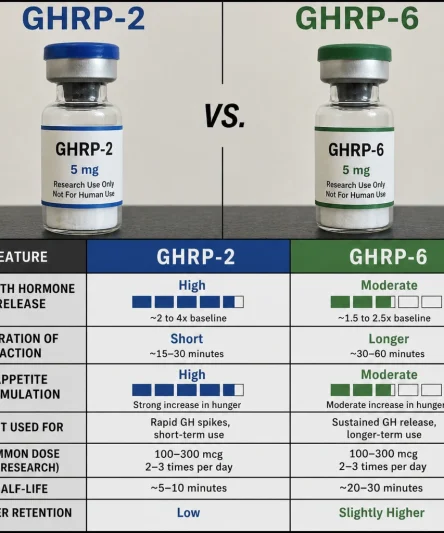
How does it differ from GHRP-2?
GHRP-2, pralmorelin, replaces His and D-Trp at positions 1 and 2 with D-Ala and D-2-naphthylalanine, keeps one tryptophan instead of two, and is approved in Japan as a diagnostic. GHRP-6 has no approved product anywhere. The GHRP-2 versus GHRP-6 comparison covers the rest.
Does GHRP-6 release ACTH and cortisol as well as GH?
Yes. Frieboes et al. 1995 reported reproducible ACTH and cortisol release in normal men alongside GH, which is why “selective GH release” is a claim the literature contradicts. Appetite stimulation is a class effect of GHSR agonism, and transient flushing and sweating appear in the early human studies.
What is the regulatory status of GHRP-6?
No approved formulation in the US, EU, Japan, Australia or Canada. FDA placed it in Category 2 of the 503B bulk drug substances list on 29 September 2023 and it is absent from the 503A list, so no lawful compounded preparation exists. WADA prohibits it at all times under S2.2.4.
Has chronic subcutaneous GHRP-6 been studied in people?
No. There is no controlled human trial of repeated subcutaneous GHRP-6, no human trial with a body-composition, muscle or healing endpoint, and no safety data beyond single administrations. Rat and cell-culture findings, including the ischaemia-reperfusion work of Cibrián 2006, have not been carried into any human study.
What is the GHRP-6 peptide?
His-D-Trp-Ala-Trp-D-Phe-Lys-NH2, one of the synthetic peptides in the Bowers series and the first widely studied member of the growth-hormone-releasing hexapeptide family. Like the other gh secretagogues it binds GHS-R1a, the ghrelin receptor, and produces growth hormone release by agonism on somatotrophs plus suppression of somatostatin tone in the hypothalamus.
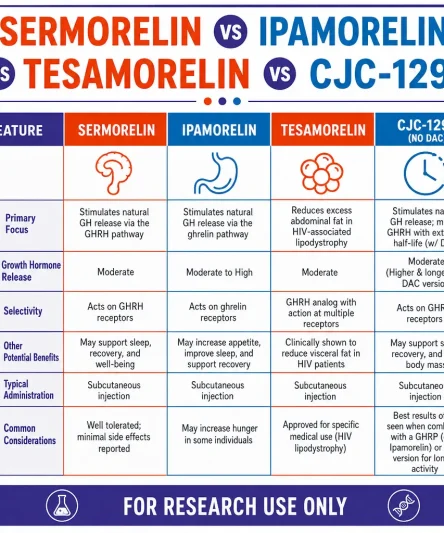
Why does this compound cause hunger when CJC-1295 does not?
Because GHS-R1a is the ghrelin receptor and ghrelin is the hunger signal. An analogue of the releasing hormone such as CJC-1295 works on a different receptor and does not touch that pathway. The appetite effect appears at doses below those needed for a growth hormone response, which makes it the most reproducible finding in the human literature for this molecule.
Has muscle growth been measured for this peptide?
Not in a controlled human trial. Published human work measured growth hormone and IGF-1 after single or short courses in small groups. Tissue repair has not been an endpoint either, despite this molecule being listed beside BPC-157 in recovery catalogues; the two share neither a receptor nor a literature.
What side effects and dosing are on record?
Water retention is the most consistent finding across the class, dose-related, as peripheral oedema and joint discomfort. This compound also raises prolactin and cortisol, unlike ipamorelin. Dosing in the published work was set for endocrine testing rather than derived from efficacy studies, so no established schedule exists to import.
What should the certificate of analysis show?
Purity by HPLC with the gradient described and detection at 214 and 280 nm, an accurate mass against the stated formula, water content and counter-ion percentage. Oxidation adds sixteen and thirty-two daltons per affected tryptophan. A peptide vial certificate describes a dry solid reconstituted with bacteriostatic water at the bench, and cannot describe this solution fill.
Compliance Statement
The GHRP-6 autoinjector is sold exclusively for laboratory research use. It is not a drug, food, or cosmetic product, and it is not a dietary product of any kind. It is not approved by the FDA or any comparable authority for human or veterinary use. This product is not intended to diagnose, treat, cure, or prevent any disease. It must not be given to humans or animals. Purchase is restricted to qualified researchers and institutions operating within applicable laws. All handling is the responsibility of the purchasing laboratory.
Other formats of GHRP-6
GHRP-6 is also stocked as GHRP-6 5mg and GHRP-6 10mg Nasal Spray. Each listing states its own quantity and concentration, and the pen and vial comparison explains what changes between formats.









Reviews
There are no reviews yet.