Description
PrymaLab · Research Use Only
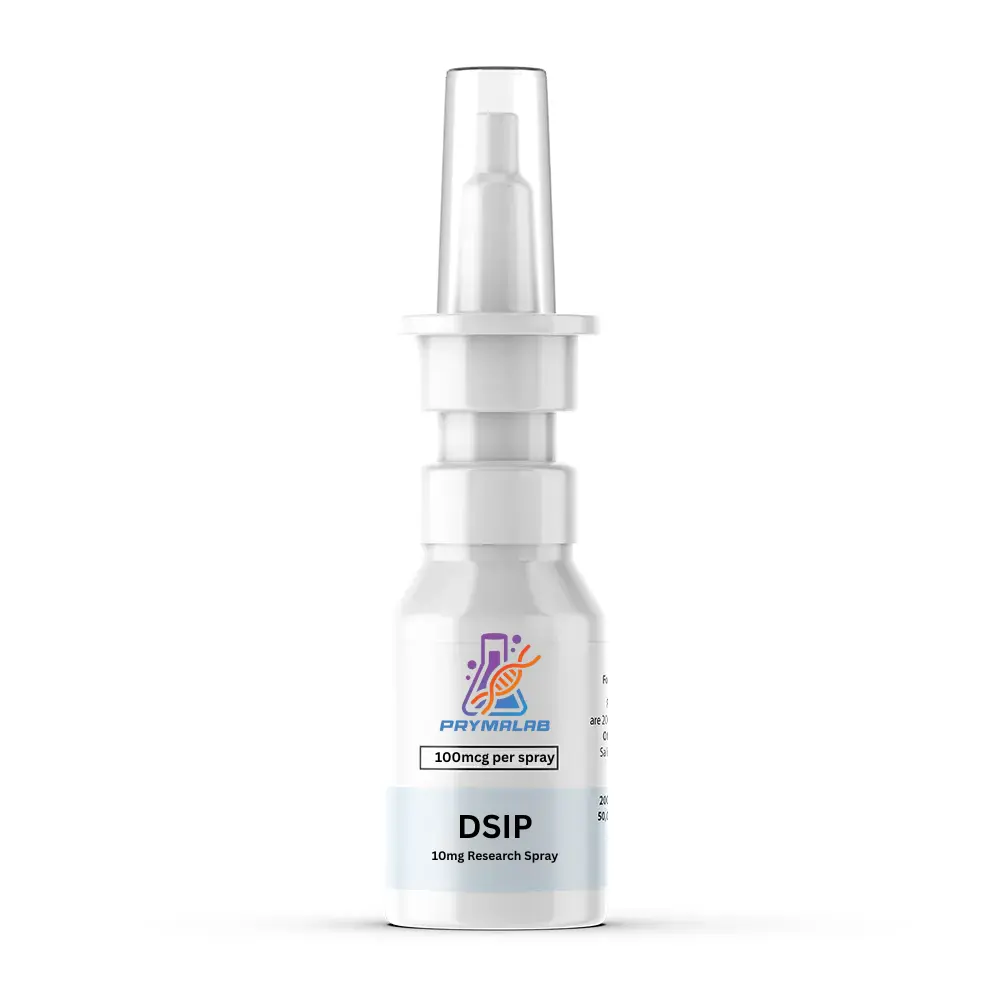
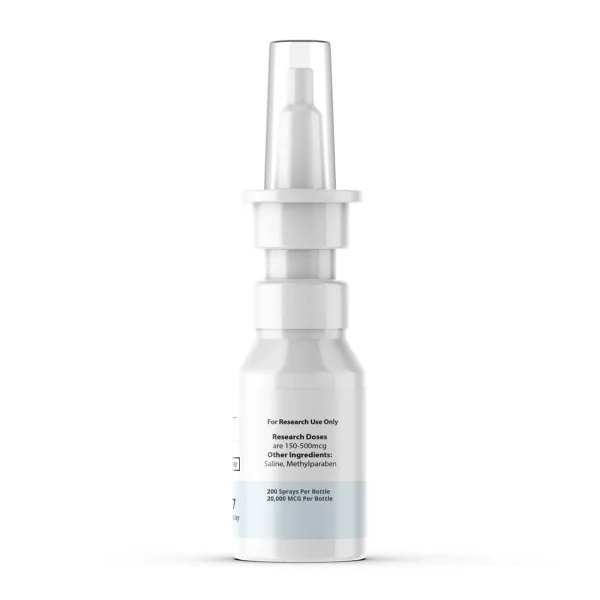
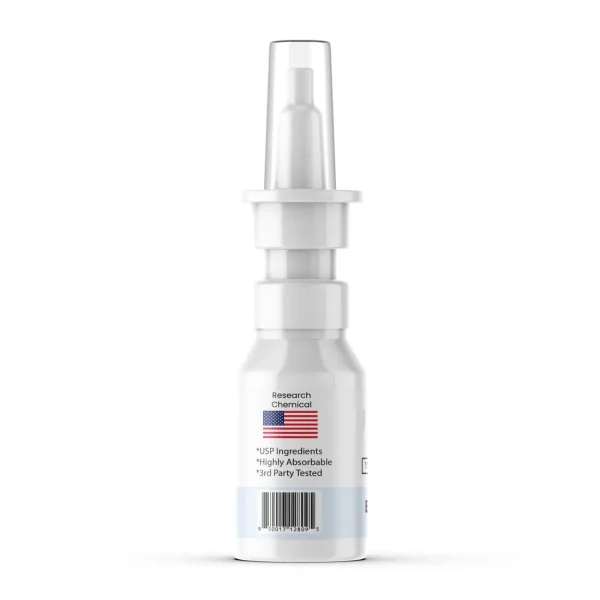
DSIP Nasal Spray
WAGGDASGE · 9 residues · CAS 62568-57-4
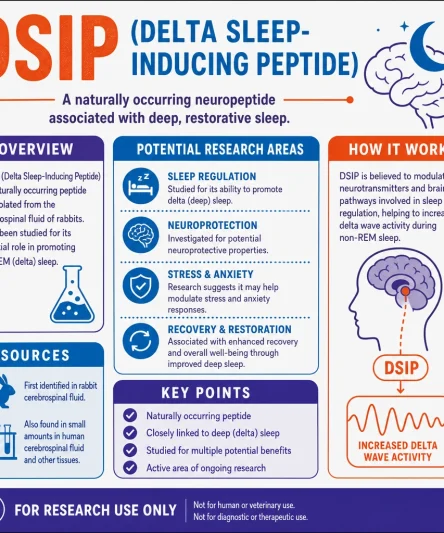
DSIP nasal spray supplies the nonapeptide Trp-Ala-Gly-Gly-Asp-Ala-Ser-Gly-Glu, CAS 62568-57-4, molecular weight 848.82, in a metered spray. The compound was first described in 1977 and remains one of the few named peptides in wide circulation with no identified receptor.
Specification Table
| Property | Value |
|---|---|
| Compound | Delta sleep-inducing peptide |
| Common designation | DSIP |
| Alternative name | Emideltide |
| CAS number | 62568-57-4 |
| Molecular formula | C35H48N10O15 |
| Molecular weight | 848.82 g/mol |
| Residue count | 9 |
| Single-letter sequence | WAGGDASGE |
| Net charge at neutral pH | Negative, from one aspartate and one glutamate |
| Year first described | 1977 |
| Original isolation source | Cerebral venous blood of rabbits under electrical thalamic stimulation |
| Receptor | Not identified in nearly five decades |
| Precursor gene | None identified in any sequenced genome |
| Oxidation-prone residues | One tryptophan at position 1 |
| Cysteine content | None |
| Deamidation-prone motifs | None. No Asn-Gly present |
| Format | Metered nasal spray, solution state |
| Purity | Per lot-specific certificate of analysis |
| Storage | 2-8°C, protected from light. Do not freeze |
| Regulatory status | No approved formulation in any jurisdiction |
Why Has No DSIP Receptor Ever Been Found?
This is the central fact about the compound and it is worth examining rather than glossing, because the reasons are instructive about how peptide pharmacology normally works.
For most bioactive peptides the sequence comes first from a purification, and a receptor follows within a few years through radioligand binding studies and expression cloning. That pipeline was applied to DSIP and did not converge.
Several explanations remain open. The peptide may act through a low-affinity interaction that binding assays cannot resolve above background. It may act indirectly through another system rather than a dedicated receptor. Or the transferred activity in the original rabbit experiments may have come from something else in the fraction.
A further difficulty compounds all three. No gene encoding this sequence has been found in any sequenced genome, and endogenous peptides are normally carved out of a precursor protein. Its absence raises the question of whether the sequence occurs naturally at all.
Nearly five decades of work has not settled any of this, and the publication rate in the area has declined sharply since the 1980s. A declining rate usually indicates a line of investigation that stopped producing tractable questions rather than one that was resolved.
What DSIP Nasal Spray Dosage Figures Are Published?
Published amounts exist but they need reading with the caveats above attached.
Rodent work has used amounts spanning roughly 1 to 100 nanomoles per kilogram depending on route and endpoint, with substantial variation between groups. Older studies frequently report in nanomoles rather than mass, which requires conversion through the 848.82 molecular weight before comparison.
Human work is sparse and mostly dates from the 1980s, with reported amounts sitting in the low milligram range per exposure by parenteral routes.
Intranasal figures specifically are close to absent from the peer-reviewed record. A researcher using this format is doing dose-finding rather than following a published range, and the design should acknowledge that rather than borrowing a figure from a different route.
Because no receptor affinity is known, there is no pharmacological basis for narrowing a concentration range either. Wide concentration-response is a requirement here rather than good practice.
How Should the Compound Name Be Read?
DSIP carries a name that asserts an activity, which is unusual and which creates a reading problem worth naming.
Peptides are normally named for their sequence, their source, their discoverer or an arbitrary code. Names encoding a claimed function are rare, and they persist unchanged once citations accumulate even when the function becomes contested.
The name records what the Basel group believed they had found in 1977 on the basis of transferred activity in rabbits. It is a historical label rather than a description of established pharmacology.
The alternative designation emideltide exists partly for this reason, offering a neutral name without an embedded claim, though it appears far less often in practice.
For anyone writing about the compound, using the acronym or the alternative name avoids restating a claim in every mention. That is a small precision, and it matters more for this compound than for almost any other in the catalogue.
What Does the Sequence Suggest About Nasal Delivery?
Nine residues at 848.82 daltons puts the DSIP nasal spray peptide in the size range where intranasal absorption is least unfavourable, which is a genuine point in the format favour.
Intranasal bioavailability falls sharply with molecular weight, and the steepest part of that decline sits above roughly one kilodalton. DSIP sits just below it, so the barrier is less severe here than for the larger peptides in this cluster.
The net negative charge from one aspartate and one glutamate cuts the other way slightly, since charged molecules cross lipid membranes less readily than neutral ones of the same size.
The glycine-rich centre gives the chain considerable flexibility, which offers no protection against peptidases. Aminopeptidases and carboxypeptidases both have accessible termini here, and the internal region is conformationally available to endopeptidases.
Taken together the molecule is small enough to cross reasonably and unprotected enough to be degraded quickly, which means local peptidase activity is likely to be the limiting factor rather than the epithelial barrier.
What Does the Certificate Need to Show?
Nine residues is about as straightforward as peptide analysis gets, so a thin certificate has nothing behind it.
Mass confirmation against 848.82. At this length deletion sequences resolve cleanly on any modern instrument, and a shortfall is unambiguous rather than a matter of interpretation.
A plus-16 satellite indicates oxidation at the single tryptophan. With only one oxidisable residue in the whole molecule, the reading requires no interpretation at all.
Purity by reversed-phase chromatography. The two acidic residues make retention sensitive to mobile phase pH, which is worth controlling deliberately rather than leaving to a default method.
Solution concentration determined analytically, counterion identity with net peptide content, and the fill date.
Sequence confirmation matters more than usual given the three circulating names. Ask for WAGGDASGE explicitly rather than accepting a trade name on the paperwork.
What Would a Rigorous DSIP Study Include?
Without a target, the usual evidence hierarchy inverts and the controls carry the weight the binding data would normally carry.
A scrambled-sequence arm is the primary specificity control and it is not optional here. A peptide of identical composition in randomised order is the only comparator available when no binding assay exists.
A degraded-peptide arm addresses a question specific to this compound. A nonapeptide breaks down into fragments and free amino acids that have their own activities, so an observed effect may not belong to the intact sequence.
Unbiased readouts beat targeted panels in this situation. Transcriptomics or proteomics can reveal what the peptide affects without presupposing a mechanism, whereas a targeted panel finds only what its designer expected.
A negative unbiased result is substantive rather than a failure. Demonstrating no detectable transcriptional change across a wide concentration range meaningfully constrains the space of possible mechanisms.
Pre-registration is worth the hour it costs, because it fixes the analysis before the data exist and this is exactly the literature where flexible analysis produced findings that did not hold.
How Should the Spray Be Handled?
A DSIP nasal spray holds a chemically forgiving peptide, so the requirements are modest.
Hold at 2 to 8 degrees Celsius, protected from light. The tryptophan at position 1 is both photosensitive and oxidation-prone, and it is the only degradation-relevant residue in the sequence.
With no cysteine there is no disulfide chemistry to manage, and with no asparagine-glycine motif the fastest deamidation route is unavailable. Very little in this sequence is chemically reactive.
Do not freeze, on pump-assembly grounds rather than peptide grounds. This peptide would tolerate freezing perfectly well in an ordinary tube.
Microbial growth is a more realistic concern than chemical degradation for a pump product holding a small peptide in aqueous solution. Confirm the preservative status on the certificate and inspect for cloudiness before use.
Confirm the sequence as WAGGDASGE rather than relying on the name, since three designations circulate for this one nonapeptide and only the sequence is unambiguous.
A closing note on what would move this field. Replication carries more value here than extension, because the foundation is thin enough that adding a new endpoint to it compounds rather than reduces the uncertainty.
A well-controlled negative replication would be particularly useful, and the low material cost of a nonapeptide makes adequately powered group sizes affordable in a way that they are not for larger compounds.
Publishing that result, positive or negative, would do more for the compound standing than another decade of the current pattern.
It is worth saying plainly that none of this makes the compound uninteresting. An unresolved question with a cheap, well-characterised, chemically stable reagent attached to it is a good research opportunity.
What it does mean is that any page describing settled mechanism for this peptide is describing something that does not exist.
A last note for anyone ordering. Confirm whether the material was synthesised as the free acid or with any terminal modification, since the original 1977 description specifies neither clearly and suppliers differ.
Two preparations described identically can therefore differ at a terminus, and that difference is invisible unless the certificate states it.
Asking that question of a supplier also tells you something useful about whether they characterise their own material or resell someone else characterisation.
For a compound with this much unresolved about it, that distinction is worth more than a price difference.
Published Literature
References verified against the publisher record. Note that the most recent substantive review dates from 2006, which itself indicates the state of activity in this area.
- Schoenenberger GA, Monnier M. Proceedings of the National Academy of Sciences. 1977;74(3):1282-1286.
- Graf MV, Kastin AJ. Neuroscience and Biobehavioral Reviews. 1984;8(1):83-93.
- Kovalzon VM, Strekalova TV. Neuroscience and Biobehavioral Reviews. 2006;30(1):1-7.
- Graf MV, Kastin AJ. Peptides. 1986;7(6):1165-1187.
- Illum L. Journal of Pharmacy and Pharmacology. 2004;56(1):3-17.
- Lochhead JJ, Thorne RG. Advanced Drug Delivery Reviews. 2012;64(7):614-628.
Frequently Asked Questions
What is DSIP nasal spray?
A metered spray supplying the nonapeptide Trp-Ala-Gly-Gly-Asp-Ala-Ser-Gly-Glu, CAS 62568-57-4, molecular weight 848.82. Described in 1977 and still without an identified receptor. Laboratory research use only.
Why has no receptor been found?
Several explanations remain open. It may act through a low-affinity interaction binding assays cannot resolve, or indirectly through another system, or the original transferred activity may have come from something else in the fraction.
Is there a gene encoding it?
None has been found in any sequenced genome. Endogenous peptides are normally carved out of a precursor protein, so the absence of one raises the question of whether this sequence occurs naturally at all.
What does the declining publication rate indicate?
Usually that a line of investigation stopped producing tractable questions rather than that it was resolved. Primary work has fallen sharply since the 1980s and the most recent substantive review dates from 2006.
What dosage figures are published?
Rodent work spans roughly 1 to 100 nanomoles per kilogram depending on route and endpoint. Older studies report in nanomoles rather than mass, which requires conversion through the 848.82 molecular weight before any comparison.
Are there intranasal figures?
Close to none in the peer-reviewed record. Anyone using this format is doing dose-finding rather than following a published range, and the design should say so rather than borrowing a figure from a different route.
Why is wide concentration ranging necessary?
Because no receptor affinity is known, so there is no pharmacological basis for narrowing the range. Without a binding constant to anchor on, a single chosen concentration cannot be justified from first principles.
Why is the name a problem?
Because it asserts an activity. Peptides are normally named for sequence, source, discoverer or code. A name encoding a claimed function persists unchanged once citations accumulate, even when the function becomes contested.
Is there a neutral alternative name?
Emideltide, which carries no embedded claim. It appears far less often in practice, but using it or the bare acronym avoids restating an assertion in every mention of the compound.
Does the size favour nasal delivery?
Somewhat. Intranasal bioavailability declines steeply above roughly one kilodalton and this peptide sits just below that, so the epithelial barrier is less severe here than for the larger peptides in this cluster.
What is likely to limit delivery then?
Local peptidase activity rather than the barrier. The glycine-rich centre is flexible and both termini are unprotected, so aminopeptidases, carboxypeptidases and endopeptidases all have access.
Compliance Statement
DSIP nasal spray is sold exclusively for laboratory research use. It is not a drug, food, or cosmetic product, and it is not a dietary product of any kind. It is not approved by the FDA or any comparable authority for human or veterinary use, no receptor for this compound has been identified in nearly five decades, and amounts cited are figures from published studies. This product is not intended to diagnose, treat, cure, or prevent any disease. It must not be given to humans or animals. Purchase is restricted to qualified researchers and institutions operating within applicable laws. All handling is the responsibility of the purchasing laboratory.


11 reviews for DSIP 10mg Nasal Spray