Description
PrymaLab · Research use only
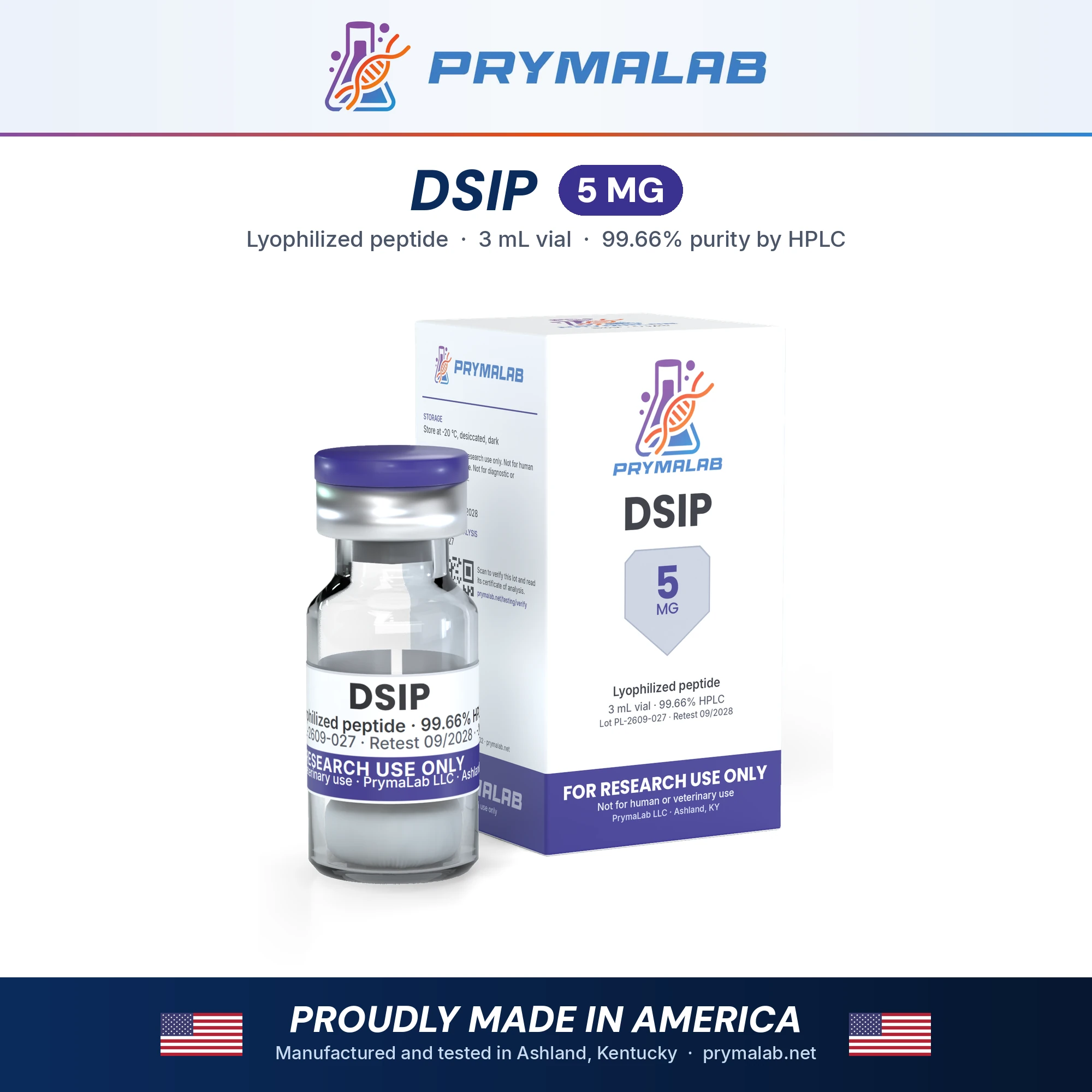
DSIP 5MG
Delta sleep-inducing peptide, the nonapeptide WAGGDASGE, 5 mg freeze-dried
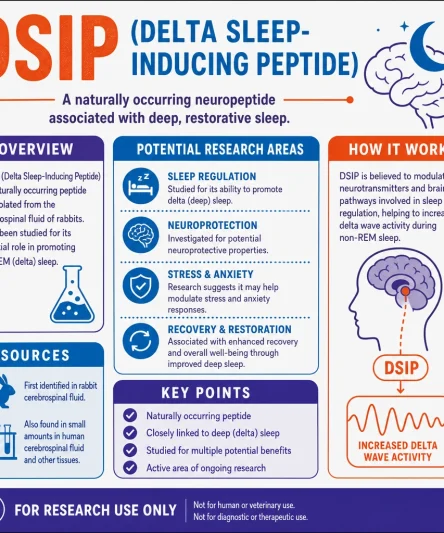
DSIP, delta sleep-inducing peptide, is a nine-residue peptide, Trp-Ala-Gly-Gly-Asp-Ala-Ser-Gly-Glu, isolated from rabbits by a group in Basel in the 1970s and named for the EEG pattern it was reported to induce. This listing is the 5 mg vial of freeze-dried powder, the main fill; a 10 mg vial is also sold. Research on DSIP spans rabbit EEG experiments, reviews of where DSIP-like material occurs in the body, and a long debate over whether the peptide has a gene or receptor at all.
Specifications
| Property | Value |
|---|---|
| Compound | DSIP Delta sleep-inducing peptide |
| CAS number | 62568-57-4 |
| Molecular formula | C35H48N10O15 |
| Theoretical mass | 848.8 Da |
| Sequence / structure | H-WAGGDASGE-OH (9 residues; free N- and C-termini) |
| Label claim | 5 mg/vial |
| Form | Lyophilized (freeze-dried) powder or cake in a sealed glass vial with a rubber stopper and aluminium crimp cap |
| Storage, sealed | −20 °C, desiccated, dark |
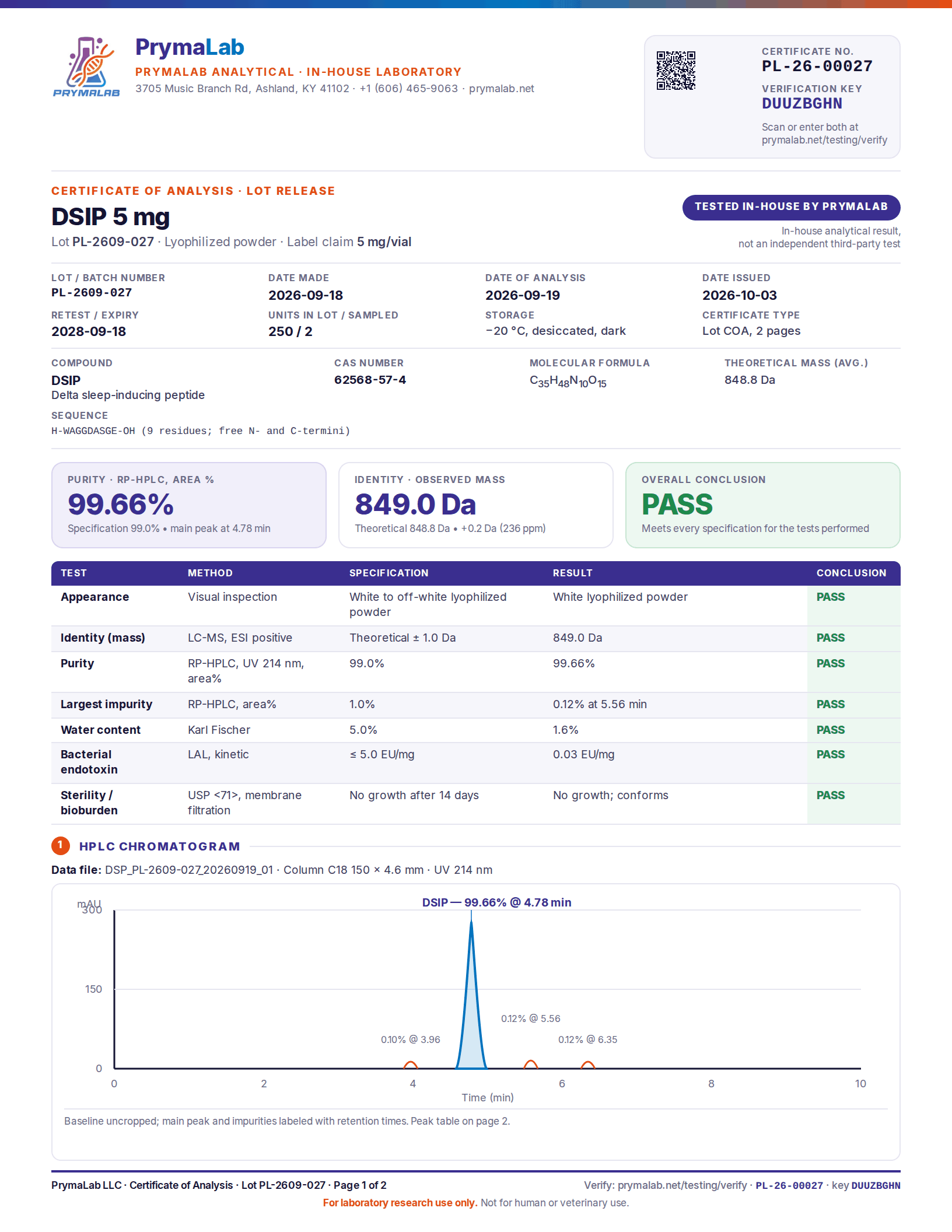
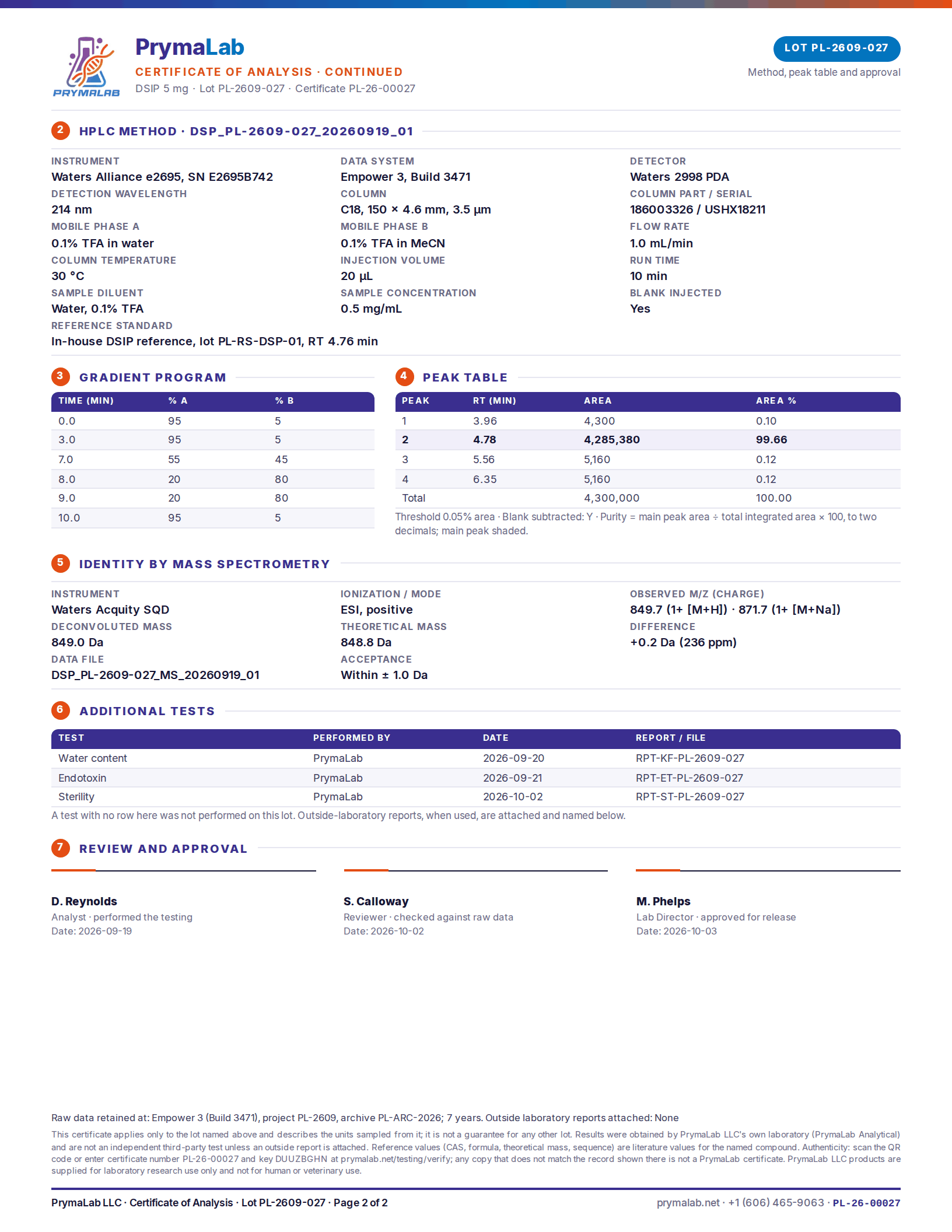
| Purity specification | 99.0% or higher by RP-HPLC |
| Lot certificate | Results for the lot now shipping are in the certificate panel on this page |
| Safety data sheet | PL-SDS-046 |
Fills in this range
DSIP is sold in 2 fills. The compound and the testing are the same in every fill; only the amount in the vial changes.
| Fill | Listing |
|---|---|
| 5 mg | DSIP 5MG (this page) |
| 10 mg | DSIP 10MG |
One name, two molecules
This vial contains the nonapeptide: H-WAGGDASGE-OH, nine residues with free termini, formula C35H48N10O15 and a theoretical mass of 848.8 Da, consistent with the molecular weight of 849 reported in the early reviews1. The DSIP name also turns up attached to a protein. Glucocorticoid-induced leucine zipper (GILZ) is also known as ‘delta sleep-inducing peptide immunoreactor’, and papers on it, such as work on its circadian expression in fat tissue and its effect on stem cell differentiation, are studies of that protein, not of this peptide2.
In molar terms the vial holds about 5.9 µmol (5 mg at 848.8 Da), a little less once the water content on the certificate is allowed for. The sealed vial is stored at −20 °C, desiccated and dark, and brought to room temperature before opening; general guidance is in peptide storage and stability.
What the research covers
Discovery and the original EEG work
In 1977 Schoenenberger and Monnier described a peptide isolated from rabbits that enhanced slow-wave (delta) and spindle EEG activity after intraventricular infusion, and named it delta-sleep-inducing peptide3. They reported its sequence and synthesised it, along with five possible metabolic fragments, two nonapeptide analogues with two amino acids exchanged and a related tripeptide, Trp-Ser-Glu3. All nine synthetic peptides were tested under double-blind conditions in 58 rabbits, controls included, with EEG from the neocortex and archicortex analysed by Fourier transform. Only synthetic DSIP produced a significant and specific increase in delta and spindle patterns3.
What the early reviews collected
Graf and Kastin’s 1984 review described DSIP as a nonapeptide of molecular weight 849 with effects mainly on delta sleep in rabbits, rats, mice and humans, a stronger effect on REM sleep in cats, and a U-shaped activity curve1. DSIP-like material had been found by radioimmunoassay and immunohistochemistry in rat brain, by radioimmunoassay in peripheral organs, and in the plasma of several mammals1. Effects reported beyond sleep included changes in electrophysiological activity, brain neurotransmitter levels, circadian and locomotor patterns and hormone levels1. Their 1986 update added work on possible therapeutic applications and concluded that DSIP’s physiological functions, and a proposed mechanism involving adrenergic transmission, remained to be established4.
A small human study
Schneider-Helmert and Schoenenberger recorded sleep in six middle-aged adults with chronic insomnia after synthetic DSIP, measuring sleep duration, interruptions and REM sleep through the night5. Six participants is a very small sample, and the study is best read as an early observation; the guide sets out how later work compared.
Breakdown in blood
When DSIP was incubated in human or rat blood it released products that ran like free tryptophan on gel filtration, at rates that depended on temperature, time and species6. Two iodinated analogues, one phosphorylated, broke down more slowly and formed complexes, and the authors concluded that DSIP disappears from blood quickly because it is degraded6.
What is not established
Kovalzon and Strekalova’s 2006 review found that the link between DSIP and sleep had never been characterised further, partly because no DSIP gene, precursor protein or receptor had been isolated, and called the sleep-factor hypothesis extremely poorly documented and still weak7. DSIP’s structure differs from every known peptide family. The authors’ own early studies had found slow-wave sleep promotion with certain synthetic DSIP analogues but not with DSIP itself, and they proposed that a related, still unidentified peptide accounts for at least part of the immunoreactivity and activity attributed to DSIP7. Much of the primary work comes from the Basel group that first isolated the peptide and dates from before 1990. None of it used PrymaLab material.
The What is DSIP (Delta Sleep-Inducing Peptide)? guide covers the literature in more depth.
How each lot is tested
Every lot is tested in PrymaLab’s own laboratory in Ashland, Kentucky before release: RP-HPLC for purity, LC-MS for identity, Karl Fischer titration for water, LAL for endotoxin and USP <71> for sterility. The results for the lot now shipping are in the certificate panel on this page, and the certificate number, key and QR code can be checked on the verify page. These are in-house results from PrymaLab Analytical, not an independent test, and the lab is not accredited to ISO 17025. The third-party testing guarantee on this page still applies: if any independent laboratory finds the wrong compound, or less than the stated purity or amount, the order is refunded and the cost of the test is reimbursed.
Frequently asked questions
What exactly is in the vial?
5 mg of freeze-dried delta sleep-inducing peptide, H-WAGGDASGE-OH: nine residues with free termini, theoretical mass 848.8 Da, about 5.9 µmol. The lot certificate reports purity by RP-HPLC and identity by LC-MS checked against that mass.
How do the 5 mg and 10 mg vials differ?
Only in quantity. The 10 mg vial holds twice the peptide, about 11.8 µmol, and is made and tested as a separate lot with its own certificate number. Sequence, storage and testing are the same for both fills.
Has a DSIP receptor been found?
Not in the literature cited here. A 2006 review noted that no DSIP gene, precursor protein or receptor had been isolated and judged the case for DSIP as a natural sleep factor weak. How the peptide acts is still unknown.
How should the vial be stored?
Keep it sealed at −20 °C, desiccated and dark, and let it reach room temperature before opening. After reconstitution, keep the solution at 2 to 8 °C, protected from light, and use it within a period your laboratory has established.
How do I check the certificate for my vial?
Match the lot number on the vial label to a certificate. The panel on this page shows the lot now shipping, earlier lots are on the testing results page, and the verify page confirms a certificate from its number and key.
Is DSIP a sleep aid?
No. It is a research peptide sold for laboratory use only, not approved by the FDA for human or veterinary use, and it must not be given to people or animals. The name records an early EEG finding in rabbits, not an established effect.
References
- Graf MV, Kastin AJ. Delta-sleep-inducing peptide (DSIP): a review. Neurosci Biobehav Rev. 1984;8(1):83-93. DOI · PubMed
- Gimble JM, Ptitsyn AA, Goh BC, et al. Delta sleep-inducing peptide and glucocorticoid-induced leucine zipper: potential links between circadian mechanisms and obesity?. Obes Rev. 2009;10 Suppl 2:46-51. DOI · PubMed
- Schoenenberger GA, Monnier M. Characterization of a delta-electroencephalogram (-sleep)-inducing peptide. Proc Natl Acad Sci U S A. 1977;74(3):1282-6. DOI · PubMed
- Graf MV, Kastin AJ. Delta-sleep-inducing peptide (DSIP): an update. Peptides. 1986;7(6):1165-87. DOI · PubMed
- Schneider-Helmert D, Schoenenberger GA. The influence of synthetic DSIP (delta-sleep-inducing-peptide) on disturbed human sleep. Experientia. 1981;37(9):913-7. DOI · PubMed
- Graf MV, Saegesser B, Schoenenberger GA. Degradation and aggregation of delta sleep-inducing peptide (DSIP) and two analogs in plasma and serum. Peptides. 1987;8(4):599-603. DOI · PubMed
- Kovalzon VM, Strekalova TV. Delta sleep-inducing peptide (DSIP): a still unresolved riddle. J Neurochem. 2006;97(2):303-9. DOI · PubMed
Research use only
For laboratory research use only. DSIP 5MG is not a drug, food, cosmetic or dietary supplement, is not approved by the FDA or any comparable authority for human or veterinary use, and must not be given to people or animals. It is sold to qualified researchers and institutions, and the buyer is responsible for lawful handling and disposal.
Other formats of DSIP
DSIP is also stocked as DSIP 10mg Nasal Spray and DSIP 10mg preloaded 3ml pen. Each listing states its own quantity and concentration, and the pen and vial comparison explains what changes between formats.






Reviews
There are no reviews yet.