


Description
PrymaLab · Research use only
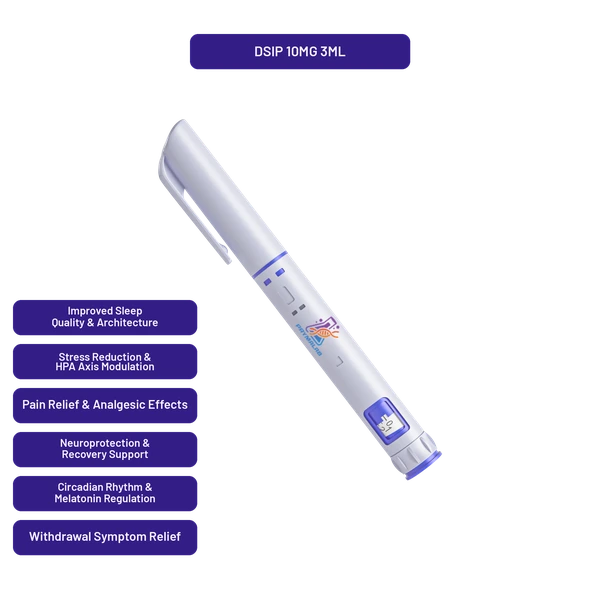
Preloaded Autoinjector | DSIP | 3ml Pen | 10mg
DSIP in bacteriostatic water: 10 mg in a preloaded 3 mL pen at 0.33% w/v
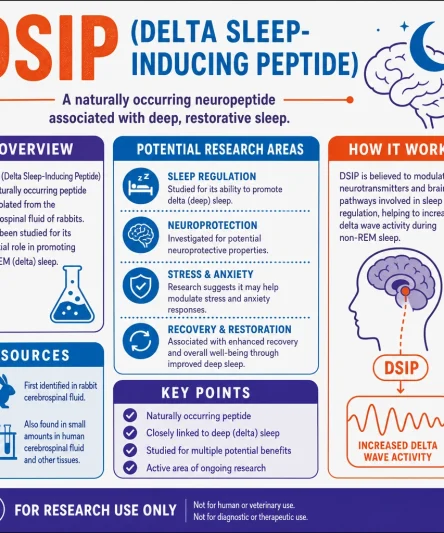
DSIP, delta sleep-inducing peptide, is a nine-residue peptide, Trp-Ala-Gly-Gly-Asp-Ala-Ser-Gly-Glu, first characterised from rabbits in 1977. This listing supplies it in solution: a preloaded autoinjector pen with a 3 mL cartridge holding 10 mg of DSIP at 0.33% w/v. The DSIP literature covers EEG work in rabbits, the peptide’s rapid breakdown in blood and the unresolved question of how, or through what receptor, it acts.
Specifications
| Property | Value |
|---|---|
| Compound | DSIP Delta sleep-inducing peptide |
| CAS number | 62568-57-4 |
| Molecular formula | C35H48N10O15 |
| Theoretical mass | 848.8 Da |
| Sequence / structure | H-WAGGDASGE-OH (9 residues; free N- and C-termini) |
| Contents | DSIP: 10 mg per 3 mL pen (0.33% w/v) |
| Form | Sterile aqueous solution in bacteriostatic water (0.9% benzyl alcohol), supplied in a 3 mL glass cartridge inside a preloaded autoinjector pen fitted with a needle |
| Storage, sealed | Store at 2–8 °C in the original carton, protected from light |
| Safety data sheet | PL-SDS-047 |
What is in the pen
The cartridge holds 3 mL of sterile aqueous solution with 10 mg of DSIP, which is 0.33% w/v or about 3.3 mg/mL. In molar terms 10 mg of an 848.8 Da peptide is about 11.8 µmol. The solvent is bacteriostatic water with 0.9% benzyl alcohol as preservative. The safety data sheet does not classify DSIP; it lists benzyl alcohol as harmful if swallowed or inhaled, a serious eye irritant and a possible skin sensitiser.
Keep the pen at 2 to 8 °C in its carton and away from light, and keep it capped once in use. Do not freeze it, and discard it if the solution has frozen, discoloured or turned cloudy. The same peptide is sold dry as the DSIP 5 mg vial, and the general differences between formats are in peptide pen vs vial.
What the research covers
DSIP was described in 1977 as a peptide from rabbits that, infused into the brain’s ventricles, specifically enhanced delta and spindle EEG activity; fragments and analogues tested in the same double-blind series did not1. Since then the case has weakened. A 2006 review found the sleep-factor hypothesis poorly documented, with no DSIP gene, precursor or receptor isolated, and proposed that an unidentified DSIP-like peptide may explain some of the activity attributed to DSIP2.
For a product supplied in solution, the most relevant study among the references concerns blood, not a cartridge. Incubated in human or rat blood, DSIP broke down to products that behaved like free tryptophan on gel filtration, at a rate set by temperature, time and species, while two modified analogues degraded more slowly3. That tells a researcher DSIP is readily degraded in biological fluid. It says nothing about how long the peptide stays intact in preserved bacteriostatic water, which none of the references measured, so the storage limits on the safety data sheet are the ones to follow.
The DSIP research guide covers the full literature, including why the evidence is mixed.
How each lot is tested
Every lot is tested in PrymaLab’s own laboratory in Ashland, Kentucky before release: RP-HPLC for purity, LC-MS for identity, Karl Fischer titration for water, LAL for endotoxin and USP <71> for sterility. Published certificates are listed on the results page and can be checked by number and key on the verify page. The certificate covers the peptide lot used to fill the pen, not the finished solution. These are in-house results from PrymaLab Analytical, not an independent test, and the lab is not accredited to ISO 17025. The third-party testing guarantee on this page still applies: if any independent laboratory finds the wrong compound, or less than the stated purity or amount, the order is refunded and the cost of the test is reimbursed.
Frequently asked questions
How does the pen differ from the DSIP vials?
The vials hold 5 mg or 10 mg of freeze-dried DSIP kept at −20 °C until the laboratory dissolves it. The pen holds 10 mg already in bacteriostatic water at 0.33% w/v, stored at 2 to 8 °C, so the concentration is fixed when it arrives.
What does the certificate cover for the pen?
It covers the DSIP peptide lot used to fill the pen, not the finished solution in the cartridge. The testing section on this page lists what each certificate reports and where a certificate can be checked by number and key.
Has DSIP stability in solution been measured?
Not in a preserved solution like this one, as far as the references here go. The one stability study measured breakdown in human and rat blood, which was fast. Follow the safety data sheet: 2 to 8 °C, dark, never frozen.
Is the pen for human use?
No. It is sold for laboratory research only, is not approved by the FDA for human or veterinary use, and must not be given to people or animals. DSIP is not a sleep aid, and nothing here describes use in a person.
References
- Schoenenberger GA, Monnier M. Characterization of a delta-electroencephalogram (-sleep)-inducing peptide. Proc Natl Acad Sci U S A. 1977;74(3):1282-6. DOI · PubMed
- Kovalzon VM, Strekalova TV. Delta sleep-inducing peptide (DSIP): a still unresolved riddle. J Neurochem. 2006;97(2):303-9. DOI · PubMed
- Graf MV, Saegesser B, Schoenenberger GA. Degradation and aggregation of delta sleep-inducing peptide (DSIP) and two analogs in plasma and serum. Peptides. 1987;8(4):599-603. DOI · PubMed
Research use only
For laboratory research use only. This product is not a drug, food, cosmetic or dietary supplement, is not approved by the FDA or any comparable authority for human or veterinary use, and must not be given to people or animals. It is sold to qualified researchers and institutions, and the buyer is responsible for lawful handling and disposal.
Other formats of DSIP
DSIP is also stocked as DSIP 10MG and DSIP 10mg Nasal Spray. Each listing states its own quantity and concentration, and the pen and vial comparison explains what changes between formats.







Reviews
There are no reviews yet.