Description
PrymaLab · Research Use Only
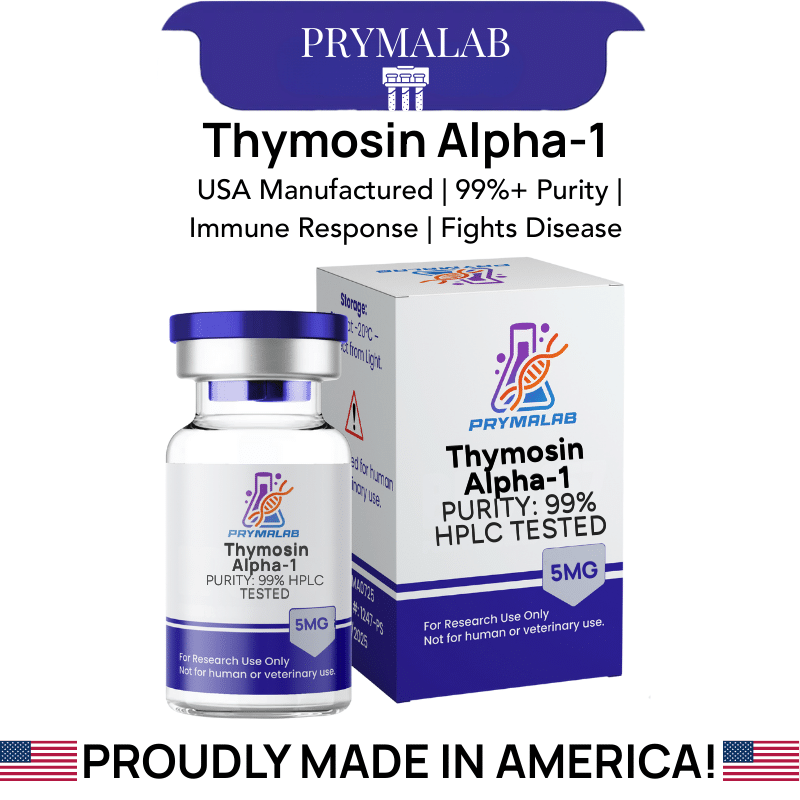
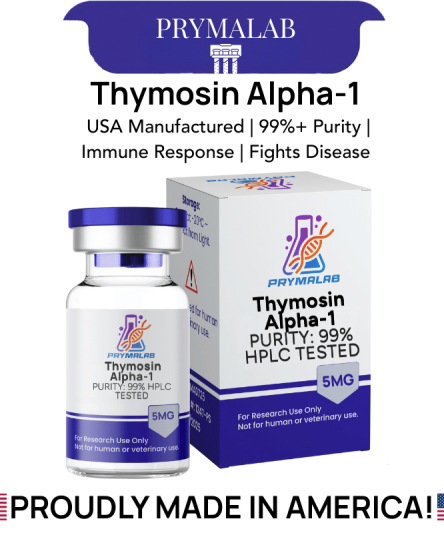
Thymosin Alpha-1 5mg
About 1.7 micromoles · The one peptide here with a licensed twin
Anybody making a thymosin alpha 1 peptide buy decision has an advantage that almost no other purchase on this site offers: a licensed version of this exact molecule exists under the name thymalfasin, with a specification behind it. That hands you something concrete to hold a research certificate against, which is rarer here than it should be.
Specification Table
| Property | Value |
|---|---|
| Compound | Thymosin alpha-1 |
| International nonproprietary name | Thymalfasin |
| Nominal fill | 5 mg |
| Residue count | 28 |
| Molecular weight, approximate | 3,108 g/mol |
| Molar content | Approximately 1.7 µmol |
| N terminus | Acetylated. The acetyl group is part of the molecule, not an artefact |
| Origin | Cleaved from prothymosin alpha |
| Licensed elsewhere | Yes, in a number of jurisdictions, under the INN thymalfasin |
| What the licence gives you | A published specification a research lot can be compared against |
| What it does not give you | Any suggestion that this article is that product. It is not |
| Purity specification here | 99%+ by HPLC, identity by mass spectrometry |
| Certificate | Lot-specific, readable before purchase |
| Independent testing | Outside laboratory verification before dispatch |
| Made in | Ashland, Kentucky. Veteran-owned |
| Storage, lyophilised | -20°C, sealed, dark and dry |
| Regulatory status | The article supplied here is research material and is not a licensed product |
Why Does a Licensed Twin Change the Thymosin Alpha 1 Peptide Buy Decision?
Because it gives you a specification, and almost nothing else you can buy has one.
When a compound goes through regulatory review somebody writes down what acceptable material looks like. Identity, purity, impurity limits, and the methods behind each.
That document exists for thymalfasin, written by people whose job was to be difficult about it. No comparable document exists for most research peptides sold anywhere. The only specification is whatever the supplier printed.
You cannot buy the licensed product here, and nothing on this page suggests otherwise. What you can do is ask whether a research certificate covers the same attributes that dossier does.
A supplier reporting the same categories a monograph would has told you something real about how they work.
One who reports a purity percentage and nothing else has answered a smaller question than the one available.
What Is Awkward About Quantifying This Peptide?
The composition. It catches anyone assuming a 280 nanometre reading will work.
Thymosin alpha-1 runs to 28 residues and is unusually acidic, carrying a great many glutamates and aspartates.
What it lacks is aromatic residues, so absorbance at 280 nanometres runs weak relative to the mass.
That means the standard spectrophotometric concentration check is unreliable here in a way it is not on, say, GHRP-6 with its two tryptophans.
The 10mg page on this site takes that argument up in more detail and this page does not repeat it.
The practical consequence for a 5mg purchase is that the net peptide content figure on the certificate carries more weight, because the second measurement that would catch an error in it is weak.
What Does the Acetyl Group Do?
It caps the N terminus, and it has to be confirmed rather than assumed.
The molecule as it occurs is acetylated on the terminal serine. That is not a modification somebody added for stability; it is part of what thymosin alpha-1 is.
A synthesis that failed to acetylate produces a molecule 42 daltons lighter with a free amino terminus, which is a different compound and an aminopeptidase substrate.
Forty-two daltons on 3,108 is 1.4 percent. Mass spectrometry resolves that without heroics, unlike the sub-one-dalton problems on some smaller peptides.
So this is a defect that routine analysis can catch, provided somebody looks for it.
Ask whether the certificate confirms the acetylation specifically. A fair question to put to any supplier, and informative whichever way it comes back.
What Does 5 Milligrams Actually Give You?
About 1.7 micromoles. Modest by the standards of this catalogue. Ample for plate work.
Reconstituted into 1.7 millilitres, that comes to exactly 1 millimolar.
Published in vitro work on this compound runs well below that, so the stock is the head of a dilution series rather than a working concentration.
The 10mg fill on this site holds twice as much. For a first study, the smaller vial is the cheaper way to find out whether the assay behaves.
For animal work neither fill goes far, and the question becomes how many vials rather than which one.
What Should the Certificate Show?
The full 28 residue sequence, written out rather than summarised.
The N-terminal acetylation, stated explicitly, with the method that confirmed it named.
Observed mass, against a calculated value near 3,108.
Purity by chromatography. Column and gradient both named.
Net peptide content, which matters more here than usual because the spectrophotometric cross-check is weak.
Salt form, plus the lot number and its manufacturing date.
What Comes With the Order?
A lot-specific certificate you can read before paying, which is not how most of this market works.
Purity specified at 99%+ by HPLC with mass spectrometry confirming identity, and independent laboratory verification on every lot before it ships.
Synthesis and dispatch from Ashland, Kentucky, in a veteran-owned facility.
US orders above $100 ship free. Everywhere else, above $200.
A free reconstitution calculator handles the volume arithmetic.
What Does the Acidic Composition Change at the Bench?
Solubility and pH, both in your favour and one of them worth watching.
A 28 residue peptide with a large number of glutamate and aspartate residues carries substantial negative charge at neutral pH, so it dissolves readily in aqueous buffer without organic solvent.
That is a real convenience and it puts this article at the opposite end of the catalogue from kisspeptin-10, which needs a diluent chosen in advance.
What the same acidity does is lower the pH of a concentrated stock. At millimolar concentrations in unbuffered water, the solution is measurably acidic.
Reconstitute into a buffered diluent rather than plain water if the working solution will go anywhere near a cell, and check the pH once rather than assuming it.
That is the whole handling caution on this compound, which is fewer than most things sold here carry.
What Is Published on This Molecule?
More than on most things sold here, and from more than one source.
The peptide was characterised as a fragment of prothymosin alpha, and the thymic peptide literature runs from the 1970s onward with contributions from several groups.
It reached regulatory review in several jurisdictions. A dossier exists, and people whose job was finding problems with it went through it.
That is a stronger evidential position than almost anything else sold on this site, and saying so plainly matters because most pages here have to report the opposite.
What does not follow is that the research material in this vial inherits any of it. The literature describes the molecule. The certificate describes the lot. Those are different objects and the gap between them is exactly what a certificate is for.
What Would You Ask Before Ordering?
Two questions, and both are short.
Whether the certificate confirms the N-terminal acetylation specifically, and by what method. Forty-two daltons is easily resolvable and the answer tells you whether anybody looked.
What the net peptide content is, and how it was determined, because the spectrophotometric cross-check is weak on this sequence and that figure is doing more work than usual.
Neither request costs anything. A supplier who answers both has read their own document.
Why Does This Vial Sit Oddly in the Catalogue?
Because this is the one article here where the published record beats the certificate.
Almost everywhere else here the situation reverses. The material is well specified and the biology is thin.
The molecule has decades of work behind it, a dossier somewhere, and an INN of its own. What this particular vial does not have attached is any of it.
So the gap a buyer closes here is a different gap. Not whether the compound does anything, but whether this lot is the compound.
That is a narrower question and a much easier one to answer with two emails.
One Reason to Prefer This Thymosin Alpha 1 Peptide Buy
A specification exists somewhere.
Anyone making a thymosin alpha 1 peptide buy decision can hold a research certificate against a real regulatory dossier for the same molecule, which is a comparison available almost nowhere else in this catalogue.
That is the argument, and the 5mg fill is the cheap way to test it.
What the 10mg Page Covers Instead
The compound itself, in more depth than this page attempts.
Where the sequence comes from within prothymosin alpha, what is known about the mechanism, the regulatory split between jurisdictions, and why quantification is awkward on a peptide this acidic.
This page is about the purchase decision on a 5mg fill and about the one comparison that fill makes cheap to run.
Read both if you are new to the compound. Read this one if you already know it and are deciding what to order.
How Should the Vial Be Handled?
As an acidic peptide with no unusual liabilities, which makes it easier than most of this catalogue.
Sealed, dry and dark, at minus 20 degrees Celsius.
Room temperature before opening. A highly acidic 28 residue peptide is hygroscopic and cold glass collects water.
Diluent down the wall. Gentle rotation, never shaking.
Aliquot the solution into single-use volumes and refrigerate. There is no acyl chain here, so the freezing prohibition that applies to the GLP-1 analogues does not apply.
Ordinary consumables are adequate. This peptide is polar enough that adsorption to plastic is not a practical concern at working concentrations.
Published Literature
References on thymosin alpha-1 and its regulatory position, confirmed against the publisher record. The licensed product referenced is not the article supplied here.
- Goldstein AL, Goldstein AL. Expert Opinion on Biological Therapy. 2009;9(5):593-608. DOI: 10.1517/14712590902911412
- Manning MC, Chou DK, Murphy BM, Payne RW, Katayama DS. Pharmaceutical Research. 2010;27(4):544-575. DOI: 10.1007/s11095-009-0045-6
- Geiger T, Clarke S. Journal of Biological Chemistry. 1987;262(2):785-794. PMID: 3805008
Frequently Asked Questions
What is in a Thymosin Alpha-1 5mg vial?
Five milligrams of a 28 residue acetylated thymic peptide, about 1.7 micromoles at roughly 3,108 g/mol. It is supplied lyophilised for laboratory research use only.
Why does a licensed version matter to a research purchase?
Because a specification exists. Regulatory review produces a written account of what acceptable material looks like, and you can ask whether a research certificate covers the same attributes. Most research peptides have no such reference point.
Is this the licensed product?
No. This is research material, and it is not manufactured to pharmaceutical standards. The licensed compound is referenced here as a specification comparison, nothing more.
Can I check concentration by absorbance?
Weakly. The sequence is highly acidic with few aromatic residues, so 280 nanometre absorbance is low relative to mass. So the net peptide content figure carries more weight here than on a tryptophan-rich peptide.
What does the N-terminal acetyl group do?
It caps the terminus and is part of the molecule rather than an added stabiliser. A synthesis that failed to acetylate gives a compound 42 daltons lighter with a free amino terminus, which is an aminopeptidase substrate and a different molecule.
Can that defect be detected?
Yes. Forty-two daltons on 3,108 is 1.4 percent, which routine mass spectrometry resolves without difficulty. Ask whether the certificate confirms the acetylation specifically.
How many micromoles are in the vial?
About 1.7 at roughly 3,108 g/mol. Reconstituted into 1.7 millilitres that gives exactly 1 millimolar, which is far above published in vitro working concentrations.
Should I buy 5mg or 10mg?
For a first study 5mg is cheaper, and finding out whether the assay behaves is the whole point of a first study. For animal work neither fill goes far and the question becomes how many vials.
What should the certificate show?
The full 28 residue sequence written out, the N-terminal acetylation stated with the confirming method, observed mass against a calculated 3,108, chromatographic purity with column and gradient, net peptide content, salt form and lot details.
What purity do you supply?
Purity is 99%+ by HPLC with identity confirmed by mass spectrometry. Independent testing happens on every lot before dispatch, and the certificate is available up front.
How should the vial be stored?
Sealed, dry and dark, at minus 20 degrees Celsius. Reconstituted solution at 2 to 8 degrees in single-use aliquots. There is no acyl chain, so freezing the solution is permissible here unlike on the GLP-1 analogues.
Is this for human use?
No. This vial is laboratory research material. It is not a drug, food, cosmetic or dietary product, the FDA has not evaluated this article, and it must not be given to a person or an animal.
Compliance Statement
Thymosin Alpha-1 5mg is supplied exclusively for laboratory research use. It is not a drug, food, cosmetic or dietary product. A licensed formulation of this molecule exists in some jurisdictions under the international nonproprietary name thymalfasin; the article supplied here is not that product, is not manufactured to pharmaceutical standards, and no equivalence is claimed or implied. This article has not been evaluated by the FDA. It is not intended to diagnose, treat, cure or prevent any disease, and it must not be given to humans or animals. Purchase is restricted to qualified researchers and institutions.
Other formats of Thymosin Alpha-1
Thymosin Alpha-1 is also stocked as Thymosin Alpha-1 10mg. Each listing states its own quantity and concentration, and the pen and vial comparison explains what changes between formats.







19 reviews for Thymosin Alpha-1 5mg