Description
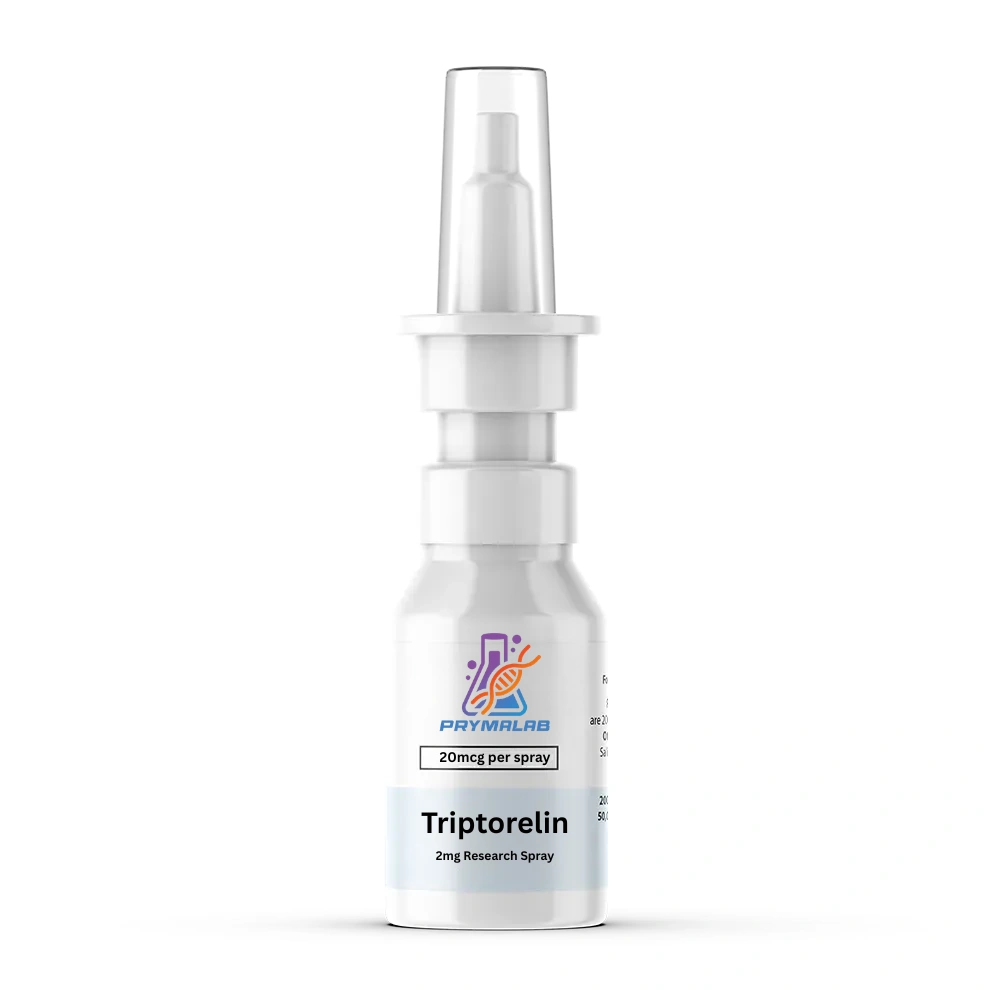
This triptorelin nasal spray supplies triptorelin, a synthetic decapeptide agonist at the gonadotropin-releasing hormone receptor. The sequence is pGlu-His-Trp-Ser-Tyr-D-Trp-Leu-Arg-Pro-Gly-NH2, molecular formula C64H82N18O13, molecular weight 1311.46 Da, CAS 57773-63-4. It differs from native GnRH at exactly one position, and that single change is responsible for everything that makes it pharmacologically distinct. Supplied strictly for laboratory research use only.
The clinical compound, and the research material
Triptorelin exists as a licensed medicine, and that has to be separated from what is sold here before anything else.
As a prescription gonadotropin-releasing hormone (GnRH) agonist it is marketed under names including Trelstar, Triptodur and Decapeptyl. Its licensed indications centre on central precocious puberty, abbreviated CPP and often described as early puberty, where suppressing the axis delays development of secondary sexual characteristics, along with endometriosis and advanced prostate cancer. Related compounds serve assisted reproductive technology protocols, where controlling follicle development and the luteinizing hormone surge is the point. There is also a GnRH agonist supplied as an actual nasal product: Synarel, which is intranasal nafarelin. That is the licensed nasal comparator in this class, and this listing is not it.
The physiology those medicines act on runs through the pituitary gland, which releases luteinizing hormone and follicle-stimulating hormone, usually shortened to FSH, and downstream to estrogen and testosterone production. Because sustained agonist exposure suppresses rather than stimulates, the effects prescribers manage are those of a low-hormone state: hot flashes, vaginal dryness, changes to menstruation up to amenorrhea, thinning of endometrial tissue, reduced bone density and osteoporosis risk over longer courses, acne, mood swings, a change in sex drive, and pelvic pain. Ovarian cysts and ovarian hyperstimulation syndrome appear in the fertility setting, seizures and allergic reactions are listed as less common events, and patients are advised to use a non-hormonal method of contraception because suppression is not a reliable contraceptive. This is a synthetic hormone analog under medical supervision, and none of that management belongs to a research chemical.
What is supplied here is the peptide itself, for laboratory use. The rest of this page is about its chemistry, its receptor behaviour in cell systems, and how to verify it.
One residue, two different drugs
Native GnRH carries glycine at position 6. Triptorelin carries D-tryptophan there instead. Both the identity of the residue and its stereochemistry matter, and the D configuration is the important half.
Endopeptidases that clear GnRH recognize L-amino acids in the expected geometry. A D-residue at position 6 sits outside what those enzymes read, so the peptide is not cleaved at the usual site. The reported consequences are a half-life extending from minutes for native GnRH to roughly three hours for triptorelin in free form, and approximately 100-fold greater potency at the receptor.
That single substitution is one of the cleaner demonstrations in peptide chemistry that stability and potency are not independent properties. A peptide that survives longer occupies its receptor longer, and for this particular receptor the duration of occupancy determines the direction of the biological outcome. Which brings up the part that surprises people.
Why a receptor agonist ends up suppressing the axis
Triptorelin activates the GnRH receptor. It is not an antagonist. Yet sustained exposure produces suppression, and that apparent contradiction is the compound’s defining pharmacology.
The GnRH receptor is built to read pulses. Physiologically, the hypothalamus releases GnRH in discrete bursts, and downstream gonadotropin output tracks that rhythm. Fill the gaps between pulses and the system responds by shutting itself down: continuous receptor occupancy drives receptor internalization, reduced surface receptor expression and progressive desensitization of downstream signalling. The observed sequence is an initial stimulation phase, often called the flare, followed by sustained suppression.
For an in-vitro program the design implication is that time is a variable, not a detail. The same peptide in the same cells reads as stimulatory at short exposure and suppressive at long exposure, so an experiment that samples one time point can support either conclusion depending on when the sample was taken. Any dose-response for this compound needs a time axis alongside it. This is also why work on GnRH receptor gene expression under agonist desensitization is worth reading before designing the experiment rather than after.
In-vitro models and readouts
The GnRH receptor is a class A GPCR coupling principally to Gq, so the immediate readouts are the familiar ones: inositol phosphate accumulation and intracellular calcium mobilization. Recombinant lines expressing human GnRH receptor are the usual system for receptor-level pharmacology, and primary pituitary cell cultures or gonadotroph-derived lines are used where gonadotropin output itself is the endpoint, measured as LH and FSH release by immunoassay.
Receptor-level work suits this compound well because the desensitization phenomenon can be observed directly. Receptor internalization by fluorescent imaging or surface-binding assays, and surface receptor quantification over a time course, both give a mechanistic picture that a single functional endpoint does not.
Beyond the pituitary, GnRH receptors are expressed in some reproductive tumour cell lines, and analogs have been studied in that setting. If you work in that area, confirming receptor expression in your specific line is the prerequisite, since expression varies widely and a negative result in a receptor-negative line says nothing about the compound. Intranasal triptorelin research appears in the animal literature, but the supplied format here carries no implication about administration to anything.
Triptorelin nasal spray specifications
Core identity data for this triptorelin nasal spray. Quote the sequence and CAS number in your methods section, and state the exposure duration explicitly given the time-dependence described above.
| Compound |
Triptorelin, GnRH receptor agonist |
| Sequence |
pGlu-His-Trp-Ser-Tyr-D-Trp-Leu-Arg-Pro-Gly-NH2 |
| Modification |
D-tryptophan replacing glycine at position 6 |
| Molecular formula |
C64H82N18O13 |
| Molecular weight |
1311.46 Da |
| CAS number |
57773-63-4 |
| Termini |
N-terminal pyroglutamate; C-terminal glycinamide |
| Receptor |
GnRH receptor (GnRHR), Gq-coupled class A GPCR |
| Reported potency |
Approximately 100-fold that of native GnRH |
| Time-dependent effect |
Initial stimulation, then receptor downregulation and desensitization |
| Format |
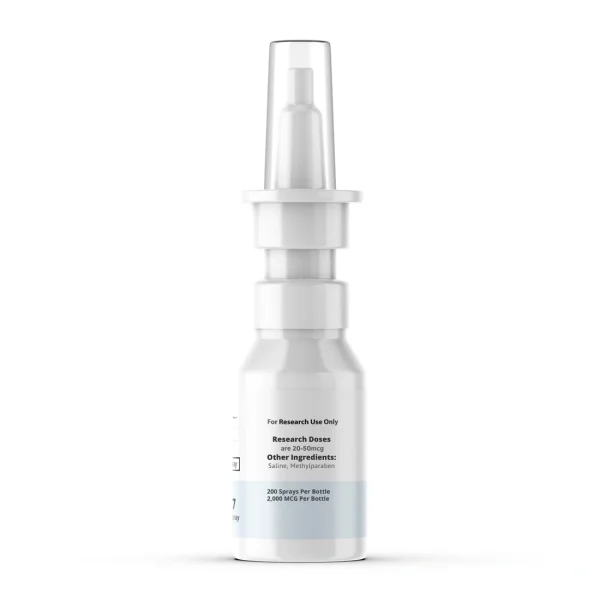
Metered spray bottle [CONFIRM: fill volume, mg per bottle, concentration] |
| Analytical verification |
Reversed-phase HPLC for purity, mass spectrometry for identity, independent third-party testing |
| Classification |
Research chemical. In-vitro laboratory use only. Not for human or veterinary use. |
Triptorelin nasal spray storage and handling
Both termini of this peptide are modified, the N-terminus as pyroglutamate and the C-terminus as glycinamide, which blocks the exopeptidase routes that degrade many linear peptides. Combined with the D-residue at position 6, the molecule is more stable than most in this catalogue.
The residue to watch is tryptophan, and this peptide has two of them, one L and one D. Tryptophan is among the most light-sensitive and oxidation-prone amino acids, so keeping the material out of light is not generic advice here, it is the specific vulnerability. Amber containers or foil-wrapped tubes, minimal bench time, and prompt return to storage all matter more than they would for a peptide without tryptophan.
Otherwise, sensible triptorelin nasal spray storage is routine: cold, sealed, single-use aliquots rather than repeated freeze-thaw, and low-binding plasticware at the low concentrations that receptor assays use. Given the reported potency, working concentrations tend to be very low, which makes adsorption losses proportionally more damaging.
How research grade triptorelin spray is characterized
One verification point is specific to this molecule and worth insisting on. The D-tryptophan at position 6 is what distinguishes triptorelin from native GnRH, and a D and L amino acid have identical mass. Mass spectrometry alone therefore cannot tell you whether the residue is in the correct configuration, because both forms weigh the same. Chiral analysis or a validated synthetic route is what addresses that, and it is a fair question to ask of any supplier of this compound.
Beyond that, a research grade triptorelin spray is characterized by reversed-phase HPLC for purity and mass spectrometry for identity at 1311.46 Da. This material is supplied under the same verification PrymaLab applies across its research peptides, HPLC and MS confirmation plus independent third-party testing. No specific lot figures are asserted here; request the certificate of analysis for the lot you receive.
Two points on documentation generally. Quality control on research peptides is only as informative as the method behind it, so certificates of analysis are worth reading for what was measured rather than filing on the strength of a percentage. And bioavailability, which appears throughout the marketing of nasal formats, is an organism-level measurement that does not transfer to cell culture and is not established for this compound in any case. The same standard applies across the catalogue, whether the compound is this decapeptide, a repair peptide such as BPC-157, or a metal complex such as GHK-Cu.
For related research compounds, see the PrymaLab Research Library.
Frequently asked questions
What is triptorelin?
Triptorelin is a synthetic decapeptide agonist at the GnRH receptor, sequence pGlu-His-Trp-Ser-Tyr-D-Trp-Leu-Arg-Pro-Gly-NH2, 1311.46 Da, CAS 57773-63-4. It differs from native GnRH by a D-tryptophan at position 6. Material supplied here is a research chemical for in-vitro laboratory use only.
How does triptorelin differ from gonadorelin?
Gonadorelin is native GnRH with glycine at position 6. Triptorelin substitutes D-tryptophan there. Some sources wrongly treat the two names as interchangeable. They are different molecules with different half-lives and different pharmacological behaviour, and the substitution is the reason.
Why does a GnRH agonist cause suppression?
Because the receptor responds to pulsatile stimulation. Continuous occupancy drives receptor internalization, reduced surface expression and desensitization, producing an initial stimulation phase followed by sustained suppression. Exposure duration determines which effect you observe.
What does triptorelin nasal spray storage require?
Cold, sealed and strictly out of light. The molecule contains two tryptophan residues, and tryptophan is among the most light-sensitive and oxidation-prone amino acids. Use single-use aliquots and low-binding plasticware, since working concentrations are typically very low.
Is triptorelin nasal spray approved for human use?
No. This material is a research chemical for in-vitro laboratory use only and is not intended for human or veterinary use. Triptorelin exists as a prescription medicine in other contexts, which has no bearing on research-chemical material. Nothing here is medical advice.
Ordering and compliance
Every PrymaLab research compound ships from the United States and is sold research-use-only. This triptorelin nasal spray is supplied for in-vitro laboratory research, is not intended for human or veterinary use, is not a drug or supplement, and has not been evaluated by the FDA for the research-chemical context. Verify the legal status of any research compound in your jurisdiction before ordering, and note that GnRH analogs are prescription medicines in many jurisdictions. Certificates of analysis are available on request for the lot you receive.













Reviews
There are no reviews yet.