Description
PrymaLab · Research Use Only
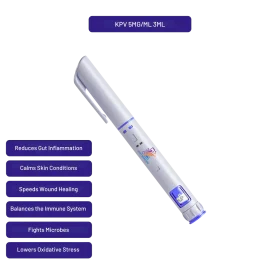
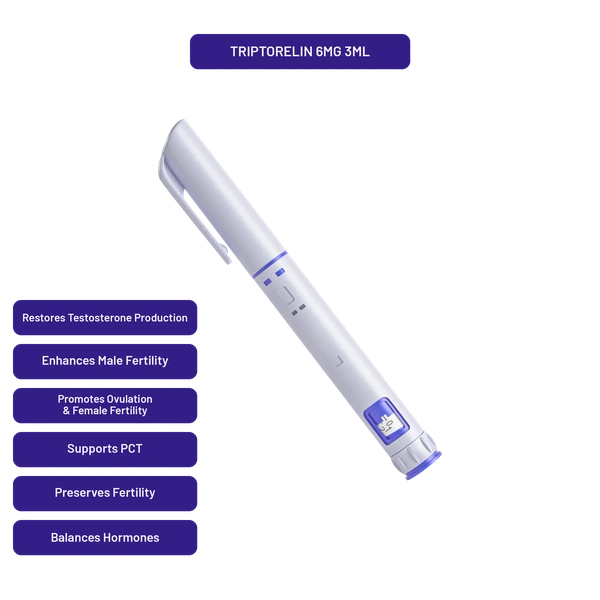
Preloaded Autoinjector | Triptorelin | 3ml Pen | 6mg
GnRH decapeptide in solution · 3ml at 2mg/ml · No reconstitution step
The triptorelin pen is a preloaded 3ml research autoinjector holding the [D-Trp6]-GnRH decapeptide in solution at 2 mg/ml, giving 6 mg in the device. Its characteristic degradation is not oxidation but epimerisation of Ser4 to D-Ser4, a change of zero mass that no mass spectrometer can see.
Specification Table
| Property | Value |
|---|---|
| Device format | Preloaded autoinjector pen, glass cartridge |
| Fill volume | 3 ml |
| Concentration | 2 mg/ml |
| Total compound in device | 6 mg |
| Molar concentration | 1.525 mM (1,525 microM), calculated on the free-peptide mass |
| Compound | Triptorelin, [D-Trp6]-gonadotropin-releasing hormone, a synthetic decapeptide agonist |
| CAS number | 57773-63-4 for the free peptide. Acetate and pamoate salt numbers unverified |
| Molecular formula | C64H82N18O13 (free peptide) |
| Molecular weight | 1311.45 average; 1310.6309 monoisotopic. Acetate 1371.6; pamoate 1699.9 |
| Amino acid sequence | pGlu-His-Trp-Ser-Tyr-D-Trp-Leu-Arg-Pro-Gly-NH2, ten residues, blocked at both ends |
| Solution appearance | Clear and colourless |
| Reconstitution required | None. Supplied as solution |
| Excipient system | Not published on the product record. Confirm against certificate of analysis |
| Solution pH | Not published on the product record. Published maximum stability is near pH 5.0 |
| Storage | 2-8°C, protected from light, do not freeze |
| Light sensitivity | Trp3, D-Trp6 and Tyr5 absorb at 280 nm; indole photo-oxidation applies |
| Solution stability | Not established for this fill. The extrapolated 7.7-year time to 10 percent loss at 20°C applies to 0.1 M acetate at pH 5.0 with 3 percent mannitol |
| Mass-silent route | Ser4 epimerisation to D-Ser4, resolvable only by chiral HPLC |
| Buffer sensitivity | Phosphate accelerates degradation; acetate is the published optimum |
| Salt form | Triptorelin acetate in solution products and research material; pamoate in the depots. Not stated on the product record |
| Purity | Per lot-specific certificate of analysis |
| Regulatory status | Approved products of this compound exist: Trelstar (2000) and Triptodur (2017) as pamoate depots in the USA, Decapeptyl SR 3 mg in the UK from 29 December 1994, and Decapeptyl or Gonapeptyl Daily at 0.1 mg/ml in the EU and Canada. This research preparation is none of them. WADA 2026 Prohibited List S2.2.1, prohibited at all times in males |
What Changes When Triptorelin Ships in Solution?
The decapeptide loses its usual protections in water, but the route that matters most is one no purity certificate is likely to catch: hydroxyl-catalysed epimerisation of the serine at position 4 into its D-form, which changes nothing about the molecular mass.
Hoitink and colleagues established this in two papers. The 1997 study identified the degradation products of gonadorelin, triptorelin, buserelin and goserelin; the 1998 study measured the kinetics and found solvent-catalysed backbone hydrolysis and hydroxyl-catalysed epimerisation at the Ser4 position operating at comparable rates across all four analogues. A D-Ser4 diastereomer has the same formula, the same monoisotopic mass of 1310.6309 and, on an ordinary reversed-phase gradient, close to the same retention time. Only a chiral-resolving method separates it. That single fact should shape how a stored solution of this compound is checked.
The oxidisable residues are the more familiar hazard. Trp3 and D-Trp6 both carry indoles, and the D-configuration at position 6 alters stereochemistry rather than reactivity, so the D-Trp is no more resistant to photo-oxidation than the L. Tyr5 is weakly oxidisable and His2 both oxidises and chelates trace metals. Three chromophores at 280 nm in a ten-residue peptide is a lot, and Ferring’s instruction for the approved solution is to keep it in the original package away from light.
Several routes that trouble other peptides are absent here. The N-terminus is already pyroglutamate, so there is no free alpha-amine and no diketopiperazine route. The C-terminus is glycinamide, which hydrolyses only at high pH. There is no Asn, no Gln, no Asp-Gly and no Asp-Pro, so deamidation and isoaspartate formation do not apply. No cysteine means no disulfide chemistry.
The formulation evidence is unusually good for a research peptide, because Helm and Müller published a stability-indicating study in 1990 that mapped pH, temperature, buffer and ionic strength. Maximum stability sits near pH 5.0. Acetate buffer performed best and phosphate accelerated degradation. Ionic strength made no difference. In 0.1 M acetate at pH 5.0 with 3 percent mannitol they extrapolated a 7.7-year time to 10 percent loss at 20°C. The buffer, not the peptide, sets the shelf life, which is why the excipient system of any solution-format product is the first thing to ask about.
Triptorelin Acetate and What the Salt Choice Signals
Triptorelin acetate is the form used in every aqueous product and by most research suppliers, while the depots use the pamoate, and the difference is a solubility decision rather than a chemical subtlety.
Decapeptyl 0.1 mg/ml, licensed in Canada on 9 August 2012 and sold in the EU as Gonapeptyl Daily, contains triptorelin acetate equivalent to 95.6 microgram of base per 1 ml prefilled syringe, with glacial acetic acid, sodium chloride and water. That is a true solution sitting close to the Helm and Müller optimum: acetate-buffered, mildly acidic, no surfactant. It is the closest approved analogue to what a pen contains.
The pamoate salt does the opposite job. Trelstar and Triptodur suspend triptorelin pamoate in poly-d,l-lactide-co-glycolide microgranules precisely because the salt is poorly soluble, which is what allows one intramuscular injection to release peptide over 4 to 24 weeks. Anyone comparing triptorelin acetate against pamoate is comparing a solution product with a controlled-release solid, not two grades of the same thing.
Whether this device holds the acetate, and how much residual acetate or trifluoroacetate accompanies it, is not on the product record. In cell work the counter-ion is not inert at stock concentrations.
What Does the Triptorelin Pen Deliver Per Increment?
Six milligrams in 3 ml is 2.0 mg/ml, and dividing by the free-peptide mass of 1311.45 gives 1.525 mM, or 1,525 micromolar.
One 0.01 ml increment on a standard insulin-graduated barrel therefore holds 20 microgram, and 0.1 ml holds 200 microgram. Those are the two numbers that set the floor on what this device can measure out.
Against the published concentrations, the pen is a stock rather than a working solution. The only approved aqueous product carries 95.6 microgram of base per millilitre, so the device is roughly 20 times more concentrated, and 0.05 ml of it contains about the same mass of peptide as a full 1 ml unit of that solution. GnRH-receptor assays run at nanomolar agonist levels; reaching 10 nM from 1.525 mM is a 152,500-fold dilution, which is one microlitre carried into roughly 150 millilitres and is not a single-step operation.
Helm and Müller’s stability figures were generated in 0.1 M acetate at pH 5.0. Nothing published applies at 2 mg/ml in an undisclosed matrix, so the arithmetic above is exact while the stability inference behind it is not.
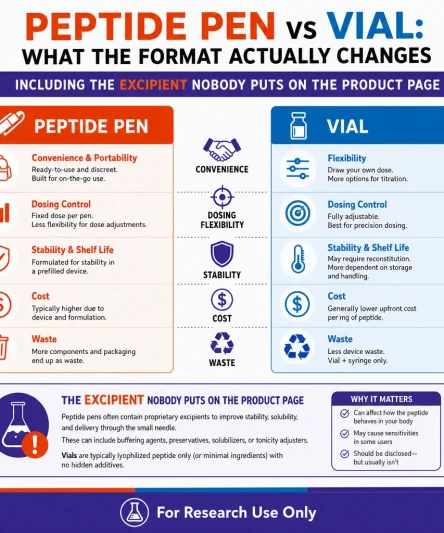
Triptorelin Pen vs Vial: What the Format Settles
The triptorelin pen vs vial question turns on a peculiarity of this molecule: the approved daily product is already a solution, so a solution format is not the departure from precedent it would be for most research peptides.
A pen fixes concentration at manufacture and removes reconstitution as a source of variability. The pen versus vial comparison and the preloaded autoinjector category page set out that general case.
What is specific here is the buffer question. A lyophilized 2mg vial lets the investigator choose the reconstitution medium, and Helm and Müller showed that choice changes shelf life by a wide margin: acetate favourable, phosphate not. A pen removes that decision and hands it to the manufacturer, undisclosed. On the triptorelin pen vs vial trade-off, the pen buys consistency and the vial buys control over the one variable the published stability work identified as decisive.
Two related presentations answer different questions again: the nasal format, and gonadorelin, which is the native decapeptide without the position-6 substitution and about a hundredfold less potent at releasing LH.
What the Product Record Does Not State
Four values are missing, and for this compound the first two are the ones the published literature says matter most.
Buffer identity is unpublished. Given that phosphate measurably shortens the life of this peptide in solution while acetate lengthens it, a page of stability reassurance means nothing without knowing which one is in the cartridge.
Solution pH is unpublished. The optimum is near 5.0; both backbone hydrolysis and Ser4 epimerisation accelerate away from it, and epimerisation in particular is base-catalysed.
Salt form and counter-ion content are unpublished. Acetate is expected but not stated, and trifluoroacetate from synthesis is invisible in a purity figure quoted as area percent.
Solution stability at this fill strength is unpublished. The 7.7-year extrapolation belongs to a defined acetate matrix at a lower concentration, and no equivalence study exists for 2 mg/ml in a multi-draw cartridge.
Verifying the Triptorelin Pen and Confirming Its Contents
Two indoles and a tyrosine make ultraviolet quantification easy, and the same molecule then hides its main degradation route from every mass-based method, which is an awkward pairing.
Absorbance at 280 nm gives a fast concentration check, since Trp3, D-Trp6 and Tyr5 all contribute. Photo-oxidation products extend absorbance above 320 nm, so a shoulder there in a stored device points at indole damage. Neither measurement says anything about the serine.
Mass spectrometry finds the routes that move mass. Backbone hydrolysis produces fragments; oxidation adds 16 Da per oxygen to an indole; glycinamide hydrolysis at high pH adds 1 Da. What mass spectrometry cannot find is the D-Ser4 diastereomer, which has an identical formula. Certifying that a stored triptorelin pen still contains the L,L peptide throughout requires a chiral-resolving HPLC method, and most certificates of analysis do not include one.
Inspect the solution against a white background before each draw: clear, colourless, no particulate or fibres. Let the device equilibrate to ambient temperature before actuating, because cold solution is more viscous and viscosity shifts delivered volume in a spring-driven mechanism. A single gravimetric check against a tared vessel is worth more than the nominal figure printed on the barrel.
What the Triptorelin Peptide Literature Actually Reports
Every controlled result for this compound belongs to an approved formulation, and none of it was generated with a 2 mg/ml solution in a multi-dose device.
The triptorelin peptide entered the literature in 1976, when Coy, Vilchez-Martinez, Coy and Schally reported that D-amino-acid substitution at position 6 of luteinizing hormone-releasing hormone raised biological activity. That substitution gives protease resistance and higher receptor affinity, and the Trelstar label puts the compound at roughly 100-fold the potency of native GnRH for LH release.
Human pharmacology follows a two-phase pattern. Continuous exposure first stimulates LH, FSH and sex-steroid release, then desensitises the pituitary receptor, with testosterone reaching castrate concentrations in 2 to 4 weeks. Registration data covers advanced prostate cancer (Trelstar, adverse-event tables of 140, 174 and 120 participants), central precocious puberty (Triptodur, a single-arm study of 44 children aged 2 to 9 in which at least 93 percent reached prepubertal LH suppression), and prevention of premature LH surges during ovarian stimulation with the daily solution.
Disposition is fast. Müller and colleagues measured triphasic intravenous half-lives of about 6 minutes, 45 minutes and 3 hours, with total clearance of 211.9 ml/min, renal clearance 90.6 ml/min and no plasma-protein binding. Subcutaneous bioavailability of the 0.1 mg solution is close to 100 percent with a terminal half-life of 3 to 5 hours and Tmax near 45 minutes. Depot formulations exist because the free peptide is cleared within hours.
Reported adverse findings, all from approved products, include the initial hormone flare with transient worsening of disease, hot flushes, reduced bone density, hyperglycaemia and new-onset diabetes, cardiovascular and QT effects, hypersensitivity and rare pituitary apoplexy. In children the labelling carries injection-site reactions, psychiatric events and the 2022 class warning on pseudotumor cerebri. It is contraindicated in pregnancy. What has never been studied is the post-cycle testosterone use circulated in fitness forums, which runs against the pharmacology, and any regimen of repeated 0.01 ml increments.
Triptorelin Solution Stability and Storage
Triptorelin solution stability has been measured, which is rare in this catalogue, and the measurements point at the buffer rather than the peptide.
Store at 2-8°C, protected from light, and do not freeze, which is exactly what Ferring specifies for the approved 0.1 mg/ml syringe. Light protection is mechanistic here because of the two indoles. The freezing prohibition matters because freeze-concentration raises local solute concentration and shifts pH in the unfrozen fraction, and pH excursion is what drives both hydrolysis and epimerisation.
Hahn and colleagues reported in 1987 that GnRH activity survived 4 weeks at 4°C or at room temperature, which is a useful floor but a short one. Extrapolating the 7.7-year figure to a research pen would require the same acetate matrix, the same pH and a similar concentration, and none of the three is established. Record the fill date, the date of first actuation and cumulative time out of refrigeration, and treat any stability claim about triptorelin solution stability at 2 mg/ml as an open question until a certificate addresses it. The storage and stability notes cover the general handling case.
What Is the Safety and Regulatory Position?
Approved triptorelin products exist in several countries, and this research preparation is not one of them.
In the USA, Trelstar (triptorelin pamoate, 3.75, 11.25 and 22.5 mg intramuscular depots) was first approved in 2000 for advanced prostate cancer, and Triptodur 22.5 mg was approved in 2017 for central precocious puberty as a single intramuscular injection every 24 weeks. In the UK, Decapeptyl SR 3 mg was authorised on 29 December 1994. Decapeptyl and Gonapeptyl Daily at 0.1 mg/ml are the aqueous products in the EU, with Canadian authorisation on 9 August 2012 and an Australian registration at 100 microgram. All of them differ from this device in salt, concentration, container, sterility assurance and legal standing.
The WADA 2026 Prohibited List names triptorelin explicitly under S2.2.1, among testosterone-stimulating peptides, prohibited at all times in males. That the prohibition is sex-specific is a detail most vendor listings get wrong. The compound does not appear on the FDA 503B category lists published 21 March 2025; as an approved-drug ingredient it sits outside the nominated-bulks question, and research-labelled material sits outside the compounding framework altogether.
No safety data exists for this preparation. The adverse findings above were generated with depots and with a solution 20 times more dilute, under clinical supervision. Supply here is laboratory research only, and nothing in the cartridge may be given to a human or an animal.
What Are GnRH Agonists Approved to Treat?
Triptorelin is the decapeptide [D-Trp6]-GnRH, and the approved products containing it are prescription medicines with substantial labels. GnRH agonists as a class work by exploiting the difference between pulsatile and continuous stimulation: a brief initial surge of LH and FSH is followed, under continuous exposure, by receptor downregulation in the pituitary gland and near-complete suppression of gonadotropin output. LHRH is the older name for the same hormone, and LHRH agonists is the older name for the same class.
Three indications carry most of the approved use. In men, advanced prostate cancer is treated by suppressing androgen to castrate levels, and triptorelin injection given as a depot is one of several ways to do that. In children, central precocious puberty, abbreviated CPP, is treated by halting premature activation of the axis until an appropriate age. CPP is the paediatric indication throughout this section. In women, endometriosis and uterine fibroids are treated by suppressing oestrogen. Trelstar is the United States brand for the oncology indication, marketed in three strengths given every four, twelve or twenty-four weeks, with Trelstar Depot and Trelstar LA surviving as legacy names for two of them; Triptodur is the extended-release paediatric formulation; Decapeptyl SR is the principal European brand.
The initial surge is a clinical problem in its own right. Because LH and FSH rise before they fall, testosterone rises in the first one to two weeks of treatment, and in men under treatment that flare can worsen bone pain, urinary obstruction or spinal cord compression. Labels address it with anti-androgen cover in the first weeks. That is a documented mechanism-driven risk, and it is one of the clearest examples of why a compound with a well-understood mechanism still needs supervised administration.
What Adverse Effects Do the Approved Labels Carry?
A long list, and it is worth reading as an entity description of an approved medicine rather than as anything about this research preparation. The commonest side effects follow directly from hormone suppression, and the side effects below are grouped by the sex and indication they were recorded in. In men: hot flashes, reduced libido, erectile dysfunction, fatigue and, over time, reduced bone mineral density. In women and in girls treated for CPP: flushing, headache, mood changes and vaginal bleeding, the last of which is expected in the first weeks as oestrogen falls and is specifically addressed in the labelling.
Other documented findings span several systems. Tumour flare in the first weeks of treatment. Reactions where the depot was given. Changes in blood sugar and reduced insulin sensitivity with long-term androgen deprivation, alongside an increased risk of cardiovascular events including heart attack, which is why labels direct monitoring of glucose and cardiovascular status. Constipation, flu-like symptoms and visual disturbance including blurred vision appear in the adverse reaction tables. Swollen glands appear in patient-facing summaries of this class but not in the approved adverse reaction lists for these brands, which is worth knowing if that symptom is what brought you here. Pituitary apoplexy has been reported rarely after a first dose in patients with an undiagnosed pituitary adenoma.
The severe reactions are rare and specific. Allergic reactions including anaphylaxis and angioedema are described, and severe cutaneous adverse reactions including Stevens-Johnson syndrome and toxic epidermal necrolysis have been reported for this class. Pregnancy is the other clear boundary. European labelling describes a theoretical risk of abortion or foetal abnormality rather than an observed pattern of birth defects, United States labelling states the drug may cause foetal harm, and both direct that pregnancy be excluded before treatment starts.
None of this belongs to a research chemical. Every finding above was collected from a licensed product, in monitored patients, under a label that specifies dose, route, monitoring and contraindications. This device contains a research preparation at 2 mg/ml with no label, no approved indication and no monitoring framework, and the adverse event profile of the medicine does not transfer to it in either direction.
How Do the Approved Formats Differ From This One?
Fundamentally, and the difference is the point. The approved products are depot formulations: microgranules or microspheres of a biodegradable polymer that release the peptide over one, three or six months from a single injection, given intramuscularly into either buttock in the case of Trelstar. Decapeptyl presentations vary between intramuscular and subcutaneous routes. That sustained release is what produces continuous receptor exposure and therefore suppression. That release profile is the mechanism, not a convenience.
A solution at 2 mg/ml does not do that. Given as a bolus it produces a short exposure that resembles pulsatile stimulation more than continuous suppression, and pulsatile GnRH agonist exposure has the opposite endocrine effect: it stimulates the axis rather than shutting it down. Anyone reading the triptorelin injection literature and assuming a solution device reproduces it is missing the formulation science that makes the medicine work. The published pharmacology belongs to the depot.
Published Literature
Each entry below was confirmed against the publisher record or a primary index while this page was researched. None of them studied a pen.
- Helm VJ, Müller BW. Stability of gonadorelin and triptorelin in aqueous solution. Pharmaceutical Research. 1990;7(12):1253-1256. PMID: 2151342
- Hoitink MA, Beijnen JH, Boschma MU, et al. Degradation kinetics of three gonadorelin analogues: developing a method for calculating epimerization parameters. Pharmaceutical Research. 1998;15(9):1449-1455. PMID: 9755899
- Hoitink MA, Beijnen JH, Boschma MU, et al. Identification of the degradation products of gonadorelin and three analogues in aqueous solution. Analytical Chemistry. 1997;69(24):4972-4978. DOI: 10.1021/ac970634x
- Coy DH, Vilchez-Martinez JA, Coy EJ, et al. Analogs of luteinizing hormone-releasing hormone with increased biological activity produced by D-amino acid substitutions in position 6. Journal of Medicinal Chemistry. 1976;19(3):423-425. DOI: 10.1021/jm00225a018
- Müller FO, Terblanché J, Schall R, et al. Pharmacokinetics of triptorelin after intravenous bolus administration in healthy males and in males with renal or hepatic insufficiency. British Journal of Clinical Pharmacology. 1997;44(4):335-341. DOI: 10.1046/j.1365-2125.1997.t01-1-00592.x
- Hahn PM, Van Vugt DA, Reid RL. The stability of synthetic gonadotropin-releasing hormone in solution. Fertility and Sterility. 1987;48(1):155-158. PMID: 3297811
Frequently Asked Questions
What is the triptorelin pen?
A preloaded 3ml research autoinjector holding the [D-Trp6]-GnRH decapeptide in solution at 2 mg/ml, giving 6 mg in the device and 1.525 mM molar concentration. No reconstitution is needed. Approved triptorelin medicines exist in several countries, and this research preparation is not any of them.
What degrades first in solution?
The serine at position 4 epimerises to D-Ser4 under hydroxyl catalysis, alongside solvent-catalysed backbone hydrolysis. Hoitink and colleagues measured both across four gonadorelin analogues in 1998. The epimer has an identical formula and mass, so it is the degradation route least likely to appear on a routine certificate.
Why does buffer choice matter so much here?
Because it was measured. Helm and Müller reported in 1990 that maximum stability sits near pH 5.0, that acetate buffer performed best and phosphate accelerated degradation, and that ionic strength was irrelevant. In 0.1 M acetate at pH 5.0 with 3 percent mannitol they extrapolated 7.7 years to 10 percent loss at 20°C.
What does the device deliver per 0.01 ml increment?
Twenty micrograms, from a solution of 2.0 mg/ml. One 0.1 ml increment holds 200 microgram. The molar concentration is 1.525 mM, calculated on the free-peptide mass of 1311.45, so reaching a 10 nM receptor-assay concentration requires a 152,500-fold serial dilution.
How does the triptorelin pen vs vial decision look?
The pen fixes concentration and removes reconstitution error; the vial lets the investigator choose the buffer, which the published stability work identified as the variable that matters most for this peptide. Since the approved daily product is itself an acetate solution, the solution format is not unprecedented for this compound.
Is triptorelin acetate the same as the pamoate in the depots?
Same peptide, different salt and different purpose. Triptorelin acetate dissolves and is used in aqueous products; the pamoate is poorly soluble, which is why Trelstar and Triptodur suspend it in lactide-glycolide microgranules for release over 4 to 24 weeks. Molecular weights are 1371.6 and 1699.9 respectively.
What is known about triptorelin solution stability at this strength?
Nothing specific. The measured work covers 0.1 M acetate at pH 5.0 and the approved product at 95.6 microgram per millilitre, not 2 mg/ml in an undisclosed matrix. Hahn and colleagues reported activity surviving 4 weeks at 4°C or room temperature in 1987, which is a short floor rather than a shelf life.
How should the device be stored?
At 2-8°C, protected from light, never frozen, which matches Ferring’s instruction for the approved 0.1 mg/ml syringe. Light protection addresses the two indoles at 280 nm. The freezing prohibition matters because freeze-concentration shifts pH in the unfrozen fraction, and pH excursion drives both hydrolysis and epimerisation.
Can ultraviolet absorbance confirm concentration?
Yes. Trp3, D-Trp6 and Tyr5 all absorb at 280 nm, giving a quick check against a buffer blank. Photo-oxidation products extend absorbance above 320 nm, so a shoulder there in a stored device indicates indole damage. None of this detects the serine epimer.
Why can mass spectrometry miss the main degradation product?
Because D-Ser4 has the same molecular formula and the same monoisotopic mass of 1310.6309 as the parent. Epimerisation moves no mass at all. Confirming that a stored solution still holds the intended stereochemistry needs a chiral-resolving HPLC method, which routine certificates of analysis rarely include.
What should be checked before each draw?
The solution against a white background: clear, colourless, no particulate or fibres. Let the device reach ambient temperature first, since cold solution is more viscous and viscosity shifts delivered volume in a spring-driven mechanism. One gravimetric check against a tared vessel beats trusting the nominal barrel graduation.
What is the triptorelin peptide sequence?
pGlu-His-Trp-Ser-Tyr-D-Trp-Leu-Arg-Pro-Gly-NH2, ten residues, with pyroglutamate blocking the N-terminus and glycinamide the C-terminus. The only difference from native GnRH is D-tryptophan replacing glycine at position 6, reported by Coy and colleagues in 1976 as the substitution that raised biological activity.
How fast is it cleared?
Within hours. Müller and colleagues measured triphasic intravenous half-lives of about 6 minutes, 45 minutes and 3 hours, total clearance of 211.9 ml/min, renal clearance of 90.6 ml/min and no plasma-protein binding. Subcutaneous terminal half-life is 3 to 5 hours. Depot formulations exist for exactly this reason.
What has the compound been studied for?
Advanced prostate cancer, central precocious puberty, prevention of premature LH surges in ovarian stimulation, endometriosis and fibroids. Registration data include adverse-event tables of 140, 174 and 120 participants for the depot and a single-arm study of 44 children for Triptodur. All of it belongs to approved formulations.
What adverse findings appear in the labelling?
An initial hormone flare with transient worsening of disease, hot flushes, reduced bone density, hyperglycaemia and new-onset diabetes, cardiovascular and QT effects, hypersensitivity and rare pituitary apoplexy. Paediatric labelling adds injection-site reactions, psychiatric events and the 2022 class warning on pseudotumor cerebri. Contraindicated in pregnancy.
How does it compare with gonadorelin?
Gonadorelin is the native decapeptide with glycine at position 6; triptorelin carries D-tryptophan there. That substitution resists proteolysis and raises receptor affinity, putting triptorelin at roughly 100-fold the LH-releasing potency of the native sequence according to the Trelstar label. Both were characterised in the same 1997 degradation study.
What is the regulatory and anti-doping position?
Approved products exist: Trelstar from 2000, Triptodur from 2017, Decapeptyl SR from 29 December 1994 and Decapeptyl 0.1 mg/ml from 9 August 2012 in Canada. This preparation is none of them. WADA lists triptorelin under S2.2.1, prohibited at all times in males only.
What are GnRH agonists approved to treat?
Advanced prostate cancer in men by suppressing testosterone to castrate levels, central precocious puberty in children, and endometriosis and uterine fibroids in women. The class works by continuous rather than pulsatile stimulation, which downregulates pituitary receptors after an initial surge. LHRH agonists is the older name for the same class.
Which brands contain this molecule?
Trelstar in the United States for the oncology indication, in three strengths given every four, twelve or twenty-four weeks, with Trelstar Depot and Trelstar LA as legacy names; Triptodur as the extended-release paediatric formulation for CPP; and Decapeptyl SR as the principal European brand. All are depot formulations.
What is the initial flare?
The surge of LH and FSH before downregulation, which raises testosterone for the first one to two weeks. In men under treatment that can worsen pain, urinary obstruction or spinal cord compression, so labels direct anti-androgen cover during those weeks.
What side effects do the labels list?
Hot flashes, reduced libido, fatigue and falling bone density in men; flushing, headache, mood change and vaginal bleeding in women and girls. Also injection site reactions, changes in blood sugar with reduced insulin sensitivity, increased cardiovascular risk including heart attack, constipation, flu-like illness and blurred vision. Swollen glands appear in patient summaries of the class but not in these brands’ adverse reaction lists. Allergic reactions including angioedema, and Stevens-Johnson syndrome and toxic epidermal necrolysis, are reported rarely. Birth defects are a stated concern and pregnancy must be excluded.
Does a 2 mg/ml solution behave like the depot products?
No, and the difference is mechanistic. Extended-release depot formulations produce the continuous exposure that downregulates receptors. A bolus from solution produces a short exposure closer to pulsatile stimulation, which stimulates the axis rather than suppressing it. The published triptorelin injection pharmacology belongs to the depot, not to a solution device.
Compliance Statement
The triptorelin pen is sold exclusively for laboratory research use. It is not a drug, food, or cosmetic product, and it is not a dietary product of any kind. It is not approved by the FDA or any comparable authority for human or veterinary use. This product is not intended to diagnose, treat, cure, or prevent any disease. It must not be given to humans or animals. Purchase is restricted to qualified researchers and institutions operating within applicable laws. All handling is the responsibility of the purchasing laboratory.


Reviews
There are no reviews yet.