Description
What Is Livagen Peptide?
Livagen peptide is a synthetic tetrapeptide bioregulator with the amino acid sequence Lys-Glu-Asp-Ala (KEDA), developed by Professor Vladimir Khavinson at the St. Petersburg Institute of Bioregulation and Gerontology. Livagen targets hepatic tissue, functioning as a liver bioregulator that tunes gene expression in hepatocytes, hepatic stellate cells, and supporting liver parenchyma. It belongs to the Khavinson bioregulator peptides class — short control peptides that show tissue-specific gene expression tuning at natural levels — and has been studied in lab models of liver aging, hepatic repair, chromatin remodeling, and age-related hepatic functional decline.
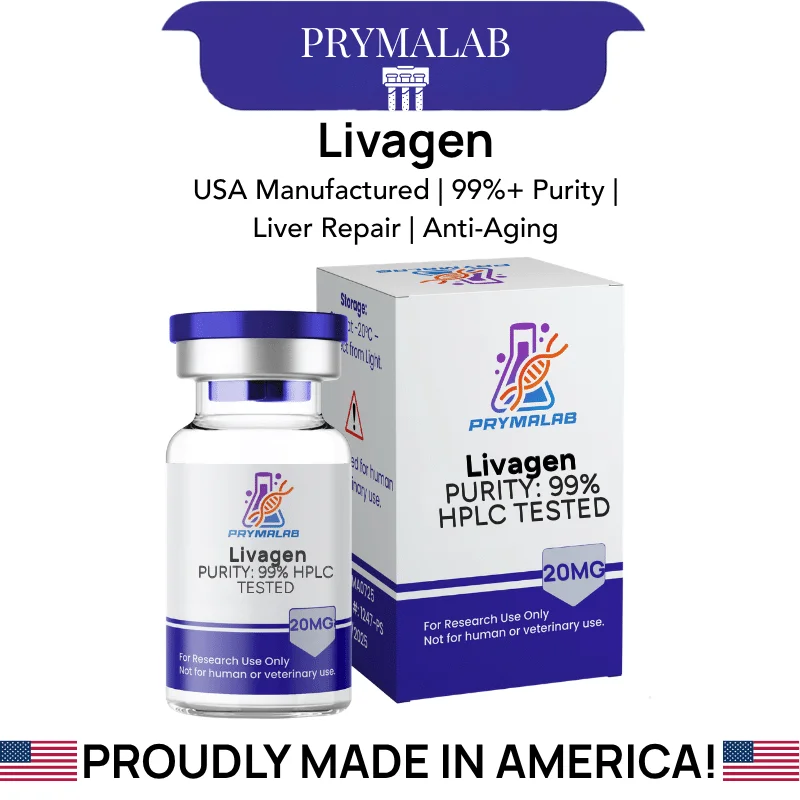
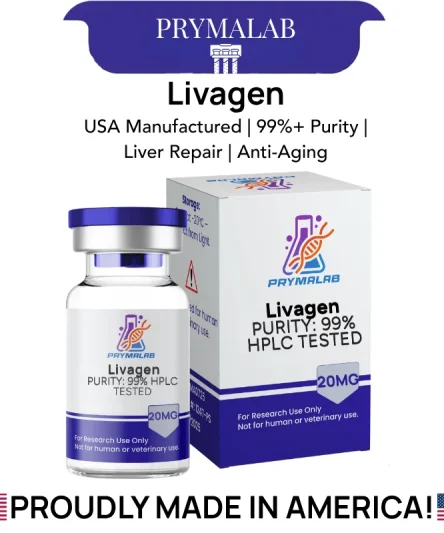
The liver is uniquely positioned as both the body’s main body organ and one of the few tissues with major regrowth capacity. Despite this regrowth possible, age-related epigenetic changes progressively impair hepatocyte function, compromise detoxification pathways, and reduce the liver’s capacity for self-renewal. Livagen addresses this research gap by operating at the chromatin level, tuning the transcriptional programs that govern hepatocyte function and renewal. Among the Khavinson bioregulators, livagen is distinguished by its documented effects on chromatin condensation and decondensation in hepatic tissue, offering a direct window into the epigenetic mechanisms of liver aging. PrymaLab Livagen 20mg is manufactured to high purity standards and supplied exclusively for qualified lab research.
Livagen 20mg: Key Specifications
| Specification |
Detail |
| Compound |
Livagen (tetrapeptide bioregulator) |
| Sequence |
Lys-Glu-Asp-Ala (KEDA) |
| Quantity |
20mg |
| Target Tissue |
Liver (hepatocytes, hepatic stellate cells, liver parenchyma) |
| Class |
Khavinson bioregulator peptide (short control peptide) |
| Purity |
≥98% (HPLC-verified per batch) |
| Testing |
HPLC, mass spectrometry, identity check |
| Form |
Freeze-dried powder |
| Storage |
Store at −20°C desiccated; protect from light |
| Intended Use |
Lab research only — not for human or veterinary treatment use |
How Does Livagen Peptide Work?
Chromatin Remodeling in Hepatic Tissue
Livagen is one of the most mechanistically characterized peptides in the Khavinson bioregulator system due to its documented effects on chromatin structure. The KEDA sequence can induce decondensation of heterochromatin in hepatocyte nuclei, effectively “opening” before silenced regions of the genome and restoring access to genes that become epigenetically suppressed during aging. This chromatin remodeling mechanism provides a direct cell-level explanation for how a short peptide can reactivate age-suppressed gene expression programs in liver tissue.
Hepatocyte Gene Expression Modulation
Through its chromatin-modifying activity, livagen tunes the expression of genes governing hepatocyte body function, detoxification enzyme systems, protein synthesis, and cellular renewal. Lab studies have showed that livagen treatment in aged hepatocyte cultures restores expression levels of genes that decline during liver aging, including cytochrome P450 enzymes, albumin synthesis genes, and energy-cell biogenesis factors. This broad transcriptional restoration distinguishes livagen from compounds that target single body pathways.
Hepatic Tissue-Specific Targeting
The tissue specificity of livagen derives from the selective affinity of the KEDA sequence for control DNA motifs enriched in hepatocyte gene promoters. While livagen’s chromatin effects have been most extensively documented in liver tissue, the specificity of its gene expression tuning to hepatic programs confirms its classification as a dedicated liver bioregulator within the Khavinson system.
Livagen Peptide Benefits Reported in Preclinical Research
Published studies on livagen peptide benefits report multiple hepatic-specific effects relevant to liver aging and repair research. All findings described below are from lab animal and cell culture models.
Chromatin Decondensation and Epigenetic Rejuvenation
The most distinctive livagen peptide benefit documented in the literature is its capacity to reverse age-related heterochromatin buildup in hepatocyte nuclei. Aging liver cells progressively silence genes through chromatin condensation, reducing functional gene expression capacity. Livagen can mainly decondense these silenced chromatin regions, effectively reversing one of the basic epigenetic hallmarks of cellular aging. This finding has significance beyond hepatology, providing experimental evidence for the reversibility of age-related epigenetic changes.
Hepatic Metabolic Function Restoration
Age-related liver functional decline involves reduced drug body function, impaired protein synthesis, and diminished bile production. Livagen research reports restoration of cytochrome P450 enzyme expression, improved albumin and transferrin gene expression, and enhanced hepatic body capacity in aged animal models. These body restoration effects correlate with the saw chromatin remodeling, suggesting a causal relationship between epigenetic rejuvenation and functional healing.
Anti-Fibrotic Effects in Liver Tissue
Hepatic fibrosis (progressive scarring) impairs liver architecture and function during aging and in chronic liver disease models. Among the reported livagen benefits, tuning of hepatic stellate cell start and reduced collagen deposition have been documented. These anti-fibrotic findings position livagen as a research tool for studying whether epigenetic interventions can prevent or reverse the fibrotic cascade in aging liver tissue.
Hepatocyte Proliferative Capacity
The liver’s regrowth possible declines with age as hepatocytes lose proliferative capacity. Livagen research has showed enhanced hepatocyte proliferation markers and improved liver regrowth kinetics in aged models following partial hepatectomy. These findings suggest that chromatin remodeling may help restore the regrowth programs that become epigenetically silenced during liver aging.
Antioxidant Defense Gene Expression
Lab livagen studies report upregulation of endogenous antioxidant defense genes in hepatic tissue, including superoxide dismutase (SOD), catalase, and glutathione-related enzymes. Enhanced antioxidant gene expression in the liver has systemic significance given the organ’s central role in detoxification and oxidant stress care throughout the body.
Livagen Peptide Dosage in Research Applications
Published research provides context for livagen peptide dosage parameters across different experimental paradigms. The following represents reported dosage ranges from lab literature and is intended solely to inform research protocol design.
| Research Use |
Reported Dosage Range |
Protocol Context |
| Cell Culture (Hepatocytes) |
10–200 nM |
Chromatin remodeling and gene expression studies |
| Liver Aging Models |
1–10 µg/kg |
Chronic use in aged rodent hepatic studies |
| Hepatic Fibrosis Models |
5–20 µg/kg |
Anti-fibrotic protocols in chronic liver injury paradigms |
| Liver Regrowth Models |
1–10 µg/kg |
Post-hepatectomy regrowth and healing studies |
Important: These are reported research dosages from published lab literature. Best dosing depends on experimental design, animal model, route of use, and research objectives. This product is not intended for treatment use.
Livagen vs. Ovagen: Liver Bioregulator Comparison
Researchers studying hepatic aging often compare livagen and ovagen because both target the liver within the Khavinson bioregulator system. Grasp their distinct mechanisms and overlapping uses is essential for selecting the appropriate hepatic bioregulator peptide for specific research protocols.
| Feature |
Livagen |
Ovagen |
| Classification |
Liver bioregulator (hepatic tissue) |
Liver and GI bioregulator (hepatic + gut) |
| Sequence |
Lys-Glu-Asp-Ala (KEDA) |
Glu-Asp-Leu (EDL) |
| Main Target |
Hepatocytes, hepatic stellate cells |
Hepatocytes, GI mucosal epithelium |
| Unique Mechanism |
Chromatin decondensation and epigenetic remodeling |
Dual-organ gene expression tuning (liver + gut) |
| Research Emphasis |
Epigenetic liver aging, chromatin biology, hepatic repair |
Liver-gut axis, GI barrier function, dual-organ aging |
| Anti-Fibrotic Data |
Direct hepatic stellate cell tuning |
Indirect via hepatocyte support and GI integrity |
| Best For |
Pure hepatic research: chromatin, regrowth, fibrosis |
Liver-gut interaction research: barrier, microbiome, dual-organ |
| Combined Use |
Paired: epigenetic hepatic + gut-liver axis support |
Paired: gut-liver axis + epigenetic hepatic support |
The livagen-ovagen mix represents the most thorough hepatic bioregulator research approach in the Khavinson system, with livagen providing deep epigenetic tuning of hepatocyte gene expression and ovagen addressing the gut-liver axis and dual-organ interactions that influence overall hepatic health during aging.
How to Store and Handle PrymaLab Livagen 20mg
- Store freeze-dried at −20°C. Keep sealed, desiccated, and protected from light. Stable for 24+ months.
- Allow vial to reach room heat before opening to prevent condensation.
- Reconstitute with appropriate sterile solvent. Add slowly along vial wall.
- Use mixed solution within 2–4 weeks. Refrigerate at 2–8°C.
- Avoid repeated freeze-thaw cycles. Aliquot into single-use portions.
- Retain the Certificate of Test for lot traceability.
Why Choose PrymaLab Livagen 20mg?
PrymaLab supplies Livagen 20mg as a high-purity research-grade liver bioregulator peptide verified at ≥98% purity by reverse-phase HPLC and identity-confirmed by mass spectrometry. Each batch ships with a unique lot number and Certificate of Test. Independent third-party testing ensures unbiased quality check and full traceability for GLP-compliant hepatic and aging research.
Frequently Asked Questions About Livagen Peptide
What is livagen peptide and what does it target?
Livagen is a synthetic tetrapeptide bioregulator (Lys-Glu-Asp-Ala, KEDA) developed by Professor Khavinson targeting hepatic tissue. It tunes gene expression in hepatocytes and hepatic stellate cells through chromatin remodeling. Research uses include liver aging, hepatic repair, fibrosis, and epigenetic rejuvenation in lab models.
What are the reported livagen peptide benefits in research?
Published lab research reports livagen peptide benefits including chromatin decondensation in aged hepatocyte nuclei (reversing epigenetic silencing), restored expression of body enzymes (cytochrome P450, albumin synthesis), anti-fibrotic effects through hepatic stellate cell tuning, enhanced hepatocyte proliferative capacity, and upregulated antioxidant defense gene expression. All benefits are from lab research.
How does livagen differ from other liver-targeting compounds?
Livagen operates through chromatin remodeling and epigenetic gene expression tuning rather than receptor agonism, enzyme use, or direct antioxidant activity. It targets the transcriptional programs governing liver function rather than supplementing personal body pathways. Among Khavinson bioregulators, livagen provides direct hepatic epigenetic effects paired to ovagen’s dual liver-GI bioregulation.
What is the recommended livagen dosage for research?
Published livagen dosage ranges include 10–200 nM for cell culture studies and 1–10 µg/kg for in vivo liver aging models. Dosing depends on experimental design, model system, and research objectives. This product is for lab research only and is not intended for treatment dosing.
How should livagen be stored?
Store freeze-dried livagen at −20°C, desiccated and protected from light, for 24+ months shelf life. After mixing, store at 2–8°C and use within 2–4 weeks. Aliquot to avoid freeze-thaw cycles.
Research Disclaimer
For Research Use Only. PrymaLab Livagen 20mg is intended exclusively for qualified lab research use. This product is not intended for human consumption, treatment use, veterinary treatment, or any use outside controlled research environments. Livagen has not been approved by the FDA or any equivalent control authority for treatment use. All research uses described are from published lab and gerontological literature. Researchers are responsible for control compliance.










14 reviews for Livagen Peptide 20mg