Description
PrymaLab · Research Use Only
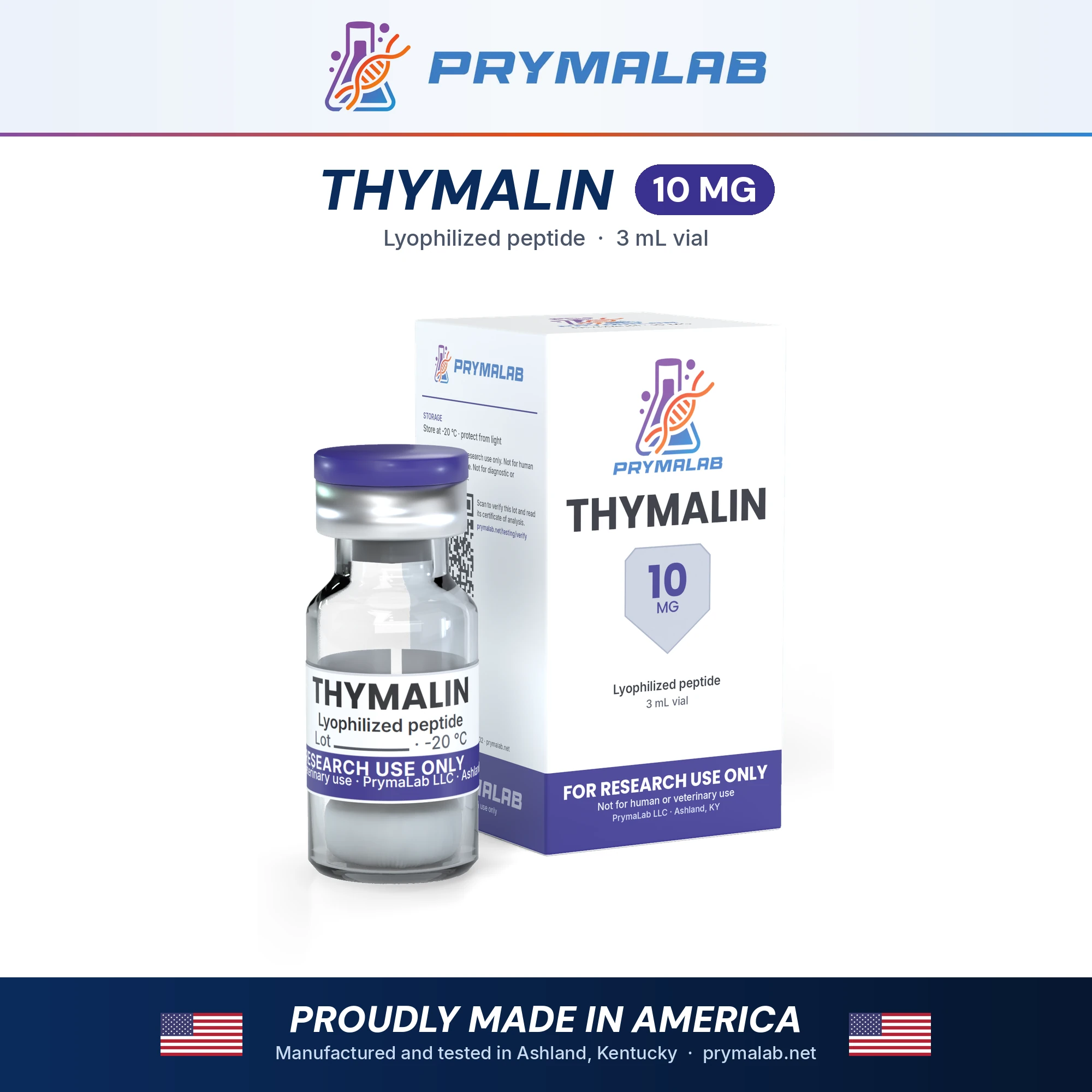
Thymalin 10mg
An extract, not a molecule, and the difference runs through everything
Everything else in the bioregulator range here is a defined molecule with a written sequence, usually two or three residues long. Thymalin is not one of those. It is the extract those defined peptides were isolated from, and an extract is a fundamentally different kind of article to buy, verify and report.
Specification Table
| Property | Value |
|---|---|
| Article | Thymalin, a polypeptide fraction |
| Article class | An extract. Not a single chemical entity |
| Source material | Calf thymus |
| Isolation | A low molecular weight peptide fraction separated from the tissue |
| Origin of the method | Described by Morozov and Khavinson in 1974 |
| Sequence | None. An extract has no single sequence |
| Molecular weight | None. A fraction has a distribution rather than a mass |
| CAS number | None for a pure compound. A CAS number identifies a substance, not a mixture |
| Known constituents | Short peptides including Glu-Trp and Lys-Glu have been identified in this class of preparation |
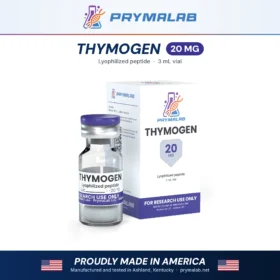
| Relationship to Thymogen | Thymogen is the Glu-Trp dipeptide, sold separately in this catalogue as a defined molecule |
| Relationship to Vilon | Vilon is the Lys-Glu dipeptide, from the same research programme |
| Consequence for verification | Purity is not a meaningful measurement on a fraction |
| What can be measured | Total peptide content, molecular weight distribution and a batch fingerprint |
| Vial | 10mg lyophilized |
| Storage | Sealed at minus 20°C. Protect from light and moisture |
What Kind of Article Is Thymalin?
The distinction that matters for thymalin is between a substance and a mixture.
A substance has a formula, a mass and a structure, and those three things travel with it wherever it goes. Two preparations of the same substance are the same material, whoever made them and whenever.
A mixture derived from tissue has none of those properties in the same way. It has a composition, and the composition depends on the source material, the isolation method and the batch.
Thymalin belongs to the second category. It is a low molecular weight peptide fraction separated from calf thymus, and the method was described in the Soviet research programme that produced most of the bioregulator literature.
That programme went on to isolate defined short peptides from these fractions and to synthesise them, which is where the rest of this catalogue comes from.
Thymogen, sold here as a defined dipeptide, is Glu-Trp. Vilon is Lys-Glu. Both were identified as constituents of thymus preparations of this kind before being made synthetically.
So the relationship between this vial and those synthetic dipeptides is genealogical rather than chemical. The synthetic dipeptides are what came out of work on the extract.
A researcher choosing between them is choosing between a defined molecule with a narrow scope and an undefined mixture with a broader and less specifiable one.
Why Does Purity Not Apply?
Purity is the fraction of a material that is the intended substance, and it requires an intended substance to exist. Thymalin has none.
On an extract there is nothing for the figure to measure against.
A certificate quoting ninety-eight percent for a tissue fraction is either measuring something else and labelling it wrongly, or it is measuring nothing.
This is not a pedantic objection. It is the reason extract-derived articles need a different verification approach, and pharmacopoeial practice for botanical and tissue-derived preparations reflects that.
What can be measured on a fraction is a different list.
Total peptide content, by nitrogen determination or by a colorimetric assay, which establishes how much peptide material is present regardless of what it consists of.
Molecular weight distribution, by size exclusion chromatography. That describes the size range the fraction covers and is the closest thing to an identity statement available on a mixture.
A chromatographic fingerprint, which is a reference trace against which subsequent batches can be compared for similarity rather than for identity.
Residual protein and nucleic acid, since the starting material is tissue and incomplete separation carries both.
Bioburden and endotoxin, with the methods named, since both matter considerably more on a biologically sourced article than on a synthetic one.
It is worth being clear that none of this makes the article unusable or the supplier dishonest.
Tissue-derived preparations are used across biology and there are established ways of characterising them.
The problem is a template mismatch rather than a quality problem: a certificate written for a synthetic compound gets applied to a fraction, and the fields it contains are the wrong fields.
Asking for the right ones is a reasonable request and most suppliers of this class of article can answer it.
What Does Batch Variation Mean Here?
Two batches of a synthetic dipeptide are the same molecule and differ only in impurity profile. Two batches of thymalin are not.
Two batches of a tissue fraction are two different mixtures that resemble one another to a degree the fingerprint can describe and cannot guarantee.
The sources of variation are ordinary and unavoidable: animal age, tissue handling before extraction, the exact conditions of the separation, and the cut points chosen for the fraction.
None of those is a manufacturing failure. They are properties of working with tissue.
The experimental consequence is that lot number is not a bookkeeping field on this article. It is part of the material description.
A study that changes lot part way through has changed a variable, and a study comparing its own data against published work has changed a variable it cannot even see, because the published work used a batch nobody has access to.
The discipline that follows is to buy enough for a study in one lot, to record the lot everywhere, and to regard any comparison across lots as a comparison across materials rather than across conditions.
That is normal practice in fields that work with biologically derived reagents and it is frequently ignored on articles sold as though they were compounds.
How Does This Compare With the Synthetic Bioregulators?
The catalogue sells several defined short peptides from the same research tradition as thymalin, and the comparison is instructive in both directions.
A defined dipeptide can be verified completely. Its sequence, mass and purity are all measurable and a certificate can establish exactly what is in the vial.
It also carries a narrower hypothesis. Whatever is claimed for it has to be claimed for two residues, and the bioregulator literature asks a great deal of very short sequences.
The extract carries the opposite pair of properties. It cannot be fully characterised and it makes no claim to be a single active entity.
Where the underlying proposal is that a mixture of short peptides acts together, the extract is the article that matches that proposal and the isolated dipeptide is the reduction of it.
Where the proposal is that one specific sequence carries the activity, the synthetic peptide is the article and the extract is a confound.
Which of those is the right frame is precisely what the literature in this area has not settled, and the honest position on a product page is to say so rather than to pick.
What a researcher can do is choose the article that matches the question being asked, and record which one was used with enough detail that a reader can tell.
A note on how the two should be reported when both appear in one programme of work.
They should not be described in the same terms.
A synthetic dipeptide is named by its sequence and a fraction is named by its source, its method and its lot, and collapsing both into a trade name loses the distinction entirely.
A methods section that reads as though the two were the same kind of input has misdescribed one of them.
What Should a Thymalin Certificate Show?
For thymalin, the source tissue and species, stated explicitly.
The isolation method in enough detail to identify the fraction, including the molecular weight cut points used.
Total peptide content by a stated determination.
A molecular weight distribution by size exclusion chromatography, which is the closest available substitute for an identity statement.
A chromatographic fingerprint, supplied as a trace rather than described in words.
Residual protein and nucleic acid figures.
Bioburden and endotoxin, with the methods named.
Lot number and manufacturing date, which on this article are part of the material description rather than administrative fields.
A certificate that reports a purity percentage and a molecular weight for a tissue fraction has been written to the wrong template, and that is the most common thing wrong with paperwork on this class of article.
Asking for those fields is also a useful test of a supplier. A vendor who can produce a fingerprint trace and a size distribution is working from real analytical data on the article they sold.
How Should the Vial Be Handled?
Handling thymalin follows the general rules for a lyophilized peptide preparation, with two additions that come from the extract nature of the material.
Sealed lyophilized material holds at minus 20 degrees Celsius, protected from light and moisture.
Let the vial reach ambient temperature before opening it, since the powder takes up water from room air readily and cold glass makes that worse.
Reconstitute gently by adding diluent down the wall and letting it stand.
Inspect the reconstituted solution. A fraction can contain material that does not fully dissolve, and a haze on an extract means something different from a haze on a pure compound.
Consider filtering if the work requires a clear solution, and record that filtration happened, since it changes the composition of a mixture in a way it would not change a substance.
Aliquot on first reconstitution and use low-binding consumables at working dilutions.
Do not pool lots. Combining two batches of a fraction creates a third mixture that neither certificate describes.
Record the lot, the source and species, the total peptide content, the diluent, whether the solution was filtered, the storage temperature and the date.
Filtration and lot both belong on that list here and on very few other pages in this catalogue, because on a mixture they change what the material is rather than only how it was handled.
Published Literature
Selected references on the peptide bioregulator programme that produced this preparation and on the general chemistry of peptide storage.
- Khavinson VK, Malinin VV. Gerontological Aspects of Genome Peptide Regulation. Karger, Basel; 2005.
- Khavinson VK. Neuroendocrinology Letters. 2002;23(Suppl 3):11-144.
- Anisimov VN, Khavinson VK. Critical Reviews in Oncology/Hematology. 2010;74(1):46-66. DOI: 10.1016/j.critrevonc.2009.04.003
- Manning MC, Chou DK, Murphy BM, Payne RW, Katayama DS. Pharmaceutical Research. 2010;27(4):544-575. DOI: 10.1007/s11095-009-0045-6
Frequently Asked Questions
Is thymalin a peptide?
Not a single one. Thymalin is a low molecular weight polypeptide fraction extracted from calf thymus, which means it is a mixture rather than a defined chemical substance.
Why does it have no CAS number?
Because a CAS registration identifies a substance with a defined structure, and thymalin does not have one. A tissue-derived fraction has a composition rather than a structure.
Does it have a molecular weight?
No single figure. Thymalin covers a distribution of sizes, and the distribution is what a size exclusion measurement describes.
How does it relate to Thymogen?
Thymogen is the Glu-Trp dipeptide, identified as a constituent of thymus preparations of this kind and then made synthetically. The relationship is genealogical.
And to Vilon?
Vilon is the Lys-Glu dipeptide from the same research programme. Both synthetic dipeptides came out of work on fractions like this one.
Why does purity not apply?
Purity is the fraction of a material that is the intended substance, and it requires an intended substance to exist. On a mixture there is nothing for the figure to measure against.
What can be measured instead?
Total peptide content, molecular weight distribution, a chromatographic fingerprint, residual protein and nucleic acid, and bioburden and endotoxin.
What causes batch variation?
Animal age, tissue handling before extraction, the exact separation conditions and the cut points chosen for the fraction. None of those is a manufacturing failure.
Why is lot number more important here?
Because it is part of the material description rather than a bookkeeping field. Two lots are two mixtures that resemble one another rather than two portions of one substance.
Should lots be pooled?
No. Combining two batches creates a third mixture that neither certificate describes, which is a different situation from pooling two lots of a defined compound.
Which article suits which question?
Where the proposal is that a mixture of short peptides acts together, the extract matches it. Where the proposal is that one sequence carries the activity, the synthetic peptide is the article.
What is usually wrong with the paperwork?
A purity percentage and a single molecular weight, both of which come from a template written for a defined compound and neither of which means anything on a tissue fraction.
Compliance Statement
Thymalin is sold exclusively for laboratory research use. It is not a drug, food, or cosmetic product, and it is not a dietary product of any kind. It is not approved by the FDA or any comparable authority for human or veterinary use, it is a tissue-derived fraction rather than a defined chemical substance and no purity figure or molecular weight can meaningfully describe it, its composition varies between batches for reasons inherent to working with tissue so lot number forms part of the material description, the research programme behind this class of preparation is largely published outside the mainstream English-language literature and independent replication is limited, and no article in this range is offered for any human or veterinary purpose. This product is not intended to diagnose, treat, cure, or prevent any disease. It must not be given to humans or animals. Purchase is restricted to qualified researchers and institutions operating within applicable laws. All handling is the responsibility of the purchasing laboratory.







Reviews
There are no reviews yet.