Description
PrymaLab · Research Use Only
What is the Superhuman blend?
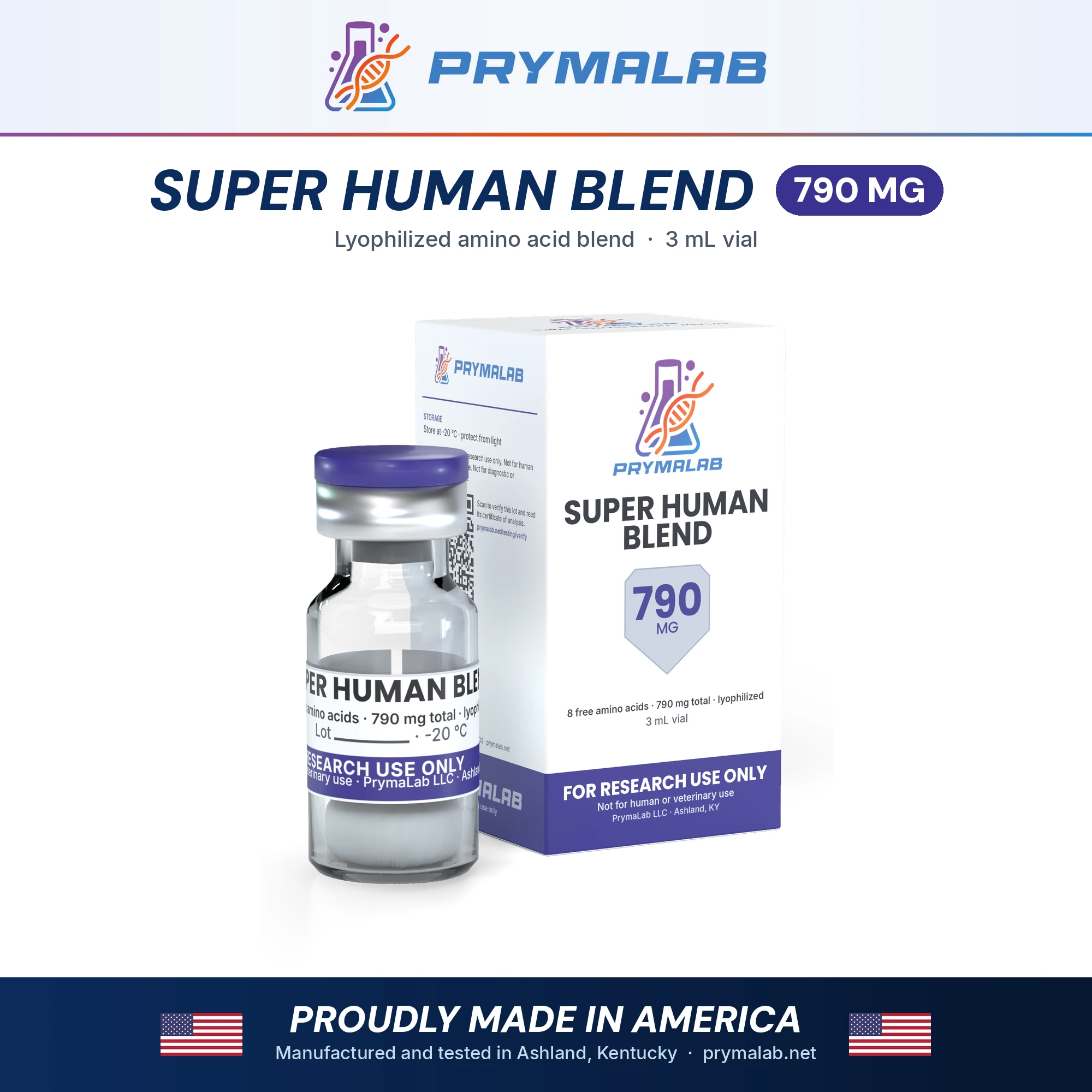
The SUPER Human Blend is a lyophilised mixture of eight free amino acids (L-carnitine, L-citrulline, L-arginine, L-ornithine, L-lysine, L-proline, taurine and L-glutamine) totalling 790 mg per vial, with no peptide bonds and no sequence. “Superhuman blend peptide” is the search term people use for it; chemically it is an amino acid blend, characterised by amino acid analysis rather than a single purity figure, and supplied for laboratory research use only.
Pryma SUPER Human Blend
Eight free amino acids, 790mg total · No peptide bonds, and no single purity number
The superhuman blend peptide search term describes a vial that holds no peptide. SUPER Human Blend is eight free amino acids totalling 790 milligrams, unlinked, with no amide bond anywhere in the vial. That single fact decides what the certificate can say, what the assay has to be, and why one purity number cannot describe the contents.
Specification Table
| Property | Value |
|---|---|
| Product format | Lyophilised powder, single vial |
| Article type | Eight-component free amino acid mixture |
| Stated total content | 790 mg |
| Peptide bonds present | None. Every component is an unlinked monomer |
| CAS number, blend | Not applicable. A mixture has no single registry number |
| Component 1 | L-Carnitine, 220 mg · 161.20 g/mol · approx. 1,365 µmol |
| Component 2 | L-Citrulline, 120 mg · 175.19 g/mol · approx. 685 µmol |
| Component 3 | L-Arginine, 110 mg · 174.20 g/mol · approx. 632 µmol |
| Component 4 | L-Ornithine, 110 mg · 132.16 g/mol · approx. 832 µmol |
| Component 5 | L-Lysine, 70 mg · 146.19 g/mol · approx. 479 µmol |
| Component 6 | L-Proline, 60 mg · 115.13 g/mol · approx. 521 µmol |
| Component 7 | Taurine, 60 mg · 125.15 g/mol · approx. 479 µmol |
| Component 8 | L-Glutamine, 40 mg · 146.14 g/mol · approx. 274 µmol |
| Summed molar content | Approx. 5,270 µmol, if every figure above is free base |
| Proteinogenic components | Four of eight: arginine, lysine, proline, glutamine |
| Non-proteinogenic alpha-amino acids | Two: citrulline and ornithine, both urea cycle intermediates |
| Not alpha-amino acids | Two: carnitine, a quaternary ammonium compound; taurine, an aminosulfonic acid |
| Appropriate assay | Amino acid analysis. Ion exchange with post-column ninhydrin, or pre-column derivatisation with reverse phase |
| Purity | Certificate for the current lot: in preparation; the safety data sheet is linked above. |
| Solubility | All eight components are water soluble across the range in question |
| Storage, lyophilised | -20°C, sealed, dry and dark |
| Storage, reconstituted | 2-8°C. Glutamine cyclises in aqueous solution, so prepare fresh |
| Regulatory status | No approved human or veterinary formulation of this mixture exists |
Why Is Superhuman Blend Peptide the Wrong Name?
Because a peptide is two or more amino acids joined by amide bonds, and there are no amide bonds in this vial.
The eight components are monomers sitting next to each other as a dry powder. Nothing links them. Nothing in the manufacturing joins them, and nothing in solution will.
This is not pedantry about naming. It removes an entire analytical toolkit.
A peptide certificate confirms identity by sequence and by observed mass against a calculated one. Neither test exists here. There is no sequence to confirm and there is no single mass, because there are eight of them.
It also removes the failure modes. Peptides in this catalogue degrade by deamidation at asparagine, by oxidation at methionine, by disulfide scrambling, by aspartyl-prolyl bond cleavage. Every one of those is a property of the backbone, and there is no backbone.
What remains is the chemistry of eight separate small molecules, which is a shorter and much duller list. That is a real advantage and nobody sells on it.
What Is Actually in the Vial?
Four proteinogenic amino acids, two urea cycle intermediates, and two compounds that are called amino acids out of habit.
Arginine, lysine, proline and glutamine are encoded by the genetic code and appear in proteins. Those four are amino acids in the strict sense.
Citrulline and ornithine are alpha-amino acids by structure but no codon encodes either. Both sit in the urea cycle rather than in protein sequence, and the published chemistry classifies them accordingly.
Carnitine is not an alpha-amino acid. It is a quaternary ammonium compound, beta-hydroxy-gamma-trimethylaminobutyrate, with the nitrogen four carbons away from the acid group rather than adjacent to it.
Taurine is not a carboxylic acid at all. The acid group is a sulfonic acid, which makes it 2-aminoethanesulfonic acid rather than an amino acid in the ordinary sense.
So the eight amino acid blend description is loose in two directions at once. Two components are not peptide building blocks and two more are not protein building blocks.
None of this makes the article worse. It makes the label inexact, and a laboratory ordering against a specification should know which four of the eight would show up in a protein hydrolysate.
Why Can This Vial Not Have One Purity Number?
Because purity is a ratio, and a ratio needs a numerator that names one thing.
On a single peptide, 99 percent by HPLC means the main chromatographic peak carries 99 percent of the absorbance and everything else carries one. The number is interpretable because there is one intended compound.
Run the same method on this vial and you get eight peaks by design. The largest is 28 percent of the mass. Calling that 28 percent pure would be absurd, and calling the sum of the eight 99 percent pure says nothing about whether the ratio between them is right.
The number that matters for a mixture is composition, not purity. How much of each of the eight is present, measured, against how much the label says.
That is a different assay. Amino acid analysis, as described in the protein science literature, separates and quantifies each component rather than integrating one peak against the rest.
The classical version is ion exchange chromatography with post-column ninhydrin detection. The modern version derivatises before the column and runs reverse phase. Either gives eight numbers.
A certificate that reports one purity figure for this article has answered a question nobody asked. Ask for the composition table instead, and ask what method produced it.
I would also ask for the purity of each input material separately, because that is the number the supplier actually has, and it is the one that governs what went into the blend before anybody weighed anything.
Why Does the Salt Form Matter More Here?
Because three of the eight are basic amino acids and one is a quaternary ammonium compound, and all four are normally sold as salts.
Arginine, ornithine and lysine are commonly supplied as hydrochlorides, and carnitine as the L-tartrate at two carnitines to one tartaric acid.
Hydrochloride adds 36.46 to the mass and contributes nothing else. That is 20 percent of the salt on lysine, 22 percent on ornithine, which is lighter, and 17 percent on the heavier arginine.
Carnitine L-tartrate is the largest correction of the four. The tartrate contributes 150.09 across two carnitines, so free carnitine is 68 percent of the salt mass and the tartrate is the other 32.
Apply all four corrections to the label and 790 milligrams of stated content becomes about 663 milligrams of free base. That is 84 percent.
A 16 percent gap is not fraud and it is not unusual. Every supplier in this market quotes salt masses, and the correction is standard practice for anybody who has worked with basic amino acids before.
What matters is that the label does not say which convention it used. Read as free base, 790 milligrams is one thing. Read as salt mass, it is another, and the difference is larger than most of the errors this catalogue spends whole pages worrying about.
One line on the certificate fixes it. Free base or salt, per component, stated once.
How Many Moles Are in 790 Milligrams?
Eight answers, and the total is not the useful one.
Summed, and assuming free base throughout, the vial holds about 5,270 micromoles. For scale, a 100 milligram vial of tirzepatide in this catalogue is around 21 micromoles.
So this article carries roughly 250 times the molecule count of the largest peptide fill on the site, at a fraction of the mass, because the components weigh between 115 and 175 daltons rather than 4,800.
The total is close to meaningless though, because the eight are not interchangeable and nothing consumes them in a fixed ratio.
The per-component figures are the ones to work from. Ornithine is the interesting case: it is joint third by mass at 110 milligrams but second by molecule count at 832 micromoles, because at 132.16 daltons it is the lightest thing in the vial.
Arginine sits at the same 110 milligrams and delivers 632 micromoles, a quarter fewer molecules for identical mass.
Anybody designing around a molar ratio rather than a mass ratio should run those numbers first, because the mass ranking and the molar ranking are not the same ranking.
Why Does This Page Not List Superhuman Blend Peptide Benefits?
Because this is a research-chemical listing and the honest answer to that question is a literature review rather than a product page.
Each of the eight components has a separate published literature, some of it extensive. Carnitine and taurine have both been the subject of full-length reviews in Physiological Reviews. Citrulline has a two-hundred-reference review in Amino Acids. Those are linked below.
What does not exist, as far as I can find, is published work on this specific eight-component combination at these specific ratios.
That is the gap worth naming. Reviewing what has been reported for eight compounds individually and then presenting the sum as though it describes the mixture is the move every competitor page makes, and it does not follow.
Combination chemistry is not additive by default. Whether eight compounds in one vial behave as eight separate inputs is an empirical question about this mixture, and I have not found anyone who has asked it in print.
So the page states the composition, names the assay, and stops. If a laboratory wants to know what the combination does, the design that answers it needs a comparator arm running the components separately, which is a study rather than a purchase.
What Should the Certificate Show?
More rows than a single-compound certificate, and one fewer of the rows people expect.
A composition table naming all eight components with measured content against label, not a single purity figure.
The method that produced it, named specifically enough to repeat. Ion exchange with ninhydrin, or the derivatising agent if the method is pre-column.
Salt form per component, stated as free base or as the named salt.
Identity confirmation for each component, which for small molecules is usually retention time against an authentic standard plus mass.
Water content, because several of these are hygroscopic and water is mass that looks like product on a balance.
Lot number and manufacturing date.
What should not be there is a sequence, an aggregate content figure by size exclusion, or an endotoxin result presented as a purity claim. The first two do not apply to monomers and the third measures something else.
Why Is There No Superhuman Blend Peptide Dosage Here?
Because the compliance position of this catalogue is that no page carries one, and because on this article the question has an extra layer.
Every product on this site is supplied for laboratory research and is not for human or animal consumption, which settles it on its own.
The extra layer is that a quantity figure for a mixture is ambiguous even inside a laboratory. Eight components, no fixed ratio in any published protocol, and a label whose salt convention is unstated.
A concentration derived from the 790 milligram figure describes the mixture rather than any component in it, and the concentration of each component is what an assay would need.
So the useful thing this page can do is give the arithmetic rather than a number. The per-component masses and molar quantities are in the table above, and a working concentration follows from those and whatever volume the reconstitution uses.
Anyone arriving at this page from a search for a quantity figure is going to be disappointed, and I would rather that than the alternative.
How Should the Vial Be Handled?
As eight small molecules rather than as a peptide, which makes most of it easier.
Sealed, dry and dark at minus 20 degrees Celsius keeps the powder stable for a long time. Free amino acids as dry solids are among the least reactive materials in this catalogue.
Let the vial reach room temperature before opening. Several components are hygroscopic and cold glass condenses water out of room air onto the cake.
Reconstitute with the diluent run down the wall rather than onto the cake, and give it time rather than shaking.
Prepare solutions fresh. Glutamine cyclises to pyroglutamate in aqueous solution, releasing ammonia, and the published analytical work shows the same cyclisation happening in the mass spectrometer source, which means a solution that has aged is a different composition from the one that was weighed.
That is the one genuine stability caution on this article, and it applies to a single component out of eight rather than the vial as a whole.
Do not freeze and thaw a made-up solution repeatedly. There is no aggregation risk here, but there is no reason to add cycles either.
Low-binding consumables are unnecessary. Adsorption to plastic is a problem for surface-active peptides, and none of these eight qualifies.
Published Literature
Full citations for the work named above. Each was confirmed against the publisher record before it was listed. Nothing on this list describes the eight-component mixture itself, because no such work was found.
- Rutherfurd SM, Gilani GS. Current Protocols in Protein Science. 2009;58(1). DOI: 10.1002/0471140864.ps1109s58
- Purwaha P, Silva LP, Hawke DH, Weinstein JN, Lorenzi PL. Analytical Chemistry. 2014;86(12):5633-5637. DOI: 10.1021/ac501451v
- Curis E, Nicolis I, Moinard C, Osowska S, Zerrouk N, Benazeth S, et al. Amino Acids. 2005;29(3):177-205. DOI: 10.1007/s00726-005-0235-4
- Huxtable RJ. Physiological Reviews. 1992;72(1):101-163. DOI: 10.1152/physrev.1992.72.1.101
- Bremer J. Physiological Reviews. 1983;63(4):1420-1480. DOI: 10.1152/physrev.1983.63.4.1420
- Manning MC, Chou DK, Murphy BM, Payne RW, Katayama DS. Pharmaceutical Research. 2010;27(4):544-575. DOI: 10.1007/s11095-009-0045-6
Frequently Asked Questions
What is the super human blend?
The super human blend is PrymaLab’s SUPER Human Blend: eight free amino acids in one lyophilised vial, 790 mg in total. Per vial it holds L-carnitine 220 mg, L-citrulline 120 mg, L-arginine 110 mg, L-ornithine 110 mg, L-lysine 70 mg, L-proline 60 mg, taurine 60 mg and L-glutamine 40 mg. It is supplied for laboratory research use only.
Is the superhuman blend a peptide?
No. A peptide is a chain of amino acids joined by amide bonds in a fixed order, with one sequence and one molecular weight. The superhuman blend has no bonds between its components, no sequence and eight molecular weights, from 115 to 175 g/mol. It is a free amino acid mixture that shares only the vial format with a peptide.
What are superhuman peptides?
“Superhuman peptides” is a search phrase rather than a class of compounds. It usually refers to this SUPER Human amino acid blend, which contains no peptides, or loosely to research peptides marketed for performance. A listing for a peptide states a sequence and a molecular weight; this product states a composition table instead, because it is a mixture of monomers.
What is in the SUPER Human blend?
Eight free amino acids: L-carnitine 220 mg (about 1,365 µmol), L-citrulline 120 mg (685 µmol), L-arginine 110 mg (632 µmol), L-ornithine 110 mg (832 µmol), L-lysine 70 mg (479 µmol), L-proline 60 mg (521 µmol), taurine 60 mg (479 µmol) and L-glutamine 40 mg (274 µmol). The total is 790 mg, about 5,270 µmol, supplied lyophilised in one vial.
How is the blend characterised on the certificate?
By composition rather than by purity. Purity is a ratio against one intended molecule and this vial has eight, so the right assay is amino acid analysis, with one measured content per component against the label. The lines to look for are the method (ion exchange with ninhydrin or pre-column derivatisation HPLC), how carnitine was quantified separately, the salt form per component and water content.
What is superhuman blend peptide?
It is a search term rather than a compound. The article people mean is SUPER Human Blend, a vial of eight free amino acids totalling 790 milligrams. There are no amide bonds between the components, so nothing in the vial is a peptide. It is supplied lyophilised for laboratory research use only.
What are the super human blend ingredients?
Eight components: L-carnitine at 220 milligrams, L-citrulline at 120, L-arginine and L-ornithine at 110 each, L-lysine at 70, L-proline and taurine at 60 each, and L-glutamine at 40. The masses sum to 790 milligrams. The full table with molecular weights and molar quantities is above.
Is SUPER Human Blend a peptide blend?
No. A peptide blend contains peptides, meaning chains of amino acids joined by amide bonds. This vial contains the amino acids themselves, unlinked. The distinction matters because it removes sequence confirmation, single-mass confirmation and every backbone degradation route from the analysis.
Why does the certificate not give one purity figure?
Because purity is a ratio against one intended compound and there are eight here. A single chromatographic purity number would either describe the largest component, which is 28 percent of the mass, or the sum of all eight, which says nothing about their ratio. Composition is the correct measurement.
What assay should be used for this article?
Amino acid analysis, which separates and quantifies each of the eight components individually rather than integrating one peak against everything else. The classical form is ion exchange chromatography with post-column ninhydrin detection, and modern methods derivatise before a reverse phase column instead. Either way the output is eight numbers.
How much of the 790 milligrams is free amino acid?
It depends on the salt convention, which the label does not state. If arginine, ornithine and lysine are present as hydrochlorides and carnitine as the tartrate, the free base content of 790 milligrams is about 663, or 84 percent. If every figure is already free base, it is 790.
How many moles are in one vial?
About 5,270 micromoles summed, assuming free base throughout. Per component the range runs from 274 micromoles of glutamine to 1,365 of carnitine. The summed figure is not much use because the components are not interchangeable, so work from the per-component numbers in the table.
Are all eight components actually amino acids?
Four are, in the strict sense: arginine, lysine, proline and glutamine are encoded and appear in proteins. Citrulline and ornithine are alpha-amino acids that no codon encodes. Carnitine is a quaternary ammonium compound and taurine is an aminosulfonic acid, so neither is an alpha-amino acid at all.
What are the superhuman blend peptide benefits reported in the literature?
Individual components have substantial published literatures, including full reviews of carnitine and taurine in Physiological Reviews and a large review of citrulline in Amino Acids. No published work covers this eight-component combination at these ratios. So the page states what is in the vial and does not extrapolate from the parts to the whole.
Why is there no superhuman blend peptide dosage on this page?
Every article in this catalogue is supplied for laboratory research and is not for human or animal consumption, so no page carries a quantity figure. On a mixture the question is also ambiguous, because a figure derived from the 790 milligram total describes the blend rather than any component in it.
How should the vial be stored?
Sealed, dry and dark at minus 20 degrees Celsius. Free amino acids as dry solids are unusually stable. Let the vial warm to room temperature before opening, because several components are hygroscopic and cold glass condenses water onto the cake.
Does a made-up solution keep?
Prepare it fresh. Glutamine cyclises to pyroglutamate in aqueous solution with release of ammonia, and published analytical work records the same cyclisation occurring in a mass spectrometer source. A solution left standing is a different composition from the one that was weighed out.
Compliance Statement
Pryma SUPER Human Blend is supplied exclusively for laboratory research use. It is not a drug, food, cosmetic, or dietary product of any kind, and it is not a dietary supplement. It has not been evaluated by the FDA or any comparable authority, and no approved human or veterinary formulation of this mixture exists. It is not intended to diagnose, treat, cure or prevent any disease, and it must not be given to humans or animals. Purchase is restricted to qualified researchers and institutions. No published work describing this eight-component combination at these ratios was identified, and nothing on this page should be read as a claim about the mixture derived from work on its individual components.







18 reviews for Pryma SUPER Human Blend