Description
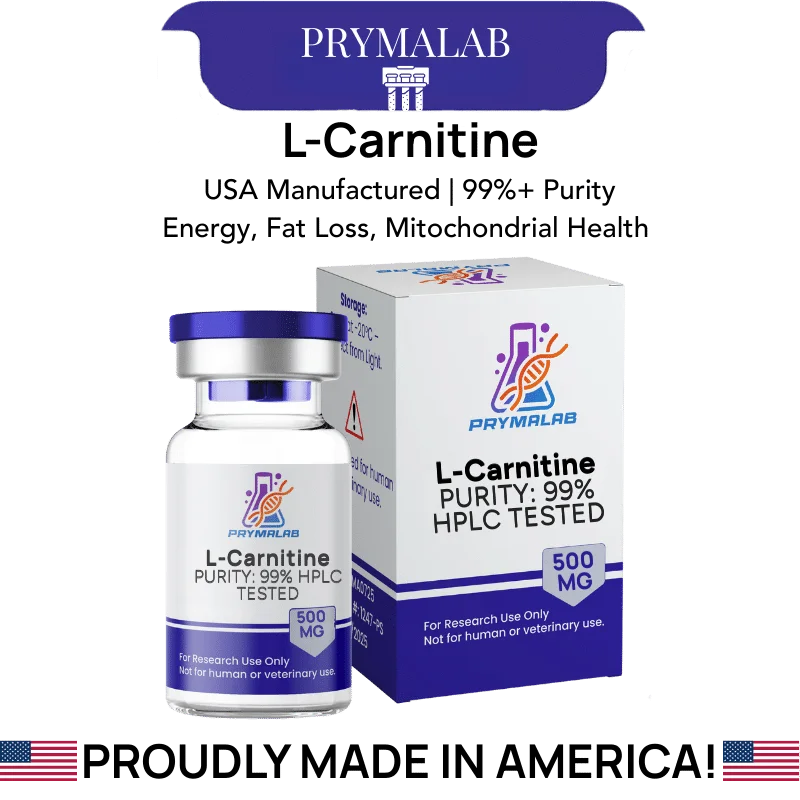
L-Carnitine Injectable 500 mg/mL — Levocarnitine Solution
For laboratory research use only. Not for human consumption, diagnostic, or therapeutic use.
What Is L-Carnitine Injectable 500 mg/mL?
L-Carnitine Injectable 500 mg/mL is a sterile aqueous solution of levocarnitine — the biologically active L-isomer of carnitine — supplied in a multi-dose vial for laboratory research applications. Each milliliter of solution contains 500 mg of levocarnitine base.
Carnitine is not a true amino acid, despite how it is usually described in supplement marketing. Amino acid derivative is closer to right: it is a quaternary ammonium compound, β-hydroxy-γ-trimethylaminobutyrate, biosynthesized in the liver and kidneys from two precursor amino acids, lysine and methionine, in a four-step pathway requiring vitamin C, vitamin B6, niacin, and iron as cofactors. Endogenous synthesis supplies roughly 1.2 µmol/kg of body weight per day. An omnivorous diet supplies considerably more — red meat is the densest common source — while strict vegetarian and vegan diets supply very little, which is why plasma and muscle carnitine concentrations differ measurably between these populations.
Approximately 95% of total body carnitine resides in skeletal muscle, with the remainder distributed across cardiac muscle, liver, kidney, and plasma. Skeletal muscle concentrations sit in the range of 20–25 mmol per kilogram of dry muscle, which is roughly 100-fold higher than plasma concentrations of 40–60 µmol/L. Maintaining that steep gradient requires active transport, and the mechanism of that transport turns out to be the single most important consideration in evaluating any carnitine preparation — including this one.
This listing describes a research-grade injectable presentation. It is not a dietary supplement, it is not a substitute for a prescription levocarnitine product, and nothing below should be read as a dosing recommendation for a person.
Why an Injectable Presentation Exists
Oral carnitine has a well-characterized absorption problem. Rebouche’s kinetic work, summarized in Annals of the New York Academy of Sciences (2004), established that the bioavailability of oral carnitine supplements in the 0.5–6 g range is only 14–18% of the administered dose, because absorption at supplemental doses is largely passive and the saturable intestinal transport mechanism is quickly overwhelmed. Carnitine consumed as part of a normal meal behaves quite differently, with bioavailability of 54–87%, since the smaller quantities are handled by active transport.
That leaves a large unabsorbed fraction in the gut lumen, and its fate matters. Koeth and colleagues, publishing in Nature Medicine (2013), demonstrated that intestinal microbiota metabolize dietary and supplemental carnitine into trimethylamine, which the liver oxidizes to trimethylamine-N-oxide (TMAO). In their mouse work, chronic carnitine feeding altered cecal microbial composition, elevated TMAO, and accelerated atherosclerosis, the mechanism by which carnitine intake was proposed to raise cardiovascular disease risk, and those effects were abolished when the microbiota were suppressed with antibiotics. In their human cohort of 2,595 subjects undergoing cardiac evaluation, plasma carnitine predicted incident major adverse cardiac events, but only in subjects who also had high TMAO. Omnivores generated substantially more TMAO from a carnitine challenge than vegans or vegetarians, consistent with a microbiome-dependent mechanism.
Parenteral administration is the direct answer to both problems. It bypasses intestinal absorption entirely, delivering the full dose to the plasma compartment, and it leaves no unabsorbed residue for gut bacteria to convert to trimethylamine. This is the clearest, most defensible rationale for an injectable carnitine preparation, and it is worth stating plainly because most of the surrounding marketing in this category does not.
Injectable L-carnitine exists as a category for exactly that reason. Most of the L-carnitine injections sold commercially come from a 503A pharmacy compounding against patient-specific prescriptions, administered by intramuscular injection or subcutaneously. This listing is a different thing: a research-grade injectable formulation, not a compounded prescription and not an injectable supplement.
What injection does not do is solve the second bottleneck, and any honest description of this product has to address that directly.
The Transporter Bottleneck: Why Plasma Concentration Is Not the Whole Story
Carnitine enters skeletal muscle through OCTN2, a sodium-dependent, high-affinity organic cation transporter encoded by SLC22A5. The defining characteristic of OCTN2 is its affinity: its Michaelis constant for carnitine is in the low micromolar range, well below normal circulating plasma concentrations of 40–60 µmol/L.
The implication is counterintuitive and frequently ignored. The muscle carnitine transporter is already close to saturation at normal plasma concentrations. Raising plasma carnitine — by any route, oral or parenteral — does not by itself drive proportionally more carnitine into muscle, because the transporter is the rate-limiting step and it is already running near capacity.
This is why the early generation of carnitine research produced so many null results. Investigators raised plasma carnitine, measured muscle biopsies, and found muscle carnitine unchanged.
The mechanism that does move the needle was identified by Stephens and Greenhaff at the University of Nottingham. In work published in The FASEB Journal (2006), they showed that insulin acutely increases muscle carnitine content during hypercarnitinemia. Combining elevated plasma carnitine (approximately 500 µmol/L) with hyperinsulinemia raised muscle total carnitine from 22.0 to 24.7 mmol/kg dry mass and produced a 2.3-fold increase in carnitine transporter protein. Insulin upregulates OCTN2. Without that signal, hypercarnitinemia is largely a plasma phenomenon that the kidney then clears.
The renal clearance data make this concrete. Per the CARNITOR (levocarnitine) injection prescribing information, following a single intravenous dose approximately 76% of the administered levocarnitine is excreted in urine within 24 hours. Compare that to steady-state oral dosing, where urinary excretion during a 12-hour dosing interval is around 9% of the administered dose. Tubular reabsorption of carnitine is efficient at physiological plasma concentrations and saturates sharply above them. Push plasma carnitine well past the renal threshold and the excess is filtered and lost rather than reabsorbed.
The practical research conclusion: a parenteral route guarantees plasma delivery, but tissue loading is governed by transporter kinetics, not by how much you inject. Study designs that ignore this tend to produce negative findings regardless of route.
Mechanism of Action: Mitochondrial Fatty Acid Transport
Carnitine’s central biochemical role is as the obligatory carrier in the carnitine shuttle, the system that moves long-chain fatty acids into the mitochondrial matrix for β-oxidation. That is the whole of its contribution to fat metabolism and, downstream, to energy production: carnitine gets the substrate across the membrane. It does not oxidize anything itself.
Long-chain acyl-CoA molecules cannot cross the inner mitochondrial membrane unaided. The shuttle operates in three enzymatic steps:
- Carnitine palmitoyltransferase I (CPT1), embedded in the outer mitochondrial membrane, transfers the acyl group from coenzyme A to carnitine, forming acylcarnitine. CPT1 is the committed, rate-limiting step of long-chain fatty acid oxidation and is allosterically inhibited by malonyl-CoA — the mechanistic link between carbohydrate availability and fat oxidation rate.
- Carnitine-acylcarnitine translocase (CACT), in the inner membrane, exchanges acylcarnitine inward for free carnitine outward.
- Carnitine palmitoyltransferase II (CPT2), on the matrix side of the inner membrane, regenerates acyl-CoA and releases free carnitine for another cycle.
Carnitine has a second, less-discussed function that matters more than the fat-transport story at high exercise intensities. Free carnitine buffers the mitochondrial acetyl-CoA pool by accepting acetyl groups via carnitine acetyltransferase to form acetylcarnitine. During intense exercise, glycolytic flux generates acetyl-CoA faster than the TCA cycle consumes it, and the rising acetyl-CoA/CoA ratio inhibits pyruvate dehydrogenase. Free carnitine relieves that inhibition. This is why carnitine status affects high-intensity metabolism at all — a point the older literature, focused exclusively on fat burning, largely missed. It also explains why carnitine is studied against oxidative stress markers: a saturated acetyl-CoA pool and stalled electron flow are the conditions that generate reactive oxygen species.
Complementary mitochondrial research compounds available for related work include MOTS-c, SLU-PP-332, and AICAR, which act on mitochondrial biogenesis and AMPK signaling rather than on substrate transport.
What the Evidence Actually Shows
The published literature on carnitine is large, uneven in quality, and considerably more mixed than most product pages admit. Here is a fair reading of it.
Body composition: real but modest
Pooyandjoo and colleagues published a systematic review and meta-analysis in Obesity Reviews (2016) covering nine randomized controlled trials and 911 participants. Subjects receiving carnitine lost significantly more weight than controls — a mean difference of −1.33 kg (95% CI −2.09 to −0.57) — with a BMI reduction of −0.47 kg/m². Meta-regression found that the magnitude of the effect significantly decreased with longer trial duration (p = 0.002).
A larger dose-response meta-analysis by Talenezhad et al. in Clinical Nutrition ESPEN (2020), covering 37 randomized controlled trials, reached broadly similar conclusions.
Roughly 1.3 kg over the course of a trial is a genuine, statistically significant effect. It is not the transformation that most carnitine marketing implies, and the attenuation over time suggests adaptation. Any research protocol built around carnitine as a primary body-composition intervention should be powered with that effect size in mind. Related compounds in this category include Lipo-C lipotropic solution, 5-Amino-1MQ, and tesofensine. Lipotropic blends of the Lipo-C type pair carnitine with methionine, inositol, choline, and often vitamin B12.
Exercise metabolism: the strongest mechanistic study
Wall et al., The Journal of Physiology (2011), remains the most rigorous demonstration that muscle carnitine loading changes fuel metabolism. Participants ingested 2 g of L-carnitine L-tartrate plus 80 g of carbohydrate twice daily — 4 g of carnitine and 160 g of carbohydrate per day — for 24 weeks, in a randomized double-blind design with muscle biopsies.
Results in the carnitine group:
- Muscle total carnitine rose 21% from baseline; controls were unchanged.
- At 50% VO₂max, subjects used 55% less muscle glycogen than controls, with 31% lower PDC activation.
- At 80% VO₂max, PDC activation was 38% higher, muscle lactate 44% lower, and the PCr/ATP ratio better maintained.
- Work output in a 30-minute performance trial increased 11% from baseline; controls showed no change.
Two points deserve emphasis, because this study is routinely misquoted. First, the 55% figure is glycogen sparing at low intensity, not an increase in fat oxidation — it is frequently cited as the latter, and that is simply wrong. Second, this required 24 weeks and large daily carbohydrate co-ingestion to drive insulin-mediated transporter upregulation. Shorter protocols without the insulin stimulus have generally failed to increase muscle carnitine.
Systematic reviews of acute and chronic oral carnitine and exercise performance find intensity-dependent and inconsistent effects. A 2025 randomized double-blind placebo-controlled crossover trial found acute carnitine did not improve CrossFit performance. The honest summary is that chronic loading with adequate insulin signal alters muscle fuel selection; acute dosing largely does not.
Endurance, stamina, and athletic performance are outcome words. What the loading studies measured is muscle fuel selection and, in the Wall protocol, work output across a single 30-minute trial. Muscle fatigue and muscle cramps were not endpoints in that work at all. The 160 g of daily carbohydrate that made the protocol succeed is itself an insulin sensitivity variable, and most shorter study designs neither supply it nor control for it.
Recovery: the most consistent finding
The recovery literature is where carnitine performs most reliably. Volek, Kraemer, and colleagues, in the American Journal of Physiology–Endocrinology and Metabolism (2002), gave ten resistance-trained men 2 g/day of L-carnitine L-tartrate or placebo for three weeks before a squat protocol. Exercise-induced rises in markers of purine catabolism (hypoxanthine, xanthine oxidase, serum uric acid) and in circulating cytosolic proteins (myoglobin, fatty acid-binding protein, creatine kinase) were all significantly attenuated (P ≤ 0.05).
A follow-up trial in middle-aged men and women reproduced the pattern, and subsequent systematic reviews of exercise-induced muscle damage have generally supported an attenuating effect. Note that these are biochemical markers, not performance outcomes — a reduction in circulating creatine kinase is a meaningful signal of reduced sarcolemmal disruption, but it is not the same as demonstrated faster return to full function. Muscle recovery is the word the category reaches for; attenuated efflux of cytosolic proteins is the measurement that exists. Research on recovery-oriented compounds may also involve amino acid blends.
Where the evidence is genuinely strong — and why it may not transfer
The most robust carnitine data come from populations with carnitine deficiency: primary systemic carnitine deficiency from SLC22A5 mutations, secondary deficiency from valproic acid therapy or organic acidemias, long-term parenteral nutrition without carnitine supplementation, and end-stage renal disease on hemodialysis, where dialysis strips carnitine from plasma. Advanced kidney disease is the setting with the clearest parenteral evidence base. Intravenous levocarnitine is an established, approved therapy in these settings, which is precisely why an injectable levocarnitine product exists as a pharmaceutical at all.
Cardiac literature is also substantial. Meta-analytic work in Mayo Clinic Proceedings has reported reductions in mortality and ventricular arrhythmia with carnitine following acute myocardial infarction. Propionyl-L-carnitine carries its own vascular literature in peripheral artery disease, where meta-analysis found roughly a 16-meter gain in peak walking distance over placebo, and small trials have looked at angina. Carnitine also appears in male infertility research: a meta-analysis of three randomized trials reported improved sperm motility and morphology with no change in concentration. Smaller and less consistent literatures touch hypertension and blood flow, mostly as secondary endpoints in metabolic-syndrome trials.
None of that makes carnitine a heart health or cardiovascular health compound in replete subjects, and nothing in the published record supports the longevity or brain function framing the category has picked up.
The important caveat: these are repletion studies in deficient or diseased populations. Correcting a deficiency produces large effects. Adding carnitine to an already-replete system produces small ones. Extrapolating from dialysis and cardiac trials to healthy, well-fed research subjects is not supported, and this listing does not make that claim.
The gap specific to this presentation
There is essentially no controlled trial literature on injectable carnitine in healthy exercising humans. The parenteral evidence base is in deficiency and dialysis populations; the exercise and body-composition evidence base is almost entirely oral. Anyone designing research with this product should understand they are working in a space where the route-specific data do not yet exist. That is a legitimate reason to run a study. It is not a reason to assume the oral findings transfer.
Pharmacokinetics of Parenteral Levocarnitine
Parameters below are drawn from published pharmacokinetic characterization of intravenous levocarnitine, including the CARNITOR injection prescribing information.
| Parameter |
Value |
| Route-specific bioavailability |
100% (parenteral, bypasses intestinal absorption) |
| Oral supplement bioavailability, for comparison |
14–18% |
| Plasma profile after IV bolus |
Two-compartment model |
| Distribution half-life |
≈ 0.585 h |
| Terminal elimination half-life |
≈ 17.4 h |
| Urinary excretion, 0–24 h after IV dose |
≈ 76% of dose |
| Urinary excretion, oral steady state (12 h interval) |
≈ 9% of dose |
| Primary reservoir |
Skeletal muscle, ≈ 95% of total body carnitine |
| Hepatic metabolism |
Minimal; largely excreted unchanged |
| Renal handling |
Extensive tubular reabsorption at physiological concentrations; saturates above threshold |
The contrast between 76% and 9% urinary recovery is the most informative line in this table. It quantifies exactly how much of a parenteral bolus is cleared rather than retained, and it is the reason that dose escalation is an unproductive strategy with carnitine. Once plasma concentration exceeds the renal reabsorption threshold, additional drug is excreted.
Carnitine Forms: What This Product Is and Is Not
The compound in this vial is levocarnitine base in solution — the free L-isomer. It is not a tartrate, fumarate, acetylated, or propionylated derivative. Salt forms exist principally to stabilize carnitine for solid oral dosage; carnitine base is hygroscopic and difficult to compress into tablets, so oral products bind it to tartaric or fumaric acid. In an aqueous injectable, that stabilization is unnecessary. Any listing for an injectable that claims “L-carnitine L-tartrate” as the active ingredient is describing an oral formulation.
Levocarnitine (this product). The parent compound, and the form used in every approved parenteral carnitine product. Appropriate for research on systemic carnitine status, mitochondrial fatty acid transport, and tissue repletion.
L-Carnitine L-Tartrate (LCLT). Carnitine base bound to tartaric acid, typically 68% carnitine by mass. An oral solid-dose form. It carries the bulk of the exercise-recovery literature (Volek 2002 and successors) purely because that is what those investigators used — the tartrate moiety dissociates in solution and has no independent activity in the shuttle. LCLT’s evidentiary depth reflects study history, not pharmacological superiority.
Acetyl-L-Carnitine (ALCAR). An acetylated derivative with materially better blood-brain barrier penetration, making it the form of interest for central nervous system research. The acetyl group also feeds the acetyl-CoA pool. Distinct research applications from levocarnitine; not interchangeable.
Propionyl-L-Carnitine (PLC). Carries a propionyl group that enters the TCA cycle as succinyl-CoA. Studied primarily in peripheral arterial disease and heart failure models, with reported improvements in claudication-limited walking distance. Its literature is vascular rather than athletic.
L-Carnitine Fumarate. Another oral salt form. The fumarate contributes a TCA intermediate, though its metabolic significance at typical doses is unclear.
Contrary to what the previous version of this listing claimed, there is no credible basis for “95–98% absorption” figures attached to any oral carnitine form. The measured figure across oral supplemental forms is 14–18%. That claim has been removed.
Doses Reported in the Published Literature
The following are doses used in published human research, provided for reference in study design and literature comparison. They are not instructions and not recommendations.
| Study context |
Reported protocol |
| Wall et al. 2011, muscle carnitine loading |
2 g LCLT + 80 g carbohydrate, twice daily oral, 24 weeks |
| Volek et al. 2002, recovery markers |
2 g/day LCLT oral, 3 weeks |
| Stephens & Greenhaff 2006, transporter mechanism |
IV carnitine to ≈ 500 µmol/L plasma plus hyperinsulinemic clamp |
| Weight-management meta-analyses |
Typically 1–4 g/day oral, 4–24 weeks |
| Hemodialysis repletion (approved indication) |
10–20 mg/kg IV post-dialysis |
Note that the studies producing the largest changes in muscle carnitine required an insulin stimulus and sustained administration measured in months. Study durations under 8–12 weeks have generally been insufficient to alter muscle carnitine content by any route.
At 500 mg/mL, each milliliter of this solution contains 500 mg of levocarnitine. Volumetric calculations should be performed against the labelled concentration and verified against the certificate of analysis supplied with each lot.
Handling, Stability, and Multi-Dose Vial Considerations
- Storage: Store at controlled room temperature, 20–25 °C, protected from light. Do not freeze.
- Multi-dose handling: Swab the stopper with 70% isopropyl alcohol before each entry. Multi-dose vials are subject to progressive contamination risk with repeated access; laboratory SOPs should specify a beyond-use date after first puncture.
- Inspection: Levocarnitine solution should be clear and colorless. Discard any vial showing particulates, discoloration, or a compromised stopper or seal.
- Compatibility: Levocarnitine is a small, highly water-soluble molecule. Do not assume compatibility with other solutions without verification; do not combine with other compounds in a shared vial.
- Documentation: Retain the lot-specific certificate of analysis. Identity should be confirmed by HPLC, and the L-isomer specifically — D-carnitine is a competitive inhibitor of carnitine-dependent enzymes and its presence is a meaningful quality failure, not a trivial impurity.
Safety Signals and Limitations in the Literature
Reported side effects. The side effects associated with oral carnitine are gastrointestinal — nausea, vomiting, cramping, diarrhea — largely attributable to the unabsorbed luminal fraction. Parenteral administration would not be expected to produce these, though injection-site reactions are a route-specific consideration. Trimethylaminuria, the fishy body odor sometimes reported, occurs in a small minority and reflects incomplete hepatic oxidation of trimethylamine.
The TMAO question. As discussed above, TMAO generation is microbiome-mediated and therefore depends on unabsorbed carnitine reaching the colon. Parenteral administration should substantially reduce this pathway relative to oral dosing. This is a mechanistically sound inference, but it has not been directly tested in a controlled comparison of routes, and it is presented here as reasoning rather than as a demonstrated finding.
D-carnitine. The D-isomer competitively inhibits carnitine acyltransferases and can induce functional carnitine deficiency in muscle. Racemic DL-carnitine, written in older literature as D, L-carnitine, is not an acceptable substitute for levocarnitine in any research context.
Thyroid interaction. Carnitine has been reported to antagonize thyroid hormone action at the nuclear level, which is relevant to study design in any protocol involving thyroid parameters.
Renal function. Since elimination is almost entirely renal, renal impairment materially alters the pharmacokinetic profile.
Anticonvulsants. Valproic acid depletes carnitine and is the best-documented drug cause of secondary deficiency; the risk rises on polytherapy with phenytoin, phenobarbital, or carbamazepine. Levocarnitine is used clinically for valproate-induced hyperammonemic encephalopathy, which is a repletion indication rather than a performance one.
Anticoagulation. Case reports describe potentiation of warfarin-type anticoagulants.
Frequently Asked Questions
How does the injectable route change carnitine pharmacokinetics compared to oral? It removes the absorption barrier entirely. Oral supplemental carnitine is 14–18% bioavailable; parenteral administration delivers the full dose to plasma. It also eliminates the unabsorbed luminal fraction that gut microbiota convert to trimethylamine. What it does not change is muscle uptake, which is governed by OCTN2 transporter kinetics rather than by plasma concentration.
Does higher plasma carnitine mean more carnitine in muscle? Not proportionally. OCTN2 is a high-affinity transporter operating near saturation at normal plasma concentrations of 40–60 µmol/L. Stephens and Greenhaff showed that insulin is required to upregulate the transporter before hypercarnitinemia translates into meaningful muscle accumulation. Absent that signal, roughly 76% of an intravenous dose is excreted in urine within 24 hours.
Why is this 500 mg/mL rather than 5,000 mg? The concentration describes the solution, not a serving. Each millilitre contains 500 mg of levocarnitine, so total delivered mass depends on volume drawn. The reference-grade parenteral levocarnitine product supplies 1 g per 5 mL, or 200 mg/mL; this preparation is 2.5-fold more concentrated per unit volume.
Is this the same as L-carnitine L-tartrate? No. This is levocarnitine base in aqueous solution. LCLT is a solid-dose oral salt in which carnitine is bound to tartaric acid at roughly 68% carnitine by mass. The tartrate dissociates in solution and contributes nothing to the carnitine shuttle. LCLT dominates the exercise-recovery literature because that is what those investigators happened to use.
What does the research say about carnitine and fat loss? Meta-analytic data support a real but modest effect: −1.33 kg versus control across nine RCTs in 911 participants, with the effect attenuating significantly as trial duration increases. Mechanistically, carnitine facilitates fatty acid entry into mitochondria, which is one step in fat metabolism rather than a driver of it; it does not create an energy deficit, and CPT1 flux is not the limiting step in fat loss under most conditions.
Why did the previous version of this listing recommend 75 mg three times weekly? It was incorrect, and internally inconsistent with the rest of that document, which elsewhere referenced 2,500 mg and 5,000 mg daily. No published carnitine research uses anything resembling a 225 mg weekly total. Those figures have been removed rather than corrected, because dosing guidance is outside the scope of a research-use listing.
Is there research on injectable carnitine in healthy athletes? Essentially none. The parenteral literature is concentrated in hemodialysis and carnitine-deficiency populations; the exercise literature is almost entirely oral. No controlled trial has tested L-carnitine injections against oral dosing for any performance or body-composition endpoint. This is an open area, and it should be described as one.
Who has the largest baseline carnitine deficit? Strict vegetarians and vegans, who obtain very little dietary carnitine and rely primarily on endogenous synthesis. Individuals with SLC22A5 variants, those on valproate, and hemodialysis patients also carry documented deficits. Repletion effects in deficient systems are consistently larger than supplementation effects in replete ones — the single most important pattern in the entire carnitine literature.
Product Specifications
| Specification |
Detail |
| Compound |
Levocarnitine (L-carnitine base) |
| CAS number |
541-15-1 |
| Molecular formula |
C₇H₁₅NO₃ |
| Molecular weight |
161.20 g/mol |
| Concentration |
500 mg/mL |
| Vial format |
Multi-dose vial, [insert fill volume] mL |
| Total content per vial |
[insert fill volume × 500] mg levocarnitine |
| Physical form |
Clear, colorless sterile aqueous solution |
| Purity |
≥ 99% by HPLC |
| Isomeric purity |
L-isomer; D-carnitine below detection limit |
| Storage |
20–25 °C, protected from light; do not freeze |
| Documentation |
Lot-specific certificate of analysis provided |
Compliance Notice
This product is supplied strictly for laboratory and research use only. It is not a dietary supplement, not a drug, and is not for human or veterinary consumption, diagnostic use, or therapeutic use. It is not intended to diagnose, treat, cure, or prevent any disease.
Levocarnitine injection is an FDA-approved prescription pharmaceutical for specific indications including primary and secondary carnitine deficiency and carnitine depletion in end-stage renal disease patients on dialysis. Nothing in this listing should be interpreted as a recommendation to use this research material in place of a prescribed pharmaceutical or as a substitute for medical care.
All references to published research are provided for scientific context. Doses cited are those used in published studies and are reported for literature reference only. Purchasers are responsible for compliance with all applicable local, state, and federal regulations, and for appropriate institutional oversight of any research conducted with this material.
Key References
- Wall BT, Stephens FB, Constantin-Teodosiu D, Marimuthu K, Macdonald IA, Greenhaff PL. Chronic oral ingestion of L-carnitine and carbohydrate increases muscle carnitine content and alters muscle fuel metabolism during exercise in humans. J Physiol. 2011;589(4):963–973.
- Stephens FB, Constantin-Teodosiu D, Laithwaite D, Simpson EJ, Greenhaff PL. Insulin stimulates L-carnitine accumulation in human skeletal muscle. FASEB J. 2006;20(2):377–379.
- Volek JS, Kraemer WJ, Rubin MR, Gómez AL, Ratamess NA, Gaynor P. L-Carnitine L-tartrate supplementation favorably affects markers of recovery from exercise stress. Am J Physiol Endocrinol Metab. 2002;282(2):E474–E482.
- Pooyandjoo M, Nouhi M, Shab-Bidar S, Djafarian K, Olyaeemanesh A. The effect of (L-)carnitine on weight loss in adults: a systematic review and meta-analysis of randomized controlled trials. Obes Rev. 2016;17(10):970–976.
- Talenezhad N, Mohammadi M, Ramezani-Jolfaie N, Mozaffari-Khosravi H, Salehi-Abargouei A. Effects of L-carnitine supplementation on weight loss and body composition: a systematic review and meta-analysis of 37 randomized controlled clinical trials with dose-response analysis. Clin Nutr ESPEN. 2020;37:9–23.
- Rebouche CJ. Kinetics, pharmacokinetics, and regulation of L-carnitine and acetyl-L-carnitine metabolism. Ann N Y Acad Sci. 2004;1033:30–41.
- Koeth RA, Wang Z, Levison BS, et al. Intestinal microbiota metabolism of L-carnitine, a nutrient in red meat, promotes atherosclerosis. Nat Med. 2013;19(5):576–585.
- Evans AM, Fornasini G. Pharmacokinetics of L-carnitine. Clin Pharmacokinet. 2003;42(11):941–967.
- CARNITOR (levocarnitine) Injection prescribing information. Leadiant Biosciences.
- Linus Pauling Institute Micronutrient Information Center. L-Carnitine. Oregon State University.












14 reviews for L-Carnitine 500mg