Description
PrymaLab · Research use only
L-Carnitine 500mg
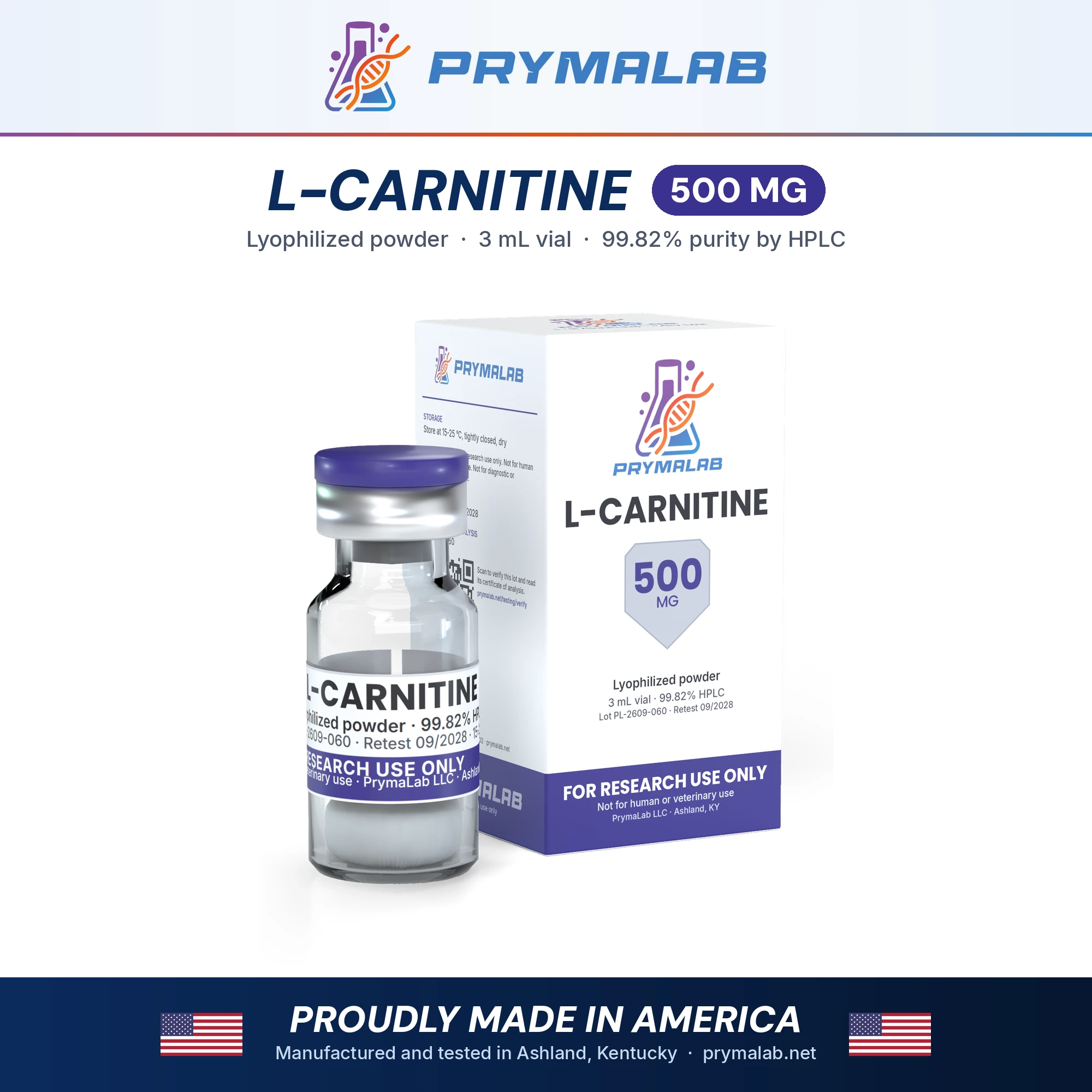
Levocarnitine, a 161.2 Da quaternary ammonium compound, as 500 mg of powder in a vial
L-carnitine, or levocarnitine, is a small zwitterionic molecule of 161.2 Da, not a peptide, that carries fatty acids into mitochondria so they can be broken down by beta-oxidation. This listing is a sealed vial holding 500 mg of it as white crystalline powder. The research on carnitine covers how mammals make it from lysine, how it is absorbed, distributed and excreted, and why only one of its two mirror-image forms occurs in nature.
Specifications
| Property | Value |
|---|---|
| Compound | L-Carnitine Levocarnitine (inner salt); small molecule, not a peptide |
| CAS number | 541-15-1 |
| Molecular formula | C7H15NO3 |
| Theoretical mass | 161.2 Da |
| Sequence / structure | (R)-3-Hydroxy-4-(trimethylammonio)butanoate; zwitterionic quaternary ammonium compound; strongly hygroscopic. |
| Label claim | 500 mg/vial |
| Form | Crystalline or amorphous powder in a sealed glass vial |
| Storage, sealed | 15–25 °C, tightly closed, dry |
| Purity specification | 99.0% or higher by RP-HPLC |
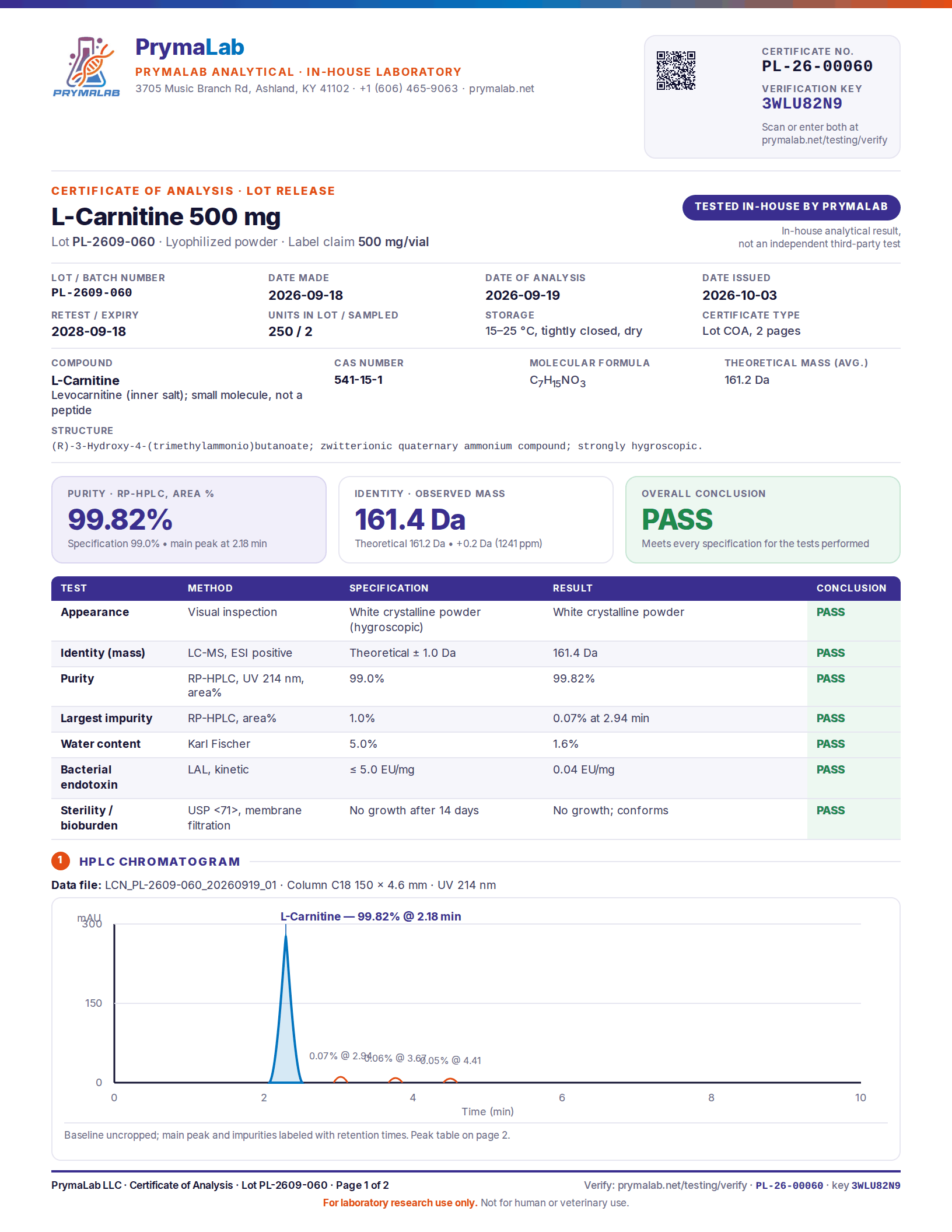
| Lot certificate | Results for the lot now shipping are in the certificate panel on this page |
| Safety data sheet | PL-SDS-100 |
Handling notes
The lot certificate describes L-carnitine as strongly hygroscopic: the powder pulls water out of the air. Unlike the peptides in the catalogue it is stored at room temperature, 15 to 25 °C, with no freezer needed, but the vial has to stay tightly closed and dry. Each opening lets in humid air, and powder that has absorbed water weighs more than the carnitine it contains, so a weighed amount drifts away from the true one. The water content on the certificate was measured on the sealed lot at the date of analysis and does not describe a vial that has been opened many times. Weigh quickly and reseal straight away.
At a theoretical mass of 161.2 Da, 500 mg corresponds to about 3.1 mmol of L-carnitine before any allowance for water. The safety data sheet lists the compound as not classified as hazardous.
What the research covers
What carnitine does
L-carnitine moves fatty acids into mitochondria, where they are broken down by beta-oxidation1. Carnitine itself was detected at the start of the twentieth century, but biochemists paid it little attention until its importance in fatty acid metabolism was established about fifty years later, as Bremer recounted in his 1983 review2.
How mammals make it
Most eukaryotic organisms synthesise their own carnitine. A few insects, and probably some newborn animals, need it from food, which is why it was once labelled vitamin BT2. In mammals, synthesis starts with the methylation of lysine. The trimethyllysine that results is converted to butyrobetaine in all tissues, and butyrobetaine is hydroxylated to carnitine in the liver and, in some species, the kidneys2. Carnitine is released from those organs and actively absorbed by every other tissue2. Its turnover is slow, and Bremer wrote that the control of its synthesis was still incompletely understood2. Gut microorganisms can break it down to trimethylamine, dehydrocarnitine and betaine2.
One natural isomer
Carnitine has a stereocentre, and only one form occurs naturally. Bremer noted that mammals convert the unnatural (+) isomer to trimethylaminoacetone, while natural (−)-carnitine is excreted unchanged in the urine2. The certificate for this vial gives the structure as (R)-3-hydroxy-4-(trimethylammonio)butanoate, which is the natural L or (−) form.
Pharmacokinetics in people
Evans and Fornasini reviewed the pharmacokinetics of L-carnitine in 2003 and noted its clinical use in carnitine deficiency disorders1. The body’s carnitine pool, free carnitine together with its short-, medium- and long-chain esters, is maintained by absorption from food, by synthesis and by very efficient reabsorption in the kidney tubules1. Carrier-mediated transport keeps concentrations well above plasma levels in tissues that rely heavily on fatty acid oxidation1. Absorption from the gut runs partly through carriers and partly by passive diffusion. The review put the absolute bioavailability of supplemental oral amounts at 5 to 18%, against as much as 75% for the smaller quantities found in a normal diet1. Carnitine and its short-chain esters do not bind plasma proteins, and they move between red cells and plasma very slowly1.
What is not established
The two carnitine reviews cited here concern biochemistry and pharmacokinetics. Neither abstract reports a study of body weight, body fat or exercise performance, so the claims about fat and energy that often travel with this compound find no support in them. Most products in this catalogue are peptides, and the chemical and physical instability of protein and peptide drugs, in solution and in the dried state, has a literature of its own3. L-carnitine is a small molecule rather than a protein, so that literature applies to it only loosely; for this compound the practical issue is water uptake, covered in the handling notes. Other compounds studied in fatty acid and energy metabolism have their own guides, among them Cardarine (GW501516) and SR9011 and SR9009, and the guide to peptides studied for weight loss separates human trial evidence from animal work.
How each lot is tested
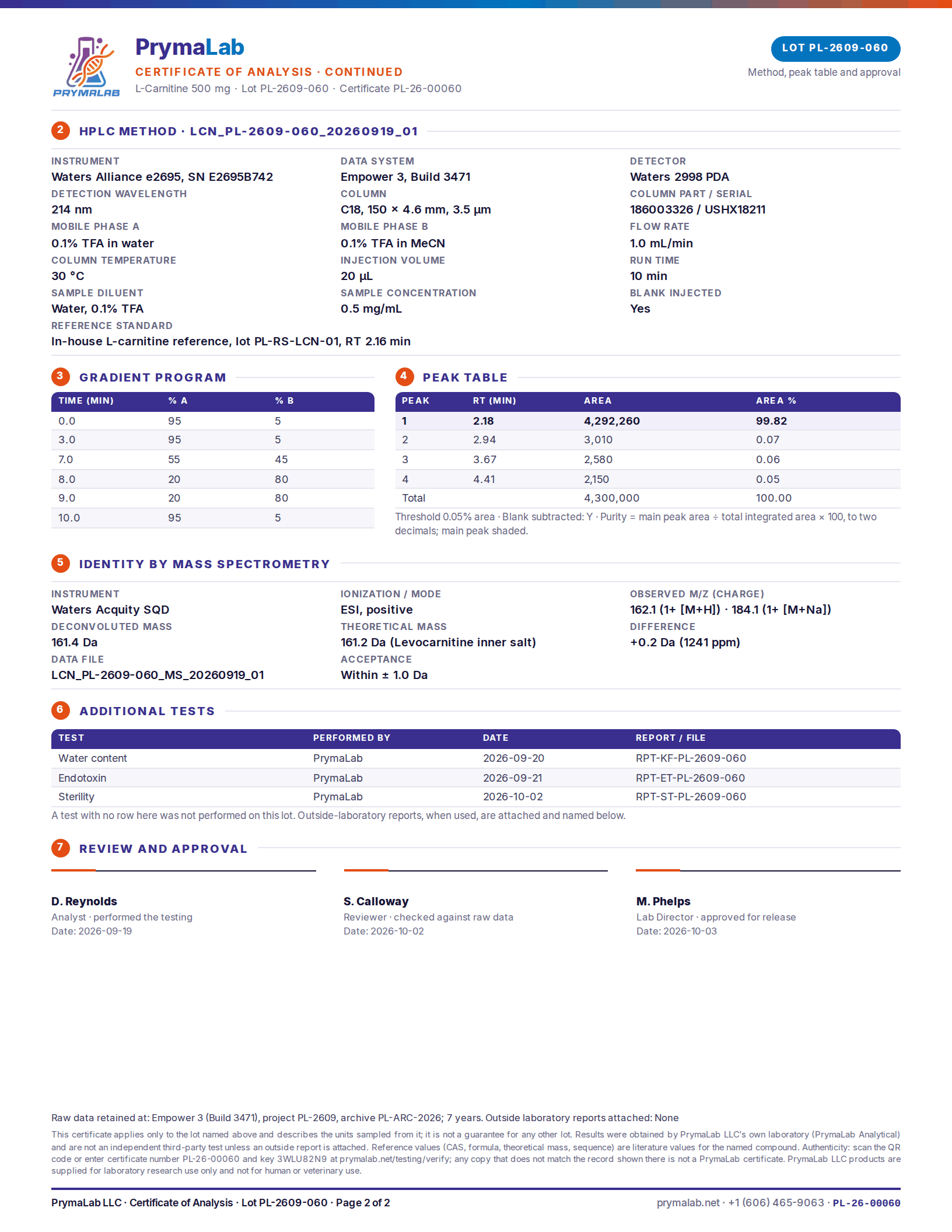
Every lot is tested in PrymaLab’s own laboratory in Ashland, Kentucky before release: RP-HPLC for purity, LC-MS for identity, Karl Fischer titration for water, LAL for endotoxin and USP <71> for sterility. The results for the lot now shipping are in the certificate panel on this page, and the certificate number, key and QR code can be checked on the verify page. These are in-house results from PrymaLab Analytical, not an independent test, and the lab is not accredited to ISO 17025. The third-party testing guarantee on this page still applies: if any independent laboratory finds the wrong compound, or less than the stated purity or amount, the order is refunded and the cost of the test is reimbursed.
Frequently asked questions
Is L-carnitine a peptide?
No. L-carnitine is a small zwitterionic molecule of 161.2 Da, a quaternary ammonium compound carrying a hydroxyl group and a carboxylate, which mammals make from lysine. It has no peptide bonds. It sits in a peptide catalogue, but chemically it is a small molecule.
Which isomer is in the vial?
The certificate gives the structure as (R)-3-hydroxy-4-(trimethylammonio)butanoate, which is L-carnitine, the natural (-) isomer. The other isomer, D-carnitine, is the unnatural form, and the published biochemistry shows that mammals handle the two differently.
How should the vial be stored?
Sealed, at 15 to 25 °C, tightly closed and dry, as the certificate states. No freezer is needed. The powder is strongly hygroscopic, so open the vial only to weigh from it and reseal it straight away.
What does the certificate report?
The certificate panel on this page shows the lot now shipping: RP-HPLC purity, an LC-MS mass to compare with the theoretical 161.2 Da, water content, endotoxin and sterility. Match the lot number on the vial to the certificate, then confirm it by number and key on the verify page.
Is this the same compound as prescription levocarnitine?
The molecule is the same, and L-carnitine has clinical uses in carnitine deficiency disorders. This vial is not a drug product. It is research material, not approved by the FDA for use in people or animals, and it is not a dietary supplement either.
Can this vial be used in people or animals?
No. It is sold for laboratory research only and must not be given to people or animals, whatever other uses the compound has. Nothing on this page describes a clinical or personal use.
References
- Evans AM, Fornasini G. Pharmacokinetics of L-carnitine. Clin Pharmacokinet. 2003;42(11):941-67. DOI · PubMed
- Bremer J. Carnitine–metabolism and functions. Physiol Rev. 1983;63(4):1420-80. DOI · PubMed
- Manning MC, Chou DK, Murphy BM, et al. Stability of protein pharmaceuticals: an update. Pharm Res. 2010;27(4):544-75. DOI · PubMed
Research use only
For laboratory research use only. L-Carnitine 500mg is not a drug, food, cosmetic or dietary supplement, is not approved by the FDA or any comparable authority for human or veterinary use, and must not be given to people or animals. It is sold to qualified researchers and institutions, and the buyer is responsible for lawful handling and disposal.









Reviews
There are no reviews yet.