
Description
.pl-doc{–pl-ink:#15191e;–pl-mute:#5b6672;–pl-line:#dde3ea;–pl-accent:#0b5c4d;–pl-warn:#8a5a00;–pl-warn-soft:#fdf6e7;max-width:820px;margin:0 auto;padding:0;color:var(–pl-ink);font:16px/1.65 -apple-system,BlinkMacSystemFont,”Segoe UI”,Roboto,Helvetica,Arial,sans-serif;-webkit-font-smoothing:antialiased}
.pl-doc *{box-sizing:border-box}
.pl-schema{display:none}
.pl-doc .pl-masthead{border-bottom:3px solid var(–pl-accent);margin:0 0 2rem;padding:0 0 1.25rem}
.pl-doc .pl-eyebrow{font-size:.72rem;letter-spacing:.14em;text-transform:uppercase;color:var(–pl-accent);font-weight:700;margin:0 0 .6rem}
.pl-doc h2.pl-title{font-size:1.95rem;line-height:1.22;margin:0 0 .5rem;padding:0;border:0;font-weight:700;letter-spacing:-.015em;color:var(–pl-ink)}
.pl-doc .pl-subtitle{color:var(–pl-mute);font-size:1.02rem;margin:0}
.pl-doc>h2{font-size:1.28rem;line-height:1.3;margin:2.6rem 0 .85rem;font-weight:700;letter-spacing:-.01em;padding-top:1.4rem;border-top:1px solid var(–pl-line);color:var(–pl-ink)}
.pl-doc>h2:first-of-type{border-top:0;padding-top:0;margin-top:0}
.pl-doc h3{font-size:1.02rem;margin:1.7rem 0 .5rem;font-weight:700;color:var(–pl-ink)}
.pl-doc p{margin:0 0 1.05rem}
.pl-doc a{color:var(–pl-accent)}
.pl-doc strong{font-weight:650}
.pl-doc .pl-lede{font-size:1.09rem;line-height:1.6}
.pl-doc table{width:100%;border-collapse:collapse;margin:1.2rem 0 1.6rem;font-size:.9rem;background:transparent}
.pl-doc caption{text-align:left;font-size:.75rem;letter-spacing:.1em;text-transform:uppercase;color:var(–pl-mute);font-weight:700;padding:0 0 .6rem}
.pl-doc th,.pl-doc td{text-align:left;padding:.58rem .75rem;border:0;border-bottom:1px solid var(–pl-line);vertical-align:top}
.pl-doc thead th{background:#f5f8fa;font-weight:650;font-size:.78rem;letter-spacing:.05em;text-transform:uppercase;color:var(–pl-mute);border-bottom:2px solid var(–pl-line)}
.pl-doc tbody tr:hover{background:#fafcfd}
.pl-doc td:first-child{font-weight:600;width:38%;color:#2b3540}
.pl-doc .pl-spec td:last-child{font-variant-numeric:tabular-nums}
.pl-doc .pl-faq{margin-top:.6rem}
.pl-doc .pl-faq details{border:1px solid var(–pl-line);border-radius:7px;margin:0 0 .6rem;background:#fff}
.pl-doc .pl-faq details[open]{border-color:#c6d8d3;box-shadow:0 1px 3px rgba(11,92,77,.07)}
.pl-doc .pl-faq summary{cursor:pointer;padding:.85rem 2.6rem .85rem 1.1rem;margin:0;font-weight:650;list-style:none;position:relative}
.pl-doc .pl-faq summary::-webkit-details-marker{display:none}
.pl-doc .pl-faq summary::after{content:”+”;position:absolute;right:1.1rem;top:.78rem;font-size:1.2rem;color:var(–pl-accent);font-weight:400}
.pl-doc .pl-faq details[open] summary::after{content:”2212″}
.pl-doc .pl-faq .pl-ans{padding:0 1.1rem 1.05rem;color:#2b3540}
.pl-doc .pl-faq .pl-ans p{margin:0}
.pl-doc ol.pl-refs{font-size:.88rem;padding-left:1.3rem;margin:1rem 0 0;list-style:decimal}
.pl-doc ol.pl-refs li{margin-bottom:.6rem;color:#2b3540}
.pl-doc ol.pl-refs em{color:var(–pl-ink)}
.pl-doc .pl-compliance{margin-top:3rem;border:1px solid #e2c9a0;background:var(–pl-warn-soft);border-radius:8px;padding:1.35rem 1.5rem;font-size:.88rem;line-height:1.6;color:#4a3a1c}
.pl-doc .pl-compliance h2{margin:0 0 .7rem;padding:0;border:0;font-size:.8rem;letter-spacing:.12em;text-transform:uppercase;color:var(–pl-warn)}
.pl-doc .pl-compliance p{margin:0}
@media (max-width:600px){.pl-doc h2.pl-title{font-size:1.55rem}.pl-doc td:first-child{width:44%}}
@media print{.pl-doc .pl-faq details{border:0}.pl-doc .pl-faq summary::after{display:none}.pl-doc .pl-faq details>.pl-ans{display:block!important}}
PrymaLab · Research Use Only
PNC-27 5mg
Chimeric p53-penetratin peptide · 32 residues · CAS 1159861-00-3
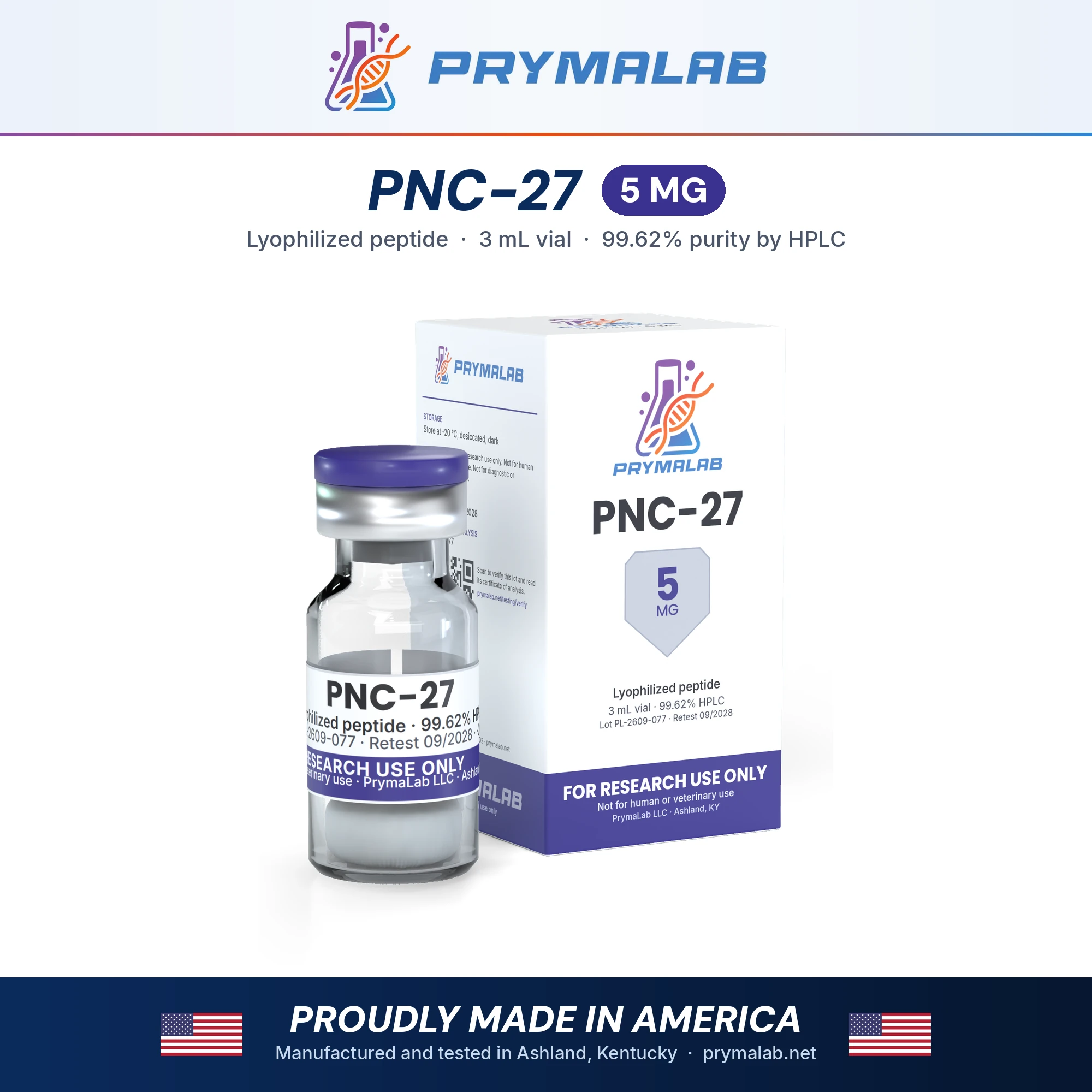
PNC-27 5mg is a lyophilized vial of a 32-residue chimeric peptide, CAS 1159861-00-3, molecular weight 4031.72. It joins two functional domains: residues 12 to 26 of p53, which constitute the HDM-2 binding region, and penetratin, a membrane residency sequence derived from Drosophila antennapedia protein.
Specification Table
| Property | Value |
|---|---|
| Compound | PNC-27 |
| Vial content | 5 mg lyophilized powder |
| Molar content of vial | Approximately 1.24 µmol |
| Stock at 1 ml diluent | Approximately 1.24 mM |
| Compound class | Chimeric synthetic peptide |
| CAS number | 1159861-00-3 |
| Molecular formula | C188H293N53O44S |
| Molecular weight | 4031.72 g/mol |
| Residue count | 32 |
| Single-letter sequence | PPLSQETFSDLWKLLKKWKMRRNQFWVKVQRG |
| N-terminal domain | p53 residues 12 to 26, the HDM-2 binding region |
| C-terminal domain | Penetratin, a membrane residency peptide from Drosophila antennapedia |
| Reported molecular target | HDM-2 (human double minute-2), residues 1 to 109 |
| Reported in vitro observation | Transmembrane pore formation and necrosis in cultured tumour cell lines |
| Originating group | Pincus, Michl and colleagues, SUNY Downstate |
| Oxidation-prone residues | Methionine at position 20, three tryptophans |
| Appearance | White lyophilized cake |
| Purity | Per lot-specific certificate of analysis |
| Solubility | Water soluble. Dilute acetic acid also used |
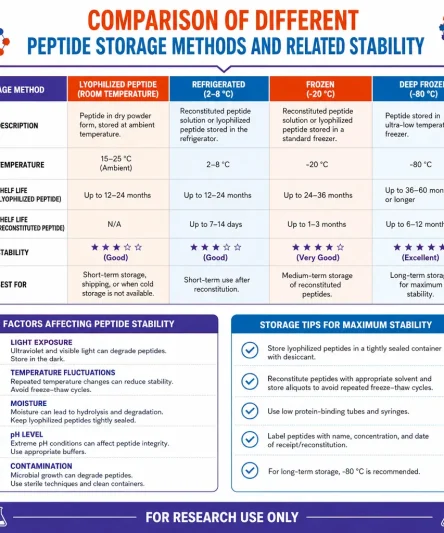
| Storage, lyophilized | -20°C, protected from light and moisture |
| Storage, reconstituted | 2-8°C, protected from light |
| Human clinical data | None published |
| Regulatory status | No approved human or veterinary formulation in any jurisdiction |
What Are the Two Domains?
PNC-27 is not a natural sequence. It is a deliberately constructed fusion of two functional elements, and reading the sequence in two halves is the only way it makes sense.
The first fifteen residues, PPLSQETFSDLWKLL, correspond to residues 12 through 26 of human p53. That stretch is the region of p53 that contacts HDM-2, the E3 ubiquitin ligase that normally regulates p53 by targeting it for degradation. The interaction between them is one of the best-characterised protein-protein interfaces in molecular biology.
The remaining seventeen residues, KKWKMRRNQFWVKVQRG, are penetratin. That sequence derives from the third helix of the Drosophila antennapedia homeodomain and belongs to the cell-penetrating peptide family, sequences capable of crossing lipid membranes without a dedicated transporter.
Joining a binding domain to a membrane-crossing domain is a standard construct strategy. What makes PNC-27 unusual in the published work is that the penetratin portion appears to contribute more than delivery, participating in the membrane interaction itself rather than simply carrying cargo across.
What Has Been Reported In Vitro?
The published characterisation of PNC-27 5mg material is specific about what was measured, and reporting it precisely matters more here than on most pages in this catalogue.
Sarafraz-Yazdi and colleagues used nuclear magnetic resonance to determine that PNC-27 adopts a conformation resembling the p53 peptide when bound to HDM-2, which established that the construct retains the structural feature the binding domain was chosen for (Sarafraz-Yazdi et al., Proceedings of the National Academy of Sciences, 2010).
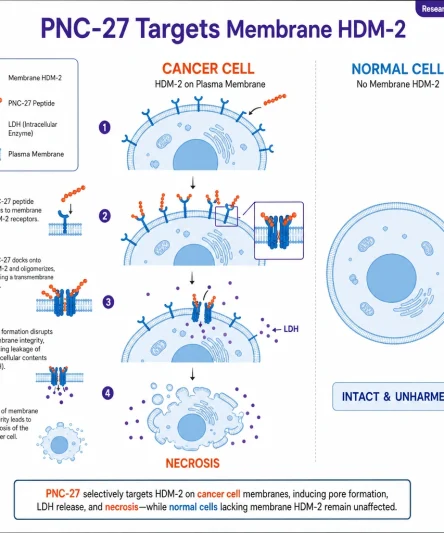
In cultured tumour cell lines, the same body of work reports transmembrane pore formation and subsequent necrosis. The proposed mechanism involves HDM-2 present in the plasma membrane rather than the nucleus, with the peptide binding it there and disrupting membrane integrity.
Michl and colleagues had earlier reported differential effects between transformed and untransformed cell lines in culture (Michl et al., International Journal of Cancer, 2006). Later work from the group examined mitochondrial membrane interaction as an additional component.
Every finding above is an in vitro or cell-culture observation reported by the investigating group. None of it is a statement about any organism, and no human study of this compound has been published.
Why Is Membrane HDM-2 the Central Claim?
HDM-2 is conventionally understood as a nuclear and cytoplasmic protein. Its recognised job is binding p53, masking its transactivation domain and marking it for proteasomal degradation.
The mechanism proposed for PNC-27 depends on something different: HDM-2 present in the plasma membrane. That is the load-bearing assumption in the whole model, because a peptide that cannot enter cells efficiently would need a surface-accessible target to act on.
Published work from the originating group reports detecting HDM-2 in the membrane fraction of certain cultured cell lines and not others, and correlates that presence with the observed membrane effects. Independent confirmation of membrane-localised HDM-2 from unaffiliated laboratories is more limited than the primary literature volume suggests.
A researcher designing around this compound should treat membrane HDM-2 detection as something to measure in their own system rather than assume. Cell-surface biotinylation followed by immunoblot, or membrane fractionation with appropriate purity controls, both address it directly.
What Should PNC-27 5mg Work Control For?
Three controls address the specific weaknesses of PNC-27 5mg work of this construct, and all three are frequently omitted.
A penetratin-only arm is the most important. Penetratin is a membrane-active peptide in its own right and can perturb membranes at sufficient concentration independently of any cargo. Without that arm, membrane disruption attributed to the HDM-2 interaction could simply be penetratin behaving as membrane-active peptides do.
A scrambled-sequence control addresses the same question from another direction. A peptide with identical amino acid composition in randomised order retains the physicochemical properties, including net charge and hydrophobicity, while losing the specific binding conformation.
A membrane HDM-2 measurement in the specific cell system establishes whether the proposed target is present at all. A negative finding in a system without membrane HDM-2 says nothing about the mechanism.
The published work from the originating group includes several of these. Secondary descriptions of the compound frequently do not mention them.
What Does PNC-27 5mg Supply in Molar Terms?
Molar arithmetic is where mass-labelled peptide vials most often mislead, and a 4031.72 dalton construct makes the point clearly.
Five milligrams divided by 4031.72 grams per mole gives approximately 1.24 micromoles. For comparison, five milligrams of a tripeptide near 400 daltons supplies roughly 12.5 micromoles, ten times as much material in molar terms from an identical weight.
Since receptor and protein interactions occur on a molar basis rather than a mass basis, comparing this construct against a smaller peptide by weight introduces an error of an order of magnitude. Any experiment placing PNC-27 alongside a shorter peptide must normalise by moles.
The counterion contributes a further correction that is frequently ignored. Solid-phase synthesis using trifluoroacetic acid cleavage leaves trifluoroacetate associated with basic residues, and this construct has many, with multiple lysines and arginines across the penetratin domain.
Each associated trifluoroacetate adds 114 daltons to the weighed mass without adding peptide. A preparation carrying several can be ten percent or more counterion by weight, which shifts every downstream calculation in the same direction.
Requesting counterion identity and net peptide content on the certificate resolves it, and where net peptide content is stated, use that figure rather than the vial label for molar calculation.
A programme that runs past a handful of plates will exhaust this fill quickly. The PNC-27 10mg vial is the same 32-residue construct at double the quantity, which halves the number of reconstitution events and the lot variation that comes with them.
What Does the Certificate Need to Show?
For a construct of this length, four fields between them establish whether the material matches the specification.
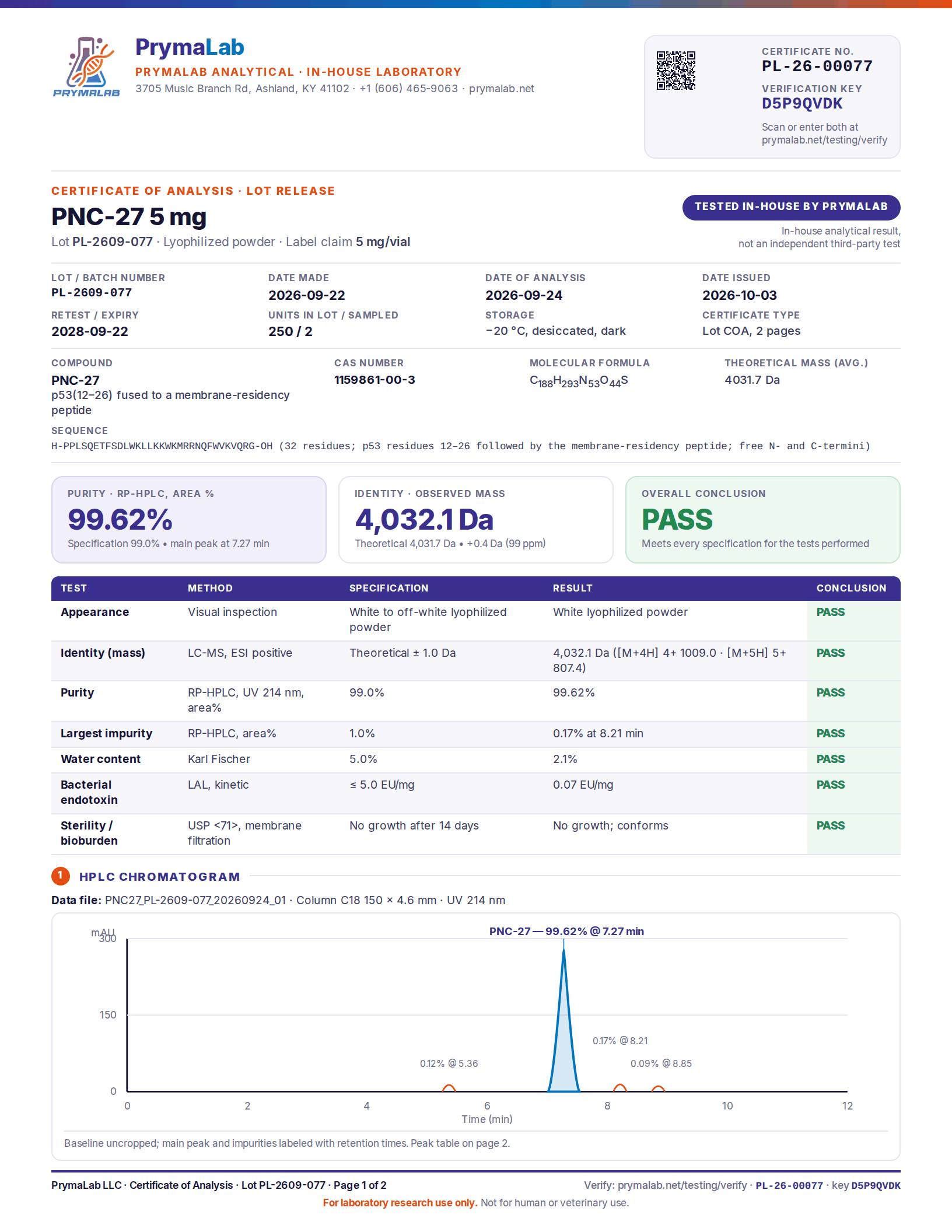
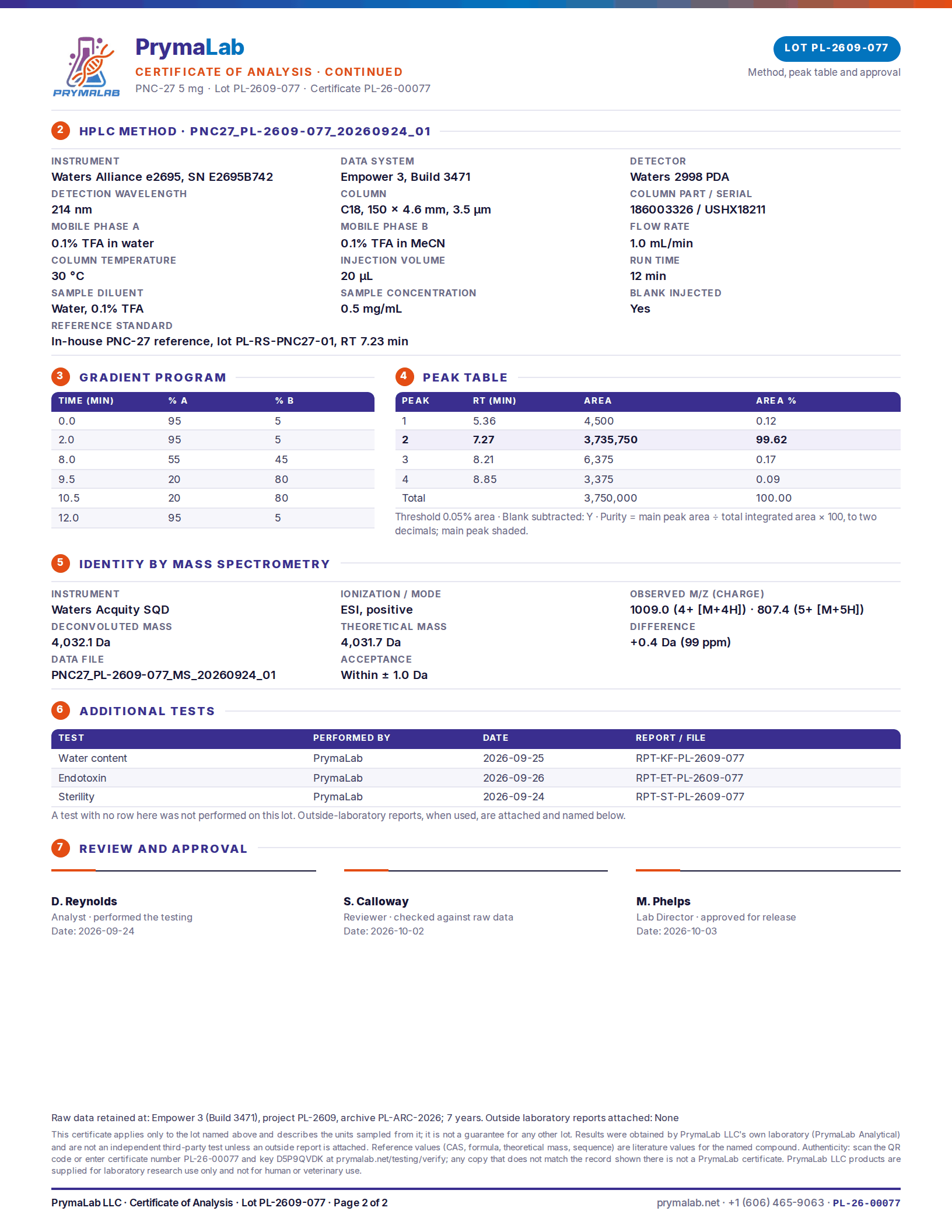
Mass by high-resolution mass spectrometry, checked against 4031.72. Purity by reversed-phase chromatography with a gradient shallow enough to resolve single-residue deletions, which co-elute under fast methods and inflate the apparent purity figure.
Net peptide content, distinguishing peptide mass from total weighed mass including counterion and residual water. Without it the vial label overstates molar content by a margin that varies between lots.
Counterion identity, which for a construct with this many basic residues determines the size of that correction. Trifluoroacetate is the usual product of standard cleavage chemistry and it associates preferentially with lysine and arginine.
Sequence confirmation by tandem mass spectrometry is worth requesting for a two-domain construct specifically, because it verifies that both domains are present and correctly joined rather than only that the total mass is right.
Who Uses PNC-27 5mg and For What?
The vial size fits a defined kind of programme. Cell-based work at this scale rarely consumes more than a fraction of 1.24 micromoles, so five milligrams typically covers a full concentration series with material left for repeats.
Groups running membrane permeabilisation assays are the most obvious users, since those designs need a range rather than a point and gain from having enough for the penetratin and scrambled arms alongside.
Structural work is the other case. Nuclear magnetic resonance and calorimetry both consume more material per measurement than a cell assay does, and PNC-27 5mg supports a limited amount of either.
What the format does not suit is animal work of any kind, which consumes material at a rate this fill cannot support and which sits outside the in vitro framing the published evidence actually supports.
Nor does it suit a programme needing lot continuity across many months. The extended-supply format exists for that.
Reconstitution and Storage in Laboratory Practice
Five milligrams is approximately 1.24 micromoles. Reconstituted into 1 ml that gives roughly a 1.24 mM stock, which suits most cell-based designs with straightforward dilution.
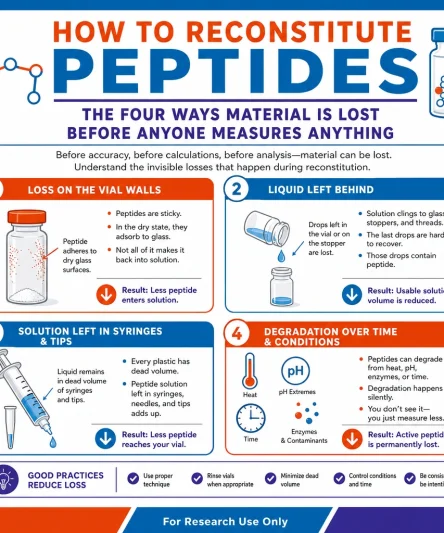
The sequence contains three tryptophans and one methionine, which makes it more oxidation-sensitive than a peptide of comparable length without them. Minimise headspace air exposure, protect from light, and avoid leaving the open vial standing. The tryptophan content also gives strong absorbance at 280 nm, which is convenient for concentration checking.
Introduce diluent slowly along the vial wall and swirl. At 32 residues with a highly basic penetratin region, this peptide adsorbs readily to container surfaces, so low-binding consumables are worth using at working concentrations.
Keep the dry cake at -20°C, sealed, dark and dry. Once in solution, 2-8°C in the dark, divided into aliquots before any freezing step. Record lot, diluent, volume, concentration and date.
Published Literature
Every reference below was confirmed against the publisher record or a primary index. Note that the great majority originates from one research group, which is discussed in the sections above.
- Sarafraz-Yazdi E, Bowne WB, Adler V, Sookraj KA, Wu V, Shteyler V, Patel H, Oxbury W, Brandt-Rauf P, Zenilman ME, Michl J, Pincus MR. Proceedings of the National Academy of Sciences. 2010;107(5):1918-1923. PMID: 20080680
- Michl J, Scharf B, Schmidt A, Huynh C, Hannan R, von Gizycki H, Friedman FK, Brandt-Rauf P, Fine RL, Pincus MR. International Journal of Cancer. 2006;119(7):1577-1585.
- Do TN, Rosal RV, Drew L, Raffo AJ, Michl J, Pincus MR, Friedman FK, Petrylak DP, Cassai N, Szmulewicz J, Sidhu G, Fine RL, Brandt-Rauf PW. Oncogene. 2003;22(10):1431-1444.
- Bowne WB, Sookraj KA, Vishnevetsky M, Adler V, Sarafraz-Yazdi E, Lou S, Koenke J, Shteyler V, Ikram S, Harding MA, Bluth MH, Frenkel S, Michl J, Zenilman ME, Pincus MR. Journal of Cellular Biochemistry. 2008;104(2):595-604.
- Sarafraz-Yazdi E, Gorelick C, Wagreich AR, Salame G, Angert M, Gartman CH, Gupta V, Bowne WB, Lee YC, Abulafia O, Pincus MR, Michl J. Journal of Oncology. 2018;2018:9483805.
Frequently Asked Questions
What is PNC-27 5mg?
A lyophilized vial of a 32-residue chimeric peptide, CAS 1159861-00-3, molecular weight 4031.72, joining p53 residues 12 to 26 with a penetratin membrane residency sequence. Supplied for laboratory research use only and not approved for human or veterinary use anywhere.
What are the two domains?
The first fifteen residues correspond to p53 residues 12 to 26, which form the HDM-2 binding region. The remaining seventeen are penetratin, derived from the third helix of the Drosophila antennapedia homeodomain, a cell-penetrating sequence able to cross lipid membranes.
What does the published work report?
Nuclear magnetic resonance showing the construct adopts a p53-like conformation when bound to HDM-2, and, in cultured tumour cell lines, transmembrane pore formation followed by necrosis. All of it is in vitro or cell-culture observation reported by the investigating group.
Why does membrane HDM-2 matter?
It is the load-bearing assumption in the whole model. HDM-2 is conventionally a nuclear and cytoplasmic protein, and the proposed mechanism requires it to be present in the plasma membrane where a surface-acting peptide could reach it.
Is membrane HDM-2 well established?
Reported by the originating group, which detected it in membrane fractions of some cultured lines and not others. Independent confirmation from unaffiliated laboratories is more limited than the primary literature volume suggests, and measuring it in your own system is advisable rather than assuming it.
What controls does this compound require?
Three. A penetratin-only arm, since penetratin is membrane-active in its own right and could produce disruption independently. A scrambled-sequence control retaining composition while losing conformation. And a membrane HDM-2 measurement in the specific cell system being used.
Why is the penetratin-only control so important?
Because membrane-active peptides perturb membranes at sufficient concentration regardless of what they are attached to. Without that arm, disruption attributed to a specific HDM-2 interaction could simply be penetratin doing what membrane-active peptides do.
Is there human data on PNC-27?
No human study of this compound has been published. The evidence base is cell culture and in vitro work, with the great majority originating from a single research group at SUNY Downstate. No approved formulation exists in any jurisdiction.
How oxidation-sensitive is the sequence?
More than most peptides of this length. It carries three tryptophans and one methionine, all susceptible to oxidation. Minimise headspace air exposure, protect from light, and avoid leaving the open vial standing. The tryptophans also give strong 280 nm absorbance for concentration checks.
How should the vial be reconstituted?
Five milligrams is approximately 1.24 micromoles, so 1 ml gives roughly a 1.24 millimolar stock. Add diluent slowly down the wall and swirl gently. The basic penetratin region makes this peptide adsorb readily, so low-binding consumables are worth using at working concentrations.
Compliance Statement
PNC-27 5mg is sold exclusively for laboratory research use. It is not a drug, food, or cosmetic product, and it is not a dietary product of any kind. It is not approved by the FDA or any comparable authority for human or veterinary use, no human study of this compound has been published, and all reported findings are in vitro or cell-culture observations. This product is not intended to diagnose, treat, cure, or prevent any disease. It must not be given to humans or animals. Purchase is restricted to qualified researchers and institutions operating within applicable laws. All handling is the responsibility of the purchasing laboratory.







Reviews
There are no reviews yet.