Description
PrymaLab · Research Use Only
Preloaded Autoinjector | Cortagen | 3ml Pen | 20mg
AEDP tetrapeptide in solution · 3ml at 20/3 mg/ml · No reconstitution step
The cortagen pen is a preloaded 3ml research autoinjector holding the tetrapeptide Ala-Glu-Asp-Pro in solution at 20/3 mg/ml, giving 20mg per device. Proline at position 4 blocks the isoaspartate route that dominates in related bioregulators and replaces it with the most acid-labile linkage in peptide chemistry, so the pH of the fill decides the shelf life.
Specification Table
| Property | Value |
|---|---|
| Device format | Preloaded autoinjector pen, glass cartridge |
| Fill volume | 3 ml |
| Concentration | 20/3 mg/ml |
| Total compound in device | 20 mg |
| Molar concentration | 20 x 0.775 mM (a 10 mg fill is 7.74 mM) |
| Compound | Cortagen (AEDP), L-alanyl-L-alpha-glutamyl-L-alpha-aspartyl-L-proline |
| CAS number | 335591-03-2 is unverified. It appears on PubChem only as a depositor-supplied synonym and is not in CAS Common Chemistry or ChemIDplus. No UNII exists |
| Molecular formula | C17H26N4O9 |
| Molecular weight | 430.4 g/mol average; 430.170 Da monoisotopic |
| Amino acid sequence | Ala-Glu-Asp-Pro (AEDP), linear, free N-terminal amine, free C-terminal acid on proline |
| Solution appearance | Clear and colourless expected; no chromophore above about 220 nm |
| Reconstitution required | None. Supplied as solution |
| Excipient system | Not published on the product record. Confirm against certificate of analysis |
| Solution pH | Not published on the product record. It is the single most consequential missing value for this compound |
| Storage | 2-8°C, protected from light. Do not freeze |
| Light sensitivity | Low. No aromatic residue; protection is good practice, not a mechanistic need |
| Solution stability | Not established over device shelf life in published data |
| Acid-labile bond | Asp3-Pro4. Cleaves to Ala-Glu-Asp at 333.3 Da plus free proline at 115.1 Da |
| Succinimide site | None. Proline has no backbone NH, so isoaspartate cannot form |
| Salt form | Acetate on vendor sheets, unverified; TFA salts circulate. Not published on the product record |
| Net charge at pH 7 | About -2 (calculated; not measured) |
| Purity | Per lot-specific certificate of analysis |
| Regulatory status | No approved product in any jurisdiction. Never nominated for the FDA 503A bulks list and absent from every 2024-2026 advisory committee docket, so it carries no FDA category at all |
What Changes When Cortagen Ships in Solution?
Putting AEDP into water swaps one degradation problem for another: the succinimide route that quietly isomerises most aspartyl peptides cannot operate here, and in its place sits the bond that peptide chemists have spent fifty years cutting on purpose.
Start with what cannot happen. Isoaspartate forms when the backbone amide nitrogen of the residue after aspartate attacks the aspartate side-chain carbonyl and closes a five-membered ring. Proline has no backbone NH. Its nitrogen is tied into the pyrrolidine ring and carries no hydrogen to donate, so the nucleophile that drives the reaction does not exist in this sequence. Cortagen therefore cannot accumulate the mass-silent isoaspartyl isomer that dominates the solution chemistry of Ala-Glu-Asp-Gly, and that is the cleanest chemical difference between the two tetrapeptides marketed side by side. Oliyai and Borchardt (1994) showed the general principle with bulkier residues after aspartate suppressing cyclic-imide formation; proline is the extreme case, where suppression is complete rather than partial.
What replaces it is not subtle. The aspartyl-prolyl amide is the most acid-labile bond in ordinary peptide chemistry. The protonated aspartate side-chain carboxyl assists hydrolysis of the neighbouring amide, and the tertiary nitrogen of proline protonates more readily than a secondary amide would, so the two effects compound. Piszkiewicz, Landon and Smith reported the reaction in 1970 as an anomaly that confused protein sequencers, and Marcus turned it into a deliberate mild-acid fragmentation method in 1985. A technique that reliably cuts a bond in dilute acid is a warning label for anything formulated below neutral pH.
The products are worth naming because they are the analytical handle. Cleavage releases the tripeptide Ala-Glu-Asp at 333.3 daltons and free proline at 115.1 daltons. Both are visible by liquid chromatography and mass spectrometry, and both sit far from the 430.4 dalton parent. That is the reverse of the epithalon problem: here the main degradant announces itself, so an ordinary LC-MS check on an aged fill is informative rather than falsely reassuring.
Everything else in the molecule is quiet. The free N-terminal alanine could close a diketopiperazine with Glu2, but Goolcharran and Borchardt (1998) found that reaction slow unless residue 2 is proline or glycine, and it has never been measured for AEDP. There is no methionine, tryptophan, cysteine, histidine or tyrosine, so oxidation has no target and nothing absorbs above about 220 nanometres. Aggregation is neither expected nor reported for a four-residue anion with a calculated XLogP3 of -6.5.
No approved product exists whose formulation could be copied. The parent preparation Cortexin, from which the sequence was derived by amino-acid analysis of a bovine cerebral-cortex polypeptide fraction, is a lyophilised material, and its composition and registration are unverified. In the animal work AEDP was dissolved in saline immediately before injection, which tells a formulator nothing about months in a sealed cartridge.
Cortagen Asp-Pro Bond Hydrolysis: What Sets the Rate?
Two variables set it, and only one is under a laboratory’s control: hydrogen ion concentration, which is fixed at manufacture and unpublished, and temperature, which the purchaser controls. Nobody has measured cortagen Asp-Pro bond hydrolysis in this peptide directly.
The rate profile comes from the model literature. Cleavage of aspartyl-prolyl bonds is acid-catalysed and falls steeply as pH rises toward neutrality; Marcus (1985) used dilute acid precisely because the reaction is impractically slow otherwise. Oliyai and Borchardt (1993) mapped the same territory for aspartyl residues generally, finding direct hydrolysis dominant below pH 3. A fill held near pH 6 to 7 is therefore in the least reactive part of the profile available to this sequence, and a fill at pH 4 or 5, chosen for solubility or for compatibility with some other excipient, is not.
This is the argument for asking about formulation pH before purchase rather than after. For a peptide whose degradation is dominated by a temperature-driven succinimide route, cold storage is most of the answer. For this one, cold storage slows a reaction whose rate constant was largely decided by whoever chose the buffer. Neutral pH, not refrigeration alone, is what protects the fill, and the product record does not state it.
How Concentrated Is the Cortagen Pen?
At 20mg in 3 ml the concentration is 20/3 mg/ml, the molar concentration is 20 x 0.775 mM, and each 0.01 ml increment carries 20/300 mg of peptide, which for a 10 mg fill is 33.3 micrograms.
Working the 10 mg example: 3.333 mg/ml divided by 430.4 g/mol and multiplied by 1000 gives 7.74 mM, or 7,745 micromolar. One 0.01 ml increment holds 33.3 ug, which is 77.4 nanomoles; ten increments deliver 333 ug. The general forms are 20/300 mg per 0.01 ml and 20/30 mg per 0.1 ml.
Those quantities are large against every published experiment with this compound. Turchaninova and colleagues (2000) gave rats 10 micrograms per kilogram intramuscularly, which is about 2.5 micrograms for a 250 gram animal, so a single 0.01 ml increment of a 10 mg fill holds roughly thirteen times the quantity a whole rat received in that study. Anisimov and colleagues (2004) gave mice 0.1 micrograms subcutaneously, and the same increment is about 330 times that. In cell culture the Khavinson group’s working range for this family is 2 to 200 nanograms per millilitre, which for AEDP is 4.6 to 465 nanomolar; reaching 100 nanomolar from 7.74 mM requires a serial dilution of roughly 77,000-fold. The peptide calculator handles that arithmetic.
No water solubility figure has been published for AEDP, so nothing in the literature caps the fill strength. Charge and a topological polar surface area of 216 square angstroms predict high solubility, which is inference rather than measurement.
Cortagen Pen vs Vial: What Does the Format Suit?
The cortagen pen vs vial choice comes down to whether the buyer knows the formulation pH: a solution at a stated near-neutral pH is a reasonable multi-week device, and a solution at an unstated pH is an experiment with an unknown rate constant running inside it.
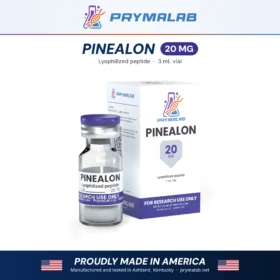
The Cortagen lyophilized vial keeps the Asp-Pro bond intact by keeping water away from it, and a solution made up on the day of an experiment carries an age known to the hour. The device removes the diluent-volume, dissolution and transfer errors that come with doing that repeatedly, which is the trade the pen versus vial article sets out in general terms.
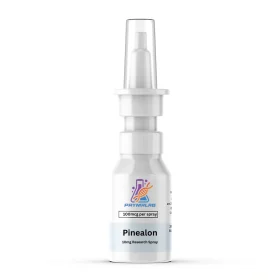
The tilt for this compound is unusual in one respect. Because the main degradant is mass-visible rather than mass-silent, a device several weeks into use can be checked rather than assumed, which makes the pen easier to defend here than for peptides whose degradants hide under the parent peak. Work running over months, or work at a pH-sensitive interface, still favours a vial opened fresh. The preloaded autoinjector category page covers graduation resolution and cold-chain history, and a nasal spray presentation is listed as well, so the format decision is three-way rather than binary.
What the Cortagen Pen Product Record Does Not State
Four values are missing, and for this compound one of them outranks the rest: the formulation pH, the excipient system, the salt form and the fill date.
The pH matters more here than on any other page in this range, because it is the rate-determining variable for the only fast degradation route the molecule has. A stated value near 6 to 7 would justify a multi-week device. A value near 4 would not, and no value at all leaves the question open.
The salt form changes the peptide content of a weighed milligram. Vendor sheets say acetate, unverified, and trifluoroacetate salts are common unless the material has been salt-exchanged, so whether 20mg means net peptide or gross salt is a certificate question. The excipient system follows the solution into any assay, and for a four-residue anion the buffer species and ionic strength are not neutral background. The fill date is what turns a rate constant into an estimate of how much intact AEDP remains. Confirm all four against certificate of analysis.
One identity value deserves separate mention. The CAS number circulating for this compound, 335591-03-2, exists on PubChem only as a depositor-supplied synonym and is absent from CAS Common Chemistry and ChemIDplus, and no UNII has been assigned. A certificate quoting that number is repeating vendor practice rather than a registry entry.
Cortagen Pen Storage and Verifying the Device
Correct cortagen pen storage is 2 to 8°C, protected from light and never frozen, with the caveat that refrigeration slows a reaction whose rate was mostly set by the formulation pH rather than by temperature.
Hold the cartridge against white before each draw. The solution should read clear and colourless with nothing suspended in it. Allow the cartridge to warm to ambient temperature first, because viscosity falls as it does and a spring-driven mechanism delivers differently against a thinner solution and viscosity shifts delivered volume in a spring-driven mechanism, and verify delivered volume gravimetrically once per device. Those steps apply to any pen.
Verification of contents is where this compound is easier than its neighbours. Liquid chromatography with mass detection resolves the intact 430.4 dalton peptide from its two cleavage products, Ala-Glu-Asp at 333.3 and free proline at 115.1, and the ratio of those peaks is a direct readout of how far hydrolysis has run. There is no isobaric degradant hiding under the parent, so a single well-run chromatogram answers the question. Ultraviolet detection has to be set at 210 to 220 nanometres, since the sequence contains no tryptophan or tyrosine and nothing absorbs at 280, which means excipient carbonyls are in the same window and a matched blank is needed for any concentration estimate.
What Does the Cortagen Literature Actually Report?
The published record is one rat sciatic-nerve study with a follow-up note, one mouse cardiac microarray, one in-vitro cytogenetics paper on lymphocytes from donors over 80, and rat oxidative-stress and ischaemia models. There is no human study of any kind.
Turchaninova and colleagues (2000) transected and repaired the rat sciatic nerve and gave 10 micrograms per kilogram intramuscularly daily for 10 days, reporting fibre regrowth 27 percent faster and conduction velocity 40 percent higher than controls. Kolosova and colleagues (2002) published a short follow-up on delayed effects on injured-nerve function. Those two papers are the entire nerve-regeneration file, and both are from the St Petersburg institute that developed the compound.
Anisimov and colleagues (2004) gave 6-month-old female CBA mice 0.1 micrograms subcutaneously daily for 5 days and profiled cardiac transcripts on a 15,247-clone array. They reported 252 clones changed, which is 1.65 percent of the array, mapping to 110 known genes with 208 transcripts up and 26 down and fold changes from plus 5.42 to minus 2.86, naming Hsc70, Bmp2, Wnt4 and mitochondrial 16S, COX3 and ND5 among them. A microarray in healthy animals describes an expression change and not an outcome.
Lezhava and colleagues (2015), working in Tbilisi and closer to independent than the rest of this literature, reported decondensation of facultative heterochromatin and activation of ribosomal genes in cultured lymphocytes from donors aged over 80, with the working concentration not stated in the abstract. Kozina (2007) reported reduced lipid peroxidation in rat serum and brain, and Zarubina and Shabanov (2016) reported neuroprotective readouts in rat ischaemic preconditioning models. The site’s bioregulator research overview places these short peptides in context.
Unstudied: any human exposure, pharmacokinetics in any species, concentration-response, toxicology, immunogenicity, formulation stability, and replication outside the developing institute and its collaborators. The clinical literature that circulates under this compound’s name belongs to Cortexin, the bovine extract, and not to the four-residue molecule in this cartridge.
What Is the Safety and Regulatory Position?
No regulator has approved AEDP anywhere, and unlike most compounds in this range it has never been nominated for US pharmacy compounding, so it holds no FDA category and appears in no advisory committee record between 2023 and 2026.
Searches of Drugs@FDA, the EMA register and the Japanese, Australian and Canadian registers return nothing. The compound is absent from the FDA interim 503A bulk drug substances list of 29 September 2023, from the significant-safety-risk page as updated on 22 April 2026, and from every Pharmacy Compounding Advisory Committee docket in that period. That absence is neither an endorsement nor a warning; it means no regulator has ever examined the substance. The Russian status of Cortagen, as distinct from the registered extract Cortexin, could not be verified, and the two must not be conflated. The compound was not found by name on the WADA Prohibited List, which should be confirmed against the current document.
Adverse findings are absent from the animal studies cited, which reflects the size of the literature rather than a demonstrated absence of harm: five rodent studies with small group sizes are not a safety database. No toxicology, no immunogenicity work and no pharmacokinetic study exists in any species. The device is a laboratory research item and nothing here describes administration to a person or an animal.
Where Do Bacteriostatic Water and Lyophilized Powder Fit With a Pen?
They do not, and that is the point of the format. A vial of Cortagen 20mg arrives as a lyophilized powder and has to be brought into solution before anything can be measured out of it, which is what bacteriostatic water is for. The benzyl alcohol in bacteriostatic water suppresses microbial growth in a container that will be entered more than once, and the volume added is what sets the concentration. Get that volume wrong and every subsequent figure is wrong with it.
This pen skips the step. The peptide is already in solution at 20/3 mg/ml, so no bacteriostatic water is added, no reconstitution volume has to be recorded, and the concentration is fixed by the manufacturer rather than by the person opening the box. What the format gives up is the ability to choose that concentration, and the ability to store the dry material, which keeps far better than any solution does.
The trade shows up on the certificate of analysis. A CoA written against a lyophilized powder describes the solid: identity, purity by HPLC, water content, counter-ion. A CoA for a solution product should describe the fill as well, which means concentration, pH, excipients and the date the solution was made. Ask for the CoA that matches the format you are holding. A powder CoA supplied with a solution device tells you what went in, not what is in there now.
What Does the Cortagen Literature Report About Neurons?
The published work on this synthetic peptide is thin and comes almost entirely from one group. The recurring claim is neuroprotection in models of cortical damage, reported as better survival of cultured neurons under stress and as improved behavioural recovery in rats after experimental injury. Sample sizes are small, blinding is rarely described, and no independent laboratory has repeated the central findings.
The proposed mechanism is regulation of gene expression rather than receptor binding. Khavinson’s group argues that short peptides of this kind enter the nucleus, bind directly to DNA in the promoter regions of specific genes, and change the transcription rate. The supporting work is mostly modelling and gel-shift experiments. What has not been shown for this peptide is that intact AEDP reaches a cell nucleus in a living animal after injection, which is the step the whole model depends on.
Antioxidant activity appears in the same literature, usually as reduced lipid peroxidation markers in brain tissue from treated animals. That is an observation about tissue chemistry, not a demonstration that the peptide scavenges radicals itself, and the two are often conflated in secondary sources. Neither claim has a dose-response curve behind it that would let a researcher choose a concentration for a new experiment.
Where Does Cortagen Sit Among the Khavinson Peptides?
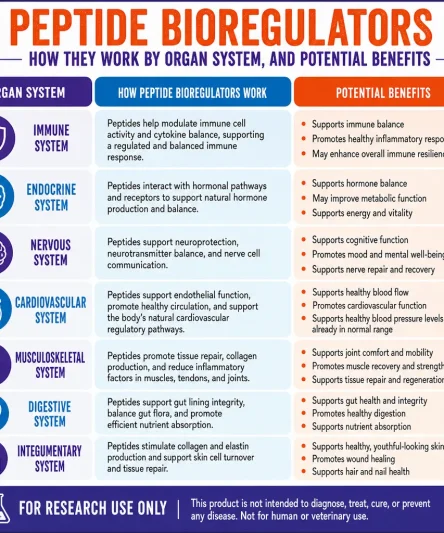
Vladimir Khavinson’s programme at the Institute of Bioregulation and Gerontology in St. Petersburg produced a family of short peptide bioregulators, each assigned to an organ and each named for it. Cortagen is the cortex member. Vilon, a dipeptide, is the thymus member. Epitalon is the pineal member. The Cortagen peptide is one entry in a catalogue built on the same design principle, which is that a two to four residue fragment can stand in for a whole tissue extract.
The grouping is a research programme, not a mechanism. Every Khavinson peptide carries broadly the same claim shape, that it regulates gene expression in its assigned tissue, and the evidence for each is broadly the same size, which is small and largely in-house. Treating any one of these short peptide bioregulators as better established than the others is not supported by what is published. Cortagen has less independent literature behind it than Epitalon and about the same as Vilon.
A note on naming. The suffix conventions in this family are inconsistent across transliterations, and the same molecule can appear as Cortagen, Cortagene or Cortagen 20 mg depending on the supplier’s source. AEDP, the four-letter sequence code, is the only unambiguous identifier, and it is what should be checked against a certificate of analysis rather than the trade name.
What Side Effects Are on Record for This Peptide?
Nothing usable. The published rodent work reports no treatment-related side effects, but none of those studies was designed to detect them, and no toxicology package exists for AEDP in any species. There is no human safety database, because there has been no registrational human trial anywhere.
Absence of reported side effects is easy to misread. It means no one has looked systematically, not that the compound has been examined and found benign. The counter-ion is unstated on the product record, the excipient system is unstated, and the solution pH is unstated, so three of the variables that most often produce local reactions in peptide work are unknown for this device. Any handling protocol has to account for that rather than assume it away.
Peptide therapy providers sometimes list this compound alongside approved medicines, which gives an impression of comparable scrutiny that the record does not support. No regulator has approved AEDP anywhere. This pen is supplied for laboratory research, and the honest summary of its safety profile is that one does not exist yet.
Published Literature
Each item below was confirmed at the publisher or in a primary index; none of it concerns the pen.
- Turchaninova LN, Kolosova LI, Malinin VV, et al. Bull Exp Biol Med. 2000;130(6):1172-1174. DOI: 10.1007/BF02682018
- Anisimov SV, Khavinson VKh, Anisimov VN. Neuro Endocrinol Lett. 2004;25(1-2):87-93. PMID: 15159690
- Lezhava T, Monaselidze J, Jokhadze T, et al. Int J Pept Res Ther. 2015;21(1):157-163. DOI: 10.1007/s10989-014-9443-7
- Kozina LS. Bull Exp Biol Med. 2007;143(6):744-746. DOI: 10.1007/s10517-007-0230-8
- Zarubina IV, Shabanov PD. Bull Exp Biol Med. 2016;160(4):448-451. DOI: 10.1007/s10517-016-3193-9
- Kolosova LI, Moiseeva AB, Turchaninova LN, et al. Dokl Biol Sci. 2002;384:183-184. DOI: 10.1023/A:1016098302564
- Piszkiewicz D, Landon M, Smith EL. Biochem Biophys Res Commun. 1970;40(5):1173-1178. DOI: 10.1016/0006-291X(70)90918-6
- Marcus F. Int J Pept Protein Res. 1985;25(5):542-546. DOI: 10.1111/j.1399-3011.1985.tb02208.x
Frequently Asked Questions
What is the cortagen pen?
A preloaded 3ml autoinjector holding the tetrapeptide Ala-Glu-Asp-Pro in solution at 20/3 mg/ml, 20mg in total, with no reconstitution step. It is supplied for laboratory research only. No approved product containing this peptide exists in any jurisdiction, and no regulator has ever reviewed the substance.
Does cortagen come in a pen?
Yes. This listing is a preloaded 3ml autoinjector supplied as a ready-made solution, alongside a lyophilized vial and a nasal spray on the same site. Anyone asking does cortagen come in a pen should ask the formulation pH in the same message, because that value decides how long the solution lasts.
What is cortagen Asp-Pro bond hydrolysis?
Cleavage of the amide between aspartate 3 and proline 4, which is the most acid-labile bond in ordinary peptide chemistry. It splits the molecule into Ala-Glu-Asp at 333.3 daltons and free proline at 115.1. The reaction is acid-catalysed, so a near-neutral fill runs it far more slowly than an acidic one.
Why can this peptide not form isoaspartate?
Because proline has no backbone amide hydrogen. Succinimide formation needs the nitrogen of the residue after aspartate to attack the aspartate side chain, and proline’s nitrogen sits inside a ring with no hydrogen to donate. The mass-silent isomer that dominates Ala-Glu-Asp-Gly chemistry simply cannot form here.
How was the Asp-Pro reaction first discovered?
As a nuisance. Piszkiewicz, Landon and Smith reported it in 1970 as anomalous cleavage that confused amino acid sequence determination, and Marcus turned the same reaction into a deliberate mild-acid fragmentation method in 1985. A bond people cut on purpose in dilute acid is a bond to keep out of an acidic formulation.
Cortagen pen vs vial: which suits which work?
The device suits repeated equivalent draws over weeks when the formulation pH is known and near neutral, and its degradant is mass-visible so an aged fill can be checked. A lyophilized vial reconstituted on the day suits studies running for months or work where the solution age has to be exact.
What is the correct cortagen pen storage?
Two to eight degrees Celsius, protected from light, never frozen. Refrigeration helps, but it slows a reaction whose rate was largely fixed when the buffer was chosen. On this compound cortagen pen storage is a secondary control and formulation pH is the primary one.
How much peptide does each 0.01 ml increment deliver?
20/300 mg, which for a 10 mg fill is 33.3 micrograms, or 77.4 nanomoles. Ten increments deliver 20/30 mg, which is 333 micrograms at that fill. Delivered volume should be verified gravimetrically once per device rather than taken from the graduation marking.
What molar concentration does the device hold?
20 x 0.775 millimolar. A 10 mg fill is 3.333 mg/ml, which divided by the 430.4 g/mol molecular weight gives 7.74 mM, or 7,745 micromolar. Reaching 100 nanomolar from there, the middle of the published cell-culture range, requires a serial dilution of about 77,000-fold.
Is the CAS number on vendor sheets reliable?
No. The number 335591-03-2 appears on PubChem only as a depositor-supplied synonym and is absent from CAS Common Chemistry and ChemIDplus, and the compound has no UNII. A certificate quoting it is repeating vendor practice rather than citing a registry entry, which is worth knowing before it is copied into a methods section.
Which salt form is in the device?
The product record does not say. Vendor sheets give acetate without verification, and trifluoroacetate salts are common unless the material has been salt-exchanged. The counterion contributes mass to a weighed milligram of a 430.4 dalton peptide, so whether 20mg is net peptide or gross salt is a certificate of analysis question.
Is light protection necessary for this compound?
It is good practice rather than a chemical requirement. The sequence contains no tryptophan, tyrosine, histidine, cysteine or methionine, so nothing absorbs above about 220 nanometres and there is no photosensitiser present. Chromatographic detection has to run at 210 to 220 nanometres for the same reason.
What did the rat nerve study report?
Turchaninova and colleagues (2000) transected and repaired the rat sciatic nerve and gave 10 micrograms per kilogram intramuscularly daily for 10 days, reporting fibre regrowth 27 percent faster and conduction velocity 40 percent higher than controls. That study and a 2002 follow-up note are the entire nerve-regeneration record.
What did the mouse heart microarray find?
Anisimov and colleagues (2004) gave female CBA mice 0.1 micrograms subcutaneously daily for 5 days and found 252 of 15,247 cDNA clones changed, which is 1.65 percent, with 208 transcripts up and 26 down and fold changes from plus 5.42 to minus 2.86. That is an expression profile in healthy animals, not an outcome.
Is there any human evidence for this tetrapeptide?
None. No clinical trial, case series or registered study of AEDP was identified. The Russian clinical literature that circulates under this name concerns Cortexin, the bovine cerebral-cortex extract from which the sequence was derived, and it cannot be attributed to the four-residue synthetic molecule.
Does this compound have an FDA category?
No, and that is unusual. It never appeared on the interim 503A bulk drug substances list of 29 September 2023, on the significant-safety-risk page updated 22 April 2026, or on any advisory committee docket between 2024 and 2026. Absence means no regulator has examined it, which is neither approval nor warning.
Is this compound approved anywhere?
No. Nothing appears in Drugs@FDA, the EMA register, PMDA, TGA or Health Canada, and the Russian status of the synthetic tetrapeptide could not be verified. It was not found by name on the WADA Prohibited List, which should be confirmed against the current document. This research preparation is not a medicine.
Do I need bacteriostatic water for the Cortagen pen?
No. Bacteriostatic water is for bringing a lyophilized powder into solution, and this device ships as a solution at 20/3 mg/ml. That removes the reconstitution arithmetic and the chance of getting the volume wrong, and it gives up the ability to choose a concentration and the better shelf stability of dry material.
Which certificate of analysis should come with a solution device?
One written against the fill, not against the powder that went into it. A CoA for a solid describes identity, purity, water content and counter-ion. A solution product should add concentration, pH, excipient system and the date the solution was prepared. A powder CoA supplied with a pen tells you what went in rather than what is in there now.
What does the literature report about Cortagen and neurons?
Better survival of cultured neurons under stress and improved behavioural recovery in rats after experimental cortical injury, in small studies from one group, with no independent replication. The proposed mechanism is direct regulation of gene expression rather than receptor binding, and the step that has never been shown is that intact AEDP reaches a nucleus in a living animal.
How does Cortagen relate to the other Khavinson peptides?
It is the cortex member of a family of short peptide bioregulators developed by Vladimir Khavinson’s group in St. Petersburg, alongside Vilon for thymus and Epitalon for pineal. Every member carries the same claim shape and about the same weight of evidence. AEDP is the only unambiguous identifier for this Khavinson peptide, since the trade name varies by transliteration.
What side effects have been reported for Cortagen?
None, from studies that were not designed to find any. There is no toxicology in any species and no human safety database. The counter-ion, excipient system and solution pH are all unstated on the product record, which leaves three of the commonest sources of local reaction unknown for this device.
Compliance Statement
The Cortagen autoinjector is sold exclusively for laboratory research use. It is not a drug, food, or cosmetic product, and it is not a dietary product of any kind. It is not approved by the FDA or any comparable authority for human or veterinary use. This product is not intended to diagnose, treat, cure, or prevent any disease. It must not be given to humans or animals. Purchase is restricted to qualified researchers and institutions operating within applicable laws. All handling is the responsibility of the purchasing laboratory.
Other formats of Cortagen
The Cortagen sourcing guide covers what to check on a certificate before ordering.


Reviews
There are no reviews yet.