15% fall discount applied automatically at checkoutFree USA shipping over $100Free worldwide shipping over $200Credit/debit checkout disabled for updates
Sign in 0

Preloaded Autoinjector | Cartalax | 3ml Pen | 20mg

$79.99 or subscribe for $67.99/mo

Cartalax from PrymaLab is a research-use-only compound supplied in a preloaded 3ml autoinjector pen at 20/3 mg/ml for laboratory study, with no reconstitution step. The Cartalax pen contains a tripeptide with no oxidisable or deamidating residue, so its only route of loss in water is hydrolysis, and the fill pH sets the rate.

Description

PrymaLab · Research Use Only

Preloaded Autoinjector | Cartalax | 3ml Pen | 20mg

Acidic tripeptide in solution · 3ml at 20/3 mg/ml · No reconstitution step

The Cartalax pen is a preloaded 3ml research autoinjector containing the tripeptide L-alanyl-L-glutamyl-L-aspartic acid (Ala-Glu-Asp, laboratory code T-31) in solution at 20/3 mg/ml, giving 20mg of total peptide. With no oxidisable, deamidating or aromatic residue in any of its three positions, this molecule ages in water by hydrolysis alone, and every product of that hydrolysis has a different mass from the parent.

Specification Table

Cartalax pen device and compound data
Property Value
Device format Preloaded autoinjector pen, glass cartridge
Fill volume 3 ml
Concentration 20/3 mg/ml
Total compound in device 20 mg
Molar concentration Approximately 20 mM (1 mg in 3 ml is 1.00 mM at 333.30 g/mol)
Compound Cartalax, L-alanyl-L-glutamyl-L-aspartic acid (Ala-Glu-Asp, AED; Khavinson laboratory code T-31)
CAS number Unverified. No registry entry confirmed against PubChem or CAS Common Chemistry; PubChem CID 87815447
Molecular formula C12H19N3O8 (free peptide)
Molecular weight 333.30 g/mol average; 333.117 Da monoisotopic
Amino acid sequence Ala-Glu-Asp, free N-terminal amine and free C-terminal carboxylate; no modification of any kind
Solution appearance Clear and colourless; no particulate
Reconstitution required None. Supplied as solution.
Excipient system Not published on the product record. Confirm against certificate of analysis
Solution pH Not published on the product record
Storage 2-8°C, protected from light. Do not freeze
Light sensitivity Low. No chromophore above about 220 nm; light protection is precautionary
Solution stability No published study for Ala-Glu-Asp in any solution format
Net charge at pH 7.4 About -2 (three carboxylates, one protonated amine); estimated pI about 3.2, unverified
Degradation routes Hydrolytic only: diketopiperazine release of free aspartic acid; acid-catalysed cleavage of the Glu-Asp bond
Salt form Not published on the product record. Acetate or trifluoroacetate expected; confirm against certificate of analysis
Purity Per lot-specific certificate of analysis
Regulatory status No approved human or veterinary formulation in any jurisdiction. Marketed in Russia as an oral dietary supplement, not a medicine

What Changes When Cartalax Ships in Solution?

Dissolving Ala-Glu-Asp puts a tripeptide with one free amine and three carboxylates into water at a pH that sets its rate of loss, and the only chemistry available to it there is hydrolysis of its two peptide bonds.

Start with what is absent. No asparagine or glutamine, so no deamidation. No methionine, cysteine, tryptophan, histidine or tyrosine, so nothing to oxidise, no disulfide to scramble and no chromophore to absorb bench light. What remains is the backbone, and a backbone of 333.30 g/mol has two ways to fail.

The first is diketopiperazine formation. The free amine of Ala1 folds back onto the carbonyl of Glu2 and severs the Glu-Asp bond by transamidation, releasing cyclo(Ala-Glu) at about 200 Da together with free aspartic acid at 133 Da. This is the characteristic loss pathway of any tripeptide with an unprotected N-terminus; it runs fastest when residue 2 is proline or glycine and comparatively slowly when residue 2 is glutamic acid. Slow is not zero, and nobody has published the rate for this sequence.

The second is acid-catalysed cleavage. Bonds flanking an aspartate are the most acid-labile in any peptide, because the side-chain carboxyl assists hydrolysis of its own backbone amide. Here the aspartate is C-terminal, so only the Glu-Asp bond qualifies, and cutting it yields the dipeptide Ala-Glu at about 218 Da plus free aspartic acid. The rate climbs steeply as pH falls, and the free acid in unbuffered water sits near pH 3 at tens of millimolar, so the pH of the fill is the one formulation number that decides how this device ages.

Earlier product notes described the C-terminal aspartate forming a succinimide slowly. That is a fair expectation for Asp inside a chain and a wrong one here: succinimide formation needs a backbone amide nitrogen on the C-terminal side of the aspartate, and a terminal aspartate with a free carboxylate has none. The isoaspartate problem that shadows the tetrapeptides Cardiogen (Ala-Glu-Asp-Arg) and Bronchogen (Ala-Glu-Asp-Leu) is absent from Cartalax, with one useful consequence: every degradation product of Ala-Glu-Asp has a mass different from the parent. The 333 Da signal declines and signals near 200, 218 and 133 Da appear. For most peptides a purity-by-mass figure tells part of the story; for this one it tells all of it.

Charge state governs the rest. Four ionisable groups are present: the N-terminal amine (pKa about 8), the Glu gamma-carboxyl (about 4.3), the Asp beta-carboxyl (about 3.9) and the C-terminal carboxyl (about 3). At pH 7.4 the net charge is about -2 and the estimated isoelectric point is around 3.2, unpublished. An anionic molecule is repelled by the anionic silanols of a glass cartridge, and a single methyl group gives it almost no drive toward elastomer or polypropylene. A 333 Da tripeptide carrying three carboxylates does not form fibrils, so particulate in this device would mean contamination or precipitated counter-ion, never aggregated peptide.

No approved product containing Ala-Glu-Asp exists anywhere to borrow a formulation from; in Russia the products of this class are oral capsules sold as dietary supplements, which says nothing about an injectable solution. No validated pH, buffer, preservative or in-use period exists for this molecule in any solution format.

What Is Known About Cartalax Solution Stability?

Nothing quantitative has been published on cartalax solution stability: a Crossref search in September 2026 found no forced-degradation, shelf-life or formulation study for Ala-Glu-Asp in any journal.

The only handling data in the literature is Caputi 2019 holding AED at 0.01 µg/ml in phosphate-buffered saline with medium replaced every 3 days, a culture schedule at a millionth of a pen fill’s concentration. The chemistry predicts slow loss cold and near neutral pH, faster loss in the unbuffered acid, but no rate constant exists for either, and cartalax degradation in solution has never been followed over the weeks a device stays in use.

One risk is independent of chemistry. Every approved multi-dose peptide pen contains phenol or metacresol, because a solution pierced repeatedly over weeks is exposed to microbes whatever its chemical stability. Whether this fill is preserved is not stated.

Concentration and Increment Arithmetic for the Cartalax Autoinjector

At 20mg in 3 ml the concentration is 20/3 mg/ml, and because the molecular weight is 333.30 g/mol that is almost exactly 20 millimolar: 1 mg in 3 ml is 1.00 mM, and 20 mg in 3 ml is 20.0 mM.

Each 0.01 ml step holds 20/300 mg of compound, so 0.1 ml holds 20/30 mg. At a 20 mg fill that is 66.7 µg per 0.01 ml, or 200 nanomoles, and 667 µg per 0.1 ml; at a 1 mg fill the smallest increment carries 3.33 µg, or 10 nanomoles.

The published work sits far below any of that. The Khavinson group’s systematic review gives 2-200 ng/ml as the effective culture window for this family, which for a 333 Da molecule is 6-600 nM, and Caputi 2019 used 0.01 µg/ml, which is 30 nM. Reaching 30 nM from a 20 mM fill takes a 667,000-fold dilution; from 1 mM, 33,000-fold. One increment of a 20 mg fill would make 6.67 litres of medium at Caputi’s concentration, so an actuation supplies an intermediate stock, never a working solution, and the serial dilutions that follow reintroduce every pipetting variable the pen was bought to remove.

Does Cartalax Come in a Pen?

Cartalax does come in a pen: this preloaded 3 ml autoinjector holds Ala-Glu-Asp in solution and sits alongside the lyophilized Cartalax vial in the PrymaLab catalogue, so the open question is which presentation an experiment needs, not whether the pen form exists.

The phrase “does cartalax come in a pen” arrives here mostly from people who have seen the vial and want a ready-to-use alternative. Fixed concentration at fill, the degradation clock starting at the fill line and the six fields to verify before ordering are covered on the preloaded autoinjector category page. What is specific to cartalax in pen form is that the one thing that cannot be inspected, the fill pH, is the one thing that controls its loss rate.

Cartalax Pen vs Vial: Which Presentation Suits the Tripeptide?

The cartalax pen vs vial decision turns on one fact: Ala-Glu-Asp is so soluble and so resistant to adsorption that reconstituting the vial is unusually forgiving, which removes the pen’s main advantage for difficult peptides and leaves consistency across sessions as its remaining case.

The pen suits work that draws from one lot repeatedly over weeks and needs each draw to match the last, such as a dose-response series prepared from one stock on six separate days. Weighing a small hygroscopic acetate salt is where most vial error lives for a 333 Da molecule, and the pen removes the balance from the procedure.

It does not suit work that must choose its own conditions. The fill pH is fixed and unpublished, so a study that needs the tripeptide at pH 7.4 in a defined buffer, or as the free acid, or above the fill concentration, starts from powder; cartalax solution vs lyophilized is a solution of unknown age against a powder whose clock starts when water is added. The peptide pen versus vial article covers the trade-offs common to every compound in this format; for this tripeptide the cartalax autoinjector vs vial question is less about stability than about whether a fixed, unpublished pH suits the assay in hand.

What the Product Record Does Not State

Five values are missing from the record for this preloaded Cartalax pen, and for a tripeptide whose loss rate is set by acidity, the first matters more than the other four together.

Solution pH is not stated. The unbuffered free acid sits near pH 3, buffered fills of short peptides sit anywhere from 4 to 7, and the Glu-Asp cleavage rate differs by orders of magnitude across that range. A pH meter and 50 µl settle the question in a minute; make that measurement on receipt.

The excipient system is not stated; buffer, tonicity agent and any preservative enter the assay with the peptide. The salt form is not stated; trifluoroacetate is not inert in cell culture at the concentrations a 20 mM stock carries. The fill date and the stability over shelf life are not stated. Ask for the first; nobody has the second.

Verifying the Cartalax Pen Before Use and Confirming the Contents

Inspect the solution before each draw against a dark background: it should be clear, colourless and free of particulate, and because a 333 Da tripeptide with three carboxylates does not aggregate, anything visible is contamination, precipitated counter-ion or excipient rather than peptide.

Let the cartridge reach room temperature before actuating, since a refrigerated solution is more viscous and a spring-driven pen delivers by displacement, and check delivered volume gravimetrically on the first day across several actuations; the actuation-to-actuation spread is the number that matters.

Confirming the contents is easier for this molecule than for most, with one exception. Ultraviolet absorbance at 280 nm is useless: with no tryptophan or tyrosine the peptide has no absorbance there, so detection must use the peptide bond at 205-215 nm, in practice reversed-phase HPLC at 214 nm, or mass spectrometry.

Mass spectrometry sees everything. The intact tripeptide gives a protonated ion near 334 Da (monoisotopic mass 333.117 Da); cyclo(Ala-Glu) appears near 201 Da, the Ala-Glu dipeptide near 219 Da and free aspartic acid near 134 Da. There is no mass-silent product to miss, no fibril for thioflavin T to bind and no aromatic ring for a 280 nm scan to excite. A same-day solution from the lyophilized vial run on the same column is the comparator, and the ratio of the 334 Da peak areas gives the fraction still intact.

Cartalax Pen Storage and Handling in the Laboratory

Cartalax pen storage is 2-8°C, protected from light and never frozen, with the device returned to the refrigerator between sessions, because warmth drives the hydrolysis described above and freezing threatens the cartridge and plunger rather than the tripeptide.

Light is the least of this molecule’s concerns: with no chromophore above roughly 220 nm, photodegradation is not available to it, and the protect-from-light instruction guards against lamp heat and excipient photochemistry. Temperature is the variable that matters, because diketopiperazine closure and Glu-Asp cleavage both accelerate with heat.

Freezing is prohibited for the device, not the peptide. A triacidic tripeptide survives freeze-thaw without aggregating, but 3 ml of solution expanding inside a glass cartridge sealed by an elastomer plunger cracks glass and displaces plungers, so keep the device away from the cooling element. Record fill date if supplied, date of first actuation, volume drawn at each session and any excursion outside 2-8°C; no in-use period has been established by anyone, so refrigeration history is the only substitute for stability data. The peptide storage and stability guide covers the general principles.

One downstream point is specific to a triacidic peptide: adding a 20 mM stock to weakly buffered medium at 1:100 brings 200 µM of carboxylate into the medium, enough to shift the pH of a bicarbonate-buffered culture measurably, so check medium pH after addition rather than assuming it.

What Does the Cartalax Literature Actually Report?

Every peer-reviewed data point on Ala-Glu-Asp comes from kidney tissue, skin fibroblasts or stem-cell cultures, none from cartilage and none from a human, which is the reverse of what the product positioning would lead a reader to expect.

“T-31 (AED)” appears in a 2015 abstract from the Khavinson group; the trade name Cartalax appears in no peer-reviewed abstract reachable through Crossref, so the identification rests on the institute’s product literature and secondary sources. The T-31 background article covers that history.

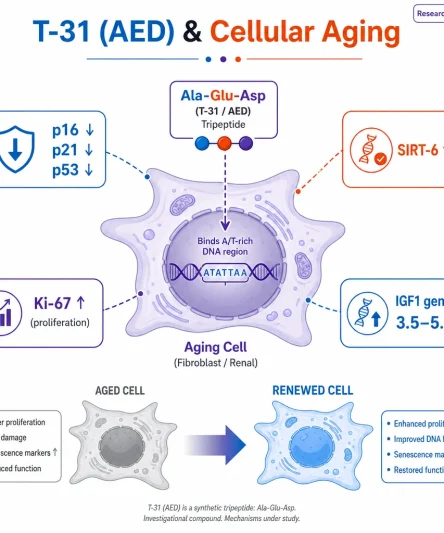
Chalisova and colleagues (2015) grew organotypic kidney cultures from young and old rats; T-31 raised Ki-67 and lowered p53, less strongly than the whole kidney polypeptide complex it derives from. Lin’kova and colleagues (2016) found that KE, KED, AED and AEDG all suppressed MMP-9 and raised Ki-67 and CD98hc in ageing human skin fibroblasts, and that AED and AEDG suppressed caspase-dependent apoptosis. Caputi and colleagues (2019) treated human periodontal-ligament stem cells at 0.01 µg/ml; the significant GAP43 and nestin increases were for KED and the mixture, not AED alone. Ashapkin and colleagues (2020) reported IGF1 up 3.5-5.6-fold and TERT up to 8-fold at nanomolar concentration in an ageing FetMSC line.

The single in vivo study is Zamorskii and colleagues (2019): old rats received a kidney polypeptide complex or one of AED, EDL or AEDG, and AED and EDL raised diuresis 1.2-1.4-fold, reduced urinary protein, improved sodium handling and raised antioxidant enzyme activity, with no nephrotoxicity reported. Route and dose are not in the abstract, and Khavinson is a co-author here as on the Italian and Moscow papers.

No receptor has been identified. Docking assigned AED to an “acct” DNA tetranucleotide (Khavinson 2016) and scored it at -28.14 kcal/mol against the LAT1 transporter (Khavinson 2023); no binding constant has been measured. No pharmacokinetic study, no chondrocyte or joint model, no injectable route, no toxicology and no replication outside the institute exist, and the institute’s own 2014 review of clinical results for peptide bioregulators covers seven other preparations and omits Cartalax. The bioregulator research overview sets this record beside the better-studied members of the family.

What Is the Safety and Regulatory Position?

No safety study of Ala-Glu-Asp exists in any species, and no regulator has approved a product containing it: not the FDA, EMA, PMDA, TGA or Health Canada, and the compound is absent from the FDA Orange Book.

In Russia the products of this class are marketed as dietary supplements rather than medicines, a status not verified against the Russian register. The compound is not on the FDA section 503A bulk-substance list nor the Category 1 or 2 lists (FDA page updated 22 April 2026), is not a component of any approved drug and has no USP monograph, so no lawful basis exists for compounding it in the United States. It is not named on the WADA Prohibited List as far as the dossier could establish; the 2026 list was not retrievable.

No adverse finding has been reported, because no study designed to find one has been run. Claims about cartilage, joints or lifespan have no study behind them for this sequence; the rodent lifespan work belongs to other Khavinson peptides such as AEDG and KE. Nothing in the published record describes what this reagent does after injection into anything.

Published Literature

The entries below concern the tripeptide Ala-Glu-Asp; nothing has been published on this delivery format.

  1. Chalisova NI, Lin’kova NS, Nichik TE, et al. Bulletin of Experimental Biology and Medicine. 2015;159(1):124-127. DOI: 10.1007/s10517-015-2906-9
  2. Lin’kova NS, Drobintseva AO, Orlova OA, et al. Bulletin of Experimental Biology and Medicine. 2016;161(1):175-178. DOI: 10.1007/s10517-016-3370-x
  3. Khavinson VK, Lin’kova NS, Tarnovskaya SI. Bulletin of Experimental Biology and Medicine. 2016;162(2):288-292. DOI: 10.1007/s10517-016-3596-7
  4. Caputi S, Trubiani O, Sinjari B, et al. International Journal of Immunopathology and Pharmacology. 2019;33:2058738419828613. DOI: 10.1177/2058738419828613
  5. Ashapkin V, Khavinson V, Shilovsky G, et al. Molecular Biology Reports. 2020;47(6):4323-4329. DOI: 10.1007/s11033-020-05506-3
  6. Zamorskii II, Shchudrova TS, Zeleniuk VG, et al. Advances in Gerontology. 2019;9(1):75-80. DOI: 10.1134/S207905701901017X
  7. Khavinson VK, Popovich IG, Linkova NS, et al. Molecules. 2021;26(22):7053. DOI: 10.3390/molecules26227053. PMID: 34834147

Frequently Asked Questions

What is the Cartalax pen?

A preloaded 3ml research autoinjector holding the tripeptide Ala-Glu-Asp (T-31) in solution at 20/3 mg/ml, giving 20mg in total and roughly 20 millimolar. No reconstitution step is needed. It is supplied for laboratory research only; no approved product containing Ala-Glu-Asp exists anywhere.

Does Cartalax come in a pen?

Yes. Cartalax is available in a pen as this preloaded 3 ml autoinjector, alongside the lyophilized vial. The pen fixes concentration at the fill line and removes weighing and reconstitution; the vial leaves pH, buffer and concentration to the researcher. Neither has been through regulatory review.

What makes Ala-Glu-Asp different from other peptides in solution?

It can only hydrolyse. With no Asn, Gln, Met, Cys, Trp, His or Tyr, deamidation, oxidation, disulfide scrambling and photodegradation are impossible. The two remaining routes, diketopiperazine release of free aspartic acid and acid cleavage of the Glu-Asp bond, both change the mass, so nothing degrades invisibly.

How does the Cartalax pen vs vial choice come out?

Closer than for most compounds. Ala-Glu-Asp dissolves readily and barely adsorbs, so reconstituting the vial is forgiving and the pen’s advantage is repeatability across sessions rather than rescue from a difficult peptide. Work needing a chosen pH, a defined buffer or a fresh reference should start from the vial.

What is known about Cartalax solution stability?

Nothing quantitative. A Crossref search in September 2026 found no forced-degradation, shelf-life or formulation study of Ala-Glu-Asp in solution. The chemistry predicts slow loss at 2-8°C near neutral pH and faster loss in the unbuffered acid near pH 3, but no rate constant has been published for either.

What are the correct Cartalax pen storage conditions?

Refrigerate at 2-8°C, keep in the original packaging, and never freeze. Light protection is precautionary because the peptide has no chromophore above about 220 nm; temperature is the real variable, since both hydrolytic routes accelerate with warmth. Record the date of first actuation and every draw.

Can the pen be frozen?

No. The peptide would survive freezing, since a 333 Da triacidic molecule does not aggregate on freeze-thaw, but 3 ml of solution expanding inside a sealed glass cartridge can crack the glass or displace the elastomer plunger. The prohibition protects the device, and a damaged device delivers wrong volumes silently.

Why does the solution pH matter so much for this compound?

Because the Glu-Asp bond is acid-labile and the fill pH is not published. The unbuffered free acid sits near pH 3, where cleavage to Ala-Glu and free aspartic acid is fastest; a buffered fill near pH 6 slows it by orders of magnitude. Measure the pH on receipt.

How much peptide is in one 0.01 ml increment?

20/300 mg. At a 20 mg fill that is 66.7 µg, or 200 nanomoles; at a 1 mg fill it is 3.33 µg, or 10 nanomoles. Either is an intermediate stock rather than a working concentration, since the published culture window of 6-600 nM is a 33,000- to 667,000-fold dilution away.

How would degradation be detected in the solution?

By mass spectrometry or HPLC at 214 nm. The intact tripeptide gives a protonated ion near 334 Da; cyclo(Ala-Glu) from diketopiperazine loss appears near 201 Da and the Ala-Glu dipeptide from acid cleavage near 219 Da. No degradation product shares the parent’s mass, so a mass-based check is complete.

Why is UV absorbance at 280 nm useless here?

Because the sequence contains no tryptophan or tyrosine, the residues that absorb at 280 nm, so a reading there reports excipients or nothing. Concentration has to be checked through the peptide bond at 205-215 nm, in practice by reversed-phase HPLC at 214 nm against a standard made fresh from the vial.

Is there any evidence about cartilage?

None. No study of Ala-Glu-Asp in chondrocytes, cartilage explants or any joint model was located. The in vitro work concerns rat kidney cultures, human skin fibroblasts, periodontal-ligament stem cells and a mesenchymal stem-cell line, and the single animal study measured kidney function in old rats.

What did the rat study report?

Zamorskii and colleagues (2019) gave old rats a kidney polypeptide complex or one of AED, EDL or AEDG. AED and EDL raised diuresis 1.2-1.4-fold, lowered urinary protein, improved sodium handling and raised antioxidant enzyme activity, with no nephrotoxicity reported. Route and dose are absent from the abstract.

Has Cartalax been tested in humans?

No. No controlled trial, case series or registered study of Ala-Glu-Asp exists. The Khavinson group’s own 2014 review of clinical results for peptide bioregulators covers seven other preparations and does not mention Cartalax. Claims of decades of clinical use in Russia have no published trial behind them.

What is T-31?

The Khavinson laboratory code for Ala-Glu-Asp, used in the 2015 kidney-culture paper where the peptide first appears in a peer-reviewed abstract. The trade name Cartalax appears in no indexed abstract, so the link between name and sequence rests on the institute’s own literature and on secondary sources.

Is Cartalax approved anywhere?

No. There is no authorisation from any of the FDA, EMA, PMDA, TGA or Health Canada, and no Orange Book listing. In Russia it is marketed as an oral dietary supplement rather than a medicine. It is not on the FDA 503A bulk-substance list or the Category 1 or 2 lists as of 22 April 2026.

Can it be compounded in the United States?

Not lawfully under section 503A. Ala-Glu-Asp is not a component of an approved drug, has no USP monograph and is not on the bulk-substance list, so none of the routes to lawful compounding applies. The page on whether research peptides are legal covers the wider position.

Compliance Statement

The Cartalax autoinjector is sold exclusively for laboratory research use. It is not a drug, food, or cosmetic product, and it is not a dietary product of any kind. It is not approved by the FDA or any comparable authority for human or veterinary use. This product is not intended to diagnose, treat, cure, or prevent any disease. It must not be given to humans or animals. Purchase is restricted to qualified researchers and institutions operating within applicable laws. All handling is the responsibility of the purchasing laboratory.

Additional information

Weight N/A
Dimensions N/A

Reviews

There are no reviews yet.

Only logged in customers who have purchased this product may leave a review.

Peptide Research Articles

Bacteriostatic water depiction

Bacteriostatic Water Peptide Science: Why It Matters in Reconstitution & Research

Bacteriostatic water peptide science is the foundation of safe, accurate peptide reconstitution. This 2026 guide covers bacteriostatic water composition, how to reconstitute peptides using a peptide reconstitution calculator and peptide dosage calculator, bacteriostatic water vs sterile water differences, peptide storage best practices, and a 10-step reconstitution protocol. Expert insights from PrymaLab.

wolverine blend article vial

Peptides for Injury Recovery: The Wolverine Stack Peptide Guide (BPC-157 + TB-500)

The Wolverine stack peptide combines BPC-157 and TB-500 for research into tendon, ligament, and joint recovery. This 2026 guide covers BPC-157 peptide where to buy responsibly, BPC 157 peptide side effects, peptides for tendon repair, peptides for joint recovery, peptides for elbow pain, and the BPC-157 TB-500 peptide blend scientific research. Expert insights from PrymaLab.

are peptides healthy

Are Peptides Good for You? A Complete 2026 Guide

Are peptides good for you? This comprehensive 2026 guide explores peptide therapy benefits, safety, side effects, and how peptides work in the body. Learn about peptide health benefits, research findings, and what you need to know before considering peptide therapy. Expert insights from PrymaLab.

Ovagen peptide capsules for liver health with dosage cycling chart showing 10-20 day protocols repeated 2-3 times per year

Ovagen Peptide Guide: Uses, Research, Safety & Buying Info

Ovagen peptide is a short-chain liver bioregulator developed at the St. Petersburg Institute of Bioregulation and Gerontology under Professor Vladimir Khavinson. It contains the AC-3 peptide complex (glutamic acid and aspartic acid) designed to target hepatocyte gene expression for liver cell repair, bile production, and detoxification. This guide covers dosing protocols, cycling schedules, side effects, a head-to-head comparison with NAC, milk thistle, TUDCA, and BPC-157, cost analysis ($120-360 per year), and how to verify genuine Ovagen products online.

GHK-Cu peptide vial and syringe with dosage chart showing injection protocols for skin rejuvenation and hair growth

GHK-Cu Peptide: Benefits, Dosage, Side Effects & Complete Research Guide (2026)

GHK-Cu peptide is a naturally occurring copper tripeptide that modulates over 4,000 human genes involved in collagen synthesis, wound healing, and tissue regeneration. This comprehensive guide covers injection dosage protocols, clinical research on skin rejuvenation and hair growth, side effects, safety data, and how to reconstitute GHK-Cu 50mg vials. Includes dosage charts, comparison tables, and 10 frequently asked questions answered by a peptide research specialist.

Sermorelin dosage guide for anti-aging muscle growth and weight loss showing GHRH analog pituitary stimulation

Sermorelin Dosage Guide 2025: Complete Protocol for Anti-Aging, Muscle Growth & Weight Loss

Sermorelin acetate is a growth hormone-releasing hormone (GHRH) analog that stimulates natural GH production from the pituitary gland. This comprehensive dosage guide covers protocols for anti-aging, muscle growth, weight loss, and sleep optimization — along with side effects, before-and-after timelines, and comparisons to HGH and ipamorelin.

24/7 Online support

support@prymalab.net info@prymalab.net

Money back guarantee

30 Day return window. Satisfaction guaranteed or your money back.

FREE shipping and return

All orders over %150 in value will receive free shipping.