Description
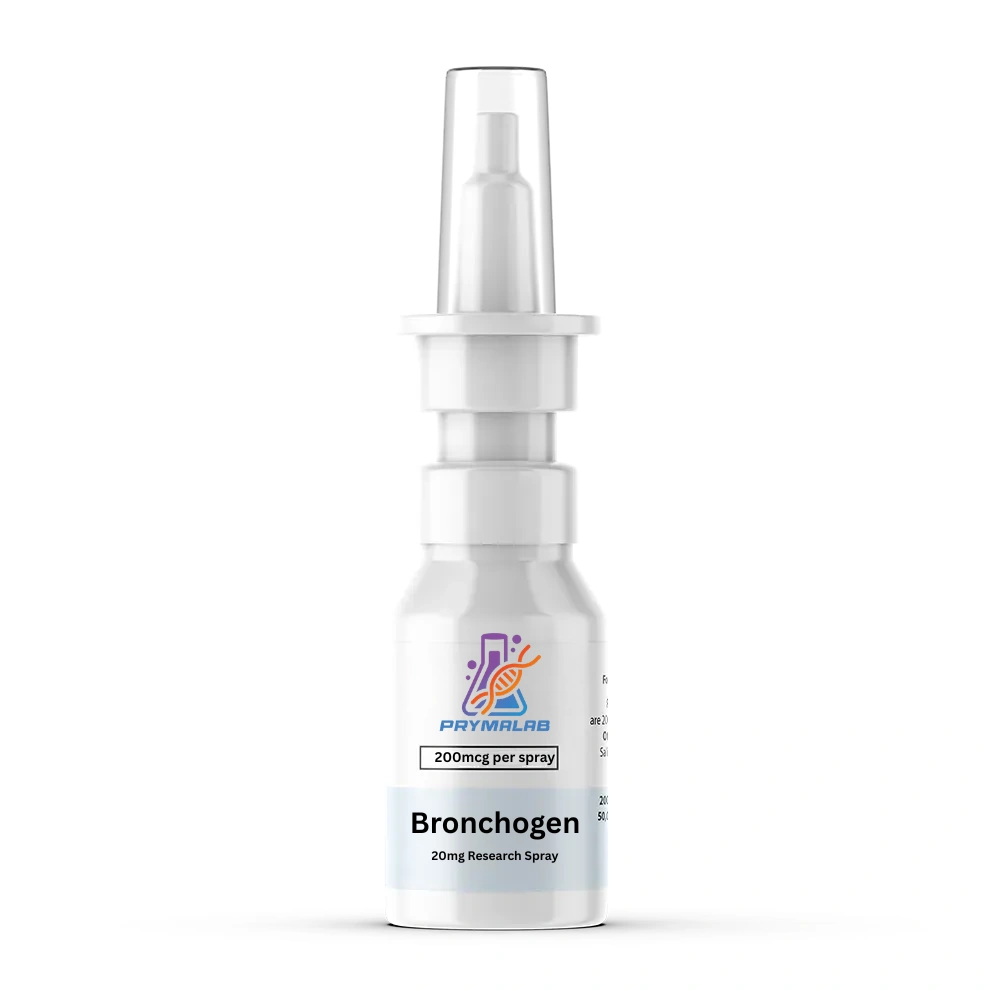
This bronchogen nasal spray supplies Bronchogen, a synthetic tetrapeptide with the sequence Ala-Glu-Asp-Leu, abbreviated AEDL. It comes from the short peptide bioregulator programme at the St Petersburg Institute of Bioregulation and Gerontology, and within that framework it is associated with bronchial tissue. It is one of two respiratory-associated peptides in this catalogue, so the first job is telling them apart. Supplied for laboratory research use only.
Bronchogen and Chonluten are different molecules
Both are respiratory-associated peptides from the same programme, and they are frequently discussed together, which makes confusing them easy.
The Bronchogen peptide is Ala-Glu-Asp-Leu, four amino acids, opening with an alanine. Chonluten is Glu-Asp-Gly, three residues, sometimes labelled T-34. Beyond length they differ in character: Bronchogen carries a leucine, a genuinely hydrophobic residue, where Chonluten ends in glycine and has no hydrophobic character at all. That single difference changes solubility, chromatographic behaviour and, presumably, whatever binding specificity each has. Bronchogen is the easier of the two to handle analytically for exactly that reason.
When you write a methods section, name the sequence. “Respiratory bioregulator” describes at least two distinct molecules in this catalogue, and a reader cannot reconstruct which you used from a trade name.
“Restores normal gene expression” needs a reference state
The claim usually made for this class is that the peptides restore gene expression patterns characteristic of younger or healthier tissue. That is a coherent idea, and it is also one that quietly assumes something an experiment has to supply: a reference state to restore toward.
In practice this means a properly designed experiment needs three conditions, not two. A healthy control establishes the target pattern. A damaged or aged or challenged condition establishes the departure from it. And the treated condition shows whether the compound moves the second toward the first. Comparing only treated against untreated in an unstressed culture cannot demonstrate restoration, because nothing was disturbed, and any change you observe is a change away from normal rather than back toward it.
For bronchial work the challenge conditions that make sense are cigarette smoke extract, an inflammatory cytokine cocktail, oxidative stress, or serial passage to model replicative ageing. Titrate the challenge to produce measurable but submaximal disruption first, because a challenge that flattens the culture leaves no room to detect recovery. This single design point separates a testable restoration claim from an untestable one, and its absence is the most common weakness in intranasal bronchogen research and cell work across this compound class.
What a damaged airway actually looks like
The condition this peptide gets discussed against is COPD, chronic obstructive pulmonary disease, so it helps to know what changes in that tissue, because those changes are what a model has to reproduce before anything can be tested against them.
Diseased bronchial epithelium differs from healthy epithelium in specific, countable ways. Ciliated cells are lost, which impairs clearance. Goblet cell hyperplasia increases their number and raises mucus production. Squamous metaplasia replaces the normal columnar epithelium with a flatter, tougher cell type that does neither job properly. Neutrophilic inflammation is the characteristic pattern of airway inflammation here, distinct from the eosinophilic picture in asthma, and it comes with raised pro-inflammatory cytokines and other inflammatory markers. In the deeper lung tissue, surfactant production falls. Clinically all of that shows up as reduced pulmonary function.
Each of those is measurable in a differentiated culture, which makes them the honest endpoints for work on any compound claimed to support respiratory health. Counting ciliated and goblet cells, quantifying mucin, measuring cytokine output and assessing epithelial cell function in bronchial epithelial cells gives you something a spirometer reading in a person does not: a mechanism you can attribute. What none of it does is establish that anything happens in a respiratory tract, and no claim about COPD or any other respiratory disease is made here.
The DNA-binding claim, and one gene worth flagging
The proposed mechanism for this series is usually described in terms of DNA stability. Khavinson’s group reported that short peptides alter DNA thermostability, meaning the temperature at which the double helix separates, and framed the peptides as acting through DNA stabilization at specific sequences. That is a real published line of work and a real physical measurement, whatever you conclude about what it implies for gene expression in a living cell. Calling a tetrapeptide a DNA stabilizer describes an observation in a cuvette rather than a demonstrated function in a nucleus.
One specific claim deserves naming. Vendor material for this compound frequently attributes activity at NKX2-1, the transcription factor governing lung epithelial identity, alongside a short list of other lung genes. I could not trace that attribution to primary literature. The competitor set for this compound contains no peer-reviewed sources at all, which is consistent with the claim circulating between vendor pages rather than originating in a study. If you have the source, I would genuinely like to see it. Until then, treat NKX2-1 as a testable hypothesis rather than a finding, and note that testing it is straightforward: qPCR for NKX2-1 in a differentiated bronchial culture, with and without the peptide, against a proper control.
Measuring differentiation in bronchial epithelium
If the proposition is that this peptide supports normal bronchial epithelial character, then differentiation markers are the readout, and they need a differentiated culture to be measurable at all. Air-liquid interface culture is the standard for that, where cells on a permeable insert with an air-exposed apical surface develop cilia, mucus-producing cells and tight junctions over three to four weeks. Submerged culture does not produce those features, so differentiation markers cannot be assessed in it.
The measurable features are ciliated-cell content by beat frequency or cilia-associated markers, secretory-cell content by mucin quantification, barrier function by transepithelial electrical resistance, and transcript-level changes by qPCR or RNA-seq since the proposed mechanism is transcriptional.
On what has actually been published, I would rather be accurate than impressive. Specific gene lists for this peptide circulate on vendor pages, and I could not trace them to primary literature, so they are not stated as findings here. What is supportable is that Bronchogen is a defined synthetic tetrapeptide from a research programme with a preclinical evidence base concentrated in one lineage and limited independent replication. The shared mechanistic proposal for the class, that short peptides interact with DNA promoter regions or chromatin-associated histones, is argued in Short Peptides Regulate Gene Expression, and it remains a hypothesis without high-resolution structural confirmation.
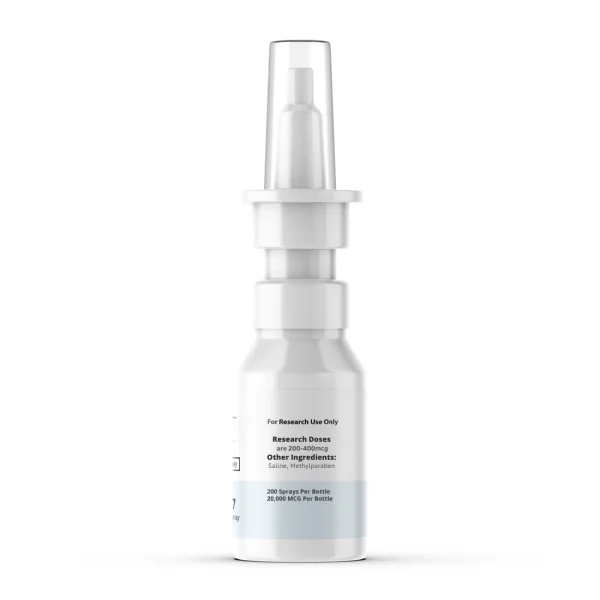
Bronchogen nasal spray specifications
| Compound |
Bronchogen, synthetic short peptide bioregulator |
| Sequence |
Ala-Glu-Asp-Leu (AEDL) |
| Length |
Tetrapeptide (four residues) |
| Character |
Two acidic residues plus alanine and a hydrophobic leucine |
| Distinct from |
Chonluten (EDG, tripeptide), also respiratory-associated |
| Origin |
St Petersburg Institute of Bioregulation and Gerontology |
| Proposed mechanism |
Peptide-DNA or peptide-histone interaction altering gene accessibility (hypothesis) |
| Evidence status |
Preclinical, single research lineage, limited independent replication |
| Regulatory status |
No FDA or EMA approval |
| Format |
Metered spray bottle [CONFIRM: fill volume, mg per bottle, concentration] |
| Classification |
Research chemical. In-vitro laboratory use only. Not for human or veterinary use. |
Bronchogen nasal spray storage and handling
AEDL contains no cysteine, no methionine and no tryptophan, so disulfide chemistry, oxidation and photodegradation are not the practical risks. The leucine gives this peptide some hydrophobic character, which makes it slightly better behaved than the more polar members of the series, both in solution and on a chromatography column.
Two acidic residues still mean charge state and solubility shift with pH, so buffer control matters. And a four-residue peptide is a ready substrate for serum peptidases, so long incubations in serum-containing medium give a declining exposure. In an air-liquid interface culture the apical surface is air rather than medium, which changes exposure conditions again and is worth planning for rather than discovering. Sensible bronchogen nasal spray storage is otherwise routine: cold, sealed, out of light, single-use aliquots, and low-binding plasticware at low working concentrations. Material supplied after lyophilization arrives as a lyophilized powder and needs reconstitution before use, usually with bacteriostatic water; once reconstituted, aliquot rather than keeping one working stock. Record the diluent alongside the concentration.
Two comparisons worth keeping straight. This peptide bioregulator is sometimes shelved beside repair compounds such as BPC-157 and thymosin beta 4, which act through entirely different mechanisms and share nothing with it beyond a research-use label. And immune modulation, a phrase attached to most of the Khavinson series, describes a proposed effect rather than a measured one for this particular sequence.
How research grade bronchogen spray is characterized
The leucine helps here. A four-residue peptide with one hydrophobic residue retains better on a reversed-phase column than a purely polar tripeptide does, so standard methods are more applicable to this compound than to Chonluten. That said, it is still a small peptide, and the method behind a purity figure remains worth asking about. A research grade bronchogen spray is characterized by reversed-phase HPLC for purity and mass spectrometry for identity, and this material is supplied under the same verification PrymaLab applies across its research peptides, HPLC and MS confirmation plus independent third-party testing. No specific lot figures are asserted here; request the certificate of analysis for the lot you receive.
For related bioregulator research, see the PrymaLab Research Library.
Frequently asked questions
What is Bronchogen?
Bronchogen is a synthetic tetrapeptide, Ala-Glu-Asp-Leu (AEDL), one of the Khavinson-class short peptide bioregulators associated with bronchial tissue in that framework. Material supplied here is a research chemical for in-vitro laboratory use only.
How does Bronchogen differ from Chonluten?
Bronchogen is a four-residue peptide containing a hydrophobic leucine. Chonluten is a three-residue peptide with no hydrophobic character. Both are respiratory-associated, but they are different molecules with different solubility and chromatographic behaviour, and methods sections should name the sequence.
How would a restoration claim be tested?
With three conditions rather than two: a healthy control defining the target pattern, a challenged condition defining the departure, and a treated condition showing whether the compound moves the second toward the first. Treated versus untreated in an unstressed culture cannot demonstrate restoration.
Why does differentiation require air-liquid interface culture?
Because bronchial epithelium only develops cilia, mucus-producing cells and proper barrier function when its apical surface is exposed to air. Submerged culture produces an undifferentiated monolayer in which differentiation markers cannot meaningfully be assessed.
Is Bronchogen nasal spray approved for human use?
No. This material is a research chemical for in-vitro laboratory use only, has no FDA or EMA approval, and is not intended for human or veterinary use. Nothing here is medical advice.
Ordering and compliance
Every PrymaLab research compound ships from the United States and is sold research-use-only. This bronchogen nasal spray is supplied for in-vitro laboratory research, is not intended for human or veterinary use, is not a drug or supplement, and has not been evaluated by the FDA for the research-chemical context. Verify the legal status of any research compound in your jurisdiction before ordering. Certificates of analysis are available on request for the lot you receive.












Reviews
There are no reviews yet.