Description
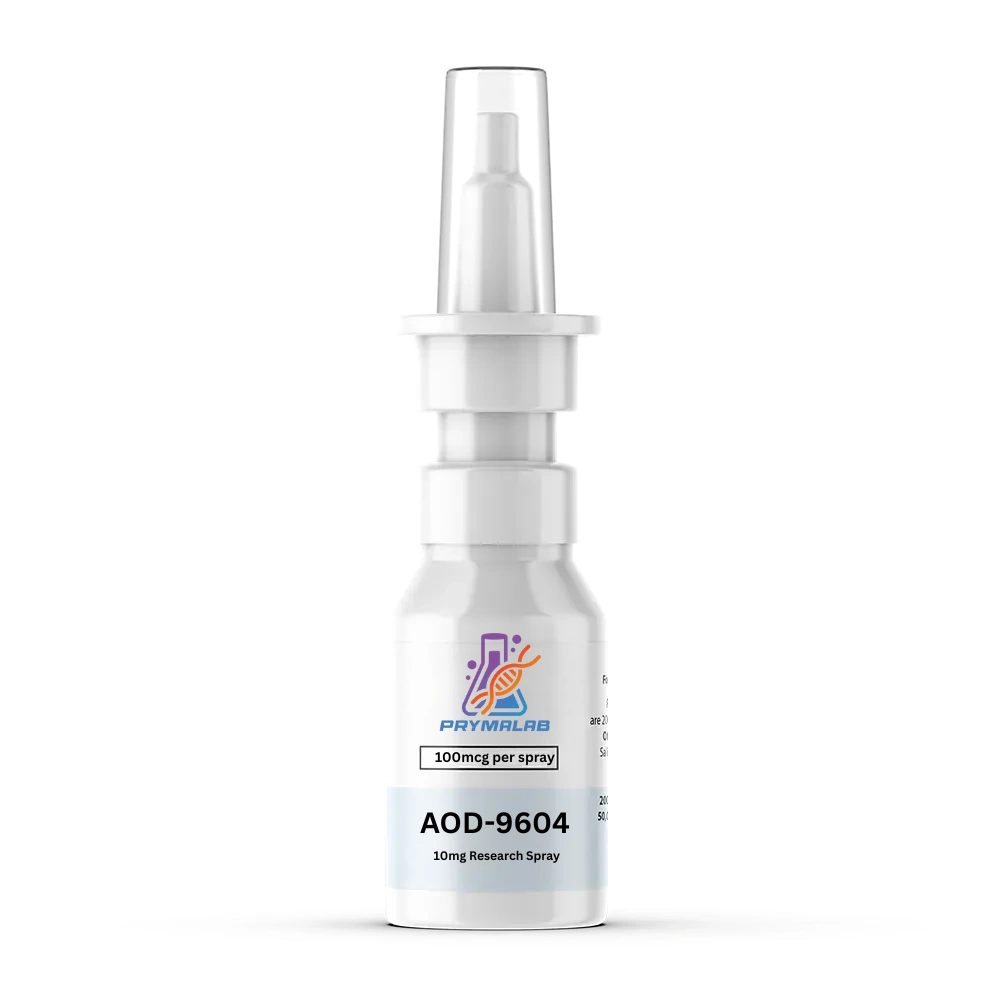
This AOD-9604 nasal spray supplies a 16-amino-acid synthetic peptide corresponding to the C-terminal region of human growth hormone with an added N-terminal tyrosine. The sequence is Tyr-Leu-Arg-Ile-Val-Gln-Cys-Arg-Ser-Val-Glu-Gly-Ser-Cys-Gly-Phe, molecular formula C78H123N23O23S2, molecular weight about 1815 Da, CAS 221231-10-3. It was developed at Metabolic Pharmaceuticals in Australia. The fragment is cited in the literature as hGH 176-191 or 177-191 depending on numbering convention, which is worth noting because both appear and they describe the same construct. Supplied for laboratory research use only.
The disulfide bridge is the structural point
The two cysteines at positions 7 and 14 of the peptide form an intramolecular disulfide bridge. In the parent hormone these correspond to Cys182 and Cys189, and the bond closes the C-terminal loop of growth hormone. The whole premise of the molecule is that this loop can be excised from the hormone and retain some activity of its own, separate from the receptor-mediated actions of full-length hGH.
That has an immediate practical consequence, and it is the same one that applies to oxytocin. AOD-9604 disulfide structure depends on an intact bond, so any reducing agent in a buffer will open the loop. Dithiothreitol, beta-mercaptoethanol and TCEP all do this. If a shared lysis or storage buffer in your lab already contains a reducing agent, this peptide will not survive contact with it, and the failure is silent. Mass spectrometry distinguishes the two forms by two mass units, which is the check worth running if results stop making sense.
The preclinical case that started it
The rationale came from rodent work. Ng and colleagues (2000), publishing in Hormone Research, reported metabolic studies of this synthetic lipolytic domain in obese Zucker rats, where daily treatment reduced body weight gain by more than half against controls. The argument was that the C-terminal region of growth hormone carries lipolytic activity separable from the growth-promoting, insulin-antagonizing actions of the whole hormone, which would make it useful without the metabolic cost of hGH itself.
Worth keeping in view: reduced weight gain in a genetically obese rat strain is a different endpoint from weight loss in humans, and the gap between those two is where this program eventually came apart. Analytical chemistry on the compound has also been published, including detection and in-vitro metabolism work in Drug Testing and Analysis, which is the more useful reference if you need to track the peptide or its breakdown products in a matrix.
What the clinical program actually found
This is the section most pages about this compound leave out, and it is the one a research audience should read first.
The early human data looked promising. A 12-week randomized controlled trial in roughly 300 adults with obesity reported average weight loss of about 2.6 kg on 1 mg per day against 0.8 kg on placebo, and a 23-week study reported a similar separation, roughly 2.8 kg against 0.8 kg. Those numbers are modest but real, and they are the figures usually quoted.
Then the program failed. In 2007 a larger 24-week trial in 536 subjects did not produce weight loss sufficient to support pharmaceutical development, the Phase 2b obesity program missed its primary endpoint, and development was formally discontinued that year. The detail I find most instructive: when an intensive diet and exercise regimen was built into the study design, the separation from control essentially disappeared.
That last point is the useful one for anyone designing work with this compound. An effect that vanishes against an active background is a different kind of finding from an effect that persists. It says the signal is small relative to the things that actually move the endpoint, and it is a reason to be careful about extrapolating from a cell-culture result to anything larger. The molecule remains a legitimate probe for the lipolytic activity attributed to the hGH C-terminal region. It is not a validated therapeutic, and the record on that is closed rather than pending.
Designing an in-vitro lipolysis experiment
The standard adipocyte lipolysis assay uses differentiated 3T3-L1 adipocytes or primary human adipocytes, treated across a concentration range, with glycerol or free fatty acid release into the medium as the readout. Glycerol release is the more common measure because glycerol is not appreciably re-used by the adipocyte, so it tracks triglyceride breakdown more faithfully than fatty acid measurement does.
Three controls matter for AOD-9604 in vitro research specifically. A positive control such as isoproterenol establishes that your cells are capable of lipolysis at all on the day, which is the single most common reason a plate reads flat. Full-length growth hormone as a comparator addresses whether any effect you see is distinguishable from the parent hormone. And a viability assay run in parallel separates genuine lipolysis from cells dying and leaking contents, which reads the same way in a glycerol assay if you are not looking for it.
Differentiation state is the other variable people underestimate. 3T3-L1 differentiation efficiency varies between batches and between labs, and a poorly differentiated plate has little triglyceride to mobilize. Reporting differentiation day and confirming lipid accumulation before treating is what makes results comparable to anyone else’s.
AOD-9604 nasal spray specifications
Core identity data for this AOD-9604 nasal spray. Quote the sequence and CAS number in your methods section rather than the product name.
| Compound |
AOD-9604, synthetic hGH C-terminal fragment analog |
| Sequence |
Tyr-Leu-Arg-Ile-Val-Gln-Cys-Arg-Ser-Val-Glu-Gly-Ser-Cys-Gly-Phe |
| Length |
16 residues |
| Disulfide |
Cys7 to Cys14 (hGH Cys182 to Cys189) |
| Modification |
Added N-terminal tyrosine relative to the native fragment |
| Molecular formula |
C78H123N23O23S2 |
| Molecular weight |
Approximately 1815 Da |
| CAS number |
221231-10-3 |
| Origin |
Metabolic Pharmaceuticals, Australia |
| Clinical status |
Phase 2b obesity program missed primary endpoint; development discontinued 2007 |
| Format |
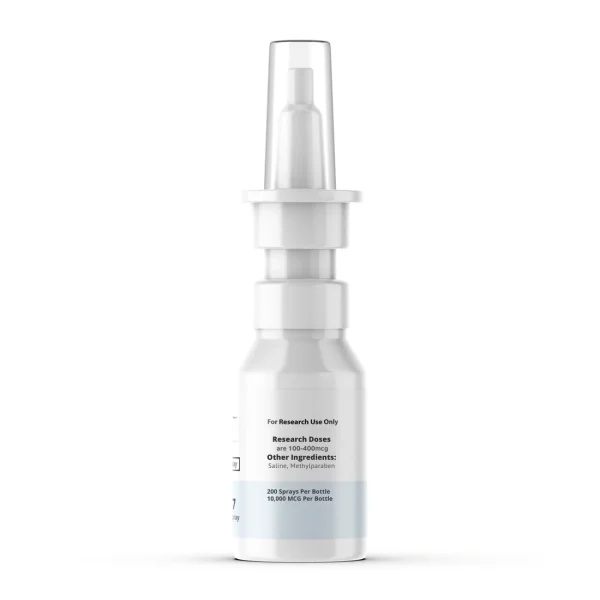
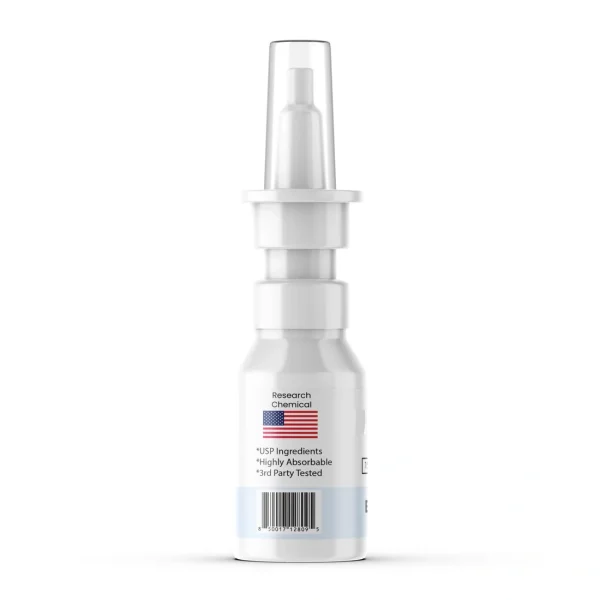
Metered spray bottle [CONFIRM: fill volume, mg per bottle, concentration] |
| Analytical verification |
Reversed-phase HPLC for purity, mass spectrometry for identity, independent third-party testing |
| Classification |
Research chemical. In-vitro laboratory use only. Not for human or veterinary use. |
AOD-9604 storage and handling
The disulfide dominates everything else here. [CONFIRM: whether this SKU ships pre-filled in solution or as lyophilized material with an applicator.]
Keep reducing agents away from this peptide entirely. Check inherited buffers, wash solutions and any stock reagent that came from a shared shelf, because a reducing agent introduced upstream will open the Cys7 to Cys14 bond before the material ever reaches your cells. Disulfide-containing peptides can also scramble or form intermolecular bridges under oxidizing conditions or at high concentration, so avoid leaving concentrated solution sitting warm.
Beyond that the routine applies: keep it cold, sealed and out of light, work from single-use aliquots rather than repeatedly freezing and thawing, and use low-binding plasticware at low working concentrations. Sound AOD-9604 storage and handling is mostly about protecting one chemical bond and avoiding the small losses that read as variability later.
How this material is characterized
For a disulfide-containing peptide, verification has to confirm that the bridge is intact rather than reduced or scrambled. Reversed-phase HPLC establishes purity and mass spectrometry confirms identity near 1815 Da, with the oxidized cyclic form separated from the reduced linear form by two mass units. This AOD-9604 nasal spray is supplied under the same verification PrymaLab applies across its research peptides, HPLC and MS confirmation plus independent third-party testing. No specific lot figures are asserted here; request the certificate of analysis for the lot you receive, and if disulfide integrity is central to your work, ask for it to be addressed rather than inferred from purity alone.
For broader background on metabolic research peptides, see the PrymaLab Research Library.
Frequently asked questions
What is AOD-9604?
AOD-9604 is a 16-amino-acid synthetic peptide corresponding to the C-terminal region of human growth hormone with an added N-terminal tyrosine, about 1815 Da, CAS 221231-10-3, containing a disulfide bridge between Cys7 and Cys14. Material supplied here is a research chemical for in-vitro laboratory use only.
Did AOD-9604 succeed in clinical trials?
No. Early 12-week and 23-week studies showed modest separation from placebo, but a 536-subject 24-week trial did not produce weight loss sufficient to support development, the Phase 2b obesity program missed its primary endpoint, and development was discontinued in 2007.
What happened when diet and exercise were added to the trials?
The separation from control essentially disappeared. An effect that vanishes against an active diet and exercise background indicates a signal that is small relative to the factors actually driving the endpoint, which is important context for interpreting any cell-culture result.
Why must reducing agents be avoided with AOD-9604?
Because the peptide contains a disulfide bridge between Cys7 and Cys14 that closes the C-terminal loop. Dithiothreitol, beta-mercaptoethanol and TCEP will reduce that bond and open the structure. Check shared and inherited buffers before they contact the material.
Is AOD-9604 nasal spray approved for human use?
No. This material is a research chemical for in-vitro laboratory use only and is not intended for human or veterinary use. It is not an approved drug for any indication, and its obesity development program was discontinued. Nothing here is medical advice.
Ordering and compliance
Every PrymaLab research compound ships from the United States and is sold research-use-only. This AOD-9604 nasal spray is supplied for in-vitro laboratory research, is not intended for human or veterinary use, is not a drug or supplement, and has not been evaluated by the FDA for the research-chemical context. Verify the legal status of any research compound in your jurisdiction before ordering. Certificates of analysis are available on request for the lot you receive.










Reviews
There are no reviews yet.